Chapter 1: The Wine of Shadows
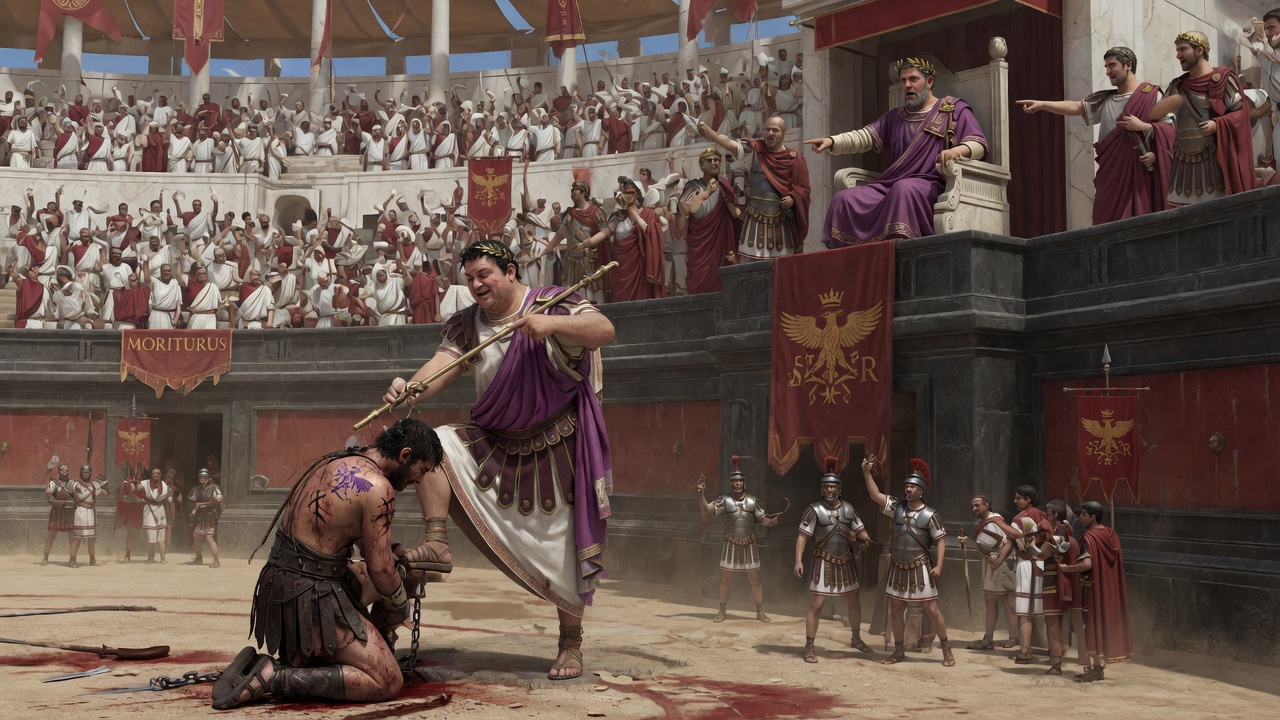
The wine was sour, stinging my eyes as it mixed with the sweat and the dried blood of the morning’s “training.” Prefect Varro leaned down, the silver goblet clinking against his rings, and laughed as the dark red liquid soaked into my tunic—the rags of a man the world had forgotten.
“Look at you,” Varro hissed, his breath smelling of expensive meat and cowardice. “The great Marcus. The beast of the pits. To think, the girls in the market once whispered that you looked like a prince. Now, you look like what you are—fodder for the beasts.”
I didn’t answer. I didn’t even blink. I remained on one knee in the damp, filth-ridden stone tunnel beneath the Colosseum. To speak was to invite the whip, and I needed my strength. Not for the lions. For what came after.
Varro’s boot, polished to a mirror shine, caught me under the chin, forcing my head up. He wanted to see the spark of life go out. He wanted me to beg.
“You’re silent today, gladiator,” he mocked. He turned to the guards, who stood in the shadows of the flickering torches, their armor gleaming with the wealth stolen from my family’s province. “He thinks he’s a martyr. He thinks the people will remember him. Throw the old woman in the pen first. Let him watch her scream before the gates open.”
My heart stopped. In the corner of the cell, Livia—the woman who had been my wet nurse, the only person who knew the truth of the night the fires took the palace—trembled. She was eighty years old, her hands gnarled and shaking as she clutched a threadbare shawl.
“No,” I whispered. My voice was a rasp, unused to anything but the grunts of combat.
“Oh?” Varro grinned, a predatory, ugly thing. “He speaks! Did you hear that, men? The dog barks for his master.”
He grabbed Livia by her white hair and dragged her toward the iron bars where the lions were pacing, their low, guttural roars vibrating through the very stone of the arena. Livia didn’t scream. She looked at me with eyes full of a terrifying, heartbreaking peace.
“Don’t let them see you break, little eagle,” she whispered.
Varro backhanded her, the crack echoing like a whip. “Shut up, hag!”
I felt the heat then. Not the heat of the Roman sun, but the heat of the bloodline I had spent twelve years trying to drown. My hand went to the small, jagged piece of iron hidden in the lining of my belt—a broken signet ring, the only thing that hadn’t burned in the coup.
Varro stepped over to me, leaning in so close I could see the pores on his face. “Today, Marcus, the name of your father is finally erased from history. When you die, the last memory of the true Rome dies with you.”
He didn’t see my hand tighten around the iron. He didn’t see the way the guards at the far end of the tunnel, the ones with the old scars on their forearms, were suddenly standing straighter, their eyes fixed on me.
“The gates are opening, Varro,” I said, my voice steadying, gaining the weight of a command. “But it’s not for me.”
The horn sounded—a long, mournful blast that signaled the start of the midday games. The heavy wooden doors at the end of the tunnel began to rise, revealing a sliver of the blinding, golden sand and the roar of fifty thousand people calling for a slaughter.
Varro shoved me toward the light. “Go to your grave, slave.”
I walked forward, the wine still dripping from my hair, but as I stepped into the light, I didn’t look at the crowd. I looked at the golden box where the Emperor sat, a man wearing a crown that belonged to a ghost. And for the first time in twelve years, I stopped being a slave.
Read the full story in the comments.
If you don’t see the new chapter, tap “All comments”.
FULL STORY
Chapter 2: The Night the Eagle Fell
The sand was hot beneath my calloused feet, a familiar grit that had been the only constant in my life since the age of sixteen. Every step I took toward the center of the arena was a step back into a memory I had tried to murder.
I remembered the smell of cedar wood and expensive oils. I remembered the way my father, Emperor Valerius, had laughed as he showed me the blueprints for the new library. He had been a man of peace in an empire built on war, and that had been his greatest sin.
The coup had happened on a Tuesday. The sky had been the color of a bruised plum, a storm brewing over the Seven Hills. I was in the courtyard, practicing with a wooden gladius, when the silence of the palace was shattered by the rhythmic, heavy thud of boots—not the Praetorian Guard, but the mercenaries hired by the Senate’s shadow cabinet.
Varro had been there. He was younger then, a captain with hungry eyes and a debt he couldn’t pay. He was the one who had opened the side gate. He was the one who had watched as they dragged my father from his bed.
“Run, Marcus!” my mother had screamed, her voice cutting through the smoke. She had thrust a small, heavy object into my hand—the Imperial Signet—and pushed me into the servant’s passage. “Live! By the gods, you must live!”
I had watched through a hidden grate as the fire took the tapestries. I had seen my father stand tall, even with a blade in his side, refusing to kneel to the man who now sat in the golden box above me—Emperor Cassius, the puppet king.
I had spent years in the gutters, then the mines, and finally the gladiator pits. I had changed my name. I had let the sun burn my skin and the scars map my body until I was unrecognizable. I had become the “Shadow of Rome,” a gladiator who never spoke, who fought with a cold, mechanical efficiency that terrified opponents.
Livia had found me in the slave markets of Capua three years ago. She had been sold to a laundry house, her back broken by labor, but she had recognized the way I stood. She had whispered my true name in the dark of the barracks, and for a moment, I had wanted to kill her just to keep the secret safe.
“You cannot hide the sun with a handful of dirt, Marcus,” she had said, her voice like dry leaves. “The Legions still talk. They remember the man who paid them in silver and honor, not just empty promises.”
Now, standing in the center of the arena, the roar of the crowd felt like a distant ocean. I could see Cassius leaning forward in his chair, his purple robes fluttering in the breeze. He looked bored. He had seen a thousand executions. To him, I was just a nameless criminal, a bit of entertainment before lunch.
Varro stood at the edge of the sands, basking in the reflected glory of the Emperor. He signaled to the beast-master.
A heavy iron grate on the far side of the arena began to slide up. The growl that emerged from the darkness was low, chest-vibrating, and hungry. Two Barbary lions, the largest I had ever seen, stepped into the light, their manes matted with the blood of the morning’s victims.
I reached into the small pouch at my waist and pulled out the broken iron ring. It wasn’t gold. Gold was for vanity. This was the “Iron Oath”—a ring given only to the commanders of the Lost Seventh Legion, the men who had bled with my father in the Germanic forests.
I didn’t hold a sword. I hadn’t been given one. The crowd began to jeer, throwing crusts of bread and insults. “Where is his blade?” “Let the cats have him!”
I ignored them. I looked at the lions, then I looked at the Emperor. I raised my hand high, the iron ring catching the midday sun, and I didn’t scream. I sang. It was a low, melodic chant in the old tongue of the mountain tribes—the rallying cry of the Seventh.
The lions stopped. They didn’t pounce. They lowered their heads, sniffing the air, sensing a change in the atmosphere.
A sudden, sharp silence began to spread through the stadium, starting from the lower tiers where the veterans sat—the men in their old tunics, with their missing limbs and their haunted eyes. One by one, they stood up.
Varro’s smile flickered. He looked around, confused. “What is this? Guards! Order the men to sit!”
But the guards didn’t move. In the tunnels behind me, I heard a sound that didn’t belong in a circus. It was the sound of a thousand scabbards being emptied at once.
Chapter 3: The Signal of the Fallen
The tension in the air was so thick it felt like the moment before a lightning strike.
Varro, realizing the crowd’s energy had shifted from bloodlust to a confused, terrified awe, drew his own ceremonial gladius. “Kill him!” he roared at the beast-master. “Release the hounds! Kill the slave now!”
The lions, however, were no longer looking at me. They were looking behind me, toward the entrance tunnel. From the shadows, a man emerged. He wasn’t a gladiator. He was an old man, wearing the rusted, dented breastplate of a Centurion. He carried no weapon, only a standard—a pole topped with a silver eagle, its wings broken.
It was Galen. My father’s most loyal commander, a man who had been reported dead a decade ago.
He walked onto the sand with a limp, but his head was held high. He didn’t look at the Emperor. He walked straight to me and sank to one knee in the dirt, the silver eagle thudding into the sand beside my feet.
“The Seventh has waited, Caesar,” Galen’s voice boomed, carrying to the highest reaches of the stone tiers. “The sun has set on the usurper. The dawn has returned.”
The stadium erupted—not into cheers, but into a chaotic, panicked roar. Emperor Cassius stood up so quickly his wine spilled across his lap. “Treason!” he screamed, his voice cracking. “Praetorians! Clear the floor! Execute them all!”
The Praetorian Guard, the elite soldiers in their black-and-gold plumes, began to file out from the side gates, their shields forming a wall of steel. They were the Emperor’s personal killers, and they knew only one thing: obedience.
Varro scrambled back toward the safety of the shields. “You’re dead, Marcus! You and every one of these old fools! You think a broken eagle and a few grandfathers can stop the might of the palace?”
I looked at Galen. He smiled, a grim, toothless grin. “We aren’t the ones they should be worried about, my Prince.”
I reached into my rags and pulled out a small, hollowed horn made of a ram’s bone. It had been Livia’s most prized possession, hidden in her bedding for twelve years. I put it to my lips and blew.
The sound was high and piercing, a note that seemed to vibrate in the very marrow of my bones. It was the “Cry of the Raven,” the signal that the city was no longer under the control of the Senate.
For a heartbeat, nothing happened. Then, the ground began to shake.
It wasn’t an earthquake. It was the rhythm of a forced march. From the Great North Gate of the city, miles away, came the sound of the war-drums. Thump-thump. Thump-thump.
The people in the top rows of the arena began to scream and point toward the city walls. A cloud of dust was rising, so massive it blotted out the sun.
“The legions,” someone whispered. The word spread like fire through a dry field. “The legions are here!”
Not just any legions. The Black-Banner Cavalry, the men who had been exiled to the frontiers of Gaul, the men who had never sworn an oath to Cassius. They had been moving in secret for months, traveling by night, fed by the very peasants Varro had spent years oppressing.
The Praetorians at the edge of the sand hesitated. They were professionals, but they were also Romans. They knew that sound. They knew that even they couldn’t hold a city against ten thousand battle-hardened veterans.
I stepped toward Varro. I didn’t have a sword, but as I walked, the lions moved with me, flanking me like golden shadows. The beasts, sensing the apex predator in the arena had changed, were no longer interested in my blood.
“The wine you poured on me, Varro,” I said, my voice echoing in the sudden hush. “It was sour. Just like your soul. I think it’s time we cleansed the floor.”
Chapter 4: The Iron Tide
The gates of the Colosseum didn’t just open—they were shattered.
The heavy oak and iron portals groaned and buckled under the weight of a battering ram, and as they fell, the “Iron Seventh” poured in. These weren’t the polished, decorative soldiers of the city. These were men who had lived in the dirt, whose armor was scarred by Germanic axes and Persian arrows. They moved with a terrifying, silent precision.
They didn’t attack the crowd. They didn’t even attack the Praetorians. They simply surrounded the arena floor, a ring of steel three men deep, their spears leveled at the Emperor’s box.
Cassius was trembling now, his hands clutching the marble railing until his knuckles were white. “I am the Emperor! I am the voice of Rome! Kill them! I command it!”
But the Praetorians were looking at me. They were looking at the iron ring I held high. They were looking at Galen and the broken eagle.
One by one, the elite guards began to lower their shields. The sound of their heavy rectangular scuta hitting the sand was like a series of hammer blows.
“No…” Varro whispered, his face turning a sickly shade of grey. “No, this is impossible. You’re a slave. You’re nobody!”
I walked up to him. He tried to swing his sword, but my hand shot out, catching his wrist with a strength born of a decade of hauling ore and fighting for my life. I squeezed until the bone groaned, and the silver blade fell into the dirt.
“I was a slave,” I said, leaning in so close he could see the reflection of his own terror in my eyes. “And in the pits, I learned something your teachers never taught you in the palace. I learned that a crown is just a piece of metal. But loyalty? Loyalty is a blood-debt.”
I turned to the Emperor’s box. “Cassius! Look at me!”
The man who had stolen my father’s life shrank back into his throne.
“Twelve years ago, you stood in the ruins of my home and told me that the world would forget the House of Valerius,” I shouted. “You told me that Rome belonged to the highest bidder. Look around you! Look at the men you starved. Look at the soldiers you cheated. They didn’t come for me. They came for the Rome you tried to bury!”
From the stands, a single voice cried out, “Valerius!”
Then another. “The Son of the Eagle!”
Soon, the entire stadium was shaking with the name. Fifty thousand people who had come to watch a death were now witnessing a resurrection.
Livia was brought out from the tunnel by two veteran soldiers. They handled her as if she were made of glass, their rough hands gentle on her shoulders. When she saw me standing there, surrounded by the Iron Seventh, she didn’t cheer. She simply closed her eyes and let a single tear track through the dust on her face.
“It is finished,” she whispered.
I looked at the Praetorian Prefect, the commander of the guards who had been about to kill me. He was an older man, one who had served under my father. He looked at me, then at the ring, and slowly, he removed his helmet. He knelt, bowing his head.
“The palace is yours, Caesar,” he said.
I looked at the sand, soaked with the wine Varro had poured on me. I looked at the lions, who were now sitting calmly at the edge of the fray. And then I looked at Varro, who was weeping, begging for mercy at my feet.
“Justice is not revenge, Varro,” I said. “But it is a debt that must be paid in full.”
Chapter 5: The Reckoning of the Sand
The Emperor was dragged from his box by his own guards. It was a pathetic sight—the man who had ruled with an iron fist now clutching at the statues and the curtains, screaming for a mercy he had never shown to others.
They brought him to the center of the arena, forcing him to stand in the same dirt where I had knelt in rags just an hour before.
The crowd was silent now. This wasn’t a game anymore. This was a trial.
“You speak of law, Cassius,” I said, standing before him. I had been given a commander’s cloak, a heavy crimson wool that felt like the weight of the world on my shoulders. “You speak of the Senate and the will of the gods. But here, on this sand, there is only the truth.”
I turned to the people. “This man did not just kill a King. He killed the soul of our city. He sold our grain to foreign kings while our children went hungry. He sent our brothers to die in wars for gold, not for glory. He thought that by putting me in chains, he could chain the heart of Rome itself!”
I looked at Cassius. “Where is the Imperial Seal? The one you stole from my mother’s cold hands?”
Cassius fumbled with a chain around his neck, pulling out a golden seal. It was beautiful, encrusted with rubies, but in his trembling hand, it looked like a toy.
“It… it belongs to the throne!” he stammered.
“The throne belongs to the people,” I countered. “And the seal belongs to the man who can protect them.”
I didn’t take it. I didn’t need to. Galen stepped forward with a scroll—a confession signed by the very senators who had helped Cassius rise. It detailed the bribes, the murders, and the secret pacts.
“The people have heard enough,” Galen declared.
I looked at Varro, who was still kneeling nearby. “And what of the man who pours wine on the suffering? The man who strikes the elderly and calls it sport?”
Varro looked up, his eyes darting around for an escape that didn’t exist. “I was following orders! I was just a soldier!”
“A soldier protects the weak,” I said softly. “A coward bullies them.”
I turned to the crowd. “What is the price for treason? What is the price for the blood of a King and the tears of the poor?”
The response was a single, deafening word that shook the Colosseum to its foundations: “JUSTICE!”
I didn’t execute them then and there. I wouldn’t turn the arena into a slaughterhouse to match their cruelty. I ordered them to be taken to the Mamertine Prison, to face a public trial by the very citizens they had wronged.
As they were led away, Cassius stripped of his purple and Varro reduced to a shivering wreck, I felt a hand on my arm.
It was Livia. She looked at the red cloak, then at my face.
“The rags are gone, Marcus,” she said, her voice stronger than I had ever heard it. “But don’t forget the cold of the tunnel. A King who has never been a slave can never truly be free.”
I nodded, the weight of the crown I hadn’t yet put on feeling heavier than any chain I had ever worn.
“I won’t forget, Livia,” I promised. “I’ll build a Rome where no one has to hide their name in the dirt.”
Chapter 6: The Dawn of the Iron Eagle
The sun was beginning to set over the city, painting the marble of the temples in shades of fire and gold.
I stood on the balcony of the palace, the very place where I had watched the fires twelve years ago. Below me, the city was alive. Torches were being lit in every window, and the sound of music and celebration drifted up from the streets.
The Iron Seventh stood guard at the gates, their black banners snapping in the wind. They weren’t just soldiers anymore; they were the foundation of something new.
Galen stood beside me, his old armor polished until it shone. “The Senate is waiting, Caesar. They are eager to swear their loyalty.”
“Let them wait,” I said. “They were eager to swear it to Cassius, too. Loyalty that is given out of fear is worth nothing. I want their respect, or I want their silence.”
I looked down at my hands. They were still stained with the dust of the arena, the skin calloused and scarred. I didn’t want to wash it off yet. I wanted to remember the feeling of the sand.
I went back inside to the small room where Livia was resting. She was tucked into a bed with silk sheets, a healer attending to her. She looked small in the massive room, but her spirit seemed to fill the space.
“Are you happy, Marcus?” she asked, her eyes finding mine.
“I am at peace,” I said, sitting by her side. “The debt is paid. The truth is out. My father can finally rest.”
“And you?” she pressed. “The boy who wanted to be a blacksmith? The boy who loved the mountains?”
I smiled sadly. “That boy died in the fire, Livia. But the man who survived… he has work to do.”
I reached into my belt and pulled out the broken iron ring. I placed it on the table beside her. It was a simple thing, but it represented more power than the golden seal in the treasury. It represented the promise of a man who had seen the bottom of the world and fought his way back to the top.
Justice had been served, but the healing would take a lifetime. The corrupt would be removed, the granaries would be opened, and the veterans who had been forgotten would be brought home.
As I walked back out to the balcony, the crowd below saw my silhouette against the torchlight. A roar went up—not the bloodthirsty roar of the arena, but a sound of hope, deep and resonant.
I looked out over the Seven Hills, at the city that had tried to break me and ended up making me. I wasn’t just a gladiator anymore. I wasn’t just a slave.
I was the Emperor of the people.
And as the old banner rose above the castle again, I finally understood that a kingdom is not built by crowns, but by the people who refuse to let love kneel in the dust.