Chapter 1
The iron bars of the cellar had been caked in frost all night, and my fingers were so numb I could no longer feel the pulse in my own wrists. Through the small, street-level grate, I had watched the carriages of the high-born arrive at the Great Arena of Aethelgard, their wheels splashing slush onto my face.
They were here for the games. They were here for blood. And today, thanks to Lady Cassia’s “missing” sapphire brooch, the blood was going to be mine.
“Get up, filth,” a guard spat, kicking the bars. He didn’t look me in the eye. No one ever did. To them, I was just Elara, the girl who shoveled manure in the royal stables and slept in the hay.
They dragged me out into the blinding morning light. My legs buckled, the thin linen of my tunic offering no protection against the biting wind. Standing there, waiting for me, were the twins—Marcus and Livia. At seventeen, they were the golden children of the court, dressed in furs and smelling of spiced wine.
“Mother says a night in the cold makes the meat tender for the cats,” Livia giggled, poking at a fresh bruise on my cheek with her silk-covered fan.
“Where is the brooch, Elara?” Marcus asked, his voice a mock-whisper. He leaned in close, his breath warm against my freezing skin. “Tell me where you hid it, and maybe I’ll tell the beast-master to blunt the panther’s claws.”
“I didn’t take it,” I whispered, my voice a raspy ghost of itself. “You know I didn’t.”
Marcus’s face hardened. He reached out and grabbed the small, hidden cord around my neck. He pulled until I was on my tiptoes, gasping for air. “What’s this? More stolen goods?”
He saw the tarnished silver ring hanging there—a simple band with a cracked amethyst. He laughed, a sound like breaking glass, and shoved me toward the arena gates. “Keep your trinket. You can wear it to the afterlife.”
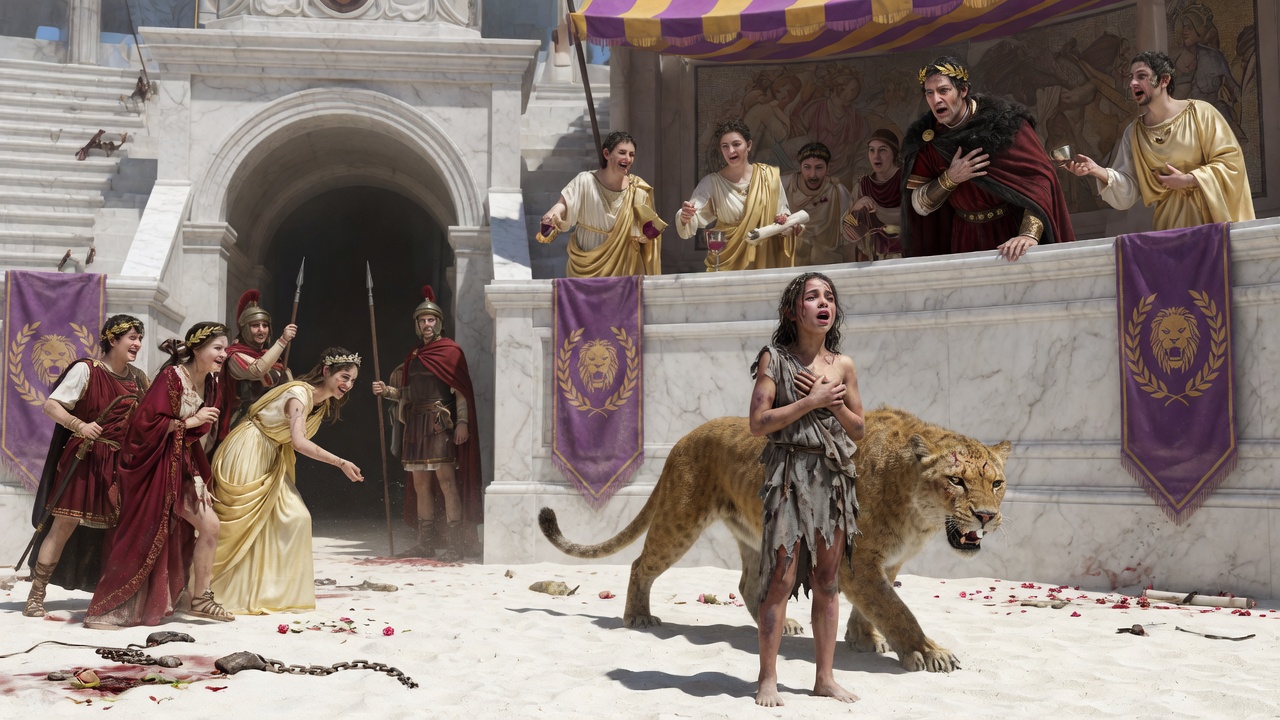
The gates groaned open. The heat of the arena sand hit me first, a jarring contrast to the freezing cellar. Thousands of people filled the stone tiers, a sea of chanting voices that died down as I was pushed into the center of the dust.
High above, in the Royal Box, sat King Alaric. He looked bored, his chin resting on a fist, his crown glinting in the sun. He didn’t know me. He didn’t know that his sister—the woman he had mourned for fifteen years—had spent her final days in a peasant’s hut, teaching her daughter how to hide in plain sight.
The sound of a heavy wooden bolt sliding back echoed through the silence. From the North Tunnel, the shadow emerged. The Black Panther of the Abyss. It was a creature of nightmare, starved for three days, its ribs showing through its sleek fur.
Marcus and Livia watched from the front row, leaning over the railing with hungry eyes. They wanted to see me scream. They wanted to see the “stable-rat” beg for a life they thought was worthless.
But as the beast lowered its head, preparing to charge, a strange calm washed over me. I wasn’t afraid of the dark anymore. I had lived in it my whole life.
I closed my eyes, ignored the roaring crowd, and opened my mouth. I didn’t scream. I sang.
It was a low, haunting melody—the “Song of the Silver Moon.” It was the lullaby the Queens of Aethelgard had sung to their heirs for a thousand years. A song that was never written down. A song that was only passed from mother to daughter by blood.
The first note hung in the air like a physical weight.
And then, for the first time in the history of the Great Arena, the screaming stopped.
Read the full story in the comments.
If you don’t see the new chapter, tap “All comments”.
FULL STORY
Chapter 2
The melody drifted upward, weaving through the heat waves rising from the sand, carrying with it the scent of a time long forgotten. To the commoners in the stands, it was merely a beautiful, eerie sound. But to those of the blood, it was a thunderclap in a clear sky.
I remembered the night this song was etched into my soul. I was five years old, huddled in the hold of a merchant ship that smelled of rotted grain and salt. The palace behind us had been a pillar of fire, the sky choked with the black smoke of betrayal. My mother, Queen Selene, had held me so tight I could hear the frantic drumming of her heart.
“Listen to me, Elara,” she had whispered, her voice trembling but her eyes like flint. “They think we are dead. Let them believe it. The world is a cruel place for a fallen star. You must become the dust. You must be the shadow. But never forget the song. The song is the key to the gate you cannot yet see.”
She had died two years later in a fever-stricken village, leaving me with nothing but that tarnished ring and the melody. I had walked for miles until I reached the capital, finding work in the only place a nameless orphan could—the Royal Stables. I had spent eight years watching my uncle, King Alaric, ride past me on his white charger. I had brushed the mud from the boots of the men who had betrayed my mother. I had stayed silent. I had been the “stable-rat.”
But Lady Cassia, the King’s cousin and the woman who had clawed her way into the vacuum my mother left behind, had always sensed something in me. She hated the way I carried my head. She hated the way I looked her children in the eye. The “theft” of the brooch was merely the excuse she needed to erase the girl who reminded her of a ghost.
As I sang the second verse, the black panther did something impossible. It stopped ten feet from me. Its tail, which had been lashing the sand in a murderous rhythm, went still. It tilted its head, its golden eyes widening. This beast was a creature of the royal forests, its ancestors bred to guard the throne. It recognized the vibration of the song in its very marrow.
I watched Marcus’s face from the corner of my eye. His arrogant smirk was beginning to crumble. He looked around at the crowd, confused by their sudden, breathless silence. “What is she doing?” he hissed to Livia. “Why isn’t it attacking?”
Livia didn’t answer. She was staring at the Royal Box.
King Alaric had stood up. His hands were gripping the marble railing so hard his knuckles were white. The wine he had spilled was a dark, spreading stain on the white stone, looking like a fresh wound. His eyes were fixed on me, searching my face, stripping away the dirt and the years of malnutrition.
I hit the high note—the one my mother called the ‘Cry of the Sovereign’. It was a sound that shouldn’t have been able to come from a girl who had spent the night freezing in a stone hole. It was pure, resonant, and carried the authority of a hundred generations.
“STOP!”
The King’s voice didn’t just command; it broke. It was the roar of a man who had suddenly seen a dead woman walking.
He didn’t wait for the guards. He vaulted over the railing of the royal box, his heavy velvet cloak fluttering behind him like the wings of a great bird. He landed in the sand with a heavy thud, his crown falling and rolling into the dust, ignored.
The beast-master, a brutish man with a whip, stepped forward, confused. “Your Majesty, the girl is a thief! She—”
Alaric didn’t even look at him. He backhanded the man with such force the beast-master was sent sprawling into the dirt. The King kept walking toward me, his boots crunching on the sand.
I stopped singing. The silence that followed was heavier than the noise had been.
The panther let out a low whine and, to the collective gasp of ten thousand people, lay down in the sand at my feet, exposing its throat in a gesture of absolute submission.
The King stopped three paces away. He was older than I remembered from the stables. There was grey in his beard and deep lines of grief around his eyes. He looked at my rags, my bruised face, and the small silver ring I was still clutching with trembling fingers.
“That song,” he whispered, his voice cracking. “Only one person knew that song. I buried her in an empty tomb fifteen years ago.”
“She told me to wait,” I said, my voice finally finding its strength. “She told me the song was the key to a gate I couldn’t see. I think I see it now, Uncle.”
The word ‘Uncle’ rippled through the arena like a shockwave.
Behind us, in the front row, Lady Cassia stood up, her face a mask of pale terror. She knew. She had always known who I was. And she knew that the girl she had thrown to the beasts had just turned the entire empire against her.
Chapter 3
The King’s hand reached out, his fingers hovering just inches from my cheek, as if he feared I was a mirage that would dissolve into smoke if touched. “Elara?” he breathed. “Selene’s daughter?”
“Her name was Elara,” I replied, my voice steadying. “And she died in a hut in the Western Marches while you sat on her throne, believing the lies of the woman who set the palace on fire.”
I felt a surge of cold, sharp satisfaction as I pointed a dirty finger toward the front row. “I spent eight years in your stables, King Alaric. I watched you ride past. I watched Lady Cassia wear my mother’s silks. I watched her son, Marcus, use me for target practice with his blunted arrows. I stayed silent because I promised her I would survive. But today, they decided survival wasn’t enough for me. They wanted me to be a spectacle.”
Alaric turned. The transition in his eyes from grief-stricken uncle to the Warlord of Aethelgard was terrifying to behold. He looked up at Lady Cassia, who was currently trying to shrink into the shadows of the stone pillars.
“Cassia,” the King said, his voice a low, vibrating growl that carried to every corner of the arena. “You told me the girl was a stable-thief. You told me she had confessed to stealing the sapphire of the crown.”
“She… she did, Majesty!” Cassia stammered, her voice high and brittle. “The guards found it in her bedding! Marcus saw her take it!”
Marcus, usually so bold and cruel, looked as if he wanted to melt into the sand. He backed away from the railing, but he found his path blocked.
The Silver Legion—the King’s personal guard, men who had been loyal to my mother before they were loyal to him—had already moved. They didn’t need an order. They had heard the song. They knew the face of the Queen they had lost. They had surrounded the noble section, their shields forming a wall of impenetrable steel.
“I found the brooch, Uncle,” I said softly, reaching into the waistband of my rags. I pulled out a heavy, shimmering sapphire set in gold.
The crowd gasped.
“I didn’t steal it,” I continued, looking directly at Marcus. “Marcus dropped it into my water bucket this morning while I was chained. He thought I wouldn’t notice. He thought I’d be too busy dying to show it to anyone.”
I tossed the brooch into the sand. It landed with a dull thud at the King’s feet.
“He told me if I gave it back, he’d ask the beast-master to blunt the panther’s claws,” I added, a single tear finally escaping. “He wanted me to beg. But I am a daughter of the Silver Moon. We do not beg.”
King Alaric looked at the brooch, then at me, then at the panther still guarding my feet. The realization of the atrocity he had almost permitted—the execution of his own blood, the last piece of his sister—seemed to break something inside him.
“Guards,” Alaric commanded, his voice echoing like a death knell. “Bring Lady Cassia and her children to the sand. Now.”
The screaming started then. It wasn’t the scream of a victim, but the indignant, terrified shrieking of a noblewoman being dragged from her seat by common soldiers. Marcus tried to fight, but a legionnaire simply caught his wrist and twisted, forcing the boy to his knees in the dirt.
Within minutes, the three of them—Cassia, Marcus, and Livia—were kneeling in the arena dust, directly in front of the girl they had spent years tormenting.
“You said she was filth,” the King said, standing over them. “You said she was a rat.”
He reached down and picked up his crown from the dust. He didn’t put it on his own head. He turned to me, his eyes wet with tears.
“I have spent fifteen years looking for a ghost,” he said to me, his voice loud enough for the whole city to hear. “And all that time, the heart of the empire was sleeping in the straw. Elara of Aethelgard, Princess of the Realm… forgive a blind old man.”
He knelt before me. The King of the Silver Empire, kneeling in the dirt before a girl in rags.
And as he did, ten thousand people in the stands followed suit. The sound of ten thousand bodies hitting the stone in unison was like a wave breaking on the shore.
I looked down at Lady Cassia. Her face was pressed into the sand, her expensive silks being ruined by the very dust she had forced me to eat. I felt no pity. I felt only the weight of the eight years of cold, of hunger, and of the silent nights spent weeping for a mother whose name I wasn’t allowed to speak.
“The arena is for justice, isn’t it, Uncle?” I asked, my voice cold and clear.
Alaric looked up, a grim smile touching his lips. “It is, my child. And today, the games have only just begun.”
Chapter 4
The atmosphere in the Great Arena had shifted from a bloodthirsty spectacle to a chilling tribunal. The sun, once warm and welcoming, now seemed to beat down like an interrogator’s lamp.
Lady Cassia was no longer screaming. She was shivering, her forehead pressed so hard into the grit that a small stone had cut her skin. Marcus and Livia were flanked by two massive legionnaires, their hands clamped on the children’s shoulders like iron vices.
“Majesty, please!” Cassia choked out, her voice muffled by the sand. “It was a mistake! A misunderstanding! We didn’t know!”
“You didn’t know?” Alaric’s voice was a whip-crack. “You lived in the palace where her mother grew up! You saw her face every day for eight years! You didn’t see the eyes of my sister? Or did you simply hope that by treating her like a dog, she would eventually believe she was one?”
The King turned to the captain of the Silver Legion, a scarred veteran named Valerius. “Captain, search Lady Cassia’s estate. Every room, every ledger, every servant’s mouth. I want the truth about the night of the fire. I want to know who held the torch.”
Cassia’s breath hitched. That was the sound of a woman whose secret had just been dragged into the light.
“And as for these two,” Alaric said, gesturing to Marcus and Livia. “They seem to enjoy the arena so much. They find the plight of the ‘stable-rat’ amusing.”
“Please, Sire!” Livia wailed, her golden hair tangled and dusty. “We were just playing! It was just a game!”
“A game?” I stepped forward, the panther rising with me, a low rumble of a growl vibrating in its chest. I looked down at the girl who had once poured hot tea on my hands just to watch me jump. “Yesterday, you watched Marcus lock me in a cellar that was minus ten degrees. You watched him tell the guards to take my blanket. You laughed when he said my mother was probably a whore who died in a ditch.”
I leaned down, my face inches from hers. “Is that the game, Livia? Because I don’t think you’re winning anymore.”
Alaric watched me, a flicker of pride—and perhaps a little fear—crossing his face. He saw the fire that had been forged in the cold.
“The sentence,” Alaric announced, “for the attempted murder of a Princess of the Blood, and for the treasonous concealment of her identity, is simple. Lady Cassia will be taken to the Black Tower to await trial for the fire of fifteen years ago.”
He paused, looking at the two teenagers. “Marcus and Livia will be stripped of their titles, their lands, and their furs. They will be given the rags of the lowest stable-hands. And they will work. They will clean the stalls. They will sleep in the hay. And every day, they will look at the throne they tried to steal.”
“No!” Marcus screamed, trying to lunge toward the King. “I am a Noble of the Court! You can’t make me a servant!”
“I am not making you a servant, Marcus,” I said softly. “I am making you a human. Maybe, in ten years, you’ll learn the difference.”
The legionnaires began to drag them away. Their cries echoed through the silent arena, a stark contrast to the mocking laughter they had brought with them that morning.
The King turned back to me. He reached out and took my hand. It was the first time I had felt the warmth of a family member in over a decade. His hand was rough, calloused from his sword, but it was steady.
“The palace is being prepared,” he said. “Your mother’s chambers have been locked since the day she disappeared. I couldn’t bear to open them. I think it’s time they were aired out.”
I looked around the arena. The thousands of people were still kneeling. They weren’t looking at a stable-girl anymore. They were looking at the future.
“Wait,” I said.
I walked over to the beast-master, who was still cowering by the gate. I took the heavy iron keys from his belt. I walked to the cages where the other animals were kept—the lions, the wolves, the creatures captured just to be killed for sport.
One by one, I unlocked the gates.
“Uncle,” I said, as the animals began to cautiously sniff the air of the arena. “My mother always said that Aethelgard was built on the strength of its people, not the blood of its victims. If I am to be a Princess, let my first act be to end the games. The arena will be a marketplace. A place for trade, not for dying.”
Alaric looked at the animals, then back at me. He smiled—a real, weary smile. “Your mother would have said the exact same thing.”
He picked up his crown from the sand, brushed the dust from the gold, and placed it back on his head. Then, he offered me his arm.
As we walked out of the arena, the black panther followed at my heels like a loyal hound. We passed the stables where I had spent eight years. I saw the pitchfork I had used that morning. I saw the bucket where Marcus had dropped the brooch.
I didn’t look back. The girl who lived there was gone.
Chapter 5
The walk through the city was unlike anything I had ever experienced. When I was a servant, the streets were a place of danger—of being stepped on by horses or pushed aside by merchants. Now, the crowds parted like the Red Sea. They threw flowers—not the expensive roses of the court, but the simple wildflowers of the fields.
They were shouting a name I hadn’t heard in so long I almost didn’t recognize it. “Elara! Elara of the Moon!”
We reached the palace gates, the towering white marble arches that I had only ever entered through the servant’s entrance. Today, the Great Gates were swung wide.
Inside, the court was in a frenzy. News had traveled faster than we had. Nobles who had ignored me for years were now bowing so low their noses nearly touched the floor.
The King led me to the Great Hall, but I stopped at the foot of the stairs.
“Not yet,” I said. “I need to see the cellar.”
Alaric frowned. “Why would you want to go back there?”
“Because the truth isn’t just in the song, Uncle. It’s in the walls.”
I led him, along with a dozen guards, down into the damp, dark bowels of the palace. We reached the tiny cell where I had spent the night. It was even smaller and more miserable than I remembered.
“Search the back wall,” I told the guards. “Behind the loose stone near the floor.”
Valerius, the Captain, knelt and pried a stone away. He reached into the darkness and pulled out a small, oilskin-wrapped bundle.
I took it and handed it to the King.
Inside was a single, charred piece of parchment. It was a letter, signed with the seal of the Senate—the men who had supposedly been the King’s closest advisors. It was an order to Lady Cassia to ensure the Queen did not survive the night of the fire, in exchange for a seat on the High Council for her husband.
Alaric’s face turned a shade of purple I didn’t think possible. “They all knew,” he whispered. “The Senate… they weren’t just incompetent. They were murderers.”
“My mother found this in Cassia’s room the night of the fire,” I explained. “She grabbed it before we ran. She hid it here years later, when she realized she was dying and that I would have to come to the palace alone. She told me if I ever found the strength to sing, I should find the strength to show you this.”
The King clutched the letter so hard it crinkled. The betrayal was complete. It wasn’t just a jealous cousin; it was a rot that had infected the very heart of his government.
“Valerius!” the King roared. “Arrest the High Council. Every single one of them. Use the dungeons. They’re empty now that the stable-girl is gone.”
That night, for the first time in fifteen years, the palace was purged. The men who had whispered in the King’s ear, the ones who had helped Cassia hide the truth, were dragged from their beds in their nightshirts.
I sat in my mother’s chambers. They were exactly as she had described them—filled with books, maps, and the faint scent of jasmine. A healer had bathed my wounds and dressed me in a gown of midnight blue silk. My hair, which had been a tangled mess of straw and dirt, was now brushed until it shone like spun silver.
There was a knock on the door. It was the King. He looked older, tired, but relieved.
“The Senate has confessed,” he said, sitting on the edge of a chair. “Cassia told them everything once she saw the letter. She thought by talking, she could save her children.”
“And?” I asked.
“I kept my word to you. They are in the stables. I watched Marcus try to lift a bale of hay ten minutes ago. He cried.” Alaric chuckled darkly. “He’ll learn. Or he won’t. But he will never hurt anyone again.”
He looked at me, truly looked at me. “I failed you, Elara. I failed your mother. I spent fifteen years drinking and mourning while my family was right under my nose.”
“You didn’t fail us,” I said, walking over and taking his hand. “You were just waiting for the song. Sometimes, the truth is too quiet to hear until it’s shouted in an arena.”
He leaned forward and kissed my forehead. “Tomorrow, we announce the Regency. I’m tired, Elara. I’ve been a King with no heart for too long. I think Aethelgard needs a Queen who knows what it’s like to be the dust.”
Chapter 6
The coronation was not held in the palace. It was held in the Great Arena, now transformed. The sand had been covered with colorful rugs, and the stone tiers were packed with people from every corner of the empire—not just the nobles, but the farmers, the blacksmiths, and the stable-hands.
I stood on the very spot where I had faced the panther. But today, I wasn’t in rags. I wore a mantle of silver fox fur over a gown that shimmered like the moon on water. Around my neck, the tarnished silver ring had been cleaned and set into a heavy gold necklace.
King Alaric stood before me. He took the Great Crown of Aethelgard and held it high.
“People of the Silver Empire!” he shouted. “For fifteen years, we lived in a winter of lies. But the sun has returned. I present to you your Queen—Elara, the First of Her Name, the Daughter of the Moon, and the Voice of the People!”
As the crown touched my head, the black panther, which had been granted a permanent place as my royal guardian, let out a roar that shook the very foundations of the arena.
The roar was answered by the people. It wasn’t the roar of a crowd watching a kill. It was the roar of a nation finding its soul.
Later that evening, after the feasts and the speeches, I slipped away from the Great Hall. I didn’t want the wine or the dancing. I walked down to the stables.
It was quiet there. The smell of horses and hay felt more like home than the silk sheets of the palace ever would.
In the furthest stall, I saw a figure hunched over a shovel. It was Marcus. He looked exhausted, his hands blistered, his expensive boots ruined. He didn’t see me at first. He just kept digging, his breath coming in ragged gasps.
“It’s heavier than it looks, isn’t it?” I said softly.
He jumped, dropping the shovel. He looked at me—really looked at me—in my royal finery. There was no more hate in his eyes. There was only a profound, hollow realization.
“I’m sorry,” he whispered. It was the first time he had ever said those words.
“I know,” I said. “And that is why you’re still here. Work hard, Marcus. Learn the value of a day’s labor. Learn that the person shoveling the manure is the one who keeps the horse running. When you understand that, come see me. Maybe then, you can be a Noble again.”
I turned to leave, but stopped at the stable door. I looked up at the moon, hanging full and bright over the palace spires.
I realized then that my mother hadn’t just taught me a song. She had taught me that dignity isn’t something you’re born with, and it isn’t something that can be taken away by a cellar or a beast. It’s something you carry inside you, a quiet melody that waits for the right moment to become a storm.
And as the old banner rose above the castle again, I finally understood that a kingdom is not built by crowns, but by the people who refuse to let love kneel in the dust.