CHAPTER 3
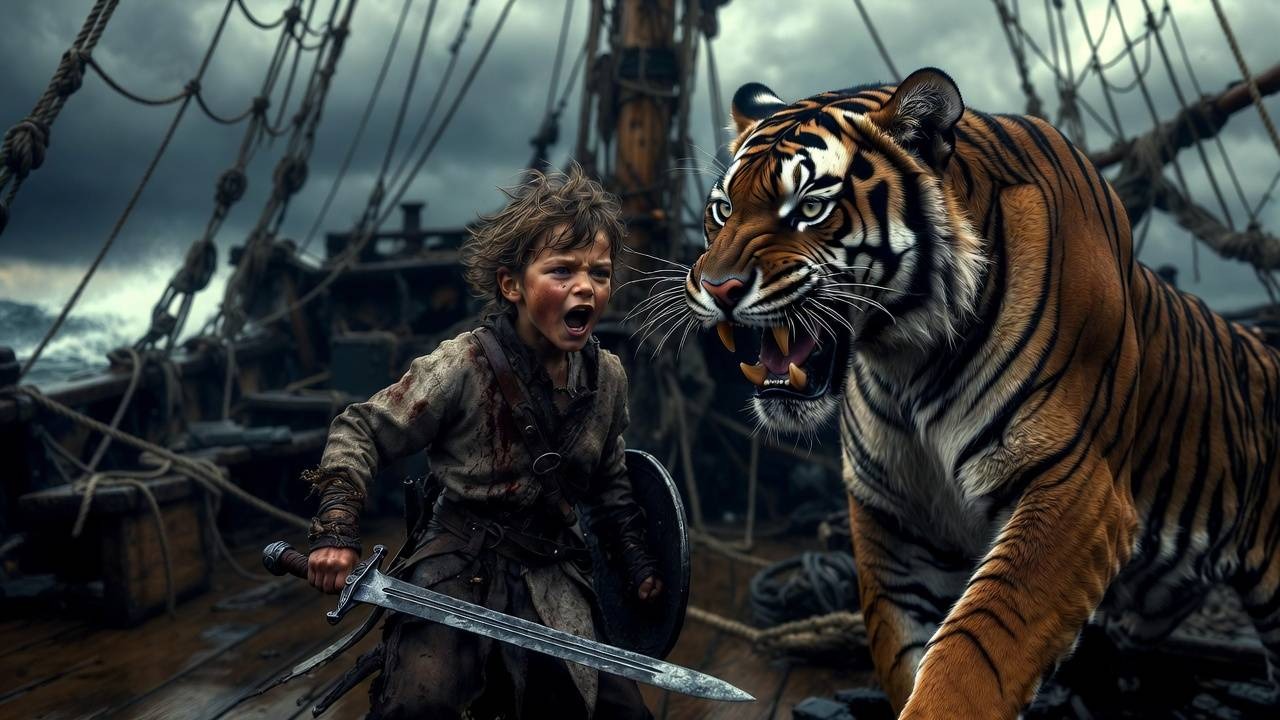
The great hall of the Black Leviathan was suffocatingly hot, yet my body could not stop shaking beneath the heavy, thick seal-fur coat Captain Asmund had wrapped around my shoulders. The scent of old salt, dried blood, and rich whale oil clung to the fur, a stark contrast to the stench of rotting bilge and sweat that had been my only reality for three brutal years. I sat on a low, wooden bench near the great hearth, where a small fire crackled against the dampness of the night. My left shoulder throbbed with a white-hot agony where the hound’s teeth had torn deep into my flesh, but a ship’s surgeon—a silent, grey-bearded man who had previously never looked at me unless it was to kick me out of his way—was now tenderly washing the wound with strong northern spirits and binding it with clean, white linen.
Every touch felt foreign. Every look from the guards standing at the door felt heavy with an unspoken terror. They didn’t look at me as a useless piece of meat anymore. They looked at me as if I were a ghost that had risen from the depths of the ocean to demand an accounting for every drop of blood spilled on these decks.
Through the heavy oak doors of the hall, the sounds of a fleet in chaos drifted into the room. The low, mournful groan of the war horns continued to echo across the flat, dead water, signaling to every ship in the High King’s armada that a blood council was being called. I could hear the rhythmic thud of heavy oars dipping into the sea as smaller longboats rowed between the massive warships, carrying the iron-clad captains and grizzled privateers toward the Black Leviathan.
Inside the hall, Captain Asmund paced the floor like a caged predator. His heavy boots made a dull, rhythmic thud against the polished deck planks, a sound that seemed to match the frantic beating of my own heart. He hadn’t spoken to me since we left the lower deck. He kept his eyes fixed on the stern windows, his large, weathered hands gripping the silver medallion that he had taken from my neck. His knuckles were white, his jaw set so tightly that the silver scar on his face twitched under the flickering light of the chandeliers.
“Captain,” the old surgeon whispered, bowing his head as he tied off the final knot on my bandage. “The boy’s wound is clean. He is weak from the lack of water, but his spirit is anchored deep. He will live.”
Asmund stopped his pacing. He turned slowly, his icy blue eyes locking onto me. For a moment, the terrifying warlord disappeared, and I saw a glimpse of the man he used to be before the sea claimed his soul—a man who had lost everything he loved in a single night of fire and betrayal.
“Leave us, Baldur,” Asmund commanded softly.
The surgeon bowed low and scurried out of the room, closing the heavy doors behind him. The silence that settled over the great hall was so absolute that I could hear the trickling of the wax melting down the iron hoops of the chandeliers.
Asmund walked over to the long oak table, pulled a wooden chair out, and placed it directly in front of me. He sat down, leaning forward with his elbows on his knees, holding the silver medallion between us. The carved image of the roaring sea wolf wrapped around a broken crown seemed to gleam with a life of its own in the firelight.
“Do you know what this is, boy?” Asmund asked, his voice low and raspy.
“My mother told me it belonged to my father,” I whispered, my voice still cracking from the dehydration. “She said it was the only thing left of our home. She told me to keep it hidden, even if I was starving, because there were men on the water who would cut my throat just to see the silver melt.”
A bitter, painful smile touched Asmund’s lips. “Your mother was a wise woman, Valdis. She knew the greed of men. But she didn’t tell you the whole truth, did she? She wanted to protect you from the burden of the dead.”
He held up the medallion, letting the candlelight catch the three deep lines carved into the back of the metal.
“Twenty winters ago, the Northern Fleet was the undisputed master of the cold seas,” Asmund said, his eyes drifting into the past. “We did not serve the High King. We did not pay tribute to the Southern empires. We were free men, ruled by the Sea Throne. My older brother, High Admiral Erik, was the leader of that fleet. He was a man of honor, a man who believed that the strength of a captain lay in the loyalty of his crew, not the fear he struck into their hearts.”
He looked at me, his gaze softening just a fraction. “Erik had a son. A newborn child whose laughter was louder than the winter gales. When the betrayal came—when the High King’s ships surrounded our fjord under the cover of a false peace storm—the world fell apart. The sky turned red with fire. The water hissed as our great ships burned to the waterline. I watched my brother stand on the burning deck of his flagship, fighting off ten men at once to give his wife and child a chance to reach the coastal caves.”
Asmund’s hand tightened around the silver piece until I thought the metal would snap. “Torstein was our mate then. He was the one assigned to guard the escape boats. After the fire died down, he came to me with blood on his hands. He swore to me that the High King’s assassins had found the boy. He swore he saw the child thrown into the freezing depths of the sea. I believed him. I took the survivors, joined the High King’s armada under a false oath of loyalty, and spent twenty years climbing the ranks, turning myself into a monster just to have the power to destroy this empire from within when the time was right.”
He reached out, his large, rough hand gently touching my cheek, wiping away a smear of soot and dried blood.
“But Torstein lied,” Asmund whispered, his voice trembling with a mixture of grief and fury. “He didn’t see you die. He took a bribe from the High King’s agents to ensure my brother’s bloodline was erased, but your mother outsmarted them all. She dragged you through the snowy forests, hid you in the dirt of the poorest coastal villages, and kept you alive. And when she died, the sea brought you right back to me. You have your father’s eyes, boy. The same dark grey of a gathering storm.”
Before I could answer, the heavy oak doors of the hall burst open.
First Mate Harek, a scarred veteran with an iron hook where his left hand should have been, stepped into the room. His face was tense, his breath coming in short gasps. Behind him, the corridor was packed with the sounds of shuffling feet, clanking armor, and the low, angry murmuring of men who lived by the edge of the blade.
“The council is assembled, Captain,” Harek announced, his eyes darting toward me with an intense curiosity. “Every captain from the twelve warships is in the hall below. Torstein is chained to the execution post, but he is already stirring up the men. He is telling them that you are losing your mind over a worthless bilge rat. He is invoking the old law of the iron code. If you do not show proof of your actions, the men are ready to riot.”
Asmund stood up. The vulnerability vanished from his eyes, replaced instantly by the terrifying aura of the Pirate King. He strapped his heavy broadsword to his waist, its iron pommel catching the light.
“Let them talk,” Asmund said, his voice echoing with a dark, predatory confidence. “The iron code belongs to the sea, but the sea belongs to us.”
He looked down at me, extending his hand. “Can you walk, son of Erik?”
I looked at his hand—the hand of the most feared man on the northern oceans. Then I looked down at my own body, covered in scars, filth, and the fresh linen bindings of a slave’s life. For three years, I had crawled. For three years, I had hidden my face in the dirt, taking the blows, taking the hunger, taking the absolute humiliation of being nothing. But the blood of the High Admiral was humming in my veins now. The fire that had kept my mother alive through the frozen winters was burning in my chest.
I took his hand. I stood up. My legs shook, and the pain in my shoulder flared like a torch, but I didn’t fall. I pulled the heavy seal-fur coat tightly around myself, letting the weight of it anchor me to the floor.
“I can walk,” I said, my voice clearer than it had ever been.
“Then let us go and remind these dogs who owns the water,” Asmund said.
We walked out of the great hall, flanked by four heavily armed personal guards. The corridors of the Black Leviathan were lined with crew members who had packed into the passages to get a glimpse of the boy who had caused the war horns to blow. They stood back against the wooden walls, their eyes fixed on the silver medallion that Asmund had pinned openly onto the front of my fur coat. The laughter that usually filled these companionways was entirely gone. There was only a heavy, trembling anticipation.
We descended the wide wooden stairs into the main deck hall—the massive, double-tiered room where the fleet’s captains gathered to divide plunder and plan their bloody raids. The air inside was thick with the smoke of fat-burning torches and the heavy, sour smell of ale and sweat. Dozens of captains sat around the long stone tables, their faces hardened by a lifetime of violence.
In the center of the hall, tied to a massive iron-reinforced wooden post, was Quartermaster Torstein. His face was a horrific mess of blood and broken bone where Asmund’s silver flagon had struck him, but his eyes were wide and filled with a desperate, animalistic rage. He was straining against the heavy iron chains wrapped around his torso, his voice booming through the hall as he shouted to the gathered captains.
“Look at him!” Torstein screamed, spitting blood onto the floor as Asmund and I entered the room. “Look at our great Pirate King! He breaks his own laws for a thieving cabin boy! He strikes his own Quartermaster because of a piece of stolen silver! Is this who we follow? A man who lets his mind be turned by the fairy tales of a bilge rat?”
A low murmur of agreement rippled through the captains. A few of them tightened their grips on their daggers, looking up at Asmund with questioning, defiant eyes. On a pirate ship, authority is only as strong as the fear it commands. If a captain appears weak, or if he acts against the unwritten laws of the crew, the blades turn on him in an instant.
Asmund didn’t say a word. He walked to the raised platform at the front of the hall, where his great wooden throne sat, and stood beside it. He signaled the guards to place me right next to him, under the brightest torch in the room.
“Silence!” First Mate Harek bellowed, slamming his iron hook against a heavy brass shield.
The murmuring died down, but the tension in the room remained high, stretching like a rope pulled to its absolute breaking point.
“You speak of the law, Torstein,” Asmund began, his voice surprisingly calm, yet every man in the room heard it perfectly. “You speak of the iron code that binds this fleet together. You say I have broken it.”
“You have!” Torstein roared, his chest heaving against the chains. “The boy stole water! The penalty is death in the pit or over the rail! You stopped the execution! You struck your officer! The crew wants to know why a piece of garbage deserves the protection of the King’s coat!”
Asmund slowly reached out and placed his hand on my shoulder, turning me so the entire room could see the silver medallion resting against the dark fur.
“He deserves the protection of this coat because he is not a thief,” Asmund said, his voice dropping into a register that made the timbers of the hull vibrate. “He was taking what belongs to him by right of blood. This boy is the son of High Admiral Erik. He is the last living heir to the Sea Throne of the Northern Fleet.”
The words hit the room like a broadside volley.
Several captains stood up so fast their chairs crashed backward onto the floor. Old men, veterans of the ancient wars who had spent the last two decades serving the High King under a forced truce, stared at me with open mouths. The torches seemed to flicker wildly as a collective gasp left the lips of nearly a hundred hardened killers.
“That’s a lie!” Torstein shouted, his voice turning shrill with a sudden, spiking terror. “Erik’s line was ended! I told you myself twenty years ago! The boy died in the water! This rat found that medallion in a dead man’s chest! He’s a fraud!”
Asmund stepped forward to the edge of the platform, his hand moving to the hilt of his broadsword.
“You told me he died, Torstein, because the High King paid you thirty pieces of southern gold to ensure the bloodline was wiped out,” Asmund said, his voice rising in power. “You thought you buried the truth in the ashes of the Great Fjord. But the sea does not keep secrets forever.”
He looked out over the gathered captains, his eyes burning with a righteous, lethal authority. “We have lived as dogs under the High King’s shadow for twenty winters. We have taken his scraps, we have fought his wars, because we believed our true leaders were gone. We believed the Northern Fleet was dead.”
He turned back to Torstein, a cold, terrible smile spreading across his face. “But the bloodline survives. And the iron code has a very specific rule for an officer who takes gold from our enemies to murder his own commander’s children.”
Torstein’s confidence finally broke. He looked around the room, desperately searching the faces of the captains he had gambled with, drank with, and intimidated for years. But he found no allies. The men who had been nodding along with him just moments before were now looking at him with a deep, murderous disgust. In our world, you could kill, you could rob, and you could burn cities to the ground—but to betray your own bloodline for enemy gold was an unforgivable sin.
“Harek,” Asmund commanded, his voice cutting through Torstein’s frantic breathing. “Bring the book of the fleet register. Let every man here see the mark of the High Admiral, and let us see if Torstein’s blood matches the price of his treason.”
The crew fell into a terrifying, breathless silence as the first mate stepped forward with a heavy, leather-bound volume, but before the book could even be opened, Torstein did something nobody expected. With a massive, desperate surge of his giant body, he shattered the old wooden post he was chained to, the splinters flying across the room as he pulled an iron spike from his belt, lunging directly toward the platform where I stood.
The crowd erupted into a chaotic roar, but the Pirate King didn’t even flinch.
CHAPTER 4
The iron spike in Torstein’s hand gleamed in the torchlight as he charged up the wooden steps of the platform. His face was a mask of bloody desperation, the roar tearing from his throat sounding like that of a dying beast. He knew he was already a dead man; he had no hope of escaping the Black Leviathan, surrounded by hundreds of sailors who now looked at him with hatred. His only goal was to take me with him—to finish the murder he had been paid to commit twenty years ago before the axes of the guard could find his spine.
“Die, you little bilge rat!” he screamed, his massive frame blocking out the light of the great hearth.
I didn’t move. I didn’t run. For three years, fear had been my shadow, controlling every breath I took, every step I made. But looking at the man who had starved my friends, who had poured our life-saving water onto the dirty deck, and who had betrayed my father’s legacy for a pouch of gold, the fear simply evaporated. It was replaced by a cold, heavy stillness that felt exactly like the frozen depths of the northern sea.
Before Torstein could reach the top step, Captain Asmund moved.
It was not the clumsy movement of an old man, but the precise, lethal strike of a warrior who had survived a thousand boardings. His heavy broadsword left its scabbard with a sharp, ringing hum that cut through the screams of the crowd. He didn’t block Torstein’s blow; he stepped inside the giant man’s reach, his shoulder slamming into Torstein’s chest with the force of a battering ram.
The impact sent a sickening crack through the room. Torstein stumbled backward, his breath leaving him in a wet gasp as he tumbled down the steps, crashing heavily onto the stone floor of the hall. The iron spike flew from his grip, spinning across the deck until it struck the boot of an old captain from the vanguard ship.
The old captain didn’t look down at the weapon. He kept his eyes fixed on Torstein, his hand resting on the pommel of his axe.
“Guards,” Asmund said, his voice dropping back into that terrifying, icy calm as he stood at the top of the steps, his sword dripping a single line of dark blood onto the wood. “Pin him down. Do not let him have the mercy of a quick death.”
Six heavily armored ship guards descended on Torstein before the giant could crawl to his feet. They slammed their iron-rimmed shields into his back, forcing him flat against the stone floor, his face pressed into the dirt and spilled ale. Heavy iron pins were driven into the deck timbers, securing his wrists and ankles until he was completely immobilized, splayed out like a captured beast before the entire leadership of the fleet.
Asmund walked slowly down the steps, his seal-fur coat billowing behind him. He stopped right above Torstein’s head, looking down at him with an expression of complete detachment.
“The iron code is simple, Torstein,” Asmund murmured, the words echoing through the dead-silent hall. “A man who takes gold from a foreign king to spill the blood of the Sea Throne shall not be given to the earth, nor shall he be given to the sharks. His blood shall be poured out upon the deck of the flagship, and his name shall be struck from the fleet register, forgotten by the wind and the waves.”
“Asmund… please,” Torstein wheezed, his arrogance completely gone, replaced by the raw, pathetic begging of a coward facing the end. “We were brothers in arms… we fought the southern empire together… it was the High King’s gold… he threatened my family…”
“You have no family, Torstein,” Asmund said softly. “A traitor has no bloodline. He only has the debt he owes to the dead.”
Asmund turned his head slightly, looking back up the steps toward me. The entire room followed his gaze. Nearly a hundred captains, men who had spent their lives watching executions without blinking, were now waiting for my word. They were waiting to see if the boy who had been a slave an hour ago possessed the iron required to rule them.
“The judgment belongs to the heir,” Asmund announced, his voice carrying a solemn weight. “Speak, son of Erik. How shall the fleet cleanse itself of this rot?”
I walked down the steps. The heavy coat dragged slightly against the wood, but my posture was straight. My left shoulder burned with a fierce intensity, the bandages soaking through with a small patch of red, but I felt no weakness. I stopped at the edge of the platform, looking down at the giant man who had kicked away our water rations, who had smiled as he watched young Thorgil shake with fever in the dark hold.
I reached into the lining of my coat and pulled out the rusted, dull iron dagger that Torstein had thrown into the sand of the fighting pit—the weapon he had told me to use to defend my life against his starving hound.
I walked over to where Torstein lay pinned to the floor. I knelt beside his face, the scent of his fear thick and sour in the air. He stared up at me with wide, bloodshot eyes, his lips trembling as he saw the rusted blade in my hand.
“This water belongs to the crew,” I whispered, my voice carrying clearly to every corner of the hall. “And your blood belongs to the sea.”
I didn’t use the knife to take his life. That would have been too quick. Too merciful.
I took the rusted blade and pressed the flat of the metal directly into the fire of the nearest torch standing beside the platform. The iron hissed as it absorbed the heat, turning a dull, glowing red in the dim light of the hall. The captains watched in a breathless awe, realizing exactly what I was about to do.
I brought the white-hot metal down, pressing it firmly into the flesh of Torstein’s right cheek—the same cheek where he carried the brand of his quartermaster status.
The sound of sizzling flesh filled the room, followed instantly by a long, agonizing scream that tore from Torstein’s throat. The smell of burning skin rose into the air, but nobody turned away. Nobody moved to help him. I held the blade there until the iron turned dark again, leaving a deep, blackened scar in the shape of a broken anchor—the ancient mark of a disgraced traitor.
“You are no longer an officer of this fleet,” I said, standing up and tossing the blackened knife onto his chest. “You will be stripped of your armor, your gold will be divided among the cabin boys you starved, and you will spend the rest of your short days working the bilge pumps in the lowest dark of the ship, tasting the bilge water you forced us to drink.”
A heavy, explosive roar of approval shattered the silence of the hall.
The captains banged their fists against the stone tables, their voices joining together in a wild, fierce chant that shook the very core of the Black Leviathan. They were not cheering for an execution; they were cheering for the return of the true law. They were cheering for the boy who had crawled out of the dirt to take his place among the kings of the ocean.
“The Sea Throne lives!” old Captain Baldur shouted, drawing his heavy broadsword and raising it toward the ceiling.
“The Sea Throne lives!” the entire hall roared back, a hundred blades rising into the torchlight, creating a forest of gleaming steel beneath the dark timbers.
Asmund walked over to me, a massive smile finally breaking through his weathered face. He reached out, his large hand gripping my good shoulder with a proud, familial warmth. He unbuckled his own secondary dagger—a beautiful weapon forged from blue southern steel, its hilt wrapped in silver wire—and fastened it to my waist.
“You did well, nephew,” Asmund whispered, his eyes gleaming with a fierce satisfaction. “Your father would have proud. Tonight, we have cleansed the ship. Tomorrow, we turn the sails toward the High King’s capital. The truce is broken.”
He led me out of the main deck hall, up to the high balcony of the forecastle deck.
The night air was cool and crisp, a welcome relief from the sweltering heat of the interior rooms. The thick fog that had held the fleet motionless for a week was finally beginning to lift, driven away by a sudden, rising gale from the north. Below us, spread across the dark, undulating surface of the ocean, were the twelve massive warships of our fleet, their black sails beginning to snap and billow in the wind like the wings of giant sea birds.
Thousands of sailors were packed onto the decks of the surrounding vessels, their faces illuminated by the bright orange glow of a thousand torches. They had heard the horns. They had heard the rumors. And now, as they looked up at the high balcony of the flagship, they saw their Pirate King standing side by side with a young boy wrapped in the royal seal fur, the ancient silver medallion gleaming brightly against his chest.
The first mate stepped forward, raising his horn to his lips, his voice carrying across the open water to the entire armada.
“Behold your true bloodline!” Harek shouted. “The line of High Admiral Erik has returned from the deep! The Sea Throne is restored!”
A silence fell over the thousands of men spread across the ocean—a silence of absolute awe, followed a second later by a sound that shook the very foundations of the sea empire. It was the collective roar of an entire army, the pounding of shields, the clinking of iron cups, and the wild, untamed cheering of free men who had finally found something worth fighting for.
I looked out over the vast, black-sailed fleet, feeling the cool wind catch my hair, the salt spray of the northern ocean stinging my face. But it didn’t taste like blood anymore. It tasted like freedom. It tasted like the beginning of a storm that would wash away the high king’s empire and rewrite the history of the world.
The small, starving cabin boy who had hidden his face in the dirt was gone, buried forever in the sand of the ship arena. I was the heir of the Northern Fleet, the protector of the deep, and the man who would lead these thousands of killers into the gates of fire to reclaim our home.
And the hall that once mocked me stood silent as I walked past.