FULL STORY
CHAPTER 3
The iron ax remained clamped in my small, calloused hands, its heavy blade scraping against the salt-crusted oak deck as I stood before the kneeling, shivering figure of First Mate Hrothgar. The hundreds of hardened raiders, brutal slave drivers, and veteran ocean warriors who packed the floating ship arena did not utter a single breath. The wind had risen, howling through the thick hemp rigging of the five interconnected warships, snapping the black canvas sails against the dark sky like the rhythmic crack of a whip.
A single hour ago, these exact same men had cheered for my blood, eager to see a starving, limping child split in half by the executioner’s steel just to break the monotony of a cold afternoon. Now, they stood frozen, their eyes wide with a mixture of terror and disbelief, watching the heavy, silver-threaded royal tunic drape over my thin shoulders. They were looking at the ghost of High Admiral Valdemar, the legendary commander whose name had been used to rally the fleet for a generation, reborn in the broken body of the boy they had spent three winters treating like absolute filth.
“Alaric,” King Torstein whispered, his deep voice carrying a heavy, gravelly weight as he stepped closer to my side, his own legendary broadsword lowered but ready. “The choice is yours by the old code of the northern waters. The blood of the man who tore your life away, who forced your noble mother to die in the rot of the lower deck camps, belongs to you. Take his head, and let the sea wash away the stain of his treason.”
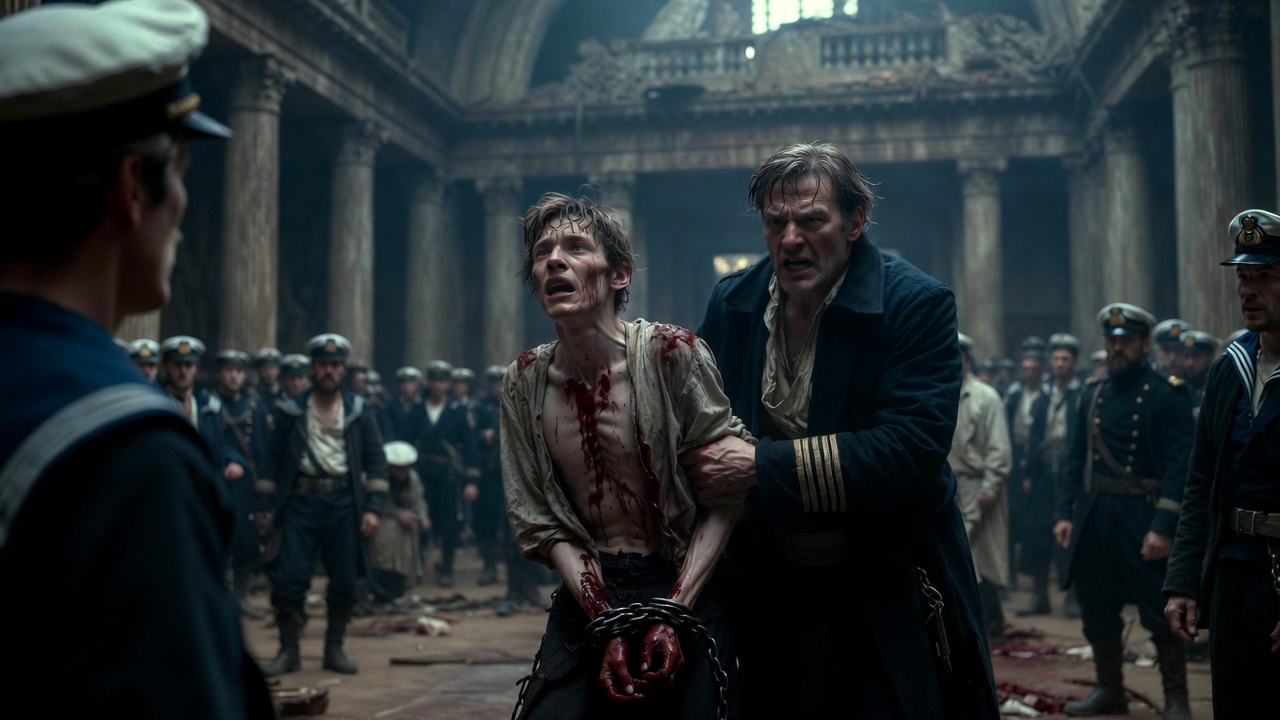
I looked down at Hrothgar. The mountain of a man who had once seemed like an unstoppable god of cruelty now looked incredibly small, his massive shoulders shaking under his grease-stained linen shirt, his eyes wide and white like a trapped animal staring into the maw of a hound. He was weeping, the tears clearing clean paths through the grime on his scarred cheeks, his thick fingers clutching at the splintered wood near my bare, scarred feet.
“Mercy, young lord,” Hrothgar wheezed, his voice stripped of every ounce of the booming arrogance that had terrorized the lower decks for years. “I am a warrior of the fleet. I served your father in the vanguard. I kept you alive when the fires took the fjord. I gave you work on the flagship. Do not let a lifetime of loyal service be ended by a single mistake.”
I felt the anger burning hot in my chest, a fierce, suffocating heat that threatened to consume my mind. My fingers tightened around the ash-wood handle of the heavy ax until my raw knuckles turned white. Every beating I had ever received, every night I had spent curled in a ball on the cold, wet ballast stones of the bilge while the rats chewed on my calluses, came rushing back into my mind. I remembered the sound of my mother’s ragged coughing in the dark, her small body shivering under a single, wet burlap sack while Hrothgar’s men laughed on the upper decks, drinking premium ale that had been bought with my father’s stolen coin.
I lifted the ax. The weight of the iron blade dragged at my thin arms, but the sheer adrenaline of the moment gave me a strength I didn’t know I possessed. I brought it up over my shoulder, bracing my twisted, scarred left leg against the wet deck, ready to swing it down with all the vengeance of a broken child. The crowd leaned forward, a collective gasp rising from a thousand throats, waiting for the spray of blood that would seal the fate of the first mate.
But as the blade reached its apex, catching the flickering orange glow of the burning pine torches, my eyes caught the reflection of my own face in the polished steel. I didn’t see a prince. I didn’t see a royal heir of the North Sea Line. I saw a face twisted by the exact same hatred, the exact same blind, brutal cruelty that had defined Hrothgar’s entire existence.
If I struck him down right here, while he was chained, helpless, and begging for his life on his knees, I would not be honoring my father’s legacy. I would simply be becoming the new executioner of the Leviathan. I would be proving to everyone in this black-sailed fleet that the only thing that mattered in this world was the power to make another human being crawl in the mud.
With a sudden, violent grunt, I turned my body and swung the heavy ax downward, burying the massive iron blade deep into the thick oak deck just inches from Hrothgar’s trembling right hand. The impact split the wood with a loud, ringing crack that echoed across the quiet bay, sending a cloud of dark splinters flying into the air.
Hrothgar shrieked, flinching away and covering his head with his chained arms, expecting the bite of the steel. When he realized he was still alive, he looked up at me in absolute bewilderment, his breath coming in short, ragged gasps.
“I will not take your head while you are in chains, Hrothgar,” I said, my voice quiet but carrying a strange, chilling authority that surprised even the King standing beside me. “A quick death on the executioner’s block is too clean for a man who spent fourteen winters building a kingdom out of lies. You made my mother live in the dark. You made the true blood of this fleet crawl through the filth of the bilge. You will face the full judgment of the great council, and every man you ever wronged will watch you lose everything you murdered to obtain.”
King Torstein stared at me for a long, silent moment, a profound look of respect softening his weathered, granite face. He slowly nodded, placing a heavy, armored hand on my shoulder. “You have the heart of your father, Alaric. A true king knows when to draw the sword, but a wiser leader knows when to let the law do the striking. Captain Orm! Remove this piece of trash from my sight. Secure him in the deepest iron cage beneath the ship arena, and double the guard. No one speaks to him until the council is fully assembled at dawn.”
“It shall be done, My King,” Orm declared, stepping forward with four heavy guards. They grabbed Hrothgar by his hair and his chains, hoisting him roughly to his feet. The disgraced first mate didn’t say another word, his head hanging low as he was dragged across the splintered arena deck, his boots trailing uselessly behind him in the exact same manner he had dragged me just hours before. The surrounding sailors didn’t offer a single cheer for him; they simply stepped back, their faces pale, avoiding his gaze as if he were a plague-ridden corpse.
The quartermaster, Gunnar, who was still kneeling flat against the wood, continued to weep, his hands clasped together in desperate prayer. “My King! Young lord! I have told you everything! I have revealed the forgery! Please, have mercy on a man who was forced to comply with a monster’s demands!”
“Your mercy will be decided by the council, Gunnar,” King Torstein said coldly, not even looking down at the groveling man. “Take him away.”
As the guards cleared the arena floor, the King turned to face the hundreds of men who remained on the warships. The atmosphere had shifted from a bloodthirsty spectacle to a solemn, high-stakes military assembly. The older captains, men who had fought alongside my father during the bloody campaigns against the southern trading empires, were already stepping down from their elevated platforms, their heavy iron boots thudding against the wooden steps as they converged on the center of the ship arena.
“Captains of the First Fleet,” Torstein announced, his voice ringing out across the dark water. “The sun has set on the lies that have infected our leadership for fourteen winters. Tomorrow, when the dawn breaks over the northern cliffs, we will hold a tribunal of the blood. We will open the sealed iron chests of the western campaigns, and we will uncover every hidden thread of this betrayal. Return to your ships. Ensure your crews are silent and orderly. Any man who attempts to raise a weapon or create a mutiny in defense of the traitor Hrothgar will be hung from the mainyard before the tide turns.”
“Hail King Torstein! Hail Lord Alaric!” a voice shouted from the upper deck of the secondary warship. It was an old, gray-bearded rower, a man whose back was covered in the same whip scars that marked my own. Within seconds, the shout was taken up by dozens, then hundreds of men across the five ships. The sound was deafening, a massive roar of human voices that seemed to push back the dark, heavy clouds gathering above the bay.
I stood there, surrounded by the roaring of the fleet, feeling the smooth silk of my father’s tunic against my skin, but my body was still shivering from the exhaustion and the lingering cold of the sea spray. The reality of what had happened was beginning to settle over me like a heavy fog. I was no longer “Limp,” the worthless deck rat who could be kicked into the bulwarks for dropping a bowl of fish. I was a commander of the North Sea Line. I was the heir to a throne I had never seen, surrounded by men who would have cut my throat yesterday but were now screaming my name until their throats were hoarse.
“Come, nephew,” King Torstein said softly, his hand guiding me back toward the warmth of the captain’s quarters. “The wind is turning bitter, and you need rest. Tomorrow will require all the strength your bloodline can muster.”
We walked back through the heavy wooden corridors of the Leviathan, the guards saluting as we passed. The captain’s cabin was just as warm as we had left it, the tallow candles burning low, casting long, dancing shadows across the heavy oak table where the fraudulent slave registry still lay open.
The King closed the heavy door behind us, cutting off the distant roaring of the crew. He walked over to a side table and poured two small horns of sweet, warm mead, handing one to me with a hand that still carried a slight tremor.
“I cannot look at you without seeing him, Alaric,” Torstein said, his voice cracking slightly as he sat back into his heavy, fur-covered chair. “Valdemar was the rock of our family. When the reports came that his estate had been burned and his family slaughtered, it broke something inside me. I became a harder man, a colder ruler. I allowed men like Hrothgar to take control of the lower decks because I didn’t care about the details of the fleet anymore. I only cared about the war. I never imagined… I never dreamed that my own negligence was forcing my brother’s child to live as a slave under my own banner.”
“You didn’t know, Uncle,” I said quietly, sitting down across from him and holding the warm horn of mead between my battered fingers. “Hrothgar was clever. He kept us hidden in the lower cargo holds during the inspections. He told the other slaves that if anyone ever spoke my true name, he would have my mother thrown into the open sea. We stayed silent to stay alive.”
“And your mother,” Torstein whispered, his eyes shining with unshed tears in the candlelight. “Elena… she was a noble woman of the Western Fjord. To think she died in the lower deck camps from the ocean rot… while I sat up here wrapped in polar bear furs and drinking imported wine. The gods will judge me harshly for my blindness.”
“She never blamed you,” I said, looking into the dark amber liquid of the mead. “She always told me that you were a good man, but that you were surrounded by wolves. She told me that if I could just survive until I was old enough to show you the ring, you would set things right. She died believing in you, Uncle.”
The old King lowered his head into his massive hands, his broad shoulders shaking silently as the grief of fourteen winters finally broke through his iron exterior. I sat there in the quiet cabin, watching the ruler of the most terrifying fleet on the northern seas weep for the family he had lost, and for the first time in my life, I felt a deep, profound sense of safety. The nightmare was not entirely over, but the walls of my cage had finally fallen.
Hours passed in a blur of quiet conversation and heavy silence. The King insisted that I occupy the large, comfortable feather bed in the sleeping alcove of his quarters, a bed that felt so incredibly soft it felt like floating on a summer cloud. For the first hours, I couldn’t even sleep. My body was so conditioned to the hard, freezing planks of the cargo hold that the comfort of the mattress actually made my aching muscles twitch with anxiety. I lay there in the dark, watching the rhythmic swinging of the silver ship lantern hanging from the ceiling, listening to the familiar groaning of the wooden hull against the waves.
When sleep finally took me, it was filled with visions of fire and black water. I saw my father’s flagship burning in the distance, the orange flames reaching up to lick the dark sky. I saw my mother’s pale face, her lips moving as she whispered the ancient runes etched into the inside of the silver ring. But then, the vision shifted. I saw Hrothgar standing over me with his leather whip, his face changing into a massive, shadowy wolf that tore at my flesh while a thousand faceless sailors laughed from the darkness.
I woke with a sharp gasp, my heart hammering against my ribs like a trapped bird. The room was no longer dark; a pale, gray morning light was filtering through the thick glass of the stern windows. The storm had passed, leaving the ocean calm and flat, but the air inside the cabin was cold and crisp.
King Torstein was already awake, standing by the large oak table. He was fully armored in his finest ceremonial gear—a breastplate of darkened iron inlaid with silver sea serpents, a heavy wool cloak of deep crimson, and his massive broadsword strapped firmly to his side. Next to him stood Captain Orm, holding a wooden tray containing a clean basin of water, a sharp shaving blade, and a heavy leather belt adorned with a silver buckle in the shape of a sea hawk.
“You slept long, Alaric,” the King said, his face clear and determined, every trace of the previous night’s grief wiped away, replaced by the stern resolve of a military commander. “The captains have assembled in the great council hall of the flagship. The lower crew has been brought up to the main decks of every vessel in the bay. The tribunal is ready to begin.”
I pulled myself out of the soft bed, my twisted left leg groaning with a dull, familiar ache as my feet touched the cold wooden floor. I washed my face in the clean water, the cold spray clearing the last remnants of the nightmares from my mind. With Orm’s assistance, I buckled the heavy leather belt around my waist, the weight of the silver sea hawk buckle resting against my hip like a badge of office.
When I looked into the bronze mirror this time, I didn’t see the frightened child who had dropped the bowl of fish. I saw a young man who had walked through the fires of betrayal and survived.
“Are you ready, nephew?” Torstein asked, looking at me with a steady, searching gaze. “The men need to see that the blood of Valdemar is unbroken. They need to see that you can stand before them not as a victim, but as a leader.”
“I am ready, Uncle,” I said, my voice firm.
We left the captain’s quarters and walked out onto the main deck of the Leviathan. The bright, cold morning sunlight was blinding, reflecting off the calm water of the bay with a sharp, brilliant glare. The scene before me was staggering.
The five massive warships were still anchored in their perfect circle, but the floating ship arena had been transformed. The high iron throne of the King had been moved to the center of the platform, surrounded by a semi-circle of heavy wooden benches where the thirty captains of the fleet sat in full battle armor. Behind them, standing shoulder to shoulder along the railings of every ship, were over fifteen hundred men—sailors, rowers, archers, and heavy infantry—all watching the central platform in absolute, breathless silence.
In the middle of the arena, bound to a heavy iron post driven deep into the deck, stood First Mate Hrothgar. His face was pale and drawn from a night in the dark cages, his lips cracked and dry from the salt air. Beside him sat the large iron chests that had been recovered from his private quarters—the chests that contained the stolen wealth and records of my father’s estate.
As King Torstein and I stepped onto the platform, the thirty captains rose to their feet in unison, their heavy iron swords drawn and held across their chests in the traditional naval salute of the North Sea Line. The sound of the steel ringing out in the quiet bay sent a shiver down my spine.
“Sit here, Alaric,” the King said, motioning to a newly placed wooden chair covered in gray wolf furs that sat directly at his right hand.
I took my seat, my bad leg extended slightly to ease the ache, my hands resting on the carved wooden armrests. I was sitting higher than the captains, higher than the warlords who had ruled my life for years. I was looking down at Hrothgar, who was forced to look up at the boy he had once considered nothing more than a piece of disposable cargo.
King Torstein stepped to the center of the platform, his voice dropping over the assembly like a heavy iron weight. “Captains of the great assembly, warriors of the five ships. We are gathered here under the eyes of the old gods to judge a crime that strikes at the very heart of our honor. We are not here to judge a simple theft of bread or a dispute over prize money. We are here to judge the systematic betrayal of the royal bloodline that built this very fleet.”
The King turned to Captain Orm, nodding slightly. “Orm, read the testimony of the recovered registries and the confession of the quartermaster.”
Orm stepped forward, opening the heavy ledger. His deep, booming voice read through the dates, the forged authorization numbers, and the specific amounts of silver that Hrothgar had paid to ensure my mother and I were kept off the official records. He detailed how my father’s private estate had been looted before the fires were set, and how the wealth that should have belonged to the crews who fought in the western campaigns had been channeled into Hrothgar’s private accounts to buy the loyalty of his lower-deck officers.
As the details of the betrayal were laid bare before the assembly, a dark, dangerous muttering began to ripple through the captains. These were men who lived by a strict code of martial honor; to steal from a dead commander and enslave his surviving family was an abomination that threatened the stability of their entire society.
“This is an outrage!” Captain Norse, a massive, one-eyed warlord who commanded the warship Sea Bear, roared as he slammed his heavy fist onto his knee. “Valdemar was the man who saved my crew at the Battle of the Three Islands! To think his son was scrubbing my boots on this very ship while this fat pig grew rich on his father’s silver! Death is too clean for him!”
“Let him speak before the judgment is passed,” King Torstein said, his eyes locked onto Hrothgar. “Hrothgar, you have heard the evidence. You have heard the testimony of your own quartermaster. Do you deny these crimes before the great council of the fleet?”
Hrothgar lifted his head, a desperate, feral look in his eyes as he realized that his life was slipping away like water through his fingers. He didn’t look at the King; he looked directly at the captains, trying to find a single face that might still offer him support.
“I did what had to be done to preserve the fleet!” Hrothgar shouted, his voice cracking with a frantic, desperate energy. “Valdemar was weak! He was talking of peace with the southern empires! He wanted to turn our warships into trading vessels! He wanted to end the raids that keep our pockets full of silver! If I hadn’t taken the western territories, this fleet would have starved ten winters ago! I made us strong! I made us rich! You all took the silver I distributed! You are all complicit in my reign!”
A stunned silence fell over the assembly as the sheer audacity of Hrothgar’s confession sunk in. He wasn’t denying the crime; he was justifying it as a necessity for the survival of the warlord society.
King Torstein’s face didn’t change, but his eyes grew incredibly dark. He turned to look at me, his hand resting on the pommel of his sword. “Alaric, the traitor has spoken. He has confessed to the betrayal of your father, the enslavement of your mother, and the theft of the royal heritage. The council has heard enough. The final judgment rests with the heir of the North Sea Line.”
I slowly rose from my fur-covered chair, my twisted leg bracing against the wood as I stepped to the edge of the platform, looking down at the man who had spent fourteen years trying to break my spirit. The entire fleet held its breath, fifteen hundred men waiting for the word that would end the life of the most powerful first mate on the northern seas.
I looked at Hrothgar, and then I looked past him, out at the hundreds of rowers and deckhands who were watching from the lower decks of the surrounding ships—the men who were still covered in dirt, whose hands were still bleeding from the ropes, the men who had been my only companions in the dark.
“Hrothgar,” I said, my voice carrying clearly across the quiet water. “You believe that strength is the only law of the ocean. You believe that because my father wanted peace, he was weak. You believe that because I am a limping child, I am powerless.”
I reached down and untied the heavy leather belt with the silver sea hawk buckle, letting it drop to the deck planks with a soft thud. I reached up and pulled the beautiful, silver-threaded royal tunic over my head, casting it aside until I stood before the assembly in nothing but my simple linen undershirt, my twisted, scarred leg and my whip-marked arms fully exposed to the bright, cold morning light.
The captains gasped, some of them averting their eyes in shame as they saw the physical evidence of the cruelty that had been allowed to happen under their leadership.
“I will not use my father’s name to destroy you,” I said, looking Hrothgar dead in the eyes. “And I will not use my uncle’s guards to execute you. You think you are a warrior of the fleet? Then you will face the law of the fleet. You will be stripped of your armor, your silver, and your title. Your name will be erased from the logs of the Leviathan. You will be thrown into the lowest cargo hold of the third warship, and you will take my place at the oars.”
Hrothgar’s eyes widened in total, absolute horror, a high-pitched gasp escaping his throat.
“You will row until your fingers bleed,” I continued, my voice cold as ice. “You will eat the moldy hardtack you claimed was good enough for the men who keep this fleet moving. You will live in the dark, in the damp, among the rats, for as many winters as you forced my mother to suffer. And every morning, when the cold sun breaks through the fog, you will look up at the quarterdeck and see the child you kicked into the dirt ruling the sea empire you tried to steal.”
The silence that followed my words was shattered by a sudden, thunderous roar from the lower decks. The rowers, the deckhands, and the slaves across the five warships began to scream, their voices rising together in a massive wave of pure, unadulterated joy. They began to bang their wooden oars against the sides of the hulls, a deafening, rhythmic drumming that shook the very foundation of the ship arena. They were not just cheering for a new prince; they were cheering for the ultimate humiliation of the tyrant who had broken their backs for a decade.
Hrothgar collapsed against the iron post, his legs giving out entirely as the realization of his fate washed over him. He wasn’t going to get the honorable death of a warrior on the executioner’s block. He was going to spend the rest of his miserable life crawling in the dark, a living monument to his own betrayal, forced to serve the very child he had tried to erase from the world.
King Torstein stepped forward, a fierce, proud smile breaking through his gray beard as he looked at me. He raised his heavy broadsword high into the sky, the polished steel catching the full light of the morning sun.
“The judgment of Lord Alaric is the judgment of the Sea Throne!” the King roared, his voice cutting through the drumming of the oars. “Strip the traitor! Chain him to the lowest bench of the Iron Wolf! Let him learn the weight of the oars he forced our people to carry!”
As the guards descended upon Hrothgar, tearing away his fine linen shirt and his leather boots while the entire fleet screamed in approval, I slowly sat back down into my fur-covered chair. The heavy ache in my twisted leg was still there, a permanent reminder of the fire that had taken my childhood, but the fear that had ruled my life for fourteen winters had officially vanished, replaced by a cold, unstoppable determination.
The long night of my captivity was officially over, but as I looked out at the massive circle of black-sailed warships, I knew that the true battle for the future of our naval kingdom was only just beginning.
CHAPTER 4
The transition from a slave deckhand to the recognized heir of the North Sea Line did not happen in the quiet comfort of a peaceful palace. In our world, a title was nothing but empty words unless it was forged in iron and maintained through absolute, unyielding resolve. For three moons following the tribunal of the blood, the black-sailed fleet remained anchored in the deep northern bays, undergoing a massive, systematic purging of the corruption that Hrothgar had sown throughout the leadership of the naval empire.
Every day, I sat at the right hand of King Torstein in the great council hall of the Leviathan. The captains who had once ignored my presence now brought their tribute logs, their cargo manifests, and their weapon inventories to my table, bowing their heads in deep respect before they presented their data. I listened to their reports with a silent, calculating intensity, using the sharp mind my mother had trained in the dark cargo holds to identify the hidden discrepancies and the false numbers that Hrothgar’s remaining allies tried to slip past the throne.
We found more than just stolen silver in Hrothgar’s hidden iron chests. We found letters—letters sealed with the dark wax of the southern trading empires, proving that the first mate had been planning a massive, coordinated betrayal of King Torstein himself. He had promised to deliver the entire black-sailed fleet into an ambush in the southern straits in exchange for total governorship of the northern coast under the southern flag. The realization of how close the empire had come to total destruction sent a shockwave through the captains, solidifying my position not just as a lost prince, but as the savior who had inadvertently broken the conspiracy before it could strike.
But while my mind was sharp, my body was still a fragile thing. The years of starvation and the severe burn injury on my left leg had left me with a permanent limp that no amount of royal silk or fine food could fully heal. The ship’s old surgeon, a wise, scarred warrior named Einar, spent hours every evening wrapping my twisted limb in hot linens soaked in wintergreen oils and whale fat, trying to restore some measure of strength to the withered muscle.
“The bone is straight, Lord Alaric,” Einar said one evening, his rough fingers working through the thick scar tissue near my hip while the cabin lantern swung overhead. “But the fire melted the skin deep into the muscle when you were a child. It will never be the leg of a berserker. You will never sprint across a shield-wall or leap between burning ships with the agility of the young raiders.”
I looked down at the pale, twisted skin, the deep red ridges that ran from my thigh to my ankle. “I do not need to run, Einar. My father led his fleet from the quarterdeck with his mind, not his legs. I spent three winters crawling through the dark ballast stones of this ship. I can handle a little pain if it means I can stand straight before my people.”
“You have a stronger spine than any man who ever wore an iron breastplate on this vessel, boy,” Einar murmured, pulling the linen wrap tight and securing it with a bone pin. “The rowers on the Iron Wolf are talking about you. They say that every time the whip cracks on their deck, they remember that a prince of the blood survived the same lash. You are becoming a god to the lower crew, Alaric. And that makes you dangerous to the men who still want to rule by the whip.”
The truth of Einar’s words became apparent on the fourth moon, when the scouting vessels returned from the open ocean with urgent news. A massive armada from the southern trading empires—over forty heavily armed war galleys—had been spotted clearing the southern capes, sailing directly toward our hidden northern stronghold. It was the exact force that Hrothgar had been conspiring with, and they were arriving expecting to find a fleet divided by internal mutiny and ready for slaughter.
King Torstein called an immediate council of war. The great hall of the flagship was thick with the smoke of fat-burning lamps and the tense heat of thirty anxious warlords. Map parchment made of dried calf-skin was pinned to the oak table, held down by heavy iron daggers.
“They outnumber us nearly two to one,” Captain Norse growled, pointing his single eye at the map. “Our fleet is still recovering from the removal of Hrothgar’s officers. Many of our ships are short on experienced vanguards. If we meet them in the open water, their heavy ballistas and flame-throwers will tear our wooden hulls to pieces before we can even board them.”
“Then we do not meet them in the open water,” I said, my voice cutting through the deep murmuring of the captains like a cold wind.
The warlords turned to look at me, some of them still showing a lingering trace of skepticism toward a fourteen-winter-old boy offering military strategy to men who had spent decades in the blood-fyrd.
“Speak, nephew,” King Torstein said, leaning forward and resting his chin on his heavy, calloused fists. “What does the mind of Valdemar see in these waters?”
I stood up, leaning heavily on a cane of polished ash-wood that had been carved with the runes of the sea hawk. I reached across the table and tapped the narrow channel between the twin cliffs at the mouth of the northern bay—the jagged pass known as the Throat of Odin.
“The southern galleys are broad, heavy vessels designed for the deep, calm waters of the southern seas,” I explained, tracking the lines of the channel with my finger. “They rely on multiple banks of slave oars to maintain their speed. If we draw them into the Throat of Odin during the turning of the morning tide, the narrow currents will force them into a single, compressed line. They will not be able to deploy their full broadsides, and their heavy oars will strike against the underwater rocks if they try to turn.”
“And what do we do while they are trapped in the channel?” Captain Orm asked, his interest clearly piqued by the tactical logic.
“We use the Leviathan and our two heaviest warships to seal the exit of the pass,” I said, my eyes flashing in the lamplight. “We create a wall of iron and oak. But we do not use our veteran warriors for the vanguard. We leave the upper decks lightly guarded to make them believe we are weak and desperate. When their lead ships crash into our line, we unleash the secret weapon that Hrothgar spent three years perfecting.”
“And what weapon is that?” King Torstein asked, a faint, dangerous smile beginning to form beneath his gray beard.
“The rowers,” I said coldly. “The thousands of men who live in the dark. Hrothgar trained them to be machines of absolute, unyielding endurance, but he ruled them through fear. We will give them something better. We will give them their freedom. We open the cargo hatches, we remove their iron chains, and we hand them the heavy iron cutlasses and the boarding axes that are currently locked in the armories. When the southern soldiers board our upper decks, thinking they are fighting a depleted crew, the true force of the black-sailed fleet will rise from the belly of the ship like a tidal wave of vengeance.”
A profound, heavy silence fell over the great hall. The captains looked at one another, the sheer audacity and brilliance of the strategy sinking into their hardened minds. It was a strategy that completely inverted the traditional rules of naval warfare, turning the lowest, most despised element of our society into the ultimate instrument of victory.
“By the old gods,” Captain Norse whispered, a low, rumbling laugh escaping his chest. “The southern knights won’t even know what hit them. They are used to fighting disciplined soldiers, not fifteen hundred furious men who have spent years collecting a debt of blood from the world.”
“The plan is sound,” King Torstein declared, slamming his heavy hand onto the table, embedding one of the iron daggers deep into the wood. “Prepare the ships. Move the fleet into position before the moon sets. Alaric, you will stand with me on the quarterdeck of the Leviathan. Tonight, we find out if the sea empire we built belongs to the masters of silver, or to the men who actually bleed to keep it afloat.”
The hours leading up to the battle passed in a blur of intense, silent preparation. The three massive warships moved into their positions at the narrowest point of the Throat of Odin, their hulls lashed together with thick iron cables, creating an impenetrable barrier of black-painted oak across the mouth of the channel. The remaining two smaller vessels stayed hidden behind the towering sea cliffs, ready to slip out and close the trap once the southern armada had fully entered the pass.
I walked down into the lower cargo holds of the Leviathan one last time before the dawn. I didn’t wear the royal silk or the silver-threaded tunic; I wore a simple leather vest and my old linen trousers, my ash-wood cane clacking softly against the damp wooden steps as I descended into the darkness. The air down here was still thick with the smell of sweat, old water, and unwashed bodies, but the heavy iron chains that usually held the rowers to their wooden benches had already been cut away by the ship’s blacksmiths.
Over three hundred men sat in the dim orange light of the naval lanterns, their massive, muscular arms resting on the long shafts of the oars. They were completely silent, their eyes fixed on the crates of heavy iron cutlasses and boarding axes that had been stacked in the center of the walkway.
When they saw me walk down the steps, every single rower rose to his feet in unison. The sound of their movement was like the shifting of a mountain, a heavy, synchronized display of respect that made my chest tighten with emotion.
“Men of the lower deck,” I said, my voice carrying clearly through the narrow spaces of the hold. “Four winters ago, I was sitting on those exact same benches. I know the weight of the oars. I know the sting of the first mate’s whip. I know what it feels like to believe that the world has forgotten your name.”
I reached down and picked up a heavy iron boarding ax from the top of the crate, lifting it high above my head with a hand that still carried the scars of my captivity.
“The southern empire is coming to turn this entire fleet into a slave camp,” I shouted, the fire in my gray eyes reflecting in the hundreds of desperate, hardened faces before me. “They think we are weak because we have purged our corrupt masters. They think the men who row this ship will run when the steel begins to clash. But today, King Torstein has declared that there are no more slaves on the Leviathan. Every man who takes up an ax today will row as a free man tomorrow, with a full share of the prize money and the protection of the Sea Throne!”
The rowers didn’t offer a chaotic cheer; they simply reached forward, their massive, calloused hands grabbing the iron weapons from the crates with a silent, terrifying intensity. They didn’t need to shout; the cold, murderous focus in their eyes told me everything I needed to know. The men who had kept this fleet moving through the worst winter storms were ready to tear the world apart to keep the freedom they had just been promised.
I climbed back up to the main deck as the first pale light of dawn began to break through the heavy fog at the mouth of the channel. The air was freezing, the sea completely flat and gray like a sheet of polished slate. King Torstein stood at the railing of the quarterdeck, his heavy broadsword drawn, his eyes locked onto the line of towering southern war galleys that were just beginning to clear the outer rocks of the Throat of Odin.
The southern ships were beautiful, terrifying things—their hulls painted in brilliant shades of blue and gold, their high prow-castles lined with heavy brass ballistas and rows of disciplined soldiers in gleaming steel plate armor. They sailed in a tight, arrogant line, their multiple banks of oars churning the water into foam as they drove deep into the narrow channel, exactly as I had predicted.
“They are taking the bait, Alaric,” the King said softly, his jaw clenched tightly as he watched the lead southern galley close the distance toward our defensive line. “They see our upper decks are empty. They think we have abandoned the flagship.”
“Let them come closer, Uncle,” I whispered, my fingers tightening around the handle of my ash cane. “Let them get their oars entangled in the rocks before we blow the horn.”
The lead southern galley came crashing through the gray mist, its high prow looming over the low side of the Leviathan. A loud, arrogant shout rose from the southern commander standing on their forward deck, a man in a polished silver breastplate who waved a long, thin rapier in the air.
“Surrender your vessels, northern barbarians!” the commander screamed across the water, his voice dripping with aristocratic disdain. “Your first mate has failed you, and your empire is ended! Fall to your knees and accept the chains of the trading guild!”
King Torstein didn’t answer with words. He turned to the ship’s horn-blower and gave a single, sharp nod.
The massive brass war horn of the Leviathan exploded with a deep, shattering roar that echoed off the towering sea cliffs of the Throat of Odin, a sound so powerful it seemed to vibrate the very water beneath our hulls. It was the signal.
From behind the outer cliffs, our two hidden warships slipped out into the open water, their black sails dropping instantly as they swung around to seal the entrance of the channel, trapping the forty southern galleys in a narrow, inescapable corridor of rock and steel. At the same moment, the lead southern vessel crashed violently into the side of the Leviathan, its heavy wooden ram embedding itself deep into our thick oak bulwarks with a terrifying, grinding screech.
“BOARD THEM!” the southern commander shouted, and hundreds of heavily armored steel soldiers began to leap across the gap, their long swords drawn, their iron boots slamming onto our seemingly defenseless deck.
They expected a slaughter. They expected to find a panicked crew of disorganized raiders.
Instead, the heavy wooden cargo hatches in the center of the Leviathan’s deck were suddenly thrown open from below with a sound like thunder.
Fifteen hundred massive, muscular men, their bare chests covered in old whip scars, their eyes blazing with the fury of a thousand lifetimes of oppression, came pouring out of the belly of the ships like an unstoppable tide of iron and muscle. They didn’t carry the refined swords of the southern knights; they carried heavy boarding axes, rusted cutlasses, and massive iron crowbars that they wielded with the terrifying strength of men who spent fourteen hours a day pulling against the resistance of the ocean.
The clash was instantaneous and absolutely brutal. The disciplined formation of the southern knights was shattered in a fraction of a second as the wave of freed rowers hit them like a physical wall. The heavy steel plate armor of the southern soldiers, designed to protect against elegant sword thrusts, was crushed completely under the devastating impact of the heavy boarding axes and the iron crowbars.
I stood on the elevated quarterdeck beside King Torstein, watching the chaos unfold below. A group of four southern knights, seeing the royal banners flying above our position, fought their way through the melee and began to ascend the wooden steps toward the throne, their swords dripping with fresh blood.
King Torstein stepped forward to meet them, his massive broadsword swinging in a terrifying, circular arc that caught the first two soldiers directly across their helmets, shattering the steel and sending them tumbling backward down the stairs. But as he turned to face the third, his boot slipped on a patch of fresh blood, his knee buckling slightly under the immense weight of his armor.
The fourth southern knight, seeing the King off balance, lunged forward with his long sword aimed directly at Torstein’s unprotected throat.
I didn’t think. I didn’t hesitate. I didn’t remember that I was a limping, starved boy with a withered leg.
I lunged forward, swinging my heavy ash-wood cane with all the strength in my upper body, catching the southern knight directly across his wrists. The impact was so severe it shattered the bones in his hands, causing his long sword to fly out of his fingers and clatter across the deck planks.
The knight stumbled back in shock, his eyes wide behind his steel visor as he looked at the limping boy who had just broken his attack. Before he could recover, King Torstein rose to his full height, his massive broadsword descending with an unstoppable, downward strike that split the knight’s breastplate from shoulder to waist.
The old King breathed heavily, his eyes locked onto me with a profound, overwhelming expression of gratitude and awe. “That is the second time your family has saved my life in this pass, Alaric. The bloodline of Valdemar does not fail.”
Below us, the battle was already turning into a total, absolute rout. The southern armada, trapped in the narrow channel, unable to turn or deploy their weapon systems, was being systematically dismantled by our fleet. The freed rowers had boarded the southern galleys, turning the enemy’s own weapons against them, their sheer physical dominance overwhelming the refined soldiers until the blue-and-gold decks were entirely slick with the blood of the invaders.
By the time the sun had reached its peak over the northern cliffs, the silver armada of the southern trading empires had ceased to exist. Twenty of their vessels lay burning and sinking into the dark, cold waters of the Throat of Odin, while the remaining twenty had raised the white flags of total surrender, their crews stripped of their weapons and forced into the cargo holds as prisoners of war.
The black-sailed fleet had won a victory that would be sung about in the great halls of the north for a thousand generations.
The next afternoon, the five warships returned to their anchorage in the main bay, their flags flying high, their decks clean, and the crew assembled for the final act of justice that would seal the future of our naval kingdom.
The floating ship arena was packed once more, but the atmosphere was entirely different. There were no chains on the platform, no weapons drawn in anger. In the center of the arena stood the heavy wooden block where Hrothgar had once tried to end my life. Behind it stood the thirty captains of the fleet, their shields polished, their faces solemn and respectful.
King Torstein sat upon his high iron throne, but he was not alone. A second throne, carved from dark western oak and inlaid with the silver sea hawk of my father’s lineage, had been placed exactly beside his own.
“Men of the First Fleet,” King Torstein announced, his voice carrying across the quiet harbor where the captured southern galleys lay secured. “The war for our survival has been won. The enemy who tried to buy our honor has been destroyed, and the treason that infected our leadership has been washed clean by the blood of our vanguard.”
The King turned to look at me, reaching out his hand to guide me forward.
“But a great empire cannot be ruled by an old man whose eyes are fixed on the past,” Torstein continued, his voice heavy with emotion. “It must be led by a man who has looked into the darkest depths of our world, who has suffered its worst cruelties, and who has shown the wisdom to rule not through fear, but through justice. By the ancient laws of the Sea Throne, and by the right of the blood that saved my life in the Throat of Odin, I hereby abdicate my title as the sole ruler of the fleet.”
The crowd gasped, a low, stunned murmur rippling through the fifteen hundred men watching from the decks.
“From this day forward,” Torstein declared, his voice booming out like a thunderclap, “the North Sea Line will be ruled by a double throne. I will command the shields of the vanguard, but the laws, the justice, and the future of this empire belong to the rightful heir of High Admiral Valdemar.”
The old King reached down, taking the heavy, deep-carved silver ring from my neck, and slowly slipped it onto my right thumb—the traditional place of the ruling monarch of the western seas.
“Rise, High King Alaric,” Torstein whispered, falling to one knee before me on the wooden deck planks, his heavy iron broadsword lowered to the floor in absolute submission.
Within a fraction of a second, the thirty captains of the fleet dropped to their knees in unison, their heavy armor clanking against the wood as they lowered their heads before the throne. And then, past the platform, out on the main decks of the five massive warships, over fifteen hundred men—the sailors, the archers, and the thousands of freed rowers who had changed the course of history—all dropped to their knees, a massive, silent sea of human beings bowing before the boy they had once called a slave.
I stood there at the edge of the quarterdeck, the heavy silver ring resting firmly on my hand, looking out at the vast, black-sailed empire that now belonged to my name. I looked down at my twisted, scarred left leg, the limb that had caused me so much agony and shame, and for the first time in my life, I didn’t feel the phantom sting of Hrothgar’s whip or the freezing cold of the cargo hold ballast stones.
The long night of my captivity was over. The names of my father and my mother had been restored to the stars, and the kingdom that had tried to break my spirit was now resting safely in the palm of my hand.
The fleet that once hunted me lowered its flags as I passed.