CHAPTER 1
The sun over the grand desert arena of Thebes did not feel like a giver of life. It felt like an executioner’s blade pressing hard against the back of my neck.
My name is Kem. To the wealthy merchants who sold fine linen and sweet figs in the crowded market squares, I was nothing but a stray dog. To the royal guards who kept the poor away from the golden gates of the palace, I was a disease that needed to be wiped away. I had spent all twelve years of my life inside the dust of Egypt, sleeping on the hard clay riverbanks of the Nile and begging for a single crust of moldy bread just to survive another night.
I never knew what it felt like to have a mother hold me when the desert nights turned freezing cold. I never knew what it felt like to have a father protect me from the cruel world. My earliest memory was the sting of a leather whip across my shins when I was just a small child, running away from a bakery with a handful of dropped grain. The streets were my parent, and the dirt was my bed.
But on this particular morning, my luck had completely run out.
The famine had been tightening its grip on the lower quarters of the city for three long moons. My stomach felt like it was eating itself from the inside out. My lips were cracked and bleeding from the dry desert wind, and my legs trembled so violently I could barely stand. I had been hiding near the grand kitchens of Commander Haremhab’s estate, hoping to find just a single discarded bone or a piece of spoiled meat in the waste heaps.
Instead, I found myself staring at a fresh, warm loaf of barley bread sitting unattended on a wooden table near the servant’s entrance.
The smell was overwhelming. It filled my head until I couldn’t think, couldn’t reason, couldn’t remember the danger. Before my mind could warn me, my hand had already reached out. My dirty, trembling fingers wrapped around the crust.
“Thief!” a voice roared like thunder.
Before I could even turn around, a heavy leather boot slammed into my spine. The force of the blow knocked the breath completely out of my lungs, and I flew forward into the gravel, the precious bread flying from my grip. Strong, callous hands grabbed me by my hair, pulling my head back so fast that my neck popped.
I looked up into the twisted, scarred face of a royal guard captain. His eyes were cold, filled with a deep disgust as if he were looking at a piece of dung on his sandal.
“Look what we have here,” the guard sneered, throwing me into the dirt at the feet of a massive man who had just stepped out of the villa doors. “A little rat trying to steal from the commander’s own table.”
The man who stood before me was Commander Haremhab. He was the leader of the Pharaoh’s elite desert vanguard, a man famous for his absolute brutality both on the battlefield and in the city streets. He was massive, his chest covered in a heavy, polished bronze breastplate that reflected the blinding morning sun. His thick arms were crossed over his chest, decorated with wide gold bands that showed his immense wealth and high status in the royal court.
I looked up at him from the dirt, weeping, my hands pressed together in a desperate plea for mercy. “Please, my lord,” I sobbed, my voice cracking with pure terror. “Please, I haven’t eaten in three days. I was so hungry. I didn’t mean any harm. Please let me go.”
Commander Haremhab did not speak immediately. He walked slowly around my small, shivering body, his heavy leather sandals kicking dust directly into my face. He looked at my torn, filthy linen wrap, my matted hair, and my bare, bleeding feet. A cruel, arrogant smile spread across his lips.
“Hungry, are you?” Haremhab said, his voice deep and mocking. “The lower quarters are full of starving rats like you. If I let every thief go, the Nile would run dry from your tears. No. The city has grown soft. The people need to remember what happens to those who take what belongs to the gods and the crowns.”
“Please, lord!” I begged, reaching out to touch the hem of his fine tunic, but a guard immediately struck me across the face with the wooden shaft of his spear. The blow split my lip open, and the taste of warm, metallic blood filled my mouth.
“Do not defile the commander with your filthy hands, rat,” the guard barked.
Haremhab looked down at me, his smile widening as a dark, twisted idea took hold in his mind. Today was the great festival of the sun, a day when the Pharaoh himself would sit upon the high balcony of the grand desert arena to watch the military displays and the judgment of captives. The arena would be packed with thousands of citizens, from the wealthiest nobles to the common laborers.
“Do not kill him here,” Haremhab ordered his guards, his eyes gleaming with malicious excitement. “That would be a waste of a good lesson. Drag him to the arena. Let him be the opening entertainment for the High Pharaoh. Let the kingdom see what happens to a thief.”
“No! Please!” I screamed, kicking and screaming as two massive guards grabbed me by my thin arms, lifting my feet completely off the ground. I knew what the arena meant. For a helpless boy like me, it meant a slow, public, agonizing death. It meant being thrown to the wild, starved beasts that the royal hunters captured from the deep southern lands.
They dragged me through the dusty streets of the city. I looked at the faces of the people we passed. Some looked away in shame, pitying the poor child being taken to the slaughter, but most simply watched with cold indifference. In the grand kingdom of Egypt, the life of a beggar was worth less than a broken clay pot. Nobody would risk the wrath of Commander Haremhab to save an orphan.
By the time we reached the grand desert arena, the noise was deafening. Thousands of voices roared from the stone tiers that rose high into the blue sky. The air was thick with the smell of sweat, roasted meats, and the underlying scent of blood and old sand.
The guards shoved me through a dark, narrow stone tunnel that led directly out into the center of the dusty ring. The blinding sunlight hit me like a physical blow, and I stumbled, falling face-first onto the hot, coarse sand. The heat radiated through my thin clothing, burning my skin.
Above me, on the high stone tiers, thousands of people laughed and pointed. To them, I was just a comical sight—a tiny, frail, dirt-covered boy standing alone in the massive execution ring.
Directly across from me, lifted high above the arena floor on a magnificent platform of white limestone and gold, was the royal box. Golden banners flapped in the desert breeze, bearing the symbol of the sacred falcon. Silken sunshades protected the wealthy nobles who sat in comfortable chairs, drinking imported wines from silver chalices.
And there, sitting upon a massive throne carved from solid cedar and overlaid with pure gold, was the Pharaoh himself.
He looked ancient and powerful, his face hidden beneath the traditional striped headdress and the golden cobra that sat upon his brow. His eyes were dark, staring down at the arena with a cold, detached majesty. Next to him sat his royal vizier, his scribes, and the high priests of the temple, all of them looking down at me as if I were a speck of dust on a grand tapestry.
Suddenly, the heavy wooden doors at the side of the arena opened, and Commander Haremhab strode out into the sunlight. He was flanked by four of his personal guards, their bronze shields catching the light. The crowd erupted into wild cheers, shouting the commander’s name. He raised his hands, absorbing the praise, his chest swelling with pride. He loved the adoration of the crowd. He loved the absolute power he held over life and death.
He walked slowly toward me, his heavy steps vibrating through the sand. I tried to crawl backward, using my hands and feet to push myself away, but I backpedaled right into the stone wall of the arena. There was nowhere left to run.
Haremhab stopped just three paces away from me. He reached over to a servant who was following him, carrying a large, heavy clay jar. The jar was filled with stagnant, dark, dirty water collected from the muddy edges of the livestock pens near the river. It smelled of rot and animal waste.
The crowd went quiet, leaning forward to see what the great commander would do to the little thief.
Haremhab looked up at the Pharaoh’s balcony, bowing deeply to show his loyalty, and then looked down at me with absolute contempt.
“You wanted a taste of the commander’s bounty, boy?” Haremhab shouted, his voice echoing loudly across the stone walls so everyone could hear. “You wanted to steal from my house? Here is your reward!”
With a brutal laugh, he lifted the heavy clay jar and poured the filthy, muddy water directly over my head.
The cold, foul liquid drenched my matted hair, blinded my eyes, and choked my throat. It washed over my face, mixing with my hot tears and the blood from my split lip. The heavy, dark mud stained my already ruined linen wrap, sticking to my skin like a second layer of filth.
The arena tiers exploded into cruel laughter. The nobles on the high balcony smiled and whispered behind their fans, amused by the public humiliation of a pathetic beggar. To them, it was a magnificent joke. The great commander had put the street rat in his proper place, covering him in the very dirt he came from.
I sat there in the mud, trembling, gasping for air, wiping the foul water from my stinging eyes. I had never felt so utterly destroyed, so completely stripped of whatever little human dignity I had left. I wanted the earth to open up and swallow me whole. I looked up at the thousands of faces mocking me, and a deep, burning sense of injustice flared in my chest, alongside a paralyzing fear.
Haremhab dropped the empty clay jar onto the sand, letting it shatter into pieces right beside my hand. He leaned down, his face just inches from mine, his eyes burning with a sadistic pleasure.
“Enjoy the bath, little rat,” he whispered, so only I could hear. “Because it is the last one you will ever have. In just a few moments, the lower gates will open, and the Pharaoh’s black panther will come out. It hasn’t been fed in a week. Let’s see if your skinny bones can run faster than a hungry predator.”
He turned on his heel, his bronze armor clanking loudly as he walked away toward the safety of the perimeter wall, leaving me entirely alone in the center of the vast, dusty ring.
My heart hammered against my ribs like a trapped bird. My breath came in short, ragged gasps. I looked toward the far side of the arena, where a massive, heavy iron gate was set deep into the limestone wall. Behind those black bars, I could hear a low, vibrating rumble that made the ground beneath my feet shake. It was the sound of a beast, wild and furious, sensing the scent of blood and fear in the air.
The crowd began to chant, a rhythmic, terrifying sound that filled the entire space. “Open the gate! Open the gate!”
I looked up at the royal box one last time, a silent, desperate prayer leaving my cracked lips. I didn’t pray to the gods of Egypt; I didn’t think they could hear a boy like me. I just looked at the Pharaoh, hoping that somewhere inside that golden armor sat a man who could see how monstrous this was. But the Pharaoh remained still as a statue, his hand raised slightly, ready to give the signal that would end my life.
The guard at the gate gripped the heavy iron lever, waiting for the command. Commander Haremhab stood by the wall, his arms crossed, a look of absolute satisfaction on his face. He had shown his power. He had entertained the masses. He had proven that inside his city, his word was law, and the weak existed only to be crushed beneath his feet.
I pulled myself to my feet, my legs shaking so badly I could barely balance. The wet, dirty linen wrap around my torso was heavy and soaked, sticking to my skin. As I moved, trying to find a defensive posture, a sharp piece of the broken clay jar caught the edge of the fabric near my neck.
With a loud rip, the ancient, decaying cloth tore completely open, sliding down my left arm and exposing my bare neck and shoulder to the blinding glare of the noon sun.
I didn’t care about the torn clothes. I didn’t care about being half-naked in front of thousands of people. I was about to die.
But high above us, on the grand limestone balcony, something incredible happened.
The Pharaoh suddenly lurked forward, his hands gripping the solid stone railing of his box so hard that his knuckles turned white. His golden staff, the symbol of his absolute authority over the entire kingdom, slipped from his fingers and went clattering down the stone steps, bouncing into the dirt below.
The high priests gasped. The vizier turned pale.
The Pharaoh did not look at his fallen staff. His dark eyes were wide, fixed with an intense, terrifying focus on my exposed left shoulder.
The rhythmic chanting of the crowd died down, replaced by a confused, uneasy murmur. People looked at each other, then looked up at the royal box, then looked down at me. They didn’t understand what had just happened. Why had the living god of Egypt dropped his sacred staff? Why was he staring at a filthy street child with a face full of sheer terror and disbelief?
Commander Haremhab’s smile faltered. He stepped forward, his eyes darting between the Pharaoh and me. He could see that something was terribly wrong, but he couldn’t see what the Pharaoh was looking at from that high angle.
On my left shoulder, washed clean of the street grime by the very dirty water Haremhab had poured over me, was a deep, distinct crimson birthmark. It was perfectly shaped like the sacred Eye of Ra, the divine protector of the royal bloodline. It was a mark that no physician could create, a mark that no slave could fake.
And it was a mark that had not been seen in the kingdom since the day the Pharaoh’s only son and heir was stolen from the royal nursery twelve years ago.
The Pharaoh’s chest heaved as he struggled to breathe. He looked at my face, then back at the mark on my shoulder, his lips trembling beneath his golden mask. The absolute silence that followed was heavy, suffocating, and filled with a sudden, terrifying tension.
“Stop…” a voice whispered from the royal box.
It was a small voice, but in the dead silence of the arena, it carried like a crack of thunder.
Commander Haremhab, desperate to regain control of his show, stepped forward and shouted to the gatekeeper, “Ignore the distraction! Open the gate! Let the beast out!”
The guard’s hand tightened on the iron lever, and the heavy chains began to rattle, lifting the iron bars. A massive black shadow moved inside the dark tunnel, its white teeth glistening in the darkness.
“I SAID STOP!”
The Pharaoh’s roar shattered the silence of the arena, a sound of pure, unadulterated fury and desperation that made every soldier in the stadium instantly drop to their knees.
The gatekeeper let go of the lever, and the heavy iron gate slammed back down with a massive crash, trapping the roaring panther inside.
Commander Haremhab froze, his face turning a sickly shade of gray as the Pharaoh stood up to his full height, pointing a trembling, golden-clad finger directly at the shivering beggar boy standing in the dirt.
CHAPTER 2
The heavy iron gates of the arena beast remained frozen halfway open, their thick chains clanking in the sudden, suffocating silence of the stadium. The dark shadow of the starving black panther paced restlessly behind the thick iron bars, its low, guttural growls echoing out into the hot desert air, but the guard handling the lever did not dare to move another muscle. He stood like a stone statue, his hands trembling on the wood, his eyes fixed on the royal box.
High above the sand, the Pharaoh stood at the very edge of the white limestone balcony. He had pushed past his personal bodyguards, ignoring the traditional protocols that forbade anyone from coming within arm’s reach of the living god of Egypt. His royal linen robes fluttered in the hot wind, and his breathing came in short, ragged gasps that were visible even from the arena floor. The golden cobra on his crown seemed to catch the blinding noon sun, flashing like a warning beacon over the thousands of stunned onlookers.
I remained on my knees in the dirt, my small body shaking violently from a combination of the burning heat, the foul stench of the muddy livestock water dripping from my hair, and the sheer terror of the beast waiting just yards away. The torn fabric of my linen wrap hung loosely around my waist, completely exposing my left shoulder to the open air. The dark crimson birthmark—the perfect, unmistakable shape of the sacred Eye of Ra—seemed to burn against my sun-browned skin, washed clean of the street grime by the very act of humiliation meant to destroy me.
Commander Haremhab stood a few paces away, his massive body frozen in a posture of half-completed triumph. The brutal, arrogant smile had been utterly wiped from his scarred face, replaced by a look of profound confusion and mounting dread. He looked up at the Pharaoh, then down at my exposed shoulder, his thick brow furrowing as he tried to comprehend why a nameless street rat’s naked flesh had caused the ruler of the entire Nile kingdom to drop his sacred golden staff.
“My Lord Pharaoh,” Haremhab called out, his deep voice cracking slightly as he tried to maintain his authoritative posture before the crowd. He took a step toward the royal box, bowing his head but keeping his eyes fixed on the throne. “This is merely a filthy thief from the lower quarters. A parasite who dared to steal bread from the vanguards of your royal army. The judgment has been passed, and the crowd awaits the justice of the crown. We should not delay the games for a creature of the dirt.”
The Pharaoh did not look at Haremhab. He did not look at the grand vizier who was whispering frantically behind him, or the high priests who had risen from their cushioned seats in absolute shock. His eyes were locked onto my face, tracing the lines of my features, searching the dark depths of my eyes with an intensity that felt like it was stripping my very soul bare.
“Silence,” the Pharaoh whispered.
The word was quiet, barely a breath carried on the desert wind, but Haremhab instantly snapped his mouth shut. The great commander, who had commanded thousands of chariots and ordered the executions of countless rebels, looked suddenly small, his broad shoulders tensing under his bronze armor.
“Bring him to me,” the Pharaoh commanded, his voice rising in power, vibrating with an emotion that no one in the kingdom had ever heard from the lips of the living god. It was not the cold command of a ruler; it was the raw, desperate cry of a broken man. “Bring the boy up to the royal court immediately. If a single hair on his head is harmed by any hand in this arena, the house of the person responsible will be leveled to the ground, and their name will be erased from the stones of Egypt forever.”
A collective gasp rippled through the stone tiers of the stadium. Tens of thousands of citizens leaned forward, whispering frantically to one another, their faces pale with disbelief. The nobles in the shaded boxes exchanged frantic, terrified looks. A moment ago, they were laughing at a beggar being drenched in animal filth. Now, the Pharaoh was threatening to erase the lineage of anyone who touched him.
The two massive arena guards who had previously dragged me across the sand looked at each other in pure panic. They dropped their spears onto the ground, falling to their knees and pressing their foreheads directly into the dirt, terrified that their previous rough handling of my body had already sealed their doom.
Haremhab’s face turned from gray to an ashen, sickly white. His thick hands tightened into fists at his sides, the gold bands on his wrists catching the light. He looked at me, a sudden flash of pure, murderous hatred crossing his features before he quickly masked it with a look of forced submission. He knew what that mark meant. Every high-ranking official in the palace knew what that mark meant. It was the ancient seal of the true royal lineage, a hereditary mark that had appeared on the firstborn sons of the dynasty for five generations.
“Guards,” Haremhab called out, trying to reclaim some shred of control over the situation before it spiraled completely out of his grasp. “You heard the living god. Lift the boy gently. Escort him to the upper courts. Do not let him stumble.”
“No,” the Pharaoh’s voice boomed down from the balcony, cutting through Haremhab’s orders like a bronze sword through papyrus. “Not your guards, Haremhab. The royal palace guards will secure him. You and your men will remain exactly where you are, on the arena floor, until I have inspected the child myself.”
From the shadows of the royal tunnel, a dozen elite palace guards clad in white linen and carrying heavy silver-plated shields marched out onto the sand. They did not look at the crowd or at Haremhab. They moved with absolute precision, forming a protective wall around my small, shivering frame. Their captain, an older warrior with deep scars across his jaw, knelt down in the sand right next to me.
He did not strike me. He did not call me a rat. With incredible gentleness, he reached into his belt and pulled out a clean, soft white linen cloth, draped it over my trembling shoulders to cover my nakedness and the birthmark, and offered his strong arm to help me stand.
“Rise, little one,” the captain whispered softly, his rough voice unexpectedly kind. “You are safe now. No one will pour dirt on you again. Walk with me.”
My legs were like water. I could barely find the strength to lift my feet from the hot sand, but the captain supported most of my weight as we walked toward the private royal entrance of the arena. As I passed Commander Haremhab, I looked up at him through the matted, filthy hair that hung over my eyes.
The powerful military leader was staring down at me, his eyes wide with a terrifying mixture of fear and desperate calculations. He knew his life, his status, and everything he had built on the suffering of others was now hanging by a single, fragile thread. If I was who the Pharaoh thought I was, the commander had just publicly tortured the legal heir to the throne of Egypt.
We walked out of the blinding heat of the arena and into the cool, shadowed stone corridors of the royal palace complex. The walls were covered in brilliant, painted hieroglyphs depicting the ancient victories of the Pharaohs, the golden light of torches reflecting off the polished limestone floors. It was a world I had only ever seen from the muddy gutters outside the great gates, a world of absolute luxury and power that felt completely alien to a boy who had spent his life begging for scraps.
Every servant, scribe, and lower official we passed in the corridors immediately threw themselves face-down onto the floor the moment they saw the palace guards escorting me. They didn’t look at my filthy rags or the smell of the livestock water that still clung to my skin; they only saw the royal guard forming a protective phalanx around a child.
We reached the massive double doors of the inner audience hall, carved from solid dark cedar from the northern lands and reinforced with bands of pure gold. The guards stationed at the entrance pulled the heavy doors open with a low, groaning sound, revealing the immense grandeur of the Pharaoh’s private court.
The hall was vast, filled with massive stone pillars that rose up to a ceiling painted like the night sky, covered in thousands of golden stars. At the far end of the hall, the Pharaoh sat upon a smaller, more intimate throne of ebony and ivory. The high priests and the grand vizier stood in a tight circle around him, their voices hushed and frantic as they debated what had just occurred in the arena.
As the heavy doors slammed shut behind us, the entire hall fell dead silent once again.
The royal guard captain led me forward, walking down the long, polished floor until we were just ten paces from the throne. He placed a gentle hand on my shoulder, signaling me to stop, and then knelt down beside me, pressing his fist to his heart in a deep salute.
“The child is brought before you, Divine One,” the captain announced.
I stood there, a small, dirty dot in the middle of the magnificent room. The wet, soft cloth the captain had given me was already soaking through with the muddy river water from my hair, and a small puddle began to form around my bare, bruised feet on the flawless white stone floor. I kept my head bowed, too terrified to look directly at the ruler of the kingdom, expecting at any moment that the illusion would break and I would be thrown back to the wild beast.
The Pharaoh did not say a word. He slowly stood up from his ebony throne, his heavy golden robes swishing against the floor. He stepped down from the royal dais, walking slowly toward me, his leather sandals clicking softly against the stone.
With every step he took toward me, I could hear his breath hitching in his chest. The high priests watched with wide, frightened eyes, none of them daring to step forward or offer counsel.
The Pharaoh stopped just inches away from me. The scent of sweet myrrh and costly oils filled the air, completely overpowering the foul odor of the dirt that covered my body. I could see his golden sandals, encrusted with precious blue lapis lazuli, right next to my bleeding, sand-stained toes.
Slowly, carefully, as if he were approaching a fragile bird that might fly away at any moment, the Pharaoh reached out his long, slender hand. His fingers trembled as he took the edge of the white cloth covering my shoulder and gently pulled it back, exposing the crimson Eye of Ra birthmark to the bright light of the throne room torches.
He touched the skin just beside the mark, his thumb brushing away a stray smear of river mud that Haremhab had poured over me. His skin was warm, and his touch was filled with a tenderness that I had never experienced in my entire life.
A heavy tear fell from the Pharaoh’s eye, splashing onto my bare shoulder right next to the birthmark.
“It is you,” the Pharaoh whispered, his voice cracking with an unbearable weight of grief and sudden, overwhelming joy. He dropped to his knees right there on the hard stone floor, completely disregarding his royal dignity, bringing his face level with mine. “By the great spirit of the Nile… it is you.”
He reached out and took my face in both of his hands, his long fingers gently brushing the matted, dirty hair away from my forehead. He stared into my eyes, his own eyes filling with a torrent of tears that ran down his aged face, washing away the cold, detached expression he had worn on the arena balcony.
“Look at me, child,” the Pharaoh pleaded softly, his hands shaking against my cheeks. “Look into my eyes. Do you know who I am? Do you remember anything from before the darkness took you?”
I looked into his eyes, my own tears finally spilling over my eyelids, mixing with the dirt on my face. I shook my head slowly, my voice a tiny, frightened whisper. “No, my lord. I… I have always been in the streets. I have always been Kem. I have nothing. I am nobody.”
“No,” the Pharaoh cried out, his voice echoing through the massive pillars of the hall, making the high priests flinch. He pulled me forward, wrapping his powerful arms around my small, filthy body, pressing me tightly against his golden royal robes, completely uncaring that the mud and livestock water were staining his sacred vestments. “You are not a beggar. You are not a thief. Your name is Prince Amenhotep, the firstborn son of the crown, the long-lost light of my life.”
The grand vizier took a hesitant step forward, his hands raised in a cautious gesture. “Divine One… we must be certain. The child was stolen twelve years ago by desert raiders. We searched the entire length of the river for three turnings of the season. We found nothing but blood in the nursery. Could a street rat truly carry the sacred mark? Could it be a trick of the dark gods?”
The Pharaoh turned his head toward the vizier, his eyes flashing with a sudden, terrifying ferocity that made the older statesman instantly step back. “Look at his face, vizier! Look at his eyes. He carries the line of his mother, the beautiful Queen Nefertari, who died of a broken heart moons after he was stolen. The mark is pure, deep beneath the skin. No ink can mimic the blood of the sun.”
He turned back to me, his expression softening back into pure love. He kissed my dirty forehead, his tears wetting my face. “For twelve years, I have ruled this kingdom in mourning, believing that my bloodline had been severed by cowards in the night. For twelve years, the man who stole you laughed in the shadows while my son ate the dirt of the streets. But the gods have brought you back to me, washed in the very water meant to humiliate you.”
Suddenly, the Pharaoh’s face hardened into a mask of pure, icy rage. He stood up to his full height, turning away from me and looking toward the massive cedar doors of the hall. The warmth was entirely gone from his voice, replaced by a cold, calculating anger that promised absolute destruction.
“Bring Commander Haremhab into the hall,” the Pharaoh ordered the guard captain, his voice dropping into a low, deadly register. “Bring him in chains. And bring the entire council of the vanguards. I want everyone who stood in that arena and laughed at the prince of Egypt to witness the true accounting of this day.”
The guard captain saluted deeply and turned to execute the command.
I stood by the throne, the white cloth wrapped around me, still unable to fully process the words that had just been spoken. I was not Kem the beggar. I was a prince. The man who had just ordered my execution was about to face the true wrath of the living god, and the entire kingdom was about to watch the scales of justice balance in a way that Egypt would never forget.
But as the guards left the room to fetch the commander, a sudden, dark thought entered my mind. Haremhab was a powerful man with thousands of loyal soldiers inside the city. He wouldn’t go down without a fight, and the secrets of how I ended up in the gutters of Thebes were far deeper than a simple raid in the night.
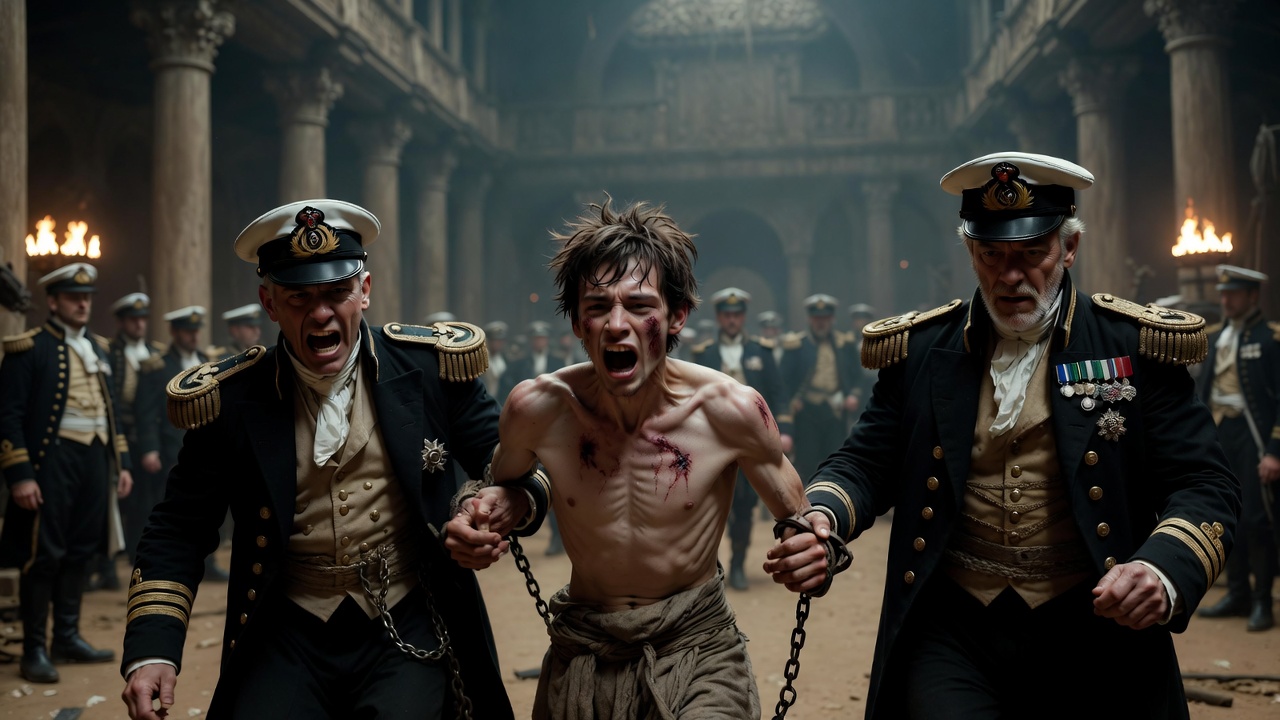
The heavy cedar doors began to open once more, and the clinking of heavy iron chains rattled against the stone floor, signaling the entrance of the man who had tried to feed me to the beasts.