CHAPTER 3
The heavy cedar doors of the grand audience hall slammed shut with a sound that vibrated deep within my bones, sealing the vast chamber off from the rest of the desert kingdom. The noise echoed against the massive sandstone pillars that stretched upward toward the star-painted ceiling, creating an eerie, breathless silence. The dozen elite palace guards wrapped around me tightly, their heavy silver-plated shields forming an impenetrable wall of metal and polished wood. I stood in the dead center of that defensive circle, still shivering, wrapped in the clean white linen cloth that was rapidly soaking through with the foul, muddy water Commander Haremhab had poured over my head.
Every breath I took felt heavy, tasting of the copper from my split lip and the pungent, rotten scent of the livestock pens that still clung to my matted hair. I looked down at my bare feet, watching a small, dark puddle of arena mud slowly expand across the flawless, ice-white stone floor. It felt entirely wrong. I was a creature of the gutters, a nameless boy who had spent twelve years fighting stray dogs for fish heads along the banks of the Nile, yet here I was, standing at the feet of the living god of Egypt.
The Pharaoh remained standing at the base of the royal dais, his magnificent golden robes trailing on the polished stone. The cold, unyielding majesty he had worn like armor out on the arena balcony had completely melted away. His chest heaved beneath his heavy turquoise and gold collar, his hands still trembling as he stared at me. Every few seconds, his eyes would dart from my face down to my left shoulder, where the crimson birthmark—the perfect, unmistakable Eye of Ra—sat exposed and vibrant against my skin.
“My Lord Pharaoh,” the grand vizier whispered, his voice trembling as he stepped forward from the shadows of the pillars. He kept his hands raised in a desperate, pleading gesture, his old eyes darting nervously toward the heavy doors. “We must handle this with extreme caution. The city is full of Haremhab’s veterans. If the rumors spread before we have total control of the palace gates, there will be chaos in the streets. The people believe the prince died twelve winters ago.”
The Pharaoh turned his head slowly toward the old advisor. The vulnerability I had seen in his eyes just moments before instantly vanished, replaced by an icy, terrifying authority that made the vizier instantly step backward and bow his head.
“Let them rumor,” the Pharaoh said, his voice a low, dangerous rumble that filled every corner of the vast hall. “Let the entire kingdom know that the bloodline of the sun is unbroken. For twelve years, I have allowed these corrupt wolves to fatten themselves on the wealth of Egypt while my only son was hunted like a dog in the dirt. That ends today.”
Before the vizier could respond, the heavy cedar doors groaned open once again.
The sound of iron chains rattling against the stone floor cut through the silence like a knife. I tensed, my heart hammering against my ribs as the palace guards parted slightly to allow the newcomers into the hall.
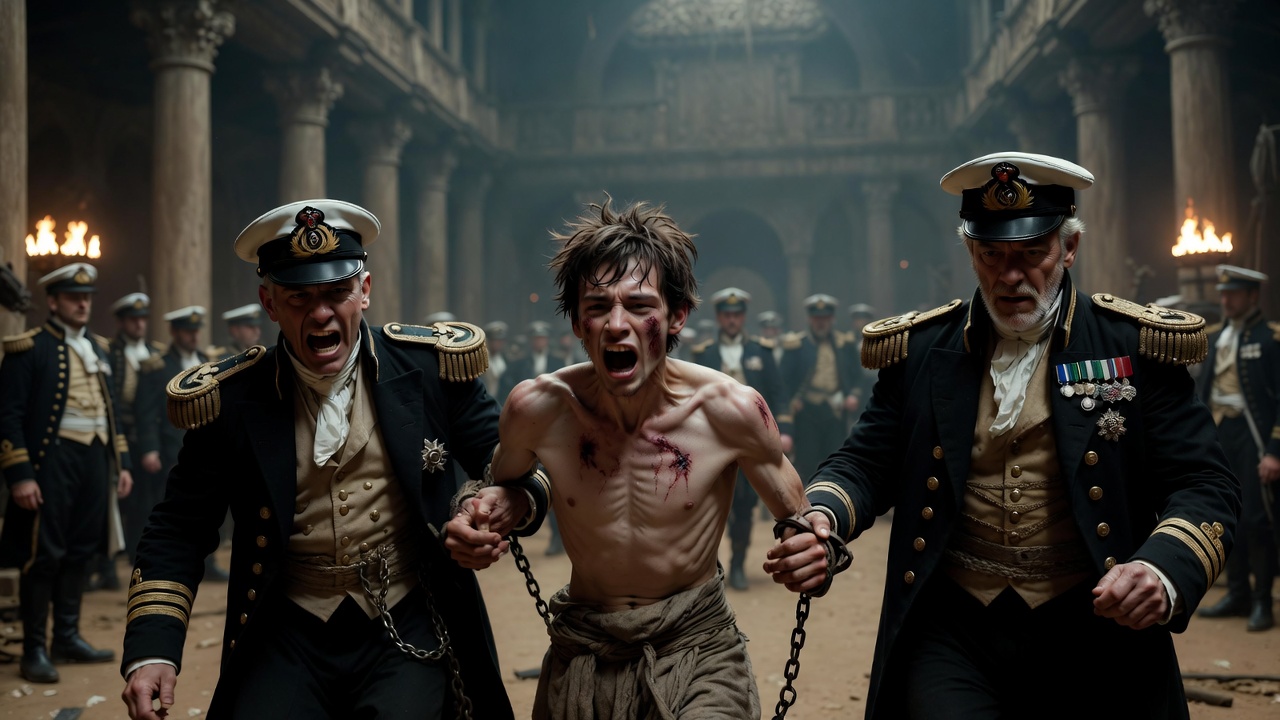
Commander Haremhab marched into the audience hall, flanked by four massive royal executioners. But he was no longer the proud, untouchable military leader who had stood over me in the arena dust. The polished bronze breastplate he wore seemed to heavy for his shoulders, and his hands were bound tightly in front of him with thick, heavy iron links that clanked with every step he took. His face was a mask of calculated defiance, but I could see the sweat glistening on his bald head and the desperate, frantic twitching of his jaw.
Behind him marched the inner council of the vanguards—the high-ranking military officers who had sat in the luxury boxes, laughing and cheering as the dirty water was poured over a helpless child. They were not in chains, but their weapons had been stripped from their belts, and their faces were completely devoid of color. They looked like men marching to their own tombs.
Haremhab stopped ten paces from the dais, his heavy leather sandals scraping loudly against the stone. He did not drop to his knees. He stood tall, his thick chest expanding as he forced himself to look directly into the eyes of the Pharaoh.
“My Lord Pharaoh,” Haremhab barked, his voice loud and echoing, though it lacked the absolute confidence it held in the desert ring. “I have served your crown for twenty seasons. I have bled in the southern sands and brought the heads of foreign kings to your feet. Why am I brought into your private court in chains like a common criminal? What is the meaning of this insult before my officers?”
The Pharaoh did not answer immediately. He walked slowly toward the commander, his golden sandals clicking softly against the floor. The contrast between them was absolute—the Pharaoh, slender, elegant, radiating an ancient, divine authority; and Haremhab, a massive, scarred brute built for slaughter.
When the Pharaoh stopped just three feet from the commander, the air in the room became so thick it was hard to breathe.
“You ask why you are in chains, Haremhab?” the Pharaoh said, his voice dangerously calm. “You, who have commanded my armies and sworn an oath upon the altars of Ra to protect the royal house?”
“I have kept that oath!” Haremhab shouted, his eyes flashing with desperate anger. “I cleared the streets of thieves today! I brought justice to the arena! The boy you protect is a common criminal, a street rat caught stealing from my own estate. If the law of Egypt no longer applies to the poor, then the kingdom is lost to chaos!”
“The law of Egypt,” the Pharaoh repeated, a dark, terrible smile spreading across his lips. “Tell me, Commander… does the law of Egypt allow a military officer to kidnap the infant heir to the throne from the royal nursery, murder his wet nurse, and leave him to rot in the gutters of the lower quarters?”
A suffocating silence fell over the hall. The military officers behind Haremhab gasped, some of them taking a step back as if trying to separate themselves from the man in chains.
Haremhab’s jaw tightened, his skin turning a deep, unnatural shade of purple. “That is an absurd accusation! The prince was stolen by desert raiders twelve years ago! We found their tracks in the sand. We found the blood of the nurse. I personally led the hunt for those raiders for three full moons until their trail disappeared into the western waste! I wept with you, my lord!”
“You did not hunt them,” a small, raspy voice cut through the grand hall.
Everyone turned. The eyes of the Pharaoh, the vizier, the officers, and Haremhab all landed on me. I was still huddled inside the white cloth, my small frame shaking, but the fear that had paralyzed me for hours was suddenly being replaced by something else—a cold, burning memory that had been locked away in the darkest corners of my mind, finally breaking free.
Haremhab glared at me, his teeth bared like a trapped animal. “Silence, you little parasite! Do not dare speak in the presence of the living god!”
“Let him speak,” the Pharaoh roared, his voice shaking the pillars. He stepped back toward me, placing a protective, heavy hand on my trembling shoulder. “Speak, my son. Tell me what you see.”
I looked directly into Haremhab’s eyes. For years, I had dreamed of a recurring nightmare—a massive man with a scarred face standing over a golden cradle, his hands covered in blood, laughing as a tiny baby cried in the dark. I had always thought it was just a trick of my mind, a horror story my brain invented to explain why I was alone in the world. But standing here, looking at the bronze armor and the specific, jagged scar that ran from Haremhab’s ear down to his collarbone, the veil was completely ripped away.
“It wasn’t desert raiders,” I whispered, my voice growing stronger with every word as the memories flooded my mind like the rising Nile. “I remember the smell of myrrh. I remember a woman singing to me. And then I remember the screams. I remember a big man with that exact scar on his neck holding a bloody knife. He didn’t throw me to the raiders. He handed me to an old woman in the slave quarters. He told her to take me to the lower city, to make sure I never learned to read, and to let the hunger kill me slowly so no one would look for a corpse.”
The military officers murmured in horror. The grand vizier crossed his arms over his chest, his eyes wide with shock.
“You lie!” Haremhab bellowed, lunging forward against his chains. The iron links snapped taut with a loud metallic crash as the executioners forcefully pulled him back. “He is a street rat coached by your enemies, Pharaoh! He has heard the stories of the lost prince and uses them to save his skin from the panther! Look at him—he is covered in filth! He is nothing!”
“He carries the blood of the sun, Haremhab,” the Pharaoh said, his voice dropping into a register of absolute certainty. He reached down and firmly gripped my left hand, lifting it high for the entire council to see. “And he carries something else. Something you forgot to check when you ordered your guards to humiliate him in the sand.”
The Pharaoh turned to the grand vizier. “Bring the royal records of the birth. Bring the seal of the firstborn.”
The vizier hurried behind the throne, his silk robes rustling as he scrambled toward the secret archives. A moment later, he returned carrying a small, heavy cedar box lined with dark velvet. Inside the box sat a solid gold medallion, an exact replica of the crimson birthmark on my shoulder, used by the royal scribes to certify the divine lineage on the day of my birth.
The Pharaoh took the golden medallion and walked toward the military officers. He held it up against my shoulder, matching the lines of the gold to the edges of the crimson mark on my skin. They were identical. Every curve of the Eye of Ra, every small indentation of the divine iris, was perfectly mirrored on my flesh.
“This mark cannot be painted,” the Pharaoh said, his voice echoing with absolute authority. “It cannot be faked by a street child. It is the seal of the gods, placed upon my son’s flesh before he ever drew his first breath. And you, Haremhab… you knew it. That is why you tried to feed him to the panther today. You saw the cloth tear in the arena. You saw the mark begin to show, and you tried to open the gates to murder my heir before I could recognize him.”
Haremhab’s calculated defiance finally began to crumble. His breathing became shallow, his eyes darting toward the exits of the hall, evaluating the number of palace guards standing between him and freedom. He knew that the moment he confessed, or the moment the council fully turned against him, his life was forfeit.
“My officers,” Haremhab called out, turning his head toward the men he had commanded for years. “Are you going to stand by and watch your commander be executed based on the word of a beggar boy and an old record? The Pharaoh has grown weak! He has spent twelve years weeping for a dead child while we protected the borders! If you allow this injustice, who will protect you when the crown turns its anger on the army?”
For a second, a tense, terrifying silence filled the room. The military officers looked at each other, their hands twitching near their empty belts. They were men of war, loyal to the general who had led them into battle. If they chose to revolt, the palace would become a slaughterhouse.
But before any officer could make a move, the captain of the palace guards stepped forward, his silver shield catching the torchlight. He drew his heavy bronze khopesh sword with a sharp, ringing sound that echoed through the hall.
“The army is loyal to the Pharaoh,” the captain declared, his voice firm and unyielding. “The army is loyal to the true bloodline of Egypt. Any man who raises his voice in support of a traitor will find his head on a spike before the sun sets over the Nile.”
One by one, the military officers dropped to their knees, bowing their heads toward the throne, completely abandoning their former commander. Haremhab was left standing entirely alone, his chains clanking loudly as his knees finally buckled under the weight of his own treason. He sank into the white stone floor, his broad chest deflating, his eyes staring blankly at the small puddle of muddy water that had dripped from my hair.
The Pharaoh looked down at the broken traitor with a cold, merciless expression.
“You thought you could hide the light of the sun in the dark corners of the lower quarters,” the Pharaoh said softly, the words dripping with venom. “You thought that by covering my son in dirt and livestock water, you could make him invisible. But the very water you used to humiliate him washed away the dust of the streets and revealed his truth to the world.”
The Pharaoh turned to the executioners. “Take him. Strip him of his titles. Strip his family of their lands and their wealth. Tomorrow, at the hour of the noon sun, he will be brought back to the very center of the desert arena. He will stand in the dust, bound to the post, and the entire kingdom will watch as the law of Egypt is executed upon his flesh.”
“No… please, my lord!” Haremhab screamed, his voice cracking into a desperate, pathetic plea as the heavy hands of the executioners grabbed him by his neck, dragging him backward across the stone floor. His iron chains screamed against the white marble, leaving dark, metallic gray streaks behind them. “I served you! I protected the kingdom! Please!”
His screams gradually faded down the long stone corridors as the heavy cedar doors slammed shut behind him, leaving the audience hall in a deep, profound silence once again.
The Pharaoh turned back to me, the icy rage vanishing from his eyes, replaced once more by the soft, tearful warmth of a father. He stepped forward and knelt before me on the wet floor, completely ignoring the mud that stained his royal linen. He took my small, dirty hands in his own, his grip warm and secure.
“The nightmare is over, Amenhotep,” he whispered, his voice trembling with emotion. “You will never have to beg for bread again. You will never have to run from the whips of the guards. Tonight, the entire palace will be purified, and you will take your rightful place at my right hand.”
I looked at him, my heart swelling with a strange, overwhelming feeling of safety that I had never known in my entire life. But as I looked down at my dirty hands wrapped inside his golden grip, I knew that the transition from a street beggar to a prince of Egypt would not be simple. The city was still full of Haremhab’s shadow, and the scars of twelve years of hunger could not be washed away by a single day of justice.
The grand vizier stepped forward, bowing deeply. “My Lord Pharaoh, the priests are assembling at the great altar of Ra. The people are waiting outside the palace gates. They want to see the face of the returned prince.”
The Pharaoh stood up, keeping his hand firmly wrapped around mine. He looked down at me with a proud, defiant smile. “Let them see him. Let them see that the true heir to the throne has returned, not in gold, but in the strength of survival.”
He led me toward the high balcony that overlooked the grand courtyard of the palace, where tens of thousands of Egyptian citizens had gathered, their voices rising in a massive, chaotic sea of sound. My heart raced as the bright sunlight hit my face once again, but this time, I wasn’t entering an execution ring. I was entering my kingdom.
CHAPTER 4
The roar of the crowd outside the grand palace balcony was like a physical wave, shaking the limestone floor beneath my newly sandaled feet. Tens of thousands of voices echoed from the plaza below, their chants rising through the dry desert air like incense. Just yesterday, those same voices had mocked my tears as I stood shivering in the arena dirt, covered in foul, stagnant water. Now, they were shouting the name I had only just learned belonged to me. Prince Amenhotep. The returned light of Egypt.
I stood just behind the massive silk draperies of the balcony, looking down at my hands. They had been scrubbed clean by three different royal servants, the embedded street grime washed away with scented oils of myrrh and sweet almond. My broken fingernails had been trimmed, and my split lip had been treated with a soothing honey balm that tasted of wild desert flowers. Wrapped around my thin shoulders was a cloak of the finest, woven white linen, so light it felt like spiderwebs against my skin, held together at the neck by a heavy gold clasp shaped like a soaring falcon.
But beneath the royal finery, my body still ached. The bruises on my shins from the heavy leather boots of the guards still throbbed. The memory of the freezing desert nights spent hiding in the gutters was still burned into my bones. You cannot wash away twelve years of starvation and survival in a single afternoon, no matter how much gold you drape over a boy’s shoulders.
“Are you afraid, my son?”
The Pharaoh’s voice was soft, devoid of the absolute power he commanded over the rest of the world. He stepped out from the shadowed audience hall, his heavy golden robes swishing against the marble. The striped royal headdress cast a long shadow over his lined face, but his eyes were wide and clear, filled with a deep, protective warmth that I was still trying to understand. For twelve years, I had believed nobody cared if I lived or died. To have the absolute ruler of the kingdom look at me with tears in his eyes was a mountain my mind could not yet climb.
“I am used to hiding in the shadows, my lord,” I whispered, keeping my eyes fixed on the floor. “In the streets, if a crowd shouts your name, it means they are holding stones. It means you ran the wrong way in the market.”
The Pharaoh knelt down before me, completely ignoring the fact that his sacred knees were touching the dust of the balcony edge. He reached out and gently took my hands in his own. His grip was warm, solid, and completely steady.
“You will never have to hide again,” he said, his voice tightening with an ancient, suppressed sorrow. “The wolves who hunted you have been put in cages. The man who tried to erase your existence will face the scales of justice today, before the very people he tried to deceive. Look out there, Amenhotep. That kingdom belongs to your bloodline. They do not hold stones for you. They hold their breath.”
He stood up, keeping his hand wrapped firmly around mine, and pulled back the heavy silk curtains.
The moment we stepped out into the blinding glare of the noon sun, the chaotic noise of the plaza instantly died. A suffocating silence fell over the square, so absolute that you could hear the snapping of the linen banners in the hot wind. Thousands upon thousands of people—merchants in their colorful tunics, laborers covered in grey quarry dust, wealthy nobles in shaded litters, and soldiers holding polished bronze spears—all stared up at the high balcony.
They didn’t see Kem the beggar boy. They saw a child standing at the right hand of the living god, his left shoulder completely exposed to show the perfect, vibrant crimson Eye of Ra birthmark catching the golden sunlight.
“People of Kemet!” the Pharaoh’s voice boomed, amplified by the high stone walls of the courtyard. “For twelve winters, our house has lived in the shadow of a lie! The gods have broken the darkness! The thief of our bloodline has been unmasked, and the true heir to the throne stands before you!”
The crowd erupted. The sound was deafening, a collective shout of joy and disbelief that seemed to shake the very foundations of the city. People fell to their knees, pressing their foreheads into the hot dust of the plaza, weeping openly as they raised their hands toward the balcony. I watched them, my chest tightening with a strange, overwhelming emotion. Just twenty-four hours ago, I would have been beaten for walking too close to their fine clothes. Now, they were worshipping the dirt beneath my feet.
But amidst the celebration, my eyes traveled to the center of the grand plaza, where a massive stone execution platform had been erected overnight.
Standing in the center of that platform, chained to a thick post of dark cedar, was Commander Haremhab.
The powerful military leader had been completely stripped of his bronze chest armor and his golden wristbands. He wore nothing but a tattered, grey loincloth, his massive, muscular chest covered in the grey dust of the square. His bald head was lowered, his thick jaw clenched so hard that the veins in his neck looked like thick ropes. The jagged scar that ran from his ear to his collarbone—the very scar that had haunted my childhood nightmares—was completely visible, a permanent brand of his hidden malice.
Surrounding the platform were the four executioners of the royal court, their faces hidden beneath heavy masks of black linen, holding long, braided leather whips encrusted with sharp pieces of obsidian. Behind them stood the inner council of the vanguards, the very officers who had sat in the arena luxury boxes, laughing as Haremhab poured muddy livestock water over my head. They were forced to stand in the front row, their faces pale with terror, knowing that their own loyalty was being watched by the palace guards.
The Pharaoh looked down at the platform, his expression turning into a mask of pure, unyielding stone. He signaled to the guard captain, who stood at the edge of the balcony holding a heavy bronze trumpet.
The captain blew a single, piercing note that silenced the shouting crowd once more.
“Bring the traitor’s judgment to the scales,” the Pharaoh commanded, his voice cutting through the heat like a bronze blade.
Two palace guards marched onto the execution platform, carrying a large, heavy clay jar. It was the exact same type of jar Haremhab had used in the desert arena. Inside it was the foulest, darkest water from the camel pens near the city gates, thick with mud and animal waste.
The crowd watched in absolute silence as the guards lifted the heavy jar. Haremhab didn’t move. He kept his eyes fixed on the wood of the post, his teeth bared in a silent expression of hatred and defeat.
With a sudden, violent movement, the guards poured the filthy, stagnant water directly over Haremhab’s head.
The dark mud drenched his face, filling his nose and his mouth, sliding down his massive shoulders and staining his grey skin with the stench of the gutters. The crowd did not laugh this time. The silence was far more terrifying than mockery. It was the silence of complete, absolute justice. The great commander who had ruled the desert vanguards with an iron fist was now covered in the very filth he had used to humiliate an orphan.
The Pharaoh looked down at the broken general, his hand tightening around mine.
“Haremhab,” the Pharaoh called out, his voice echoing over the silent thousands. “You spent twelve years trying to bury the light of the sun in the mud of the streets. You believed that by stripping a child of his name, his clothes, and his dignity, you could make him disappear. But the gods of Egypt do not sleep in the dark.”
Haremhab slowly lifted his head, the muddy water dripping from his eyes, his gaze locking onto mine with a final, desperate flash of defiance. But he couldn’t speak. The weight of his own treason, witnessed by the entire kingdom he had tried to control, had completely broken his power.
“For the crime of high treason, for the murder of the royal nursery guards, and for the attempted assassination of the prince of Egypt,” the Pharaoh announced, his voice rising to a crescendo that filled the entire plaza, “your name is hereby erased from the monuments of this land. Your wealth is given to the poor quarters you created, and your body will be cast into the desert wastes where the jackals will tear your memory from the earth.”
The Pharaoh turned to the executioners and gave a single, sharp nod.
The heavy leather whips cracked through the air with a sound like thunder. The crowd did not turn away. They watched as the scales of justice balanced, the final screams of the traitor echoing out toward the distant, red cliffs of the desert kingdom.
I stood at the edge of the balcony, the warm desert wind catching my white linen cloak. The fear that had lived inside my chest for twelve long years finally dissolved, carried away on the breeze like the dust of the arena sand. I looked up at the endless blue sky, then down at the thousands of people who were looking to me for their future.
I was no longer Kem the beggar boy, running from the whips in the dark. I was Prince Amenhotep, the returned son of the Nile, and the kingdom that had witnessed my greatest humiliation would now witness the rise of a ruler who would never forget what it felt like to be a child of the dirt.