CHAPTER 3
The sound of the high priests’ leather sandals faded into the echoing depths of the grand corridor, leaving the Great Hall trapped in a heavy, suffocating silence. Nobody moved. Nobody breathed. The air felt thick, charged with an electric tension that made my skin prickle.
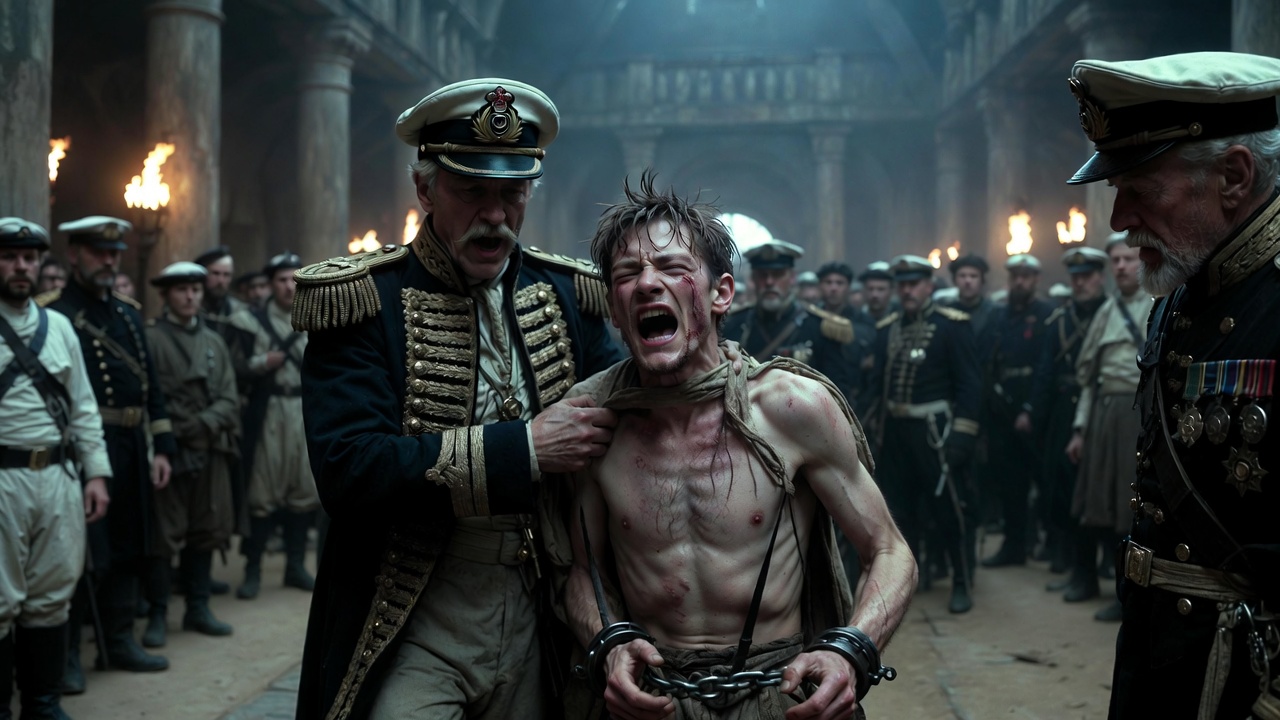
I remained on the cold stone floor, my body trembling so violently that my teeth clicked together. The cool limestone offered no comfort to my battered ribs, but the physical pain from Lord Setau’s heavy boot was nothing compared to the sheer, blinding confusion screaming through my mind.
I looked down at my left shoulder. The dirt and dried blood had been partially smeared away by my frantic movements, exposing the deep crimson birthmark. To me, it had always been a curse. It was the reason the children in the riverside slums threw rocks at me. It was the reason shopkeepers chased me away from their stalls, calling me an omen of bad luck, a marked gutter rat. The blind woman who had raised me in that collapsing mud hut had spent her final days weeping over this mark, wrapping my shoulders in thick, rotting rags even in the blistering heat of the summer sun.
“Keep it covered, Hori,” she had whispered with her dying breath, her sightless eyes staring into the dark ceiling. “If the eyes of the palace find the mark of the sun, the shadows will swallow you whole.”
I had never understood her warning. I had thought she was just an old, senile woman lost in her own fears. But now, looking at the High Pharaoh—the absolute ruler of Upper and Lower Egypt, a man considered a living god by millions—I realized her words were a shield.
The Pharaoh remained standing at the base of his grand granite dais. He had not picked up his golden crook. His gaze was anchored to me, his chest rising and falling in rapid, uneven breaths. The tears that had traced paths through the ceremonial oils on his aged face had dried, leaving faint, glistening streaks under the flickering light of the bronze torches. The cold, detached monarch who had looked ready to sign my death warrant just minutes ago had completely vanished. In his place stood a broken man, staring at a ghost.
Lord Setau stepped forward, his heavy gold bracelets clinking like chains. The sweat was pouring down his thick neck, soaking into the collar of his fine white linen robes. He was a powerful man, a master of intimidation who had spent decades crushing tax evaders and rebellious peasants under his heel. He was not used to losing control, and the desperation in his eyes was turning into something deeply dangerous.
“Your Divinity,” Setau began, his voice taking on a forced, smooth rhythm as he tried to recapture the room. “I beg you to step back from this filth. The heat of the midday sun must be affecting your royal sight. This boy is a recognized thief from the eastern docks. My guards have watched him for weeks. He bears a mark, yes, but it is nothing more than a deformed blemish—a sign of diseased blood, common among the lower classes who breed in the mud of the Nile.”
The Pharaoh did not look at him. He didn’t even blink. “Silence, Setau.”
“But Sire!” Setau pressed, taking a reckless step closer, his hands gesturing wildly toward the court. “Think of the court! Think of the empire’s dignity! If the nobles see the Living God kneeling before a parasite, it will invite weakness. Allow my men to drag him to the courtyard. I will personally ensure his tongue is removed so he can no longer speak these blasphemous lies in your presence.”
Hearing those words, a primal terror gripped me. I knew what happened to beggars who displeased noble lords. They disappeared into the deep stone quarries, or their bodies were thrown into the Nile to feed the crocodiles. I dragged myself backward on my hands and knees, my split lip burning as I looked up at the Pharaoh.
“I didn’t lie!” I cried out, my voice cracking, raw and desperate. “I don’t know who I am! I only wanted bread! I never asked for this mark!”
“Bring your spears to bear,” Setau hissed to his personal guards, completely ignoring the Pharaoh’s previous warning. He was trying to force a swift execution before the priests returned. “End the thief now!”
The two personal guards, torn between the command of their immediate master and the silent fury of the Pharaoh, hesitated for a fraction of a second. But Setau’s wrath was a daily threat. They stepped forward, raising their heavy bronze spears, the sharp metal tips aimed directly at my throat.
“Touch him,” the Pharaoh whispered, his voice dangerously low, “and your entire bloodline will be erased from the temple walls before the moon rises.”
The guards froze instantly, their faces turning a ghostly white. They dropped the tips of their spears, their knees shaking as they looked at the ruler of Egypt.
Before Setau could speak another word, the heavy cedar side doors of the throne hall groaned open. The two high priests returned, their heads bowed, walking with a solemn, heavy pace. Between them, they carried a small, rectangular chest made of dark cedar wood, reinforced with bands of tarnished black bronze. It was covered in a thick layer of grey dust, looking as though it hadn’t seen the light of day in a generation.
The court of nobles let out a low, collective murmur. The older courtiers in the back rows shifted uncomfortably, their eyes widening as they recognized the chest. It was the lost registry of the Western Palace—the private sanctuary of the Pharaoh’s late wife, Queen Nefert, which had been sealed twenty years ago after a night of fire and blood that the empire had tried to forget.
The priests placed the chest on a low limestone table at the foot of the throne. One of them, an old man with a completely shaven head and deep-set, intelligent eyes, stepped toward the Pharaoh, holding a small silver key in his trembling fingers.
“The seal remains unbroken, Your Divinity,” the priest murmured, his voice echoing in the dead silence of the hall. “Just as you ordered on the night the stars wept.”
The Pharaoh stepped toward the table. His hand shook so violently he could barely insert the key into the ancient bronze lock. With a sharp, metallic click, the lock gave way. The Pharaoh lifted the heavy cedar lid, releasing a scent of dried lotus flowers and ancient papyrus that immediately filled the front rows of the court.
He did not pull out gold or jewels. He reached inside and pulled out a single, heavily rolled scroll tied with a faded golden cord. Beside it, he lifted a heavy bronze mirror, its reflective surface polished to a pristine, flawless sheen.
The Pharaoh turned toward me, his face a mask of agonizing anticipation. “Bring the boy closer.”
Setau tried to step in the way, his face drenched in sweat. “Sire, please—”
“Stand back, traitor!” the Pharaoh roared, his voice finally breaking with the full force of his royal authority. He pointed a trembling finger at Setau. “If you speak one more word before the truth is read, I will have you thrown into the copper mines in chains!”
Setau choked on his own breath, his mouth hanging open, his arrogance completely collapsing into a state of paralyzed terror. He took five steps back, his eyes darting toward the exits of the hall, but the royal palace guards had already subtly shifted their positions, blocking every doorway with their heavy shields.
Two senior palace guards—men wearing the royal cobra crest of the Pharaoh’s personal guard—stepped toward me. They didn’t drag me. They didn’t kick me. They placed their hands gently under my arms and lifted me to my feet, guiding my trembling legs until I stood directly in front of the limestone table, just inches away from the ruler of Egypt.
The Pharaoh looked down at the scroll in his hand. With a slow, deliberate movement, he untied the golden cord and unrolled the brittle papyrus.
“Twenty years ago,” the Pharaoh began, his voice carrying a deep, resonant sorrow that gripped every heart in the room, “the Western Palace was attacked by desert bandits in the dead of night. My beloved queen was murdered in her bed. And my only son, the infant Prince Amenemhat, the rightful heir to the double crown of Egypt, was stolen from his cradle.”
A gasp ran through the crowd of nobles. Many of the younger courtiers had only heard rumors of the lost prince, a tragedy whispered about in the dark corners of the city, but to hear the Pharaoh speak of it openly was a historical shock.
“The bandits were captured and executed,” the Pharaoh continued, his eyes scanning the ancient text written by his own royal scribes. “But the child was never found. The commander of the guards reported that the infant had been thrown into the Nile, his body consumed by the river. We mourned. We carved his name into the stones of remembrance. But before my queen died, she performed a sacred ritual at the altar of Ra.”
The Pharaoh lifted the heavy bronze mirror, holding it up before my face.
“She prayed to the sun god to protect her child, marking his left shoulder with the sacred oil of the Eye of Horus, burning it into his flesh with a heated bronze stylus so that no matter where he went, no matter who hid him, the blood of the gods could never be denied.”
The Pharaoh lowered the mirror, pointing it toward my exposed left shoulder.
“Look into the mirror, Hori,” the Pharaoh commanded softly.
I looked into the polished bronze surface. My reflection was a mess of dirt, sweat, and dark red blood from my split lip. But as I looked closer at the crimson mark on my shoulder, I noticed something I had never seen before. Under the harsh, direct light of the palace torches, the star-shaped birthmark wasn’t just a random shape. Within the crimson pigment, the skin had scarred in a series of tiny, perfect geometric lines—the unmistakable, complex hieroglyphic signature of the royal house of the First Dynasty.
It was a mark that could never be counterfeited. It was a scar that could only be made by the sacred tools of the high priests during a royal birth ceremony.
The old high priest stepped forward, leaning close to my shoulder. He pulled a small magnifying crystal from his robes, examining the mark for three long, agonizing seconds. The entire throne hall held its collective breath. You could hear a feather drop onto the stone floor.
The priest dropped the crystal, his eyes filling with a profound, religious awe. He immediately fell to his knees, pressing his forehead completely against the dusty floor at my feet.
“He lives,” the priest wept, his voice echoing to the high rafters. “The Nile did not take him. The gods have brought him home. Behold the lost son of Egypt! Behold Prince Amenemhat!”
The throne hall erupted into utter chaos. Nobles gasped, women cried out, and courtiers fell to their knees in a massive, rolling wave of shock and reverence. The very people who had been laughing at my bleeding face just moments ago were now bowing their heads to the dirt, terrified of the royal blood that ran through my veins.
I stood there, completely numb, the world spinning around me. I wasn’t Hori the beggar. I wasn’t a street rat. I was the heir to the entire empire.
I looked over at Lord Setau. The powerful noble lord looked as if he had been struck by lightning. His face was a sickly, pale green, his mouth opening and closing like a fish pulled from the water. But as I looked at his terrified face, a strange memory suddenly flashed in the back of my mind—a memory of fire, of a screaming woman, and of a heavy gold ring with a black scarab stone pressing down on my infant chest.
I looked at Setau’s right hand. There, glittering in the torchlight, was the exact same black scarab ring.
The realization hit me like a physical blow. Setau wasn’t just a cruel lord who had found me stealing bread today. He was the one who had orchestrated the raid twenty years ago. He was the one who had tried to erase my entire life.
Tension filled my chest, turning my fear into a cold, burning desire for total justice. I looked up at the Pharaoh, my father, and prepared to speak the words that would destroy the monster standing before us.
CHAPTER 4
The roar of the crowd slowly subsided as the Pharaoh raised his hand, his eyes never leaving mine. The silence that followed was heavy, pregnant with a terrifying anticipation. Every eye in the grand hall was fixed on us—the old king and the beggar prince, reunited by a twist of fate that felt entirely orchestrated by the gods themselves.
“My son,” the Pharaoh whispered, his voice trembling as he stepped forward, closing the final distance between us. He reached out, his powerful, ringed hands gently cupping my dirty, bruised face. He didn’t care about the mud. He didn’t care about the blood. He wiped a tear from my cheek with his thumb, his own eyes brimming with a lifetime of accumulated grief finally washing away. “For twenty years, I believed the light of my life had been extinguished. I believed the river had taken you. Tell me, child… how did you survive the shadows?”
I looked into my father’s eyes, the warmth in his gaze giving me a strength I had never possessed in all my years of begging on the streets. The fear that had kept me small and silent for twelve years burned away, replaced by a cold, unwavering clarity.
I turned my head slowly, my eyes locking onto Lord Setau. The noble lord was trying to blend into the shadows of the massive pillars, his wealthy allies pulling away from him as if he were a leper.
“I survived because a kind woman hid me, father,” I said, my voice echoing clearly through the silent hall, no longer the whisper of a frightened child, but the steady declaration of a prince. “But I now know why she hid me. She wasn’t hiding me from the law. She was hiding me from him.”
I lifted my arm, my dirty, trembling finger pointing directly at Lord Setau’s chest.
Setau stumbled backward, his hands flying to his throat. “Lies! Your Divinity, the boy is delusional! He is trying to frame me to cover his own crimes! I am a loyal servant of the throne! I have collected your taxes for twenty years!”
“You have collected the blood of my family for twenty years,” I countered, stepping toward him, the royal guards moving with me, forming a wall of bronze shields that hemmed Setau in. “When I was lying on the floor, with your boot pressing into my spine, I looked at your hand. I saw the black scarab ring on your finger.”
The Pharaoh’s expression hardened, his eyes narrowing into cold slits as he turned his gaze toward his tax collector. “What of the ring, my son?”
“When I was a small child,” I said, memories unlocking in my mind like a floodgate bursting open, “the blind woman who raised me had nightmares every night. She used to talk in her sleep about the night the Western Palace burned. She was a servant there. She saw the man who led the bandits into the queen’s bedchamber. She managed to snatch me from the cradle and run into the darkness, but before she escaped, the leader of the assassins grabbed her, trying to tear me from her arms. His hand pressed into my chest, and this ring—this exact black scarab ring—left a deep bruise on my ribs.”
I pulled back the remaining rags of my tunic, exposing my chest. There, faint but unmistakable, was a small, circular indentation near my breastbone, a permanent mark left by a heavy, violent pressure on my infant bones.
“She told me that the man who wore that ring had a voice like a roaring lion, and smelled of expensive myrrh and heavy oils,” I continued, my voice growing louder, filling every corner of the vast hall. “The same smell that filled my lungs when you kicked me into the dirt today, Lord Setau. You didn’t find me stealing bread by accident. You recognized me in the streets weeks ago, didn’t you? You knew the blind woman had died, and you wanted to use a false accusation of theft to have me executed publicly, to ensure the true heir would never be revealed!”
The crowd of nobles erupted into a storm of furious whispers. The betrayal was monstrous. A trusted member of the royal court, a man who had sat at the Pharaoh’s right hand, was the architect of the greatest tragedy in the empire’s history.
Setau looked around the room, his eyes wild and desperate, searching for a single ally among the faces of the nobles he had dined with for years. But he found only cold, disgusted stares. His power was gone. His wealth meant nothing. He was a trapped animal, stripped of his golden armor.
“Guards,” the Pharaoh commanded, his voice vibrating with a terrifying, absolute authority that made the very stones of the hall seem to tremble. “Strip him of his titles. Strip him of his gold. Seize his estates, his lands, and his servants. Everything he owns now belongs to the prince he tried to murder.”
Four massive royal guards stepped forward, their bronze swords drawn, the sharp edges catching the torchlight. They converged on Setau like hunting jackals. With brutal, efficient movements, they ripped the heavy gold collars from his neck, tearing his fine white linen robes until he was left standing in nothing but a plain, unadorned tunic—looking just as small and desperate as I had looked only an hour before.
They forced him to his knees, slamming his face down onto the very same limestone floor where my blood still glistened in the dust.
Setau wept, his tears mixing with the grime of the floor as he looked up at me, begging for his life. “Mercy, Prince Amenemhat! Mercy! I only did what I thought was necessary for the stability of the kingdom! Spare my life, I beg of you!”
I looked down at the man who had struck me across the face, the man who had ordered me to be thrown to the beasts for the empire’s twisted amusement. I felt no hatred. I felt no rage. I only felt a deep, profound sense of justice that had been delayed for two decades.
“You showed no mercy to my mother, the queen,” I said coldly, looking down at his trembling form. “You showed no mercy to a starving child in the streets. You will face the same judgment you prepared for me. Guards, take him to the desert arena. Let him face the beasts he so eagerly wished to see consume my flesh.”
The guards dragged Setau out of the hall, his screams of terror fading down the long stone corridors until they were completely swallowed by the desert wind.
The Pharaoh turned back to me, a radiant smile breaking through his tears. He reached into his robes and pulled out a heavy, gleaming gold chain, suspending a magnificent gold scarab pendant—the ancient symbol of rebirth and royal sovereignty. With slow, reverent movements, he placed it around my neck, the heavy metal resting firmly against my chest, covering the old scars of my past.
The entire court of Egypt fell to their knees once more, a sea of white linen and bowed heads, their voices rising in a single, thunderous chant that echoed across the Nile.
“Long live Prince Amenemhat! Long live the savior of the dynasty!”
I stood beside my father, looking out over the grand kingdom that was now my birthright. The days of hunger, of fear, and of hiding in the dark alleys were gone forever. The truth had risen like the morning sun over the desert dunes, proving that no matter how deep the shadows are cast, the blood of a true king can never be hidden in the dust.