CHAPTER 3
The great iron gates of the palace courtyard ground open with a heavy, scraping screech that seemed to echo the groan of my own broken body. The afternoon sun had passed its peak, casting long, monstrous shadows across the white limestone slabs of the royal grounds.
I was carried in the arms of the High Pharaoh himself. He did not let the royal guards touch me. He did not let the temple priests approach me. His large, calloused hands—hands that had held the absolute power of Egypt for three decades—were trembling against my torn, bloody linen shirt.
Behind us, a massive procession of hundreds of wealthy nobles, high-ranking scribes, and jewel-encrusted court officials followed in a state of absolute, breathless shock. The arrogant murmurs that had filled the Great Throne Hall only minutes ago had vanished, replaced by a suffocating, terrified silence.
Right beside the Pharaoh walked the High Queen. Her royal dignity, usually so cold and unyielding, had completely shattered. She held my small, dirty hand against her wet cheek, her tears washing away the gray river mud and dried blood that coated my knuckles.
“Stay strong, my beautiful boy,” she whispered, her voice cracking with an agonizing mixture of fierce love and desperate terror. “The gods have brought you back from the jaws of the Nile. They will not take you from me again. Hold on. Your mother is here.”
I looked up at her through swollen, heavy eyelids. The word mother felt strange and heavy in my mind. For twelve years, that word had belonged to only one person—the fragile, pale woman who was currently burning with river fever in a dark, collapsing mud hut near the Western docks.
“The huts…” I managed to choke out, my throat raw and dry from the dust and the choking grip of Captain Haremhab. “We have to… hurry. The fever is eating her alive. She starved herself… so I could live. Please…”
The Pharaoh’s chest heaved as he let out a low, growling breath. He tightened his grip around my shoulders, his eyes turning toward the front of the procession.
“Move faster!” the Pharaoh roared, his voice striking the courtyard like a thunderclap.
At the front of the march, surrounded by twenty elite royal guards with drawn bronze spears, was Captain Haremhab. The proud, chest-swelling military commander who had dragged me by my hair across the marketplace was now completely unrecognizable. His face was the color of sour milk. His heavy bronze chestpiece, which had seemed so imposing when he was crushing my hand beneath his sandal, now rattled loudly with every shaking step he took.
Two guards held his arms pinned behind his back, forcing him to walk forward. He was no longer a judge; he was a prisoner walking toward his own execution.
“Where are the mud huts, Haremhab?” the Pharaoh demanded, his voice dropping to a dangerous, icy vibration that made the surrounding guards stiffen. “If we do not reach the woman who raised my son before her breath fails, I will not wait for a formal trial. I will skin you alive before the gates of Anubis.”
Haremhab stumbled, his knees nearly buckling beneath him. “To… to the western canal, my divine Pharaoh,” he stammered, his arrogant voice reduced to a pathetic whimper. “Behind the old grain storehouses… where the river silt accumulates. The poorest district.”
The procession moved through the grand limestone arches of the palace and plunged into the crowded, narrow streets of the lower city. The contrast was immediate and striking. The clean, scented air of the royal court was replaced by the thick, heavy stench of rotting fish, stagnant canal water, and burning dung fires.
As the royal procession marched into the slums, the thousands of poor laborers, dockworkers, and beggars who lined the dirt roads fell to their knees in absolute terror. They had never seen the Pharaoh walk among them. They had never seen the High Queen step into the filth of the river district.
“Look,” a blind old beggar whispered from the side of a mud wall, pointing a shaking finger toward us. “The god-king carries a child of the dirt.”
“That is the boy from the market!” a fruit vendor gasped, recognizing my torn rags. “The one Haremhab dragged away for stealing a fig!”
I kept my eyes fixed on the twisting, narrow alleyways. The shadows were growing longer, and a cold desert breeze was beginning to blow across the Nile, stirring up clouds of gray dust. My heart was pounding with a terrifying realization. Haremhab had known exactly where I lived. He had mentioned the mud huts before I ever told the court where my mother was hidden.
How did a high-ranking palace captain know the exact location of a starving beggar woman’s home in a city of a hundred thousand people?
The truth began to unravel as we turned a sharp corner into the deepest, darkest section of the western canal. The huts here were made of nothing but dried river mud and rotten reeds, leaning against each other like broken teeth.
“There,” I whispered, pointing my small, shaking finger toward a tiny, crumbling structure at the very end of the ditch. The roof had partially caved in, and the wooden door frame was warped and rotting from the moisture of the canal.
The Pharaoh stopped. He looked down at the filthy, degrading conditions of the place where his firstborn son, the heir to the greatest empire on earth, had spent the last twelve years of his life. A deep, agonizing veins of anger pulsed in his temple.
“Secure the perimeter!” the Pharaoh ordered the guards. “Let no one enter or leave.”
The Pharaoh carried me through the low, narrow doorway of the hut, with the Queen following closely behind. The air inside was thick, hot, and smelled of sickness and old straw.
On a single, threadbare reed mat in the corner of the dark room lay my mother.
Her skin was ash-gray, covered in a thick layer of cold sweat. Her breathing was shallow, a harsh, rattling sound that filled the small space. Her eyes were closed, her hollow cheeks showing how many days she had gone without a single bite of bread.
“Mother!” I cried out, twisting out of the Pharaoh’s arms. I fell to my knees beside her mat, my own pain forgotten. I grabbed her thin, burning hand, pressing it against my face. “Mother, wake up! I brought help! I didn’t get the fig, but the Pharaoh is here! The royal physicians can save you!”
The old woman’s eyelids fluttered open slowly. Her vision was cloudy with the final stages of the river fever, but as her eyes focused on my face, a soft, beautiful smile broke through her cracked lips.
“My… my sweet boy,” she whispered, her voice barely louder than the rustle of dry straw. “You came back… I was so afraid they had taken you… like they took your father.”
The Queen stepped forward, her golden jewelry clinking softly in the dark hut. She looked down at the dying woman who had hidden her son for more than a decade. There was no anger in the Queen’s face—only a profound, aching curiosity.
“Who are you?” the Queen asked softly, kneeling down into the dirt of the floor, her expensive robes dragging in the dust. “Why did you take my baby from the royal nursery twelve years ago? Why did you let the kingdom believe he was dead?”
The dying woman’s eyes drifted past me, landing on the golden headdress of the Pharaoh and the beautiful face of the Queen. She did not look surprised. She did not scream in terror. Instead, a single tear ran down her sweating temple, cutting a clean path through the gray dust on her skin.
“I did not… take him to hurt him, my Queen,” my mother whispered, her chest rising with a painful, ragged gasp. “I took him… to save his life.”
The Pharaoh stepped closer, his heavy shadow blocking out the remaining light from the doorway. “What do you mean, woman? My son was guarded by forty elite soldiers. The nursery was a fortress. Who slaughtered my guards? Who ordered the murder of the prince?”
My mother reached out, her trembling fingers moving toward a loose, hollow mud brick in the wall beside her bed. She didn’t have the strength to pull it out. I knew exactly what she was looking for. It was the old wooden box she had forbidden me from ever touching since I was a little child.
I reached into the gap, pulled out the small, dust-covered cedar box, and placed it into her shaking hands.
With her last remaining strength, she pushed the lid open. Inside, resting on a bed of old, faded linen, was not stolen gold or jewels. It was a heavy bronze medallion, carved with the official seal of the Royal Guard Command, and a rolled piece of ancient papyrus sealed with dark red wax.
The Pharaoh’s eyes widened as he recognized the medallion. He snatched it from the box, holding it up to the faint light of the doorway.
“This is the commander’s seal,” the Pharaoh whispered, his voice shaking with absolute fury. “This belonged to Lord Menes… the man I appointed to protect the royal lineage. He died in the attack twelve years ago. We found his body burned beyond recognition.”
“No, my Pharaoh,” my mother breathed, her voice growing weaker, her grip on my hand tightening with a desperate intensity. “Lord Menes did not die protecting the prince. Lord Menes was the one who planned the murder. He was paid by someone inside your own inner council to eliminate the heir, so the secondary bloodline could inherit the throne.”
A collective gasp came from the high-ranking scribes standing just outside the doorway. The betrayal went far deeper than anyone had ever imagined.
“My husband was a simple palace blacksmith,” my mother continued, her breath shallow. “He found Lord Menes in the middle of the night, carrying the royal baby toward the river to drown him. My husband fought him. He killed the corrupt commander to save the child, but he was mortally wounded in the struggle. Before he died, he brought the baby home to me. He told me to hide the prince… because the man who paid for the murder was still sitting inside the Pharaoh’s court.”
The Queen covered her mouth, her tears spilling over her fingers. “Who?” she begged, leaning over the bed. “Who paid to have my baby killed?”
My mother’s eyes began to roll back into her head as the darkness of death started to claim her. She pointed a single, trembling finger toward the open doorway of the hut, where the crowd of nobles stood waiting in the dirt.
“The papyrus…” she whispered, her voice fading to a ghost of a sound. “The contract is in the box… signed with the seal of the man who now commands your army… the man who tried to kill the boy today… Captain… Haremhab.”
The silence that followed was absolute. It was a silence more terrifying than the roar of a battlefield.
I looked down at my mother. Her hand suddenly went completely limp in mine. Her chest fell, and the final, soft breath of life escaped her lips. The woman who had given up everything to keep me safe, who had hidden the prince of Egypt in a mud hut to protect him from the vipers of the court, was gone.
“Mother!” I screamed, throwing my body over her chest, sobbing uncontrollably. “No! Please, don’t leave me! Come back!”
The Pharaoh stood up slowly. The sorrow of losing the woman who saved his son was instantly eclipsed by a volcanic, world-shattering rage. He reached down and picked up the rolled papyrus from the cedar box. He broke the red wax seal with his thumb and unrolled the scroll.
His eyes scanned the ancient ink. His jaw clenched so tightly that a drop of blood appeared where his teeth cut into his lip.
“Haremhab,” the Pharaoh whispered, his voice carrying the weight of a death sentence.
The Pharaoh turned and strode out of the dark hut, the scroll gripped tightly in his fist. The Queen gently lifted me from my mother’s body, holding me against her chest as she followed her husband out into the blinding afternoon light of the slums.
Outside, the entire royal court was waiting. Captain Haremhab stood in the center of the guard ring, his eyes darting frantically toward the alleyways, looking for any possible escape. When he saw the Pharaoh emerge with the unrolled papyrus in his hand, his legs completely gave out. He collapsed into the gray mud of the canal ditch, his bronze armor splashing in the filth.
“My divine Pharaoh,” Haremhab cried out, his voice high and pathetic, his hands raised in a desperate plea. “It is a lie! A conspiracy by a crazy beggar woman to save her thieving son! I am a loyal servant of the throne! I have led your armies! I have protected your borders!”
The Pharaoh did not stop until he was standing directly over the kneeling commander. He threw the papyrus scroll down into the mud, right in front of Haremhab’s face.
“Your own seal is upon the parchment, traitor,” the Pharaoh said, his voice echoing across the entire river district. Every noble, every slave, and every poor laborer held their breath. “Twelve years ago, you took gold from the enemies of the crown to murder an innocent baby in his crib. And today, by the hand of fate, you dragged that same child back into my palace to have him killed before my very eyes.”
The crowd of nobles began to roar with outrage. The same people who had laughed at me in the throne hall were now screaming for Haremhab’s blood. The betrayal was too massive, too sickening to ignore.
“Guards!” the Pharaoh commanded, his hand pointing toward the heavy bronze spears of the royal line. “Strip him of his armor. Strip him of his titles. Chain him like a wild beast.”
“No! Please!” Haremhab screamed as two massive guards stepped forward and violently ripped the golden chestpiece from his torso, tearing his fine linen tunic to shreds. His weapons were cast into the dirt, and heavy iron collars were slammed around his thick neck.
“We are not finished here,” the Pharaoh said, looking down at the broken, shivering traitor with cold, unforgiving eyes. “The boy you called a street rat, the child you threw into the dust, is the Crown Prince of the Two Lands. You will face your final judgment exactly where your crimes began—before the entire kingdom, at the rising of the sun.”
The cliffhanger was set, the dark truth had been dragged into the light, but the ultimate act of justice was yet to come.
CHAPTER 4
The morning sun rose over the eastern cliffs of the Nile like a shield of liquid gold, burning away the thick mist that clung to the surface of the sacred river.
The Great Desert Arena, located just outside the towering walls of the palace, was packed with a sea of humanity. Never in the history of Egypt had such a crowd gathered. More than fifty thousand people—from the wealthiest noble lords in their white silk robes to the poorest dockworkers from the western canal—filled the limestone tiers that looked down onto the massive sand pit below.
At the center of the arena stood a raised stone platform, surrounded by fires of burning myrrh. High above the arena floor sat the grand royal pavilion.
I sat upon a small golden seat right between the High Pharaoh and the High Queen. The tattered, dirty linen rags I had worn for twelve years were gone. I was now dressed in a royal kilt of woven gold thread, a heavy collar of lapis lazuli and turquoise resting against my shoulders. My hair had been washed and scented with rare oils, and the silver falcon birthmark on my left heel was now fully visible, gleaming brightly under the morning sun for the entire kingdom to see.
Yet, despite the luxury, my heart felt heavy and hollow. The image of my mother’s pale face in that dark mud hut was burned into my mind. The wealth of the entire empire could not bring her back, but today, her sacrifice would be honored in front of the world.
A deep, rolling beat of a hundred war drums began to vibrate through the stone floor of the arena. The crowd went completely silent as the heavy bronze gates at the northern end of the pit slowly ground open.
Four royal guards marched out, dragging a heavy iron cage behind them.
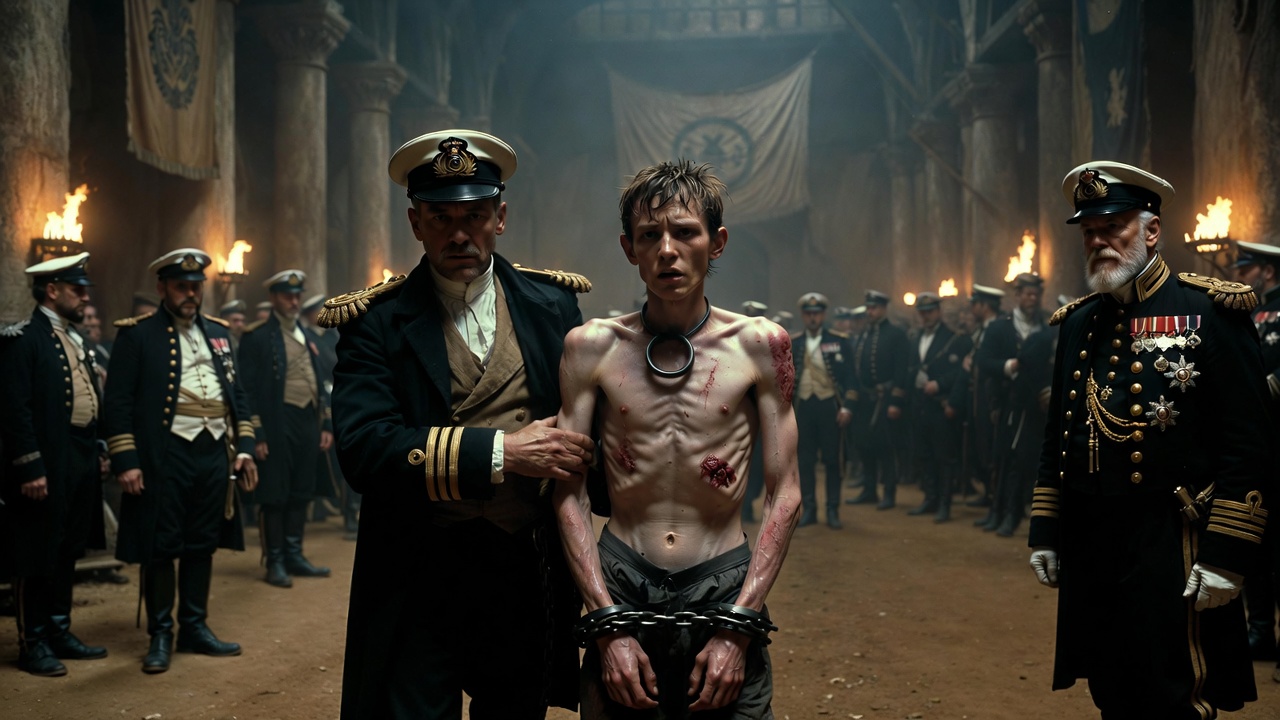
Inside the cage was Captain Haremhab. His hands were bound behind his back with thick leather ropes, and his body was covered in nothing but a simple, unrefined slave kilt. The arrogance that had once defined his every movement had been completely erased. His head was bowed, his face hollow and gaunt from a night spent in the deep, dark pits beneath the palace.
The crowd erupted into a deafening roar of anger.
“Traitor!”
“Child murderer!”
“Look at the great captain now! He is nothing but a snake in the dirt!”
The guards forced Haremhab out of the cage and dragged him up the stone steps of the central platform. They shoved him down onto his knees, forcing his face into the hot, coarse sand.
The Pharaoh stood up from his high throne, stepping to the edge of the royal pavilion. He held the golden flail of judgment in his right hand. The entire arena fell so quiet that the distant cry of a desert falcon could be heard high above the clouds.
“People of Egypt!” the Pharaoh’s voice boomed, amplified by the high stone walls of the arena. “Twelve years ago, a dark shadow fell upon our house. The crown prince was stolen, and our kingdom was left without an heir. For twelve years, we wept. For twelve years, we believed the gods had abandoned us.”
The Pharaoh reached down and took my hand, pulling me up to stand beside him. The crowd gasped, many dropping to their knees in the stone stands.
“But the gods do not sleep,” the Pharaoh continued, his voice ringing with a fierce, royal pride. “The child you see before you is Prince Amun, my firstborn son, resurrected from the dead by the hands of fate. He was hidden in the poorest slums, raised by a woman of pure heart who sacrificed her own life to protect him from the vipers who sought his blood.”
A massive cheer broke out from the lower tiers where the poor dockworkers sat. They wept with joy, seeing one of their own—the boy who had shared their hunger—revealed as the future ruler of the land.
“And now,” the Pharaoh’s voice turned dangerously low, his eyes locking onto the shivering form of Haremhab below, “we deal with the viper.”
The Pharaoh turned to me. “My son. The law of Egypt states that the victim of a royal treason holds the power of final judgment. This man dragged you into the dust. He crushed your hand. He tried to have you thrown to the beasts to cover his ancient crimes. Step forward and pronounce his fate.”
The entire arena turned their eyes toward me. Fifty thousand people waited for a twelve-year-old boy to speak the words of life or death.
I walked slowly to the edge of the pavilion, looking down at the man who had caused so much terror in my life. Haremhab slowly lifted his head. His eyes met mine, and for the first time, I did not see anger or malice in them—I saw only a pathetic, begging fear. The great commander was entirely at my mercy.
I looked down at my hand, which still bore a faint purple bruise where his heavy sandal had crushed it in the market square. I remembered the fig he had smashed into the dirt while my mother lay dying of hunger.
“Captain Haremhab,” my voice echoed through the silence of the arena, surprisingly steady, carrying the authority of the bloodline that flowed through my veins. “You believed that because I was poor, I was powerless. You believed that because my mother lived in a mud hut, her life had no value. You used your bronze armor and your golden titles to terrorize the weak and protect your own dark secrets.”
Haremhab began to weep, his shoulders shaking as he pressed his forehead against the stone platform. “Have… have mercy, my Prince,” he whispered, his voice carrying up to the pavilion. “I was weak… I was greedy… please…”
“You showed no mercy to the newborn baby you tried to drown,” I replied, my voice hardening with the memory of my mother’s final words. “You showed no mercy to the woman who starved so I could live. You showed no mercy to me when I begged for a single piece of fruit to save her life.”
I turned toward the Pharaoh, then back to the crowd.
“The law demands blood for treason,” I announced loudly. “But a quick death under the bronze axe is too merciful for a man who built his entire life on a mountain of lies and cruelty.”
The crowd leaned forward, listening intently.
“I decree that Captain Haremhab be stripped of his name forever,” I said, my voice rising with absolute authority. “His lands, his gold, and his grand palace will be seized by the crown. Every single piece of his wealth will be distributed to the poor dockworkers and laborers of the western canal—the same people he treated like dirt beneath his feet.”
A thunderous cheer erupted from the stands, the poor citizens screaming my name in a frenzy of pure joy.
“As for his life,” I continued, looking down at the broken traitor, “he will not die today. Instead, he will be chained to the great stone quarries of the southern desert. He will spend the rest of his days working in the blinding heat, pulling the heavy stones of the empire under the lash of the same whips he used against the innocent. He will live out his life as a nameless slave, knowing that the empire he tried to steal is now ruled by the boy he threw into the dust.”
Haremhab let out a pathetic, broken sob, his confidence completely shattered as the royal guards stepped forward and grabbed his chains, dragging him backward down the stone steps. The crowd jeered and threw dirt at him as he was led away, a broken shell of a man who would never see the light of freedom again.
The Pharaoh placed his heavy hand on my shoulder, a deep look of respect and love in his eyes. He knew, and the entire kingdom knew, that a true ruler had just been born—not because of the gold on his chest, but because of the justice in his heart.
The Queen pulled me into a tight embrace, her tears warm against my neck. I looked past her, out toward the winding ribbon of the Nile River that stretched into the endless desert horizon.
The dark hut was empty now, and the woman who had loved me was resting in the sacred tombs of the ancestors, honored for eternity as a savior of the kingdom. I was no longer the starving boy of the docks, but as I looked out over the vast empire that would one day be mine, I knew I would never forget the taste of the dust or the price that was paid to bring the lost prince home.