CHAPTER 3
The blade of Lord Setau’s bronze dagger caught the torchlight, flashing like a strike of lightning in the darkened throne hall. A collective scream tore through the royal court as the noblemen and elite merchants scrambled backward, knocking over cedar chairs and silver wine chalices.
“Die, you royal bastard!” Setau’s voice was completely crazed, the veins in his neck bulging like thick ropes as he lunged forward, aimed directly at my chest.
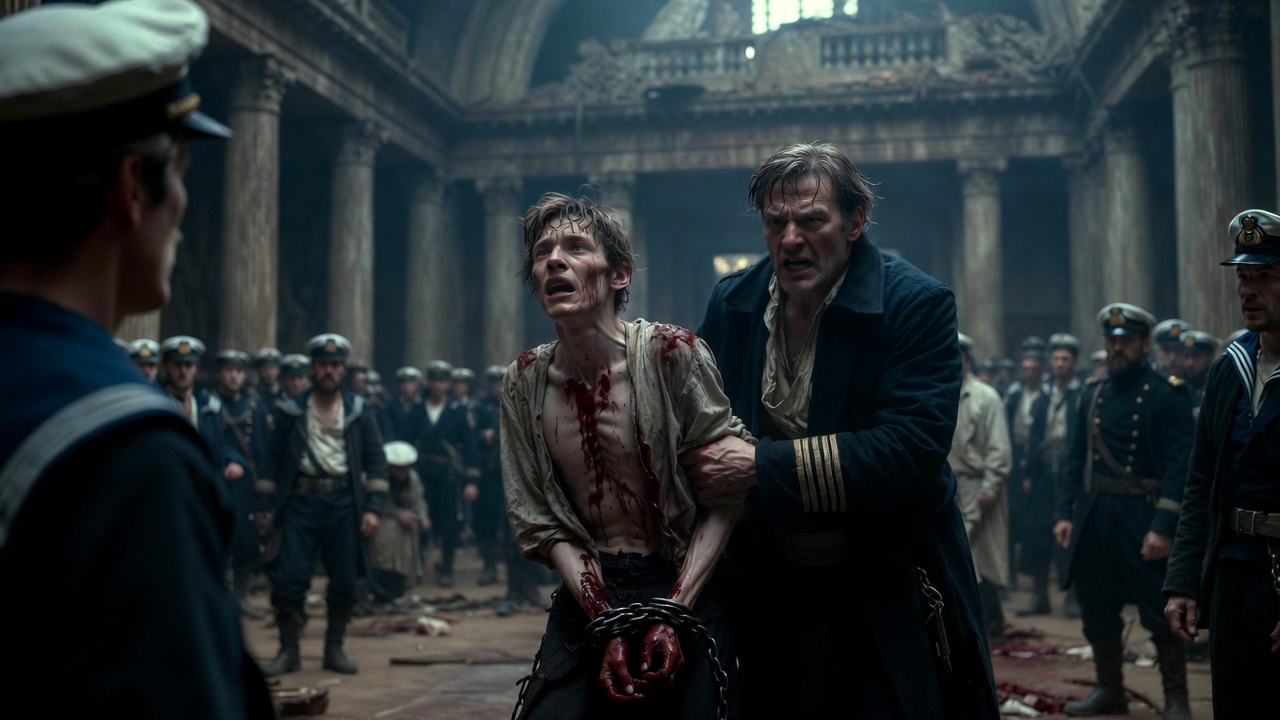
I froze. My small, starved body was too weak to move, too heavy from the weight of my iron chains. I closed my eyes, bracing for the cold bite of the bronze blade. After years of beatings in the limestone quarries, I thought this was finally the end. I thought the gods had only brought me out of the dirt just to watch me die on golden floors.
But the blow never came.
A resounding, bone-crushing crack echoed across the stone platform. I opened my eyes to see the High Pharaoh himself standing directly in front of me. He hadn’t just shielded me; he had moved with the terrifying speed of a seasoned desert warrior. With his bare left hand, the Pharaoh had caught Setau’s wrist mid-air, stopping the blade inches from my throat. With his right hand, the Pharaoh struck the noble lord across the face with a force that sent Setau flying backward, spinning across the polished floor until he crashed heavily against the base of a massive stone pillar.
The dagger clattered away, sliding across the stone until it rested near my bleeding feet.
“Guards!” the Pharaoh’s voice bellowed, shaking the very foundations of the palace. It wasn’t the voice of a grieving old man anymore. It was the roar of a supreme ruler who had just found his long-lost bloodline. “Seize him! If he so much as breathes toward the boy again, flay him where he stands!”
Within a fraction of a second, a dozen heavy palace guards in thick bronze chestplates swarmed Lord Setau. They pinned him to the floor, forcing his face deep into the dust he had just forced mine into. Setau kicked and screamed, his expensive white linen robes tearing against the stone, his perfect oiled wig falling off to reveal his balding, sweaty head beneath.
“This is madness!” Setau shrieked, his voice muffled by the floor. “Your Majesty, I am your loyal servant! I have served the treasury for twenty years! You are destroying a noble house for a lying, thieving slave who found a golden ring in the dirt!”
The Pharaoh did not answer him. He slowly turned back around to look at me, his breathing heavy, his chest heaving beneath his magnificent jeweled pectoral necklace. The cold, distant ruler who had sat silently behind a golden death mask all afternoon was completely gone.
He fell back to his knees in front of me, entirely unbothered by the fact that the blood from my torn feet was staining the hem of his sacred royal robes.
“The name,” the Pharaoh whispered, his voice trembling as he reached out and gently took both of my dirty, calloused hands into his own. “The name you just whispered into my ear… speak it once more, child. Let the whole of Egypt hear the truth that has been buried in the dark for fourteen agonizing years.”
I looked around the massive hall. Hundreds of wealthy eyes were locked onto me. The same people who had been laughing, cheering, and demanding that I be thrown into the sand-serpent pit just minutes ago were now completely breathless, leaning forward in a silence so deep you could hear the flickering of the oil lamps.
I swallowed the blood in my mouth, took a deep breath, and spoke. My voice was small, but in that silent hall, it echoed like thunder.
“The old woman called me Prince Neferure,” I said, my voice growing stronger with each syllable. “She told me I was the first-born son of the Great House of Egypt. She told me that on the night the stars aligned with the peak of the great pyramid, a wicked man paid the palace servants to steal me from my golden cradle, hoping to erase my mother’s bloodline from the face of the earth.”
A massive, unified gasp rippled through the crowd. Several older nobles dropped to their knees, their faces turning completely pale.
Fourteen years ago, the entire kingdom had gone into deep mourning. The infant prince, the sole heir to the throne, had vanished from the royal nursery in the middle of the night. The palace guards had searched every village along the Nile, every caravan camp in the eastern desert, and every hidden tomb in the Valley of the Kings. The Queen had died of a broken heart only two winters later, believing her only child had been slaughtered by bandits or dragged into the river by crocodiles.
The Pharaoh’s eyes welled with tears that finally spilled over his wrinkled cheeks. He looked down at my left shoulder, where the water had cleared away the quarry grime to fully expose the flawless birthmark—the Eye of Horus, surrounded by the three distinct moles.
“It is him,” the Pharaoh cried out, his voice cracking with a mixture of overwhelming sorrow and explosive joy. He looked up at the high ceiling, raising his arms to the heavens. “The gods have brought my boy back from the dead! The blood of the sun god flows through his veins!”
The Pharaoh pulled me into a fierce embrace, holding me so tightly against his chest that I could hear the rapid, erratic pounding of his heart. For the first time in my entire life, I felt safe. For the first time, I didn’t feel the burning sting of the overseer’s whip or the cold terror of starvation. I was wrapped in the arms of a father.
But as the Pharaoh held me, the warmth of the moment was suddenly shattered by a bitter, mocking laugh from the floor.
“A birthmark?” Lord Setau spat, lifting his bloody face from the stone as the guards held him down. He glared at me with pure venom, realizing he had nothing left to lose. “A birthmark and a story told by a dead slave woman? That is your proof, Your Majesty? The boy is a clever rat! He grew up in my slave quarters. He probably overheard the old gossips talking about the lost prince and decided to use it to save his pathetic skin from the serpents!”
Setau looked out at the crowd of nobles, trying to rally them to his side. “Are we to hand the crown of Egypt to a quarry beggar because of a mark on his skin? Anyone could have branded him with that mark! Anyone could have fabricated this lie!”
The nobles began to murmur among themselves, the tension in the room shifting once again. Setau was a powerful man with deep financial ties to half the merchants in the court. They wanted to believe him. They wanted to believe that I was just a slave, because the alternative meant that a royal prince had been treated like garbage under their very noses.
The Pharaoh slowly let go of me and stood up. The vulnerability of a grieving father vanished, replaced instantly by the absolute majesty of a supreme judge. He looked down at Setau with a cold smile that made my blood run cold.
“You speak of proof, Setau?” the Pharaoh said, his voice dangerously smooth. “You speak of fabrications? You claim you bought this boy from a southern slave trader fourteen years ago. You claim you have the receipts, the legal documents of ownership.”
“Yes!” Setau hissed, thinking he had found a loophole. “I have the scrolls in my private study! Signed by the merchants of Kush! The boy is legally my property!”
“Then tell me, Lord Setau,” the Pharaoh continued, stepping closer to the pinned nobleman, “if you bought him from a foreign trader, how is it that he knows the secret royal lullaby of my household? How is it that he knows the hidden name that was only whispered between myself and my late Queen within the stone walls of our private bedchamber?”
Setau froze. The color drained from his face so fast he looked like a limestone statue.
“You see, Setau,” the Pharaoh whispered, leaning down until his face was inches from the noble’s terrified eyes. “When my son was born, the high priests warned us that there were vipers within our own court who wished him dead. To ensure we could always recognize him, the Queen and I did not give him his public name immediately. We gave him a secret name. A name known only to three people in the entire world: myself, my wife, and the royal nurse who carried him away into the night to save his life when your assassins breached the palace gates.”
The Pharaoh turned to the high priest standing near the altar of Ra. “Bring the sacred sealed scroll from the iron chest beneath the altar. The scroll that was written on the exact day of my son’s birth, sealed with my own blood, containing his true, secret name.”
The high priest bowed deeply and hurried away, his sandals clicking rapidly against the stone.
The entire throne hall was frozen in terror. Nobody moved. Nobody breathed. Lord Setau began to tremble violently beneath the heavy hands of the guards. He looked at the grand golden doors of the hall, realizing that his grand web of lies was being torn apart piece by piece.
A few minutes later, the high priest returned, holding a small, ancient clay cylinder wrapped in a faded purple silk cloth. He broke the heavy wax seal in front of the entire assembly, carefully pulling out a piece of dark, aged papyrus.
The Pharaoh took the scroll, but he didn’t look at it. He kept his eyes locked firmly on Lord Setau.
“Scribe,” the Pharaoh commanded. “Read the name written upon this sacred scroll. Read the name of the true heir of Egypt.”
The royal scribe stepped forward, his eyes wide as he looked at the ancient ink. He cleared his throat, his voice shaking as he read the holy words aloud to the crowded court.
“Before the gods of the Nile, the first-born son of the Sun is named… Prince Neferure, the Hidden Light of Thebes.”
The crowd erupted into a deafening roar of shock and disbelief. The nobles fell to their knees one after another, bowing their heads until their foreheads touched the cold stone floor. The very name I had carried in the dark slave quarters, the name the old woman had whispered to me while hiding me from the overseers, was written in the royal blood-scroll of the Pharaoh.
The Pharaoh looked down at me, his eyes filled with absolute pride. “You are my son. You are the rightful king of this land.”
He then looked down at Lord Setau, whose face was now soaked in tears of pure panic. The powerful noble lord began to crawl forward, trying to grab the edge of the Pharaoh’s robes, his voice cracking into a desperate, pathetic whine.
“Mercy, Your Majesty! Mercy! I did not know! I swear by the gods, I did not know who the boy was! I was deceived by the slave traders! I am innocent!”
“Innocent?” I suddenly spoke up, my voice cutting through his pathetic begging. I stepped forward, my iron chains rattling loudly against the floor. I stood right over the man who had starved me, beaten me, and tried to throw me to the serpents.
“You knew exactly who I was, Lord Setau,” I said, looking down at him with an intensity that made him flinch. “Because every time you walked past the limestone quarries, every time you saw me bleeding in the sun, you didn’t just walk past. You stopped your chariot. You looked at my face, and you told the overseers to give me the heaviest stones, the hardest work, and the smallest rations. You didn’t want me to just be a slave. You wanted me to die in the dirt so I could never stand in this hall.”
The Pharaoh’s face darkened into a mask of pure, unadulterated fury. The air in the room grew heavy, suffocatingly hot, as if the wrath of the desert itself had entered the palace.
“You kept my son in chains,” the Pharaoh whispered, his voice vibrating with a rage that terrified everyone present. “You made him a beggar in his own kingdom. You whipped the blood of the gods onto the quarry stones.”
The Pharaoh raised his hand, pointing a single, trembling finger toward the massive stone platform outside, where the execution pit waited.
“Lord Setau,” the Pharaoh announced, his voice booming across the kingdom. “You brought this boy here today to be judged before the eyes of Egypt. You wanted the people to watch an innocent child be destroyed for your amusement. And so, before these very same witnesses, your judgment shall be executed.”
Setau screamed, trying to pull away from the guards, but their grip was like iron.
“No! Please! Not the pit! Anything but the pit!” Setau shrieked, his voice echoing off the high stone walls as the guards began to drag him backward toward the grand golden doors.
“Do not throw him into the pit yet,” the Pharaoh commanded coldly, stopping the guards mid-step.
Setau let out a sigh of relief, thinking he had been spared. But the Pharaoh’s next words turned his relief into an absolute nightmare.
“The pit is too quick a death for a man who stole fourteen years of my son’s life,” the Pharaoh declared, his eyes burning like hot coals. “Before he is cast to the sand-serpents, he will feel every single ounce of pain he inflicted upon my flesh and blood. Stripped of his titles, stripped of his wealth, stripped of his garments. He will be bound to the high pillars of the courtyard, and he will be flayed alive in front of the very people he sought to impress.”
CHAPTER 4
The bright, blinding glare of the afternoon sun hit my eyes as I walked out onto the grand palace balcony, supported by the strong, steady arm of my father, the Pharaoh.
The courtyard below was completely packed. Thousands of citizens, from the wealthiest nobles to the poorest field workers, had gathered around the massive stone platform. The rumors had spread through the streets of Thebes like a wildfire on a dry wind: the lost prince had returned, and the most powerful noble lord in the treasury was about to face the ultimate wrath of the throne.
At the center of the courtyard, where I had been kneeling in chains just an hour ago, stood the high wooden execution pillars.
Lord Setau was bound tightly to them, his arms stretched high above his head, secured by heavy leather ropes. His magnificent bleached linen robes had been violently ripped from his body, leaving him naked from the waist up. His expensive gold necklaces, his lapis lazuli rings, and his oiled wig had been stripped away, thrown into the dirt at his feet. Without his wealth and titles, he looked remarkably small, pale, and pathetic—nothing more than a terrified old man shivering in the desert heat.
The crowd didn’t cheer for him now. The same elite merchants who had smiled at his cruel jokes were now staring down at the floor, terrified that any association with Setau would bring the Pharaoh’s wrath down upon their own houses.
Beside the pillars stood the chief executioner of the palace, a massive man with a dark linen cloth covering his face, holding a heavy, multi-tailed leather whip embedded with sharp pieces of bronze and obsidian. It was the exact same type of whip the quarry overseers had used on my back for years.
The Pharaoh stepped to the edge of the balcony, his golden pectoral jewelry catching the sun, casting brilliant flashes of light across the crowd. He held his hand high, and a complete, deathly silence fell over the thousands of people below.
“People of Egypt!” the Pharaoh’s voice boomed, carrying across the stone walls with absolute authority. “Behold the man who dared to strike the bloodline of the sun. Behold the traitor who stole your prince, who turned the heir to the throne into a quarry slave, and who lied before the gods to protect his stolen wealth!”
Setau lifted his head, his face covered in tears and sweat, staring up at the balcony where I stood. “Prince Neferure!” he screamed, his voice cracking with a desperate, pathetic plea. “Mercy! I beg of you! Speak for me! Have mercy on an old servant!”
I looked down at him from the high balcony. I felt the smooth, luxurious silk of my new royal garments against my skin. The heavy iron chains had been cut from my ankles, replaced by golden bands. The dust had been washed from my hair, and my wounds had been treated with the finest soothing oils of the temple.
I looked at his terrified eyes, remembering all the times I had begged him for a single drop of water in the hot sun of the quarries, only for him to laugh and spill it into the sand in front of me. I remembered the nights I spent crying in the dark slave quarters, my back bleeding into the dirty straw, wondering what I had done to deserve such a cruel life.
I stepped forward, leaving the shadow of my father, and looked directly down at my former master.
“You ask for mercy, Lord Setau?” my voice rang out, clear and steady, filled with the dignity of a king. “When I was starving in your fields, you gave me rocks. When I cried out from the sting of your whip, you gave me more lashes. You showed no mercy to a helpless child. And today, the gods of Egypt shall show no mercy to you.”
I turned my gaze to the chief executioner and gave a slight, firm nod.
“Let the judgment begin,” I commanded.
The executioner stepped forward, his massive muscles tensing as he raised the heavy leather whip high into the air. With a deafening crack that echoed off the temple walls, the whip brought the full weight of royal justice down upon Lord Setau’s back.
A blood-curdling shriek of pure agony tore from Setau’s throat, a sound so loud and horrific that several noblewomen in the front rows turned their faces away in terror. The sharp bronze pieces sliced through his soft, pampered skin, instantly drawing dark, heavy lines of blood that ran down his back, staining the white stone platform below.
“One!” the royal scribe called out from the side, recording the punishment on a long papyrus scroll.
Setau sagged against the ropes, his breathing ragged, but the executioner didn’t hesitate. The whip rose again, cutting through the hot desert air with a terrifying hiss before striking his flesh once more.
“Two!” the scribe shouted.
Another scream ripped from the fallen noble lord, his knees buckling beneath him as he hung completely from his wrists. The crowd watched in absolute awe. They were witnessing the total demolition of a man who had thought he was completely untouchable, a man who believed his wealth made him a god among men.
The lashes continued, one after another, a steady, rhythmic crack of justice that washed away years of pain and humiliation from my soul. With every strike of the whip, I felt the heavy burden of my past lifting from my shoulders. The nameless slave boy who had been dragged into this courtyard in chains was truly dead. In his place stood a prince, hardened by the fires of adversity, ready to rule with a heart that understood the true meaning of suffering.
By the time the twentieth lash landed, Setau was barely conscious, his back a bloody, shredded ruin, his voice reduced to a faint, pathetic whimper. The executioner stepped back, lowering the bloody whip into the dust.
The Pharaoh stepped back to my side, his hand resting heavily on my shoulder. He looked down at the bleeding, broken body of the traitor with utter coldness.
“Cut him down,” the Pharaoh ordered the guards.
The guards sliced through the leather ropes, and Setau collapsed face-first into the dirt, rolling over weakly, his chest heaving as he stared up at the clear blue sky. He was broken, destroyed, and completely stripped of everything he had ever valued.
“Now,” the Pharaoh continued, his voice echoing with absolute finality, “fulfill his own desire. Cast him into the execution pit where he wished to destroy my son.”
The giant guards grabbed Setau by his bloody arms, dragging his limp body across the platform toward the massive, circular opening of the sand-serpent pit. Setau tried to scream, tried to claw at the stone floors with his fingernails, but he had no strength left.
They dragged him to the very edge, the exact spot where he had stood over me with an arrogant sneer just an hour ago. The crowd held their breath, leaning forward as the guards lifted his body high into the air.
With a powerful heave, they threw Lord Setau over the edge.
A long, fading scream echoed from the darkness of the pit, followed by a heavy, muffled thud as his body hit the shifting desert sand below. For a few seconds, there was absolute silence. Then, the sound of the sand shifting began to hiss through the courtyard. The massive, golden-scaled sand-serpents, disturbed by the sudden arrival of flesh, began to slide out from their hidden stone tunnels, their venomous fangs glistening in the shadows.
Another horrific shriek tore from the depths of the pit, followed by the thrashing of heavy coils against the sand. The crowd gasped, a wave of terror washing through the bleachers as the final, agonizing sounds of Setau’s life were cut short by the venom of the sacred beasts.
The traitor was gone. Justice had been delivered in the exact same place where the injustice had been planned.
The Pharaoh turned to face the thousands of people packed into the courtyard. He took my right hand and raised it high into the air, the golden bands on our wrists flashing brightly in the magnificent sunlight.
“Behold your prince!” the Pharaoh shouted to the heavens, his voice filled with an overwhelming emotion that brought tears to the eyes of the thousands of common workers watching from below. “The Hidden Light has returned to the Nile! Egypt is whole once more!”
The entire courtyard erupted into a deafening, thunderous roar of cheers and applause that shook the very pillars of the palace. The poor field workers, the bricklayers, and the stonecutters cheered the loudest, knowing that the boy who had suffered alongside them in the dirt was now the man who would one day hold the ultimate power of the land.
I looked out at the massive sea of people, my eyes brimming with warm tears as the heavy, comforting arm of my father pulled me close. I had entered this courtyard as a starving, nameless slave boy, shivering at the edge of a horrific death, but I left it standing tall as a royal prince, wrapped in the eternal love of a father and the absolute justice of the gods.