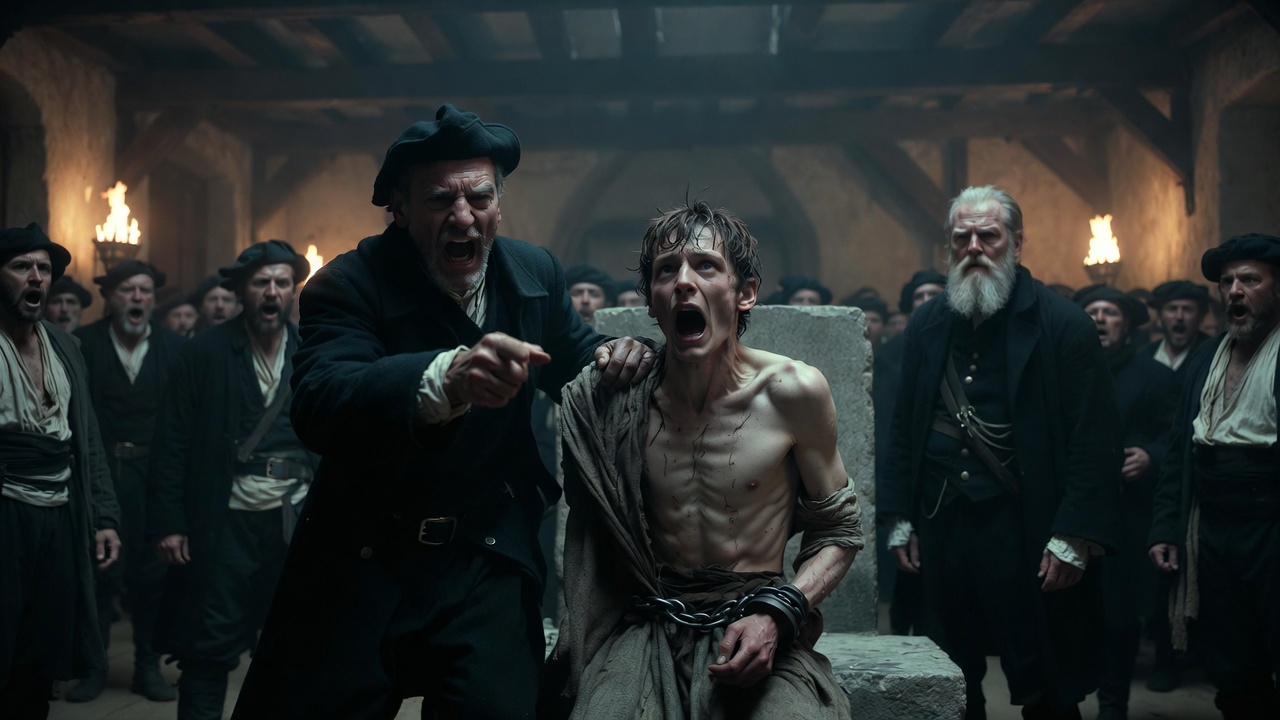
The midday sun was burning hot against the white stone walls of the grand desert arena, but my body was shaking from pure terror. I was just a fourteen-year-old boy, wearing nothing but torn, dusty rags, standing completely alone on the scorching sand.
Around me, thousands of rich nobles, royal guards, and wealthy merchants laughed and cheered from their shaded stone benches. They hadn’t come to see a fair fight. They had come to see me die.
Right in front of me stood Commander Horemheb, the most powerful and ruthless arena master in the entire Egyptian empire. He was a massive man with shoulders like stone, wearing heavy bronze armor and a golden cape that flowed in the desert wind. He looked down at me with pure disgust in his eyes.
“Look at this pathetic sewer rat,” Horemheb shouted, his voice echoing across the massive stadium. “He thought he could steal from the temple offerings! He thought a worthless orphan could disrespect the gods and survive!”
“I didn’t steal anything!” I cried out, my voice cracking with emotion. Tears streamed down my dusty cheeks, leaving clean streaks on my skin. “The bread was thrown in the trash! I was only trying to feed my dying mother!”
The crowd laughed louder. To them, my pain was a joke. My poverty was a crime.
Horemheb took a slow step forward. Without warning, he raised his heavy, calloused hand and struck me hard across the face. The force of the blow sent me spinning into the dirt. The copper-flavored taste of blood instantly filled my mouth.
“Silence, thief!” Horemheb sneered, kicking sand into my eyes. “Your mother is a beggar, and you are a curse upon the Nile. Today, your blood will wash these sands clean.”
High above us, sitting under a massive canopy of purple silk, was the High Pharaoh himself. He sat quietly on his golden throne, his face hidden behind a gleaming ceremonial mask. He looked like an unmoving god, detached from the suffering of a common peasant boy.
Horemheb turned toward the royal box, bowing low. “My Great Lord! Let us see if this little rat can outrun the hunger of the desert leopards! Open the iron gates!”
The heavy chains began to rattle. A dark, terrifying growl echoed from the deep stone tunnel beneath the stadium. I tried to push myself up from the burning ground, but my arms were shaking too badly.
But as I struggled to stand, my oversized linen tunic ripped completely open at the collar, slipping down past my left arm. The bright, harsh sunlight hit my bare shoulder.
Suddenly, the air in the arena changed.
The Pharaoh, who had been sitting completely still for hours, abruptly leaned forward. He gripped the golden arms of his throne so tightly that his knuckles turned white. He stared down at me, his eyes locked onto my exposed skin.
He didn’t look at my face. He didn’t look at my tears. He was staring at a deep, distinct scar on my upper shoulder—a scar shaped perfectly like the sacred eye of Horus, surrounded by three royal sun rays.
“Stop!” a voice roared.
It wasn’t a guard. It wasn’t the commander. It was the Pharaoh himself.
The entire stadium went completely dead silent. The heavy iron gates stopped moving. Horemheb froze, his hand still resting on the hilt of his bronze sword. He looked up at the royal box in complete confusion.
The Great Pharaoh stood up from his golden throne, his long white robes rustling in the sudden quiet. He pointed his golden scepter directly at me, his voice trembling with an emotion nobody had ever heard from the ruler of Egypt before.
“Bring that boy before me,” the Pharaoh commanded. “Now!”
I know you’re curious about what happens next—Read the full story in the comments.
CHAPTER 1
The dust of the arena floor tasted like copper and old bone. I lay there in the blinding heat, my cheek pressed against the burning sand, listening to the roar of ten thousand people who wanted to see my life come to an end. To them, I was nothing. I was Kamose, the boy from the mud-brick alleys near the docks of the Nile. I was the boy who gathered the rotten figs that dropped from the merchant carts. I was the boy whose mother lay coughing up dark blood on a mat of dried reeds in a room that smelled of damp earth and slow death.
“Get up, you little parasite,” Commander Horemheb growled. His shadow fell over me like a heavy stone slab. He was wearing his full ceremonial armor—bronze plates that had been polished with oil until they caught the sun and threw sharp, blinding needles of light into my eyes. His kilt was made of the finest pleated white linen, bordered with gold thread that had been stolen, no doubt, from the taxes of the southern villages. He looked down at me not as a man looks at a child, but as a farmer looks at a beetle beneath his sandal.
“I didn’t steal it,” I whispered, though the words were thick in my throat. My tongue felt like a piece of dry leather. “The priests had already cleared the tables of offering. The bread was being tossed into the river for the fish. It was hard as rock, Lord. It was green with mold on the edges. I only took the pieces the birds were pecking at.”
Horemheb laughed. It was a loud, booming sound that traveled up the stone tiers of the stadium, drawing a chorus of cruel chuckles from the tax collectors and minor nobles who sat in the low-tier seats, dripping with cheap perfumes to hide the smell of their own sweat.
“Listen to the little beggar,” Horemheb shouted, turning his back on me to face the crowd. He raised his massive arms, his bronze wrist-guards catching the light. “He speaks of the offerings of the Great God Amun-Ra as if they were common refuse! He admits his fingers touched the sacred bread! He stands before the laws of Egypt and confesses to his own impiety!”
“Please,” I gasped, trying to pull myself up onto my knees. The skin on my shins was scraped raw from being dragged through the stone corridors beneath the arena. “My mother… she hasn’t spoken since the river rose two moons ago. Her chest rattles like dry beans in a gourd. If I do not bring her water mixed with a little flour, she will not see the sunset. Let me go back to her. Beat me here, cut my back with the rods, but let me go back to the alley. She has no one else.”
Horemheb didn’t turn around. He simply reached down with one massive, calloused hand, caught the collar of my rough, home-spun linen tunic, and hoisted me off the ground as if I were a slaughtered lamb. He held me out toward the crowd, letting them see my skinny legs dangling in the hot air, my ribcage showing clearly beneath my skin like the wooden slats of an old basket.
“This is the rot that grows in the corners of our glorious city!” the Commander roared, his breath hot and smelling of sour wine and roasted meat. “While our soldiers bleed on the borders of the eastern deserts, while our farmers labor under the eye of the scribes to fill the granaries of the Pharaoh, these river-rats breed in the mud and steal the very breath from the temples! The law is clear, people of Thebes! A hand that steals from the gods must be severed, or the body must be given to the beasts that guard the gates of the underworld!”
The crowd screamed their approval. They didn’t care about the law; they cared about the show. The sun was high, the beer was flowing from the large clay jars being carried around by the arena slaves, and they wanted to see blood darken the white limestone dust.
I looked up past Horemheb’s brutal face, past the rows of screaming spectators, toward the high pavilion at the northern end of the arena. There, beneath a massive canopy of deep purple silk held up by four gilded pillars shaped like lotus stalks, sat the court of the High Pharaoh.
The Pharaoh himself, Menes the Second, sat perfectly still upon his throne of dark cedar and hammered gold. He wore the double crown of the Upper and Lower Kingdoms, a massive weight of white and red that made him look rigid, like a statue carved out of the mountain cliff itself. His face was covered by a thin veil of translucent white linen, a traditional custom when the sovereign sat in judgment outside the temple walls, so that the common people would not be blinded by the divine light of his countenance. To his right sat his wife, the Queen Meritamen, her fingers heavy with turquoise and lapis lazuli rings, slowly waving a fan of ostrich feathers to cool her painted neck. To his left sat the High Priest of Amun, an old man with a shaved head that gleamed like a polished skull in the sun, his leopard-skin cloak draped across his thin shoulders.
They seemed miles away. They seemed like gods who lived in a world where hunger was just a word written by a scribe on a piece of old papyrus. They did not know the sound a stomach makes when it has known nothing but river water for three days.
“My Lord Pharaoh!” Horemheb shouted, holding me higher until the collar of my tunic cut deeply into my throat, making me gasp for air. “This boy was caught by the temple guards within the inner courtyard of the storehouses. He had three loaves of temple bread hidden within his rags. He has no father to pay his fine. He has no master to claim him for labor. He is a worthless piece of drift-wood on the Nile. I ask that he be cleared from your sight by the teeth of the desert leopards, so that all who look upon his fate will know that the property of the gods is sacred!”
The Pharaoh did not move. He did not say a word. He simply raised his right hand, two fingers extended—the universal sign that the local magistrate or the commander of the arena had the right to execute justice as they saw fit.
“No!” I screamed, my voice tearing through my raw throat. “No, please! My mother! Who will watch her? Who will bury her if she dies alone in the dark?”
Horemheb dropped me. I hit the stone-hard sand with a dull thud, the wind knocked from my lungs. I rolled over, coughing, my eyes burning from the dust.
“Open the third gate!” Horemheb ordered, his voice full of cruel satisfaction. He took three long steps back toward the stone wall where his personal guards stood with their long spears held ready. “Let the desert hunger loose!”
At the far end of the arena, a massive wooden door reinforced with thick bars of black bronze began to slide upward into the stone wall. The sound of its movement was a low, grinding groan that seemed to vibrate through the very earth beneath my belly. From the dark space behind the door came a sound that made my blood turn to ice—a deep, low, rumbling hiss, followed by the dry scratching of heavy claws against flagstones.
It was a leopard from the southern hills, a massive beast that had been kept in the dark for three days without meat, stirred into a frenzy by the handlers who poked it with pointed sticks through the grates.
I tried to stand, but my knees gave way. My old tunic, rotten from years of river water and my mother’s repeated washings, caught on a sharp piece of flint embedded in the arena floor. As I fell sideways, trying to pull away from the dark gate, the linen fabric split from the collar all the way down to my waist with a loud, sharp rip.
The cloth fell away, leaving my back and my left shoulder completely bare to the harsh, unfiltered light of the midday sun.
I scrambled backward on my hands and feet, like a wounded crab, my eyes fixed on the dark opening where two yellow, glowing circles had just appeared in the shadows. The beast was sniffing the air, its long tail whipping against the stone frame of the door.
Then, a strange thing happened.
The wind, which had been blowing hot and heavy from the south, carrying the scent of the desert sand, suddenly died down to a dead calm. The purple silk canopy above the Pharaoh’s throne stopped flapping. A sudden, heavy silence fell over the royal box, a silence so sharp that even the minor nobles in the rows below noticed it and turned their heads away from the arena floor to look up.
I heard a sound. It wasn’t the roar of the leopard. It was the sound of a golden staff hitting the cedar floor of the royal pavilion with a sharp, ringing crack.
“Hold your hand, Horemheb!”
The voice did not sound like the voice of a man. It sounded like the bronze trumpets that called the army to march. It was deep, cracking with a strange, sudden intensity that caused the two guards nearest to me to instantly drop their spears to the sand and fall to their knees, their faces pressed into the dust.
I looked up, blinking through the sweat and dirt that stung my eyes.
The High Pharaoh had stood up from his golden throne. He had pulled the white linen veil away from his face, letting it drop to his feet. His countenance, usually as still as a tomb painting, was twisted into an expression of absolute, wild disbelief. His dark eyes were fixed not on my face, not on the approaching beast, but on my naked left shoulder.
There, just beneath the joint where the arm met the neck, was an old scar. It wasn’t a straight line from a knife, nor was it the jagged mark of a dog’s tooth. It was a raised, pale mark, three inches wide, shaped with unmistakable precision—the perfect form of a sacred falcon lifting its wings toward a three-rayed sun. It was a mark I had carried since I was a small child, a mark my mother had always told me to keep covered with my hair or my clothes, telling me it was a curse from an angry spirit that would get us killed if anyone ever saw it.
Horemheb froze, his hand still raised to give the final signal to the gate-keepers. “My Lord Pharaoh? The beast is already unbarred. The law—”
“I said, hold your hand!” the Pharaoh roared, his voice shaking with a rage and a terror that no one in that arena had ever witnessed before. He stepped down from the high platform of his throne, ignoring the trembling hand of the Queen who reached out to stop him. He walked straight to the stone edge of the pavilion, leaning his hands against the carved serpent railing, looking down into the dust where I lay.
“Bring that child to the stairs,” the Pharaoh whispered, his voice carrying clearly through the absolute silence of the stadium. “Bring him to me now. If a single hair on his head is harmed, Horemheb, I will skin your family and feed them to the river before the sun touches the Western hills.”
CHAPTER 2
The journey from the dusty floor of the arena to the marble steps of the royal pavilion felt like a dream. The two guards who had previously dragged me by my arms like a sack of grain now held me with fingers that trembled against my skin. They didn’t push me. They didn’t curse. They walked on either side of me as if I were made of thin glass that might shatter if they stepped too hard on the stone.
Behind us, Commander Horemheb stood in the center of the arena, his heavy bronze-clad chest heaving up and down. His face, which had been dark and red with arrogance just moments before, had gone a strange, sickly shade of grey, like the belly of a dead fish. He looked around at the silent crowd, then up at the Pharaoh, his fingers twitching against the guard of his sword. He didn’t follow us immediately; he stood there as if his feet had been glued to the limestone dust.
As we reached the base of the grand staircase—fifty steps of pure white limestone imported from the northern quarries, polished until it shone like ice—the High Priest of Amun stepped down to meet us. His long leopard-skin cloak dragged behind him, the silver bells attached to his belt tinkling softly in the quiet air.
“My Lord Pharaoh,” the old priest said, his voice smooth and cold as oil, his eyes fixed on my bare shoulder where the falcon mark lay open to the sun. “The boy is a common thief. He has confessed before the people. To bring an unclean thing into the presence of your divinity without the proper washings and prayers is an offense against the line of Ra. Let the scribes examine him in the lower chambers if there is a question of a mark.”
“Stand aside, Grandpa,” the Pharaoh said. He didn’t look at the priest. He didn’t look at his guards. He came down the stairs himself, his long white linen robes sweeping over the stone, his golden sandals clicking rhythmically against the steps.
It was unheard of. The Pharaoh did not walk down to meet commoners. He did not touch the earth where the sandals of peasants had trod. But he kept coming, down and down, until he stood just three steps above me.
The smell of him was different from anything I had ever known. He smelled of sweet myrrh, of crushed cedar needles, and of the clean, sharp scent of fresh well-water. He looked down at me, his face pale beneath his dark makeup, his lips parted slightly as if he were trying to speak but couldn’t find the air.
He reached out a long, thin hand—a hand with nails that were perfectly trimmed and painted with gold—and slowly lowered it toward my left shoulder.
I flinched, pulling back against the guards. I thought he was going to burn me. I thought he was going to trace the mark with a hot iron to see if it was real.
“Do not fear, child,” the Pharaoh whispered. His voice was no longer the roar of the commander; it was soft, cracked, and completely human. “Stay still.”
His fingers touched my skin. They were cool against my sun-burned flesh. He gently traced the lines of the scar, his thumb moving over the raised, pale edges of the falcon’s wings. As his finger touched the three sun rays at the top, his hand began to shake so violently that he had to pull it back and press it against his own chest.
“Who gave you this mark?” the Pharaoh asked, his eyes locking onto mine. Up close, I could see that his eyes were not black like mine, but a strange, dark hazel, identical to the eyes of my mother when she looked at me by the light of our small oil lamp.
“I… I do not know, Lord,” I stammered, my knees knocking together. “I have had it since I was small. My mother always told me it was a mark of the red spirits, a sign that the gods were angry with my birth. She told me to never let the sun see it, or the royal collectors would take me away.”
The Pharaoh turned his head slightly, looking toward the old High Priest who still stood on the stairs, his face like a mask of stone. “A mark of the red spirits? Is that what she told him, Amenhotep?”
The priest bowed his head slightly. “The common people have many superstitions, Divine One. They see signs in every boil and lizard-bite. The boy is from the eastern quarters. They are a mixed blood there, full of foreign slaves and mercenaries from the sea.”
“This is no lizard-bite,” the Pharaoh said, his voice dropping to a dangerous, low hum that made the guards beside me look down at their toes. “This was made with the bronze iron of the inner sanctuary. It was made by a hand that knew how to scar the skin without rotting the muscle. I know this mark, Amenhotep. I watched it being placed upon the skin of my first-born son fourteen years ago, before the great sickness took the Queen and the child was carried away by the river spirits during the great flood.”
A great murmur rose from the lower rows of the stadium, a sound like a thousand bees swarming in an acacia tree. The nobles were leaning over the railings, their brass collars clinking together as they whispered furiously to one another.
“My Lord,” Horemheb’s voice broke through the murmuring. He had finally walked up from the arena floor and now stood at the base of the stairs, ten paces behind me. His helmet was in his hand, and his forehead was covered in dark, greasy sweat. “The royal prince died in the year of the heavy rains. The temple records are sealed. The funeral boats were burned upon the river. This boy is nothing but a clever beggar who has found a way to mimic the old royal brand to escape the teeth of the leopards. His mother is a known woman of the docks. She has taken many men into her hut. He could be the son of a Libyan mercenary for all we know!”
I turned my head, my anger suddenly overcoming my fear. “My mother is not a woman of the docks! She is a good woman! She worked in the great kitchens of the palace before her hands became too stiff to hold the pots! She never took a man into our house! She told me my father was a soldier who died in the great wars of the South!”
The Pharaoh froze. He looked from me to Horemheb, then back to me. “She worked in the kitchens? What is her name, boy?”
“Her name is Tuaa,” I said, my voice strong despite the tears that were starting to come again. “She has a great scar across her left wrist where the boiling oil fell upon her when the great palace ovens blew their seals fifteen years ago.”
The High Priest Amenhotep suddenly took a sharp step forward, his old hand reaching out to grab the Pharaoh’s linen sleeve. “My Lord, do not listen to this nonsense. The boy has been coached by someone who wishes to disturb the succession. The Queen Meritamen has already given you two strong sons who sit in the school of the scribes. To listen to the tales of an alley-thief is to invite the chaos of Isfet into the palace!”
The Pharaoh shook the priest’s hand off his arm with a movement so sudden and violent that the old man stumbled backward against the stone step, his silver bells clattering loudly.
“Silence!” the Pharaoh cried out. He looked down at me, his hazel eyes wide with a mixture of hope and an old, terrible pain that had been buried for a long time. “Tuaa was the chief maid to the Queen Nefert. She was the one who held my first-born when the waters rose and the lower palace was flooded by the mud of the Nile. They told me both she and the child had been swept into the main channel and eaten by the crocodiles.”
He stepped down the final three steps until he was standing on the same level as me. He did not care about the mud on my feet or the blood on my face. He reached out and placed his large, warm hands on both of my shoulders, looking deep into my face, searching my features for something he had lost fourteen years ago.
“Horemheb,” the Pharaoh said, his voice cold as the mountain water.
“Yes, my Divine Lord?” the Commander replied, dropping to one knee on the sand.
“Bring this woman, Tuaa, from the eastern alleys,” the Pharaoh commanded. “Bring her in a litter of royal cedar. If she is dead when you find her, or if she has been harmed by your rough hands, your life will be the price. And Horemheb?”
The Commander looked up, his face pale and wet. “Yes, Lord?”
“The boy stays here, by my side, until she arrives. And if she confirms what my heart already knows…” The Pharaoh didn’t finish the sentence, but his eyes turned toward the heavy iron gates of the leopard pits, where the dark shapes were still pacing in the shadows.
The crowd held its breath. I stood there, my hand clinging to the fine white linen of the Pharaoh’s robe, my mind spinning as I thought of my mother lying alone in our dark, crumbling hut, while the heavy sandals of the royal guards began to pound through the streets of the city to find her.