Chapter 1
The heavy brass gates of the inner courtyard groaned as they shut, sealing my seven-year-old son, Ilu, and me inside the searing heat of the Sumerian noon.
The sandstone floor was hot enough to blister bare feet, but my boy wasn’t crying because of the heat. He was bleeding from a deep gash on his shoulder, his small body trembling violently against my chest as I held him in the dust.
“Look at it, slave,” a voice dripped with sweet venom from the raised marble dais. “Look at the fate of those who dare touch what belongs to the gods.”
Queen Nisaba stood beneath the shade of silk awnings, her fingers heavy with lapis lazuli rings, a cruel, satisfied smile stretching across her painted face.
At her feet lay a shattered alabaster jar of sacred anointing oil—an oil my boy had accidentally knocked over while carrying water to the royal stables. For that single mistake, the Queen had ordered him thrown into the courtyard pit.
But it wasn’t just an execution. It was a spectacle.
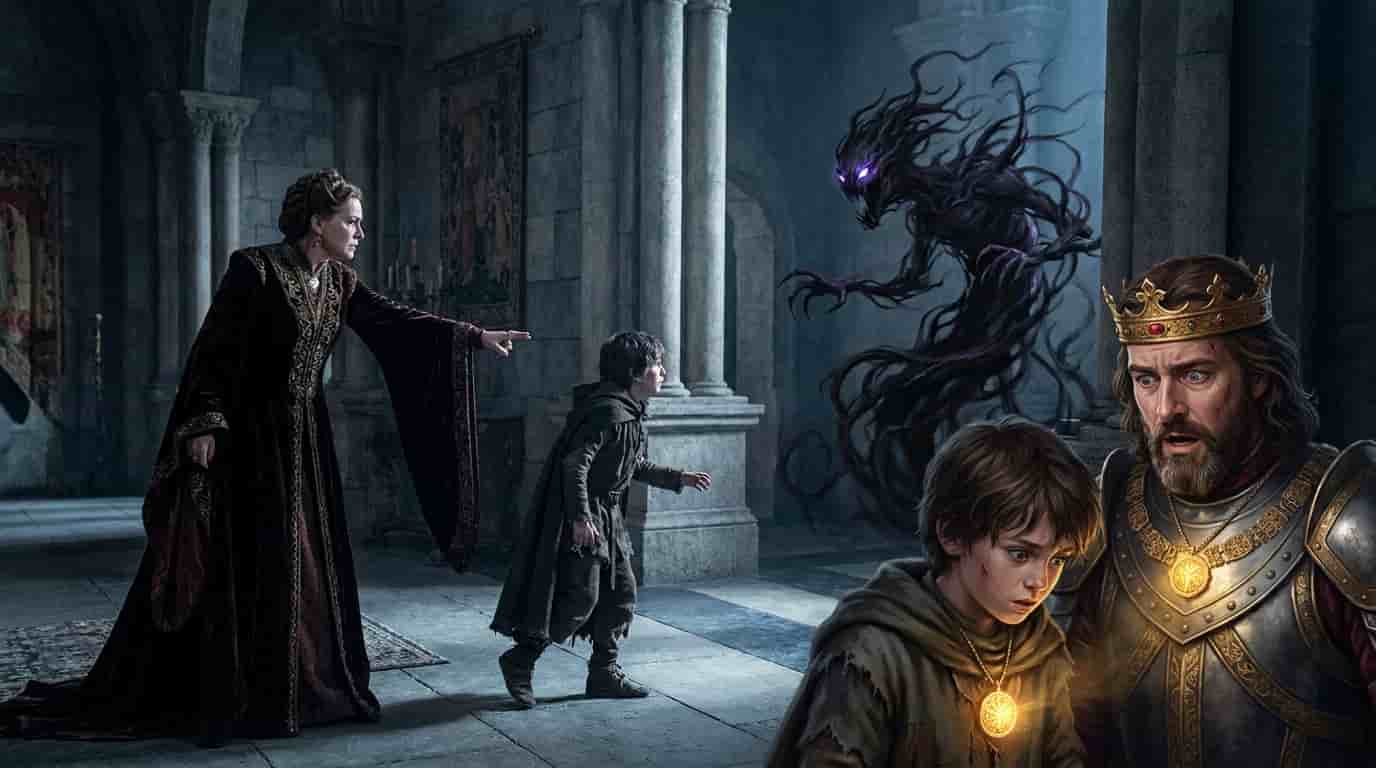
In the center of the courtyard, straining against four massive iron chains held by heavily armored guards, was the Anzu-beast. It was a colossal, mythical predator with the muscular body of a black lion and the jagged, feathered head of a massive eagle of prey. Its breath hissed like burning sulfur, and its razor-sharp talons scraped deep grooves into the ancient stone.
“Please, Your Grace,” I begged, my voice hoarse, keeping my head bowed low so the tattered linen veil covered my features. “He is only a child. He did not know. Take my life instead. Let the beast take me.”
The court ladies surrounding the Queen erupted into high-pitched, mocking laughter. Nisaba took a slow sip from her golden goblet, her eyes flashing with cold amusement.
“Your life has no value, nameless dog,” Nisaba sneered, gesturing to the guards holding the chains. “But your despair? That is quite entertaining. Let the first chain go.”
A heavy iron link clattered against the stone. The monster roared, its massive wings flaring as it lurched three paces closer to my terrified son. The heat from its jaw washed over us, smelling of old blood and impending death.
I knew I could no longer remain silent. I clutched the small, cracked clay amulet hidden beneath my rags—the only piece of my past I had left—and prepared to do what I had promised myself I would never do again.
Full story in the first comment…
👇If you don’t see the new chapter, tap “All comments”.
FULL STORY
Chapter 2
Eight years before the Anzu-beast was strained against its chains in the midday sun, I did not wear the tattered rags of a palace slave. I wore robes of woven silver, and my brow carried the weight of the golden tiara of Uruk. I was Queen Ningal, the beloved wife of King Ur-Nammu.
Ours was a marriage born of genuine love, a rarity among the city-states of Sumer. But where there is great love, there is also monstrous envy. Nisaba, the daughter of a powerful high priest from the northern provinces, had always eyed the throne. She didn’t want the King; she wanted the absolute, terrifying power that came with the crown.
On a night when the moon was swallowed by darkness, an assassin slipped into the royal bedchamber. I was stabbed in the chest and thrown into the churning waters of the Euphrates River, left to be forgotten by history. The palace mourned the “tragic murder” of Queen Ningal.
But the river did not take me. I washed ashore miles downstream, broken, bleeding, and barely alive, saved by a kind, elderly weaver who nursed me back to health in secret. Months later, I discovered I was pregnant with the King’s child—a son conceived in love, born in exile. I named him Ilu.
For seven years, I hid in the shadows of the lower city, working myself to the bone, keeping my face hidden behind a thick slave-veil to protect my boy from the political vipers who had tried to erase me. I thought we were safe. But when the old weaver died, debt forced me into servitude within the very palace that had once been my home.
Nisaba had since maneuvered her way into the King’s bed, taking the title of Queen, though everyone knew Ur-Nammu’s heart had died the night I disappeared. He had become a ghost, a warrior-king who spent his years on distant battlefields, leaving the domestic court to Nisaba’s escalating cruelty.
“Mama, hold me,” Ilu whimpered, his small hands pulling at my dirt-streaked dress as the giant beast snapped its beak, a mere five feet away. The creature’s amber eyes locked onto his blood, its feathers bristling with predatory hunger.
I looked up at Nisaba. She thought I was just another broken peasant woman, an insignificant speck of dust she could crush beneath her gilded sandals to show her absolute authority. She had no idea whose blood ran through the veins of the child she had just condemned to die.
Chapter 3
The second iron chain clattered to the floor. The Anzu-beast lunged forward with a terrifying roar, its massive talon swiping through the air, missing my son’s leg by inches. Dust and small stones sprayed across my face.
“You like to watch things break, don’t you, Nisaba?” I said, my voice dropping its submissive tone entirely. It was low, steady, and carried a chilling weight that resonated across the sudden silence of the courtyard.
The Queen froze, her golden goblet stopping halfway to her lips. The court ladies stopped whispering. No slave had ever dared speak the Queen’s name without her title, let alone in a tone that demanded an answer.
“What did you say, slave?” Nisaba whispered, her eyes narrowing into slits of pure fury. She stepped toward the edge of the marble dais. “Guard, cut out her tongue before the beast takes her son!”
A hulking guard stepped forward, raising a bronze dagger. But before he could reach me, the heavy blast of a war horn shattered the midday air.
Thoom. Thoom. Thoom.
The rhythmic, thunderous beat of war drums echoed from outside the palace walls. The massive outer gates opened, and the heavy, measured march of hundreds of iron-shod boots filled the corridor. The King had returned early from his campaign in the eastern mountains.
Nisaba’s anger instantly morphed into a mask of sweet, wifely devotion. She smoothed her silk dress and adjusted her heavy tiara. “Keep the beast restrained until the King is seated,” she commanded the guards quickly, not wanting her husband to see her as a mindless butcher, but rather as a ruler executing necessary justice. “Let his majesty witness the law being upheld.”
King Ur-Nammu strode into the courtyard. He looked older, his face hardened by years of brutal warfare, his dark beard streaked with grey. He wore the heavy bronze breastplate of the supreme commander, and behind him marched fifty Royal Immortals, their massive spears glinting in the harsh sunlight.
“What is the meaning of this commotion in my court?” Ur-Nammu demanded, his voice like grinding stones. He didn’t even look at Nisaba as she rushed down the steps to greet him.
“My love, you have returned just in time,” Nisaba purred, gesturing grandly to where Ilu and I knelt in the dust. “A filthy slave boy destroyed the sacred anointing oil meant for the temple of Enlil. I am merely enforcing the sacred law. The beast shall cleanse the insult.”
Ur-Nammu frowned, his eyes finally drifting down toward the pit. He looked at my small, bleeding son, and for a fraction of a second, a shadow of profound sorrow crossed the warrior’s face. He hated senseless cruelty, but he was bound by the rigid laws of his ancestors. He began to turn away, closing his eyes to the injustice.
“Ur-Nammu!” I called out, the forbidden name tearing from my throat like a battle cry.
Chapter 4
The entire courtyard gasped. To call the King by his bare name was an offense punishable by immediate flaying.
“Kill her! Kill her now!” Nisaba screamed, her polished mask completely slipping as she pointed a trembling, furious finger at me. “Do not let her defile the King’s ears!”
Two guards rushed forward, their spears aimed at my chest. But Ur-Nammu raised a single, massive hand. The guards froze instantly, immobilized by the absolute authority of their commander.
The King slowly turned around, his eyes burning with a mixture of shock, confusion, and a sudden, terrible hope. Nobody had spoken his name with that specific, melodic cadence in over eight long, agonizing years.
“Who are you?” the King demanded, stepping down from the raised platform, his heavy boots clicking against the sandstone.
“I am the one who gave you this,” I said softly.
With shaking hands, I held up the small, cracked clay amulet. It wasn’t a standard piece of peasant jewelry. When I flipped it over, it revealed a hidden brass key molded into the back—the key to the royal archives, a token given only to the true Queen on her wedding night.
Ur-Nammu’s breath hitched. He stepped closer, his eyes locked onto the object, completely ignoring Nisaba, who was now frantically trying to grab his arm. “My King, do not listen to this madwoman! She is a thief! She must have stolen it from the old ruins!”
“Silence!” Ur-Nammu roared, a sound so loud it caused the Anzu-beast to whimper and pull back into the shadows of the pit.
The King stood directly over me. Slowly, deliberately, he reached out with a trembling hand and grabbed the edge of my tattered linen veil. With a swift motion, he pulled it away.
The blinding Sumerian sun hit my face. The courtyard fell into a silence so profound you could hear the wind rustling through the distant palm trees.
Ur-Nammu stumbled back, his face turning entirely pale, his bronze shield clattering loudly against the stone. He stared at my high cheekbones, my dark, unyielding eyes, and the small scar beneath my jawline—the exact, unmistakable image of his late, tragically murdered queen.
“Ningal…” the King whispered, his voice cracking with an agonizing grief that had suddenly turned into an impossible reality. “By the gods… you are alive.”
Chapter 5
“It cannot be!” Nisaba shrieked, her voice reaching a frantic, hysterical pitch as she backed away toward her throne. “The Queen is dead! The river took her! This is dark sorcery! Guards, protect your King from this demon!”
But the guards didn’t move. High Commander Galzu, the oldest and most loyal of the King’s generals, stepped forward, his eyes wide as he looked at my face. He recognized me instantly. Without a word from his king, Galzu drew his massive bronze sword, slammed his fist against his breastplate, and dropped to one knee before me.
“Hail, Queen Ningal,” Galzu proclaimed, his voice booming through the courtyard.
Within seconds, the fifty Royal Immortals followed suit. The heavy thud of their knees striking the stone echoed like thunder. The very guards who had been holding the chains of the Anzu-beast dropped them, letting the massive predator retreat peacefully into its den, completely forgotten.
Ur-Nammu fell to his knees in the dust right in front of me, his rough, scarred hands gently cupping my face as if I were made of fragile glass. “How?” he choked out, tears finally spilling down his weathered cheeks. “They told me you were assassinated. I searched the river banks for months…”
“The river spared me, my love,” I whispered, leaning into his touch, but quickly pointing down to the trembling boy beside me. “And it spared your son. This is Ilu. He carries your blood, and today, he was condemned to die for dropping a jar of oil.”
Ur-Nammu looked at the boy. He saw his own strong jaw, his own resilient eyes staring back at him from a child’s face. The King’s sorrow instantly solidified into a terrifying, murderous rage.
He stood up, drawing his personal royal dagger—the blade forged from meteorite iron. He turned his gaze toward Nisaba, who was now trembling violently, surrounded by the lowered spears of the very soldiers she thought she commanded.
“You told me the assassins were bandits from the hills, Nisaba,” Ur-Nammu said, his voice terrifyingly quiet as he walked up the marble steps toward her. “But a peasant slave doesn’t know the exact layout of the royal bedchamber. A peasant slave doesn’t profit from my wife’s death.”
“Mercy, my King!” Nisaba wept, falling to her knees beneath her stolen crown, her hands clasped in desperation. “I did it for us! I did it for the empire! She was weak!”
“She was the heart of this empire,” Ur-Nammu growled. He reached down, wrapped his massive hand around the golden tiara on Nisaba’s head, and violently ripped it away, tearing strands of her dark hair with it. “And you are nothing but a parasite feeding on her ghost.”
Chapter 6
Justice in the ancient city of Uruk was swift, absolute, and devoid of mercy for those who betrayed the crown.
Queen Nisaba was stripped of her royal titles, her wealth, and her fine silks right there in the courtyard. By royal decree, she was sentenced to live out the remainder of her miserable days in the deep salt mines of the southern desert—the very place where the most forgotten slaves were sent to wither away. The court ladies who had laughed at my son’s suffering were exiled from the city gates, forbidden from ever stepping foot in Uruk again.
But the true victory wasn’t the punishment of our enemies. It was the restoration of dignity.
An hour later, the courtyard had been cleared of blood and dust. My son Ilu had been washed, his wound dressed by the finest palace healers, and he was now wrapped in a royal cloak of deep purple silk. He sat proudly on the edge of the great throne, his small hand locked tightly within his father’s massive grasp.
I stood before the large bronze mirror in the royal chambers, watching the servants drape the heavy, woven silver robes around my shoulders once more. They placed the golden tiara back onto my brow, its weight familiar and grounding. But as I looked at my reflection, I knew I was no longer the fragile queen who had been thrown into the river eight years ago. I had survived the dirt, the hunger, and the silence. I had protected the true heir of the throne with nothing but my own resolve.
Ur-Nammu stepped into the chamber, leaving the guards at the door. He walked up behind me, resting his hands gently on my shoulders, looking at our reflection together.
“Can you ever forgive me for not finding you sooner?” he asked, his eyes filled with a quiet, lingering pain.
I turned around, placing my hand over his heart, feeling its strong, steady beat. “The past is dust, Ur-Nammu. We have returned from the shadows, and our son is safe.”
Hand in hand, we walked out onto the grand balcony overlooking the entire city-state of Uruk. Thousands of citizens had gathered in the streets below, having heard the rumors of the dead Queen’s miraculous return. As we stepped into the light, a deafening roar of joy rose from the crowds, shaking the very foundations of the ziggurat.
And as the old royal banner rose above the castle walls again, I finally understood that a kingdom is not built by crowns, but by the people who refuse to let love kneel in the dust.