The crystal chandeliers in the grand ballroom of Blackwood Manor didn’t just cast light; they seemed to blind everyone to the world outside. I stood in the doorway, my boots dripping muddy rainwater onto the imported Italian marble, a living ghost at a feast of kings.
Nobody noticed me at first. They were too busy laughing, clinking champagne flutes, and admiring the man of the hour. Arthur Vance. The tech savior. The billionaire philanthropist. The man celebrating his fiftieth birthday surrounded by the glittering elite of Boston.
My fingers traced the jagged, raised tissue running from my jawline down past my collarbone. It was hot, angry skin that never let me forget who I was. Or what had been stolen from me.
I took a step forward, the squelch of my soaked sneakers cutting through the soft, ambient jazz. A woman in a silk gown turned, her smile instantly souring into a sneer of pure disgust. She clutched her diamond necklace and pulled her husband back, as if poverty were contagious.
“Security,” someone whispered sharply nearby. “How did a street kid get past the gates?”
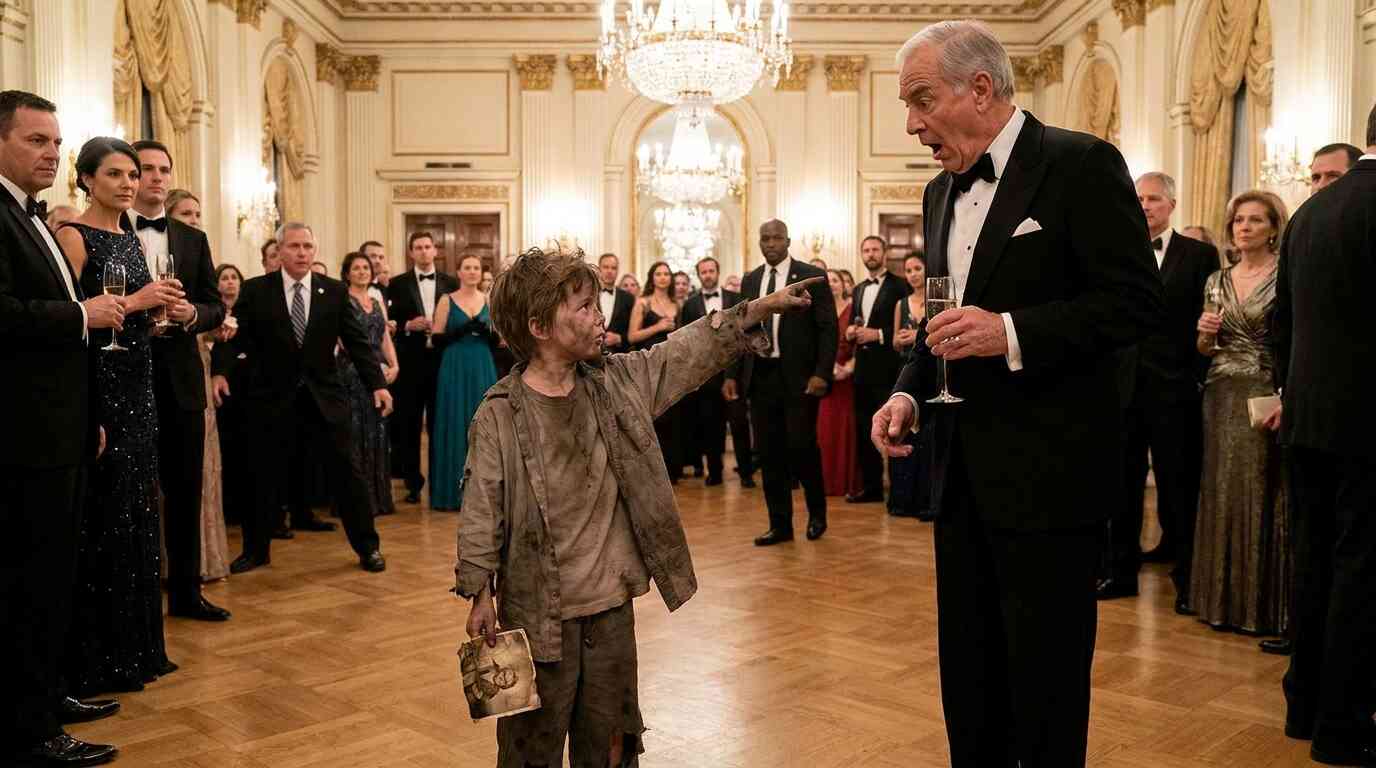
I didn’t run. I didn’t hide. My eyes were locked onto Arthur Vance, who stood by a towering, five-tier cake. He looked immaculate in his tailored tuxedo, his silver-streaked hair perfectly coiffed. But as I drew closer, his laughter died. His eyes dropped to my face, and the color drained from his skin so fast it looked like he’d been struck by lightning.
A massive guard grabbed my shoulder, his grip tightening until it bruised. “Alright, kid, out. You’re trespassing.”
I didn’t look at the guard. I kept my eyes on Arthur. With a sudden, violent wrench, I tore my arm free and stepped into the open circle of the ballroom floor. The entire room went dead silent.
I raised my right hand, palm facing toward the ceiling, exposing the thick, white, star-shaped burn scar right in the center of my flesh. It was a mirror image of the one Arthur Vance spent his entire life trying to hide beneath his luxury watches and custom cuffs.
“The scar on your hand is the same as mine, Arthur,” my voice rang out, cracked but steady, cutting through the silence like a blade. “Do you still tell people you got it from a kitchen fire, or do you remember the night the foundry burned with your family inside?”
Arthur’s hand began to shake, his fingers dropping his crystal glass. It shattered on the marble, champagne pooling around his polished shoes as his perfect life began to fracture right before his eyes.
Full story in the first comment…
👇If you don’t see the new chapter, tap “All comments”.
FULL STORY
Chapter 2: The Ghost of Iron and Ash
The silence that followed the shattering of Arthur Vance’s glass was heavy, suffocating, and smelled faintly of old rain and high-society panic. For ten seconds, nobody moved. The jazz trio had stopped playing mid-measure, the saxophonist’s fingers frozen on the keys. Hundreds of wealthy Bostonians stood like wax statues, their eyes darting between the ragged twelve-year-old boy in the center of the room and the titan of Vance Industries.
Arthur didn’t speak. His mouth opened slightly, a small, involuntary twitch dragging at the corner of his left eye. He looked older suddenly. The youthful, vigorous glow he cultivated for the press evaporated, leaving behind a gray, hollow facade.
“Arthur?” Julianne Vance stepped forward, her emerald silk gown rustling against the floorboards. Her voice was thin, laced with a sharp, defensive edge that belonged to a woman who had spent twenty years protecting a reputation. She looked at me, her eyes lingering on the red, twisted skin of my face with a mixture of revulsion and sudden, icy fear. “Arthur, who is this boy? What is he talking about?”
“He’s… he’s a nobody, Julie,” Arthur choked out, his voice a gravelly whisper. He finally found his footing, his shoulders squaring as the corporate predator reasserted itself. He looked at the head of his security detail, Marcus, a broad-shouldered man in a dark suit who was already moving toward me with dark intent. “Get him out of here. Call the police. He’s clearly delusional. Some street kid looking for a handout.”
Marcus grabbed my arm again, rougher this time, lifting my feet nearly off the ground. But I didn’t cry out. I didn’t struggle. My eyes remained locked on Arthur’s right hand, which he had instinctively tucked behind his back.
“You can throw me out, Arthur!” I screamed as Marcus dragged me toward the side exit, my heels scraping against the pristine marble. “But you can’t throw away the records! I found the ledger in the old carriage house! The insurance payouts from the 2014 fire… they didn’t go to the victims’ families! They went into your first tech startup!”
A collective gasp rippled through the crowd. These were people who understood money, fraud, and the heavy scent of a scandal. The word insurance combined with fire was a match dropped on dry grass.
“Wait,” Julianne said, her voice commanding, cracking across the ballroom like a whip. Marcus stopped. He looked at Arthur, then at Julianne, caught between the two powers of the household. Julianne walked slowly toward me, her gaze fixed on my right hand, which was still raised, shaking from adrenaline.
She reached out, her manicured fingers hovering just inches from my skin. She wasn’t looking at the dirt or the grime. She was looking at the distinct, star-shaped mark in the center of my palm—a perfect, five-point burn signature left by a pressurized industrial valve handle.
“Where did you get this?” she whispered, her voice dropping all its upper-class armor.
“The O’Leary Foundries,” I replied, the words tasting like copper in my mouth. “Ten years ago. My dad was the shift foreman. He died trying to turn the main valve off while the owner locked the fire doors from the outside to maximize the property damage claim.” I looked past her, straight at the man who paid for her diamonds. “Ask your husband why he carries the exact same shape on his palm. He was there that night. He wasn’t a savior. He was the one who turned the key.”
Arthur took a step back, hitting the edge of the dessert table. The massive, five-tier cake wobbled, a slow-motion disaster as a silver tier slid off and crashed to the floor, sending white frosting and sugar glass spraying across the expensive shoes of his closest investors.
“She’s lying to you, Julie! He’s a plant!” Arthur shouted, his face turning an angry, unnatural purple. “A corporate hit job by the Vanguard group! They’re trying to short our stock before the merger on Monday!”
But the crowd wasn’t listening to his denials anymore. They were looking at his right hand, which was trembling so violently he could no longer hide it behind his back. The custom-tailored cuff of his shirt had ridden up, revealing the edge of a white, star-shaped scar that perfectly matched the one on my face and hand.
“Marcus,” Julianne said, her voice dropping into a terrifyingly calm register. “Take the boy to the library upstairs. Lock the doors from the inside. Do not let anyone near him until I come up.” She turned her head slowly to look at her husband, her eyes devoid of any warmth. “And Arthur? Your guests are leaving. Now.”
Chapter 3: The Documents in the Desk
The library of Blackwood Manor smelled of leather, old paper, and money that had been sitting undisturbed for generations. Marcus had left me there, sitting on a plush velvet sofa that felt entirely too soft for someone who spent his nights sleeping on a thin mattress in a South End tenement. He hadn’t locked the door to punish me; he had locked it to keep the rest of the world out.
I sat in the dim light of a single desk lamp, my hands tucked between my knees to stop them from shaking. The adrenaline was fading, leaving behind a cold, hollow exhaustion. Every inch of my body ached, a reminder of the miles I had walked through the rain just to get to this neighborhood.
The door clicked open twenty minutes later. It wasn’t Arthur. It was Julianne Vance, accompanied by an older man in a sharp gray suit whom I recognized from the financial news segments on the shelter’s television. It was Thomas Sterling, the chief legal counsel for Vance Industries and a man known as Arthur’s closest confidant.
Julianne didn’t look angry; she looked shattered. The pristine elegance she carried downstairs was gone. Her hair was slightly undone, and she carried a thick manila folder under her arm.
“What is your name, young man?” Thomas Sterling asked, his voice surprisingly gentle but carrying the weight of a seasoned interrogator.
“Leo,” I said, my voice small in the cavernous room. “Leo O’Leary.”
Sterling sighed, a sound that seemed to come from his boots. He sat down in the leather chair across from me, while Julianne remained standing near the fireplace, staring into the dark hearth.
“Leo,” Sterling said, leaning forward and resting his elbows on his knees. “Your father was Sean O’Leary. A good man. A brilliant engineer who kept that old foundry running long past its expiration date.”
“He was a murderer,” I said, the words burning my throat. “That’s what the papers said. They said he sabotaged the pressure valves to get back at the management. They said he died because of his own greed.”
“The papers said what the Vance corporation paid them to say,” Julianne spoke up, her voice cracking. She walked over to the desk and dropped the manila folder onto the mahogany surface. “I found these in Arthur’s private safe three years ago, Leo. I didn’t understand them then. I thought they were just old corporate restructuring documents. But tonight… when I saw your hand… it all clicked.”
She opened the folder, revealing old, yellowed blueprints of the O’Leary Foundry, mixed with financial transaction logs dated two weeks before the fire.
“Look at this,” Sterling said, pointing to a line item highlighted in red ink. “A transfer of four million dollars from an offshore account owned by Arthur Vance to a private security firm specializing in ‘industrial liquidation.’ That’s a corporate euphemism for arson, Leo. Arthur was drowning in debt. The foundry was losing money every day. He needed a massive influx of capital to fund his new software venture, and the insurance policy on the foundry was worth forty million.”
“He locked them in,” I whispered, tears finally breaking through the dried mud on my cheeks. “My dad… he knew the valve was failing. He went back in to release the pressure manually so the whole neighborhood wouldn’t go up. That’s why his hand was burned like this. He died holding that valve.”
“And Arthur was there to make sure he didn’t succeed,” Julianne said, her voice dropping to a whisper of pure horror. “He went into the facility to ensure the fire doors were locked. He didn’t expect Sean to be at the main valve. They fought, didn’t they? That’s how Arthur got the same burn. He was burned by the same pipe when he tried to pull Sean away from the release mechanism.”
The pieces of my broken life were falling into place with a terrifying, mechanical precision. For ten years, my mother and I had lived in poverty, carrying the shame of a father who was branded a criminal and a saboteur. My mother had died of a broken heart and a lack of medical care in a damp basement apartment, while the man who had set the fire built a glass tower in downtown Boston.
“We have the financial records, Leo,” Sterling said, his eyes full of a grim determination. “But we didn’t have the physical proof of identity to link the old O’Leary lawsuit back to Arthur’s personal presence at the scene. The police report from ten years ago noted a second DNA profile on the valve handle, but it was corrupted by the heat. Your scar… and his… they are the matching signatures of that specific night.”
Suddenly, the library door shuddered. A heavy thud rattled the frame, followed by the sound of a key turning violently in the lock. The door burst open, and Arthur Vance stepped into the room. He had torn his tie off, his shirt was unbuttoned at the collar, and his eyes were wide, bloodshot, and wild.
In his right hand, he held a small, black iron poker from the downstairs fireplace.
“Get out, Thomas,” Arthur hissed, his breath coming in ragged, uneven gasps. “Get out of my house. Julie, go to your room. This is a corporate extortion plot, and I’m going to end it right now.”
Chapter 4: The Price of Silence
Thomas Sterling didn’t move. He stood up, placing himself directly between Arthur and the sofa where I sat. “Arthur, put that down. It’s over. The boy isn’t alone. I’ve already sent digital copies of the 2014 ledger to the federal prosecutor’s office. If anything happens to this child tonight, you won’t just go down for fraud and arson. You’ll go down for capital murder.”
Arthur laughed, a high, unstable sound that echoed uncomfortably against the book-lined walls. “Fraud? Arson? You think anyone cares about a ten-year-old fire in a slum neighborhood? Vance Industries employs ten thousand people in this state, Thomas! The governor is downstairs in my driveway right now! I built this city’s tech corridor from nothing!”
“You built it on the bodies of seven night-shift workers, Arthur,” Julianne said, her voice dead and flat. She looked at her husband as if he were a stranger, a monster wearing the skin of the man she had loved for twenty years. “You told me you got that scar from a motorcycle accident during our trip to Maine. I believed you. I raised our children to honor you.”
“I did it for us!” Arthur roared, slamming the iron poker against the heavy mahogany desk, leaving a deep, jagged splinter in the wood. “We were bankrupt, Julie! We were going to lose the house, the cars, everything! Your father would have disowned me! I had to create a future from something, and that old foundry was worth more dead than alive!”
He turned his furious, bloodshot gaze down to me. He looked at my face, at the jagged line of skin that ruined my features, and for a fraction of a second, a flicker of genuine, ancient guilt crossed his eyes before being swallowed by pure malice.
“You look just like him,” Arthur whispered, his teeth bared. “Sean was a fool. He stayed behind for a machine. If he had just walked out the back door like a sensible man, he would have lived. He tried to be a hero, and heroes die poor.”
“He died protecting people,” I said, standing up from the couch, ignoring the tightness in my chest and the terror screaming in my ears. I walked around Sterling, stepping into the light of the desk lamp so Arthur could see every ridge of the scarred flesh he had created. “He didn’t die poor. He died with his soul. You’re the one who’s empty, Arthur. Look at you. You have everything, and you’re screaming at a kid in a room full of books you’ve never read.”
Arthur raised the iron poker, his knuckles turning white. His right hand—the one bearing the star-shaped burn—was shaking so hard the metal tip rattled against the air. “I’ll give you five million dollars, Leo. Right now. A private trust. You can go to any school in the world. You can fix your face. You can have a life nobody in your family could ever dream of.”
He stepped closer, his voice dropping into a desperate, pleading whine that was more disgusting than his anger. “Just sign an affidavit. Say you were paid by a competitor to make a scene at the party. Say the scar is an old kitchen accident. Five million, Leo. Think about your mother.”
“My mother is dead,” I said, my voice echoing with a cold, absolute finality. “She died in a room that didn’t have heat because we couldn’t afford the gas bill. The same gas you used to burn my dad.”
I reached out and took the manila folder from the desk, pulling it toward my chest.
“Keep your money, Arthur,” I said. “I want the truth.”
Arthur lunged forward, the iron poker swinging downward with a sickening force. But he wasn’t swinging at me. He was swinging at the folder, desperate to destroy the paper evidence. Thomas Sterling tackled him from the side, both men crashing into the heavy desk as books and lamps tumbled to the floor in a chaotic scream of breaking wood and shattering glass.
Chapter 5: The Glass Castle Crumbles
The sound of sirens began as a faint, distant hum, cutting through the heavy rainstorm outside Blackwood Manor, growing louder and more insistent until the blue and red lights began to dance across the library’s high ceiling.
Marcus, the security chief, had broken down the door after hearing the crash. He hadn’t defended Arthur; instead, he had helped Sterling pin his own employer to the floor. Arthur lay there, his face pressed against the expensive Oriental rug, his expensive suit covered in dust and spilled ink, weeping not out of remorse, but out of the sheer, pathetic terror of a powerful man who had finally lost control of his narrative.
Julianne sat on the floor near the overturned desk, holding the manila folder tightly against her chest, her emerald dress stained with black ink from a broken well. She didn’t look at her husband as the police officers burst into the room, their weapons drawn, their faces tense as they took in the scene of high-society ruin.
“He’s the one,” Thomas Sterling said, his voice breathless but steady as he pointed at Arthur. “Arthur Vance. Arrest him for the 2014 arson of the O’Leary Foundries and the subsequent conspiracy to commit insurance fraud and corporate homicide.”
The lead detective, a gruff man named Miller who looked like he had seen thirty years of Boston’s worst nights, walked slowly toward Arthur. He knelt down, pulled Arthur’s right hand out from behind his back, and looked at the white, star-shaped scar on his palm. Then he looked up at me, his eyes lingering on my face for a long, quiet moment.
“I was the junior officer on that fire ten years ago,” Detective Miller said, his voice dropping into a low, somber tone. “We knew something was wrong. We knew the doors shouldn’t have been chained from the outside. But the state fire marshal’s report was overridden by a corporate panel within forty-eight hours.” He looked back down at Arthur, his grip tightening around the billionaire’s wrist. “The wheels of justice turn slow, Mr. Vance, but they still grind.”
As the handcuffs clicked into place around Arthur’s wrists, the sound seemed to echo through the entire mansion, a sharp, metallic period at the end of a ten-year sentence of lies. Arthur didn’t look at me as they pulled him to his feet. He kept his head down, his silver hair hanging in dirty strands over his eyes, a broken king being led out of his own castle.
Julianne stood up slowly, her knees trembling. She walked over to me, her expensive silk shoes stepping through the debris of her old life. She looked down at me, her eyes filled with a deep, maternal sorrow that didn’t belong to a billionaire’s wife, but to a mother who realized her children had been fed on blood money.
“I can’t fix what he did, Leo,” she said, her voice a fragile whisper. “I can’t give you back your father. I can’t give you back the years you spent in the dark.” She reached into her pocket and pulled out a small, old silver pocket watch—the only item Arthur had kept from his own father, an old foundry worker from the same neighborhood. “But I will make sure the world knows Sean O’Leary was a hero. Every cent of the Vance foundation will be turned over to the families of the night shift. Starting tonight.”
I didn’t take the watch. I looked at her, then down at my own scarred hand.
“Keep the watch, Mrs. Vance,” I said softly. “Give it to your children. Tell them the truth about how it was paid for. That’s the only thing that matters now.”
Chapter 6: The Weight of Justice
Six months later, the autumn leaves were falling thick and heavy over the Boston harbor. The trial had been short, brutal, and entirely public. The Vance Industries stock had plummeted to zero within a week of the arrest, the corporate empire dissolving like sugar in the rain as the full extent of the 2014 conspiracy was laid bare in federal court.
Arthur Vance sat in a maximum-security cell in Walpole, serving a life sentence without the possibility of parole. His name had been stripped from the university buildings, the hospitals, and the tech centers he had funded with the blood of seven men.
I stood on the pier, the cold Atlantic wind whipping against my jacket. For the first time in my life, I didn’t feel the need to hide my face. The people passing by didn’t look at my scars with disgust or pity anymore; they looked at me with a quiet, respectful recognition. The papers had run my father’s picture on the front page—not as a saboteur, but as the foreman who stayed behind to save a neighborhood.
Thomas Sterling had helped me establish the O’Leary Memorial Trust, ensuring that every survivor’s child from that terrible night would have their college paid for, their homes secured, and their futures protected. I wasn’t rich—I didn’t want the Vance money for myself—but I had a small, warm apartment with a heater that worked, a shelf full of books, and a clean bed where the nightmares didn’t follow me anymore.
Julianne Vance had moved out of Blackwood Manor, selling the estate to fund the cleanup of the old industrial district. She had sent me a letter last week, telling me that her son had applied to engineering school—not to build software, but to study structural safety and worker advocacy.
I looked down at my right palm, the white star catching the pale afternoon sunlight. It was still there, a permanent mark of fire and ash, but it didn’t feel like a curse anymore. It felt like a badge of honor. It was the same mark my father carried when he made his choice, a reminder that the skin may burn, but the truth remains cold, hard, and unbreakable.
A small girl, no older than six, walked past me with her mother, holding a bright red balloon. She stopped, staring up at my face with the unblinking curiosity that only children have. She pointed a small finger at my cheek.
“Does it hurt?” she asked innocent-eyed.
Her mother looked horrified, instantly pulling the girl back and looking at me with an apologetic panic. “I’m so sorry, sir—”
I smiled at the woman, a real, genuine smile that didn’t feel tight or painful anymore. I knelt down to the little girl’s eye level, letting the sun shine directly on the uneven, jagged lines of my skin.
“It used to hurt a lot,” I told her softly, my voice carrying the warmth of a boy who had finally come in from the rain. “But it doesn’t hurt anymore, because now I know that scars aren’t where the story ends—they’re just where the light shines through the loudest.”