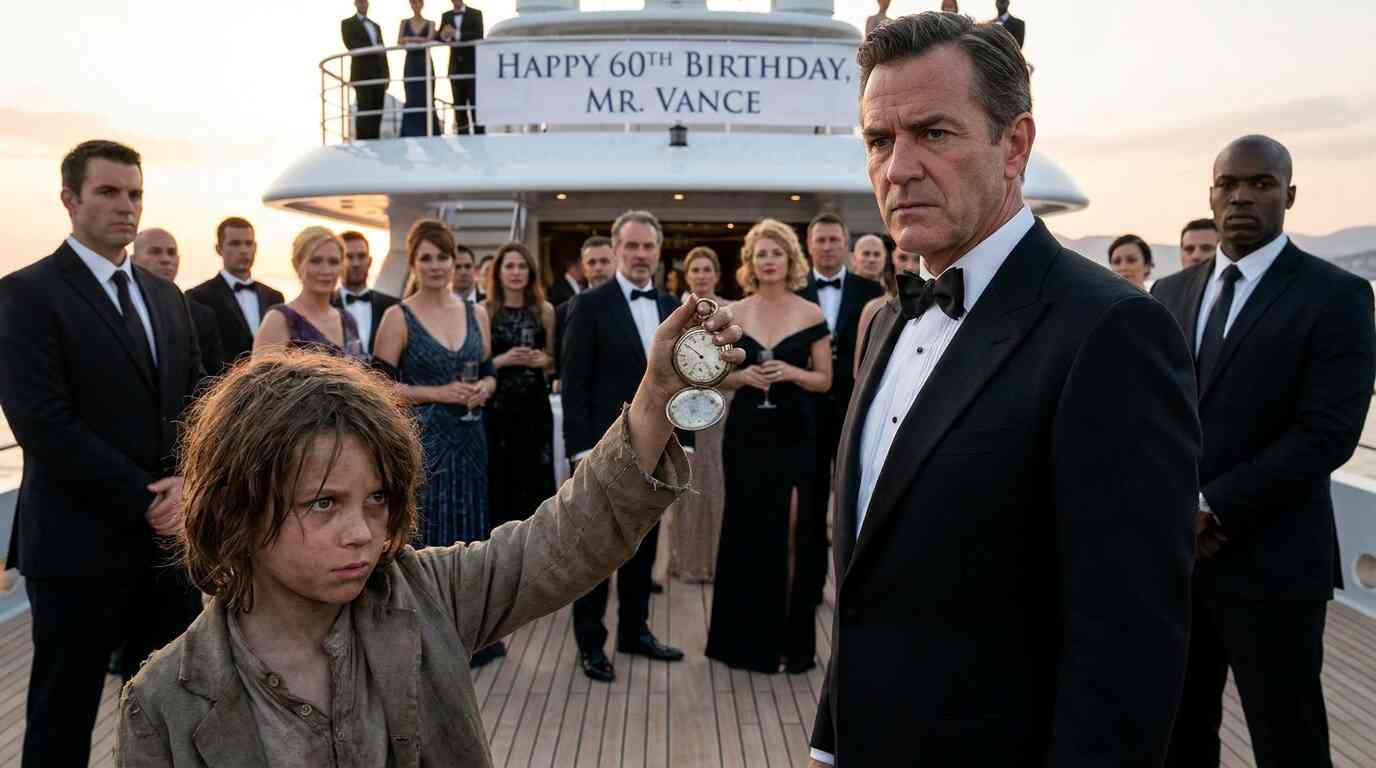
I was standing in a custom ivory silk gown, my hand tightly clasped in Julian’s. He was perfect. A self-made real estate mogul, a philanthropist, the man who had rescued my family’s struggling foundation. He looked at me with an intensity that made the rest of the crowded ballroom fade away.
“To the perfect couple,” my father announced, raising a glass of vintage champagne. The crowd erupted into polite, rhythmic applause. Julian smiled, leaning down to press a soft, reassuring kiss against my temple. His skin was warm. His life was immaculate.
Then, the heavy mahogany double doors at the back of the ballroom didn’t just open—they slammed against the wall.
The music stopped instantly. The collective intake of breath from five hundred members of Boston’s elite sounded like a sudden wind storm.
Walking down the center aisle of the pristine white carpet was a boy. He couldn’t have been more than ten years old. He wore a oversized, dirt-streaked canvas jacket that looked like it had been pulled from a dumpster. His boots left wet, muddy tracks on the velvet runner. His face was smudged with soot, but his eyes were a piercing, terrifying electric blue.
Two security guards immediately moved to intercept him, their hands reaching for his small shoulders. But the boy didn’t flinch. He didn’t run. He ducked under their arms with a practiced, street-born agility and kept marching straight toward the altar. Straight toward us.
“Hey! Get that kid out of here!” someone shouted from the front rows.
I looked at Julian, expecting him to call for his head of security, or to step in front of me to protect me. But Julian didn’t move.
I felt his hand go completely slack in mine. His fingers became ice-cold in a matter of seconds.
The boy stopped exactly five feet from where we stood. He didn’t look at the glittering ice sculptures, the diamond rings, or the politicians in tailored tuxedos. His eyes locked entirely onto Julian’s face.
The silence in the room was deafening. You could hear the faint drip of melting ice from the seafood tower.
The boy took a deep, shuddering breath. He raised a trembling, dirt-caked right hand, pointed his index finger directly at Julian’s chest, and spoke in a voice that was fiercely clear, completely devoid of childhood innocence.
“You know who I am.”
The words weren’t a question. They were a verdict.
I turned my head to look at my fiancé. The man who was always in control, the man who spoke at town halls and boardrooms with effortless charisma, was entirely gone. Julian’s face had drained of all color, turning a sickly, translucent white. A bead of sweat rolled down his temple, cutting a path through his perfect makeup. His lips parted, but no sound came out. He looked like a man staring at a ghost that had come to drag him into hell.
“Julian?” I whispered, my voice trembling as a cold dread began to coil in my stomach. “Julian, who is this? Why is he looking at you like that?”
He didn’t answer me. He couldn’t even turn his head to look at the woman he had just promised his life to.
The boy stepped closer, the guards finally grabbing his arms from behind, pinning him. But the child didn’t fight them. He just kept his eyes burned into Julian’s soul, his small chest heaving under the dirty jacket.
“Tell her,” the boy whispered, his voice cracking with a raw, ancient pain that no ten-year-old should ever know. “Tell her what you did to my dad.”
Full story in the first comment…
👇If you don’t see the new chapter, tap “All comments”.
FULL STORY
Chapter 2
The security guards didn’t hesitate any longer. Sensing the absolute horror radiating from Julian, they lifted the boy completely off his feet. The child didn’t scream or kick. He simply kept his piercing blue eyes locked onto Julian until the heavy mahogany doors swung shut behind them, cutting off the freezing winter air he had brought into the room.
The ballroom remained trapped in a suffocating silence. Five hundred pairs of eyes shifted from the closed doors back to the stage.
My father, Richard Vance, stepped forward, his face flushed with aristocratic anger. He was a man who spent his life managing perceptions, and a street urchin disrupting his only daughter’s engagement was a public relations nightmare. “Julian,” my father said, his voice low but carrying the weight of a command. “What on earth was that? Do you know that child?”
Julian blinked, the movement rigid, like a machine forcing its gears to turn. He swallowed hard, his Adam’s apple bobbing against his silk bow tie. When he finally looked at my father, and then down at me, the ghostly pallor was slowly being replaced by a forced, synthetic calm.
“No,” Julian said. His voice was raspy at first, but he cleared his throat quickly, pulling the familiar armor of his charisma back over himself. “No, of course not. Richard, Clara… I’m so sorry. When you build affordable housing initiatives across the city like my company does, you encounter… unstable situations. There are families who don’t qualify, people who fall through the cracks of the system. Sometimes they target the face of the company.”
He looked directly into my eyes, reaching out to take both of my hands. His palms were still damp with sweat, but his grip was firm, almost desperate. “He’s a confused kid, Clara. Probably put up to this by a disgruntled tenant or a rival developer looking to make a scene at our expense. I promise you, I’ve never seen him before in my life.”
The explanation was logical. It was exactly the kind of sterile, corporate answer that made sense in our world. My father nodded slowly, accepting the answer because rejecting it meant accepting a scandal. The tension in the room began to dissipate like smoke. The orchestra, taking a cue from my father’s assistant, began to play a soft, upbeat jazz standard. Guests began to chatter again, desperately trying to paint over the bizarre fracture in the evening with loud laughter and fresh glasses of champagne.
But as Julian led me toward the dance floor, his touch felt different. The warmth was gone. Every few seconds, his eyes would flick toward the exit doors, his jaw tight, his muscles coiled like a spring ready to snap.
“I need to go to the restroom,” Julian whispered into my ear after our first dance. “Just to freshen up. The heat in here got to me.”
“Of course,” I said, forcing a smile.
I watched him walk away. He didn’t walk with his usual slow, confident stride. He was moving fast, his shoulders hunched. Instead of heading toward the public restrooms near the main lobby, he turned down the service corridor—the private hallway used only by the catering staff and hotel management.
An uneasy intuition, sharp and cold, pierced through my chest. I looked around the ballroom. My parents were occupied with a senator; my friends were laughing near the bar. No one was paying attention to me.
I gathered the heavy skirts of my silk gown and followed him.
The service hallway was a stark contrast to the ballroom. The floors were uncarpeted linoleum, lit by harsh, buzzing fluorescent lights. The smell of expensive perfume was replaced by the scent of roasted garlic and industrial cleaning fluid. I walked silently, my satin heels making no sound on the floor.
As I turned the corner near the storage rooms, I heard voices.
“I told you to keep him out of the city, Marcus! I paid you to make sure they stayed in western Mass!”
It was Julian. But it wasn’t the voice he used with me. It was stripped of all warmth, reduced to a sharp, vicious hiss that made my blood run cold.
“Julian, calm down,” a second voice replied. I recognized it immediately. It was Marcus Vance—my cousin, but more importantly, Julian’s chief legal counsel and vice president of acquisitions at Vance-Aldridge Development. “The kid slipped away. His mother is in the hospital with kidney failure; the state social workers are involved now. Marcus didn’t track him here; the kid must have remembered the name of the hotel from the old press releases.”
“I don’t care how he got here!” Julian snarled. I peered around the corner, keeping back in the shadows. Julian had Marcus pinned against the cinderblock wall by his lapels. Julian’s face was contorted with a feral rage, his eyes wild. “If Clara’s father looks into this, if the board starts digging into the old Miller estate acquisitions from five years ago, we are done. Everything we built disappears. Do you understand me? The kid knows. He remembers his father’s office.”
“The father is gone, Julian,” Marcus said, his voice tight as he tried to pry Julian’s hands off his jacket. “Arthur Miller died in that facility three years ago. There is no paper trail linking the patent acquisition to anything illegal. It was a standard bankruptcy foreclosure. We bought the assets legally.”
“Then why is his kid standing in my ballroom looking at me like he’s the executioner?” Julian released Marcus, turning around and slamming his fist into a metal supply cabinet. The loud CLANG echoed down the narrow hallway, making me jump.
“We need to handle the boy,” Julian whispered, his back to Marcus. “Find out where social services took him tonight. Buy them off. Move them out of state. If that kid shows up near Clara again, I will personally hold you responsible for the collapse of this merger.”
My heart was hammering against my ribs so violently I was certain they could hear it. Arthur Miller. Patent acquisition. Bankruptcy. None of these names or terms matched the story Julian had told me about how he started his empire. He had told me he built his first tech-integrated green housing designs from a garage in South Boston using a small inheritance from his grandmother.
I stepped backward, my heel catching on the hem of my dress. A small rustle of silk cut through the quiet hallway.
“Who’s there?” Marcus called out sharply.
I didn’t think. I turned and ran, my heart in my throat, gliding back into the warmth and golden light of the ballroom just before the service door clicked open behind me. I slipped into the crowd, my breath shallow, my hands shaking so violently I had to set my champagne glass down on a passing waiter’s tray before I dropped it.
When Julian returned to the ballroom ten minutes later, his smile was perfectly back in place. He wrapped his arm around my waist, his touch smooth and protective.
“Everything alright, sweetheart?” he asked tenderly.
I looked at the man I had agreed to marry, looking past the perfect jawline, the expensive suit, and the soft eyes. For the first time, I didn’t see my soulmate. I saw a beautifully constructed mask.
“Yes,” I lied, my voice sounding hollow even to my own ears. “Everything is just perfect.”
Chapter 3
The morning after the engagement party, the Vance family estate in Beacon Hill was suffocatingly quiet. I sat in the morning room, a cup of black coffee cooling in front of me, untouched. The sunlight streaming through the leaded glass windows looked harsh, exposing the thin layers of dust on the antique furniture that my family had owned for four generations.
My family had status, but we didn’t have money anymore. That was the open secret of the Vance line. My father’s bad investments in the early 2010s had left our historical preservation foundation on the verge of bankruptcy. Then came Julian Aldridge. He was a breath of fresh air—brilliant, wealthy, and deeply eager to marry into an old-money Boston lineage. He had saved our foundation with a five-million-dollar endowment within three months of dating me.
Now, every dollar of that endowment felt like a golden handcuff.
“Clara, you’re brooding,” my mother, Eleanor, said as she floated into the room, a copy of the Boston Globe tucked under her arm. “You should be ecstatic. The social columns are calling the party the event of the season. They barely mentioned that unfortunate incident with the vagrant child.”
“Mother,” I said, my voice tight. “Did you ever look into Julian’s business history before we approved the foundation merger?”
Eleanor paused, her porcelain cup hovering an inch above its saucer. She frowned, a delicate line appearing between her perfectly manicured brows. “Why on earth would we do that? Your father’s attorneys looked at his financials. His liquidity is unmatched. He’s building three new luxury high-rises in the Seaport. Why ask this now?”
“Because something is wrong,” I whispered.
I didn’t tell her what I had heard in the hallway. In our world, accusation without absolute proof was a social suicide note. Instead, I waited until my mother left for her garden club, then I went up to my father’s private study.
My cousin Marcus was the family attorney, which meant his digital files were accessible through the firm’s shared network terminal in our home office. I logged onto the old desktop computer, my fingers hovering over the keys. I had never spied on anyone in my life. I was the good daughter, the compliant Vance heir. But the memory of that boy’s electric blue eyes—filled with a pure, righteous fury—haunted me.
I searched the firm’s archive for “Vance-Aldridge Acquisitions.” Thousands of pages of standard contracts appeared. I narrowed the search: Arthur Miller. Five years ago.
A single restricted folder popped up, dated October 14, 2021. It required a secondary password. I tried Marcus’s birthday. Incorrect. I tried his bar license number. Incorrect. Then, remembering his arrogance, I typed in the name of his yacht: TheGildedAge.
The file clicked open.
Inside were medical records, foreclosure notices, and a patent blueprint for a revolutionary modular insulation material—a green technology that reduced building energy consumption by 70%. This was the exact technology that had made Julian a billionaire. The patent was originally registered to Miller Eco-Logistics, a small firm based out of Worcester, Massachusetts.
The owner was Arthur Miller.
According to the documents, in the summer of 2021, Miller Eco-Logistics was on the verge of signing a massive contract with the city of Boston. But weeks before the signing, a sudden code-violation lawsuit was filed against Miller’s manufacturing facility by an anonymous shell corporation. The lawsuit froze Miller’s assets, driving him into sudden, catastrophic debt.
While wrapped up in the legal stranglehold, Arthur Miller suffered a massive stroke. He was hospitalized, unable to speak or defend his business.
During his incapacitation, Julian Aldridge’s company stepped in. Not to save him, but to execute a hostile foreclosure. They bought the multi-million-dollar patent out of bankruptcy court for a mere forty thousand dollars. The signature on the final transfer of rights wasn’t Arthur Miller’s—it was signed by a court-appointed temporary guardian.
That guardian was Marcus Vance.
I leaned back in the leather chair, the cold air of the study suddenly feeling heavy. It was a legal assassination. Julian and Marcus had intentionally manufactured a lawsuit to break a small business owner’s finances, waited until the stress literally broke his body, and then used my cousin’s legal positioning to steal the invention that built Julian’s empire.
At the bottom of the digital folder was a recent address from a state social services intake report, logged two weeks ago.
Patient: Sarah Miller (Spouse of deceased). Location: St. Jude’s Palliative Care, Worcester. Dependent: Leo Miller, age 10.
Leo. That was the boy’s name.
“Finding what you’re looking for, Clara?”
I jumped, nearly knocking the monitor over. Marcus was standing in the doorway of the study. He had his coat over his arm, his expression unreadable, but his eyes were hard as flints.
I closed the browser tab with a frantic click, but it was too late. He had seen the screen.
“Marcus,” I said, trying to keep my voice steady, though my heart was hammering against my ribs. “I was just… looking at the press releases for the foundation.”
Marcus walked into the room, shutting the heavy oak door behind him. The sound of the latch clicking into place felt like a trap springing shut. He walked over to the desk, leaning his palms flat against the wood, looming over me.
“You’re a smart girl, Clara. But you’re playing in deep water,” he said, his voice dangerously soft. “Your family’s house, your mother’s charity, your father’s freedom from a federal fraud investigation regarding his old investments—it all hangs on Julian’s money. If you pull on this thread, you don’t just unravel Julian. You destroy your own father.”
“You helped him do it,” I breathed, tears of anger stinging my eyes. “You and Julian targeted a dying man and left his family on the street. That little boy…”
“That little boy is an anomaly we are handling,” Marcus interrupted coldly. “Julian is a visionary. Arthur Miller was a small-town engineer who didn’t have the capital to scale that technology to the world. Julian saved the planet with that patent. A few casualties are standard corporate math.”
He straightened up, straightening his tie. “Forget what you think you found, cousin. Go pick out your flower arrangements for the wedding. For everyone’s sake.”
Chapter 4
I didn’t listen to Marcus. The moment he left the house, I grabbed my car keys, bypassed my family’s driver, and got into my small SUV. I drove west on the Massachusetts Turnpike, the shiny skyline of Boston disappearing in my rearview mirror, replaced by the gray, skeletal trees of a New England winter.
Two hours later, I pulled up to St. Jude’s Palliative Care in Worcester. It was a bleak, brick building with peeling paint, situated between an abandoned industrial park and a highway overpass. This was where the people who had been chewed up by the system went to die.
I walked through the front doors, the smell of rubbing alcohol and old soup hitting me instantly. I asked the tired-looking nurse at the front desk for Sarah Miller’s room.
“Room 214,” the nurse said, scanning my expensive wool coat and designer boots with a look of mild suspicion. “Are you with social services? Her boy has been missing since last night. We’ve been frantic.”
“I’m a friend,” I said softly, the lie tasting like ash in my mouth.
I walked up the creaking stairs to the second floor. Room 214 was small, illuminated only by the gray light filtering through a grime-covered window. In the bed lay a woman. She looked no older than thirty-five, but her skin was translucent, her frame so emaciated she barely made a dent in the hospital mattress. An IV line dripped steadily into her arm.
Sitting in a plastic chair in the corner, his head resting against his knees, was Leo.
He was still wearing the same dirty canvas jacket from the night before. His face was streaked with dry tear paths through the soot on his cheeks. When the door clicked shut behind me, his head snapped up. His electric blue eyes widened, his small body immediately tensing into a defensive crouch.
“You,” he whispered, his voice defensive. “You’re the lady from the stage. Did you bring the police?”
“No, Leo,” I said, staying near the door, keeping my hands raised to show I wasn’t a threat. “I came alone. Nobody knows I’m here.”
The woman in the bed stirred, her eyelids fluttering open. “Leo…?” she croaked, her voice incredibly weak. “Who is that?”
Leo ran to his mother’s side, taking her frail hand in both of his small, dirty ones. “It’s nobody, Mom. Just a lady from Boston.”
I walked slowly toward the foot of the bed. “Mrs. Miller, my name is Clara Vance. I… I am engaged to Julian Aldridge.”
The name acted like an electric shock. Sarah Miller’s eyes went wide with a mixture of terror and ancient, deep-seated grief. She tried to sit up, a ragged cough racking her chest. Leo gently patted her shoulder, glaring at me with an intensity that could have cut steel.
“Get out!” Leo yelled at me. “He took everything! He killed my dad! My dad spent ten years in his workshop building that insulation. He promised we’d buy a house with a yard. Then that man showed up with his lawyers. They lied about our safety certificates. They took my dad’s papers. When my dad went to their office to beg them to stop, Julian Aldridge told him he was nothing but a ghost. That’s when my dad had the stroke.”
Tears were streaming down Leo’s face now, hot and fast. “He died in a state ward, calling out for his blueprints. And Mom got sick from working three jobs to pay the legal bills. We lost the house. We lost everything. I went to that fancy hotel because I wanted everyone to know who he really is. He’s a thief!”
Listening to this child weep in a crumbling hospital room while my fiancé lived in a thirty-million-dollar penthouse built on the bones of this family broke something fundamental inside me. The carefully constructed world of high society, etiquette, and family loyalty shattered into a thousand jagged pieces.
“I know,” I said, my own tears falling freely now. I walked over and knelt beside Leo’s chair, looking into his eyes. “I know he’s a thief, Leo. And I am so, so sorry.”
Sarah Miller looked down at me, her breathing shallow. “Why are you here, Clara? To buy our silence? Your cousin Marcus already tried. He offered to pay my medical bills if I signed a non-disclosure agreement regarding Arthur’s original patents last year. I refused. I’d rather die in this bed than take their blood money.”
“I’m not here to buy you off,” I said, taking a deep breath, realizing the choice I was about to make would alter the course of my life forever. “I’m here to help you take him down.”
Chapter 5
The plan had to be executed with surgical precision. If Julian or Marcus suspected anything, they would use their immense wealth to bury the evidence and disappear Leo and his mother into the state system forever.
I returned to Boston that evening, forcing myself to act normal. I met Julian for dinner at an exclusive restaurant in Beacon Hill. I let him pour my wine, let him laugh, and let him plan our honeymoon in the South of France. Every time his hand touched mine, I felt a deep, physical revulsion, but I kept my smile secure. I needed him to believe I was still the compliant, empty-headed heiress he thought he had bought.
“The board approved the final merger paperwork for your father’s foundation today, Clara,” Julian said, raising his glass to me, his eyes gleaming with victory. “Once we sign the public documents at the City Development Gala on Friday night, the Vance and Aldridge names will be legally joined forever. A true empire.”
“To the empire,” I said, clinking my glass against his.
Over the next three days, I worked in secret. I used my access to the Vance Foundation’s event planning database to alter the program for the City Development Gala. It was the largest event of the winter, held at the Boston Public Library, attended by the Mayor, federal prosecutors, and every major media outlet in New England.
I spent my nights copying the encrypted files from Marcus’s computer onto a secure flash drive. I also recorded a video statement from Sarah Miller from her hospital bed, detailing the exact timeline of the fraudulent lawsuit and the subsequent theft of her husband’s life’s work.
On Friday night, the Boston Public Library was transformed into a cathedral of power and wealth. Icicles of glass hung from the ceilings; the grand stone staircases were lined with white roses.
I stood in the green room backstage, wearing a striking emerald green velvet gown. Julian stood next to me, looking magnificent in a tailored Tom Ford tuxedo. My father and Marcus were there too, reviewing the speech Julian was about to give on the main stage.
“You look beautiful, Clara,” Julian whispered, stepping up behind me and placing his hands on my shoulders. I saw our reflection in the mirror—the perfect American power couple.
“Thank you, Julian,” I said, my voice deadpan. “I wanted to make sure tonight was unforgettable.”
The stage manager knocked on the door. “Mr. Aldridge, Ms. Vance, you’re on in two minutes. The Mayor has just finished his introductory remarks.”
Julian smiled, offering me his arm. “Shall we change the world, sweetheart?”
“Yes,” I said, slipping my arm through his. “Let’s.”
We walked out onto the massive stage. The applause from the one thousand attendees was deafening. Flashbulbs from news cameras exploded like a wall of lightning. The Mayor smiled, shaking Julian’s hand before stepping away from the podium.
Julian stepped up to the microphone, his posture commanding, the tech-giant and philanthropist personified. Behind him was a massive, forty-foot digital projection screen, meant to display the promotional video for the new Vance-Aldridge green housing initiative.
“Thank you, Mr. Mayor, and thank you to the city of Boston,” Julian began, his voice echoing flawlessly through the cavernous hall. “Five years ago, I had a vision. A vision of a sustainable future, built on proprietary green insulation technology that would change how we live. Tonight, as we merge with the historic Vance Foundation, that vision becomes an unstoppable reality…”
I slipped away from Julian’s side, walking toward the tech booth at the left of the stage. The young technician looked up, surprised to see the bride-to-be.
“Switch the drive,” I said, handing him the secure black flash drive I had held hidden in my palm.
“Uh, Ms. Vance? The schedule says the promotional video is queued up—”
“The schedule changed,” I said, my voice cutting through his hesitation with an authority I didn’t know I possessed. “Play it now.”
The technician, intimidated by my family’s name, clicked his mouse.
Behind Julian, the bright, corporate logo of Vance-Aldridge Development suddenly vanished. The screen flickered, turning stark black.
Julian paused mid-sentence, noticing the sudden shift in the crowd’s energy. He turned around to look at the screen.
A video began to play. It wasn’t a glossy animation of luxury high-rises. It was the grainy, pale face of Sarah Miller sitting in her hospital bed.
“My name is Sarah Miller,” her voice echoed through the majestic library hall, raw, weak, and heartbreakingly real. “Five years ago, my husband, Arthur Miller, invented the Eco-Therm insulation material. And five years ago, Julian Aldridge and Marcus Vance used fraud, forged guardianship papers, and a manufactured lawsuit to steal it from us while my husband lay dying of a stroke.”
The ballroom went dead silent. A collective gasp rippled through the elite crowd.
Julian’s microphone remained live. His breath caught, a sharp, ragged sound that echoed over the speakers. He spun around to face the tech booth, his eyes wild with a sudden, desperate panic. “Turn it off! Turn that garbage off right now!” he roared, dropping his public persona entirely.
But the screen changed again. Now, it displayed a massive, high-resolution copy of the internal legal memos from Marcus Vance’s private database, highlighting the words: Target: Miller Eco-Logistics. Strategy: Freeze assets via code-violation injunction until bankruptcy forced.
“Clara!” my father yelled from the wings of the stage, his face purple with shock. “What have you done?!”
Marcus Vance tried to run toward the tech booth, but he was stopped. Two men in dark suits stepped out from the crowd near the stage stairs, flashing badges.
“Federal Bureau of Investigation,” one of them said loudly, stepping into Marcus’s path. “Mr. Vance, stay where you are.”
Chapter 6
The gala dissolved into absolute chaos. News reporters rushed the stage, their cameras flashing rapidly, catching every angle of Julian’s historic public collapse. The pristine billionaire looked like a cornered animal, surrounded by federal agents who had been waiting for the concrete evidence I had delivered to their offices that morning.
Julian looked across the stage, his eyes finally finding me standing by the tech booth. The realization hit him all at once. The love, the engagement, the compliant heiress—it had all been an execution strategy.
“You did this,” he whispered, his voice carrying over the microphone before a technician finally cut the feed. “Clara, I saved your family! Your father would be in prison without my money!”
“Then he can go to prison,” I said, my voice echoing clearly across the stage. I walked toward him, stopped three feet away, and unclasped the flawless five-carat diamond engagement ring from my finger. I let it drop. It made a sharp, tiny clink as it hit the hardwood floor, rolling into a crack in the stage.
“My family’s name was built on history, Julian. But you built your empire on a stolen life. I’d rather be broke and a Vance, than a billionaire with a monster.”
The FBI agents moved in, cuffing Julian’s wrists behind his back. As they led him down the stage stairs through the gauntlet of shouting reporters, he looked back at me, his face hollowed out by the sudden, total loss of his freedom, his reputation, and his future.
Six months later, the spring flowers were blooming in Boston Public Garden.
The fallout had been total. The Vance-Aldridge merger was dissolved. Marcus Vance had accepted a plea deal, turning state’s evidence against Julian in exchange for a reduced sentence for corporate fraud and conspiracy. My father had been forced to resign from the foundation, retiring in social disgrace to our family’s small countryside cottage, our Beacon Hill estate sold to pay off his outstanding debts.
We were no longer rich. We were no longer the elite of Boston. But for the first time in my life, when I looked in the mirror, I felt clean.
I walked down the paved path of the garden, the afternoon sun warm on my shoulders. Sitting on a bench near the swan boats was Leo.
He looked entirely different now. He wore a clean blue sweater, jeans that fit him perfectly, and his hair was neatly trimmed. His mother’s health had stabilized after an anonymous donor—using the remnants of my personal trust fund—paid for a private kidney transplant specialist in Boston. More importantly, a federal judge had officially restored the patents for the insulation technology back to the Miller estate.
When Leo saw me walking toward him, he didn’t tense up. He didn’t look like a defensive street child waiting for a blow. He smiled, his electric blue eyes bright with life, holding a brand-new notebook filled with his own sketches of engines and buildings.
“Hi, Clara,” he said as I sat down beside him.
“Hi, Leo,” I smiled, looking at his drawings. “How is school?”
“It’s great. The science teacher says I’m ahead of the whole class,” he said proudly, leaning his head against my shoulder with a natural, childlike trust.
I wrapped my arm around him, looking out over the sparkling water of the pond. We had lost our wealth, our status, and our pristine illusions, but standing up for the truth had given us something money could never buy.
Sometimes, a family isn’t defined by the bloodline you inherit or the empire you build, but by the wrongs you choose to right.