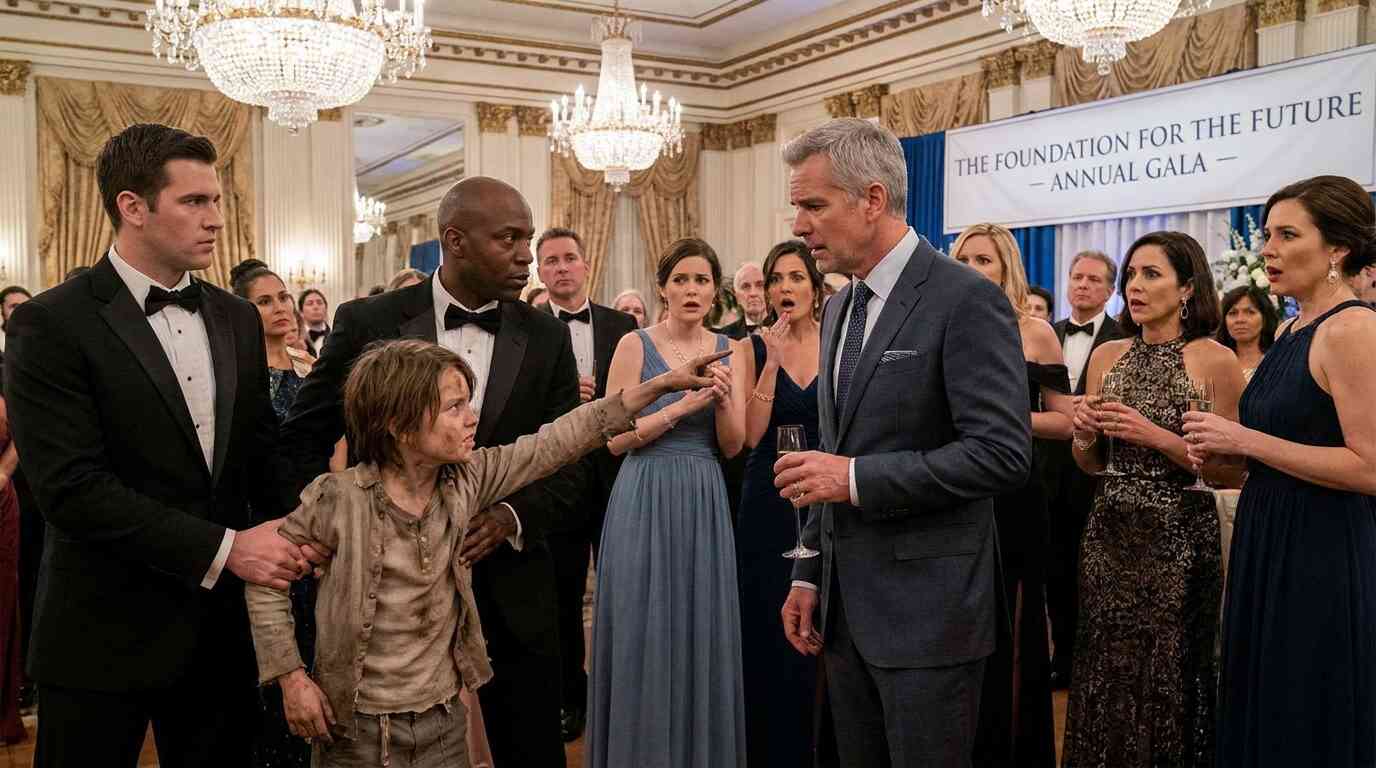
The banners overhead read: The Vance Foundation Annual Gala—Building a Brighter Tomorrow. Beneath them sat Julian Vance, the city’s favorite billionaire savior, smiling for the cameras. He was a man whose teeth were too white, whose hands were too clean, and whose conscience had been bought and paid for a long time ago. He was toasted by senators and models, a king on a temporary throne of stolen lives.
Leo didn’t hesitate. He didn’t look at the crystal chandeliers or the women in silk gowns who pulled their skirts away as he passed. He walked with a heavy, deliberate stride that didn’t belong to a child. His boots left wet, brown smears on the pristine Persian rug. The room began to quiet, the laughter dying in throats as the high-society crowd noticed the living, breathing defect in their perfect evening.
“Hey! Kid! Get the hell out of here!” A security guard, built like a brick wall in a tailored tuxedo, moved fast from the perimeter. His name was Marcus, a man paid to keep the unpleasant parts of reality away from people who could afford to ignore them. Marcus reached out, his massive hand aiming for Leo’s collar, ready to throw him into the freezing alley like garbage.
But Leo didn’t run. He didn’t flinch. He accelerated, darting between two velvet-covered chairs, his small body moving with the desperate agility of a stray dog. He hit the center aisle, the distance between him and the head table shrinking to zero. Julian Vance was mid-sip, raising a glass of vintage champagne, laughing at a joke made by a city councilman.
Marcus caught up at the edge of the dais. His heavy hand slammed onto Leo’s shoulder, crushing the boy’s frail frame down, twisting him around to drag him out. The pain flared hot in Leo’s collarbone, but he didn’t cry out. He dug his heels into the hardwood, his small face twisting into an expression of pure, unadulterated fury. He looked up at the stage, his voice cutting through the soft violin music.
“You don’t own the truth!” Leo screamed, his voice cracking but carrying an weight that made the entire room freeze. Marcus frozen for a fraction of a second, shocked by the sheer ferocity in a ten-year-old’s chest. The champagne glass in Julian Vance’s hand stopped mid-air. The billionaire’s smile didn’t fade; it crystallized into something rigid and unnatural.
Beside Julian sat his daughter, Clara Vance. She was twenty-four, dressed in a soft emerald gown, her eyes wide and clear. Unlike her father, she hadn’t learned how to turn her heart into stone yet. She looked at the ragged boy, then at the sudden, violent tension in her father’s shoulders. She felt a cold dread drop into her stomach.
Clara turned toward her father, her hand reaching out to touch his sleeve, her voice trembling but clear enough for the front tables to hear. “Look at his eyes, Dad,” she whispered. She saw the resemblance before anyone else did. She saw the familiar slate-gray color of the iris, the specific curve of the jawline. It was like looking at an old, ruined photograph of her own family.
Julian didn’t look at his daughter. He was staring at Leo, his face draining of color, turning the shade of old parchment. The security guard recovered, pulling Leo back with enough force to lift his feet off the ground. The boy was losing his grip on the moment, his small fingers slipping from the edge of the billionaire’s reality.
With every ounce of strength left in his malnourished body, Leo wrenched his arm free for one final, desperate second. He lunged forward, pointing his trembling, dirt-caked finger directly at Julian Vance’s chest. The entire room held its breath.
“Ask him about my mother!” Leo screamed, the words tearing from his throat like broken glass.
The silence that followed was absolute. The camera flashes stopped. The violins ceased. Julian Vance’s hand shook, just enough for a single drop of champagne to spill onto his white linen cuff, spreading like a drop of pale venom. His eyes widened in terror, his pupils dilating as he stared at the boy from the slums who carried his dead past in his face.
Full story in the first comment…
👇If you don’t see the new chapter, tap “All comments”.
FULL STORY
Chapter 2
The silence in the Grand Ballroom didn’t break; it shattered. For three agonizing seconds, the only sound was the low, rhythmic hum of the hotel’s ventilation system. Julian Vance sat paralyzed, the drop of spilled champagne on his cuff sinking into the fabric, turning cold against his wrist. His mind, usually a hyper-efficient machine of public relations and corporate strategy, was a white noise of panic. He looked at the boy’s face—those slate-gray eyes, the slight asymmetry of the jaw—and felt the floor beneath his expensive Italian leather shoes begin to give way.
“Get him out,” Julian whispered. The words were faint, barely carrying past his own lips, but Marcus heard the underlying desperation. The security guard didn’t just pull Leo this time; he hoisted the boy by his jacket, turning him around to carry him toward the service exit like a sack of unwanted laundry.
“Let go of me! Ask him!” Leo kicked his legs, his small fists striking Marcus’s broad chest to no avail. “He knows her name! He knows what he did to Sarah!”
The mention of the name Sarah acted like an electric shock to Julian. He stood up so quickly his heavy oak chair scraped against the marble floor with a piercing shriek. The guests at the surrounding tables—CEOs, politicians, old-money matriarchs—watched with an uncomfortable mixture of fascination and horror. They were people who dealt in rumors, but this was a public execution of a reputation.
Clara Vance stood up beside her father, her hand still hovering in the air where his arm had been. Her heart was hammering against her ribs. She looked at her father’s face, searching for the righteous anger he usually displayed when confronted by the city’s injustices. Instead, she found a mask of grey, sweaty terror. “Dad?” she asked, her voice low and tight. “Who is Sarah?”
“Nobody,” Julian snapped, his voice sharp enough to draw blood. He didn’t look at her. “An unstable woman from an old project site. A professional agitator. The boy is being used by our competitors to ruin the foundation’s night. Sit down, Clara.”
But Clara didn’t sit down. She watched Marcus drag the boy through the heavy double doors into the back corridors of the hotel. The boy’s voice lingered in the room long after the doors clicked shut, an echo that refused to settle. She looked around the ballroom. The atmosphere had changed from celebratory to predatory. The whispers were starting, a low, buzzing hive of speculation.
Julian turned to the microphone at the center of the dais, clearing his throat. His professional mask was slipping back into place, though the edges were frayed. “Ladies and gentlemen, I apologize for the disruption,” he said into the mic, his voice echoing with a forced warmth. “As you know, our work in the lower districts often brings us into contact with individuals experiencing severe mental health crises. The Vance Foundation remains committed to helping every citizen, even those who express their pain through anger. Let us continue the evening.”
The applause that followed was polite, sparse, and entirely unconvincing.
Meanwhile, in the cold, concrete service corridor behind the ballroom, Marcus slammed Leo against the wall. The air was thick with the smell of old grease and industrial bleach. “Listen to me, you little rat,” Marcus growled, his face inches from Leo’s. “You don’t come back here. You don’t say another word about Mr. Vance. If I see your face within three blocks of this hotel again, I won’t just throw you out. I’ll make sure the city’s social services put you in a place where nobody will ever hear you scream. Do you understand me?”
Leo spit. A small, dark glob of saliva landed on Marcus’s lapel. The guard’s face went purple with rage, and he raised his hand, his fingers curling into a heavy fist.
“Touch him, and I’ll have you fired before you can clear your locker,” a voice cut through the hallway.
Marcus froze, his hand suspended in mid-air. He looked up to see Clara Vance standing under the harsh fluorescent light of the corridor. Her green gown was a brilliant, ridiculous contrast against the stained concrete walls. Her hands were clenched at her sides, her posture rigid.
“Miss Vance,” Marcus said, slowly lowering his hand, his tone shifting into something resembling respect. “The boy is a trespasser. He’s dangerous. Your father wants him cleared from the property immediately.”
“I don’t care what my father wants right now,” Clara said, walking down the hall toward them. Her heels clicked loudly, a rhythmic, terrifying sound in the narrow space. She stopped two feet away from Leo. Up close, she could smell the boy—he smelled of woodsmoke, cheap damp wool, and the distinct, metallic tang of poverty. But she also saw his eyes. They were the exact same shade as her grandmother’s portraits in the Vance estate.
“Leave us, Marcus,” Clara commanded.
“But Mr. Vance said—”
“I am the Vice Chair of this foundation, Marcus,” she said, her voice dropping into a dangerous, quiet register that she had inherited directly from her father. “And I am telling you to go back to the ballroom and secure the perimeter. Now.”
Marcus hesitated, looking between the wealthy heiress and the ragged boy. Finally, he clicked his tongue, straightened his tuxedo jacket, and walked back toward the ballroom doors, leaving a heavy, tense silence behind him.
Clara sank down until she was at eye level with Leo. The silk of her dress pooled onto the dirty floor, but she didn’t seem to notice. “What’s your name?” she asked softly.
Leo stared at her, his posture defensive, his back pressed hard against the concrete wall. He didn’t trust her. She looked like the people who lived in the towers—the people who looked through him on the street like he was made of glass. “Leo,” he muttered.
“Leo,” Clara repeated, testing the weight of it. “You said a name in there. You said Sarah. Who is she?”
“She’s my mom,” Leo said, his voice cracking. He wiped his nose with the back of his dirty sleeve. “And your dad killed her.”
Clara flinched as if she’d been struck. “That’s… that’s a terrible thing to say, Leo. My father is a good man. He builds housing, he funds hospitals. He doesn’t kill people.”
“He did,” Leo insisted, his slate-gray eyes flashing with a sudden, old hatred that didn’t belong in a child’s face. “He killed her ten years ago. He buried her under his buildings, and then he paid everyone to forget she ever lived. But I didn’t forget. And she left me his name.”
From his pocket, Leo pulled out a small, crumpled piece of paper, its edges yellowed and torn. He held it out to Clara like a weapon. “She told me if I ever needed him to look at me, I should show him this.”
Clara took the paper with a trembling hand. She unfolded it under the flickering fluorescent bulb. It wasn’t a legal document or a letter. It was a receipt from a private clinic in upstate New York, dated ten years ago. It was an intake form for a patient named Sarah Thomas. And at the bottom, under the line for the party responsible for the bill, was a signature she had seen thousands of times on her own college tuition checks, on her trust fund documents, on everything she owned.
It was Julian Vance’s signature, written in his signature bold, blue ink.
Chapter 3
The rain had turned into a sleet that stung the face like needles by the time Clara walked out of the Plaza’s side exit. She had smuggled Leo out through the kitchen, wrapped in an oversized wool coat she’d taken from the employee cloakroom. She couldn’t take him to her apartment—not yet. Her father had security cameras on every property he owned, and if he knew she had the boy, the boy would disappear into the system before she could get an answer.
Instead, she drove her small, unassuming sedan down toward the docks of Brooklyn, where the air smelled of salt and rusted iron. Beside her, Leo sat perfectly still, his eyes fixed on the windshield wipers clearing the sleet. He was holding a half-eaten ham sandwich she’d grabbed from the catering trays. He ate with a slow, mechanical precision, like a person who didn’t know when the next meal would arrive and was determined to make this one last.
“Where do you live, Leo?” Clara asked, keeping her eyes on the slick road.
“Nowhere fixed,” Leo said, his mouth full. “Since the shelter burned down in October, I stay with Thomas. He’s an old guy. He has a cabin near the rail yard.”
“And your mother? Sarah?”
Leo’s fingers tightened around the remaining crust of his sandwich. “She died when I was born. Thomas says she was beautiful. He says she had eyes like mine. He was her neighbor back when the old tenements were still standing on 4th Street. Before the Vance Group bought the block.”
Clara felt a cold knot tighten in her throat. The 4th Street redevelopment project was the cornerstone of her father’s legacy. It was the project that had transformed a crumbling, dangerous immigrant neighborhood into Vance Square—a luxury high-rise district that funded the family’s philanthropy. She had been fourteen when it was built, and she remembered her father being hailed as a visionary who had cleaned up the city.
“Your father told her she had to leave,” Leo said, his voice flat, devoid of the childhood wonder most kids his age had. “But she wouldn’t. She had a lease, and she was pregnant with me. Thomas said your father came to the apartment himself one night. Not with lawyers. Just him. He wanted to buy her out, but she wouldn’t take the money. She told him some things couldn’t be bought.”
“And then what happened?” Clara’s voice was barely a whisper.
“The next week, the building caught fire,” Leo said. He turned his head to look at her, his gray eyes piercing through the shadows of the car. “Thomas pulled her out, but she was burned bad. She had me in the hospital, and then she died. The police said it was an accident. An old space heater. But Thomas says the building didn’t have space heaters. It had steam.”
Clara pulled the car over to the curb, the tires splashing into a deep puddle. She couldn’t breathe. The image of her father—the man who kissed her forehead before every board meeting, the man who had built a library in her mother’s memory—standing in a dark tenement room threatening a pregnant woman was impossible to reconcile. It was a monster from a fairy tale.
“Leo,” she said, turning in her seat. “The receipt you gave me. It’s for a clinic. If she died in the hospital after you were born, why did my father pay for a clinic?”
Leo shook his head. “I don’t know. Thomas gave me the paper before he got sick last month. He told me if things got too hard, I should go find the man who signed it. He said the man owed me a life.”
Clara’s phone began to vibrate in the center console. The screen lit up with her father’s name: Julian Vance. It vibrated against the plastic, a persistent, angry sound that seemed to demand submission. She stared at it for a long time before she picked it up and swiped to answer.
“Clara,” her father’s voice came through the speaker, crisp, controlled, and entirely lacking the panic from the ballroom. “Where are you? Security says you left through the back with the child.”
“I’m taking him to a safe place, Dad,” Clara said, her voice steadier than she felt.
“Bring him back to the office, Clara,” Julian said, his tone shifting into that parental authority that allowed no argument. “The boy is troubled, and his handlers are dangerous. You are putting yourself in jeopardy. We have specialists who can handle this. We will ensure he gets the medical care and housing he needs, but it must be done through the proper channels. Do you understand?”
“Did you know her, Dad?” Clara interrupted, her heart pounding. “Sarah Thomas. Did you know her?”
There was a long pause on the other end of the line. The sound of Julian’s breathing was heavy, deliberate. When he spoke again, the warmth was completely gone, replaced by a cold, corporate steel. “Clara, you are playing with things you don’t understand. The Vance Foundation supports everything you enjoy—your apartment, your education, your charities. That wealth wasn’t built by giving into every street hustler with a sob story. Come home. Now.”
The line went dead.
Clara looked at the dark screen, then at Leo, who was watching her with an old, knowing expression. “He’s coming for us, isn’t he?” the boy asked.
Clara put the car back into drive. “Not if we find the truth first,” she said. She looked at the receipt in her hand. The clinic was called The Pines. It was located in Beacon, New York, about an hour and a half north of the city. “We’re going for a drive, Leo.”
Chapter 4
The Pines had been abandoned for five years, a victim of state budget cuts and shifting corporate priorities. It sat on a hill overlooking the Hudson River, a gray stone Victorian mansion that had been converted into a private psychiatric facility before being left to the crows. The windows were boarded up with plywood, and the iron gates were chained shut, covered in rusted signs that read: PROPERTY OF THE STATE – NO TRESPASSING.
Clara parked her sedan half a mile down the road, hiding it behind an overgrown thicket of pines. The sleet had stopped, leaving behind a heavy, freezing fog that muffled the sound of their footsteps as she and Leo climbed the hill. She carried a heavy flashlight she’d found in her trunk, its beam cutting a yellow path through the gray mist.
“Why would my mom be here?” Leo asked, his teeth chattering against the cold. He was small, his breaths coming in white plumes.
“I don’t know,” Clara said, helping him over a section of the collapsed stone wall. “But if my father paid for her to be here, there has to be a record. These places always keep files, even after they close. They’re required by law to store them for twenty years.”
They found a basement window with the plywood pried away—likely the work of local teenagers or copper thieves. Clara went first, dropping down into the damp, moldy darkness of the lower level. The floor was covered in two inches of stagnant water that smelled of rot and old paper. She reached up and lifted Leo down, his small weight balanced against her hands.
The flashlight beam swept over rows of rusted metal filing cabinets, their drawers pulled open and cleared out. Her heart sank. “They’re empty,” she whispered.
“Not all of them,” Leo said, pointing his finger toward the back of the room. Behind a rusted boiler sat a heavy, fireproof safe, its door slightly ajar. It was too heavy for scavengers to move, and too difficult for teenagers to open, but someone had left it unlocked.
Clara hurried over, her boots splashing through the water. She pulled the heavy iron door open. Inside were three thick, leather-bound ledgers and a handful of manila folders protected from the damp by the thick steel walls. She pulled the folders out, her fingers slick with old dust.
The first folder was empty. The second contained financial records from 2015. The third had a single name label dymo-taped to the tab: THOMAS, SARAH.
Clara’s hands shook so violently she almost dropped the file into the water. She opened it on top of the safe, the flashlight beam illuminating the yellowed pages.
It wasn’t an admission form for mental illness. It was a non-disclosure agreement and a medical power of attorney. The document stated that Sarah Thomas had been admitted to The Pines under an assumed name after sustaining severe injuries in a fire on October 14th, 2016.
“She didn’t die in the hospital, Leo,” Clara whispered, reading the medical charts. “She survived the fire. She lived for six months after you were born.”
“But Thomas said she died right away,” Leo said, his voice small and confused.
Clara turned the page, and her breath caught in her throat. There was a letter attached to the medical records, written on the official letterhead of The Vance Group. It was addressed to the Director of The Pines, signed by Julian Vance.
Director Evans,
As per our verbal agreement, patient Sarah Thomas is to remain in the secure wing under continuous sedation. Under no circumstances is she to have contact with the outside world, specifically the child or the neighbor, Thomas Vance. Her condition must be reported as fatal to the public registry. The enclosed check should cover the facility’s expansion for the coming fiscal year. Ensure the records are sealed permanently.
– J.V.
Clara stumbled back against the rusted boiler, the flashlight beam dancing wildly across the ceiling. Her father hadn’t just threatened a pregnant woman. He had trapped her. He had faked her death, hidden her in an asylum under sedation, and paid to keep her a prisoner while he built his empire on top of her ruined life.
“Clara?” Leo asked, his voice terrified by the look on her face. “What does it say?”
Before she could answer, a bright, blinding light cut through the basement window, pinning them both against the wall.
“I told you to come home, Clara,” a voice boomed from the opening, distorted by the stone walls but instantly recognizable.
Julian Vance stood outside the window, flanked by Marcus and two other men in dark coats. The billionaire’s face was obscured by the glare of his flashlight, but his silhouette was immense, blocking out the gray light of the winter morning.
“You took something that doesn’t belong to you,” Julian said, his voice cold and flat. “Both of you.”
Chapter 5
The drive back to the city was silent, but it wasn’t the silence of safety. Clara and Leo were in the back of Julian’s luxury SUV, the doors locked from the console in the front where Marcus sat at the wheel. Julian sat across from them on the leather bench, his face illuminated by the passing streetlights as they entered the upper grid of Manhattan.
The folders were in Julian’s lap, his long, manicured fingers resting on the leather cover as if it were nothing more than a quarterly financial report.
“Why, Dad?” Clara asked. She wasn’t crying; her grief had burned off, leaving behind a cold, hard anger that mirrored her father’s own demeanor. “She was twenty-two years old. She was pregnant. You had millions. Why did you have to destroy her?”
Julian looked out the tinted window at the city skyline. The Empire State Building was lit up in brilliant blue and gold—the colors of the Vance Foundation gala. “You think this city is built on good intentions, Clara?” he asked, his voice low and conversational. “You think the parks you walk in and the museums you visit are paid for by kindness?”
He turned to look at her, his gray eyes devoid of any emotion. “The 4th Street project was everything. If that project failed, the Vance Group would have gone under. We owed forty million to the banks. Sarah Thomas had a rent-controlled lease and a stubborn streak that would have dragged us into court for years. The fire… the fire was an accident caused by an old radiator, just like the police report said. I didn’t order it.”
“But you used it,” Clara said.
“I found her in the hospital,” Julian admitted, his voice dropping an octave. “She was burned, she was dying, and she had just given birth to him.” He pointed a finger at Leo, who sat pressed against Clara’s side, his small body rigid with fear. “She looked at me and said she would spend her last breath making sure the world knew what my company did to that block. She was going to destroy everything I had built before it even started.”
“So you buried her alive,” Leo said, his voice trembling but clear.
Julian looked down at the boy, a slight, cruel twist at the corner of his mouth. “I gave her the best medical care available at the time. I paid for her comfort. And I protected this family. I protected you, Clara. Everything you have is because I made the hard choice that night.”
“I don’t want it,” Clara said, her voice shaking with disgust. “I don’t want a single cent of your blood money.”
Julian sighed, a sound of profound parental disappointment. “It’s too late for that, Clara. You’ve enjoyed it for twenty-four years. You are as much a part of this machine as I am. And tomorrow, this will all be over. The boy will be placed in an excellent private facility in New England. He will be well cared for, well educated, and entirely silent. And you will return to your duties at the foundation.”
The SUV pulled into the underground garage of the Vance Tower, the heavy iron security gates rolling down behind them with a definitive, metallic crash. They were in his kingdom now, surrounded by concrete and private security. There were no cameras here that he didn’t own, no witnesses he couldn’t buy.
“Get them out,” Julian ordered as Marcus opened the door.
Marcus grabbed Leo’s arm, pulling him from the leather seat. Leo fought back, biting down on Marcus’s wrist. The guard grunted in pain, shaking the boy off with a violent jerk that sent Leo tumbling across the slick concrete floor of the garage.
“Leo!” Clara screamed, lunging out of the car after him. But the second guard caught her, pinning her arms behind her back.
Julian stepped out of the vehicle, smoothing the front of his cashmere coat. He didn’t look back as he walked toward the private elevator that led to his executive suite. “Bring them up to the boardroom,” he said over his shoulder. “Let’s settle this family matter away from the staff.”
As Marcus dragged Leo toward the elevator, Leo managed to reach into his boot, his fingers closing around a small, heavy object he’d found in the basement of The Pines—a rusted brass door handle he’d slipped into his sock when Clara wasn’t looking. With a desperate, wild swing, he slammed the brass into Marcus’s knee.
The guard screamed, his leg giving way, and he dropped to the floor. Leo didn’t run for the exit; he knew the gates were shut. Instead, he ran straight into the private elevator before the doors could close, his small finger slamming the button for the top floor.
“Leo, no!” Clara shouted as the doors slid shut, sealing the boy inside the moving cage alone with Julian Vance.
Chapter 6
The executive boardroom on the 50th floor was an expanse of glass and polished mahogany, overlooking the glittering lights of the Manhattan grid. Julian Vance stood by the floor-to-ceiling windows, his back to the door, a glass of scotch in his hand. He didn’t turn around when the elevator bell dinged, announcing Leo’s arrival.
“You’re a persistent child,” Julian said, his voice echoing in the vast, empty room. “You have your mother’s eyes, but you have her lack of sense, too. You can’t win this, Leo. The world doesn’t care about a boy from the rail yards. They care about the Vance name.”
Leo didn’t answer. He walked slowly into the room, his tattered boots leaving faint, damp outlines on the dark wood floor. He stopped five feet from the billionaire’s back. In his hand, he wasn’t holding the brass handle anymore. He was holding Clara’s phone, which he had snatched from the car’s console during the struggle in the garage.
The screen of the phone was bright, a tiny red dot flashing at the top of the interface.
“You think you can hide everything,” Leo said, his voice small but steady. “But my mom told Thomas something before she went away. She said the truth doesn’t stay under the ground forever. It grows like grass through the concrete.”
Julian turned around, a condescending smile on his face. “A pretty sentiment. But concrete always wins, Leo.” He looked down at the phone in the boy’s hand and his smile froze.
“What is that?” Julian asked, his voice suddenly sharp.
“It’s a live stream,” Clara’s voice came from the doorway. She stood there, her hair disheveled, her emerald gown torn at the shoulder, but her eyes were bright with a fierce, absolute triumph. Marcus and the other guard were behind her, but they weren’t holding her anymore. They were looking at their own phones, their faces pale under the boardroom lights.
“Clara, what have you done?” Julian demanded, taking a step forward.
“I didn’t lock my phone, Dad,” Clara said, walking into the room to stand beside Leo. She placed a hand on the boy’s shoulder, a gesture of solidarity that felt like a shifting of the earth. “Leo’s been broadcasting everything since we left the garage. Every word you said in the car. Every word about the fire, about Sarah, about The Pines. There are four hundred thousand people watching right now. It’s trending on every platform in the city.”
Julian’s scotch glass slipped from his fingers, shattering against the mahogany table, the amber liquid pooling around the broken shards. He reached into his pocket and pulled out his own phone. The screen was a chaotic waterfall of notifications—messages from his legal team, his board of directors, the police chief, the mayor’s office.
The empire hadn’t fallen over years; it had collapsed in ten minutes.
The sound of distant sirens began to rise from the streets below, a faint, rhythmic wailing that grew louder with every passing second, climbing up the fifty stories of glass and steel to find the man who had thought he was above the law.
Julian looked at his daughter, his face old, wrinkled, and suddenly helpless. The corporate titan was gone, replaced by a frightened old man caught in his own trap. “Clara… I did it for us,” he whispered, his voice cracking. “I did it for the family.”
Clara looked at him, her eyes clear and cold, devoid of any hatred, leaving only a profound, empty pity. “You didn’t do it for us, Dad,” she said softly. “You did it for yourself. And now you have to pay the rent.”
She turned away from him, taking Leo’s hand in her own. The boy looked up at her, the old, guarded expression on his face finally melting into something resembling a child’s relief. They walked together toward the elevator, leaving Julian Vance alone in his glass tower, surrounded by the ruins of a legacy built on sand and secrets.
As the elevator doors opened, Leo looked back one last time at the glittering lights of the city that had tried to erase him. He felt the warmth of Clara’s hand holding his, and for the first time in ten years, he felt like he was finally going home.
The truth is a heavy thing to carry alone, but when it is shared, it can lift the world.