
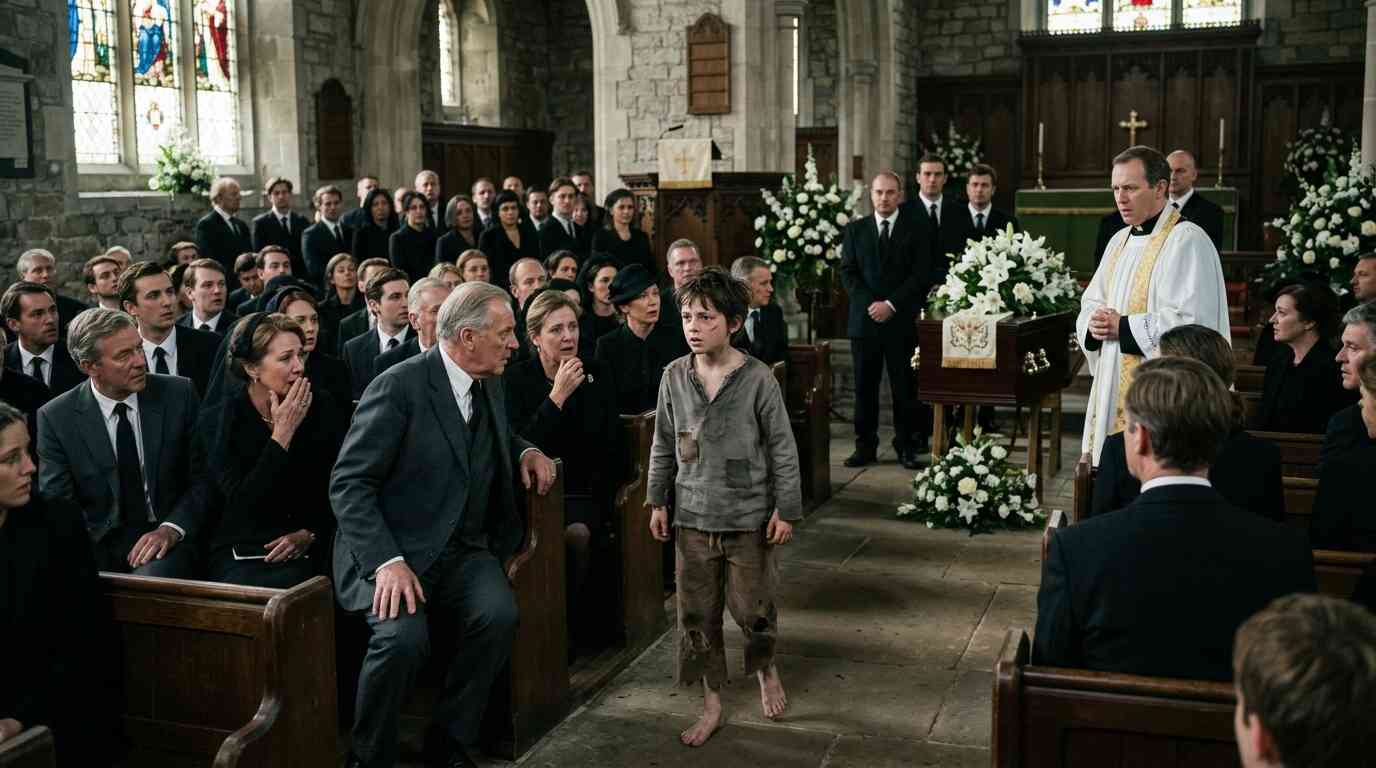
My wealthy stepmother spent twenty years pretending my father’s first family never existed, burying our past under millions of dollars. But when he died, I crashed his high-society Colorado funeral in a ragged coat, holding a single piece of paper that proved the horrifying truth she paid to hide.
The freezing Colorado wind howled against the stained-glass windows of the Grace Chapel, but inside, the air was suffocatingly warm, thick with the scent of white lilies and expensive grief.
Hundreds of people in tailored black wool sat in the pews, their heads bowed in perfect, synchronized mourning. They were there to honor Arthur Sterling, the local real estate mogul, philanthropist, and pillar of the community.
Then, the heavy oak doors at the back of the chapel slammed open.
The icy draft hit the congregation first, making the flames of a hundred scented candles flicker wildly. But it was the sound that made everyone turn—the wet, heavy thud of worn-out snow boots dragging across the pristine marble floor.
I stood in the doorway, trembling, my breath forming pale clouds in the air.
My winter coat was a cheap, threadbare thing from a thrift store, torn at the left shoulder and soaked through with melting sleet. My jeans were frayed, and my hands were raw and red from the biting cold outside.
I looked completely out of place, an ugly stain on a picture-perfect portrait of high-society mourning.
A collective whisper rippled through the pews. Security guards at the perimeter immediately tensed, their hands moving toward their blazers. But I didn’t look at them. My eyes were locked on the front of the church.
There, surrounded by walls of pristine white roses, was a polished mahogany casket. And sitting in the very first row, her posture as rigid as a marble statue, was Eleanor Sterling. My stepmother.
Eleanor slowly turned her head. When her gaze met mine, I saw the instant, terrifying recognition in her eyes, followed immediately by a flash of cold, calculating fury. She didn’t move an inch, but her knuckles turned white as she gripped her designer handbag.
Beside her sat Richard, her twenty-four-year-old son—my half-brother, though he had no idea I existed. He looked at me with a mixture of disgust and confusion, annoyed that some vagrant was ruining his father’s pristine send-off.
I didn’t care about their stares. I didn’t care about the whispers. I clutched a crumpled piece of paper tightly against my chest, the paper I had carried across three state lines, and started walking down the center aisle.
“Miss, you need to leave immediately,” a deep voice whispered harshly to my right. A large security guard stepped into the aisle, blocking my path, his hand coming down firmly on my shoulder.
I didn’t flinch. I didn’t back down. I looked past him, straight at Eleanor, and raised my voice so it echoed off the vaulted ceilings.
“He kept this for twenty years!” I cried out, my voice cracking with a raw, agonizing pain that had been building inside me since I was five years old. “He kept it until the day his heart stopped!”
The chapel fell completely silent. The organ music died with a low, groaning whine.
Pastor Thomas, who had been standing at the pulpit preparing to deliver the eulogy, froze, his Bible held open in his hands. He looked at me, then at Eleanor, sensing the deep, jagged fault line that had just ripped open beneath the sanctuary.
“Remove her,” Eleanor said, her voice low, smooth, and deadly calm, though her chest was heaving. “She is a disturbed young woman. She has no right to be here.”
“I have every right!” I screamed, breaking away from the guard’s grip with a sudden, desperate burst of strength. I ran the remaining steps toward the altar, stopping just feet away from the casket.
With trembling fingers, I unfolded the crumpled paper and held it up high, forcing Eleanor, Richard, and the hundreds of wealthy mourners to see it.
It wasn’t a legal document. It wasn’t a will.
It was a child’s drawing, done in cheap, faded crayons on a piece of construction paper that had turned yellow with age. It depicted a tall man holding the hand of a little girl with messy pigtails, standing outside a tiny blue house. Written at the bottom in clumsy, uneven block letters was: HAPPY BIRTHDAY, DADDY. I LOVE YOU. MAYA.
“He died in a cramped, one-bedroom apartment in a rundown neighborhood in Chicago,” I whispered, the tears finally spilling over my cold-flushed cheeks, dripping onto my torn coat. “While you built this kingdom on his name, he lived in exile. And he died with my name on his lips.”
Eleanor stood up, her face draining of all color, her eyes wide with a terror she couldn’t hide. The secret she had spent two decades and millions of dollars to bury was unraveling in front of the very world she had tried so desperately to impress.
Full story in the first comment…
👇If you don’t see the new chapter, tap “All comments”.
FULL STORY
Chapter 2
The silence in the chapel was deafening, the kind of heavy, suffocating quiet that precedes a violent storm. The hundreds of mourners sat frozen, caught between social decorum and the salacious thrill of a public scandal.
“Maya,” Eleanor said, her voice dropping an octave, adopting the patronizing tone one might use with a dangerous, unstable animal. “You are grieving. We are all grieving. But this is a sacred space, and you are being deeply disrespectful to Arthur’s memory.”
“Disrespectful?” I let out a harsh, bitter laugh that sounded ugly even to my own ears. “You want to talk about respect, Eleanor? Let’s talk about twenty years ago. Let’s talk about the night you arrived at our small apartment in Chicago while my mother was working the night shift at the hospital.”
Richard stood up beside his mother, his youthful face twisted in a scowl. He was tall, athletic, and wore a custom-tailored suit that probably cost more than my entire year of rent. He had Arthur’s jawline, but his eyes possessed the cold, elitist calculation of his mother.
“Hey, lady, I don’t know what kind of scam you’re trying to pull,” Richard barked, stepping into the aisle to shield Eleanor. “But my father was a good man. He didn’t have another family. You’re delusional. Get her out of here!” He snapped his fingers at the security guards, who were now moving in quickly from both sides.
“Richard, wait,” Pastor Thomas intervened, stepping down from the altar. He was an older man with kind, tired eyes, a long-time family friend of the Sterlings who had seen the town grow from a sleepy ski village into a playground for billionaires. He looked at the faded drawing in my hands, then at my face, searching for a resemblance. “Let’s handle this quietly in the back. Miss, if you have a claim—”
“I don’t want his money!” I shouted, backing away so the guards couldn’t grab me, keeping my back to the mahogany casket. “I wanted my father! But she made sure I could never have him!”
I pointed the crumpled drawing directly at Eleanor. The paper shook violently in my hand.
“Twenty years ago, Arthur Sterling wasn’t a real estate mogul. He was a struggling contractor who came to Colorado for a six-month project,” I told the crowd, my voice echoing off the stained glass. “He promised my mother and me that he would send for us as soon as he established a foothold. But then he met you, Eleanor. The daughter of the town’s wealthiest developer.”
Eleanor’s facade finally began to crack. A tight, ugly line formed around her mouth, and her eyes darted to the sides, realizing the chapel’s acoustics were carrying every word perfectly to the local reporters sitting in the back rows.
“Arthur made a mistake,” I continued, the memories flooding back, sharp and agonizing. “He had an affair with you. And when you got pregnant with Richard, your father gave Arthur an ultimatum: marry Eleanor and inherit the development empire, or go back to Chicago to his penniless wife and child and be blacklisted from the construction industry forever.”
“That’s a lie!” Eleanor hissed, her composure slipping. “Arthur loved me. We built this life together!”
“He chose the money,” I whispered, the old, familiar ache squeezing my heart. “But he wanted to come back for me. He tried to arrange joint custody. He wanted to be a father to both of his children. But that didn’t fit your perfect narrative, did it, Eleanor? You couldn’t handle the scandal of a ready-made family in Chicago.”
I took a step closer to her, ignoring the guards who were now hesitantly waiting for Eleanor’s command.
“So you gave him your own ultimatum,” I said, looking her dead in the eye. “You told him that if he ever contacted my mother or me again, you would use your father’s wealth to ruin him, and you would take Richard away so he would never see him either. You bought his silence. You bought his absence. You paid off his debts in Chicago, settled a lump sum on my mother through an anonymous corporate shell company on the condition of absolute non-contact, and forced him to sign away his parental rights.”
A gasp echoed through the middle rows of the congregation. Sarah Jenkins, Eleanor’s closest social rival, leaned forward, her eyes wide with predatory delight.
“Mom?” Richard looked down at his mother, his brow furrowed, a seed of doubt suddenly planting itself in his chest. “What is she talking about? Dad didn’t… he wouldn’t do that.”
“She’s a liar, Richard,” Eleanor said, her voice trembling with a mixture of rage and panic. “She’s an extortionist trying to capitalize on a tragedy. Guards, I said remove her now! Use force if you have to!”
The two guards lunged forward, grabbing my arms. The faded drawing slipped from my fingers, fluttering through the air before landing face-up on the polished marble floor, right at Richard’s feet.
As they dragged me backward down the aisle, my boots scuffing against the stone, I didn’t fight them. I kept my eyes locked on my half-brother.
“Look at the drawing, Richard!” I screamed as the cold air of the vestibule hit my face. “Look at the back of it! Look at the date! It’s the day he left us! He kept it in his desk for twenty years because his guilt was the only thing you couldn’t buy from him!”
The heavy oak doors slammed shut in my face, cutting off my screams, plunging me back into the freezing, snowy reality of the Colorado winter.
Chapter 3
The wind outside the chapel cut through my threadbare coat like a thousand tiny needles, but the fire burning in my chest kept me from collapsing. I sat on the frozen stone steps of the church, my knees pulled to my chest, shivering uncontrollably.
I had no money for a hotel. I had spent my last forty dollars on a Greyhound bus ticket from Chicago to Aspen, driven by a desperate, irrational need to see the man who had abandoned me, even if he was in a box. When I saw his obituary online—Arthur Sterling, Visionary Developer, Leaves Behind Devoted Wife Eleanor and Son Richard—something inside me had snapped. My mother had passed away three years prior from cancer, spending her final days in a cramped, underfunded hospice care facility, still carrying the quiet, dignified heartbreak of a woman discarded.
The heavy wooden doors behind me clicked open.
I braced myself, expecting the security guards to throw me off the property entirely, but when I turned my head, I saw Richard standing in the doorway. He didn’t have his coat on. He stood in his expensive suit, the snow falling softly onto his styled hair, melting instantly. In his right hand, he held the faded crayon drawing.
He walked down the steps slowly, as if approaching a unexploded bomb. He sat down on the frozen stone a few feet away from me, staring out at the snow-covered luxury SUVs filling the parking lot.
“The back of the paper,” Richard said, his voice hollow, stripped of the arrogance he had displayed inside the sanctuary. “It has a notary stamp from a Chicago bank. Dated November 14th, 2006. The exact day my mother and father got married in this town.”
I didn’t say anything. I just watched him, watching the realization shatter his world the same way it had shattered mine a lifetime ago.
“I grew up thinking my father was a saint,” Richard continued, his knuckles whitening around the paper. “He built parks. He funded hospitals. He never missed a single one of my hockey games. But whenever I asked him about his life before Aspen, he would just… shut down. He’d look out the window with this look in his eyes, like he was looking at a ghost. I never understood it until now.”
“He was a coward,” I said, my voice hoarse from crying and the freezing air. “He chose a life of luxury over his own flesh and blood. He let my mother work herself to death, and he let me grow up wondering what was so wrong with me that my dad didn’t want me.”
“He didn’t choose it because it was easy,” Richard whispered, looking at me, really looking at me for the first time. I could see the conflict in his eyes—the agonizing pain of realizing his entire life of privilege was funded by the destruction of mine. “My mother… her family owned this entire valley back then. If my dad had walked away from her, her father would have destroyed him. He would have been blacklisted, sued into bankruptcy, and he never would have been allowed to see me. My mother told him that. I found her old journals in the attic last year, but I didn’t understand the entries. She wrote about ‘eliminating the loose ends in Chicago.’ I thought she meant a bad business deal.”
“I wasn’t a business deal,” I said, a tear freezing on my cheek. “I was his daughter.”
“I know,” Richard said softly. He looked down at the drawing of the little girl with pigtails. “You have his eyes, you know. I always wondered why my eyes were green when both my mother and her parents had blue eyes. My dad had green eyes. Just like yours.”
Before I could respond, the chapel doors opened again, and Eleanor stepped out, wrapped in a lavish mink coat that contrasted sharply with my torn jacket. Her face was a mask of cold, imperious rage as she looked at the two of us sitting together on the steps.
“Richard, get inside this instant,” she commanded, her voice cutting through the snowy quiet. “The reception is starting, and our guests are asking questions. We have a reputation to protect, and I will not have you fraternizing with this… this person.”
Richard slowly stood up, but he didn’t move toward her. He stood between Eleanor and me, his posture defiant.
“A reputation, Mom?” Richard asked, his voice shaking with a dangerous mixture of grief and anger. “Is that all you care about? Our entire life is a lie. Dad had a daughter. He had a wife. And you forced him to abandon them.”
“I did what was necessary to protect our family!” Eleanor snapped, taking a step down the stairs, her expensive boots crunching loudly on the snow. “Arthur was nothing before he met me. A penniless laborer. I gave him a kingdom. I gave you a future. Do you think you’d be going to Dartmouth, driving a Porsche, and inheriting a multi-million dollar firm if he had stayed in a slum in Chicago? I saved him from mediocrity!”
“But you couldn’t save him from the guilt, could you?” I said, standing up to face her, my body trembling but my gaze steady. “Is that why he started drinking heavily five years ago, Eleanor? Is that why he spent his final years locked in his study, refusing to look at you?”
Eleanor froze, her eyes widening slightly, a direct hit to her armor. She looked at me with pure, unadulterated hatred, the mask completely slipping away to reveal the cruel, desperate woman underneath.
Chapter 4
“You know nothing about my marriage, you ungrateful little brat,” Eleanor said, her voice dropping to a vicious, venomous whisper. She stepped closer, her expensive perfume battling the crisp mountain air. “Your mother took the money. She signed the agreement. She chose the cash over Arthur, so don’t you dare play the saint here.”
“She took the money because she was drowning in medical debt after I got pneumonia, and she didn’t have health insurance!” I screamed back, the anger exploding out of me. “She took it because your high-priced lawyers told her that if she didn’t, you would tie her up in court until she went completely bankrupt, and she’d lose custody of me anyway! She did it to protect me from you!”
The parking lot was no longer empty. Several high-profile guests had lingered near their cars, pretending to look at their phones but openly eavesdropping on the family meltdown happening on the church steps.
Pastor Thomas stepped outside, holding a warm coat, which he gently placed over my shivering shoulders. He looked at Eleanor with a profound, sorrowful disappointment.
“Eleanor, enough,” the pastor said softly. “The truth has a way of coming to light, no matter how much concrete you pour over it. You cannot bury a human being’s soul.”
“Don’t preach to me, Thomas,” Eleanor snapped, turning her wrath on the priest. “My father built this church. My family pays your salary. You will mind your own business.”
“This is my business,” Pastor Thomas replied calmly. “Arthur came to me two weeks before his heart attack, Eleanor. He confessed everything. He told me about the secret bank account he kept, the one he was using to try and track Maya down after all these years. He wanted to change his will. He wanted to make things right.”
Eleanor’s breath hitched. Her face turned a sickly shade of gray beneath her expensive makeup. “He… he wouldn’t. He didn’t have the courage.”
“He did,” Pastor Thomas said, pulling a sealed manila envelope from inside his jacket pocket. “He left this in my care. He told me that if anything happened to him before he could find her, I was to give it to Maya. I didn’t know who she was until she walked into my sanctuary today.”
Richard stared at the envelope, then at his mother. “Mom… did you know about this?”
Eleanor didn’t answer. Her eyes were locked on the envelope in the pastor’s hand, her hands twitching at her sides as if she wanted to rip it away and burn it in the snow.
“He loved you, Maya,” Pastor Thomas said, turning to me and handing me the envelope. “He was a weak man who made a terrible, cowardly choice when he was young, and he spent the rest of his life trapped in a golden cage of his own making. But he never forgot you.”
With trembling, frostbitten fingers, I tore open the envelope. Inside was a thick stack of legal documents—a newly drafted amendment to Arthur Sterling’s estate, signed and witnessed just days before his death, allocating half of his personal wealth, properties, and a trust fund directly to Maya Sterling of Chicago. But more importantly, wrapped around the documents was a handwritten letter on his personal stationery.
To my dearest Maya, the letter began, the elegant script shaky and uneven. If you are reading this, it means I was too late to look you in the eye and beg for your forgiveness. I sold my soul for a life I thought I wanted, and I have lived in hell ever since…
I clutched the letter to my chest, sobbing openly, the heavy weight of twenty years of feeling unwanted suddenly lifting, replaced by a devastating, beautiful grief. He hadn’t forgotten me. I wasn’t a mistake.
Eleanor watched me, her empire crumbling around her feet in the Colorado snow. She knew that the document in my hands would not only cost her half of the fortune she had sacrificed her humanity to protect, but it would also expose her to the entire community as the architect of a family’s ruin.
“This isn’t over,” Eleanor whispered, her voice cracking as she backed away toward her waiting limousine. “My lawyers will tie this up in probate for years. You won’t see a dime of my family’s money.”
“It was never about the money, Eleanor,” I said loudly, looking at her with pity rather than anger. “You can keep the houses, the cars, and the millions. I have the only thing that actually belonged to him.” I held up the crayon drawing and the handwritten letter. “I have his truth. And you have nothing but a beautiful lie.”
Chapter 5
The weeks following the funeral were a whirlwind of legal battles, media scrutiny, and emotional exhaustion. The story of the ragged girl who crashed Aspen’s wedding-of-the-century equivalent funeral spread through the tight-knit mountain community like wildfire. The local newspapers ran front-page stories about the hidden past of Arthur Sterling, and the pristine reputation Eleanor had spent decades cultivating evaporated overnight.
I stayed in a small, quiet motel on the outskirts of town, funded by a small cash advance from Pastor Thomas’s personal savings, which he insisted I take. Every day, Eleanor’s corporate lawyers called me, offering increasingly large settlement amounts if I signed a non-disclosure agreement and left Colorado forever.
Every day, I tore the offers up.
One evening, a soft knock came at my motel door. When I opened it, I found Richard standing there, wearing a simple flannel shirt and jeans, looking exhausted. The arrogant boy from the chapel was completely gone; in his place was a young man who looked like he hadn’t slept in weeks.
“Can I come in?” he asked quietly.
I stepped aside, nodding. He sat down on the edge of the cheap mattress, looking around the modest room.
“I left the house,” Richard said, his voice barely above a whisper. “I moved out of the estate. I couldn’t stand looking at my mother anymore. Every time she speaks, all I hear is the sound of her threatening a desperate woman in Chicago twenty years ago.”
“Richard…” I began, sitting in the room’s single armchair. “You don’t have to ruin your life because of what your parents did. You didn’t know.”
“But I benefited from it, Maya,” he said, looking up at me, his green eyes filled with tears. “Every luxury I ever had—my private schooling, my trips abroad, my trust fund—it was all paid for with the stolen years of your life. While I was opening expensive Christmas presents, you and your mom were choosing between heating and groceries. How am I supposed to live with that?”
“By being better than them,” I said softly. “Our father spent his whole life hiding from his mistakes. He let fear dictate his choices. You have a choice right now. You can either let the guilt consume you, or you can use your life to build something real.”
Richard pulled a small, black velvet box from his pocket and set it on the nightstand. “My dad left a personal safe in his office that only I had the combination to. My mother didn’t know it existed. Inside, there was a piece of jewelry. A simple silver locket with a picture of a little girl inside. It was you.”
He looked at me, a sad, genuine smile breaking through his exhaustion. “He wanted you to have it. And I wanted to tell you that I instructed my mother’s lawyers today that I will not participate in any lawsuit against you. If you contest the will, I will stand in court and testify on your behalf. Half of the estate belongs to you, Maya. It’s justice.”
“Thank you, Richard,” I said, my voice thick with emotion. I reached out and took his hand. It was the first time I had ever willingly touched a member of my father’s second family, and instead of anger, I felt a profound, healing warmth. We were both victims of the same tragedy, bound by the blood of a man who loved us both but lacked the strength to show it.
Chapter 6
Six months later, the legal battles finally came to a quiet, definitive end. Faced with Richard’s refusal to cooperate and the overwhelming evidence provided by Pastor Thomas, Eleanor Sterling’s legal team surrendered. The amendment to Arthur’s will was validated, and half of the Sterling estate was legally transferred to my name.
Eleanor retreated from public life entirely, selling her share of the development company and moving to a secluded estate in Europe, unable to bear the whispers and judgment of the community she had once ruled with an iron fist. She had her wealth, but she had lost her son, her reputation, and her peace of mind.
I didn’t keep the millions for myself. I used the vast majority of the inheritance to establish the Sarah and Arthur Sterling Foundation, an organization dedicated to providing comprehensive healthcare, housing assistance, and legal aid to single mothers and children struggling in low-income neighborhoods across Chicago. I wanted to make sure that no mother would ever have to choose between her child’s health and her child’s presence again.
On a crisp, clear morning in early June, Richard and I walked up the hill toward the local cemetery overlooking the Aspen valley. The snow had finally melted, replaced by a vibrant carpet of green grass and wild mountain flowers.
We stopped in front of Arthur Sterling’s grave. The headstone was simple, white marble, devoid of the grandiose titles Eleanor had initially planned to carve into it. It simply read: Arthur Sterling — Father.
I knelt down in the soft grass, reaching into my jacket. I pulled out the faded crayon drawing, now preserved in a beautiful, weatherproof acrylic frame. I placed it gently at the base of the headstone, right next to a bouquet of fresh wild lilies.
Richard placed his hand on my shoulder, no longer a stranger, no longer a rival, but my brother.
I looked down at the drawing of the little girl holding her father’s hand, remembering the five-year-old child who had cried herself to sleep for years, wondering why she wasn’t enough to make her daddy stay. I knew now that love wasn’t the problem; fear was. And looking at the beautiful, sprawling valley below, I finally felt a deep, enduring peace.
I reached up, touching the silver locket resting against my collarbone, and smiled through my tears.
“We are finally home, Dad,” I whispered to the mountain wind, knowing that the longest, coldest winter of my life was finally over, and the truth had finally set us all free.



