The marble floor of St. Jude’s Cathedral was ice under my bare feet, but my chest was on fire.
I didn’t care that my jeans were torn at the knees, or that the mud on my shins was dripping onto the pristine stone. I didn’t care about the sea of polished brass, the heavy black veils, or the rows of stoic, decorated men who looked like statues carved from granite.
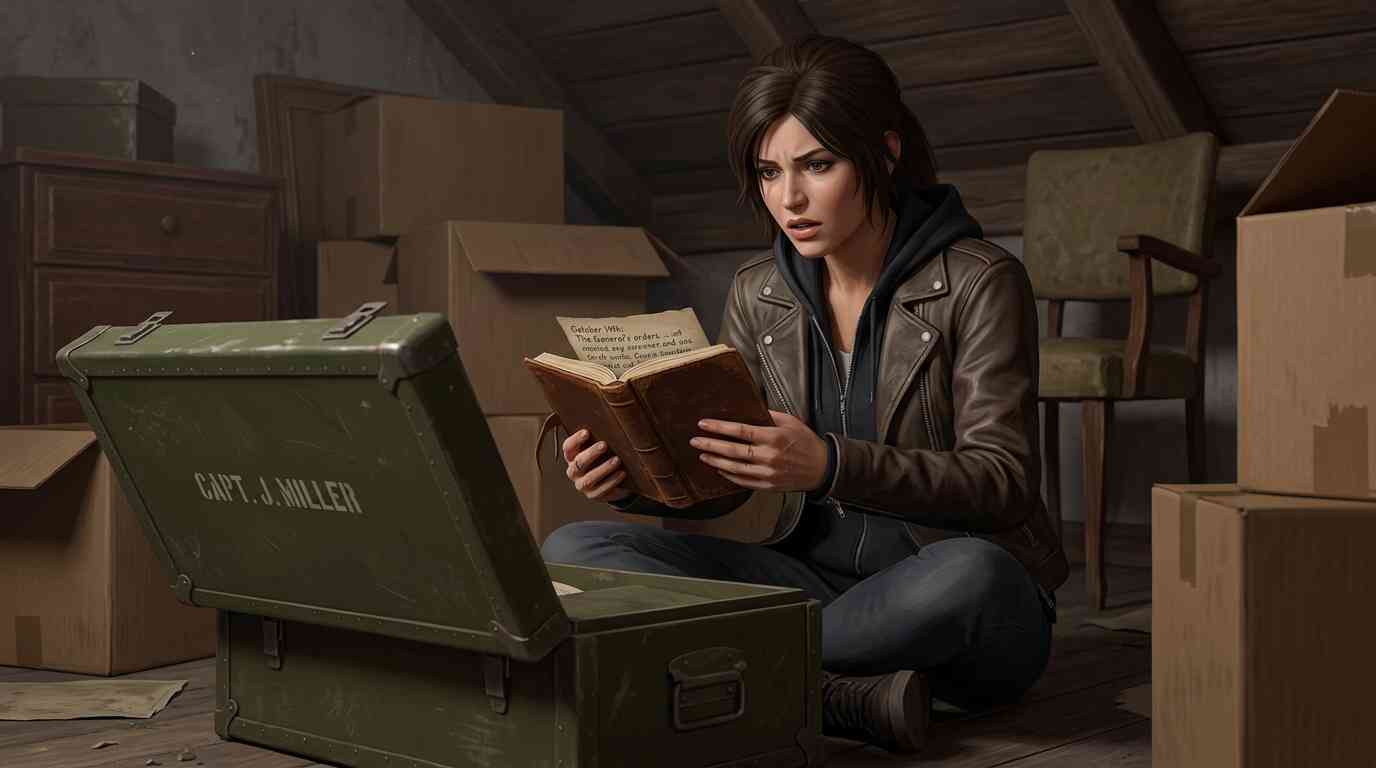
I only cared about the leather-bound book clutched in my fist. The edges were charred, the pages swollen from jungle rain, and the ink on the very last page was still legible enough to destroy a legacy.
My lungs burned as I sprinted down the endless, echoing aisle. The heavy scent of incense and white lilies choked the air, but all I could smell was the phantom scent of copper and burning oil from my dad’s old letters.
Up ahead, resting on a raised platform beneath the stained-glass window, was the mahogany coffin of Captain Robert Vance. My father’s commanding officer. A man the newspapers were calling the “Savior of the 101st.”
“Stop right there, kid!”
The voice boomed through the vaulted ceilings, but I didn’t slow down. I couldn’t. If I stopped now, the dirt would cover the coffin, the medals would be pinned to a ghost, and the truth would be buried six feet deep forever.
I waved the journal high above my head, my voice cracking with the raw, unfiltered agony of an eleven-year-old boy who had just lost everything.
“Read the last page!” I screamed, my words ricocheting off the stone walls, cutting through the somber organ music. “He didn’t die a hero!”
A collective gasp rippled through the pews. Elegant women recoiled. Decorated men stiffened, their hands instinctively moving toward their sides.
To them, I was a sacrilegious interruption. To them, I was just a crazy, grief-stricken street kid ruining the country’s most sacred farewell.
But they didn’t know what was written in the ink. They hadn’t read the dates. They hadn’t seen the final, desperate entry written at 0400 hours on a ridge that didn’t exist on any official map.
Before I could reach the first row, a massive shadow crossed my path. A young lieutenant, his dress uniform pristine, grabbed my shoulder with a grip like iron.
“Get him out of here,” a cold, sharp voice ordered from the front row. It was Colonel Sterling, his chest heavy with medals, his eyes cutting into me like glass. “This is a state funeral. Remove the child.”
I thrashed against the lieutenant’s grip, my bare feet skidding on the polished stone, my fingers tightening around the leather book until my knuckles turned white.
“Let go of me!” I howled, staring straight past my captor, locking eyes with the man who had signed my father’s death notification. “Look at the book! Look at what he wrote before the mortars hit!”
The lieutenant began dragging me backward, my heels leaving long, smudged streaks on the white marble. The crowd began to murmur, a low, rising tide of judgment and confusion. I felt the suffocating weight of their authority trying to erase me.
But then, a hand rose from the front pew.
General Harrison Vance, the fallen captain’s father and the most powerful man in the room, stood up. His spine was curved with age, his eyes cloudy with the kind of grief that doesn’t care about military protocol.
The room went dead silent. The lieutenant froze, his grip loosening just a fraction.
The old general looked at my torn clothes, looked at the desperation bleeding out of my eyes, and then looked at the charred journal in my hand. He knew what a real war journal looked like. He had filled three of them himself in a different lifetime.
“Hold on,” General Vance said, his deep, gravelly voice cutting through the tension like a blade. He looked directly at Colonel Sterling, who had gone completely rigid. “Let the boy speak.”
Full story in the first comment…
👇If you don’t see the new chapter, tap “All comments”.
Chapter 2
The silence that followed General Vance’s words was heavy, suffocating, and thick with a sudden, electric dread. The lieutenant’s hand dropped from my shoulder as if he had been burned. I stumbled forward a step, my breathing coming in ragged, shallow gasps that sounded incredibly loud in the vast, echoing cavern of the cathedral.
I didn’t look at the rows of politicians, the weeping relatives, or the television cameras streaming the service to millions of homes across the country. I kept my eyes locked onto Colonel Thomas Sterling.
The colonel was a man built on a foundation of pristine public relations and tactical brilliance. He was fifty-two, with sharp, aristocratic features, silver-tipped hair, and a chest so covered in colorful ribbons it looked like a stained-glass window itself. He had been my father’s direct superior during the brutal, undocumented deployment in the jagged valleys of the Hindu Kush. For the last three weeks, since the body bags had flown back into Dover Air Force Base, Sterling had been the face of the tragedy, giving televised speeches about sacrifice, honor, and the heavy price of freedom.
But right now, beneath the soft, filtered light of the church, the color was draining from his face, leaving him looking like a corpse in dress blues.
“Leo,” a soft, trembling voice called out from the second row.
It was my mother, Sarah. Her face was pale, hollowed out by three weeks of sleepless nights and the sudden, crushing weight of widowhood. She had tried to keep me away from the footlocker. She had tried to protect me from the ugly, jagged edges of the military machine that had consumed her husband. When I had bolted from our cramped, rented apartment two hours ago with the journal tucked under my arm, she had chased me down the street until her lungs gave out. Now, she sat among the officers’ wives, her hands trembling in her lap, torn between a mother’s instinct to shield her son and a widow’s desperate, terrifying realization that something was horribly wrong.
I ignored her. I couldn’t look at her because if I did, I would start crying, and if I started crying, they would think I was just a broken kid who needed to be comforted and carried away.
I took three deliberate steps toward the raised dais where the coffin sat. My bare feet made a dull, fleshy slapping sound against the marble. I held the journal out, pointing it directly at Colonel Sterling like a loaded weapon.
“Three weeks ago, you stood on national television and said Outpost Blackwood was overrun by an overwhelming force,” I said, my voice shaking but carrying through the custom microphone system of the pulpit. “You said Captain Vance and Sergeant Miller held the line until the very end to allow the transport helicopters to evacuate the wounded. You called it a tragic, unavoidable sacrifice.”
Sterling cleared his throat, his posture straightening instinctively, transitioning into his media-trained persona. “Young man, your father was a brave soldier. Sergeant Miller died protecting his brothers in arms. I understand your grief is—”
“My father didn’t die holding a line, Colonel!” I shouted, cutting him off, a spark of pure fire igniting in my chest. “He died in a ditch because the transport helicopters never came back for them! And they didn’t come back because you ordered them to turn around!”
A collective gasp tore through the congregation. A woman in the third row let out a sharp, stifled sob. The honor guard officers lined up along the walls shifted their weight, their eyes darting nervously toward General Vance.
General Vance didn’t move. He stood like an ancient oak, his weathered face unreadable, his eyes fixed entirely on me. “Son,” the old man said, his voice deceptively calm. “That is a very specific, very dangerous accusation to make at a man’s funeral. Especially your father’s commanding officer.”
“It’s not an accusation, General,” I whispered, opening the charred leather book to the very last page, where the paper was stained with dark, rusty brown spots that I knew weren’t dirt. “It’s a log. My dad kept a duplicate tactical log in his personal diary. He knew the black box data would be classified. He knew the radio transmissions would be wiped.”
I stepped closer to Colonel Sterling, forcing him to look at the jagged, frantic handwriting of my father, Sergeant Marcus Miller.
“Read it, Colonel,” I demanded, my voice dropping to a harsh, venomous whisper that somehow echoed louder than my screams. “Read what he wrote at 0415 hours. Read the part where he radioed base camp and told you they had secure holding positions, that the extraction zone was clear, and that they had twelve wounded men who wouldn’t survive the night without medical evac.”
Sterling didn’t reach for the book. His hands were clenched into tight fists at his sides, the knuckles turning a dangerous, bruised purple. “This is highly inappropriate. The boy is clearly suffering from acute trauma. Someone please escort Mrs. Miller and her son out of the sanctuary so we can proceed with the honors.”
Two military policemen stepped forward from the back of the cathedral, their heavy boots clicking purposefully against the stone.
“Belay that order,” General Vance barked. The command was sharp, authoritative, and carried the weight of forty years of undisputed military supremacy. The MPs froze instantly, their boots skidding to a halt. The old general turned his gaze toward Sterling, his eyes narrowing into cold, predatory slits. “Thomas, if the boy is delusional, a simple glance at the journal will dispel the rumor. Why are you sweating through your collar?”
“Sir, this is a matter of operational security,” Sterling said, his voice cracking slightly, the polished facade finally showing a hairline fracture. “The documents from Outpost Blackwood are strictly classified pending a congressional inquiry. Displaying alleged logs in a public forum is a violation of—”
“I don’t give a damn about operational security when it comes to the blood of my son and the men he commanded,” General Vance interrupted, stepping out of the pew. He walked over to me, his heavy, limping gait echoing through the silence. He reached out a large, spotted hand, his fingers trembling slightly as they touched the edge of the burnt leather notebook. “May I, Leo?”
I looked into the old man’s eyes. I saw the same deep, profound exhaustion that I had seen in my mother’s eyes every morning since the knock on the door. He wasn’t a general right now; he was a father who wanted to know how his boy had died in the dark.
I handed him the journal.
Chapter 3
General Vance took the book. The ancient leather creaked under the weight of his grip. He adjusted his reading glasses with one hand, his chest rising and falling in heavy, deliberate strokes as he turned his attention to the final page.
The entire cathedral held its breath. The silence was so absolute that I could hear the faint, mechanical hum of the television cameras in the balcony, recording every second of a breakdown that wasn’t supposed to happen.
Beside me, Colonel Sterling looked like a man watching a slow-motion car crash. A single bead of sweat broke from his hairline, tracking a slow, shiny path down his temple before disappearing into the starched collar of his dress shirt. His eyes darted toward the side exit of the cathedral, assessing the distance, calculating the optics of a retreat. But there was nowhere to go. He was trapped in a fortress of his own making, surrounded by the very community he had manipulated to secure his upcoming promotion.
“0345 hours,” General Vance read aloud, his voice dropping into a low, gravelly drone that vibrated through the wooden pews. “Outpost Blackwood under sustained mortar fire. Perimeter breached at Sector B. Captain Vance wounded in the abdomen. Sergeant Miller assuming secondary command of the defensive line.”
The general paused, his lips tightening into a thin, bloodless line. He glanced up at Sterling for a fraction of a second before returning to the text.
“0400 hours. Enemy fire suppressed. Extraction zone secured. Radioed HQ for primary medical evacuation. Request acknowledged by Colonel Sterling. Transport units Falcon-1 and Falcon-2 dispatched.”
A murmur of confusion rippled through the back rows. This matched the official timeline. This was the story the Pentagon had released to the press—the brave rescue attempt that had gone wrong due to unpredictable weather and sudden enemy reinforcements.
But General Vance wasn’t done. He turned the page, his thumb brushing against a dark, stiff stain on the corner of the paper.
“0415 hours,” the general’s voice cracked, a sudden, terrible frailty breaking through his military stoicism. “Falcon-1 and Falcon-2 aborted extraction on direct orders from Colonel Sterling. Reason given: asset preservation. We told him the zone was clear. We told him we had twelve men bleeding out on the gravel. He told us the risk to the airframes was unacceptable for a compromised unit.”
The words felt like physical blows hitting the room.
My mother buried her face in her hands, her shoulders shaking violently as a suppressed, agonizing sob finally tore from her throat. Several older veterans in the middle pews stood up, their faces contorted with a mixture of disbelief and immediate, white-hot fury.
“That’s a lie,” Sterling whispered, though the words lacked any real conviction. He took a half-step back, his boots dragging against the floor. “The logs are forged. Sergeant Miller was a disgruntled non-commissioned officer who had disciplinary issues in the past. He was looking for someone to blame for a tactical failure.”
“My dad never lied about a damn thing in his life!” I screamed, taking a step toward him, my fists clenched so hard my fingernails broke the skin of my palms. “He spent his whole life protecting people like you! He stayed behind to keep those wounded guys alive because he thought you were just delayed! He thought his country wouldn’t leave him to rot!”
“Leo, sit down,” Sterling hissed, his professional demeanor completely collapsing, revealing a desperate, cornered animal underneath. “You don’t understand the realities of command. You don’t understand what it means to make a macro-tactical decision to save an entire battalion over a single, isolated platoon.”
“So you admit it,” General Vance said.
The voice wasn’t loud, but it possessed a terrifying, absolute finality that made everyone in the room freeze. The old man closed the journal with a dull thud. He looked down at the book in his hand, then looked up at the mahogany coffin containing his only son.
“You told me Robbie died in an active firefight while the birds were trying to land,” the general said, his voice dangerously smooth. “You sat at my kitchen table, Thomas. You drank my whiskey. You looked my daughter-in-law in the eye and told her Robbie didn’t feel any pain because the mortar strike was instantaneous.”
“Sir, the situation on the ground was highly volatile—”
“You lied to me to protect your nomination for the Joint Chiefs,” General Vance said, stepping forward until he was mere inches from Sterling’s face. The height difference was minimal, but the moral disparity was an ocean. “You sacrificed forty-two men because you didn’t want a high casualty extraction operation to look sloppy on your record before the senate confirmation hearings.”
“That is an unprovable assertion!” Sterling shouted, his defense mechanism kicking into overdrive as he realized the television cameras were still rolling. He pointed a trembling finger at the balcony. “Turn those cameras off! Shut them down now! This is a highly classified military briefing being compromised by an emotional child!”
But nobody moved. The technicians in the balcony stayed frozen, their hands away from the switchboards. The entire room had become a courtroom, and the jury had already reached a verdict.
Chapter 4
“The cameras stay on,” General Vance said, his voice echoing with an absolute authority that no one in the cathedral dared challenge. He looked over at the honor guard, his eyes hard as flint. “Arrest this man.”
For a split second, the young soldiers looked confused. They were trained to follow the chain of command, and Colonel Sterling was their immediate superior in the district. They looked at Sterling, then at the old general whose name was etched onto the walls of every barracks in the country.
“You can’t arrest me on the word of a twelve-year-old boy and an unverified diary!” Sterling snarled, his eyes bulging as he took another backward step toward the altar. “This is a circus! I am a decorated officer of the United States Army! I will not be humiliated at a funeral by a street urchin!”
“You’re right, Thomas,” a new voice joined the fray.
Everyone turned to see Major Andrew Campbell step forward from the second row of officers. Campbell was thirty-eight, a quiet man with a severe burn scar running down the left side of his neck—a parting gift from a previous deployment with my father. He had been the chief logistics officer at the base camp on the night Outpost Blackwood fell. For three weeks, he had walked around like a man carrying a ghost on his back, his eyes hollow, his speech clipped and distant.
“Andrew,” Sterling warned, his voice dropping into a desperate, threatening register. “Be very careful about your next words. Conspiracy to defame a superior officer carries severe penalties under the UCMJ.”
Campbell didn’t look at Sterling. He walked straight to General Vance, pulled a small, silver digital storage drive from his dress uniform pocket, and held it out.
“This is the unredacted audio log from the tactical operations center from the night of May 14th,” Campbell said, his voice steady but thick with a profound, long-delayed shame. “I was the officer on duty. Colonel Sterling ordered me to delete the backup files and classify the primary audio track under a Tier-1 security restriction. He told me that if I ever spoke about the extraction abort, he would ensure my court-martial for negligence.”
A heavy, suffocating wave of collective realization washed over the congregation. The puzzle pieces had officially fallen into place, leaving no room for doubt, no room for spin, and no room for escape.
“Why didn’t you bring this forward sooner, Major?” General Vance asked, his voice dark and heavy.
Campbell looked over at my mother, then down at my bare, dirt-caked feet. “Because I was a coward, sir. I was worried about my pension. I was worried about my career. But then I saw a little boy walk into a cathedral with nothing but his father’s words and enough courage to face down an army. I realized that if I stayed silent today, I wouldn’t just be an accomplice to a cover-up. I’d be a dead man walking for the rest of my life.”
Sterling looked at the silver drive in Campbell’s hand, and something inside him finally snapped. The arrogant, untouchable poise vanished, replaced by the ugly, frantic desperation of a criminal who realized the walls had completely collapsed. He reached for his side holster, his fingers wrapping around the grip of his dress pistol.
“Get back!” Sterling screamed, drawing the weapon and pointing it wildly at the crowd. “All of you, back away from me! This is a setup! A coordinated political assassination!”
The cathedral erupted into chaos. Women screamed, throwing themselves onto the floor between the pews. Officers instinctively drew their own weapons, creating a terrifying, multi-tiered Mexican standoff in the center aisle. My mother lunged forward, throwing her body over mine, pinning me to the cold marble floor as she sobbed into my hair.
“Thomas, put the weapon down,” General Vance said, his voice entirely devoid of fear. He didn’t flinch. He didn’t reach for a gun. He just stood there, looking at the barrel of the pistol pointed at his chest. “You’ve already killed forty-two brave men with your pen. Don’t add another to the list with ink you can’t wash off.”
Sterling’s hand was shaking violently. The pistol trembled in his grip, his eyes darting frantically from the general to the cameras, then to the doors that were now blocked by heavily armed military police. He was looking at the end of his life, the end of his legacy, and the beginning of a cold, concrete cell in Fort Leavenworth.
“I had to make a choice,” Sterling whimpered, his voice cracking into a high, pathetic whine as tears of pure terror finally spilled over his eyelids. “The weather was turning… the intelligence was compromised… if I lost those helicopters, the entire regional strategy would have been ruined… I had to preserve the assets…”
“Those men weren’t assets, Thomas,” General Vance whispered, his voice cracking with a father’s ultimate heartbreak. “They were our children.”
Chapter 5
The standoff ended not with a gunshot, but with a pathetic, hollow clatter.
Colonel Sterling’s strength seemed to evaporate all at once. His knees buckled, and the silver dress pistol slipped from his trembling fingers, hitting the marble floor with a sharp, metallic ring that echoed through the silent cathedral. He collapsed into a heap on the altar steps, his head buried in his hands, his shoulders shaking with the dry, hacking sobs of a man who had lost everything he had spent a lifetime cheating to build.
Within seconds, four military policemen swarmed over him, pinning his arms behind his back and clicking heavy steel handcuffs around his wrists. They hoisted him to his feet, but he didn’t look like a colonel anymore. He looked small, broken, and entirely empty. As they dragged him down the aisle past the rows of furious, disgusted onlookers, he kept his chin buried in his chest, unable to meet a single pair of eyes.
The silence that returned to St. Jude’s was different now. It wasn’t the manufactured, polite silence of a state funeral; it was the heavy, exhausted silence that follows a massive explosion.
My mother slowly lifted herself off me, her hands still shaking as she checked my face, my shoulders, making sure I was unhurt. Her eyes were red, swollen, and wet with a mixture of terror and an overwhelming, long-delayed relief. She didn’t scold me for running away. She didn’t yell at me for ruining the service. She just pulled me into her chest, holding me so tight I could feel the frantic, rhythmic pounding of her heart against my ribs.
General Vance walked over to us, his heavy boots slow and deliberate. The charred leather journal was still clutched in his hand. He looked down at my mother, then down at me, his old, wrinkled face softening into something resembling profound respect.
“Sarah,” the general said, his voice low and gentle. “Marcus was one of the finest men I ever had the privilege of knowing. I am deeply, profoundly sorry that the institution he gave his life for failed him so completely.”
My mother wiped a tear from her cheek, her chin tightening as she looked up at the old man. “He just wanted his story told, General. He didn’t want his boys to be forgotten.”
“They won’t be,” General Vance promised, his voice hardening with a renewed sense of purpose. He turned back toward the altar, looking at the mahogany coffin of his son, Captain Robert Vance. Then, he looked out at the crowded cathedral, at the politicians and the high-ranking officers who were still standing in shocked silence.
The old man walked back to the pulpit, his posture straight, his shoulders square. He didn’t look at the prepared speech that sat on the wooden podium—the sanitized, public-relations-approved eulogy that Sterling had written for him. He swept the papers off the side of the desk, letting them flutter to the floor like autumn leaves.
“We will not be proceeding with the scheduled service today,” General Vance announced, his voice carrying through the speakers with a clear, undeniable authority. “The man we came to honor today was indeed a hero, but the story we were told about his final hours was a fabrication designed to protect a coward. We will not bury my son under a mountain of lies.”
He held up my father’s journal for the entire room—and the world watching through the cameras—to see.
“We will postpone the burial until a full, independent congressional investigation is launched into the events at Outpost Blackwood,” the general continued, his eyes sweeping across the rows of politicians in the front rows. “And we will not rest until every single man who was abandoned on that ridge is brought home, and every man who participated in this cover-up is held accountable to the absolute limit of military law.”
A spontaneous, thunderous applause broke out from the back of the church, started by the veterans and quickly spreading through the entire congregation. It wasn’t a celebratory applause; it was a grim, determined acknowledgement of a battle that was just beginning.
General Vance walked down from the pulpit and came back to where we stood. He handed the journal back to me, his fingers lingering on the cover for a brief second.
“Thank you, Leo,” the old man whispered, his eyes moist. “You saved my son’s honor today. You saved all of their honors.”
Chapter 6
Two hours later, the cathedral was empty. The grand television trucks had packed up their cables, the politicians had fled to draft press releases, and the heavy oak doors had been closed against the late afternoon chill.
The air inside was still cold, holding the faint, lingering trace of incense and the ghostly echoes of the afternoon’s chaos. The only light came from the massive stained-glass windows behind the altar, casting long, fractured shadows of deep blue, ruby red, and amber across the endless rows of empty wooden pews.
My mother and I sat alone in the very back row. She had wrapped her black mourning shawl around my shoulders to keep out the draft, her arm securely looped around my waist, pulling me close against her side. My bare feet were still dirty, but the burning in my chest had finally subsided, replaced by a deep, hollow exhaustion that made my eyelids feel heavy as lead.
The journal sat on the wooden bench between us, closed and quiet. The truth was out now. It was floating through the digital ether, playing on millions of screens across the country, transforming from a hidden, shameful secret into an undeniable historical fact. The battle for my father’s legacy wasn’t over—there would be courtrooms, depositions, and painful news segments for months to come—but the heaviest weight had been lifted. The lie had been broken.
I looked down at the burnt leather cover, my fingers tracing the faint, embossed initials of my father’s name: M.M.
“Do you think he heard us, Mom?” I whispered, my voice small and fragile in the vast, empty space of the church.
My mother didn’t answer right away. She leaned her head against mine, her breath warm against my hair. She looked up at the high, vaulted ceilings, as if she could see past the stone and the timber into the clear, blue afternoon sky outside.
“He heard you, Leo,” she said softly, her voice trembling but full of an absolute, unwavering certainty. “He heard every single word.”
I closed my eyes, letting the heavy, peaceful silence of the empty cathedral wash over me. For the first time in three weeks, since the moment the two men in dress uniforms walked up our front porch steps, I didn’t feel like I was drowning. I didn’t feel like a helpless spectator in a tragedy I couldn’t understand.
I had given my father his voice back. I had made sure that when people spoke his name, they would know exactly who he was—not a pawn in a colonel’s political game, not a faceless casualty on a redacted spreadsheet, but a man who stood by his brothers until the very last light faded from the sky.
My hand drifted to the journal, my fingers resting on the final page through the leather cover, feeling the silent, enduring strength of the words written inside.
A hero isn’t defined by the medals pinned to his chest by a coward, but by the truth his son refuses to let die.