The rain in Big Sky Country doesn’t just fall; it heavy-drops like a judgment, soaking through the wool coats of the rich and the denim jackets of the working hands alike.
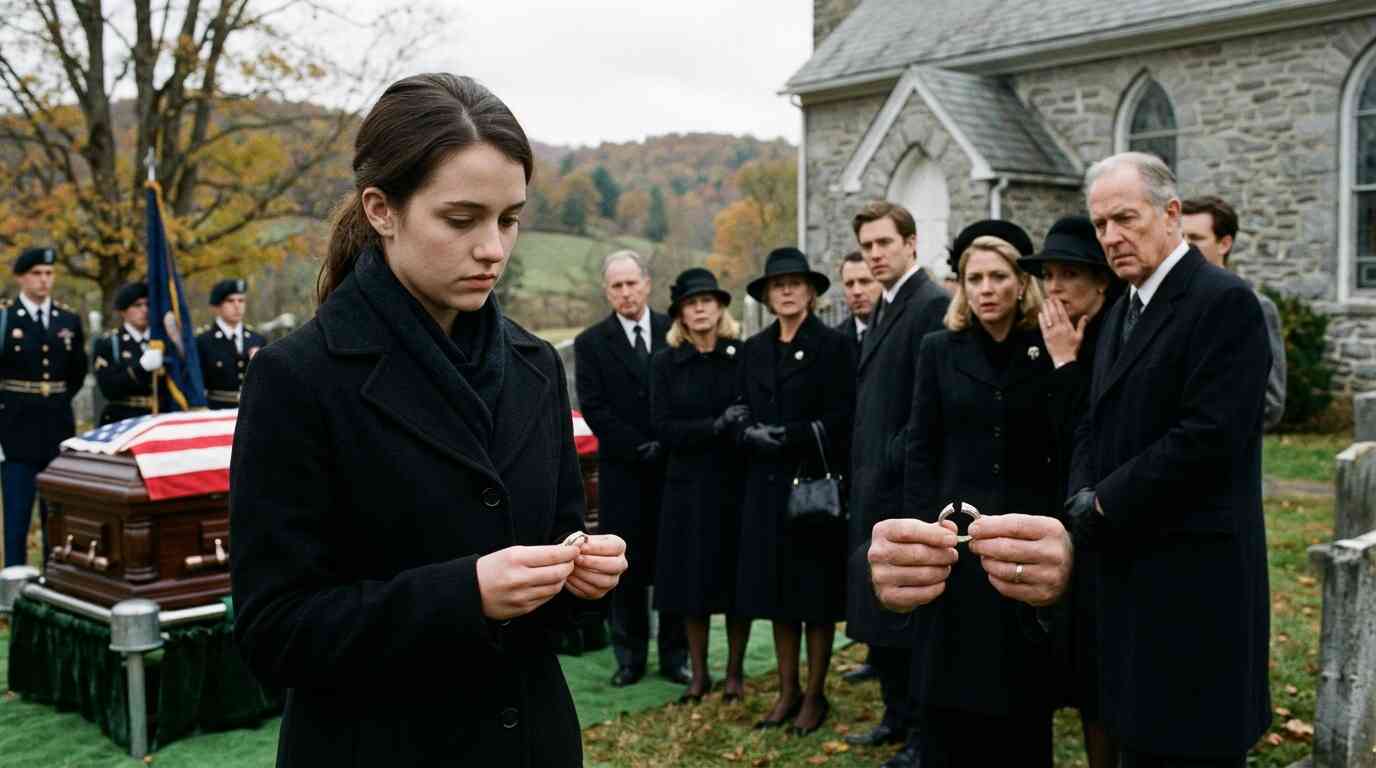
On that Tuesday morning, half of Montana had gathered at the valley cemetery to bury Colonel Arthur Vance, a man whose name was etched into the local courthouse and whose cattle roamed ten thousand acres of pristine, pine-fringed land.
The atmosphere was dense with the smell of wet earth, expensive lilies, and the stiff, formal silence of old money mourning its patriarch.
Evelyn Vance stood at the head of the grave, her face obscured by a wide-brimmed black hat, her diamond rings catching the dull gray light every time she adjusted her silk umbrella.
Beside her stood Thomas, her thirty-four-year-old son, his jaw set in a rigid line that looked more like calculated ambition than genuine grief. They were the royalty of the valley, the survivors, the keepers of the Vance empire.
Then the iron gates groaned.
Through the sea of identical black umbrellas, a figure emerged from the tree line, walking with a slow, deliberate limp that immediately disrupted the rhythmic drone of the minister’s eulogy.
It was a young woman, no older than twenty-four, her hair matted against her forehead by the downpour. She wore a faded, oversized army jacket with a frayed infantry patch on the shoulder, her jeans caked in dried river mud up to the knees.
Her boots were split at the seams, leaking water with every step she took toward the pristine, mahogany casket.
The whispers started as a low hum, passing from the bank presidents to the ranch foremen. Thomas shifted his weight, his eyes narrowing as he took a step forward to intercept her, but his mother’s hand tightened on his arm, holding him back.
There was something about the girl’s posture—the raw, unblinking focus in her gray eyes—that made the entire crowd freeze.
She didn’t look at the politicians. She didn’t look at the rows of decorated officers standing at attention. She walked straight to the edge of the open grave, her breathing ragged, the mud from her boots staining the artificial green turf that the funeral home had laid down to hide the raw dirt.
With trembling, dirt-stained fingers, she reached into the deep pocket of her weather-worn jacket. The crowd held its breath, a collective gasp rippling through the front row as if they expected a weapon.
Instead, she pulled out a heavy silver ring, its surface scratched and dull, shaped like a coiled serpent with a missing emerald eye.
She didn’t drop it. She placed it deliberately on the center of the polished wood, right above the brass nameplate of the man who had supposedly died without a single secret left behind.
She looked directly at Evelyn Vance, her voice cutting through the wind like a rusted blade.
“Who was supposed to wear this?”
Full story in the first comment…
👇If you don’t see the new chapter, tap “All comments”.
FULL STORY
Chapter 1: The Gathering of Shadows
The mud in eastern Montana has a way of holding onto things. It clings to the tires of the old Ford trucks, cakes the bellies of the Angus cattle, and buries the memories of families who spent three generations trying to forget where their wealth actually came from. On the morning of Colonel Arthur Vance’s funeral, the mud was thick, deep, and unforgiving, turning the cemetery hill into a slick graveyard of secrets.
Clara felt the cold water seeping through the split sole of her left boot with every step she took up the ridge. The old army jacket she wore had belonged to her father, its canvas heavy with thirty years of grease, campfire smoke, and the faint, metallic tang of gun oil. It was three sizes too big, the sleeves bunched at her wrists, but it was the only thing she owned that kept the mountain wind from freezing her to the bone.
She watched the funeral procession from the shadow of a grouping of ponderosa pines. From this distance, the mourners looked like a flock of crows gathered around a carcass. There were shiny black Suburbans lined up along the gravel road, their engines idling to keep the heaters running for the county commissioners and state senators who had traveled across the state to pay respects to the Vance name.
“Look at them,” Clara whispered to herself, her fingers curling around the cold metal object inside her pocket. “They think they’re burying the only witness.”
At the center of the crowd stood Evelyn Vance. Even at nearly seventy, Evelyn possessed a posture that could silence a room full of cattlemen. Her black wool coat was tailored perfectly to her slender frame, and her silver hair was pinned back beneath a veil that caught the mist. She didn’t cry. Vances didn’t cry in public; they managed. Beside her was Thomas, her only living son, looking every bit the part of the modern cattle baron in a tailored suit and a crisp black Stetson. He was already looking at his watch, his mind likely on the three thousand head of cattle that needed to be moved before the early winter freeze hit the high country.
Clara waited until the minister reached the part of the service where he spoke of Arthur’s “unblemished honor” and his “boundless generosity to the valley.” Every word felt like a stone dropping into Clara’s stomach. She remembered the small, drafty cabin six miles down the river where her mother had died of a fever because they couldn’t afford the propane to heat the bedrooms. She remembered the letters Arthur had sent—letters wrapped in plain brown paper, filled with promises he never intended to keep.
She stepped out from the trees.
The grass was slick, and her boots made a wet, sucking sound against the earth. The first person to notice her was Sheriff James Miller, an old family friend of the Vances who had spent thirty years looking the other way whenever the family needed a boundary line moved or an inconvenient tenant evicted. His hand instinctively went to his belt, his eyes tracking the girl in the oversized jacket as she breached the perimeter of the private service.
“Miss, you need to step back,” Miller said in a low, warning rumble as she reached the outer ring of mourners. “This is a private family burial.”
Clara didn’t look at him. She kept her eyes fixed on the mahogany box resting on the silver lowering straps. “I have something that belongs to the Colonel,” she said, her voice small but steady, carrying over the whistling wind.
The crowd parted. It wasn’t out of respect; it was out of the sheer, primal curiosity of small-town folks who smelled trouble. The ranch owners and their wives drew back their expensive coats, horrified by the mud dripping from Clara’s trousers and the raw, wild look in her eyes.
Thomas Vance stepped forward, his face hardening into a mask of aristocratic irritation. “Who let this girl in here? Get her off our property.”
“It’s public land, Thomas,” Clara said, using his first name with a familiarity that made his jaw tighten. “Or did your mother buy the ridge while I was gone, too?”
Evelyn Vance turned slowly. When her eyes fell on Clara’s face, something subtle shifted behind her veil. The color didn’t leave her cheeks—she was too disciplined for that—but her fingers tightened around the handle of her umbrella until her knuckles turned the color of bone.
Clara reached the edge of the grave. The smell of the fresh-turned earth was overwhelming, mixed with the chemical sweetness of the funeral wreaths. She looked down at the coffin, then pulled her hand from her pocket.
The silver ring was heavy, old, and crude, hammered out of a silver coin by a soldier who had nothing else to give during his final days in a field hospital in Da Nang. It wasn’t beautiful, but it was unmistakable.
She laid it flat on the glossy wood of the casket. The metallic clink sounded like a gunshot in the silence of the valley.
“Who was supposed to wear this, Evelyn?” Clara asked, her voice cracking slightly as the cold air hit her throat. “Because my mother died with the match to it around her neck, and she spent thirty years telling me it belonged to a man who didn’t exist.”
The silence that followed was absolute. Not even the wind seemed to move through the pines. Thomas looked from the ring to his mother, his confusion quickly turning to anger. “Mother, what is she talking about? Who is this?”
Evelyn didn’t answer her son. She kept her gaze fixed on Clara, her voice dropping to a dangerous, icy whisper. “You have your father’s mouth, girl. And his total lack of sense. Get off my ridge before I have the sheriff remove you permanently.”
Chapter 2: The Terms of the Bloodline
The wake was held at the Vance homestead, a massive log-and-stone structure that sat at the confluence of two mountain rivers. It was a house built on timber money and cattle contracts, its walls adorned with the heads of elk and bison that Arthur Vance had killed over a lifetime of conquests.
Clara sat in the Sheriff’s department three miles away, her wet boots pooling water on the linoleum floor. She hadn’t been arrested, not legally, but Miller had “strongly suggested” she wait in his office until the family decided what to do about the disturbance.
The door opened, and Thomas Vance walked in, bringing the smell of cold rain and expensive leather with him. He didn’t look like a man who had just buried his father; he looked like a lawyer preparing for a deposition. He dropped a thick manila folder onto the metal desk in front of Clara.
“There’s five thousand dollars in there,” Thomas said, leaning against the doorframe with his arms crossed. “It’s more than your cabin is worth, and it’s more than enough for a bus ticket to Seattle. You take it, you leave the ring, and you don’t come back to the valley.”
Clara looked at the folder, then up at him. She saw the Vance arrogance in his high cheekbones, but she also saw something else—a flicker of uncertainty. “You don’t know what’s in his will, do you?”
Thomas stiffened. “My father’s estate is private.”
“He left me the lower pasture,” Clara said softly. “The three hundred acres along the river that your mother has been trying to lease to the oil company for five years. He signed the deed over three weeks before his heart gave out.”
Thomas laughed, a dry, humorless sound. “My father was a lot of things, but he wasn’t a fool. He wouldn’t give away prime river bottom to the daughter of a crazy woman who lived in the woods.”
“He would if he was trying to buy his way out of hell,” Clara replied. She stood up, the oversized army jacket shifting on her shoulders. She reached into her pocket and pulled out a small, leather-bound notebook with yellowed pages. “This is his journal from 1972. Before he married your mother. Before he became the great Colonel Vance. He wasn’t a hero, Thomas. He was a deserter who let my uncle take the blame for an ambush that killed six men from this county.”
The office door opened again, and Evelyn Vance walked in. She had removed her veil, revealing a face lines with decades of bitter control. Her eyes immediately found the notebook in Clara’s hand.
“That’s enough, Thomas,” Evelyn said, her voice sharp enough to stop her son mid-sentence. “Leave us.”
“Mother, she’s claiming—”
“I know what she’s claiming,” Evelyn interrupted, not looking at him. “Wait in the truck.”
Thomas hesitated, his pride visibly warring with his lifelong habit of obeying his mother. Finally, he spat a curse under his breath and slammed the door behind him.
Evelyn sat down in the chair opposite Clara. She looked at the mud on Clara’s boots, then at the girl’s face, searching for features she had spent half her life trying to erase from her memory.
“Your mother was a fool, Clara,” Evelyn said, her voice remarkably calm. “She thought because Arthur gave her a ring and a few kind words in the dark that she was part of this family. She wasn’t. Arthur married me because my father owned the water rights to this entire valley. He stayed with me because he liked being important. A man like that doesn’t leave things to the help.”
“He did,” Clara said, tossing the deed onto the desk. It was signed, notarized by a clerk two counties over, and stamped with the state seal. “He knew what you did to my mother after he left for the state senate. He knew you cut off her credit at the store, that you had the bank call her note on the cattle. You starved her out.”
“I protected my home,” Evelyn said coldly. “And I will protect it from you.”
Chapter 3: The Ghost in the Ledger
The lower pasture was beautiful in the way only dangerous places can be. The river ran fast and deep through the limestone cliffs, and the cottonwood trees stood like old sentinels along the banks. It was the land Clara’s mother, Sarah, had loved more than any place on earth.
Clara spent the morning after the funeral fixing the fence line near the county road. Her hands were raw from the barbed wire, but the physical labor kept her from thinking about the look on Evelyn’s face or the threats Thomas had muttered as he left the sheriff’s office.
A truck pulled up to the gate—a battered old Chevy with a dented fender. Out climbed Sheriff Miller. He didn’t look like an enforcer today; he looked like an old man who had spent too many years carrying other people’s garbage.
He walked over to the fence, leaning his elbows on the cedar post. “You’re a stubborn girl, Clara. Just like your old man.”
Clara stopped her hammer mid-swing. “My father died in a VA hospital in Oregon when I was five. He wasn’t a Vance.”
Miller sighed, spitting a stream of tobacco juice into the weeds. “Arthur Vance didn’t have the stomach for the dirty work, Clara. He was a handsome boy who looked good in a uniform, but when the shooting started over there in the jungle, he panicked. He hid in a spider hole while your uncle’s squad got torn to pieces by mortar fire.”
Clara lowered the hammer, her heart pounding against her ribs. “My uncle died a traitor according to the papers here.”
“Because Arthur’s father paid off the company commander to change the logs,” Miller said softly. “They needed a hero to run for congress after the war. The Vance family couldn’t have a coward in the lineage. Your mother found out because Arthur kept the real field logs in that lockbox he gave her. That’s why Evelyn hated her. Not because of the affair. Evelyn didn’t care who Arthur slept with. She cared about the secret.”
“And the ring?” Clara asked.
“Arthur made two of them out of a silver medallion he took off a dead North Vietnamese officer,” Miller said. “One for your mother, one for himself. He told her if he ever became powerful enough, he’d come back and set the record straight. But power does things to a man. It makes him forget the promises he made when he was scared.”
Clara looked toward the horizon, where the Vance ranch house sat like a fortress on the hill. “He didn’t forget. He left me this land because the real logs are buried out here. Under the old line shack.”
Miller’s face went pale. “Clara, if Thomas finds out you have those documents, he won’t just offer you money. That boy doesn’t have his father’s conscience. He only has his mother’s blood.”
Before Clara could answer, the sound of an engine echoed down the canyon. A heavy-duty John Deere tractor was coming down the road, followed by two flatbed trucks loaded with fence posts and construction equipment. At the wheel of the lead truck was Thomas Vance.
Chapter 4: The Line in the Dirt
“Get off the tractor, Thomas,” Clara said, standing in the middle of the gravel driveway that led to the lower pasture. She had her father’s old Winchester 30-30 rifle resting across her forearm. It wasn’t pointed at him, but it was there.
Thomas climbed down from the cab, his boots kicking up dust. He didn’t look at the rifle; he looked at the fence she had just repaired. “We’re putting a ditch through here, Clara. The water rights belong to the main house. We’re turning the river into the north section.”
“If you divert the river, this pasture dies,” Clara said. “The willow trees will dry up, and the well will go sour.”
“This pasture isn’t yours,” Thomas said, pulling a document from his pocket. “My mother filed an injunction this morning. My father wasn’t of sound mind when he signed that deed. We have three doctors from Billings who are willing to sign affidavits stating he was suffering from dementia for the last six months of his life.”
Clara felt a cold rage rising in her chest. “He wasn’t crazy, Thomas. He was just tired of lying for your mother.”
“You think you’re the first person to try and shake us down?” Thomas took a step closer, his voice dropping to a harsh whisper. “My grandfather built this valley. My mother kept it alive during the drought of ’88 when every other ranch went under. We didn’t survive by letting the bastard children of camp followers tell us where the fences go.”
“He was there, Thomas,” Clara said, her voice dropping to a level that made the construction workers behind him shift uncomfortably. “Your father was in the hole when the squad died. He watched them through his binoculars while he waited for the evacuation chopper. He wrote it all down. The names, the coordinates, the times.”
Thomas froze. For a second, the arrogance left his face, replaced by a raw, naked fear that he quickly tried to cover with anger. “You’re lying. My father was decorated by the Governor.”
“Ask Miller,” Clara said, nodding toward the Sheriff’s truck. “Ask him why he’s been sitting on the county line for thirty years making sure nobody dug up the old line shack.”
Thomas turned to look at Miller, who was still leaning against his truck, his eyes fixed on the ground. “James? What is she talking about?”
Miller didn’t look up. “Your father wasn’t the man you thought he was, Tom. Your mother knew it. That’s why she kept him on such a short leash. Every contract, every land deal—she made him sign everything over to her name because she knew if the truth ever came out, the Vance name wouldn’t be worth the paper it was printed on.”
Thomas looked back at Clara, his face contorting into something ugly. “I don’t care about thirty years ago. I care about now. This ranch is mine. I’m not letting some girl from the bottoms ruin everything I’ve worked for.”
He reached for the gate handle, intending to swing it open for the tractor, but Clara raised the Winchester, the stock coming up to her shoulder with a smooth, practiced motion.
“Take one more step, Thomas, and we’ll see if that tailored suit can stop a hundred and seventy grains of lead,” Clara said.
Chapter 5: The Weight of the Basin
The confrontation at the gate didn’t end in gunfire, but it ended in a standoff that brought the entire valley to a halt. By nightfall, Evelyn Vance had arrived herself, her silver Mercedes idling at the edge of the property line while two state troopers stood by their cars, waiting for orders from a judge in Helena.
Clara sat on the porch of the old line shack, the Winchester across her knees. The cabin was tiny, its roof sagging under the weight of decades of winter snow, but inside, beneath the floorboards near the woodstove, she had found what she was looking for: an olive-drab ammunition box containing the original radio logs from July 14, 1972.
Evelyn walked up the path alone, her high-heeled boots sinking into the mud. She didn’t look like a woman who had lost her husband; she looked like a general preparing to accept a surrender.
“You’re making a terrible mistake, Clara,” Evelyn said, stopping at the bottom step of the porch. “You think you’re avenging your mother, but all you’re doing is destroying the only thing that keeps this valley alive. If the Vance name goes down, the bank calls the loans on every small ranch from here to the border. We own the debt, Clara. We own the water. You expose Arthur, you ruin everyone.”
“You always were good at making your problems sound like everybody else’s,” Clara said, her voice hollow from fatigue. “My mother didn’t want your money, Evelyn. She just wanted him to say her name out loud. She wanted him to admit that he loved her more than he loved this dirt.”
Evelyn let out a long, slow breath that turned to steam in the cold air. “Arthur didn’t love anyone, Clara. He loved being admired. When he was with your mother, he was the tragic hero who could confess his sins to a girl who wouldn’t judge him. When he was with me, he was the king of the county. He needed both to survive. But when it came down to a choice, he chose the ridge. Every single time.”
“He chose me at the end,” Clara said, pointing to the box beside her.
“He chose to hurt me at the end,” Evelyn corrected her, her voice trembling with a rare flash of genuine emotion. “He knew I spent forty years protecting his reputation, making sure our son looked up to him. He gave you that deed because he wanted to punish me for keeping him honest. He was a coward in life, and he was a coward in death.”
Thomas walked up behind his mother, his face dark with fury. “Mother, the troopers are ready to move her. The judge signed the order. She’s trespassing.”
Evelyn looked at her son, then back at Clara. For the first time, Clara saw the true cost of the Vance legacy—the isolation, the constant vigilance, the fear that every person you met was trying to steal what you had taken from someone else.
“Give me the box, Clara,” Evelyn said, her voice dropping to an almost pleading tone. “I’ll give you the lower pasture. No injunctions. No lawyers. You can have the river, the trees, everything your mother wanted. Just give me the logs.”
Chapter 6: The Harvest of Truth
The sun rose over the Big Sky mountains on Wednesday morning, casting a long, golden light across the valley that made the frost on the fence posts look like diamonds.
Clara stood at the riverbank, the olive-drab box in her left hand, her father’s silver ring in her right. Behind her, half the town had gathered along the county road—the ranchers, the deputies, Thomas, and Evelyn Vance.
She didn’t give the box to Evelyn. She didn’t give it to the troopers.
She handed it to Sheriff Miller.
“You were there when they brought the bodies home, James,” Clara said, her voice carrying through the clear morning air. “You owe it to the boys from the squad to put this in the county archive. Let people know what really happened on the ridge.”
Miller took the box, his old hands heavy with the weight of thirty years of silence. He looked at Evelyn, then at Thomas, and finally back at Clara. “It’s time, Evelyn,” he said simply. “The Colonel’s gone. The lie doesn’t have any more blood to feed on.”
Thomas stepped forward, his fists clenched, but his mother reached out and caught his arm. Evelyn looked older now, the sharp lines of her face softening into the weariness of an old woman who had finally run out of ground to retreat to.
“Let it go, Thomas,” Evelyn whispered, her voice barely audible over the rush of the river. “It’s over.”
Clara walked down to the water’s edge, where the current was slow and clear over the river stones. She looked down at the silver ring—the serpent with the missing eye, the token of a love that had been too small to survive the ambition of the valley.
She didn’t throw it. She dropped it into the shallow water near the bank, watching as the current turned it over once, twice, before it settled into the silt, becoming just another piece of the Montana earth.
She turned her back on the Vance mansion, on the troopers, and on the crowd of onlookers who were already beginning to whisper about the story they would be telling for the next fifty years.
She walked toward the lower pasture, her boots heavy with the mud that had finally given up its dead, knowing that for the first time in her life, the land beneath her feet belonged to nobody but her.
The land doesn’t care about the names we carve into the stones; it only remembers the hands that were willing to bleed for it.