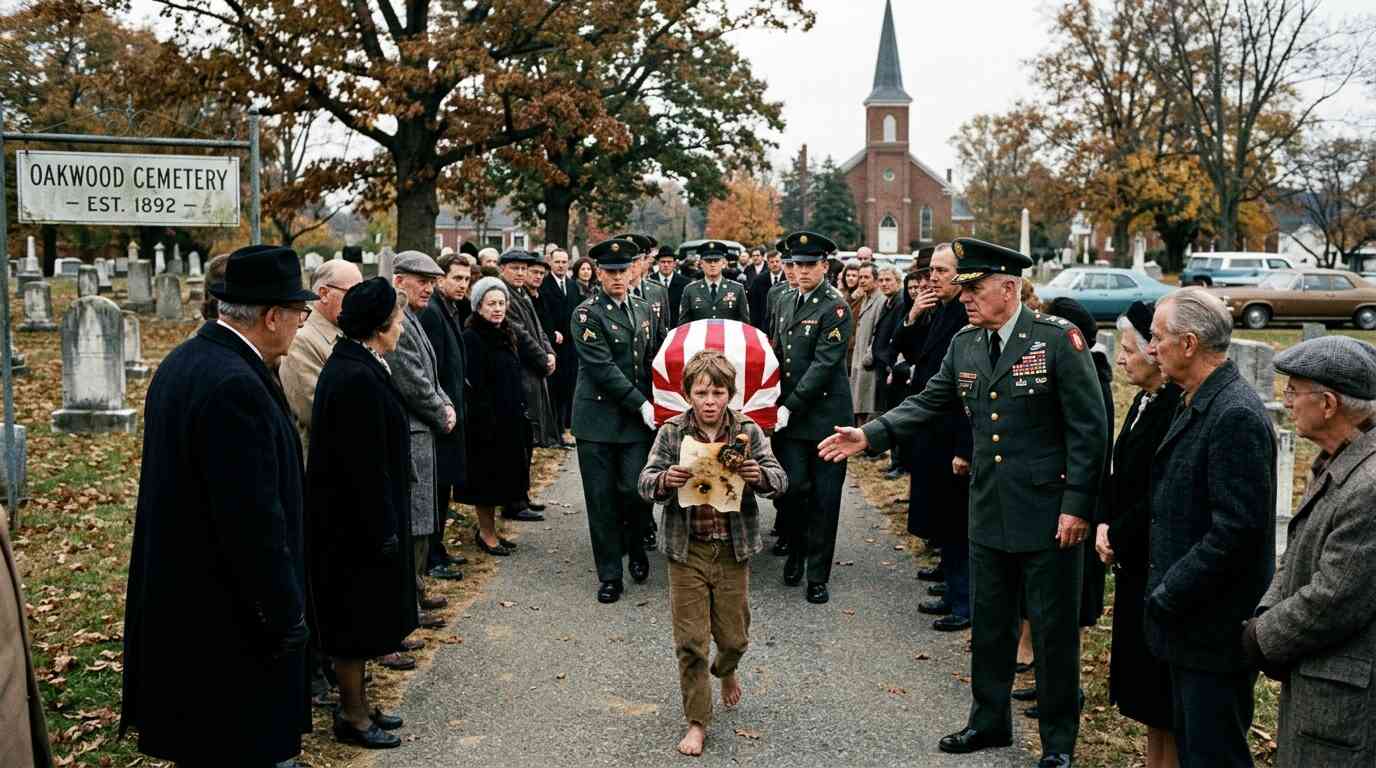
The rain over Quantico didn’t fall so much as it drifted, a heavy, gray mist that clung to the dark wool of formal dress uniforms and turned the red Virginia clay into a thick, swallowing muck.
It was a perfect day for a lie.
Colonel Arthur Vance stood at absolute attention, his chest thrust forward, a constellation of medals catching the dim, filtered light of a Tuesday afternoon. To anyone standing in the crowd of nearly two hundred mourners, he was the picture-perfect image of American grief—a decorated commander burying his closest friend and brother-in-arms, Major Thomas Henderson.
The flag-draped coffin rested on the lowering straps above the open earth. The air smelled of wet grass, expensive lilies, and the distinct, metallic tang of the seven-rifle volley that had just shattered the silence moments before.
“Earth to earth,” the chaplain’s voice droned, rich and practiced, carrying over the weeping of women in black veils and the solemn, rigid lines of active-duty Marines. “Ashes to ashes, dust to dust…”
Then came the sound.
It wasn’t a cry, and it wasn’t a violent outburst. It was the wet, rhythmic slap of bare skin against the muddy grass.
Through the parting rows of polished leather boots and pressed trousers walked a boy. He couldn’t have been more than ten years old. His hair was a wild, tangled bird’s nest of sandy blonde locks, caked with bits of dried leaves and burrs. His jeans were frayed at the cuffs, soaked through to the shins, and his feet were completely bare, blue with the biting October chill.
But it was the object on his back that made the older veterans in the front row catch their breath.
It was an old, faded ALICE pack—a Vietnam-era military issue backpack, heavily patched with crude, thick stitches of green fishing line. It looked absurdly massive on the boy’s slight frame, dragging down against his narrow shoulders, the brass buckles scraping against each other with a dull, rhythmic clink.
The honor guard hesitated, their hands freezing on the straps of the coffin. A murmur rippled through the crowd like a sudden wind through dry corn husks.
“Where is the security?” Mrs. Henderson’s sister whispered loudly, her manicured hand gripping her pearl necklace. “Someone get that child away from the family.”
Arthur Vance didn’t move a muscle, but his jaw clenched so tightly the muscle in his cheek twitched violently. He knew that backpack. He would know those jagged, hand-stitched repairs anywhere in the world. He had watched a man sew those exact patches by the light of a flickering kerosene lamp in a humid, terrifying jungle a lifetime ago.
The boy didn’t look at the crowd. He didn’t look at the rifles, or the pristine white gloves of the Marines, or the crying widow. His wide, hauntingly hollow blue eyes were locked entirely on the mahogany box.
He stepped right up to the edge of the pit, his bare toes sinking into the fresh, loose mud.
From the front pocket of his oversized canvas coat, his small, trembling hand pulled out a small, rectangular object. It was a photograph, or what remained of one. The edges were completely charred, blackened and crispy from an old fire. The heat had blistered the glossy surface, bubbling the emulsion until the image was warped.
The boy held it out toward the coffin, his arm perfectly straight, his small chest heaving with a deep, ragged breath that sounded far too old for a child.
He didn’t cry. His voice was flat, carrying an eerie, piercing clarity that cut through the damp air and struck the heart of every person standing in that cemetery.
“Why was only one face left?”
The chaplain stopped mid-sentence, the holy book trembling slightly in his grip. The wind died down. The entire world seemed to hold its breath as the little boy stood alone against the machinery of military honor, holding a dead piece of paper toward a dead man.
Full story in the first comment…
👇If you don’t see the new chapter, tap “All comments”.
FULL STORY
Chapter 2: The Weight of Seven Stitches
The silence that followed the boy’s question was heavy, the kind of stillness that precedes a structural collapse. For five seconds, ten seconds, nobody moved. The active-duty Marines of the honor guard stood like stone statues, their training warring directly with the raw, bizarre human tragedy unfolding inches from their boots.
Colonel Arthur Vance felt a cold drop of sweat trace a slow line down his spine, beneath the starched collar of his dress blues. He looked at the photograph in the boy’s hand. Even from six feet away, even with the blisters and the blackened, curled edges, he recognized the composition. He recognized the specific shade of a faded tropical sky in the background.
“Son,” Arthur said, his voice dropping into its practiced, commanding baritone—the voice he used to calm panicked privates and talk down erratic politicians. He took one deliberate step forward, his polished low-quarters sinking slightly into the sodden turf. “This is a sacred place. A time for mourning. If you’re lost, we can help you find your family, but you need to step back from the grave.”
The boy didn’t flinch. He didn’t even turn his head to look at the Colonel. His eyes remained fixed on the flag covering Thomas Henderson’s coffin. “He’s not in there,” the boy whispered.
A sharp, collective gasp came from the front row. Sarah Henderson, the widow, leaned heavily against her brother, her face turning the color of skim milk behind her black lace veil. “Arthur,” she choked out, her voice cracking with a mixture of grief and sudden, irrational terror. “Who is this? What is he talking about?”
“Get him out of here,” muttered Master Sergeant Marcus Diaz, a burly, thick-necked man who had served under Vance for twelve years. Diaz stepped forward, his massive hand reaching out to grab the boy’s shoulder, intending to guide him quickly and quietly toward the perimeter fences before the local press could catch wind of a scene.
The moment Diaz’s hand touched the worn canvas of the patched backpack, the boy didn’t run. He didn’t scream. Instead, he dropped his weight, digging his bare heels into the red clay, and pulled a small, rusted pocketknife from his jeans. He didn’t open the blade; he just held the heavy metal casing like a weapon, his knuckles white.
“Don’t touch the pack,” the boy said. It wasn’t a childish tantrum. It was a cold, protective directive. “Thomas told me never let anyone touch the pack.”
The name Thomas hit the inner circle like a physical blow.
Arthur Vance felt his breath catch in his throat. He looked closer at the boy’s face. Beneath the dirt, beneath the wild, uncombed hair, there was a frighteningly familiar symmetry to the jawline, a specific, stubborn set to the mouth. It was a face he had seen in mirror reflections of old bunker photos, a face that belonged to a woman named Clara who had vanished from the base housing records in North Carolina nearly eight years ago.
“Arthur,” the chaplain intervened softly, placing a hand on Diaz’s forearm to stay the sergeant’s aggressive advance. The old chaplain, Father Michael, had seen forty years of military grief. He knew that madness rarely walked into a funeral barefoot unless it was carrying a profound burden. “Let the boy speak. Look at his eyes, Arthur. He’s not here to cause trouble. He’s looking for something.”
“He’s disrupting a federal military service, Father,” Vance said, though his own voice lacked its usual iron certainty. His mind was racing, calculating, remembering. The valley. The coordinates. The third chopper that never arrived. “Sergeant Diaz, escort the young man to the administrative office. Do it gently. I will join you immediately following the interment.”
“No,” the boy said, finally turning his head to look directly at Vance. When those blue eyes locked onto the Colonel’s face, Arthur felt a sudden, visceral urge to look away. It was the same look Thomas Henderson had given him through the cracked plexiglass of the extraction bird as the rotors began to turn.
The boy held up the burned photograph again, pushing it directly toward Vance’s face. “The fire took my mom. It took the cabin. It took everything Thomas built for us in the woods. But Thomas told me if the fire ever came, I had to find the man with the star on his shoulder and ask him why he took the faces.”
Arthur’s heart hammered against his ribs like a trapped bird. He looked down at the photograph. The fire had consumed three-quarters of the paper, leaving only one figure intact on the far right—Arthur himself, twenty years younger, smiling under a tropical sun. The other two figures in the frame had been systematically targeted by a lighter or a match, their bodies and faces scorched away into black carbon bubbles.
“Where did you get this?” Arthur whispered, his professional veneer cracking, revealing the hollow, terrified man beneath the medals.
“From the floorboards,” the boy said simply. “Before the roof fell in.”
Chapter 3: The Ghost of Prince William County
The administrative office of the Quantico National Cemetery was cold, smelling faintly of floor wax and old ledger books. Outside, the rain had turned into a steady, gray downpour, obscuring the neat, endless rows of white marble headstones that stretched across the Virginia hills.
Colonel Vance sat behind the heavy oak desk, his formal cap placed precisely to his left. Across from him sat the boy. Sergeant Diaz stood by the door, his arms crossed over his massive chest, his eyes darting between his commander and the child with a growing, uneasy suspicion.
The boy had refused to sit in the leather chair. He remained standing by the window, his bare feet leaving faint, damp smudges on the linoleum floor. He had refused a blanket, a cup of hot cocoa, and an apple. The only thing he allowed was for Father Michael to wash the thickest layers of mud from his feet with a wet paper towel.
“His name is Leo,” Father Michael said quietly, stepping back and tossing the soiled towels into the wastebasket. “He walked all the way from the ridge near the state park. That’s nearly nine miles, Arthur. In the dark. Barefoot.”
Arthur looked at the massive canvas backpack sitting on the floor beside the boy. It looked like an ancient, slumbering beast. “Leo,” Arthur said softly. “You mentioned Thomas. Major Henderson. How did you know him?”
“He was my dad,” Leo said. He didn’t look back; he kept his eyes on the rain. “But he told me I couldn’t use that word outside the cabin. He said if people knew he had a son, the men in the white buildings would come to finish the job.”
Diaz shifted his weight by the door, the leather of his gear creaking loudly. “Colonel… Major Henderson was a bachelor. His official record says he had no dependents. No wife, no kids. Just his sister Sarah.”
“Official records can be edited, Marcus,” Father Michael murmured, his voice tinged with an old, weary cynicism.
“They can’t be edited that thoroughly,” Diaz countered, his eyes narrowing as he looked at the boy. “Unless someone with a hell of a lot of clearance wanted a man to disappear while he was still alive.”
Arthur felt the walls of the room closing in. He reached out and touched the burned photograph, which now lay on the blotter between them. “Leo, your mother… Clara. What happened to her?”
“She died when I was little,” Leo said, his voice entirely devoid of the self-pity usually found in children. It was the flat, adapted tone of a survivor. “The sickness took her. Thomas buried her under the big oak behind the garden. He told me she was a queen who lost her kingdom because she loved a soldier who knew too many secrets.”
The poetry of the phrase was pure Thomas Henderson. Thomas had always been the writer, the romantic, the man who quoted Whitman in the middle of a tactical briefing while Arthur calculated fuel consumption and casualty percentages.
“Why did you come today, Leo?” Arthur asked, his voice cracking slightly. “Why today?”
Leo finally turned around. He reached down, unbuckled the heavy brass straps of the Vietnam-era pack, and pulled open the main flap. He didn’t dig around. He reached into the very bottom and pulled out a thick, leather-bound logbook wrapped in a yellowed plastic chemical bag.
“The fire came three days ago,” Leo said, stepping toward the desk and dropping the heavy book onto the wood with a dull, echoing thud. “Two men in dark suits came to the cabin while I was checking the rabbit lines. They didn’t see me. They went inside. I heard them breaking things. Then they set the porch on fire. I hid in the root cellar. When they left, I went through the floorboards and got the pack and the book. Thomas always said, ‘If they find us, Leo, it means Arthur finally decided to clean up his past.’ Are you cleaning your past, Colonel?”
The question hung in the air like poison gas.
Sergeant Diaz took a step away from the door, his hand instinctively dropping toward his side, though he was unarmed in the cemetery office. His eyes were locked on Arthur’s face, watching the color drain from his commander’s cheeks.
“Colonel,” Diaz asked, his voice dropping an octave, losing its military deference. “What is in that book?”
Arthur didn’t answer. He couldn’t. He knew exactly what was in that book. It was the daily tactical log of Alpha Company, Third Battalion, Seventh Marines, dated May 14, 2006—the day forty-two men walked into a valley in the Kunar Province of Afghanistan, and only three walked out.
Chapter 4: The Currency of Survival
“Leave us,” Arthur said, his voice barely a whisper.
“Sir?” Diaz asked, stepping closer to the desk. “With all due respect, if there’s a security issue concerning Major Henderson’s estate or—”
“I said leave us, Sergeant!” Arthur roared, slamming his palms down on the oak desk. The force of the blow rattled the pens in their holder and made Father Michael step back toward the wall. Arthur’s face was crimson, his chest heaving under his medals. “That is a direct order. Wait in the vehicle. Both of you.”
Father Michael looked at Leo, then at Arthur. He saw the ancient, rotten grief that had been festering in Arthur Vance for twenty years finally breaking through the skin. “I’ll be right outside, Leo,” the priest said gently, placing a hand on the boy’s small, cold shoulder. “If you need me, just shout.”
The door clicked shut, leaving the decorated Colonel and the barefoot boy alone with the sound of the rain against the glass.
Arthur reached out with a trembling hand and pulled the plastic wrapping off the logbook. The smell of old paper, damp mold, and dried blood drifted into the clean office air. He opened the cover. On the first page, written in sharp, elegant cursive, was the name: Captain Thomas Henderson.
“He wasn’t a Major,” Arthur whispered to the empty room, his eyes scanning the lines of text. “We promoted him posthumously… to make the story look better. To give the family a bigger pension so they wouldn’t ask questions.”
“He told me about the valley,” Leo said, coming closer to the desk, his small fingers resting on the edge of the wood. “He told me about the mountain that looked like a broken tooth. He said you were the one who had the radio.”
Arthur closed his eyes, and suddenly he wasn’t in the warm office anymore. He was back in the dust. The sound of the rain became the rhythmic, deafening thud of 7.62 rounds tearing through the aluminum skin of a downed humvee. He could smell the burning grease, the roasted sugar smell of exploding ordnance, and the copper stench of his own men bleeding into the dirt.
“We were surrounded,” Arthur muttered, talking more to the ghost of Thomas than to the boy. “The air support was forty minutes out. The command element told us to hold the ridge. But there was a gap in the tree line to the south. Thomas wanted to move the wounded through the creek bed. I told him no. I told him the orders were to stay put.”
“You wanted the star,” Leo said. His voice wasn’t angry; it was just stating a fact, like a teacher reading an equation from a blackboard. “Thomas told me that when men get close to the big house with the flags, they start seeing people as numbers. He said you told the radio that everyone in the south creek was already dead so the choppers would focus on the ridge where you were.”
“That’s not true!” Arthur snapped, his eyes flying open, tears finally spilling over his eyelids, ruining the perfect, stoic mask he had maintained for two decades. “The signal was corrupted! The static—the mountain blocked the transmission!”
“The book has the transcripts, Colonel,” Leo said, pointing a small, dirt-caked finger at the leather volume. “Thomas copied the radio logs before he walked out of the hospital. He said you didn’t know he kept the carbon sheets. He said you thought the fire in the command tent took care of everything.”
Arthur opened the book to the middle section. There, pasted onto the lined pages, were the yellowed, chemical-scented carbon copies of military radio transmissions. His own call sign—Anvil Six—was typed repeatedly alongside the time stamps.
ANVIL SIX: South creek is black. Repeat, South creek is black. No signs of life. Divert all extraction assets to Ridge Top Alpha. Over.
BASE: Confirm, Anvil Six. Are there casualties in the creek?
ANVIL SIX: All units in the creek are gone. Focus on the ridge. That is an order.
But Thomas Henderson hadn’t been gone. He had been down in that creek bed, dragging three wounded privates through the freezing, rushing water while the enemy closed in from the ridges above. He had survived by crawling through the mud for four days, keeping those three boys alive on wild grass and dirty water, only to return to the staging base and find Arthur Vance being photographed by public affairs officers, a silver star already being pinned to his collar.
“He didn’t want to ruin you,” Arthur whispered, his head dropping into his hands. “When he came back… when he walked into the headquarters tent like a ghost… I thought I was going to court-martialed. I thought my life was over. But Thomas… he just looked at me. He said he didn’t want to live in a world where people knew what we had done to survive.”
“He didn’t do it for you,” Leo said, his voice dropping into a harsher tone. “He did it for Clara. You told him if he went public, the army would tie up his medical benefits in investigation loops for years. Clara was sick, Colonel. She needed the money from the private clinic in Germany. You bought his silence with his own wife’s life.”
“I gave her the best care money could buy!” Arthur shouted into his hands, his shoulders shaking with violent, uncontrollable sobs. “I transferred funds from my own family’s accounts! I kept them hidden in that cabin in the hills so the media wouldn’t track them down and dig up the creek transcripts! I protected him!”
“You hid him,” Leo corrected. “You hid him like a mistake.”
Chapter 5: The Alignment of Scars
The rain outside began to slacken, turning into a dull, gray drizzle that cast long, distorted shadows across the cemetery office. The door opened slowly, without a knock.
Master Sergeant Marcus Diaz stepped back inside. He had stripped off his wet dress uniform jacket, standing now in his white uniform shirt, his service ribbons pinned unsteadily over his heart. His face wasn’t that of a loyal subordinate anymore. It was the face of a man who had spent twenty years believing in a myth, only to find out the foundation was made of rotting bones.
“I heard the radio call, Colonel,” Diaz said, his voice dangerously quiet. “I was on the ridge that day. I was one of the ones you brought back on the first bird.”
Arthur didn’t look up from the desk. “Marcus… you don’t understand the tactical reality of that valley—”
“I understand that my cousin was in the south creek,” Diaz said. He stepped toward the desk, his massive frame towering over the seated commander. His large hands were trembling, not with fear, but with a terrible, repressed violence. “We were told the enemy overran them in the first twenty minutes. We were told there was nothing we could do. I spent twenty years thanking God that you had the courage to keep us on that ridge, sir.”
“Marcus…”
“Don’t use my name,” Diaz spat, the words cutting through the room like shrapnel. He looked down at the boy, his expression softening into something agonizingly tender. “Your dad… Thomas… he carried my cousin three miles through that water. My cousin died in the field hospital two weeks later, but he died holding his mother’s hand because Captain Henderson didn’t leave him behind. He never told us it was you who turned off the lights on them.”
“He wanted to protect the regiment’s honor,” Arthur whispered, his voice hollowed out by the realization that his empire of cards was finally collapsing. “If the public knew we abandoned an entire platoon to save the command staff—”
“You saved yourself, Arthur,” Father Michael said, entering the room behind Diaz, his vestments damp from the cemetery air. “The regiment would have survived the truth. The Marine Corps has survived losses before. What it cannot survive is a coward wearing the silver star.”
The boy, Leo, stood perfectly still between the angry men, his giant backpack resting against his legs like an old hound dog. He reached out and closed the leather logbook, sliding it carefully back into its plastic chemical sleeve.
“The men who burned the cabin,” Leo said, looking directly at Arthur. “They had your name on their paperwork. I saw the envelope in their vehicle before I ran into the woods. It had the star logo from your office.”
Arthur looked up, his eyes wide with a genuine, horrified confusion. “No… Leo, I didn’t send anyone to hurt you. I swear on my life, I didn’t know Thomas was dead until Sarah called me about the cancer three weeks ago. I didn’t order a fire.”
“You didn’t have to,” Diaz said, his voice flat and heavy as lead. “When you rise as high as you did, Colonel, you surround yourself with people who clean up your loose ends without you ever having to ask. The staff officers, the contractors, the people who keep the Vance legacy clean for the Senate hearings next month. They saw Major Henderson’s death as an accounting detail that needed to be closed out.”
Arthur felt a cold realization wash over him. His Chief of Staff, a ruthless young major named Sterling, had been asking for the Henderson file for months, claiming he was preparing the documentation for Arthur’s upcoming Congressional confirmation for the Joint Staff. ‘We need to ensure there are no lingering liabilities from the 2006 deployment, sir,’ Sterling had said during a late-night brief.
Arthur had simply nodded and told him to ‘handle it efficiently.’
He had signed the warrant for his friend’s son’s death with a casual wave of his hand over a cup of morning coffee.
Chapter 6: The True Soil of Virginia
The burial service was over. The crowd of mourners had long since dispersed, driven away by the cold rain and the unsettling scene of the barefoot boy. The mahogany coffin had been lowered into the wet red earth of Virginia, without the final standard honors, without the folding of the flag by the Colonel.
The flag now sat on the edge of the open grave, crumpled and damp, abandoned by the honor guard when the command structure broke down in the administrative building.
Arthur Vance walked out out of the office alone. He had stripped off his medals. The silver star, the Legion of Merit, the Bronze Stars with valor devices—they lay in a messy, metallic heap on the oak desk, looking less like symbols of heroism and more like the cheap trinkets of a thief.
He walked down the muddy path toward the open grave, his expensive dress shoes ruined, the hem of his trousers caked in the same red clay that covered the boy’s bare feet.
Leo was standing by the edge of the pit, looking down at the dark wood of the coffin six feet below. The massive ALICE pack was back on his shoulders, the straps digging into his thin cotton shirt.
Arthur stopped three feet away. The rain had stopped completely, leaving only the heavy, suffocating scent of wet earth and dying lilies.
“What will you do with the book, Leo?” Arthur asked, his voice stripped of all its authority, sounding old, tired, and defeated.
“Thomas told me to give it to the newspapers if you forgot who he was,” Leo said, his eyes not leaving the coffin. “But you didn’t forget. You just got scared.”
“I am scared,” the decorated Colonel admitted, the truth tearing out of his throat like a jagged piece of glass. “I’ve been scared every single day for twenty years. Every time someone saluted me, every time they played the anthem, I was terrified that someone would look at my face and see the valley.”
Leo turned his head, his wide blue eyes assessing the broken old soldier. He reached into his pocket and pulled out the burned photograph once more. He looked at the single, unburned face left in the frame—the young, smiling Arthur Vance.
With a sudden, deliberate movement, Leo dropped the photograph into the open grave. It fluttered through the damp air, landing precisely on top of the flag-draped mahogany box, its blackened edges curling in the wetness.
“You can keep the face, Colonel,” Leo said softly, his voice carrying the finality of a judge passing sentence. “My dad has the rest of the picture.”
Sergeant Diaz stepped out from the shadow of the cemetery pines, his old civilian truck idling at the perimeter gate, its headlights cutting through the gathering dusk. He didn’t look at Arthur as he walked past. He reached down and took Leo’s small, dirt-caked hand in his own massive palm.
“Come on, kid,” Diaz said gently, guiding the boy toward the truck. “Let’s go get you some shoes.”
Arthur Vance stood alone at the edge of the open pit as the shadows of the Virginia hills lengthened around him. He looked down at his own solitary face resting on the coffin of the friend he had killed to save his own name. He knew that tomorrow the investigators would come. He knew the Senate hearings would turn into a public execution of his character. He knew his family name would become a footnote in the history of military scandals.
But as he looked at the wet red clay sinking slowly under the weight of the rain, he realized it was the first time in twenty years that he could breathe without the medals crushing his chest.
The true soil of Virginia didn’t care about stars or stories; it only knew the weight of what was buried inside it.