The Golden Fender
I never thought a scratch on a car could cost a man his soul, but this afternoon on 5th and Elm, I watched a billionaire lose his entire mind over a dented fender—until a hidden mark on a poor kid’s neck changed everything.
The silver sports car was worth more than the houses in my neighborhood combined, and the man driving it looked like he owned the city. When the kid on the rusty bicycle swerved to avoid a stray dog, his handlebar grazed the flawless paint of the front fender.
It was a tiny scratch. Barely visible. But to the man in the tailored suit, it was an act of war.
He slammed his door open, his face twisted in pure rage. He didn’t care that the boy was barely twelve, trembling on the hot asphalt, his knee bleeding from the fall. The man just saw red.
“Do you have any idea what this costs, you little piece of trash?” the billionaire roared, towering over the terrified child. “Your parents couldn’t afford the lug nuts on this car if they worked three lifetimes!”
The boy couldn’t even speak. He just choked back tears, holding his bruised arm, staring up at the monster in front of him.
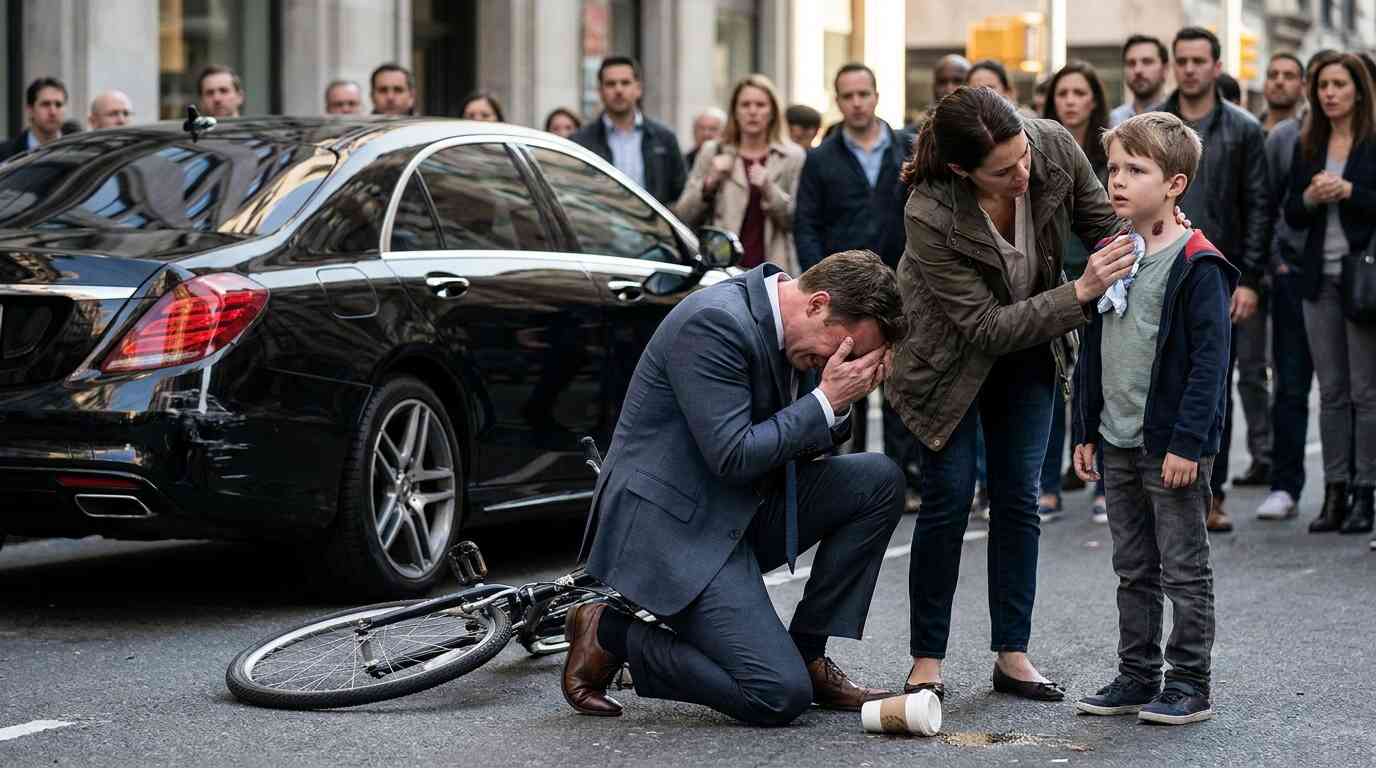
The man wasn’t finished. In his right hand, he held a large, steaming cup of black coffee. Without a second thought, driven by pure, unchecked arrogance, he tipped the cup and poured the hot liquid right over the boy’s head.
“Maybe that’ll wake you up,” he sneered.
The crowd gathered on the sidewalk gasped. People muttered, pulling out their phones, but nobody moved. Except for one guy—a construction worker in a dusty vest who had been eating his lunch nearby. He pushed through the crowd, his eyes blazing.
“Hey! Get your hands off him!” the worker yelled, shoving himself between the billionaire and the crying boy.
He didn’t wait for the rich man to reply. He knelt down immediately, pulling a clean white rag from his tool belt. He began gently wiping the hot, sticky coffee from the boy’s face and neck, making sure the kid wasn’t badly burned.
The billionaire rolled his eyes, adjusting his expensive cuffs. “Mind your own business, pal. The kid ruined my car.”
But the construction worker wasn’t listening. He kept wiping away the coffee, clearing away the layer of city grime and sweat from the back of the boy’s neck. And then, he stopped.
The worker’s hand froze.
As the wet cloth cleared the skin just beneath the boy’s hairline, a distinct, dark mark appeared. It was a birthmark, shaped perfectly like a crescent moon.
The billionaire glanced down, ready to deliver another insult, but the moment his eyes hit that mark, the words died in his throat.
The color instantly drained from his face. His expensive sunglasses slipped from his hand, shattering on the pavement. He stumbled backward, his breath catching in a ragged, suffocating gasp.
“No,” the billionaire whispered, his voice suddenly stripped of all its power. “No, it can’t be.”
He dropped to his knees right there in the dirt, staring at the crying boy as if he had just seen a ghost. The entire street went dead silent.
Full story in the first comment…
👇If you don’t see the new chapter, tap “All comments”.
FULL STORY
Chapter 1: The Weight of Silver
The sun over midtown Manhattan didn’t feel warm; it felt heavy, reflecting off the glass towers and the polished chrome of thousands of vehicles trapped in the midday gridlock. Julian Vance loved that heat. He loved how it made everything glisten, especially the hood of his brand-new Aston Martin. To Julian, the city wasn’t a collection of people; it was a giant, chaotic machine, and he was one of the few men who held the keys to its engine.
At forty-two, Julian had achieved everything the brochures of the American Dream promised. He was a billionaire twice over, a titan of venture capital, and a man whose time was measured in thousands of dollars per second. He wore a six-thousand-dollar Brioni suit like armor, and his heart, though he would never admit it, had become just as rigid and expensive as the fabric.
“Look at these moving obstacles,” Julian muttered to himself, tapping his fingers impatiently on the leather-wrapped steering wheel. He adjusted his Tom Ford sunglasses, staring through the windshield at the sea of yellow cabs and pedestrians crossing the intersection at 5th and Elm. He had a lunch meeting with three international investors in ten minutes, and the traffic was costing him peace of mind.
In the passenger seat sat a large, steaming cup of artisanal black coffee, the aroma thick and bitter in the airconditioned cabin. Julian reached for it, taking a slow sip, his eyes never leaving the road.
Then, it happened.
It was a split-second distraction. A stray, scruffy dog bolted from between two parked delivery trucks, darting straight into the crosswalk. A young boy riding an old, squeaking Schwinn bicycle swerved violently to avoid the animal. The boy’s foot slipped from the pedal, the bike tilted, and with a sickening, metallic screech, the rusty metal handlebar scraped along the front right fender of Julian’s pristine silver car.
The impact was minor—a shudder that barely registered in the heavy chassis—but the sound was a declaration of war.
Julian’s grip tightened on his coffee cup until the cardboard buckled. He looked out the side window. The boy had collapsed onto the asphalt, his bicycle tangled around his skinny legs. He looked about twelve years old, wearing an oversized, faded gray t-shirt and worn-out sneakers with holes in the toes.
Julian didn’t look at the boy’s scraped knee, which was already bleeding onto the pavement. He didn’t look at the terror in the child’s wide, pale eyes. Julian looked down at the fender.
A jagged, white scratch, about eight inches long, scarred the flawless silver paint.
A dark, hot surge of adrenaline flooded Julian’s veins. It wasn’t just about the car; it was about the audacity of the world disrupting his order. It was about a cheap, worthless piece of metal daring to deface his property.
He threw the driver’s side door open, the heavy thud echoing across the intersection.
“Do you have any idea what you just did?!” Julian roared, his voice cutting through the ambient hum of city traffic. He marched around the hood of his car, his polished leather shoes clicking sharply on the road.
The boy, still trapped under the frame of the bike, scrambled backward in fear, his hands scraping against the hot asphalt. “I-I’m sorry, mister! A dog ran out, and I—”
“I don’t give a damn about a dog!” Julian interrupted, standing over the child like an angry god. He pointed a trembling, manicured finger at the scratch. “Do you know what this car costs? Your parents couldn’t afford the lug nuts on this vehicle if they worked three lifetimes in whatever basement they live in!”
Pedestrians began to slow down. A few people stopped on the sidewalk, their faces tight with discomfort. In America, people hated scenes, but they loved to watch them.
“I didn’t mean to,” the boy sobbed, his chest heaving. He was small for his age, his face covered in a layer of city sweat and dust. “Please, I was just trying to get home.”
“You’re going to pay for this,” Julian sneered, his civility entirely consumed by a lifetime of unchecked privilege and deep-seated, buried anger. He felt a twisted sense of righteousness. The world needed to know that actions had consequences, that the small could not deface the great without penalty.
He looked down at the boy, then down at the large paper cup of coffee still clutched in his right hand. The liquid was still incredibly hot, wisps of steam rising into the humid air.
Driven by an impulse of pure, malicious arrogance, Julian tilted his wrist.
He poured the hot, dark liquid directly over the boy’s head.
The boy shrieked, flinching away, covering his face with his thin arms as the coffee soaked through his hair, scalded his forehead, and ran down his neck in dark, steaming rivulets.
“Maybe that’ll teach you to look where you’re going, you little parasite,” Julian spat, tossing the empty cup into the street.
A collective gasp rippled through the crowd of onlookers. Someone shouted, “Hey! That’s a kid!” but no one stepped off the curb. Julian adjusted his cuffs, his chest expanding with a dark, triumphant satisfaction. He had reestablished control. He had punished the offender.
Then, a heavy hand slammed onto Julian’s shoulder, spinning him around with immense force.
Chapter 2: The Unwiping of Time
Julian staggered back a step, his eyes flashing with fury as he faced his challenger.
Standing in front of him was a broad-shouldered man in his mid-thirty, wearing a faded orange construction vest over a sweat-stained gray t-shirt. His work boots were coated in drywall dust, and his face was hardened by years of manual labor. His name was Marcus Taylor, a local structural welder who had been sitting on a concrete barrier eating a ham sandwich when the commotion started.
“Are you out of your absolute mind?” Marcus bellowed, his voice vibrating with a raw, protective rage that Julian’s money could never buy. “He’s a child! You just poured hot coffee on a kid over a piece of plastic?”
“Get your hands off me, you ape,” Julian hissed, brushing his shoulder as if Marcus’s touch had contaminated the expensive fabric. “He damaged my property. He’s going to learn a lesson. And if you touch me again, my lawyers will ensure you spend the next decade paying off the lawsuit.”
Marcus didn’t even look at Julian’s expensive suit or his threats. Instead, his eyes went down to the boy, who was shivering on the ground, whimpering softly as the dark coffee soaked into his oversized shirt.
“Don’t worry, buddy. I got you,” Marcus said, his voice instantly dropping to a gentle, steady rumble. He ignored Julian completely and knelt down on the dirty asphalt beside the boy.
The crowd grew thicker, a ring of fifty people now watching the drama unfold. Cars behind Julian’s Aston Martin began honking, a symphony of urban impatience, but the world inside that small circle had slowed down to a crawl.
Marcus pulled a clean, white cotton shop rag from his heavy leather tool belt. He gently reached out, placing a hand on the boy’s trembling shoulder. “Hey, look at me. Is it burning? Do we need an ambulance?”
“It… it stings,” the boy whispered, his teeth chattering from shock despite the summer heat. “It’s hot.”
“Let’s get it off you,” Marcus said. He used the white rag to carefully wipe the dark liquid from the boy’s forehead, making sure it didn’t get into his eyes. He wiped the boy’s cheeks, clearing away a mixture of tears, dirt, and premium arabica beans.
Julian stood a few feet away, his arms crossed, a sneer plastered across his face. “Go ahead, play the hero. It won’t change the fact that his parents are getting the bill for that fender. I have his face on my dashcam.”
Marcus ignored the billionaire’s barking. He moved his hand to the back of the boy’s head, gently tilting the child’s face forward so he could clean the heavy stream of coffee that had pooled around the collar of his t-shirt.
Marcus gripped the collar, pulling it down slightly, and began to firmly rub the rag against the back of the boy’s neck, clearing away the sticky residue and the layers of city grime that a kid on a bike accumulates.
With three clean strokes of the white cloth, the skin was laid bare.
Marcus stopped. His hand froze mid-wipe.
There, situated precisely at the base of the boy’s skull, just above the spine, was a dark, distinct birthmark. It was roughly the size of a quarter, shaped in a perfect, elegant crescent moon, with a tiny, dark mole sitting just outside the upper tip, like a solitary star.
Marcus didn’t know what it meant, but he heard a sudden, sharp intake of air behind him.
Julian Vance had stopped breathing.
The billionaire’s arrogant smirk didn’t just fade; it disintegrated. His face turned a sickly, asymmetric shade of gray. The world around him seemed to lose its sound. The honking cars, the whispering crowd, the hum of the city—all of it vanished into a deafening, roaring silence inside his skull.
Julian took a shaky step forward, his legs suddenly feeling like water. His eyes were locked onto that crescent moon.
Ten years ago. A rainy night in Boston. A hospital room filled with the scent of sterile plastic and cheap flowers. A tiny, fragile bundle wrapped in a blue blanket. And on the back of that newborn baby’s neck, the exact same mark. A mark Julian had kissed a thousand times before the world fell apart.
“No,” Julian whispered, his voice cracking, stripping away every ounce of the powerful executive he had spent a decade building. “No… it’s not possible.”
Chapter 3: The Ghost of Boston
To understand the ghost that had just materialized on 5th and Elm, you had to understand the man Julian Vance used to be before he allowed money to eat him from the inside out.
Eleven years ago, Julian wasn’t a billionaire. He was a struggling, ambitious analyst living in a cramped two-bedroom apartment in South Boston with his wife, Clara, and their infant son, Leo. They didn’t have a silver Aston Martin; they had a rusted Honda Civic with a broken heater. But they had everything.
Clara was a schoolteacher with a laugh that could clear the clouds from any sky, and Leo was a miracle—a boy born with his mother’s bright green eyes and a strange, beautiful crescent-moon birthmark on the back of his neck. Julian used to joke that the universe had branded the boy so he could always find his way home.
But ambition is a quiet poison. Julian wanted more. He wanted to prove he could provide, to show the world he wasn’t just another working-class guy from the suburbs. He started working eighty-hour weeks. He missed first steps. He missed first words. He was chasing the golden fender of life, believing that wealth was the ultimate expression of love.
Then came the night of November 14th, 2016.
Julian had been at a celebratory dinner after closing his first multi-million-dollar fund. He had turned his phone on silent. Clara had called seven times. There had been a gas leak in their apartment building. An explosion. A fire that consumed three floors in a matter of minutes.
By the time Julian arrived at the scene, the building was a blackened husk. The firefighters told him his wife hadn’t made it. They told him they couldn’t find his son. In the chaos of the evacuation, amidst the smoke and the screaming crowds, eleven-month-old Leo had vanished. Some said a neighbor had taken him; others said he was lost in the rubble.
For two years, Julian spent every penny he made hiring private investigators, tearing the country apart. But the trail went cold. The pain was an agonizing, living thing that ate at his sanity. Eventually, a dark, cynical realization took root in his heart: the universe didn’t reward love; it only recognized power.
So, Julian buried the pain under a mountain of gold. He moved to New York. He stopped looking for a family and started looking for a fortune. He became cold, ruthless, and impatient. He treated people like numbers because numbers couldn’t die in a fire, and numbers couldn’t abandon you.
And now, ten years later, the ghost was looking at him through a layer of spilled coffee.
“Mister?” the boy asked, his voice shaking as he looked at the rich man who had suddenly fallen to his knees on the dirty street.
Julian’s knees hit the asphalt hard, tearing the fabric of his six-thousand-dollar trousers, but he didn’t feel it. He didn’t care about the suit. He didn’t care about the Aston Martin. He didn’t care about the investors waiting for him.
“What’s your name?” Julian choked out, his hands trembling so violently he had to press them against his thighs to keep them still. Tears were already spilling over the rims of his eyes, cutting clean tracks through the dust on his face.
The boy shrank back toward Marcus, terrified by the sudden alteration in the man’s demeanor. From a monster to a broken child in five seconds. “My… my name is Leo,” the boy whispered. “Leo Miller.”
Chapter 4: The Currency of Regret
The crowd began to murmur, confused by the sudden shift in the narrative. The villain of the story was currently kneeling in the dirt, weeping openly, his expensive sunglasses discarded like trash next to a puddle of black coffee.
Marcus, the construction worker, kept his arm around the boy, his brow furrowed in deep suspicion. “Hey, man, what’s your angle? You go from torturing a kid to crying in the street? You need to back off before I call the cops myself.”
“Leo,” Julian breathed, ignoring Marcus entirely. He reached out a hand, his fingers twitching, desperately wanting to touch the boy’s shoulder, to feel the reality of his skin, but he was too afraid he would scare him away. “Leo… your mother… was her name Clara?”
The boy’s eyes went wide. The fear transitioned into a profound, childish confusion. “How… how do you know my mom’s name? She died when I was a baby.”
Julian let out a sound that wasn’t a cry; it was a sob torn straight from the deepest, darkest cavern of his chest. It was the sound of a man being crushed by the weight of ten years of useless wealth.
“She was my wife, Leo,” Julian cried, his voice breaking so loudly that the people on the sidewalk fell completely silent. “She was my wife… and you are my son.”
The words hung in the humid air, heavy and unbelievable.
Marcus looked from Julian to the boy, then down at the birthmark on the kid’s neck. He saw the resemblance now—the structure of the jaw, the shape of the eyebrows. The rich man wasn’t crazy; he was a father looking at a resurrection.
“I don’t understand,” Leo said, his voice small and fragile. “My foster mom, Sarah, she told me I was found after a fire in Boston. She said nobody came for me.”
“I looked for you,” Julian sobbed, his head dropping until his forehead almost touched the dirty asphalt. He was a billionaire, a man who commanded boards of directors, a man who bought and sold companies before breakfast, and he was currently groveling in the dirt at the feet of a child in a torn t-shirt. “I looked for you for years, Leo. I thought you were gone. I thought everything I loved was dead.”
He looked up, his face soaked in tears, his chest heaving with an agonizing mix of joy and profound shame. He looked at the boy’s wet hair, the dark coffee stains on his shirt, and the small, red burn mark beginning to form on his shoulder where the liquid had been hottest.
I did that, Julian thought, the realization cutting into his soul like a jagged blade. I did that to my own son. I became the monster that hurts my own child because he scratched a piece of silver.
The golden fender he had chased for ten years wasn’t a prize; it was his prison. His wealth had made him so blind, so ugly, that when his own blood returned to him, his first instinct was to pour hot poison on his head.
“Can you ever forgive me?” Julian wept, his hands hovering in the air, begging for a mercy he knew he didn’t deserve. “Leo… please. Look at me. I’m your father.”
Chapter 5: The Shattered Mirror
The intersection of 5th and Elm had completely transformed. The honking had stopped; drivers were leaning out of their windows, their faces hushed with awe. The construction worker, Marcus, slowly stood up, stepping back to give the father and son space, though his face remained a mask of solemn contemplation. He had witnessed the worst of humanity and the most miraculous in the span of five minutes.
Leo sat on the ground, his small hands gripping the frame of his rusty bicycle. He looked at the silver sports car, then at the man in the ruined suit. He had spent his entire life wondering about the man who had left him, imagining a father who was a hero, a man who would come rescue him from the cramped foster homes and the hand-me-down clothes.
He had never imagined his father would be the man who called him trash.
“You poured coffee on me,” Leo whispered, the simplicity of the statement carrying more weight than any legal indictment. His green eyes, so like Clara’s, were filled with a profound, quiet hurt. “You said I wasn’t worth the car.”
Julian felt those words slice through his chest, severing whatever pride he had left. He didn’t try to defend himself. He didn’t offer excuses about stress, or meetings, or the value of the vehicle.
“I know,” Julian choked out, his voice thick with self-loathing. “I am a fool, Leo. I let the world turn me into a monster. I thought if I had enough money, nothing could ever hurt me again. But all it did was make me blind to what actually matters.”
He crawled forward on his knees, completely indifferent to the oil stains and road grime ruining his expensive clothes. He stopped just inches away from the boy’s bicycle.
“Every dime I have, every car, every building… it’s all dirt compared to you,” Julian said, his voice dropping to a desperate whisper. “If I could give it all away right now to take back the last ten minutes, to take back the pain I caused you, I would do it in a heartbeat. I would live in the dirt with you, Leo, just to be your dad.”
Leo looked at the man’s trembling hands. He saw the raw, unedited agony in Julian’s eyes. A child doesn’t understand venture capital or billions of dollars, but a child understands tears. A child understands a broken heart.
Slowly, hesitantly, Leo reached out his small, scraped hand. He didn’t hug Julian—not yet—but he placed his fingers gently against his father’s wet cheek, wiping away a single, hot tear.
“Does it still hurt?” Leo asked softly, referring to the old fire, to the loss of his mother, to the ten years of empty silence.
Julian closed his eyes, leaning his face into his son’s tiny palm, feeling a warmth that no amount of money could ever buy. “It hurts less now that you’re here,” Julian whispered.
Chapter 6: The True Value of Silver
The lunch meeting with the international investors never happened. Julian’s phone rang thirty times in his pocket, vibrating against his leg like a distant, irrelevant insect, before he finally pulled it out and switched it off completely.
With the help of Marcus, who refused to leave until he knew the boy was entirely safe, Julian helped Leo up from the asphalt. The silver Aston Martin remained parked in the middle of the intersection, its hazard lights blinking rhythmically, a two-hundred-thousand-dollar obstacle that Julian didn’t give a single damn about. He told a passing police officer to have it towed wherever they wanted. He didn’t need it anymore.
Julian walked away from the car, his arm wrapped tightly around his son’s shoulders, holding him as if the boy might dissolve into the humid air if he let go.
They sat together on the concrete steps of a nearby library, away from the worst of the crowd. Marcus had gone to a corner bodega and returned with a cold bottle of water and a pack of ice for Leo’s minor burn, delivering them with a nod of quiet respect before disappearing back into the city’s rhythm.
Julian used the ice pack to gently soothe the red skin on Leo’s shoulder, his movements careful and full of a reverence he hadn’t felt in a decade.
“We have a lot of time to make up for,” Julian said, looking into his son’s green eyes. “And I have a lot of things I need to fix. Not just with you, but with myself.”
“Are you going to take me away from Sarah?” Leo asked, a slight trace of anxiety in his voice. “She was nice to me when nobody else was.”
Julian smiled, a genuine, soft expression that felt foreign on his face but felt incredibly right. “No, Leo. Anyone who loved you when I wasn’t there is a part of our family now. We’re going to take care of her, too. We’re going to take care of everyone.”
He looked back toward the intersection, where a flatbed truck was currently hoisting his silver sports car into the air. The scratch on the front fender caught the light, gleaming like a silver scar. Julian looked at it and felt absolutely nothing but gratitude. If that car hadn’t been scratched, if that boy hadn’t swerved, Julian would still be sitting in that leather seat, a wealthy corpse driving a beautiful coffin.
He looked back at Leo, who was now drinking the cold water, his small frame relaxed against his father’s side. The coffee was drying in his hair, but the mark on his neck was clean, shining under the New York sun like a promise kept.
Julian pulled his son close, burying his face in the boy’s coffee-scented hair, knowing that the longest search of his life was finally over.
In a world where we spend our entire lives chasing things that can be broken, stolen, or scratched, the only true wealth we possess is the love we are willing to grovel in the dirt to protect.