The Billionaire’s Cruel Strike Unleashed a Truth That Shattered His Entire Life Forever
The sound of metal scraping against carbon fiber was loud enough to drown out the heavy thrum of the Seattle rain.
Julian Vance didn’t see the boy on the bicycle. He didn’t care to look. He was too busy screaming at his assistant over his Bluetooth earpiece about a multi-million-dollar tech acquisition that was falling through. All Julian felt was the jarring thud against his passenger door, followed by the high-pitched screech of a cheap aluminum bike sliding across the wet asphalt.
In an instant, pure, unadulterated rage consumed him.
He didn’t check to see if the person he hit was breathing. He didn’t care that the wet pavement was slick and dangerous. Julian shoved his door open, stepping out into the chilly afternoon air, his custom-tailored charcoal suit instantly catching the drizzle. He looked down at the front quarter-panel of his pristine, limited-edition sports car.
There it was. A jagged, six-inch scratch cutting right through the custom matte-black paint.
“Are you completely blind, you pathetic piece of trash?!” Julian roared, his voice echoing off the concrete walls of the downtown corridor.
On the ground, tangled in the frame of a rusted, oversized mountain bike, was a teenage boy. He couldn’t have been more than fifteen. He was wearing a faded green rain jacket that was two sizes too big, and a neon delivery vest that marked him as one of the hundreds of underpaid couriers weaving through the city’s tech district. A crumpled paper food bag lay ruptured in the gutter, its contents spilling into the dirty water.
The boy was trembling, his face pale as he tried to untangle his leg from the pedals. “I-I’m sorry, sir! The light turned, and my brakes didn’t catch in the wet—”
“I don’t give a damn about your excuses or your garbage brakes!” Julian snapped, stepping forward and kicking the bike’s front wheel out of his way with his polished leather shoe. The metal groaned against the pavement. “Do you have any idea what this car costs? Do you know who I am? You couldn’t earn enough to pay for this scratch if you worked for the next three lifetimes!”
A few pedestrians stopped, pulling up their hoods, their faces tight with discomfort as they watched the wealthy executive tower over the terrified teenager. Downtown Seattle was full of these contrasts—men who controlled billions walking past kids who counted pennies—but Julian’s raw venom was making people uncomfortable.
“I can pay for it… I can try,” the boy whispered, his voice cracking with a thick, heavy terror. He was shivering violently now, from both the cold rain and the sheer intimidation of the man standing over him. “I have twenty dollars on my app… and my manager might give me an advance…”
Julian let out a cruel, barking laugh that made a woman walking past gasp. “Twenty dollars? You think twenty dollars fixes a custom Italian paint job? You stupid, illiterate little parasite.”
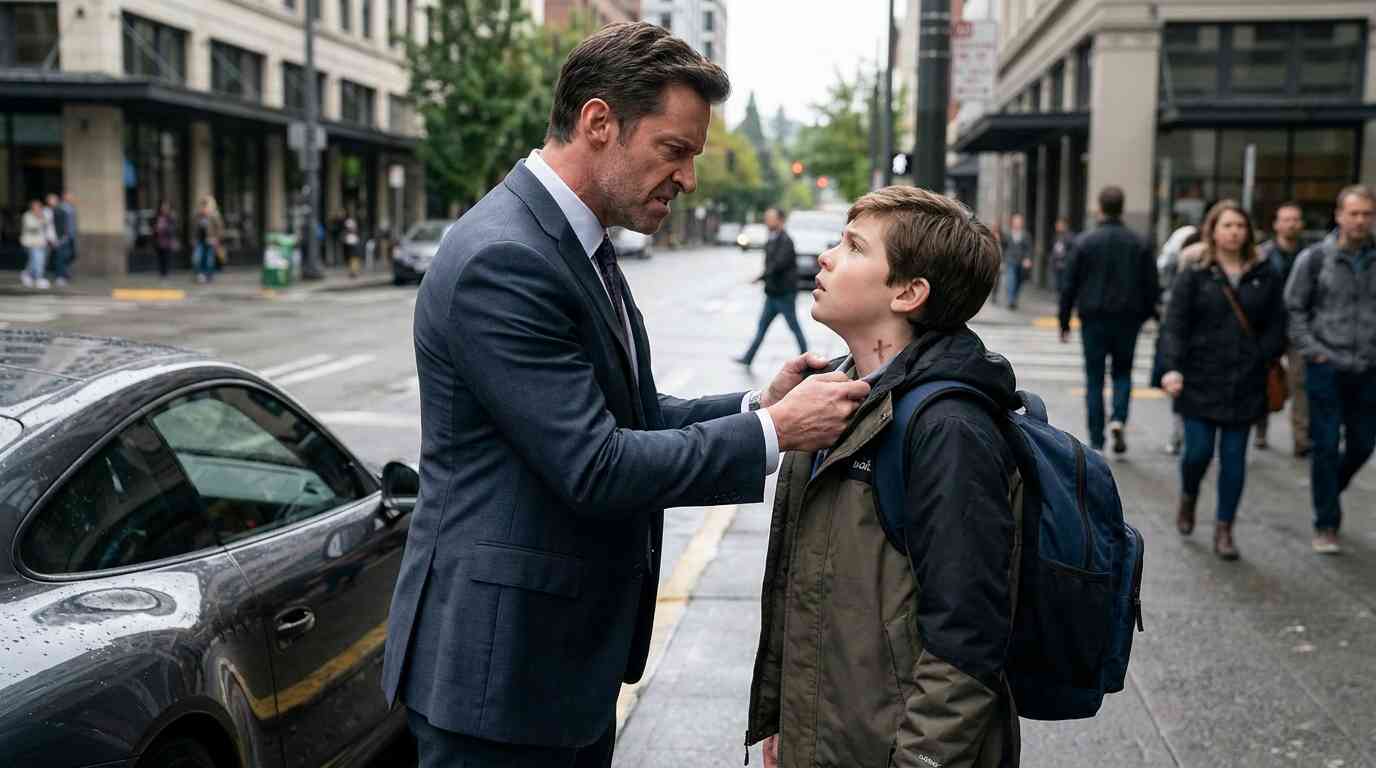
Julian reached down, his large, manicured hand gripping the collar of the boy’s cheap green jacket. With a single, aggressive jerk, he yanked the teenager to his feet, slamming him back against the cold brick wall of the bank behind them.
“Listen to me, you little punk,” Julian hissed, his face inches from the boy’s. “You are going to call your parents right now. They are going to bring me ten thousand dollars in cash, or I am going to personally ensure the police drag you to a juvenile detention center before the sun goes down. Do you understand me?”
“My mom doesn’t have that kind of money!” the boy sobbed, his hands flying up to grasp at Julian’s wrists, trying to loosen the suffocating grip on his throat. “Please, mister! She works two jobs! She’s sick! Please don’t call the police!”
“Then you should have looked where you were going!” Julian shouted, tightening his fingers around the fabric, pulling the boy’s neck upward to completely break his spirit.
But as Julian tilted the boy’s head back against the brick wall, the cheap zipper of the green jacket slid down a few inches. The wet collar parted.
Julian’s words died in his throat.
Right there, on the left side of the boy’s neck, just beneath the jawline, was a highly distinct, dark red birthmark. It was shaped perfectly like a small, crooked cross, with a tiny jagged branch extending from the bottom edge.
The world around Julian suddenly lost all its sound. The blaring car horns, the patter of the rain, the angry murmurs of the gathering crowd—everything vanished into a suffocating, echoing silence.
Julian’s fingers went entirely numb. His mind raced back fifteen years, into a dark, locked room of his memory that he had spent millions of dollars and a decade of heavy drinking trying to bury. He remembered a hospital room. He remembered a tiny, fragile newborn baby wrapped in a blue blanket. And he remembered staring at that exact, identical cross-shaped birthmark on the infant’s neck, while his then-wife, Clara, cried tears of joy.
Clara, whom he had abused. Clara, whom he had driven away with his monstrous temper and relentless cruelty until she fled into the night with their six-month-old son, changing her name and vanishing into the vast, unforgiving underbelly of the country to escape him.
Julian looked into the boy’s eyes. They weren’t just any eyes. They were a piercing, deep sea-green. Clara’s eyes.
“What…” Julian’s voice was no longer a roar. It was a hollow, terrified whisper that barely carried in the wind. His hands began to shake so violently that he lost his grip completely, stumbling backward two steps as if he had been struck in the chest with a sledgehammer. “What is your name?”
The boy choked, rubbing his bruised neck, staring at the wealthy executive with absolute horror, thinking the man was completely insane. “L-Leo,” the boy stammered, his chest heaving. “Leo Vance… I mean, Leo Miller. Please don’t hurt me.”
Julian felt the ground tilt beneath his feet. The breath left his lungs in a sharp, painful gasp.
Full story in the first comment…
👇If you don’t see the new chapter, tap “All comments”.
FULL STORY
Chapter 1: The Scratch on the Surface
The rain in Seattle didn’t wash things clean; it just made the grime slicker. Julian Vance stood by the floor-to-ceiling windows of his penthouse office on the forty-second floor, looking down at the gray, crawling lines of traffic below. To the world, he was a visionary—the founder of Vance Nexus Systems, a logistics software conglomerate that kept the veins of American commerce pumping. To himself, he was an island.
He liked it that way. Islands didn’t have to explain themselves. Islands didn’t bleed when someone else made a mistake.
“Julian, the board is leaning toward the lower valuation for the Chicago acquisition,” his assistant, Sarah, said through the desk speaker. Her voice was cautious, calibrated to the exact frequency required to handle a man whose temper was a corporate legend.
“Tell the board they can take their lower valuation and find another company to save them from bankruptcy,” Julian snapped, not bothering to look back. “I didn’t spend twenty years building this empire to play nice with midwestern trust-fund babies. We push the hard line at four o’clock, or we walk.”
He checked his Patek Philippe watch. 3:30 PM. He needed to be across town for a private dinner with a city councilman who held the keys to the new downtown drone-delivery zoning permits. It was a meeting that required his personal touch—which, in Julian’s world, meant a heavy hand and a fat campaign contribution.
Five minutes later, Julian was in the underground garage, sliding into the custom-molded leather seat of his limited-edition Italian sports car. The engine ignited with a predatory growl that echoed off the concrete pillars. He loved this machine. It was one of only fifty in the world, painted in a proprietary matte-black finish that absorbed light like a black hole. It was a physical manifestation of his status: untouchable, expensive, and unforgiving.
As he surged out of the garage ramp and into the slick, neon-lit chaos of the rush-hour drizzle, his Bluetooth earpiece chimed. It was his lead attorney, Marcus Hale, a man Julian paid seven figures a year to keep his closet free of skeletons.
“Julian, we have a problem with the compliance audit,” Marcus said, his voice strained. “Some of the labor data from the early warehouse days… it’s showing discrepancies. If the press gets hold of how we treated the independent contractors back in 2012—”
“Then don’t let them get hold of it,” Julian interrupted, weaving aggressively through a tight gap between a city bus and a delivery van. “That was over a decade ago, Marcus. Those people were paid what they agreed to. If they wanted health insurance and predictable hours, they should have gone to law school. Fix it.”
“It’s not just data, Julian. One of the old plaintiffs is trying to track down your personal history. They’re looking into the old domestic filings from before the company went public. Your ex-wife—”
“Do not say her name,” Julian growled, his knuckles turning white on the steering wheel. The mention of Clara was an instant trigger, a sudden rip in the carefully constructed armor he wore every day. “She made her choice fifteen years ago. She took my money, she took the kid, and she vanished into whatever gutter she belonged in. She doesn’t exist. If a reporter asks, you tell them I’ve been a bachelor since birth. Do you hear me?”
“Understood,” Marcus muttered.
Julian cut the call. His heart was hammering against his ribs, an old, toxic adrenaline flooding his system. He hated being reminded of that time. He hated remembering the shouting matches in their cramped, damp apartment back when he was broke and desperate. He hated remembering the look of absolute terror on Clara’s face the night he had thrown a whiskey glass across the room, shattering it inches from her head while she held their crying six-month-old son.
The next morning, the apartment had been empty. No note. No forwarding address. Just a missing suitcase and an empty crib. He had spent two years hunting for them, not out of love, but out of a furious, wounded pride. He couldn’t stand losing. Eventually, as the billions started rolling in, the anger had calcified into a cold indifference. He had erased them from his taxes, his corporate bio, and his conscience.
He slammed his foot on the accelerator, trying to outrun his own thoughts. The car surged forward down the steep decline of Fourth Avenue.
Up ahead, the traffic light at the intersection was turning from yellow to solid red. A crowded crosswalk was filling with pedestrians huddled under a sea of black umbrellas. Julian didn’t want to wait. He calculated the distance, intending to make a sharp, aggressive right turn into an alleyway shortcut that would bypass the gridlock.
He didn’t see the kid until it was too late.
The boy was riding an old, heavy mountain bike with mismatched tires and a rusted chain that squeaked rhythmically. He was wearing a neon-green reflective vest over a faded, oversized rain jacket, a large square food-delivery backpack strapped to his thin shoulders. He was coasting down the bicycle lane, trying to clear the intersection before the cross traffic started.
Julian jerked the steering wheel to the right. The sports car’s wide nose clipped the rear wheel of the bicycle.
The sound was a sickening mix of crunching aluminum and scraping fiberglass. The force of the impact lifted the back of the bike into the air, sending the teenager flying over the handlebars. He hit the wet asphalt hard, sliding several feet until his body jammed against the concrete curb. The food delivery bag tore open, spilling plastic containers of warm soup and Thai noodles into the rushing stream of dirty water in the gutter.
Julian didn’t feel a pang of worry. He didn’t feel his stomach drop the way a normal human being would after hitting a child. All he felt was a violent, white-hot surge of inconvenience.
He threw the car into park, shoved the door open, and stepped out into the rain. The cold water hit his face, but it did nothing to cool the fire in his chest. He didn’t even look toward the boy who was groaning on the pavement. Instead, Julian walked straight to the passenger side of his car.
There it was. A deep, jagged, six-inch gouge cutting through the custom matte-black paint, revealing the bright, raw silver of the composite metal underneath. The front fender was slightly buckled.
“Are you completely blind, you pathetic piece of trash?!” Julian roared, his voice cutting through the ambient hum of the city traffic like a circular saw.
The boy on the ground was trembling violently. He was trying to untangle his left leg from the twisted chain of his bike. His jeans were torn at the knee, a dark, slow ooze of blood beginning to mix with the rainwater on his skin. He looked up at Julian, his face pale, his lower lip quivering with a terror so profound it looked like he was staring at a monster.
“I-I’m sorry, sir!” the boy stammered, his voice cracking with the high-pitched fragility of an adolescent who hadn’t fully grown into his vocal cords. “The light… it turned so fast, and my brakes… they didn’t hold in the wet pavement…”
“I don’t give a damn about your excuses or your garbage brakes!” Julian stepped forward, his polished Italian leather shoes splashing carelessly through the dirty puddles. He kicked the boy’s front wheel out of his path, the rusted rim clattering against the curb. “Do you have any idea what this car is? Do you know what this paint job costs? You couldn’t earn enough to pay for this scratch if you worked for the next three lifetimes!”
A few pedestrians stopped on the sidewalk. A man in a heavy carhartt jacket paused, his jaw tightening as he looked at Julian’s expensive suit and then at the bleeding kid on the ground. “Hey, buddy, take it easy,” the man called out. “The kid’s hurt. Call an ambulance.”
“Mind your own business!” Julian shot back, turning a lethal glare toward the onlooker. “Unless you want to write a check for ten thousand dollars to cover the damage this little parasite just caused, keep moving!”
The onlooker hesitated, intimidated by the sheer, unhinged authority in Julian’s voice, and stepped back into the crowd, murmuring to a woman next to him who was already pulling out her phone to record.
Julian turned back to the boy, who was now crying silently, his shoulders shaking as he tried to pull himself onto his knees. “I can pay for it… I can try,” the boy whispered, wiping his nose with the back of a dirty, wet sleeve. “I have twenty-two dollars on my delivery app right now… and my manager might give me an advance on my weekend shift…”
Julian let out a cruel, barking laugh that made the boy flinch. “Twenty-two dollars? You think twenty-two dollars fixes a custom Italian composite panel? You stupid, illiterate little parasite.”
Julian’s patience was entirely gone. He wanted this over with. He wanted this kid to feel the weight of what he had disrupted. He reached down, his large, powerful hand gripping the collar of the boy’s cheap green rain jacket. With a single, brutal jerk, he yanked the teenager off the ground, slamming his back hard against the cold brick wall of the bank building next to the alley.
“Listen to me, you little punk,” Julian hissed, his face inches from the boy’s. The smell of Julian’s expensive cologne mixed with the metallic scent of the rain and the boy’s sweat. “You are going to call your parents right now. They are going to bring me ten thousand dollars in cash, or I am going to personally ensure the police drag you to a juvenile detention center before the sun goes down. Do you understand me? I will ruin your life before it even starts.”
“My mom doesn’t have that kind of money!” the boy sobbed, his small hands flying up to grasp at Julian’s heavy wrists, trying desperately to loosen the suffocating grip on his throat. “Please, mister! She works two jobs! She’s sick! She can’t take another crisis! Please don’t call the cops!”
“Then you should have looked where you were going!” Julian shouted, tightening his fingers, pulling the boy’s neck upward to completely break his resistance.
But as Julian tilted the boy’s head back against the rough brick wall, the cheap plastic zipper of the green jacket gave way, sliding down a few inches. The wet, frayed collar of his t-shirt parted.
Julian’s words died instantly in his throat.
Right there, on the left side of the boy’s neck, just an inch below his jawline, was a highly distinct, dark red birthmark. It was shaped perfectly like a small, crooked cross, with a tiny jagged branch extending from the bottom edge.
The world around Julian suddenly lost all its sound. The blaring car horns, the patter of the heavy rain, the angry murmurs of the gathering crowd—everything vanished into a suffocating, ringing silence.
Julian’s fingers went entirely numb. His mind raced back fifteen years, into a dark, locked room of his memory that he had spent millions of dollars trying to bury. He remembered a hospital room. He remembered a tiny, fragile newborn baby wrapped in a blue blanket. And he remembered staring at that exact, identical cross-shaped birthmark on the infant’s neck, while his then-wife, Clara, cried tears of joy.
Julian looked into the boy’s eyes. They weren’t just any eyes. They were a piercing, deep sea-green. Clara’s eyes.
“What…” Julian’s voice was no longer a roar. It was a hollow, terrified whisper that barely carried in the wind. His hands began to shake so violently that he lost his grip completely, stumbling backward two steps as if he had been struck in the chest with a sledgehammer. “What is your name?”
The boy choked, rubbing his bruised neck, staring at the wealthy executive with absolute horror, thinking the man was completely insane. “L-Leo,” the boy stammered, his chest heaving as he slid down the wall. “Leo Vance… I mean, Leo Miller. Please don’t hurt me.”
Julian felt the ground tilt beneath his feet. The breath left his lungs in a sharp, painful gasp. The billionaire was looking at the son he had abandoned to the world.
Chapter 2: The Ghosts of Concrete and Rain
The rain kept falling, but Julian Vance couldn’t feel it anymore. The expensive charcoal wool of his suit was soaking through, turning heavy and cold against his skin, but his chest felt like it was on fire. He stared down at the boy—at Leo—who was now curled into a defensive ball against the brick wall, tucking his head between his knees as if expecting another blow.
“Leo,” Julian said, the name tasting like ash in his mouth. He reached out a trembling hand, but the boy flinched so violently that Julian pulled his fingers back as if he’d been burned.
“I’m sorry! I’m sorry about the car!” Leo cried out, his voice muffled by his knees. “Don’t call the police. My mom… she can’t handle it. She’s in the clinic right now. She’s having tests done. If she finds out I ruined everything… if she finds out I’m going to jail…”
The crowd on the sidewalk had grown. The man in the Carhartt jacket, Marcus from earlier, stepped directly between Julian and the boy. His face was set in a hard, protective scowl. “Hey! Back off, man! I don’t care how much money you have or what kind of car you drive. You don’t put your hands on a kid like that. I’ve already called the cops on you.”
For the first time in his life, Julian didn’t fire back. He didn’t threaten a lawsuit. He didn’t use his wealth as a shield. He didn’t even look at Marcus. His eyes were locked on the rusted frame of the bicycle, on the torn delivery bag, and on the cheap, faded blue plastic keychain that had fallen out of Leo’s pocket into the gutter.
Julian knelt down in the dirty water, his knee sinking into a puddle of oil and rain. He picked up the keychain. Written on the plastic in fading, silver sharpie were the initials: L.V.
Leo Vance. Clara had kept the name for him, at least initially. She had carried that piece of their shattered past with her through whatever hell she had endured after escaping his apartment all those years ago.
“Is your mother’s name Clara?” Julian asked, his voice cracking, entirely devoid of the corporate authority that usually defined him.
Leo raised his head slowly, his sea-green eyes wide with an intense, sudden confusion that cut through his terror. He wiped a mix of blood and rain from his forehead. “How… how do you know my mom’s name?”
Before Julian could answer, the distant, rhythmic wail of a police siren began to echo through the downtown high-rises, drawing closer by the second. The crowd shifted, some people looking down the block toward the flashing blue and red lights that were reflecting off the wet buildings.
“Kid, don’t say anything to this guy,” Marcus said, keeping a wary eye on Julian. “The cops are almost here. We’ll get this sorted out. He’s the one who hit you, and he’s the one who assaulted you. There are ten people here who saw him grab your throat.”
Julian looked at his son. Really looked at him. Leo was small for fifteen. His wrists were thin, his face slightly gaunt, showing the subtle, unmistakable signs of a childhood shaped by missed meals and chronic stress. He was working a grueling delivery job in the freezing rain just to bring home a few dollars, while Julian sat in a temperature-controlled office tower blocks away, arguing over millions like they were poker chips.
The realization didn’t just hurt; it dismantled him. Every piece of his identity—the self-made billionaire, the ruthless negotiator, the man who owed nothing to anyone—shattered into sharp, jagged pieces that cut deep into his soul.
“Leo,” Julian said, his voice urgent as the sirens grew louder. “I’m not going to call the police. I don’t care about the car. I don’t care about any of it.” He pulled his wallet from his coat, his hands shaking so much that several hundred-dollar bills slipped out and floated into the puddle. He didn’t care. He pulled out a heavy, matte-black business card with his direct personal number embossed in silver.
He pressed it into Leo’s damp hand. “Take this. Please. Tell your mother… tell her Julian found you. Tell her I’m sorry.”
“Hey! Don’t intimidate the kid with your cards!” Marcus yelled, reaching down to pull Leo up, but Leo was staring at the card in his hand. The name Julian Vance was printed in bold, clean lettering.
Leo’s breath hitched. He looked from the card up to Julian’s face, his eyes searching the older man’s sharp features, the shape of his nose, the structure of his jaw. A terrible, heavy comprehension began to dawn on the boy’s face. He had seen old, crumpled photographs in the bottom of his mother’s jewelry box—photographs with the father’s face neatly cut out with scissors, leaving only a silhouette of a large, powerful man.
“You…” Leo whispered, his voice dropping into a register of pure, profound heartbreak. “You’re him.”
A Seattle police cruiser pulled up to the curb with a sharp yelp of its siren, its tires splashing a wave of dirty water over the sidewalk. Two officers opened their doors, their expressions alert and cautious as they stepped into the rain.
“What’s going on here?” the first officer asked, his hand resting near his belt as he looked at the expensive car, the broken bike, and the billionaire kneeling in the dirt.
Julian stood up slowly. He looked at the officer, then turned his head back to look at Leo one last time. The boy was staring at him not with anger, and not with fear anymore—but with a deep, generational sorrow that Julian knew he could never fully heal.
“It was my fault,” Julian said to the officer, his voice dead and flat. “Everything is my fault. Take me to the station.”
Chapter 3: The Price of Silence
The holding room at the West Precinct smelled of old coffee and industrial floor cleaner. For three hours, Julian sat on a metal bench, his hands clasped between his knees, staring at the scuff marks on the linoleum floor.
His corporate legal team had arrived within forty-five minutes. Marcus Hale had stormed into the precinct with three junior partners, throwing around their firm’s weight, demanding Julian’s immediate release on bail, and threatening the department with a civil suit for unlawful detention. They had handled the paperwork, paid the fees, and managed to keep the local tech bloggers from getting wind of the arrest.
But when Marcus finally opened the door to the holding room, expecting to find an enraged, vindictive billionaire ready to fire half his staff, he found a man who looked like he had aged twenty years in an afternoon.
“Julian, it’s done,” Marcus said, adjusting his glasses as he walked into the small room. “The police filed a report for an unsafe lane change and a minor altercation, but I’ve already spoken to the precinct captain. We’re going to settle this quietly. The crowd outside had some cell phone footage, but our digital crisis team is already issuing takedown notices for copyright and privacy violations. We’ll pay off the kid’s family, offer them a nice lump sum for his medical expenses and a new bike, and get a non-disclosure agreement signed by tomorrow morning. You won’t even have to see them.”
Julian didn’t move. He didn’t look up at his lawyer. “No NDA,” he whispered.
Marcus blinked, confused. “Pardon? Julian, an NDA is standard procedure. We need to protect the company’s valuation. If the market thinks you’re out here assaulting delivery couriers in the street—”
“I said no NDA, Marcus!” Julian slammed his hand against the metal table, the sound echoing like a gunshot in the small room. He stood up, his suit wrinkled and damp, his eyes bloodshot and fierce. “You don’t understand. You don’t know who that kid is.”
Marcus stepped back, startled by the raw emotion in Julian’s voice. “He’s a courier, Julian. His name is Leo Miller. His mother is a shift nurse at Harborview. They live in a rented two-bedroom apartment in White Center. We’ve already done the background check. They have zero leverage against us.”
“His name isn’t Leo Miller,” Julian said, his voice dropping into a ragged, painful whisper. He walked over to the small, barred window that looked out into the gray evening. “His name is Leo Vance. He’s my son, Marcus.”
The silence in the room became absolute. Marcus Hale had been Julian’s legal counsel for twelve years. He knew about the hidden line items in the corporate budget from the early days—the private investigators who had been paid to search for a woman named Clara Vance before Julian had ordered the search canceled out of spite.
“Julian…” Marcus stammered, his legal mind temporarily failing him. “Are you… are you certain? The birthmark? The name?”
“I held him when he was born, Marcus,” Julian said, a single tear finally cutting through the grime on his cheek. “I remember the day he got that mark. The doctors said it was benign. I told Clara it looked like a cross because he was going to be a saint to make up for his father’s sins. And then I went out and became the very demon she had to protect him from.”
Julian turned around, his face tight with a desperate, newfound purpose. “Where are they? You said you did a background check. Where is he right now?”
“According to our scout, the boy was cleared from the clinic with some minor bruising and a sprained wrist,” Marcus said, his professional composure returning, though his voice remained hushed. “He went back to their apartment in White Center. His mother was discharged from her appointment an hour ago. She’s there with him.”
“Get the car,” Julian ordered, walking past his lawyer toward the door.
“Julian, wait,” Marcus said, grabbing Julian’s arm. It was a bold move—no one touched Julian Vance without permission. “Think about this. If you go there right now, in this state, you are a predator walking into their home. You hit him with your car. You grabbed him by the throat. You represent every nightmare that woman has been running from for fifteen years. You can’t just buy your way back into their lives with an apology.”
Julian looked down at Marcus’s hand on his sleeve, then up into his old friend’s eyes. The anger wasn’t there anymore. Only a profound, heavy weight of truth.
“I’m not going there to buy anything, Marcus,” Julian said softly. “I’m going there to let them break me.”
Chapter 4: The House on the Edge of the World
White Center was a neighborhood that the Seattle tech boom had forgotten. It was a place of older, low-slung apartment complexes, used tire shops, and neon-lit laundromats that stayed open all night. It was twenty miles and a universe away from Julian’s penthouse.
The luxury sports car was gone, left at the precinct to be towed. Julian rode in the back of Marcus’s black luxury SUV, staring out the window as the gleaming glass towers of downtown gave way to cracked asphalt and power lines.
When the SUV pulled up to the complex, Julian’s heart sank. It was a two-story building with peeling brown paint and exterior walkways. A broken plastic tricycle sat in the small, muddy patch of grass near the entrance. This was where his son had grown up. While Julian was buying a twelve-million-dollar vacation home in Aspen that he visited twice a year, his flesh and blood was living in a place where the front security door didn’t even lock properly.
“Do you want me to come with you?” Marcus asked from the front seat, looking at Julian through the rearview mirror.
“No,” Julian said, opening the door. “Stay here. If I’m not back in an hour… don’t call anyone. Just wait.”
Julian walked up the concrete stairs to the second floor, his leather shoes clicking against the wet metal treading. He walked down the long, narrow balcony until he reached Unit 214. There was a small, faded welcome mat outside with a picture of a cartoon cat, worn down to the gray fibers.
He stood before the door for a full two minutes. His hand hovered over the cheap brass knocker. For a man who had delivered keynote addresses to audiences of ten thousand people, the act of knocking on this door felt like trying to lift a mountain.
He knocked. Three short, sharp thuds.
Inside, he heard the sound of footsteps. A lock turned. The chain slid back.
The door opened, and Julian Vance found himself looking at the ghost of his youth.
Clara was forty-one now, but the years had been heavy on her. Her long brown hair was pulled back into a messy bun, streaked with lines of silver that hadn’t been there when she was twenty-six. She was wearing a faded gray oversized sweatshirt and flannel pajama pants. Her face was pale, her eyes tired and sunken from a long day at the hospital—but the moment those eyes locked onto Julian, the exhaustion vanished, replaced instantly by a raw, ancient terror.
She tried to slam the door shut.
Julian was faster, but he didn’t use force. He simply placed his palm flat against the wood, holding it open with just enough pressure to resist her weight. “Clara… please,” he begged, his voice breaking. “Please don’t run. Not again.”
“Get out!” Clara screamed, her voice cracking with a terrifying mixture of anger and panic. “Get away from my home! I’ll call the police! I swear to God, Julian, I’ll call them right now!”
“They already know where I am, Clara,” Julian said, his head dropping against the edge of the doorframe. “I’m the one who hit him. I’m the one who hit Leo today.”
The resistance behind the door stopped instantly.
Clara stepped back into the small, dimly lit living room, her hands flying to her mouth. Her eyes went wide as she stared at him, the pieces of the puzzle clicking together in her mind. Leo had come home covered in mud, his wrist wrapped in medical tape, talking about a crazy rich man in a black car who had grabbed him and given him a card. She hadn’t looked at the card yet—she had been too busy cleaning her son’s cuts and crying over his broken bicycle.
“You…” Clara whispered, her body trembling so violently she had to hold onto the back of a cheap dining chair to stay upright. “You found us. You came to take him.”
“No!” Julian stepped into the room, closing the door softly behind him. He raised his hands in the air, showing his open palms, a universal gesture of surrender. “No, Clara. I swear to you on my life, I didn’t know. It was an accident. I was driving like an idiot, I hit a delivery bike, and I… I was a monster to him. I didn’t see his face until I grabbed his jacket. I saw the mark, Clara. I saw our boy.”
From the small hallway to the right, a door opened. Leo stepped out, his left arm held tightly against his chest in a dark blue medical sling. He looked at Julian, then at his mother, who was sobbing silently into her hands.
“Mom?” Leo asked softly, his voice full of protective instinct as he stepped between his mother and the large man in the expensive suit. “Is this the man from the street? Why is he in our house?”
Clara reached out, pulling Leo into her side, wrapping her arms around his shoulders as if she could shield him from the sheer presence of his father. “Go back to your room, Leo,” she whispered fiercely. “Please, baby, just go back to your room.”
“I’m not leaving you with him,” Leo said, his sea-green eyes locking onto Julian with a defiance that made Julian’s heart ache with a twisted sense of pride. The boy had his mother’s heart, but he had his father’s stubborn, unyielding spine.
Julian looked at the two of them—the small, fragile family unit that had survived fifteen years in the dark, cold corners of the world without a single dime of his billions. He looked at the mismatched furniture, the old television, the small kitchen with a leaking faucet that ticked like a countdown clock.
“I don’t expect you to forgive me,” Julian said, his voice barely audible above the sound of the rain outside. “I don’t deserve it. If you want me to leave, I will walk out that door right now and I will never trouble you again. But please… let me fix what I broke today. Let me take care of him.”
“We don’t want your money, Julian!” Clara spat, her tears spilling over her pale cheeks. “We never wanted your money! I left because your money didn’t make you a man—it made you a god who thought he could destroy anyone who didn’t bow to him. Look at what you did to my boy today! You haven’t changed at all!”
The words cut through Julian’s remaining defenses, stripping away the last illusions of his greatness. She was right. He hadn’t changed. Until five hours ago, he was still the same brutal, selfish boy who thought the world owed him everything.
Julian looked at his son, whose sprained wrist was a physical testament to his father’s cruelty. Then, without a word, the billionaire sank to his knees right there on the worn, faded carpet of the living room floor. He bowed his head, his hands flat on the ground before them.
“I am a monster,” Julian sobbed, his shoulders shaking as twenty years of suppressed grief, arrogance, and loneliness finally tore through his chest. “I am so sorry, Leo. I am so sorry, Clara. Please… just let me help you. Not for me. For him.”
Leo stared down at the wealthy man kneeling at his feet, his young face torn between a deep, instictive anger and a strange, overwhelming confusion. He had never seen a grown man look so utterly, completely broken.
Chapter 5: The Anatomy of a Second Chance
The following morning, the rain finally stopped, leaving Seattle shrouded in a crisp, cold fog that hung low over the Puget Sound.
Julian Vance did not go into the office. For the first time since the founding of Vance Nexus Systems, the CEO’s desk remained completely empty. The corporate board sent thirty-two urgent emails regarding the Chicago acquisition, but Julian’s assistant had been given strict instructions: If it isn’t a matter of life or death, delete it. If it is a matter of life or death, handle it yourself.
Instead, Julian sat in the office of Dr. Elena Rostova, the chief oncologist at the Swedish Medical Center. He had used his personal cell phone at six in the morning to wake up the hospital’s chairman of the board, a man who owed Julian a massive favor from a previous charitable foundation grant. By eight o’clock, Clara’s medical files from the public clinic had been transferred to the top facility in the Pacific Northwest.
“The biopsy from the clinic was inconclusive, Mr. Vance,” Dr. Rostova said, flipping through the digital charts on her tablet. Clara sat in the chair next to Julian, her hands clamped tightly around a paper cup of black coffee. She hadn’t spoken a single word to him during the forty-minute drive from White Center, but she had gotten into the car for one simple reason: she wanted to live for her son.
“What does that mean?” Julian asked, his voice sharp but controlled. He was back in executive mode, but this time, the stake wasn’t a software platform—it was the life of the only woman he had ever truly loved, and the mother of his child.
“It means the public clinic didn’t have the high-resolution imaging equipment required to determine if the mass is benign or malignant,” the doctor explained, looking kindly at Clara. “But looking at her baseline blood panels, we are in a very good position. We’ve scheduled an advanced MRI for eleven o’clock today. We’ll have the results by this evening. If it requires surgery, we have the best thoracic team in the country on standby.”
Clara stared at the floor, her voice a tiny, fragile thing. “I don’t have insurance that covers this facility, Doctor. The copay alone for an MRI here is more than my monthly rent.”
Julian reached out, his hand hovering over hers for a fraction of a second before he pulled it back, respecting her boundaries. “The bill has already been settled, Clara. The entire treatment course, whatever it takes, has been funded through a private medical trust. You don’t owe this hospital a single penny. You never will.”
Clara looked up at him, her sea-green eyes searching his face for the old trick, the hidden catch, the transactional manipulation she knew so well. But she found nothing. Julian’s face was tired, his eyes clear and steady, devoid of the smug satisfaction that usually accompanied his financial triumphs.
“Why are you doing this, Julian?” she asked after the doctor had left the room to prepare the imaging lab. “Is this how you buy your way out of the assault charge? Is this just a PR stunt to keep your company’s name clean?”
“The assault charge is going forward, Clara,” Julian said quietly, looking out the window at the gray sky. “I told Marcus not to fight it. I’m pleading guilty to the unsafe lane change and the misdemeanor battery. My lawyers say I’ll likely get probation and two hundred hours of community service because I don’t have a prior record. I’m not running from it.”
Clara blinked, genuinely shocked. “You’re… you’re going to let them put that on your record? It’ll ruin your reputation on Wall Street.”
“Let it,” Julian said, turning to look at her. “Wall Street didn’t give me a son, Clara. Wall Street didn’t keep you alive when you were working twelve-hour shifts with an undiagnosed mass in your chest. I spent fifteen years thinking I was a king because I had a billion dollars in a digital ledger. Yesterday, I realized I’m just a man who let his family starve while he slept on gold sheets.”
He stood up as a nurse tapped on the door to take Clara down to the imaging department. “I’ll be in the waiting room,” Julian said softly. “Leo is at the apartment finishing his online schoolwork. I had an assistant drop off a new bicycle for him this morning—nothing flashy, just a reliable hybrid with good disc brakes. I didn’t want him to feel like I was buying him off.”
Clara stood up, her body looking small in the hospital gown. She looked at him for a long, quiet moment before she walked toward the door. “He likes blue,” she said quietly, her hand on the knob. “The old bike was red, but his favorite color is blue.”
Julian felt a small, delicate bloom of warmth in his chest for the first time in fifteen years. “I’ll remember that,” he whispered.
Chapter 6: The Language of the Broken
Three months later, the rain had returned to Seattle, but it felt different now. It didn’t feel like a shroud anymore; it felt like a curtain rising on a new act.
The municipal court judge had given Julian Vance exactly what he deserved: twelve months of unsupervised probation, a heavy fine that went directly into a city fund for bicycle safety infrastructure, and two hundred hours of community service at the downtown youth center. The business press had had a field day, with headlines screaming about the tech mogul’s fall from grace, but Julian hadn’t read a single article. He had spent his weekends teaching basic computer literacy to teenagers from low-income families in the Central District, sitting on plastic chairs in a basement classroom, wearing a plain white t-shirt and jeans.
The mass in Clara’s chest had been benign. It had been removed during a three-hour laparoscopic surgery at Swedish Medical Center, paid for entirely by the trust Julian had established. Her recovery had been swift, her color returning to her cheeks, the silver streaks in her hair now looking like badges of a war she had finally won.
They hadn’t moved out of White Center. Clara had refused Julian’s offer of a house in Bellevue or a condo in West Seattle. She wanted to keep her roots, her independence, and her life on her own terms. But she had allowed Julian to pay for Leo’s tuition at a private academy downtown that specialized in engineering and digital design—a school where the boy could finally nurture the brilliant, analytical mind he had inherited from both his parents.
It was a Saturday afternoon when Julian pulled his newly repaired, plain gray sedan up to the curb outside Unit 214. The Italian sports car had been sold at an auction, the proceeds donated to a local women’s shelter.
He walked up the stairs, his step lighter than it had been in years. He didn’t wear a Tom Ford suit anymore when he came here; he wore a soft navy sweater and comfortable boots. He knocked on the door.
Leo opened it. The fifteen-year-old had grown an inch over the summer, his shoulders broadening out, his green eyes bright and clear. He wasn’t wearing his delivery vest anymore. Instead, he wore a blue hoodie from his new school.
“Hey,” Leo said, a small, genuine smile touching his lips. “You’re right on time. The game starts in twenty minutes.”
“I told you I wouldn’t be late,” Julian smiled, stepping into the small living room. The apartment smelled of baked chicken and clean laundry. On the kitchen counter, Julian saw the black business card he had given Leo three months ago—it wasn’t in the trash. It was tucked neatly into the frame of a mirror, a reminder of the day their world had broken open to let the light in.
Clara walked out of the kitchen, wiping her hands on a dish towel. She looked at Julian, her expression soft, the old lines of terror completely gone from her face. “There’s extra chicken if you want to stay for dinner after the game, Julian. Leo made the salad.”
Julian looked at his ex-wife, then at the young man who was already grabbing his coat from the closet. He thought about the billions he still had in the bank, and how completely worthless they felt compared to the simple, fragile invitation to sit at this small dining table and share a meal with the people he had spent a lifetime hurting.
He had spent twenty years trying to build an empire that would make him unforgettable, only to find that his true legacy was a fifteen-year-old boy with a cross-shaped mark on his neck and a heart large enough to forgive a monster.
“I’d love to stay,” Julian said, his voice thick with an emotion he no longer tried to hide.
They walked out of the apartment together, down the concrete stairs into the cool afternoon air. As they reached the sidewalk, Leo hopped onto his new blue bicycle, testing the handbrakes with a sharp, satisfying click before looking back at his father.
“Come on, dad,” Leo called out, his voice ringing clear through the quiet street. “Try to keep up.”
Julian watched his son pedal down the block, his chest expanding with a profound, aching joy that he knew he would spend the rest of his life protecting. True wealth isn’t measured by what we possess, but by the pieces of ourselves we are willing to break in order to heal the ones we love.