The Million-Dollar Mistake: The Day a Billionaire Director Crushed the Wrong Child’s Bicycle
The asphalt on Wilshire Boulevard was baking under the fierce afternoon sun, radiating a suffocating heat that matched the venom inside Julian Vance’s chest. Julian didn’t do traffic. He didn’t do waiting. As one of the most bankable directors in Hollywood, his time wasn’t just money—it was power. He sat behind the wheel of his pristine, custom-matte-black Mercedes G-Wagon, the engine purring like a caged beast, his knuckles white against the leather steering wheel. He had a production meeting in ten minutes, and the gridlock was tearing at his fragile patience.
Then came the boy.
Leo was nine years old, wearing a faded Spider-Man hoodie that had seen far too many trips through a laundromat, riding a battered blue bicycle with rusted handlebars. He was trying to navigate the crowded sidewalk, his small legs pedaling furiously to get home before his father’s shift ended. In a split second of imbalance, Leo’s tire slipped off the curb, sending him wending into the narrow gap just in front of Julian’s stationary luxury SUV.
Julian didn’t see a child. He saw an annoyance. He saw a moving piece of trash threatening his perfect, quarter-million-dollar vehicle.
With a sneer, Julian deliberately pressed his foot onto the accelerator. The massive bumper of the G-Wagon lunged forward, striking the back wheel of the bicycle with a sickening crunch of metal and plastic.
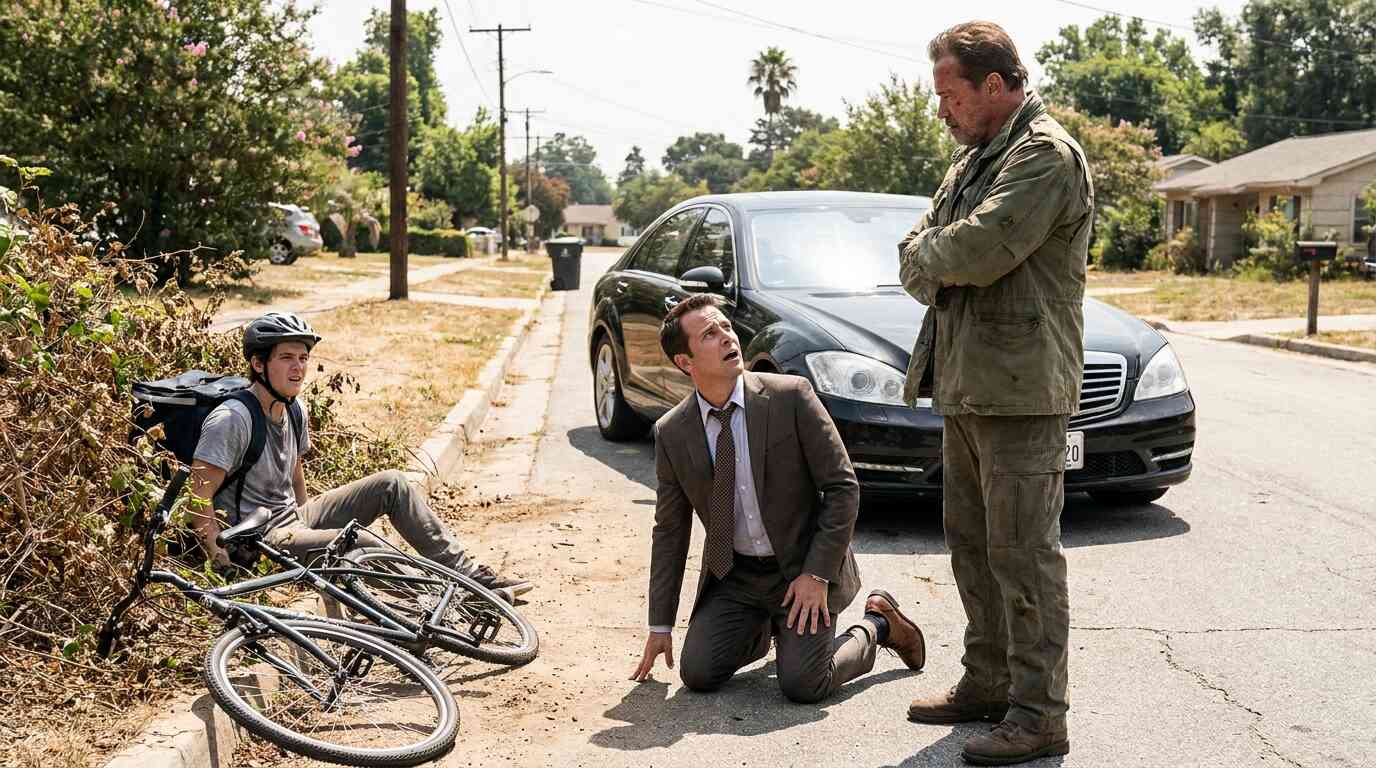
The impact threw Leo violently off the seat. He hit the concrete hard, his palms scraping against the rough pavement, tearing the skin. The battered bicycle was pinned beneath the heavy tire of the SUV, its frame groaning under the weight.
“Hey! Look what you did!” Leo cried out, his voice cracking with the pure, unadulterated terror of a child who had just stared down a monster. Tears welled up in his eyes instantly, mixing with the dust on his cheeks. He wasn’t just hurt; he was devastated. That bike was the only thing his father had been able to buy him for his birthday after working three consecutive double shifts.
The heavy door of the G-Wagon swung open. Julian stepped out, his Italian leather shoes clicking sharply against the pavement. He looked immaculate—a tailored linen suit, expensive designer sunglasses hiding his cold eyes, and an aura of absolute invincibility. He didn’t look at the bleeding child. He looked down at his bumper, checking for scratches.
“Are you blind, you little rat?” Julian barked, his voice carrying over the hum of the city traffic. “Look at my car! Do you have any idea how much this costs? Your parents couldn’t afford the paint job if they worked for the rest of their miserable lives!”
“You hit me!” Leo sobbed, holding his bloody knee, his tiny body trembling on the hot asphalt. “You did it on purpose!”
A crowd began to form on the sidewalk. Passersby slowed down, pulling out their phones, whispering in disgust but too intimidated by Julian’s expensive stature and aggressive demeanor to intervene. This was Los Angeles; wealth was a shield, and everyone knew it.
Julian walked over to where Leo’s helmet had rolled onto the street. With a cruel, mocking laugh, he pulled his foot back and kicked the plastic helmet hard. It shattered against the concrete curb, pieces of styrofoam scattering into the gutter. “Get your trash out of my street before I have the police throw you in a cell,” Julian hissed, leaning down so his shadow completely swallowed the boy. “People like you don’t belong on my road.”
Leo cowered, covering his face, utterly defenseless against the billionaire’s wrath. Julian turned on his heel, a smug smile playing on his lips, completely satisfied with his display of dominance. He reached for his car door handle, ready to drive away and leave the broken boy in the dust.
He didn’t hear the black, unmarked suburban pull up behind him. He didn’t notice the heavy, rhythmic thud of combat boots approaching until a shadow fell over his own.
“Is there a problem here?” a voice boomed. It wasn’t loud, but it possessed a terrifying, low-frequency resonance that made the air in Julian’s lungs instantly turn to ice.
Julian turned around, his sharp tongue ready to slice into whoever dared question him. But the words died in his throat. The man standing there was massive, built like a brick wall, wearing a sharp, dark tactical suit. His face was a mask of cold, calculated fury. But it wasn’t just his size that made Julian’s heart skip a beat.
It was the face. Julian knew that face. The entire elite underworld knew that face.
It was Marcus Vance—no relation, but a man whose reputation carried far more weight than any Hollywood director. Marcus was a legendary ex-Special Forces operative turned high-profile private security mogul, the man who handled the dirty secrets, asset protection, and absolute enforcement for the city’s most powerful, dangerous billionaires. He was the man you called when you wanted someone to disappear legally. And more importantly, he was a man who possessed enough blackmail on Julian’s studio backers to destroy Julian’s career with a single phone call.
And Marcus was looking at the crying boy on the ground.
“Dad…” Leo whispered through his tears, reaching out his small, scraped hand.
Julian’s breath caught in his throat. The world around him seemed to stop spinning. The invincible billionaire director suddenly felt very, very small. He had just crossed the absolute worst man possible.
Full story in the first comment…
👇If you don’t see the new chapter, tap “All comments”.
FULL STORY
Chapter 2: The Weight of the Shadow
The silence that settled over the crowded intersection was suffocating. The ambient noise of Los Angeles—the distant honking, the hum of engines, the chatter of pedestrians—seemed to fade into a dull, white noise. Julian Vance stood frozen, his hand still resting on the handle of his G-Wagon, his mind frantically trying to process the catastrophic mistake he had just made.
Marcus Vance did not move immediately toward his son. Instead, his eyes swept over the scene with the clinical precision of a predator assessing a crime scene. He saw the bent metal of the blue bicycle pinned beneath the massive tire of the Mercedes. He saw the shattered fragments of the helmet in the gutter. Finally, his gaze locked onto the bloody scrapes on Leo’s knees and hands.
Only then did the mask of tactical indifference crack, revealing a deep, agonizing pain beneath. Marcus closed the distance between himself and his son in two long strides, dropping to one knee on the scorching asphalt without a care for his expensive trousers.
“Leo,” Marcus said, his voice dropping into a gentle, gravelly cadence that Julian had never heard in the rumors about the man. “Look at me, buddy. Are you broken anywhere?”
“My bike, Dad,” Leo choked out, big fat tears rolling down his cheeks as he pointed a trembling finger at the crushed frame. “He ran it over. He did it on purpose. And he broke my helmet.”
Marcus gently ran his large, calloused hands over his son’s arms and legs, checking for broken bones with practiced ease. When he was certain the injuries were superficial, he pulled the boy into his chest. Leo buried his face in his father’s shoulder, his small body shaking with residual fear. Marcus held him tightly, his eyes closing for a brief second as he absorbed his son’s pain.
Julian watched this display, his mind racing. He needed to control the narrative. He was a director, damn it; he was used to manipulating scenes to get the desired reaction. He forced a tight, artificial smile onto his face and took a cautious step forward, taking off his designer sunglasses to appear more transparent.
“Marcus,” Julian said, his voice carrying an sycophantic pitch he hated himself for using. “Marcus, man, I had no idea he was your son. Truly. The kid… he just darted out into the street. It was an absolute accident. You know how these streets are, completely unpredictable. I was just shaken up, you know? Adrenaline.”
Marcus didn’t acknowledge Julian’s words. He didn’t even look up. He carefully lifted Leo, standing up in one fluid, imposing motion. He walked over to his unmarked suburban, opened the passenger door, and placed Leo gently inside. He reached into the glove compartment, pulled out a clean microfiber cloth and a bottle of water, and handed them to his son.
“Clean the dirt out of the scrapes, Leo. Keep the AC running. I’ll be right back,” Marcus said softly, closing the door until it clicked shut.
When Marcus turned around to face Julian, the tenderness was entirely gone. His features were carved from granite, his eyes twin pools of absolute, lethal certainty. He walked toward Julian, not with a hurried anger, but with a slow, deliberate pace that felt like a countdown.
Julian felt his knees grow weak. He backed up until his spine pressed against the hard metal of his own vehicle. “Look, Marcus, let’s be reasonable here. I’m a reasonable man. I’ll buy him a new bike. The best one money can buy. A motorized one. Ten of them. Whatever he wants. And I’ll cover the medical bills, obviously. Let’s just… let’s not make this a whole thing.”
Marcus stopped exactly two feet away from Julian. The height difference was suffocating. Julian could smell the faint scent of leather, gunpowder, and cheap coffee radiating off the larger man.
“You think this is about a bicycle, Julian?” Marcus asked, his voice dangerously quiet.
“No, of course not, it’s about the safety of the child, and I deeply regret—”
“You didn’t see a child,” Marcus interrupted, his tone cutting through Julian’s frantic babble like a scalpel. “You saw someone you thought couldn’t fight back. You saw someone you deemed less than you, and you decided to remind him of his place in your world.”
Marcus reached out. His movement was so fast Julian didn’t even have time to flinch. Marcus didn’t strike him. Instead, he gripped the collar of Julian’s expensive linen suit jacket, his fist tightening until the fabric groaned. He pulled Julian forward until their faces were inches apart.
“That boy is everything I have left in this world,” Marcus whispered, the words vibrating against Julian’s skin. “His mother died in a clinic three years ago because we couldn’t afford the treatment in time. I spent years bleeding in dirt roads overseas so he could have a life. And you crushed his joy because you were in a hurry?”
“I’m sorry,” Julian whimpered, all the arrogance completely drained from his body. “Please, Marcus. I didn’t know.”
“That’s your sickness, Julian. You only care when you know who holds the whip,” Marcus said. He released his grip, shoving Julian back slightly against the G-Wagon. Marcus looked down at the crushed bicycle under the tire. “Get into your car. Back it up.”
Julian didn’t hesitate. He scrambled into the driver’s seat, his hands shaking so violently he missed the ignition button twice. He started the engine, threw the vehicle into reverse, and backed up five feet.
Marcus walked over, picked up the mangled piece of blue metal that used to be a child’s prized possession, and threw it into the back of his suburban. He didn’t look at Julian again. He got into his vehicle, shifted into drive, and pulled away into the traffic, leaving Julian alone in the middle of the street, surrounded by a crowd of onlookers who had recorded every single second of his humiliation.
Julian sat in his air-conditioned cabin, his chest heaving. He thought it was over. He thought he had escaped with just a scare. He had no idea that Marcus Vance hadn’t even begun to strike back.
Chapter 3: The Unraveling
By nine o’clock that evening, Julian Vance’s world began to splinter at the seams.
He was sitting in his sprawling Bel-Air mansion, a glass of twenty-year-old scotch in his hand, trying to convince himself that the incident on Wilshire Boulevard was a minor PR hiccup at worst. He had called his personal publicist, Clara Boyd, a woman who had successfully buried scandals involving drug overdoses and hit-and-runs for top-tier stars. Clara had assured him she would monitor the situation.
Then, his phone began to vibrate continuously, the screen lighting up like a Christmas tree.
It was Clara. When Julian answered, there was no professional composure in her voice. She sounded panicked, her breath coming in short, ragged gasps.
“Julian, open your laptop right now. You’re trending number one globally,” Clara slammed out without a greeting.
“What? How? It was just a minor dispute with some local kid,” Julian said, his heart dropping into his stomach.
“It’s not just a dispute, you idiot! Someone recorded the entire thing from a balcony overlooking the street. High-definition. The audio is crystal clear. You can hear you calling the kid a rat. You can see you kicking his helmet into the gutter. It’s everywhere. TikTok, Reels, Twitter. It has thirty million views in three hours.”
Julian’s hand shook, spilling a few drops of scotch onto his Persian rug. “So what? People get cancelled every day. We release an apology statement. We say I was stressed, that the video was edited out of context, that I’ve made a massive donation to a children’s charity.”
“You don’t understand,” Clara whispered, her voice cracking with a terrifying realization. “This isn’t just a public outrage cycle. Someone is actively pulling the strings behind the scenes. Ten minutes after the video went viral, Apex Studios called. They are pulling the funding for your upcoming ninety-million-dollar sci-fi trilogy.”
Julian stood up so fast his chair toppled over. “They can’t do that! We have a contract!”
“There’s a morality clause, Julian! And it gets worse. The distribution company just canceled your premier for next month. The board of directors at the Vanguard Agency just voted to drop you as a client. You are toxic. No one is taking your calls.”
Julian hung up the phone without another word. The room felt suddenly claustrophobic. The expensive artwork on the walls, the marble floors, the panoramic view of the Los Angeles skyline—everything he had built on the foundation of his arrogance felt like it was resting on shifting sand.
He knew who was doing this. It wasn’t the algorithm. It wasn’t a random surge of internet justice. It was Marcus Vance.
Marcus knew exactly where the bodies were buried in Hollywood. He knew which studio executives were skimming money, which producers had hidden affairs, and which board members owed their lives to his discretion. Marcus wasn’t just taking Julian’s reputation; he was systematically dismantling his livelihood, brick by brick, using the very system Julian had mastered to destroy others.
Desperate, Julian dialed a number he had sworn he would never use unless his life was in immediate danger. It was the private line of Arthur Pendelton, the billionaire Chairman of Apex Studios and Julian’s primary benefactor for the last decade. Arthur was a ruthless kingmaker who despised weakness.
The phone rang four times before a cold, detached voice answered. “Julian.”
“Arthur, thank God,” Julian breathed, gripping the phone like a lifeline. “You have to help me block this narrative. Apex can’t pull out of the trilogy. We’ve spent two years in pre-production. This is a targeted smear campaign by a security contractor named Marcus Vance. He’s using a minor misunderstanding to black—”
“Julian, shut up,” Arthur interrupted, his voice devoid of any warmth or past camaraderie. “Do you know who Marcus Vance is?”
“He’s a security guy, Arthur! A glorified bodyguard! We can buy him off, or we can find something on him and—”
“Marcus Vance pulled my son out of a burning vehicle in Kabul eight years ago when a security detail failed,” Arthur said, each word hitting Julian like a physical blow. “Marcus Vance holds the security codes to every compound I own. He is the only reason half the men on my board aren’t serving life sentences for corporate espionage. When Marcus Vance called me tonight, he didn’t blackmail me. He simply asked me a question.”
Julian’s throat felt entirely dry. “What… what did he ask?”
“He asked me if my loyalty lay with a man who creates fake stories for a living, or with a man who protects real lives. It wasn’t a choice, Julian. You’re done. Don’t call this number again.”
The line went dead.
Julian stared at his phone, the silence of his mansion echoing back at him. The house that had once felt like a fortress now felt like a gilded cage. He looked out the floor-to-ceiling windows and noticed, for the first time, a dark, unmarked suburban parked at the edge of his driveway, its headlights cutting through the darkness, watching him.
Chapter 4: The Confrontation at the Crossroads
The next morning, the financial bleeding had turned into a full-scale hemorrhage. Julian’s bank accounts weren’t frozen by the government, but his credit lines were abruptly terminated by the banks due to “sudden risk reassessment.” His talent agency filed a lawsuit against him for breach of contract, demanding the return of their upfront retaining fees. He was losing millions by the hour.
But the psychological torture was worse. The dark suburban remained at the gate of his property, never moving, never leaving. It was a physical manifestation of a debt that hadn’t been settled.
Julian couldn’t take it anymore. The isolation was driving him insane. He realized that Marcus wasn’t going to stop until Julian had nothing left but the clothes on his back. He had to face him. He had to beg.
Julian walked down his long, winding driveway, his steps heavy and lacking any of the swagger he had possessed twenty-four hours ago. He approached the suburban. The driver’s side window rolled down smoothly, revealing the stoic, scarred face of Marcus Vance. He looked entirely rested, a stark contrast to Julian’s bloodshot eyes and disheveled appearance.
“What do you want from me?” Julian demanded, his voice trembling with a mixture of anger and despair. “You’ve ruined my career. You’ve destroyed my reputation. My movie is gone. My agency is gone. Are you happy now? Is this enough revenge for a goddamn toy bicycle?”
Marcus looked at Julian for a long, quiet moment. He opened the door and stepped out of the vehicle, standing tall in the morning light. He wasn’t wearing his tactical suit today; he wore a simple, worn flannel shirt and jeans—the clothes of an ordinary father.
“You still think this is about revenge,” Marcus said, his voice calm, almost disappointed. “Revenge is a emotional response, Julian. It’s sloppy. What I am doing to you is a correction.”
“A correction?” Julian laughed bitterly, tears of frustration pricking his eyes. “You’re destroying my life!”
“I am showing you what it feels like to have your security taken away in an instant,” Marcus corrected him. “Yesterday, you encountered a child who had no power, no money, and no voice. You used your massive car and your status to crush his spirit because you knew he couldn’t hurt you back. You felt safe in your wealth. I am simply stripping away the armor that makes you feel entitled to be cruel.”
Julian fell to his knees on the gravel driveway. The pride that had defined his entire adult life evaporated. He looked up at the man he had dismissed as a nobody just twenty-four hours prior.
“Please,” Julian whispered, his head bowing. “Tell me what I have to do to make it stop. I’ll do anything. I’ll issue a public apology on live television. I’ll give your son millions. Just… don’t take everything from me.”
Marcus looked down at the broken director, his expression devoid of malice, containing only a profound, heavy sadness. “You want to buy your way out of a moral failure. You think a check can heal a child’s understanding of how cruel the world is. It doesn’t work that way.”
Marcus reached into his pocket and pulled out a small, printed card. He dropped it onto the gravel in front of Julian.
“That is the address of a community youth center in East Los Angeles,” Marcus said. “It’s a place for kids whose parents work two jobs just to keep the lights on. Kids like Leo. The center’s equipment is falling apart. Their bikes are broken. Their facility is crumbling.”
Julian picked up the card with trembling fingers. “You want me to donate money to them?”
“No,” Marcus said firmly. “I don’t want your money. I want your labor. You will go there every day for the next six months. You will clean the floors, you will fix the broken equipment, and you will teach those kids how to tell stories if they want to learn. You will do it without a camera crew, without a press release, and without your name on the building.”
Julian looked at the card, then back up at Marcus. “And if I do this? Will you give me my life back?”
“I won’t give you anything back, Julian,” Marcus said as he stepped back into his suburban. “But if you do it, you might actually earn a life worth living. If you miss a single day, the rest of your world collapses. The choice is yours.”
The suburban started with a low rumble, backed down the driveway, and disappeared into the morning fog, leaving Julian alone on his knees, clutching a small piece of cardboard like it was a lifeline.
Chapter 5: The Crucible of the Concrete
The East Los Angeles Youth Center was a far cry from the air-conditioned luxury of Hollywood studios. Located sandwiched between a auto body shop and a faded laundromat, the building was a concrete block with peeling green paint and a chain-link fence that rattled every time a heavy truck drove past.
When Julian arrived on Monday morning, dressed in an old pair of sweatpants and a plain t-shirt he had unearthed from the back of his closet, his skin crawled. The air smelled of cheap pine cleaner, old sweat, and industrial exhaust.
The director of the center was a woman named Elena, a sharp-eyed grandmother with silver hair tied in a practical bun. She didn’t look at Julian with the awe he was accustomed to. She looked at him with an open, protective skepticism.
“Marcus told me you’d be coming,” Elena said, handing him a heavy industrial mop and a bucket filled with gray, soapy water. “The bathrooms are in the back. The main rec room needs to be scrubbed before the kids arrive at three o’clock. Don’t touch the equipment unless you know how to fix it.”
“Do you know who I am?” Julian asked, a residual spark of his old ego flaring up.
Elena paused, looking him dead in the eye. “I know exactly who you are, Mr. Vance. I saw the video. Around here, we don’t care about your movies. We care about how you treat people who can do nothing for you. Now, get to work. The floor doesn’t clean itself.”
For the first three weeks, Julian lived in a state of physical agony and profound humiliation. His hands, which had previously only held high-end viewfinders and expensive pens, developed deep, painful blisters from the rough wooden handle of the mop. His back ached from scrubbing the scuff marks left by hundreds of children’s sneakers off the linoleum floors.
Every afternoon at three o’clock, the doors would burst open, and dozens of kids from the neighborhood would flood in. They were loud, chaotic, and filled with a raw, unfiltered energy that terrified him. They didn’t know he was a famous director; to them, he was just “the grumpy old guy with the mop.”
Julian kept his head down, speaking only when spoken to, counting the hours until he could return to his empty mansion. He expected Marcus to show up, to gloat, or to check on him. But Marcus never appeared. Only the silent presence of an unmarked car occasionally parked across the street reminded him that he was still on a leash.
The turning point occurred during the fourth week.
Julian was in the storage shed, attempting to organize a pile of donated sporting goods, when he saw a familiar silhouette. Leo walked into the yard, pushing a brand-new, bright red bicycle. The boy looked happy, his scrapes healed, his laughter ringing out as he challenged another boy to a race across the small asphalt parking lot.
Julian stood frozen in the shadow of the shed, watching the boy he had terrorized. He expected to feel anger, a resentment that this child had been the catalyst for his downfall.
Instead, as he watched Leo carefully park his new bike and put on a brand-new, sturdy helmet, a strange, heavy knot formed in Julian’s throat. He remembered the sheer, unadulterated terror in Leo’s voice on Wilshire Boulevard. He remembered the cruel satisfaction he himself had felt when he kicked that helmet.
For the first time in his life, Julian didn’t see the situation through the lens of his own inconvenience. He saw the reality of his actions. He had tried to break a child’s spirit just because he could. It wasn’t a PR crisis; it was a moral atrocity.
Julian pulled himself further into the darkness of the shed, leaning his forehead against the cold metal wall, and for the first time in thirty years, Julian Vance wept. They weren’t tears of self-pity or anger. They were tears of genuine, agonizing remorse.
Chapter 6: The True Definition of a Director
By the fifth month, a profound transformation had taken place within the walls of the youth center.
Julian no longer arrived with a look of dread. He arrived early, often bringing box lunches he had purchased with the dwindling remains of his personal checking account. He had finished fixing every broken chair and desk in the facility.
But his real work began when he noticed a group of older kids hovering around an old, discarded digital camera in the center’s small library. They were trying to figure out how to adjust the exposure, their faces frustrated.
Julian had walked over, took the camera gently from their hands, and without any pretension, began to teach them.
He didn’t teach them about Hollywood budgets or studio politics. He taught them about light. He taught them how a shadow could convey sadness, how a wide angle could express loneliness, and how a close-up could capture the unspoken truth of a human heart.
The small group of three kids turned into ten, then twenty. Every afternoon, the rec room turned into a makeshift film studio. Julian found a joy he hadn’t felt since he was a twenty-two-year-old student filmmaker holding a camera for the first time. He wasn’t directing for a paycheck or an Oscar; he was helping kids tell their own stories—stories of survival, of family, and of life on the block.
On his final day of the six-month term, the youth center held a small screening. Using a dusty projector and a white bedsheet stapled to the wall, they showed a fifteen-minute short film the kids had written and shot themselves, edited by Julian on an old laptop.
The film was a raw, beautiful portrait of their neighborhood. When the lights came on, the parents in the audience burst into thunderous applause, tears streaming down many of their faces. Elena walked up to Julian, her strict demeanor finally melting into a warm, genuine smile, and pulled him into a brief, fierce hug.
“You did good, Julian,” she whispered. “You really did.”
Julian walked out into the cool evening air, his chest feeling lighter than it had in years. He sat on the concrete steps of the center, watching the sun dip below the horizon, casting a long, golden light over East Los Angeles.
A soft crunch of gravel alerted him to a presence. He looked up.
Marcus Vance was standing at the bottom of the steps. He looked older, tired, but the cold intensity in his eyes had been replaced by a quiet, respectful calm.
“Your six months are up, Julian,” Marcus said, stepping closer. “The studio called me this morning. Arthur Pendelton is willing to greenlight a new project for you. A smaller budget, but it’s a start. Your agency is willing to take you back. The world is ready to let you return.”
Julian looked down at his calloused hands, then back at the building behind him, where the sound of children’s laughter still echoed through the open windows.
He realized, with a sudden and absolute clarity, that the life he had lost was a life he no longer wanted. The man who had driven that luxury SUV onto Wilshire Boulevard was a stranger to him now.
“Thank you, Marcus,” Julian said, his voice steady, devoid of any fear.
Marcus looked surprised for a fraction of a second, then nodded slowly. “For what?”
“For stopping me,” Julian said softly. “For reminding me that the most expensive things we own are worthless if we lose our humanity along the way.”
Marcus stared at him for a long moment, a faint, approving smile touching his lips. He reached out his hand—not to grab a collar, but to offer a firm, respectful handshake. Julian stood up and took it.
“Live a good life, Julian,” Marcus said, turning back toward his suburban.
Julian watched him drive away, but this time, he didn’t feel alone or threatened. He looked back at the youth center, knowing that his true work was just beginning. He had spent his entire career creating spectacles for the screen, but he finally understood that the most powerful stories are the ones we write through the kindness we show to others.