CHAPTER 4: THE LONG ROAD HOME
The Iron Kindred didn’t just disappear into the night. They took Cooper to a vet clinic owned by a woman who knew when not to ask questions about how a dog arrived at 9:00 PM on a Saturday.
I followed them in my car. I couldn’t stay away. I felt like I owed it to Cooper to see the end of this day.
The clinic was bright and smelled of antiseptic. Cooper was on the table, his tail giving a tiny, tentative wag every time Bear walked past the exam room door. Sarah, the female biker, sat in the waiting room with me. She told me her story.
“I was like Cooper once,” she said, staring at her tattooed knuckles. “Not a dog, obviously. but I was in a house where the screaming never stopped. I waited for the blow every day for six years. Then Mac—Bear—found me. He didn’t just get me out; he gave me a reason to keep breathing. That’s what the Kindred is. We’re the people who didn’t have anyone to roar for us, so now we roar for everyone else.”
The vet came out an hour later. Her face was grim.
“He’s malnourished,” she said. “Severe hip dysplasia that’s been untreated for years. He’s got cigarette burns on his belly, Sarah. Old ones.”
I felt a wave of nausea. Jim Whitaker hadn’t just been “getting rid” of a dog. He had been a monster in slow motion.
“Will he make it?” Bear asked, stepping into the light.
“He’s got a strong heart,” the vet said, smiling sadly. “But he needs a home where he isn’t afraid of his own shadow. He needs someone who understands that he might never be a ‘fun’ dog. He just needs to be a safe one.”
Bear looked at the dog through the glass. Cooper was curled up on a heated pad, finally asleep. For the first time, his muscles weren’t tensed. He wasn’t waiting for the rug to fall.
“He’s coming to the farm,” Bear said. “I’ve got a porch that’s been waiting for a dog like him for a long time.”
But the story didn’t end with a warm bed. The next morning, the “civil matter” became very uncivil. Jim Whitaker, fueled by a mixture of shame and beer, showed up at the police station to report a “violent gang” stealing his property.
He didn’t realize that Sarah had already sent the footage to the local news.
By noon, Jim Whitaker’s face was on every screen in the county. The “civil matter” had become a public outcry.
FULL STORY
CHAPTER 5: THE RECKONING
The trial of Jim Whitaker wasn’t just about animal cruelty. It became a trial for the entire neighborhood. When the footage was played in court—the sound of Jim’s voice, the sight of Cooper cowering, and the cold indifference of Carla—the jury didn’t even need an hour.
I stood on the witness stand, looking at Jim. He wasn’t the big man from the cul-de-sac anymore. He was a man who had lost his job, his reputation, and his pride.
“Why didn’t you stop him sooner, Ms. Beth?” the defense lawyer asked, trying to shift the blame.
“Because I was afraid,” I said, looking directly at the jury. “I was afraid of the noise. I was afraid of the conflict. I was afraid that if I spoke up, I’d be the next one in his sights. But when I saw those bikers ride in, I realized that fear is just a wall we build to keep ourselves safe while someone else suffers. They tore that wall down.”
Jim was sentenced to two years of probation, a massive fine, and a lifetime ban on owning animals. It wasn’t enough, but it was a mark. A stain he could never wash off.
But the real change happened in Willow Creek.
The silence was gone. Tommy, the ten-year-old from next door, started a “Pet Watch” program in the neighborhood. People started talking over their fences again. We realized that being a “good neighbor” wasn’t about ignoring the screaming; it was about stopping it.
A month later, I drove out to Bear’s farm.
It was a beautiful place, tucked into the rolling hills of North Georgia. The sound of the wind through the peach trees was the only thing you could hear.
Bear was sitting in a rocking chair on the porch. And there, lying across his boots, was Cooper.
His coat was shining. He’d put on weight, and his eyes… they didn’t look like they’d seen the end of the world anymore. They looked like they’d finally found the beginning of it.
“He likes the chickens,” Bear laughed as I walked up the steps. “Doesn’t chase ‘em. Just watches ‘em like he’s the foreman of the ranch.”
Cooper saw me and let out a deep, happy woof. He didn’t tuck his tail. He stood up—slowly, painfully, but with dignity—and walked over to lick my hand.
“He’s a different dog, Bear,” I said, blinking back tears.
“Nah,” Bear said, scratching Cooper’s ears. “He’s the same dog. He just finally found the right pack.”
FULL STORY
CHAPTER 6: THE FINAL THUNDER
It’s been a year since the Iron Kindred rode into our lives.
The Whitakers moved away six months ago. Nobody said goodbye. The house was bought by a young couple with a toddler and a rescue cat. The yard where Cooper used to cower is now full of toys and the sound of laughter.
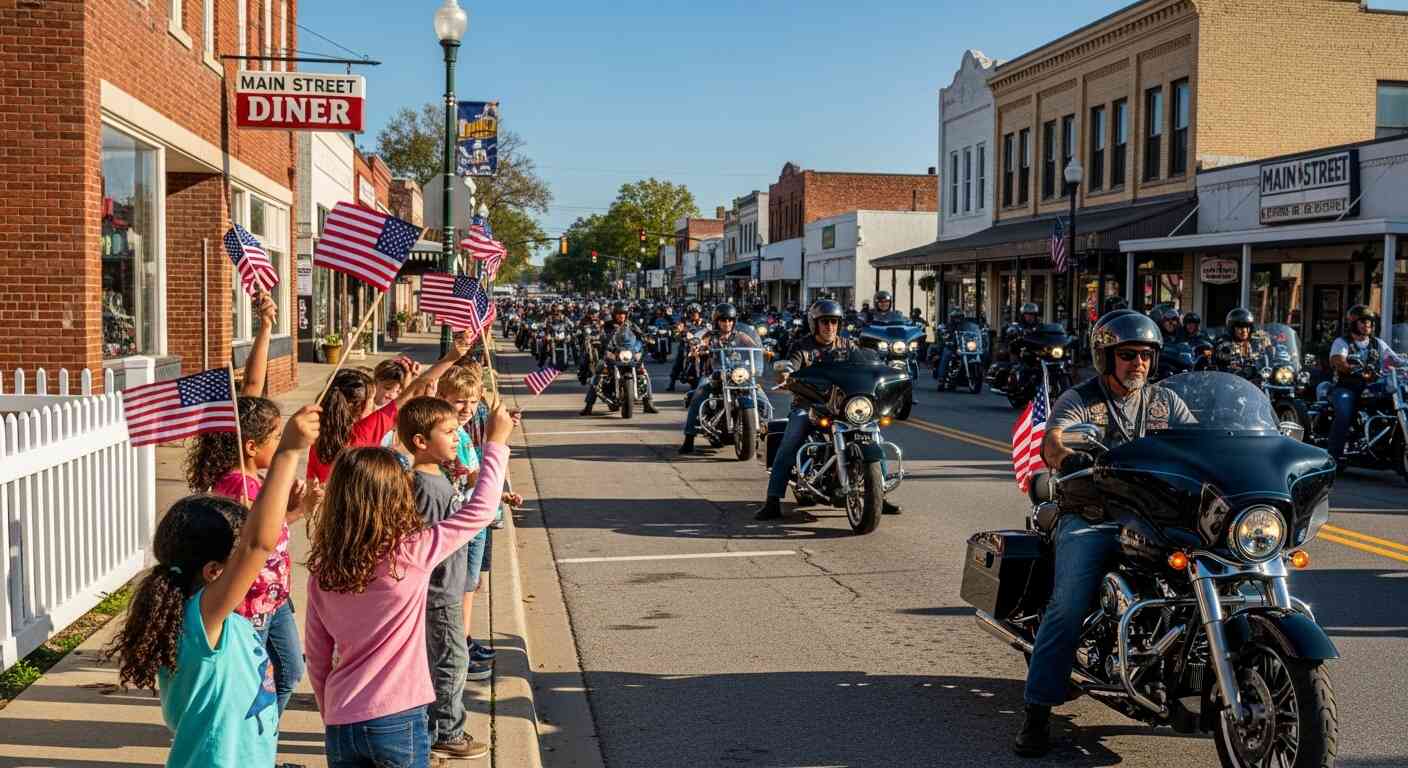
I still see the Kindred. Every few months, they do a “Peace Run” through the county, raising money for local shelters. Whenever they pass through Willow Creek, they slow down. They don’t roar anymore; they just purr.
Today was different, though.
I was sitting on my porch when I heard the familiar rumble. But it wasn’t twenty bikes. It was just one.
Bear pulled into the cul-de-sac. In the sidecar, wearing a custom leather bandana, was Cooper.
He looked like a king. He looked like he owned the road, the wind, and every blade of grass in Georgia. Bear stopped in front of my house.
“Just thought he’d want to see his old haunts,” Bear said, leaning back on his bike.
Cooper hopped out—much faster than he used to move—and ran straight to me. He put his head in my lap, and I felt the warmth of his fur and the strength in his breath. He wasn’t a “trash dog” or a “useless thing.” He was a miracle.
“He’s the mascot of the club now,” Bear said, a rare, genuine smile on his face. “Every time we go on a run, he’s in the front. People see him, and they know what we stand for. They know that no matter how loud the screaming gets, the thunder is always louder.”
As they pulled away, the sound of the engine echoing off the suburban houses, I realized something.
We all wait for heroes. We wait for the police, the government, or some divine intervention to fix the darkness in the house next door. But sometimes, the hero doesn’t wear a cape. Sometimes, the hero wears a leather vest, smells like exhaust, and has enough love in his heart to roar for those who can only whisper.
Cooper looked back at me as the bike turned the corner, his ears flapping in the wind.
He wasn’t waiting for the blow anymore. He was chasing the horizon.
Because the roar of a thousand engines is nothing compared to the sound of a heart finally learning it doesn’t have to be afraid.