Chapter 4: The Night of the Long Shadows
The woods behind the Oakhaven mill were a labyrinth of pine and shadow. The rain had started again, a cold, needle-like drizzle that made the ground slick and the air thick with the scent of damp earth.
The teenagers—led by a boy named Jax who had too much ego and not enough heart—had Silas cornered against a rusted freight car. Silas was shielding a small, shivering pup, his back to the metal.
“Move aside, old man!” Jax yelled, brandishing a long cattle prod that hissed with blue energy. “We’re doing the town a favor!”
“They haven’t hurt anyone,” Silas wheezed, his shoulder throbbing from the morning’s assault. “Please… they’re just dogs.”
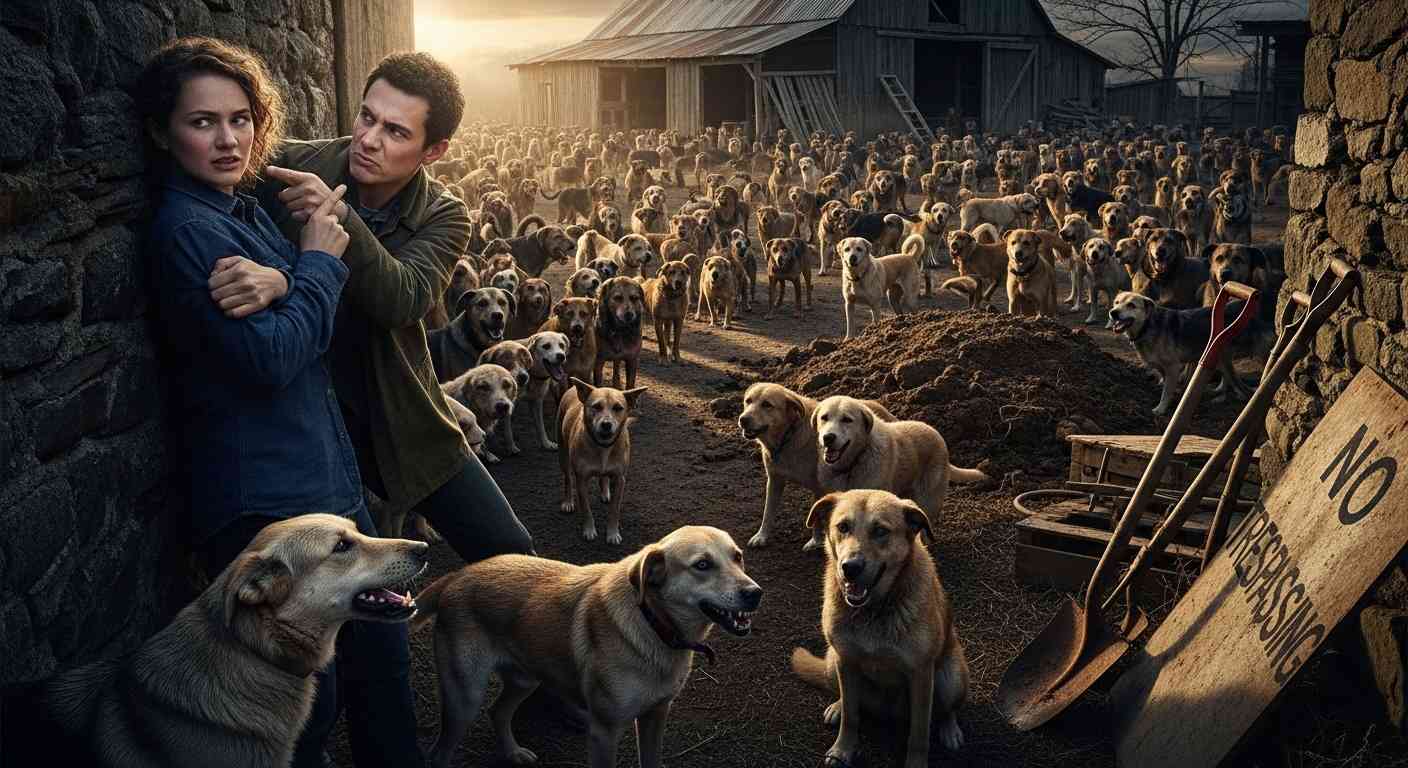
The General stood in front of Silas, his hackles raised, a low, constant vibration coming from his chest. The other hundred dogs were in the shadows, waiting for the command. They were a hair-trigger away from a bloodbath.
Suddenly, a pair of high-beam headlights tore through the darkness. A heavy-duty truck skidded to a halt, followed by a police cruiser.
Arthur Miller stepped out of the truck. He wasn’t wearing his apron. He was wearing an old hunting jacket, and in his hand was a heavy-duty industrial spotlight. He clicked it on, bathing the clearing in a blinding, artificial noon.
“Jax! Drop the prod!” Arthur roared.
The teenagers froze. They looked at Arthur, the man whose violence had inspired them, expecting a cheer. Instead, they saw a man whose face was a mask of absolute, terrifying disappointment.
“Mr. Miller?” Jax stammered. “We’re just… we’re finishing what you started.”
“I started a mistake, Jax,” Arthur said, stepping into the clearing. He walked past the prods, past the shouting boys, and stopped right in front of Silas.
Arthur looked at the man he had dragged by the collar. He saw the bruise on Silas’s forehead. He saw the way the dogs were ready to tear the world apart for him.
Arthur reached into his pocket and pulled out a small, wrapped sandwich—the one he’d made for his own lunch. He held it out to Silas.
“I’m a bitter man, Silas,” Arthur said, his voice cracking. “I’ve been angry at this town for so long I forgot how to be a neighbor. But I’m not letting these kids do this.”
Arthur turned to the teenagers. “You think you’re tough because you have a battery and a stick? You’re cowards. Get out of my woods before I show you what a real man does to people who hurt the innocent.”
Officer Miller stepped forward, his hand on his handcuffs. “You heard him, boys. Let’s go. We’ve got a lot to talk about at the station.”
As the teenagers were led away, the clearing fell into a heavy, resonant silence. The dogs slowly emerged from the shadows, their eyes fixed on Arthur.
The General looked at Arthur, then at the sandwich in Silas’s hand. With a low, soft huff, the dog sat down. The others followed.
“I can’t go back, Arthur,” Silas said, leaning against the freight car. “The town… they’re afraid of them.”
“Then we change the town,” Arthur said. He looked at the abandoned mill behind them. “My grandfather used to own the deed to this land. It’s been sitting in a drawer at the shop for thirty years. It’s got a roof. It’s got heat. And it’s got a hell of a lot of space for a pack.”
Chapter 5: The Sanctuary of Oakhaven
The following month in Oakhaven was unlike anything the state had ever seen.
The “Miller-Thorne Sanctuary” was established in the old textile mill. It wasn’t a shelter with cages. It was a massive, open-concept facility where the “Discarded”—both animal and human—found a place to belong.
Silas Thorne was the Director. He lived in a small, clean apartment built into the former manager’s office. He no longer wore a faded denim jacket; he wore a clean work shirt with “SILAS” embroidered on the pocket.
But he still spent his nights sitting on the floor with the General.
Arthur Miller didn’t close his hardware store. Instead, he turned half of it into a boutique pet supply shop. Every Saturday, he would load up his truck with “near-expired” kibble and “factory-second” dog beds and drive it to the mill.
He arrived on a crisp October morning, the leaves turning the color of rust and gold. Silas was out front, training a group of local veterans on how to work with the more “difficult” dogs.
“Morning, Silas,” Arthur said, dropping a heavy bag of food on the dock.
“Morning, Arthur,” Silas smiled. His face had filled out, the hollows of hunger replaced by a healthy glow.
“How’s the shoulder?” Arthur asked, looking at the ground.
“It heals,” Silas said. “The body is good at that. It’s the heart that takes time.”
Arthur looked at the pack. The hundred dogs were still there, but they weren’t a “Wild Pack” anymore. They were the Oakhaven Sentinels. They worked with the police, they visited the elderly at the local home, and they sat with the kids who were having a hard time at school.
“I saw the video again last night,” Arthur said. “The one where I… you know.”
“Don’t look back, Arthur,” Silas said, placing a hand on the hardware store owner’s shoulder. “A man is more than his worst day. The dogs taught me that. They don’t remember the kick; they remember the hand that finally offered the bread.”
Suddenly, the bell at the gate rang.
A young woman stood there, holding a scruffy, shivering pup she’d found on the highway. She looked at the sign—THE OAKHAVEN PACK: WHERE NO ONE WALKS ALONE—and then at the two men on the dock.
“Can you help him?” she asked, her eyes full of the same desperation Silas had once known.
Silas looked at Arthur. Arthur looked at Silas.
“We don’t just help the dogs, miss,” Arthur said, opening the gate. “We help the people who find them. Come on in. The coffee is hot, and the General here is looking for a new recruit.”
Chapter 6: The Language of the Pack
Oakhaven changed. It was no longer a town of boarded-up windows and fading memories. It became a destination. People came from all over the country to see the “Dog King” and the “Redeemed Store Owner.” They came to see how a community could be rebuilt, not with money, but with loyalty.
On the one-year anniversary of the “Incident on Main Street,” the town held a celebration in the town square. There was music, barbecue, and a massive parade of a hundred dogs.
Silas stood on a small platform in the center of the square. At his feet was the General. Beside him was Arthur.
“People ask me how I survived the streets,” Silas told the crowd. “And I tell them the same thing every time. I survived because I realized that being invisible is a choice we make as a community. We choose who to see, and we choose who to ignore.”
He looked at the dogs, their tails wagging in a rhythmic, percussive chorus.
“These dogs didn’t see a homeless man,” Silas continued. “They saw a friend. And when I was at my lowest, they didn’t ask for my resume. They just asked for my company.”
Arthur stepped forward. He held up a small, silver whistle. “We’re establishing the Thorne Scholarship today,” Arthur announced. “For any kid in this town who wants to study animal behavior or social work. Because we’re not just raising dogs here. We’re raising a new kind of town.”
The crowd erupted. But as the sun began to set, the celebration quieted.
Silas and Arthur walked back toward the mill, the hundred dogs trailing behind them like a living, breathing shadow. They reached the stoop of the old hardware store where it had all begun.
The concrete was still hard. The brick was still old. But the air felt different.
“You ever think about that day, Silas?” Arthur asked, looking at the stoop.
“Every day,” Silas said. “It was the day I stopped being a ghost.”
Arthur reached out and gripped Silas’s hand—not by the collar, but with a firm, brothers-in-arms handshake.
“I’m glad you didn’t leave, Silas,” Arthur said.
“Me too, Arthur. Me too.”
As the moon rose over Oakhaven, casting a silver light over the sanctuary, the only sound to be heard was the rhythmic, peaceful breathing of a hundred souls who had finally found their way home.
The world may try to drag you down, but remember: the hand that shares its last crust builds an army that no fire can burn and no winter can freeze.