He Pointed His Finger In My Face And Called My “Army Of Mutts” A Public Nuisance, Not Realizing The 500 Howls In Unison Weren’t Just Noise—They Were The Sound Of His Multi-Million Dollar Empire Falling.
Chapter 1
The humidity in Blackwood County always felt like a wet wool blanket, but today, the air was thick with something else: the smell of impending ruin. I stood on the porch of the “Last Chance Sanctuary,” a sprawling, fifty-acre patch of dust and heartbreak, watching the black Mercedes-Benz kick up a plume of red clay as it tore down my driveway.
Beside me, Sarge—a retired Belgian Malinois with more shrapnel in his hip than I had in my knee—let out a low, rhythmic huff. He knew. Dogs always know when the devil is coming to visit.
Silas Vane stepped out of the car before it had even fully stopped. He was draped in an Italian suit that cost more than my mortgage, his silver hair slicked back with the kind of confidence only blood money can buy. He was the king of Blackwood, the “philanthropist” developer who owned the docks, the local police, and apparently, the very dirt beneath my boots.
“Elias,” he barked, his voice cutting through the afternoon heat like a serrated blade. He didn’t wait for a greeting. He marched up to my porch, his polished loafers splashing through a puddle of water from the dogs’ bowls. “I gave you thirty days. The zoning board signed the order. This eyesore is finished.”
I didn’t move. I didn’t blink. I just looked at the man. “The dogs have nowhere to go, Silas. These are the ones the world gave up on. The ones you dumped when they weren’t ‘useful’ to your friends anymore.”
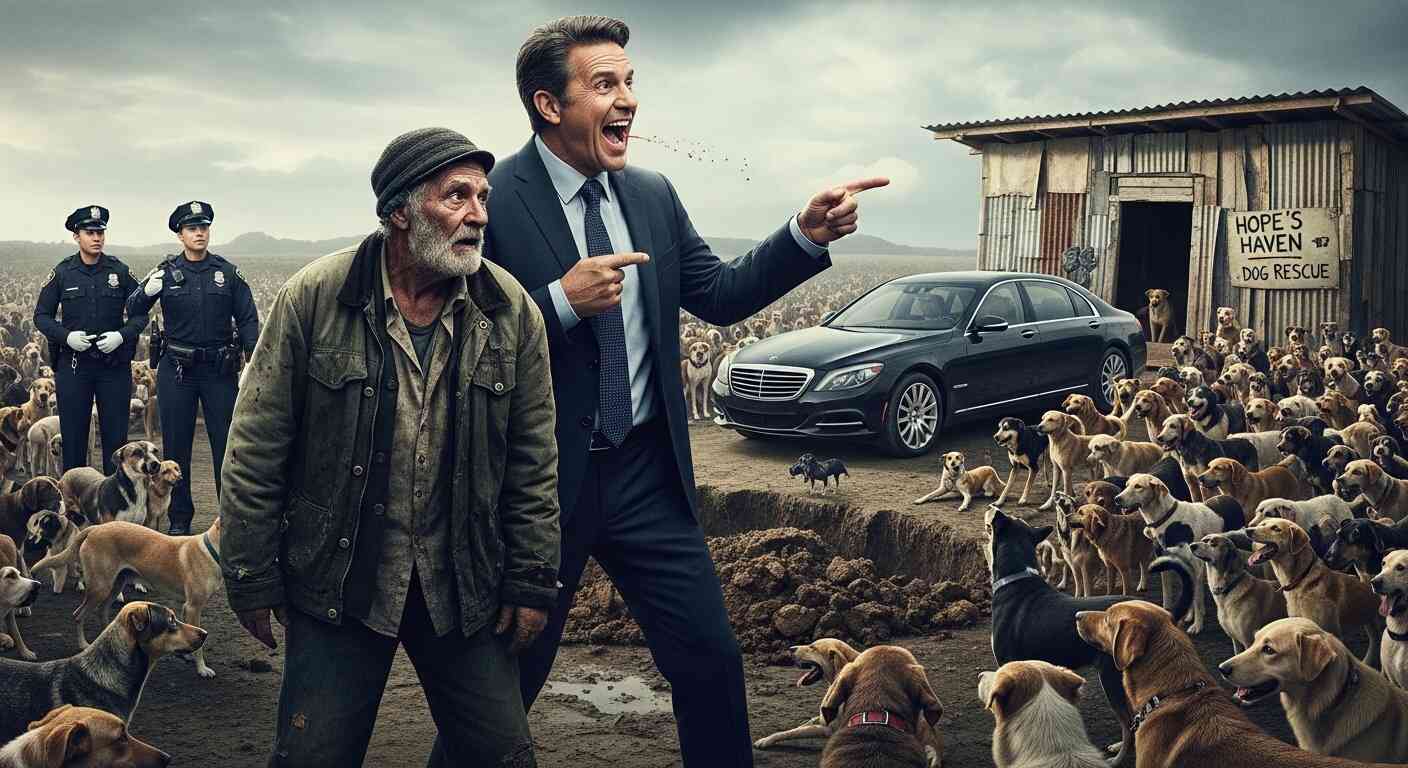
Vane let out an ugly, jagged laugh. He stepped into my personal space, the scent of his expensive cologne clashing with the smell of wet fur and pine. He raised a thick, manicured finger and jabbed it inches from my nose.
“I don’t care about your ‘army of mutts,’ Elias,” he growled, his face reddening with a predatory rage. “They are a public nuisance. A health hazard. By dawn tomorrow, I’m bringing the dozers. If you and your mangy collection of trash are still on this property, you’ll be part of the foundation of the new resort.”
He thought he was looking at a broken veteran. He thought he was looking at a man who had nothing left but the loyalty of 500 strays. He didn’t see the tiny, high-gain microphone hidden in my collar. He didn’t see the infrared cameras hidden in the trees.
I looked him dead in the eye and did something that made him freeze. I smiled.
“You should have listened to the dogs, Silas,” I said softly. “They’ve been trying to tell you for months that you aren’t the alpha in this valley.”
Chapter 2
The silence that followed my smile was heavy, broken only by the distant, rhythmic thumping of 500 tails against the wooden floors and the dry earth. Vane’s brow furrowed. He wasn’t used to people smiling at him when he threatened them. He was used to them trembling.
“You’ve finally lost it, haven’t you, Elias?” Vane sneered, taking a half-step back. “The isolation. The smell of dog dander. It’s rotted what was left of your brain. Enjoy your last night in the dirt.”
He turned to walk back to his car, signaling his two “security” guys—men with thick necks and the vacant eyes of career thugs—to follow him. But they didn’t move. They were staring at the perimeter of the yard.
From the tall golden grass, from the shadows of the rusted barns, and from the porches of the small kennels, the dogs began to emerge. They didn’t bark. They didn’t lung. They just walked out, one by one, until they formed a massive, silent semi-circle around Vane and his Mercedes.
There were Pit Bulls with cropped ears, Labradors with greying muzzles, and tiny Terriers with fierce hearts. Each one had been rescued from the very shipping containers Vane used for his “import/export” business. They knew his scent. They remembered the cold, the hunger, and the sound of his voice when he’d told his men to “dispose of the livestock.”
“What the hell is this?” Vane hissed, his hand reaching for the concealed pistol at his waist. “Elias, call them off! Now!”
“I told you, Silas,” I said, leaning back against the porch railing. “It’s not my army. It’s theirs.”
I looked at Sarge. The old Malinois stood up, his gaze locked on Vane. I checked my watch. 5:00 PM. The federal task force—led by Detective Sarah Miller—was exactly two miles out, moving in a silent convoy. For six months, this sanctuary hadn’t just been a home for dogs. It had been the “hub” for a multi-agency sting operation.
Every time Vane’s trucks passed the property line on their way to the docks, the high-frequency sensors in the dogs’ collars logged the weight of the loads and the heat signatures of the “product” hidden inside—usually rare wildlife and illegal narcotics.
Vane thought he was bullying a hobo. He was actually standing in the middle of a billion-dollar evidence locker.
“One more step and I start shooting!” Vane screamed, pulling his gun. His bodyguards followed suit, their weapons shaking as they looked at the sea of fur and teeth surrounding them.
“The dogs aren’t going to bite you, Silas,” I said, my voice as calm as a frozen lake. “They’re just the signal.”
I let out a sharp, piercing whistle.
Sarge tilted his head back, his throat vibrating. He let out a long, haunting howl that pierced the humidity. A second later, a Beagle joined in. Then a Great Dane. Within ten seconds, five hundred dogs were howling in perfect, bone-chilling unison. It was a sound that didn’t just fill the air; it vibrated in your bones. It was the sound of a thousand secrets finally being told.
Vane dropped his gun, covering his ears, his face turning a ghostly, translucent white. He knew that sound wasn’t for him. It was the “go” signal for the hunters.
Chapter 3
The howl hadn’t even faded when the first black tactical van breached the gate. It didn’t slow down, smashing through the weather-beaten wood like it was made of paper. Three more followed, tires screaming on the red clay, circling the clearing with military precision.
“FEDERAL AGENTS! DROP THE WEAPONS!”
The voice came from a megaphone, but the real authority was in the red laser dots that suddenly painted Silas Vane’s chest like a target.
Detective Sarah Miller stepped out of the lead vehicle before it had even stopped. She was a woman who lived for the chase—sharp-featured, wearing a tactical vest, her hair pulled back into a tight, professional knot. She ignored Vane entirely and walked straight to me.
“Status, Elias?” she asked, her eyes scanning the dogs.
“The target is contained. The ‘nuisance’ did its job,” I replied, nodding toward Sarge.
Miller finally turned to Vane, who was now facedown in the dirt, a federal agent’s boot pressed firmly between his shoulder blades. Handcuffs clicked shut with a finality that echoed through the yard.
“Silas Vane,” Miller said, her voice dripping with cold satisfaction. “You are under arrest for conspiracy to smuggle endangered species, trafficking of controlled substances, and roughly a dozen environmental crimes. We’ve been watching your ‘docks’ through the eyes of these dogs for six months.”
Vane struggled, his face pressed into the dust he had threatened to bury me in. “You… you used strays? You used a hobo and a bunch of trash mutts to bring me down?”
“They aren’t strays, Silas,” Miller said, kneeling down to show him the micro-camera embedded in the tag of a nearby Golden Retriever. “They’re witnesses. And unlike your business partners, they can’t be bribed.”
I watched as the agents began to unload the evidence from Vane’s car—the encrypted burner phones, the ledger of bribes, and the manifest for the shipment arriving tonight at Pier 4. The empire that had held Blackwood County in a chokehold for twenty years was crumbling in the time it took for the sun to set.
But as I looked at the dogs, I realized the cost. They were agitated, the tension of the raid causing them to pace and whine. Tommy, a local runaway who had been helping me at the sanctuary for months, emerged from the barn, his face pale.
“Elias? Is it over?” Tommy asked, his hand resting on the head of a shivering Greyhound.
“For Vane, it is,” I said, looking at the boy. Tommy had his own scars, most of them given to him by men like Vane. “But for us, the real work is just beginning.”
Vane was hauled to his feet and shoved toward a van. He caught my eye one last time. There was no more rage, only a hollow, pathetic fear. He realized that the “nothing” he had pointed his finger at was actually the one man who had seen through him.
Chapter 4
The weeks following the raid were a whirlwind of legal filings, news cameras, and a strange, overwhelming influx of support. The “Last Chance Sanctuary” wasn’t a secret anymore. It was national news. People from across the country were calling to adopt the “Hero Dogs of Blackwood.”
But for me, the victory felt hollow. I was sitting on the porch with Detective Miller, watching the dogs play in the newly fenced fields—funded by the seized assets of Vane’s estate.
“You look like you’re waiting for another bomb to drop, Elias,” Miller said, handing me a coffee.
“Vane was the head, Sarah. But he wasn’t the whole body,” I said, looking at the treeline. “The smuggling ring had roots in the state house. Those people don’t just go away because one developer got caught.”
Miller sighed. “We’re working on it. But right now, you need to focus on this place. The city wants to give you an award. The ‘Key to the County.'”
“I don’t want a key,” I said. “I want a guarantee that these dogs will never have to see the inside of a shipping container again.”
I looked at Tommy, who was training a young Lab mix in the distance. The boy had found a home here, but he was still jumpy. He knew, better than anyone, that bullies like Vane usually had friends in high places.
An old man named Jenkins, my closest neighbor, walked up the driveway. He was a man of few words, a retired fisherman who had lost his only son to the “product” Vane had been bringing into the county.
“Elias,” Jenkins said, his voice gravelly. “I heard the news about the trial. They say Vane’s lawyer is going for a plea deal. Something about ‘cooperation.'”
I felt a chill. Cooperation meant Vane would give up names to save himself. And people who get given up tend to get desperate.
“He won’t make it to a plea, Jenkins,” I said. “He knows too much. And the people he knows are far more dangerous than he ever was.”
That night, the sanctuary was quiet. Too quiet. I was doing my rounds when I noticed Sarge wasn’t in his usual spot on the porch. I found him by the back fence, staring into the dark woods. His ears were pinned back, his body a rigid line of muscle.
I didn’t reach for a flashlight. I reached for my radio. “Sarah? We have movement on the north perimeter.”
The response was static. I checked the camera feed on my tablet. All black. The “federal protection” we’d been promised had been cut at the source.
Vane’s friends had arrived.
Chapter 5
The first shot didn’t come from a rifle; it was the sound of a window shattering in the main barn.
“Tommy! Get the dogs into the bunkers!” I roared, my military training kicking in like a cold engine. I didn’t have a weapon—not a real one. The task force had insisted on a “non-aggressive” presence during the transition. All I had was a flare gun and 500 loyal hearts.
Three men emerged from the shadows, wearing tactical gear with no markings. These weren’t thugs; these were professionals. They were here to burn the evidence, and the sanctuary was the evidence.
“Elias! The back door is blocked!” Tommy’s voice came over the radio, filled with panic.
“Go through the cellar, Tommy! Take Sarge!”
I moved through the darkness of the porch, staying low. I could hear the men talking in low, clipped tones. They were looking for the servers—the hard drives that held the backup data from the dogs’ collars.
“The hobo is somewhere in the house,” one of the men said. “Kill him. Burn the rest. Make it look like a tragic accident. The public loves a tragic hero.”
I felt a surge of white-hot rage. They were going to kill the dogs. They were going to kill the boy. Just to protect a few names on a spreadsheet.
I looked at the dogs. They were silent, tucked into their reinforced kennels, watching me. They were waiting for a command.
“You want a public nuisance?” I whispered into the darkness. “I’ll give you one.”
I didn’t whistle this time. I hit the panic button on my phone.
Across the property, the high-frequency emitters—usually used for training—blasted a deafening, 120-decibel tone that only the dogs could hear. It wasn’t a “howl” signal. It was a “protect” signal.
The sanctuary erupted. 500 dogs didn’t just bark; they became a storm. They poured out of the kennels, a living wall of fur and fury. They didn’t lunge for the men’s throats; they swarmed their legs, tripping them, knocking them off balance, creating a chaotic, shifting landscape that made it impossible to aim a weapon.
I fired the flare gun into the sky. The red light illuminated the yard, showing the three professional killers being pinned to the ground by a dozen dogs each. No one was biting—not yet. They were just holding.
Sarge stood over the lead operative, his teeth inches from the man’s jugular.
A second later, the real cavalry arrived. This time, it wasn’t Sarah Miller. It was the State Police, led by Old Man Jenkins in his rusted truck, followed by half the town. They had seen the flare. They had heard the dogs.
The “nuisance” had become the town’s shield.
Chapter 6
The cooling down took months. The men in the yard were linked back to a private security firm owned by a state senator. The fallout was a tidal wave that swept through the capital, cleaning out more corruption in a week than Blackwood had seen in a century.
Silas Vane didn’t get his plea deal. He died in his cell two weeks into his sentence—some say a heart attack, others say a message.
I stood on the porch of the new sanctuary. It was no longer a “front.” It was the Silas Vane Memorial Rescue and Training Center—named with a heavy dose of irony that Sarah Miller found hilarious.
Tommy was no longer a runaway. He was the head trainer, a young man who walked with his head high and a whistle around his neck. Jenkins was the board president, making sure every penny of the “Vane Fund” went to the animals.
I looked down at Sarge. He was lying in the sun, his old bones finally getting the rest they deserved. He looked up at me, his one good eye reflecting the golden afternoon light.
Sarah Miller walked up the steps, wearing a civilian sundress for the first time since I’d met her. She looked at the field, where 500 dogs were running, playing, and living lives free of shipping containers and fear.
“You did it, Elias,” she said, leaning against the railing. “You changed the world with a bunch of mutts.”
“I didn’t do anything, Sarah,” I said, scratching Sarge behind the ears. “I just gave them a voice. They’re the ones who decided to use it.”
I thought back to the day Vane had pointed his finger at me. I thought about the ghost-white look on his face when the howling started. He had seen 500 “nuisances.” I had seen 500 brothers.
In the end, the world doesn’t belong to the people who point fingers or build empires on secrets. It belongs to the ones who are willing to stand in the dust, look the devil in the eye, and wait for the pack to arrive.
I looked out at my army, my beautiful, broken, perfect army of mutts. They were no longer strays, and I was no longer a ghost. We were a family, forged in the howl of justice.