Chapter 4: The Court of Public Opinion
The case of The State vs. Travis Vance became a lightning rod for the community. Travis’s father, a man named Sterling Vance, had indeed tried to sue for the phone. He had tried to spin the narrative that Grimm was a “rogue officer” who had used “excessive force” against a “young content creator.”
But Sterling had underestimated the power of the “Mouse.”
Deputy Sarah Jenkins had been wearing her body cam.
The footage was leaked to the local news. The community didn’t see a “rogue officer.” They saw a hero. They saw the contrast between Travis’s high-pitched laughter and the dog’s silent suffering. They saw the “gloved hand” reach in and silence the mockery.
The day of the hearing, the courthouse was surrounded by hundreds of people holding signs. They weren’t just there for Ghost; they were there for every creature that had ever been used for a “like.”
Sterling Vance sat in the front row, his expensive suit looking out of place in the humid courtroom. Travis sat next to him, his head bowed, finally realizing that his digital kingdom had no walls high enough to protect him from the truth.
Grimm took the stand. He didn’t look at the cameras. He didn’t look at the crowd. He looked at Travis.
“Sergeant Miller,” the defense attorney started, his voice dripping with condescension. “Isn’t it true you have a history of aggressive behavior? That you were disciplined in the Army for ‘unauthorized interventions’?”
“I was disciplined for refusing to let innocent people be used as target practice,” Grimm said, his voice level and cold. “And I would do it again today. I saw a crime being committed. Not just a crime of property, but a crime against the very concept of life. I didn’t see a dog and a phone. I saw a victim and a predator.”
The courtroom went silent.
“Travis Vance didn’t just spray that dog with water,” Grimm continued. “He sprayed him with the idea that his life didn’t matter. He taught that animal that the only reason it existed was to be a punchline. That’s a scar that doesn’t show up on an X-ray, but it’s the one that takes the longest to heal.”
Travis’s defense crumbled. The judge, a woman who had spent thirty years on the bench and had no patience for “influencer” culture, sentenced Travis to a year in the parish jail and five hundred hours of community service at a high-kill shelter.
“You want to see what life is like for the animals you mock, Mr. Vance?” the judge said. “You’re going to spend your next year cleaning up after them. And you will never, ever be allowed to own a phone with a camera again.”
Chapter 5: The Shadow and the Bone
The transition from “Ghost” to “Beau” happened in the quiet of Grimm’s porch.
Beau—because the dog was finally starting to look “beautiful” again—had been living with Grimm for two months. The weight was back. His fur had grown in thick and soft, a deep chocolate brown that shimmered in the sun.
But the fear was a stubborn tenant.
Beau still flinched at the sound of the garden hose. He still hid under the dining room table whenever Grimm’s voice got too loud on a phone call. He was a dog who lived in the shadows, always waiting for the “Live” feed to start again.
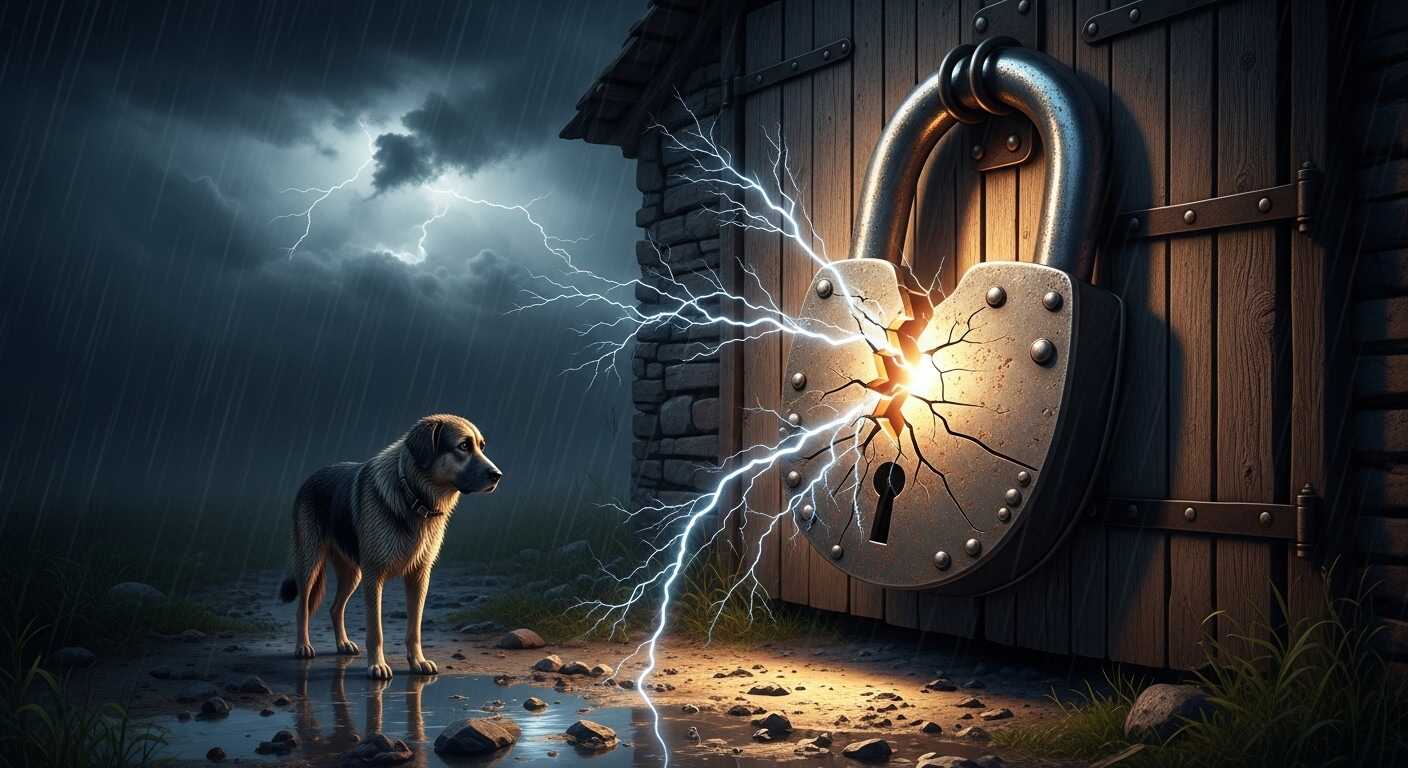
One evening, a massive summer storm rolled over the bayou. The thunder was a guttural roar, and the rain lashed against the windows like a million tiny whips.
Beau was in his “safe spot” under the table, his body vibrating with a terror that broke Grimm’s heart.
Grimm sat on the floor. He didn’t try to pull the dog out. He just sat there, leaning his back against the wood of the table. He took off his heavy leather belt, his badge, and his radio. He sat in the dark, the only light coming from the flashes of lightning outside.
“I know, buddy,” Grimm whispered. “I know it sounds like the world is ending. I’ve heard it too. I’ve heard the sky scream.”
Slowly, an inch at a time, a wet nose emerged from under the table. Beau crawled out, his belly low to the floor. He didn’t go for the food bowl. He didn’t go for the door.
He crawled into the space between Grimm’s legs. He pressed his head against Grimm’s chest, right over the veteran’s heart.
Grimm wrapped his massive arms around the dog. He didn’t say anything else. He just breathed with him. In and out. In and out.
For the first time since he’d been rescued, Beau’s shivering stopped. The storm was still raging outside, the water was still hitting the house, but for Beau, the “hose” was finally off. He was with the man who had tossed the phone aside. He was with the man who had seen the Ghost and called him a Brother.
Chapter 6: The Final Frame
A year later.
Bayou Blue was hosting its annual “Hometown Heroes” parade. Usually, Grimm avoided these things like the plague. He didn’t like the crowds, he didn’t like the noise, and he certainly didn’t like the attention.
But Sarah Jenkins had talked him into it.
“It’s for the shelter, Sarge,” she had said, using the only leverage she had. “We’re trying to raise money for the new medical wing. People want to see the ‘Gloved Hand’ in person.”
Grimm walked the parade route, not in a cruiser, but on foot. He was wearing his uniform, his medals glinting in the Southern sun.
And walking right beside him, on a sturdy leather leash, was Beau.
The dog was a marvel. He was sixty pounds of muscle and joy. He didn’t look at the crowds with fear; he looked at them with a calm, steady curiosity. He was the “Hometown Hero” of the year.
As they reached the town square, a young man stepped out of the crowd. He was wearing an orange vest—the uniform of the community service crew. He was holding a trash picker and a heavy black bag.
It was Travis.
He looked different. The smugness was gone. His skin was tanned from working in the sun, and his hands were calloused. He looked at Grimm, and then he looked at the dog.
Travis didn’t reach for a phone. He didn’t look for a camera.
He just nodded. A short, respectful nod of a man who had finally learned the difference between being seen and being significant.
Grimm stopped. He looked at Travis, and for the first time in a year, the “Grimm” mask slipped. He gave the boy a single, tight nod back.
“He looks good, Sergeant,” Travis said, his voice quiet.
“He looks like he’s supposed to look, Travis,” Grimm said.
Grimm and Beau continued walking. As they reached the end of the route, Sarah was waiting with a camera—a real camera, the kind that captured memories, not clout.
“One picture, Sarge?” she asked.
Grimm looked at Beau. The dog was looking up at him, his tail wagging a slow, rhythmic beat against Grimm’s leg.
Grimm sat down on a stone bench, pulling Beau into his side. He didn’t pose. He didn’t look for the light. He just rested his hand on the dog’s head—the same gloved hand that had changed everything.
The shutter clicked.
The photo didn’t go viral for a “like.” It went viral because it captured the one thing that a screen can never replicate: the moment a soul realizes it is no longer alone in the dark.
The most important thing a hand can do isn’t to hold a screen, but to hold the line for those who cannot stand for themselves.