
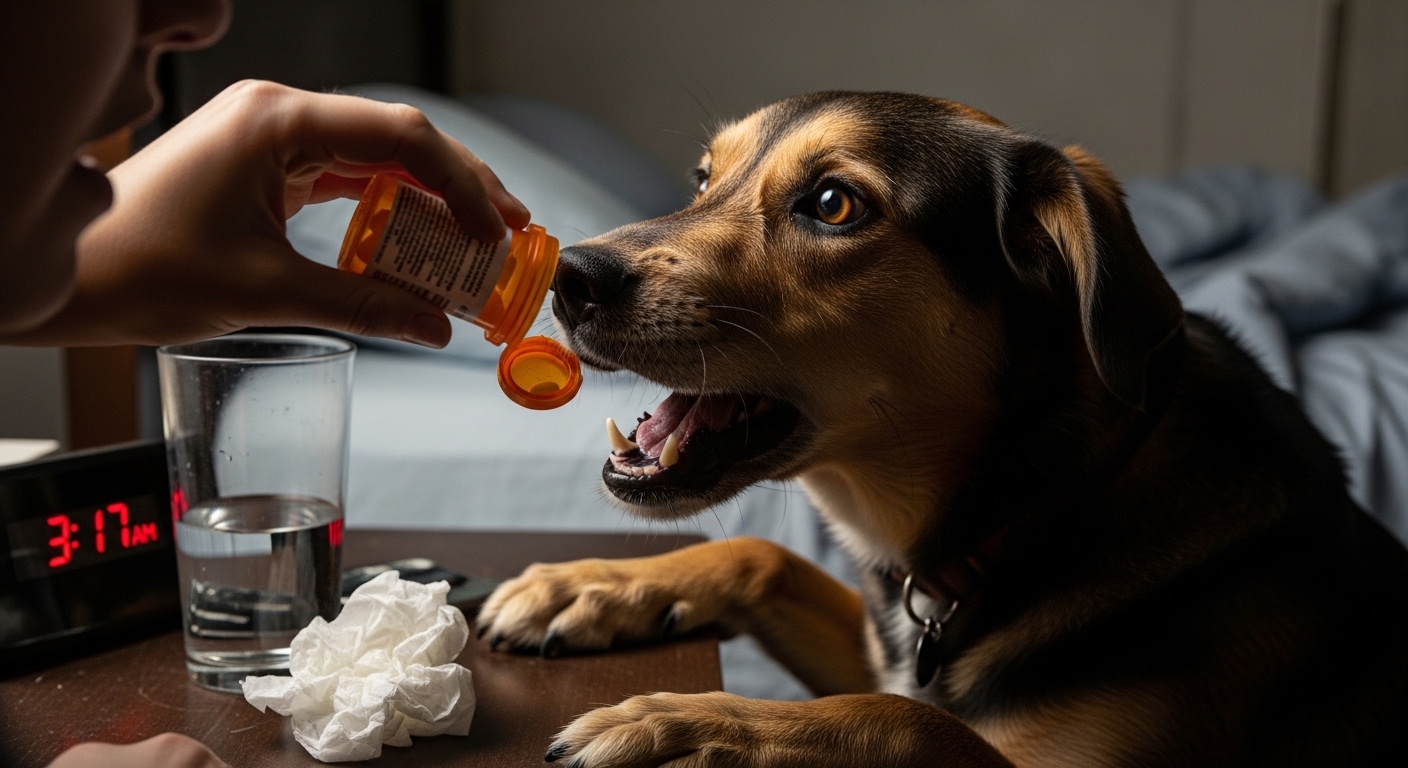
My family thought I was just napping on the kitchen counter—until the stray I’d fed for years did the unthinkable to my son to save my life.
In our house, my “naps” were a running joke.
“Artie’s just resting his eyes again,” my son, Daniel, would say with a roll of his eyes. He’s a busy man, a corporate lawyer who lives by his watch and has no time for “senior moments.”
But last Tuesday, I wasn’t napping. I was dying.
I felt the world tilt. It wasn’t a crash; it was a slow, heavy slide into the dark. My vision blurred into black, and my strength vanished like smoke in a gale. I slumped over the kitchen counter, my forehead resting on the cold granite, unable to make a sound as a stroke took hold of my brain.
Daniel was ten feet away in the living room, checking his emails. He saw me, but he didn’t see me. He just saw a tired old man taking a mid-day snooze.
But Bones knew.
Bones is a one-eared, scruffy stray I’ve been feeding scraps to on the back porch for five years. He’s a dog that doesn’t trust anyone—not even the people who live here. But when he saw me go down, he did something that made Daniel scream in rage.
He didn’t bark. He didn’t whine. He sank his teeth into Daniel’s leg and wouldn’t let go until he’d dragged him into the kitchen to see my lifeless body.
What happened next didn’t just save my life—it revealed the jagged truth about a family that had forgotten how to look at each other.
Chapter 1: The Golden Hour
Oak Ridge, Ohio, is the kind of town where people measure their success by the height of their hedges and the silence of their neighbors. I’ve lived in the same blue-shingled house for forty years. I built the back deck with my own two hands, back when my wife, Mary, was still around to bring me lemonade and tell me I was doing it wrong.
Since Mary passed three years ago, the house has grown a specific kind of quiet. It’s a heavy silence that seeps into the walls. My son, Daniel, moved back in “temporarily” after his divorce, bringing with him three suitcases and a mountain of stress. We lived like two ghosts in a shipwreck—him in his digital world of billable hours, and me in my world of memories and the stray dog on the porch.
The dog’s name is Bones. He’s a mutt of indeterminate origin, mostly wire-hair and suspicion. He showed up one winter with a torn ear and ribs that looked like a xylophone. I started leaving a bowl of scraps by the screen door. For five years, we had a contract: I provide the meat, he provides the company—at a respectful ten-foot distance.
On that Tuesday, the heat was a physical weight. I was in the kitchen, trying to pour a glass of water. Suddenly, my right arm felt like it was made of lead. The glass didn’t shatter; it just slipped from my numb fingers and thudded onto the rug.
“Dad? You okay in there?” Daniel called out from the living room, his voice distracted. He was on his third conference call of the morning.
I tried to answer. I opened my mouth, but the words were tangled. My tongue felt like a piece of dry wood. Then came the darkness. It started at the edges of my vision, a creeping ink. I leaned against the counter, then slumped forward. My forehead hit the granite. It was cold. It was the last thing I felt before the world went black.
“Artie’s just resting his eyes again,” I heard Daniel mutter to someone on his headset. “Yeah, he’s fine. Just an old man and his naps. Anyway, about the merger…”
I was in the “Golden Hour.” That’s what the doctors call it later. The sixty minutes where you either come back or you drift away forever. I was drifting.
Outside the screen door, Bones froze. He had been waiting for his mid-day bacon rind. He didn’t see the man who fed him; he saw a pack leader falling. He saw the “napper” wasn’t breathing right.
Bones did something he had never done. He tore through the flimsy screen door, the mesh screaming as it gave way. He ignored the living room, ignored the furniture, and went straight for Daniel.
“Hey! Get out of here!” Daniel yelled, standing up as the dog circled him. “Bones, out! Bad dog!”
Bones didn’t growl. He lunged. He sank his teeth into the meat of Daniel’s calf. Not a nip—a deep, grounding bite.
“AAAGH! YOU MADDOG!” Daniel shrieked. He tried to kick the dog away, but Bones was an anchor. The dog backed up, tugging, dragging Daniel’s leg toward the kitchen.
Daniel stumbled, clutching the wall, his face contorted in pain and fury. “I’m gonna kill you, you mutt! Dad! Dad, your dog is—”
Daniel stopped. He had reached the kitchen archway. He saw me.
The anger vanished, replaced by a terrifying, hollow silence. I wasn’t napping. My face was skewed, my right side sagging, my eyes rolled back into my head.
“Dad?” Daniel whispered, his voice cracking. He didn’t even notice the blood dripping from his leg. “Dad! Oh god, no. Dad!”
As Daniel scrambled for his phone, his hands shaking so hard he dropped it twice, Bones let go of his leg. The dog walked over to me and rested his scruffy head on my shoe. He had done his job. He had pulled the world back into the room.
Chapter 2: The Sound of the Siren
The sound of an American ambulance is a singular thing—a jagged, high-pitched wail that cuts through the polite veneer of a suburb. In Oak Ridge, that sound meant someone had failed. Someone’s heart had slowed, someone’s brakes had slipped, or, in my case, someone’s brain had begun to devour itself.
I remember bits and pieces of the transport. The smell of latex. The bright, clinical white of the ceiling lights. The feeling of being moved like a piece of lumber.
“Arthur, can you hear me? Arthur, squeeze my hand.”
I couldn’t. I wanted to tell the paramedic that I was still there, trapped behind a wall of glass, but my body had gone on strike.
Daniel was in the front seat, his voice a frantic staccato. “He was just sitting there. I thought he was sleeping. I swear to god, I thought he was just tired.”
The guilt in his voice was a physical weight. It was the sound of a man realizing he had spent three months living in the same house as his father without actually looking at him once.
We reached St. Jude’s Emergency. The transition was a blur of swinging doors and shouting.
“Arthur Miller, 64. Ischemic stroke. Symptoms started approximately forty minutes ago. One arm paralyzed, facial drooping, non-verbal.”
They wheeled me into the “Snake Pit”—the neurology bay. A woman with sharp, intelligent eyes and a white coat appeared over me. Dr. Aris. She didn’t look at me with pity; she looked at me like a puzzle she intended to solve.
“He’s within the window,” she said to a nurse. “Start the tPA. Now.”
Daniel was standing behind the glass partition, a bandage around his leg. He looked smaller than I remembered. He looked like the eight-year-old boy who had fallen off his bike and waited for me to tell him he was okay. But I couldn’t tell him anything.
While they pumped the “clot-buster” into my veins, Daniel sat in the waiting room. He wasn’t alone.
Elias Thorne, my neighbor, walked in. Elias is a man of few words and many opinions. He was the one who had seen Bones drag Daniel into the kitchen. He was the one who had called the vet to make sure the dog didn’t get put down for the bite.
“How is he?” Elias asked, sitting in the plastic chair next to Daniel.
“They’re working on him,” Daniel said, his head in his hands. “The dog, Elias… why did he do it? He’s a stray. He hates us.”
“He doesn’t hate your father,” Elias said, his voice a low gravel. “He’s been watching Artie for five years. He knows Artie’s rhythms better than you do, son. He knew the difference between a nap and a grave.”
Daniel looked at the bandage on his leg. “He bit me. He really sank his teeth in.”
“He knew you weren’t listening,” Elias said. “Sometimes you have to draw blood to get someone to pay attention.”
Daniel didn’t answer. He looked at the television on the wall, playing a silent news loop, and for the first time in a decade, he didn’t check his phone. He just sat there, listening to the hum of the hospital, waiting to see if his father would ever wake up to see the dog he’d tried to ignore.
Chapter 3: The Broken Language
Coming back from a stroke isn’t like waking up from a dream. It’s like being reassembled, piece by jagged piece.
Three days later, I was in a private room. The “clot-buster” had worked its magic, but the damage was done. My right side felt like it belonged to a different, much heavier man. My speech was a slurry of vowels and frustration.
“W… w… wuh,” I managed, looking at Daniel.
“Water? You want water, Dad?” Daniel asked, leaning in. He was trying so hard. He hadn’t left the hospital since the intake. His expensive suit was wrinkled, his hair a mess.
I shook my head. “D… d… dog.”
Daniel stiffened. He looked at his leg. The bite was healing, but the memory was fresh. “He’s at the house, Dad. Elias is feeding him. But… the animal control people, they came by. They said if a dog bites a human, there’s a protocol. Especially a stray with no shots.”
I felt a surge of panic. It was the most emotion I’d felt since the stroke. I reached out with my left hand—my good hand—and grabbed Daniel’s arm. I gripped him with a strength that surprised us both.
“No,” I growled. It was the first clear word I’d spoken.
“Dad, he bit me! I had to get six stitches!” Daniel’s voice rose, the old defensiveness coming back. “He’s a dangerous animal. Sarah thinks we should just let them take him. She says it’s a liability.”
Sarah. Daniel’s wife—ex-wife. She had always hated the “filth” of the porch. She was the one who had convinced Daniel that my house was “unstable.”
“He… s… saved… m… me,” I choked out. Each word felt like pulling a tooth. “He… knew.”
Daniel looked at me. He saw the tears leaking out of the corner of my eye. He saw the desperation in the man who had always been his rock.
“He did know, didn’t he?” Daniel whispered. The anger drained out of him, replaced by a crushing realization. “You were dying right behind me, and I was talking about a contract in Chicago. I didn’t even turn my head.”
He sat on the edge of the bed. “I told the animal control officer that I tripped. I told him the bite was from a piece of jagged metal in the garage. I lied for him, Dad. For the dog.”
I let out a long, shaky breath. “G… good… b… boy.”
“I don’t know if I’m a good boy, Dad,” Daniel said, his voice thick. “I think I’m a pretty terrible son. But I’m going to bring him home. I don’t know how, but I’m going to make sure he’s there when you get back.”
But the hospital had other plans. Recovery was going to take weeks. Physical therapy, occupational therapy, speech therapy. And while I was learning how to hold a spoon again, Bones was back at the house, guarding a screen door that was still torn, waiting for a man who might never walk through it again.
Chapter 4: The Old Wound
To understand why my son and I were strangers, you have to understand the year Mary died.
Cancer is a thief. It doesn’t just take the person; it takes the family they left behind. When Mary got sick, I threw myself into caring for her. I became her nurse, her cook, her ghost. Daniel was in the middle of making partner at his firm. He sent checks. He sent flowers. He didn’t send himself.
“He’s busy, Mary,” I’d tell her when she’d look at the empty doorway. “He’s building a life.”
“He’s building a wall, Artie,” she’d whisper back.
When she died, I blamed him. I didn’t say it, but silence is a louder accusation than any shout. I stopped calling. He stopped coming. When he finally moved back in after his divorce, it wasn’t a reconciliation; it was two people running out of options.
That was the “Old Wound.” And it was festering long before the stroke.
In the second week of my recovery, Daniel brought a laptop into the room. He wasn’t working. He was showing me videos from the Ring camera on our porch.
“Look at him, Dad,” Daniel said.
On the screen, Bones was sitting by the screen door. He wasn’t eating the food Elias had left. He was just sitting, his one ear pricked, staring at the driveway. He stayed there for hours. Sometimes he would walk to the spot where I usually sat and sniff the air, then let out a low, mournful howl that made my chest ache.
“He’s waiting for you,” Daniel said. “He hasn’t left that porch in ten days. Even when it rained last night, he just huddled under the eaves. He won’t go into the garage.”
“L… l… lonely,” I said.
“Yeah,” Daniel said. “We both are.”
He looked at me, really looked at me. “I talked to Dr. Aris. She says your progress is incredible. She thinks you can come home next week if we have 24-hour care. I told her I’d do it. I’m taking a leave of absence.”
“The… c… Chicago… d… deal?” I asked.
Daniel laughed, and for the first time, it sounded like Mary’s laugh. “The Chicago deal can go to hell, Dad. I’d rather be in Oak Ridge. I’d rather be the guy who learns how to cook your terrible oatmeal.”
He reached out and squeezed my hand. “And I’d rather be the guy that the dog actually likes. Although, I think I have a long way to go for that.”
We sat in the quiet of the hospital room, the afternoon sun hitting the linoleum. The wall was still there, but a few bricks had been kicked out. And they had been kicked out by a dog that didn’t know the first thing about billable hours, but knew everything about a dying heart.
Chapter 5: The Homecoming
The day I left the hospital was one of those crisp, October mornings where the air tastes like apples and the world feels like it’s holding its breath.
Daniel drove me home in his pristine SUV. I was in the passenger seat, my right leg still a bit stiff, my speech slow but clear. We turned onto our street, and I felt a knot of anxiety in my stomach. What if he wasn’t there? What if the “protocol” had happened anyway?
We pulled into the driveway. The house looked the same, but the screen door was fixed. Daniel had replaced the mesh.
“Wait here,” Daniel said. “I’ll get the wheelchair.”
“N… no,” I said. “W… walk.”
With Daniel on one side and a cane in my left hand, I shuffled toward the porch. My heart was thumping against my ribs.
Bones was there.
He was sitting in his usual spot. When he saw the car, he didn’t bark. He stood up, his shaggy tail giving a single, cautious wag. He looked at Daniel, then his eyes moved to me.
He didn’t lunge. He didn’t jump. He walked toward me with a slow, dignified grace. He stopped three feet away, sniffing the air—the smell of hospital, of medicine, of survival.
I let go of Daniel’s arm and slumped into my old porch chair. My breath was coming in ragged gasps. Bones walked over and rested his head on my lap. I buried my hand in his coarse, dirty fur.
“T… thank… y… you,” I whispered.
Bones let out a long, contented sigh and closed his eyes.
Daniel stood on the porch, watching us. He looked at the dog that had bitten him, the dog that had saved me, and he did something I never thought I’d see. He knelt down in his expensive trousers and rested a hand on Bones’s back.
The dog didn’t growl. He didn’t flinch. He just stayed there, a bridge between two men who had finally found their way home.
“He needs a bath, Dad,” Daniel said, wiping his eyes. “He smells like a junkyard.”
“H… he… smells… like… l… life,” I said.
Daniel nodded. “Yeah. He does.”
We sat there for a long time, the three of us. The neighbor, Elias, came over with a tray of lasagna. Sarah called to check in, her voice sounding smaller, less certain. The hedges were still high, and the town was still quiet, but the silence in our house had finally been broken.
Chapter 6: The Language of Scraps
It has been six months since the “Golden Hour.”
I still walk with a slight limp, and sometimes my words get tangled when I’m tired, but for the most part, I’m back. I spend my mornings on the porch, watching the world go by.
Bones isn’t a stray anymore. He has a collar now—a sturdy leather one with a brass tag that simply says BONES – 114 MAPLE DR. He sleeps in the house now, usually at the foot of Daniel’s bed. It turns out, Daniel needed the company more than I did.
Daniel didn’t go back to the firm in the city. He opened a small practice in town, specializing in elder law. He’s home for dinner every night. He’s the one who makes the oatmeal now, and he’s actually getting pretty good at it.
“Dad, look at this,” Daniel said this morning, holding up his phone.
It was a video of Bones in the backyard. Daniel was tossing a tennis ball, and Bones—the dog who didn’t trust anyone—was chasing it with an unbridled, goofy joy. He brought the ball back and dropped it at Daniel’s feet, his tail wagging a mile a minute.
“He likes you,” I said.
“He tolerates me,” Daniel joked. “He knows I’m the one with the high-quality steak scraps.”
We laughed. It was a good sound. A sound Mary would have recognized.
I looked at my son. The wall was gone. The “naps” weren’t jokes anymore; they were moments of rest we shared together. We talked about Mary. We talked about the future. We talked about the dog.
Bones walked onto the porch and sat between our chairs. He looked at me, then at Daniel, his amber eyes full of a deep, quiet satisfaction. He wasn’t a hero in his own mind. He was just a dog who had seen a crack in the world and decided to fill it with himself.
I realized then that the stroke hadn’t been an ending. It had been a violent, terrifying beginning. It took a near-death experience and a bite to the leg to make us see what was right in front of us.
Life is short. The “Golden Hour” can come for any of us, at any time. But if you’re lucky—truly, deeply lucky—you have someone watching the door. Someone who isn’t afraid to draw a little blood to save a soul.
I reached down and scratched Bones behind his one good ear.
“G… good… b… boy,” I whispered.
The sun set over Oak Ridge, casting long, golden shadows across the lawn. The house was full. The hearts were open. And the scraps? The scraps were the best part of the meal.
True loyalty doesn’t wait for an invitation; it bites through the silence until you have no choice but to listen.


