
My neighbor almost killed the only thing left of his son until a retired Sergeant intervened—what happened next made me realize we never truly knew the man next door.
The sound of the metal bowl hitting the asphalt sounded like a gunshot in our quiet cul-de-sac. It wasn’t just the noise; it was the sheer, ugly vibration of it.
We all saw it. Sarah from across the street stopped watering her hydrangeas. Old Mr. Henderson paused his lawnmower. We all watched Mark Vance—a man who used to host the best 4th of July barbecues—transformed into something unrecognizable by grief and whiskey.
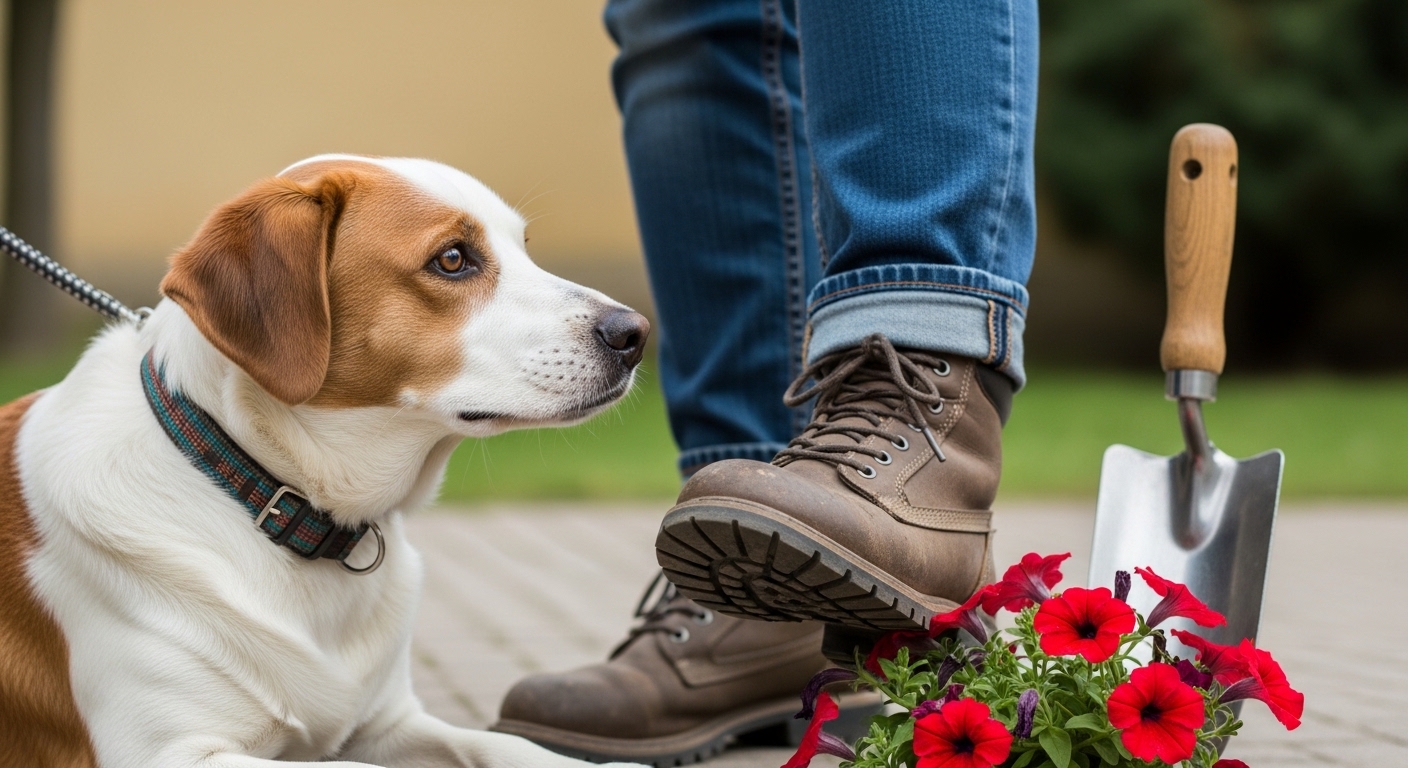
He kicked that bowl so hard it dented. Then he turned on the dog, Buster. Buster, who was the only thing left of Mark’s seven-year-old son, Leo.
“Stop whining!” Mark screamed, his voice cracking like dry wood. “He’s not coming back! You hear me? He’s gone!”
The dog didn’t run. He just lowered his head, tail tucked, eyes filled with a confusion that would break your heart. Mark raised his foot again, and for a second, I thought I’d have to be the one to run over.
But I wasn’t fast enough.
A heavy, calloused hand slammed onto Mark’s shoulder. It was Elias Thorne, the retired Sergeant from the end of the block. Elias doesn’t talk much, mostly just nods when he’s out getting the mail. But in that moment, he looked like a mountain ready to crumble onto Mark.
He didn’t yell. He whispered, and somehow, that was louder than the screaming.
“Try that one more time,” Elias said, his face inches from Mark’s. “Lay one more hand on that animal, and you’ll answer to me.”
The silence that followed was heavy. It was the kind of silence that happens right before a storm breaks. But the storm wasn’t what we expected. It wasn’t a fight. It was the beginning of a truth that had been rotting behind the white picket fences of Oak Ridge for three years
Chapter 1: The Sound of Breaking
Oak Ridge Estates was the kind of neighborhood where the biggest scandal was usually someone forgetting to bring in their trash cans on a Tuesday. We had the manicured lawns, the overpriced SUVs, and the unspoken rule that personal problems stayed behind closed doors. But grief has a way of kicking the door down.
Mark Vance had been our golden boy. He was a high-level financial analyst, the guy who always had a crisp shirt and a firm handshake. He and his wife, Clara, were the couple everyone envied. Then came the accident. A rainy night, a slick road, and a truck that didn’t see their small sedan. Clara survived. Their son, Leo, did not.
That was three years ago. Clara left six months after the funeral, unable to look at the empty bedroom or the man who had been driving the car. Mark stayed. He stayed and he withered.
On this particular Friday, the humidity in Georgia was thick enough to swallow you whole. I was sitting on my porch, nursing a lukewarm iced tea, when I heard it.
Clang.
The dog bowl skittered across the pavement of Mark’s driveway, spinning like a dying coin.
“I said shut up!” Mark roared.
He looked terrible. He’d lost at least thirty pounds since the winter. His hair, once perfectly styled, was a bird’s nest of salt and pepper. He was wearing a polo shirt that looked like it hadn’t seen a washing machine in a week. He was standing over Buster, a Golden Retriever mix with greying fur around his muzzle.
Buster had been Leo’s dog. The boy had saved up his allowance for a year to get him.
The dog wasn’t even barking. He was just let out a low, mournful whimper—the kind of sound a creature makes when it’s trying to communicate a pain it doesn’t understand.
Mark raised his work boot. He wasn’t just scaring the dog; he was aiming.
“Mark, don’t!” I shouted from my porch, but my voice was thin.
Before Mark’s foot could connect with the dog’s ribs, a blur of movement came from the sidewalk. Elias Thorne, our neighborhood’s resident enigma, moved with a speed that defied his sixty-eight years. He was a retired Army Sergeant, a man of few words and even fewer smiles. He spent most of his days in his garage, woodworking in silence.
Elias didn’t just step in; he took control. He grabbed Mark’s upper arm and spun him around with the practiced efficiency of a man who had spent a lifetime handling hostile situations.
Mark stumbled back against his SUV, the breath leaving his lungs in a sharp hiss.
“You’re drunk, Mark,” Elias said. His voice was like gravel grinding together. “And you’re about to do something you can’t take back.”
“Get off me!” Mark struggled, his eyes bloodshot and wild. “It’s my dog! It’s my house! You don’t know… you don’t know what it’s like to hear him whining every night for someone who’s in the dirt!”
The neighbors were all out now. Sarah, a young mother from three doors down, was clutching her own son’s hand tightly, her face pale. Mr. Henderson had turned off his mower, the sudden quiet making the scene feel even more theatrical.
Elias didn’t let go. He stepped closer, invading Mark’s personal space. He was a head shorter than Mark, but he looked twice as large.
“I know exactly what it’s like to live with ghosts, son,” Elias whispered. The anger in his face had shifted into something else—a hard, jagged kind of pity. “But the dog isn’t your son. And hurting him won’t bring the boy back. It’ll just make you the kind of man Leo wouldn’t recognize.”
At the mention of his son’s name, the fight seemed to drain out of Mark. His shoulders slumped. His hands, which had been balled into fists, began to shake.
He looked down at the ground, where the metal bowl lay upside down. Underneath it, partially obscured by the rim, was a small, blue-and-yellow sneaker. It was worn out, caked with old mud, and clearly too small for any child currently living in the neighborhood.
Mark dropped to his knees. He didn’t care who was watching anymore. He didn’t care about the HOA or the “perfect” neighborhood. He reached out and touched the shoe with a trembling finger.
“He was supposed to be wearing these,” Mark sobbed, a sound so raw it made Sarah turn away. “I told him to put them on before we left. He couldn’t find the other one. If he hadn’t been looking for the other one… we would have been five minutes earlier. The truck wouldn’t have been there.”
The neighborhood stood frozen. We had all judged him. We had complained about his overgrown lawn and the way he’d let the house go. We’d whispered about the empty beer cans in his recycling bin. We thought we knew his story—a man who couldn’t handle his grief.
We didn’t know he was living in a five-minute loop of “what-ifs,” anchored to a single missing shoe.
Elias slowly let go of Mark’s shoulder. He looked around at the rest of us, his gaze sharp and accusatory, as if to say Is this the show you wanted?
He then looked down at Buster. The dog, despite having been screamed at and nearly kicked, crawled forward on his belly. He put his head in Mark’s lap, right next to the muddy sneaker.
“Pick up the bowl, Mark,” Elias said, his voice softer now, but still commanding. “Go inside. I’ll be over in ten minutes with some coffee. And we’re going to talk about that shoe.”
Mark didn’t move for a long time. Then, with agonizing slowness, he gathered the dog, the bowl, and the sneaker into his arms. He walked into his house without looking back.
The rest of us stood there, the afternoon sun beating down on our shame. We had watched the “madman” next door for months, waiting for him to snap so we could feel justified in our distance. We never realized that the man was drowning right in front of us, and the only person who knew how to swim was the old soldier we all ignored.
Chapter 2: The Ghosts of Oak Ridge
The coffee wasn’t just coffee. In Elias’s world, a pot of coffee was a peace treaty, a debriefing, and a life raft all in one.
Ten minutes after the confrontation, Elias walked up Mark’s driveway. He didn’t knock; he just turned the knob and walked in. In a neighborhood like ours, that was a felony. In Elias’s world, it was an extraction.
The interior of Mark’s house smelled like stale air, unwashed laundry, and the sharp, metallic tang of cheap bourbon. It was a far cry from the “Open House” photos that had been in the real estate brochure four years ago. The hardwood floors were covered in a film of dust, and the mail was piled three feet high on the entry table—mostly bills with red “Past Due” stamps.
Elias found Mark in the kitchen. He was sitting at the island, the small sneaker placed neatly in front of him like a religious relic. Buster was curled up at his feet, his tail giving a single, hopeful thump against the floor when Elias entered.
Elias set a thermos on the counter. He moved around the kitchen with the ease of a man who had seen a thousand such rooms—rooms where the occupant had given up. He found two mugs, rinsed the dust out of them, and poured the dark, bitter liquid.
“Drink,” Elias said, sliding a mug toward Mark.
Mark didn’t look up. “I almost hit him, Elias. I’ve never… I’ve never been that person. I loved that dog. Leo loved that dog.”
“You weren’t trying to hit the dog,” Elias said, pulling up a stool. “You were trying to hit the version of yourself that let your son get into that car. Problem is, the dog is the only one who takes the blow.”
Mark finally looked up. His eyes were hollowed out, the skin underneath them dark like bruises. “How do you know? How do you know what I was thinking?”
Elias leaned back, his joints popping. He took a slow sip of his coffee. “I spent twenty-four years in the service, Mark. Three tours in Iraq. I’ve seen men come home and try to kick the world because they couldn’t kick the person who made the decision that got their buddy killed. Usually, that person is the one looking back at them in the mirror.”
Outside, the neighborhood was returning to its version of “normal,” but the air had changed. Sarah, the neighbor who had witnessed the scene, was currently in her kitchen, staring at the wall. She was thirty-two, a single mother who had moved to Oak Ridge for the safety it promised. Her own husband had walked out when their son, Jamie, was six months old. She knew about abandonment, but she didn’t know about the kind of soul-crushing guilt Mark was carrying.
She felt a pang of intense shame. Last week, she’d called the HOA about Mark’s lawn. She’d complained that the long grass was “attracting pests.” Looking at Mark’s house now from her window, she realized the only pest was the silence he was living in.
She grabbed a Tupperware container from her cupboard. It was a chicken casserole—the universal American symbol for “I don’t know what to say, but please eat.”
Back in Mark’s kitchen, the silence was thick.
“The shoe,” Elias said, nodding toward the sneaker. “Tell me.”
Mark’s voice was a whisper. “Leo was always losing things. He was seven. He lived in a world of Minecraft and dirt piles. That night… we were supposed to go to my parents’ house for dinner. Clara was already in the car. I was rushing him. I yelled at him. I told him he was being irresponsible because he couldn’t find his left sneaker.”
Mark picked up the shoe, his thumb tracing the worn-down tread.
“We spent ten minutes looking for it. I was so angry. I told him we were going to be late, and it was all his fault. We finally gave up and I told him to just put on his old rain boots. We left ten minutes behind schedule. If we had been on time… the intersection at 4th and Main would have been clear. The truck that ran the light… it wouldn’t have hit us. It would have passed through an empty street.”
Mark’s eyes filled with tears again. “I found the shoe today. It was under the porch. Buster must have dragged it there months ago. I was cleaning out the gutters—trying to be a ‘good neighbor’—and I saw it. And it all came back. The yelling. The anger. The fact that my last words to my son were about a stupid, missing shoe.”
Elias didn’t offer a platitude. He didn’t say It’s not your fault. He knew Mark wouldn’t believe it.
“My K9 in Mosul was named Max,” Elias said instead. Mark looked up, surprised. Elias never talked about the war. “German Shepherd. Smarter than most of my COs. We were on a sweep. I was tired. I was frustrated. I missed a sign—a shift in the dirt. Max didn’t. He pushed me out of the way. He took the blast.”
Elias’s hand tightened around his mug. “I spent five years blaming myself for being tired. I thought if I’d had an extra hour of sleep, or a better cup of coffee, I would have seen the wire. I hated myself. I almost drank myself into a hole I couldn’t climb out of.”
“What changed?” Mark asked.
“I realized Max didn’t die because I was tired,” Elias said, looking Mark dead in the eye. “He died because there was a bomb in the road. Your son didn’t die because he lost a shoe, Mark. He died because a truck ran a red light. You’re holding onto that shoe like it’s the murder weapon, but it’s just a shoe. And that dog? He’s not a reminder of your failure. He’s the only one who remembers Leo exactly the way you do.”
A knock came at the door. It was hesitant, light.
Elias stood up. “That’ll be the neighborhood’s peace offering. You should probably answer it.”
Mark wiped his face with his sleeve. He felt raw, exposed, but for the first time in three years, the air in the house didn’t feel quite so heavy.
He opened the door to find Sarah standing there, the casserole dish warm in her hands. She looked nervous, her eyes darting to the bruised look of his face.
“I… I brought dinner,” she said. “And Mark? I’m sorry about the HOA letter. I was being… I wasn’t being a neighbor.”
Mark looked at her, then at the dish, then at Elias, who was standing in the shadows of the kitchen like a silent guardian.
“Thank you, Sarah,” Mark said, his voice shaky. “Would you… do you want to come in? I think Buster would like the company.”
Sarah smiled, a small, genuine thing. “I’d love to. Jamie is with his grandma. I have plenty of time.”
As she stepped inside, the “perfect” neighborhood of Oak Ridge Estates finally started to live up to its name. Not because the lawns were cut, but because a door had finally been opened.
Chapter 3: The Weight of the Badge
Elias Thorne didn’t do “community outreach.” He did mission parameters. And his current mission was making sure Mark Vance didn’t become another statistic.
The week following the “Dog Bowl Incident,” as it was now whispered about in the cul-de-sac, was a strange one. The tension hadn’t vanished, but it had shifted. It was no longer the tension of a ticking time bomb; it was the awkwardness of a wound that had been stitched but was still tender to the touch.
Elias spent his mornings on his porch, watching the neighborhood like a hawk. He saw Sarah stop by Mark’s house twice more. Once with a bag of groceries, and once with a leash, offering to take Buster for a walk while Mark worked on his lawn.
Because Mark was working on his lawn. He was out there at 7:00 AM, the roar of the mower a signal to the world that he was trying to rejoin it.
But Elias knew the mower was a mask. He’d seen it before. The “busy-work” phase of grief. You fix the things you can see because you can’t fix the things you feel.
On Wednesday, Elias decided it was time for Phase Two. He walked down to Mark’s house, carrying a heavy toolbox. Mark was in the garage, staring at a mountain of boxes that had likely been sitting there since Clara moved out.
“Need a hand?” Elias asked.
Mark looked up, sweat beading on his forehead. “Just trying to clear some space. I think… I think I’m going to sell the house, Elias.”
Elias set the toolbox down on the workbench. “Selling is an escape, not a solution. You take the ghosts with you in the U-Haul, Mark. They just find new corners to hide in.”
Mark sighed, leaning against a stack of boxes. “I can’t stay here. Every time I look at the driveway, I see the ambulance lights. Every time I go into the kitchen, I see the height marks we drew on the pantry door. It’s too much.”
“Then don’t look at the height marks,” Elias said, opening his toolbox. He pulled out a sanding block. “Look at the man you are today. You’re sober. You’re standing up. That’s a start.”
They worked in silence for an hour, breaking down boxes. Then, Mark pulled a heavy, wooden crate from the back. It was sealed with duct tape.
“This is Leo’s stuff,” Mark whispered. “I haven’t opened it since the day after the funeral. Clara packed it. She said she couldn’t breathe with it all out.”
Elias stopped. He knew this was the pivot point. “You want to open it?”
Mark shook his head. “I want to burn it. If it’s gone, maybe the weight goes with it.”
“Loss doesn’t have a volume control, Mark,” Elias said, his voice dropping into that “Sergeant” tone. “You burn that, and you’ll spend the rest of your life trying to remember the smell of his favorite blanket. You don’t destroy memory. You integrate it.”
Elias walked over and sat on a plastic bin. “I told you about Max. What I didn’t tell you was what I did after I got home. I took his collar—the one with the brass nameplate—and I threw it into the Potomac River. I thought if I didn’t have the physical reminder, I wouldn’t feel the hole in my chest.”
Elias looked out at the street. “I spent ten years wishing I could dive into that water and get it back. I realized that by throwing it away, I wasn’t moving on. I was trying to erase a hero because his memory made me uncomfortable. Don’t erase your son, Mark. He was more than a five-minute mistake with a shoe.”
Mark sat down on the floor of the garage, the concrete cool against his legs. He reached out and peeled back a corner of the tape on the crate.
Inside was a stuffed dinosaur—a blue Triceratops with one eye missing.
Mark clutched the toy to his chest and let out a sob that sounded like it had been trapped in his lungs for a century. Elias didn’t move. He didn’t offer a hug. He just sat there, a silent sentry, providing the only thing Mark really needed: a witness.
“He used to sleep with this every night,” Mark choked out. “He called it ‘Trippy.’ He’d tell me Trippy was the boss of the bedroom and no monsters could get in.”
“Sounds like Trippy had a good CO,” Elias said quietly.
For the next three hours, they went through the crate. Not as a funeral, but as a census. They found Lego sets, finger paintings, a kindergarten graduation cap. And they found the other shoe.
The right sneaker. It was tucked inside a backpack, at the very bottom.
Mark held the two shoes together—the muddy one from the driveway and the clean one from the crate.
“He didn’t lose it,” Mark realized, his voice trembling. “He’d put it in his backpack for school the next day. He was being organized. He was being… he was being a good kid.”
The realization that his anger that night had been based on a complete misunderstanding of his son’s actions hit Mark like a physical blow. He hadn’t been yelling at a disorganized child; he’d been yelling at a boy who was trying to grow up.
“He was a good kid, Mark,” Elias said. “And he loved his dad. That’s the only truth that matters.”
As the sun began to set over Oak Ridge, Mark didn’t burn the box. He took the dinosaur and the shoes into the house and placed them on the mantle.
Buster followed him, sensing the shift in the air. The dog hopped up onto the sofa—a place he’d been banned from for months—and Mark didn’t yell. He just sat down next to him and rested his hand on the dog’s head.
Elias watched from the driveway, then picked up his toolbox. He’d seen men break in combat, and he’d seen them put themselves back together. It was never a clean process. There were always scars. But a man with scars is a man who survived.
As he walked back to his own house, Elias felt a strange lightness in his own chest. For the first time in years, the “ghost” of Max didn’t feel like a weight. He felt like a partner.
Chapter 4: The Neighborhood Watch
The transformation of Mark Vance wasn’t an overnight miracle. It was a slow, agonizing crawl. But the neighborhood was watching.
In the suburbs, people love a tragedy, but they’re terrified of the recovery. Recovery is messy. It’s loud. It involves seeing things you’d rather ignore.
Janet Miller, the head of the HOA and the self-appointed “Queen of the Cul-de-sac,” wasn’t convinced. She was a woman who believed that a coat of fresh paint could fix a broken soul, and she didn’t like the “element” Mark was bringing to the street.
“It’s just not good for property values, Sarah,” Janet said, standing on Sarah’s porch with a clipboard. “The police were called. There was a physical altercation. And that dog… he whines at all hours. I have a petition here to have the animal removed based on noise ordinances.”
Sarah felt a surge of heat in her chest. A year ago, she might have signed it. She might have agreed that “the neighborhood needs to maintain a certain standard.”
But Sarah had seen Mark on his knees clutching a shoe. She’d seen Elias Thorne, a man she used to think was a “grumpy hermit,” show more humanity than the rest of them combined.
“I’m not signing that, Janet,” Sarah said, her voice firm. “And if you bring that to Mark’s door, I’ll tell the whole board how you tried to evict a grieving man’s dog while he was struggling to keep his head above water.”
Janet blinked, her perfectly manicured eyebrows shooting up. “I’m just thinking of the children, Sarah. Mark is… unstable.”
“Mark is hurting,” Sarah countered. “There’s a difference. Maybe instead of a petition, you should bring him a lasagna. Or shut up.”
Sarah slammed the door, her heart racing. It was the first time she’d stood up to the neighborhood “royalty,” and it felt better than any HOA-approved lawn treatment.
She looked out her window. Mark was in his yard, playing fetch with Buster. The dog was older, slower, but he was jumping for the ball with a joy that had been missing for years.
But as she watched, she saw Mark stumble. He didn’t just trip; he collapsed.
“Mark!” Sarah screamed, dropping her phone and sprinting across the street.
Elias was already there. He’d been working on his porch when he saw Mark go down. By the time Sarah reached the driveway, Elias had Mark on his side.
Mark’s face was grey, his breathing shallow.
“Is it his heart?” Sarah cried, kneeling in the grass.
“Panic attack,” Elias said, his hands steady on Mark’s shoulders. “Deep breaths, Mark. Follow my lead. In for four, hold for four, out for four. Come on, soldier. Focus on me.”
Mark was hyperventilating, his eyes rolling back. “I can’t… I can’t breathe… the water… the rain…”
He was back in the accident. The brain is a cruel machine; it saves the worst memories for the moments you think you’re safe.
“The rain is gone, Mark,” Elias said, his voice a tether to reality. “Look at me. Look at the sun. Look at Sarah. You’re in Oak Ridge. You’re safe. Leo is safe.”
Slowly, the tremors began to subside. Mark’s breathing evened out. He gripped Elias’s forearm with a strength that spoke of pure desperation.
“I’m sorry,” Mark whispered, his eyes fluttering open. “I just… I saw the clouds and I thought…”
“Don’t apologize for being human,” Elias said, helping him sit up.
Buster was frantic, licking Mark’s face, his tail whipping back and forth.
Sarah reached out and took Mark’s hand. “We’ve got you, Mark. You’re not doing this alone anymore.”
From her porch across the street, Janet Miller watched with her clipboard. She saw the “hermit” holding the “drunk,” and the “single mom” holding his hand. She saw the dog that she wanted gone, leaning its weight against the man to keep him upright.
She didn’t take the petition to the next house. She went inside and stayed there.
That evening, a shift occurred. It wasn’t a grand gesture. But one by one, the porch lights of Oak Ridge began to flicker on. Mr. Henderson left a bag of high-end dog food on Mark’s porch. Someone else left a bouquet of flowers.
The wall of “perfection” had finally cracked, and for the first time, the light was getting in.
Chapter 5: The Truth in the Smoke
The climax of any story isn’t the explosion; it’s the moment the characters have to choose who they are when the world is burning.
For Mark Vance, that moment came on a Tuesday night in October.
A freak electrical storm had rolled through the suburbs, the kind of “dry” lightning that sets the sky on fire without the relief of rain. Mark was asleep—a deep, heavy sleep brought on by a day of hard physical labor and a mind that was finally starting to quiet down.
Buster was the first to know. The dog’s instincts, honed by years of watching over Leo, were sharper than any smoke detector.
The fire started in the old wiring of the garage—the very place where Mark had stored his grief for years. It was a slow smolder at first, feeding on the dry cardboard and the remnants of the life Mark was trying to move past.
Buster didn’t bark. He knew barking didn’t work on Mark when he was deep in his dreams. The dog jumped onto the bed and began to paw at Mark’s chest, letting out a series of sharp, urgent whines.
“Go ‘way, Buster,” Mark mumbled, turning over.
The dog wouldn’t stop. He nipped at Mark’s ear, then grabbed the sleeve of his shirt and pulled.
Mark sat up, annoyed, until he smelled it. The acrid, chemical scent of burning plastic and old wood.
“Fire!” Mark yelled, jumping out of bed.
He ran to the hallway, but the smoke was already thick, a black wall rolling along the ceiling. The garage was attached to the kitchen, and the flames were already licking at the door frame.
Mark’s first instinct was to run. To get out. But then he remembered.
The mantle. The dinosaur. The shoes.
“Buster, out! Go!” Mark shouted, pointing to the front door.
But the dog wouldn’t leave him. Buster stayed at his heel, coughing as the smoke dipped lower.
Mark ran into the living room, his eyes stinging. He reached for the mantle, his fingers closing around the blue Triceratops and the two sneakers. He stuffed them into his waistband, his skin searing as he got too close to the heat.
“Mark! Get out of there!”
It was Elias. The old Sergeant was standing in the front yard, his face illuminated by the orange glow of the house. He’d seen the smoke from his bedroom window and had already called 911.
Mark stumbled toward the front door, but a beam from the ceiling—weakened by years of neglect and now the heat—groaned and buckled. It crashed down right in front of the entry, a wall of flame cutting off the exit.
Mark was trapped.
“The window!” Elias roared from outside. “The kitchen window, Mark! Move!”
Mark turned, but the smoke was so thick he couldn’t see his own hands. He felt a weight against his leg. Buster.
The dog wasn’t panicked. He was focused. He nudged Mark’s leg and began to move toward the laundry room—a small space with a heavy door that led to the side yard. It was a route Mark never used, a forgotten corner of the house.
Mark followed the dog, crawling on his hands and knees. The heat was unbearable, a physical weight pressing down on his back.
“Almost there, boy,” Mark choked out.
They reached the laundry room door. Mark fumbled for the handle, his palms blistering. He threw it open and tumbled out onto the grass, gasping for air that didn’t taste like death.
Buster followed, his fur singed, but his tail wagging the moment he saw Mark was safe.
Elias was there in seconds, dragging Mark further away from the structure just as the windows of the living room blew out from the pressure.
The fire department arrived, their sirens a mournful wail in the night. The neighbors were out again—this time in their pajamas, their faces filled with genuine terror.
Sarah ran to Mark, wrapping a blanket around his shivering shoulders. “Are you okay? Is the dog okay?”
Mark didn’t answer at first. He reached into his waistband and pulled out the stuffed dinosaur and the two shoes. They were covered in soot, but they were whole.
“I got them,” Mark whispered, his voice a ghost of itself. “I got him.”
But as he sat there, watching his house—the house where he’d brought his son home from the hospital, the house where he’d watched him grow—becoming a skeleton of ash, something shifted.
The guilt didn’t burn away, but the weight of the stuff did.
“Elias,” Mark said, looking up at the old man who was standing over him like a guardian.
“Yeah, Mark?”
“The accident. That night in the rain.”
Elias knelt down. “What about it?”
“I remembered something. In the smoke… I saw it. When the truck hit us… Leo didn’t cry. He didn’t scream. He looked at me, and he smiled. He held up his hand, and he touched my cheek. He was trying to tell me he wasn’t afraid.”
Mark’s tears left clean tracks through the soot on his face. “I’ve spent three years thinking he died in terror because of me. But he didn’t. He died loving me.”
Elias put a heavy hand on Mark’s head. “That’s the truth, son. Fire has a way of clearing out the lies.”
The neighbors watched as the man they had once shunned sat on the damp grass, clutching a charred toy and a dog that had saved his life. There was no judgment left in Oak Ridge. Only the heavy, silent realization that we are all just one “what-if” away from the fire.
Chapter 6: The New Foundation
Six months later, Oak Ridge Estates looked different.
Mark’s house was gone. In its place was a flat, green lot. He’d decided not to rebuild. He’d sold the land to a local conservancy that wanted to turn it into a small neighborhood park.
“The Leo Vance Memorial Garden,” the sign read.
It wasn’t a playground. It was a place of quiet. There were benches, a small pond, and a stone path that led to a bronze statue of a small boy and a dog.
Mark didn’t move away. He bought a smaller house—a fixer-upper—two blocks over. He worked as a consultant now, helping families navigate the financial aftermath of tragedy. He wasn’t the “golden boy” anymore, but he was a man who knew the value of a dollar and the pricelessness of a minute.
On a warm Saturday in April, the neighborhood gathered for the garden’s dedication.
Sarah was there, her son Jamie running circles around the benches. She and Mark weren’t a “couple” in the traditional sense, but they were something deeper. They were anchors for each other.
Janet Miller was there, too. She hadn’t brought a clipboard. She’d brought a tray of lemonade and a genuine apology. She’d spent the last few months volunteering at the local animal shelter—a change of heart that had shocked everyone, herself included.
And then there was Elias.
The Sergeant walked into the garden, his back as straight as ever. He was wearing his dress blues—a rare sight. He walked up to the statue and stood there for a long time.
Mark joined him. “He would have loved this, Elias. He loved being outside.”
“It’s a good perimeter, Mark,” Elias said. “Solid ground.”
Elias looked at Buster, who was lying at the base of the statue, his greying muzzle resting on the bronze paws of the sculpted dog.
“I’m leaving, Mark,” Elias said suddenly.
Mark felt a pang of panic. “Where? Why?”
“My daughter in Montana. She’s having her first. She asked if her old man could come help build a cradle. I think it’s time I stop guarding a neighborhood that finally knows how to guard itself.”
Mark realized then that Elias had stayed for him. The old soldier had seen a man down on the field and had refused to leave until the medevac arrived.
“I don’t know how to thank you,” Mark said, his voice thick.
“You already did,” Elias said, nodding toward the garden. “You stayed alive. That’s the only thanks an old man like me needs.”
Elias turned and walked away, his footsteps steady on the gravel path. He didn’t look back. He’d finished his tour.
As the sun began to set, casting long, golden shadows over the flowers, Mark sat down on a bench. Buster hopped up next to him, his tail thumping against the wood.
Mark looked at the people of Oak Ridge. They weren’t perfect. They were flawed, judgmental, and sometimes unkind. But they were a community. They were the people who had watched him fall, and they were the people who had helped him stand back up.
He reached into his pocket and pulled out a small, blue-and-yellow sneaker. He’d had it cleaned and preserved. He didn’t carry the other one anymore. He’d left that one in the foundation of the new park.
One shoe to remember where he’d been, and one to remember that the boy was already home.
He looked at Buster and smiled.
“Ready to go home, boy?”
Buster barked—a clear, happy sound that echoed through the trees.
The neighbors watched as Mark walked toward his new life, a man who had lost everything but finally found the one thing he could keep: the courage to be seen.


