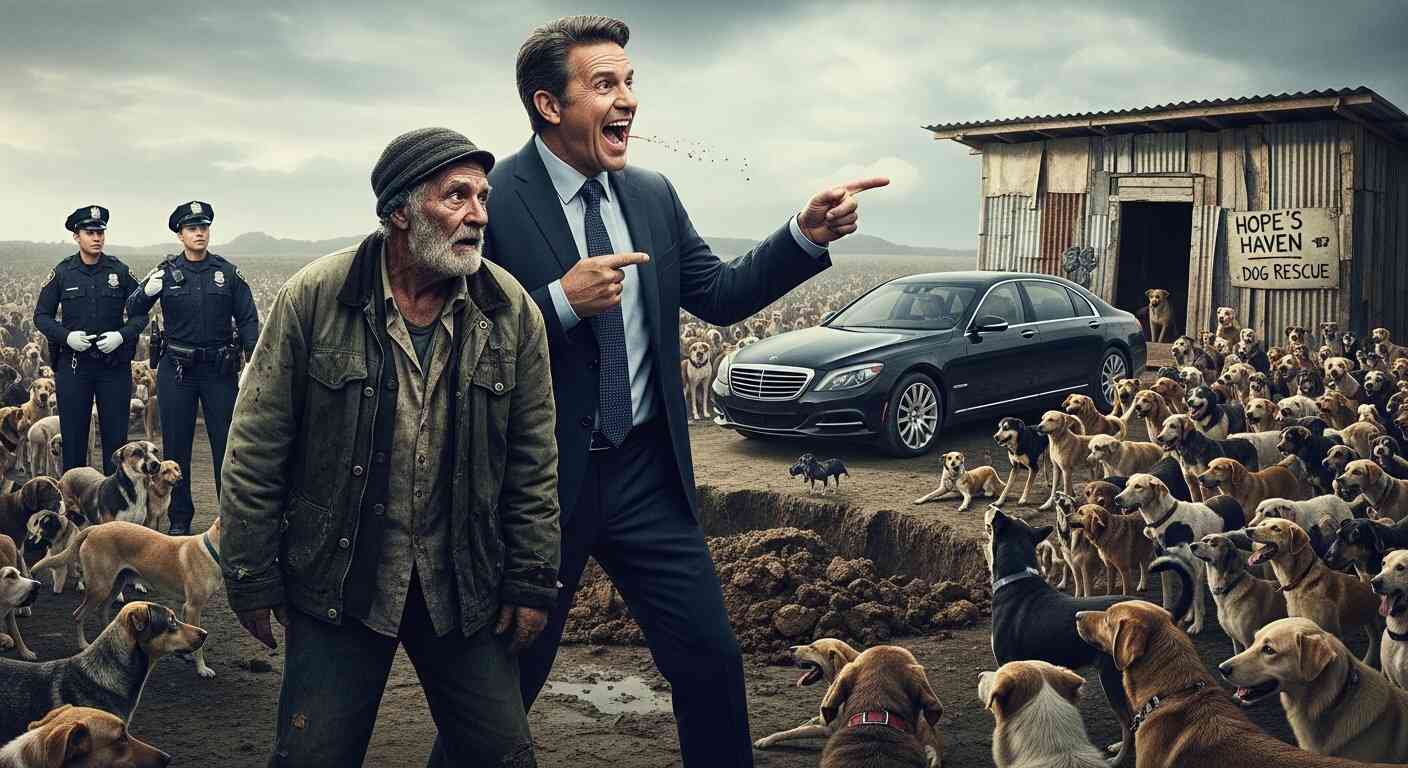
THEY PINNED THE HOMELESS BOY AGAINST THE BRICK WALL, SCREAMING INSULTS WHILE RIPPING HIS WORN-OUT JACKET, LEAVING HIM EXPOSED TO THE BITING WIND. HE CLOSED HIS EYES, WAITING FOR THE FINAL BLOW… BUT THE PACK HAD OTHER PLANS. 🐕❄️🔥
The wind in the Heights didn’t just blow; it bit. It was the kind of cold that found every hole in your shoes and every crack in your spirit.
Leo was used to it. He’d lived in the “hollow” behind the old textile mill for two years, ever since the foster system decided he was too old to care for but too young to matter. He didn’t ask for much. A few scraps from the butcher, a warm vent to sleep near, and the company of the ones the city had discarded just like him.
But tonight, Jax and his crew were bored. And in this town, a bored rich kid was the most dangerous thing on two legs.
“Look at this,” Jax sneered, pinning Leo against the freezing brick. “He’s shivering. You cold, Leo? Maybe you need a little more ventilation.”
With a sickening rrip, Jax’s hand tore through the denim of Leo’s only jacket—the one he’d found in a donation bin three winters ago. The biting wind immediately hit Leo’s skin like a thousand needles.
“Stop, please,” Leo whispered, his voice trembling. “I haven’t done anything to you.”
“You exist,” Jax laughed, raising a fist. “That’s enough.”
Leo closed his eyes. He waited for the impact. He waited for the pain he’d grown to expect from the world.
But the blow never came.
Instead, the alley was suddenly filled with a sound that made the very bricks vibrate. It wasn’t a bark. It was a roar.
A hundred pairs of eyes ignited in the darkness. A hundred paws hit the pavement in a rhythmic, terrifying march. The “silent guardian” wasn’t alone anymore.
Chapter 1: The Shredding of the Soul
The alley behind 4th and Main was a graveyard for things the city of Oakhaven wanted to forget. Rusted dumpsters, shattered glass, and Leo.
At seventeen, Leo was a ghost. He moved with a quietness that suggested he was trying to apologize for taking up space. His only luxury was a denim jacket, lined with faux wool that had long since matted down into something thin and grey. It was his armor. It was his home.
Jax Miller didn’t like ghosts. Jax was the son of the man who owned the Oakhaven Development Group, the company currently tearing down the “eyesores” of the lower district to build luxury lofts. To Jax, Leo wasn’t a person; he was an eyesore that could talk.
“Hold him,” Jax commanded.
Two of his friends, boys built like linebackers and dressed in thousand-dollar tech-wear, grabbed Leo’s arms. They slammed him against the brick wall of the old theater. The cold from the stone seeped through Leo’s jacket instantly, but it was nothing compared to the cold in Jax’s eyes.
“My dad says this whole block is getting ‘sanitized’ next week,” Jax said, leaning in so close Leo could smell the expensive mint on his breath. “That means the trash has to go. And you, Leo, are the biggest piece of trash I’ve ever seen.”
Jax reached out and hooked his fingers into a small tear in Leo’s jacket. With a violent, twisting motion, he yanked. The fabric groaned and gave way, baring Leo’s thin chest to the thirty-degree wind.
Leo gasped, his body reflexively curling inward. “Please… it’s the only one I have.”
“Now you have none,” Jax mocked. He grabbed the other side and shredded it further, tossing the scraps of denim into a puddle of oily slush. “Consider it a favor. You’ll move faster if you’re not weighed down by rags.”
Leo looked down at the remains of his jacket. To anyone else, it was garbage. To him, it was the last thing he’d touched that felt like safety. A tear escaped, freezing almost instantly on his cheek.
“Oh, look! The rat is crying!” Jax laughed, pulling back a fist. “Let’s give you something to really cry about.”
Leo braced himself. He’d been hit before. He knew how to tuck his chin, how to go limp so the bones didn’t break as easily. He waited for the darkness.
But then, the wind seemed to stop.
From the shadows beneath the fire escape, a low, guttural vibration began. It wasn’t a growl—it was a collective hum of a hundred throats.
Jax froze, his fist hovering inches from Leo’s face. “What was that?”
Out of the pitch-black darkness of the loading dock stepped a Pitbull-boxer mix with a notched ear. He was followed by a lean, scarred Greyhound. Then a massive, shaggy mutt that looked like a wolf.
They didn’t bark. They didn’t even snap. They just flowed into the alley like a rising tide of fur and muscle. One by one, they stepped into the dim light of the streetlamp, forming a tight, impenetrable semi-circle around Leo.
The leader—the Pitbull Leo called ‘Bones’—stepped forward and placed himself directly in front of Leo’s knees. He looked up at Jax, his upper lip twitching to reveal white, lethal teeth.
Jax took a step back, his face turning the color of ash. “Wh-where did they come from?”
Leo opened his eyes. He saw the pack. He saw the dogs he had shared his meager meals with, the ones he’d bandaged in the middle of the night, the ones he’d whispered his secrets to when the silence of the city became too much to bear.
The hunters had just become the prey.
Chapter 2: The Boy Who Spoke Dog
To understand why a hundred dogs would risk their lives for a homeless boy, you had to understand the two years Leo had spent in the “Underbelly” of Oakhaven.
When Leo first hit the streets at fifteen, he was terrified of everything. The sirens, the shouting, and especially the dogs. Oakhaven had a massive stray problem—abandoned pets from the foreclosed homes in the outskirts, and ‘discarded’ fighters from the rings in the industrial zone.
But one night, in the middle of a torrential downpour, Leo had found Bones. The dog was caught in a coil of rusted barbed wire behind a fence, bleeding and exhausted. Most people would have called Animal Control, which in Oakhaven meant a one-way trip to the incinerator.
Leo didn’t have a phone. He didn’t have a car. All he had was a pair of rusted wire cutters he’d found in a dumpster and a heart that knew exactly what it felt like to be trapped.
He had spent four hours in the rain, talking to the dog in a low, steady voice. He didn’t care if the dog bit him. He just didn’t want the animal to die alone. When the wire finally snapped, Bones didn’t run. He licked the salt from Leo’s tears and stayed by his side until morning.
Word travels fast in the animal kingdom.
Slowly, the “Silent Guardian” became a legend among the strays. Leo knew which dumpsters had the best scraps and which restaurants threw out the day-old bread. He would gather the food and distribute it like a tiny, bedraggled king. If a dog was sick, Leo found old blankets. If a dog was hurt, he used his own meager earnings from collecting cans to buy antiseptic.
He wasn’t just feeding them; he was giving them back their dignity.
Back in the alley, Jax was realizing that his father’s money couldn’t buy off a starving Doberman.
“Get them away, Leo!” Jax screamed, his voice hitting a high, panicked pitch. “I’ll tell my dad! I’ll have this whole alley gassed!”
Leo stood up slowly, clutching the remnants of his torn shirt against his chest. He looked at the dogs. He could feel their heat, a living furnace against the biting wind.
“They don’t like the way you smell, Jax,” Leo said softly.
“What? I’m wearing four-hundred-dollar cologne!”
“They don’t smell the cologne,” Leo replied, stepping forward. The dogs moved with him, a coordinated unit. “They smell the rot. They smell the part of you that thinks hurting something smaller than you makes you big.”
The Doberman on the left—a female Leo called ‘Satin’—let out a bark that sounded like a crack of thunder. Jax jumped, stumbling over a pile of pallets.
“Stay back! I’m warning you!” Jax pulled a switchblade from his pocket, the silver blade flickering in the light.
The growl from the pack deepened, a sound so primal it seemed to come from the earth itself. Bones tensed his muscles, ready to spring.
“Jax, don’t,” Leo warned. “If you hurt one of them, I won’t be able to stop what happens next.”
For the first time in his life, Jax Miller looked into someone’s eyes and saw a power he couldn’t comprehend. It wasn’t the power of a bank account or a family name. It was the power of a man who had nothing to lose and a hundred reasons to fight.
Chapter 3: The Detective and the Discarded
While the standoff in the alley continued, three blocks away, Detective Sarah Vance was staring at a map of Oakhaven.
Sarah was thirty-four, with hair the color of burnt copper and eyes that had seen too many “accidents” in the lower district. She was a former foster kid herself, and she had a nose for corruption that usually kept her in the Chief’s bad graces.
“The Miller Group is moving fast,” her partner, Miller (no relation to Jax), said, dropping a file on her desk. “They’ve got the demolition permits for the old theater and the surrounding alleyways. They’re calling it ‘Urban Renewal.'”
“They’re calling it an excuse to bury the evidence of the illegal asbestos dumping from three years ago,” Sarah countered. “And they’re doing it by pushing out the only people who might have seen something.”
She thought of the “Ghost Boy” she’d seen a few times during her patrols. He was always surrounded by dogs. She’d tried to buy him a meal once, but he’d disappeared into the shadows before she could even get out of her car.
“Wait,” Sarah said, leaning into the monitor. “Look at the live feed from the 4th Street intersection.”
On the grainy security footage, she saw Jax Miller’s car parked illegally in front of the alley. She saw three boys entering the darkness. And then, she saw something that made her heart stop.
Dogs.
Hundreds of them. From every side street, every basement window, every dark corner, the city’s strays were converging on that one alleyway. It looked like a migration. It looked like a war.
“Call for backup, but tell them no sirens,” Sarah said, grabbing her coat. “And tell them to bring the heavy tranquilizers—not for the dogs, but because if those rich kids get hurt, the Mayor will have our heads.”
As she drove toward the alley, Sarah felt a sense of impending doom. She knew the Miller family. They didn’t take “no” for an answer, and they certainly didn’t take it from a homeless boy.
She arrived just as the standoff reached a breaking point.
The alley was packed so tight with dogs that the air was thick with the scent of wet fur and raw adrenaline. Jax was backed into a corner, his knife shaking in his hand. Leo was standing in the center, his eyes fixed on Jax.
“Drop the knife, Jax,” Sarah said, her voice projecting with the authority of a decade on the force. She stood at the mouth of the alley, her hand on her holster but her weapon undrawn.
Jax looked at her, his eyes wild. “Officer! Thank god! Kill them! Kill these monsters!”
Sarah looked at the “monsters.” They were sitting. They were waiting. They weren’t attacking; they were guarding.
She looked at Leo. She saw the shredded jacket in the mud. She saw the red marks on his neck where he’d been pinned against the wall.
“Who started this, Leo?” she asked.
Leo didn’t speak. He just pointed to the scraps of denim in the puddle.
Chapter 4: The Secret in the Shreds
Sarah Vance stepped into the alley. The dogs didn’t move for her at first. Bones, the Pitbull, stood his ground, his eyes darting between the detective and Leo.
“It’s okay, Bones,” Leo whispered.
The dog let out a soft huff and stepped aside. Sarah walked up to Leo and draped her own heavy police-issue windbreaker over his shoulders. “You’re shivering, kid. Let’s get you out of here.”
“I can’t leave them,” Leo said, his voice a dry rasp. “If I leave, the men with the nets will come. Jax said… he said they’re going to ‘sanitize’ the block.”
Jax, seeing the police presence, regained some of his arrogance. “You’re damn right we are! This is private property! These animals are a menace!”
“The only menace I see here is a kid with a knife and a history of disturbing the peace,” Sarah snapped. She turned back to Leo. “What did he mean, Leo? Why you? Why now?”
Leo reached into the inner pocket of his shredded jacket—one of the few pieces Jax hadn’t managed to destroy. He pulled out a small, soot-stained USB drive.
Jax’s face didn’t just go pale; it went translucent. “Give that back! That’s stolen property!”
“I found it in the rubble of the old mill,” Leo said to Sarah, ignoring Jax’s screams. “I used to sleep there before the ‘fire’ last month. One of the office safes broke open when the floor collapsed. I thought it might be worth something to someone who cared about the truth.”
Sarah took the drive, her fingers brushing Leo’s cold hand. “What’s on it?”
“Photos,” Leo said. “Of the barrels. The ones the Miller Group buried under the foundation of the new lofts. The ones that are leaking into the city’s water table.”
The silence that followed was absolute. Even the dogs seemed to hold their breath.
This wasn’t about a homeless boy being in the way. This was about a witness who couldn’t be bought because he had nothing to lose. Jax hadn’t come to the alley to “play a game.” He’d come to find that drive.
“You’re dead, Leo!” Jax screamed, lunging forward with the knife.
He didn’t get three feet.
The pack didn’t wait for a command. Bones and Satin moved as a single shadow. They didn’t bite Jax, but they hit him with the force of two hundred pounds of muscle, pinning him against the same brick wall where he’d held Leo. The knife clattered to the ground.
“Stay!” Leo shouted.
The dogs froze. Jax was trapped, the hot breath of the pack on his neck, his expensive clothes being ruined by the very “trash” he despised.
Sarah looked at the USB drive, then at Jax. “Looks like Urban Renewal just got a new meaning, Jax. And your dad is going to need a lot more than a fancy lawyer to fix this.”
Chapter 5: The Reckoning
The next forty-eight hours were a whirlwind that transformed Oakhaven.
Detective Vance didn’t take the USB drive to the local precinct. She knew the Chief was on the Miller payroll. Instead, she drove straight to the State Attorney’s office.
By morning, the Miller Development Group was under a federal freeze. The EPA was on-site at the lofts, and they found exactly what Leo had described: hundreds of barrels of toxic waste, buried like a ticking time bomb beneath the luxury apartments.
Richard Miller was arrested in his penthouse. Jax was charged with assault with a deadly weapon and witness intimidation.
But the real story—the one that captured the heart of the country—was the footage from the alley.
The video Sarah’s partner had captured on his bodycam showed the moment the dogs surrounded Leo. It showed the silent, dignified protection of the pack. It showed a boy who had been treated like garbage being treated like a king by the only creatures that knew the value of a soul.
The “Silent Guardian” was no longer silent.
Leo was brought to a local hospital. For the first time in two years, he slept in a bed with clean sheets. He ate a meal that didn’t come from a dumpster. But he wouldn’t settle until he knew the dogs were safe.
“They’re being rounded up, Leo,” a social worker told him gently. “The city can’t have a hundred strays roaming the streets.”
Leo sat up, his eyes flashing with a fire the hospital staff hadn’t seen before. “Then the city is making a mistake. They’re not strays. They’re a family. And they’re the only ones who stood up when the ‘civilized’ people looked away.”
The public outcry was massive. A “Save the Pack” fund was started, raising three hundred thousand dollars in a single day. People from all over the world wanted to adopt the “Alley Dogs.”
But Leo had a better idea.
He used the reward money from the environmental whistleblowing to buy the old theater—the very building where Jax had pinned him against the wall.
He didn’t turn it into a theater. He turned it into “The Sanctuary.”
Chapter 6: The Language of the Pack
A year later, the 4th Street alley was no longer a graveyard.
The bricks were painted with a massive, colorful mural of a boy and a Pitbull, standing under a rain of denim scraps that turned into stars.
The Sanctuary was a thriving hub. It wasn’t a shelter with cages; it was a collaborative space. Homeless veterans and foster kids worked alongside trainers to rehabilitate the city’s strays. They healed each other. They taught each other that being “discarded” didn’t mean being “broken.”
Leo sat on the front steps of the theater, wearing a new jacket—heavy, warm, and made of the finest wool. It had been a gift from the neighborhood.
Bones lay at his feet, his tail giving a rhythmic thump-thump against the stone.
A car pulled up, and Sarah Vance stepped out. She wasn’t a detective anymore; she’d left the force to become the Sanctuary’s head of security and legal counsel.
“How’s the new intake?” she asked, sitting down next to Leo.
“We got three more today,” Leo said, looking at a group of dogs playing in the courtyard. “A Shepherd from the docks and two mutts from the Heights. People still haven’t learned that a dog isn’t a fashion accessory.”
“They’re learning, Leo,” Sarah said, looking at the mural. “Slowly. But they’re learning.”
Leo looked down at his hands. They were clean now, but they still carried the calluses of a life lived on the edge. He thought about that night in the alley—the cold, the fear, and the sound of a hundred paws.
He realized that Jax Miller had been wrong. He hadn’t been exposed to the wind. He had been surrounded by a wall that no storm could ever knock down.
Jax was currently serving three years in a state facility. His father was facing ten. The Miller lofts had been demolished, the soil cleaned, and the land turned into a public park—one where dogs were allowed to run off-leash.
Leo stood up, his joints no longer aching from the damp pavement. He whistled—a short, melodic note that echoed through the alley.
From the shadows of the theater, fifty dogs emerged. They didn’t run. They didn’t growl. They simply gathered around him, a sea of wagging tails and bright eyes.
“You ready to go for a walk?” Leo asked.
As they moved down the street, the people of Oakhaven didn’t look away. They didn’t pull their children closer or call the police. They waved. They smiled. They recognized the boy and the pack that had saved their city from its own rot.
Leo wasn’t a ghost anymore. He was a beacon.
And as the biting wind of another winter began to blow, he didn’t shiver. He just zipped up his jacket, felt the warmth of the pack at his heels, and kept walking.