The ice in the wine glass rattled—a tiny, rhythmic sound that was the only thing louder than the pounding of my own heart.
I sat there, in the middle of “The Gilded Rose,” the most expensive bistro in our leafy Connecticut suburb. I was wearing my Dress Blues. I’d put them on because today was our tenth anniversary, and Tiffany had always said she loved a man in uniform.
But the woman standing over me wasn’t the woman I married.
Tiffany held the Cabernet tilted at a precarious angle. Her eyes were bright with a cruel, manic energy I didn’t recognize. Behind her, Julian—the guy she’d told me was just her “creative consultant”—was holding his iPhone up, the red “record” light blinking like a warning signal.
“Go ahead, Dave,” Tiffany sneered, her voice carrying across the silent patio. “Tell everyone how you spent our mortgage on a deployment in a desert while I was here, lonely, building a real life.”
“Tiffany, please,” I whispered. “Sit down. Let’s just go home.”
“Home?” She laughed, a sharp, jagged sound. “You mean the house I decorated while you were playing soldier? The house Julian spends more time in than you do?”
The patio went dead silent. Even the birds seemed to stop chirping.
I looked at the small velvet box sitting next to my bread plate. Inside was a diamond band I’d worked three extra security shifts a week to afford. I wanted to tell her I was retiring. I wanted to tell her I was staying home for good.
“You’re a relic, David,” Julian chimed in from behind the lens. “A boring, broken relic. Give the people what they want, Tiff. Show them the ‘Hero’s’ bath.”
She didn’t hesitate.
The cold, stain-heavy liquid hit my crown first, soaking into my hair, then cascading down my face. I felt the wetness seep into the fabric of my uniform—the medals I’d bled for, the stripes that represented brothers I’d buried.
Julian’s laughter was a high-pitched cackle. “Oh, that’s going viral! #VeteranFail. Look at him! He won’t even move!”
I didn’t move. Not because I was weak. But because I heard it.
The low, rhythmic rumble of heavy engines. The sound of tires gripping the asphalt too fast.
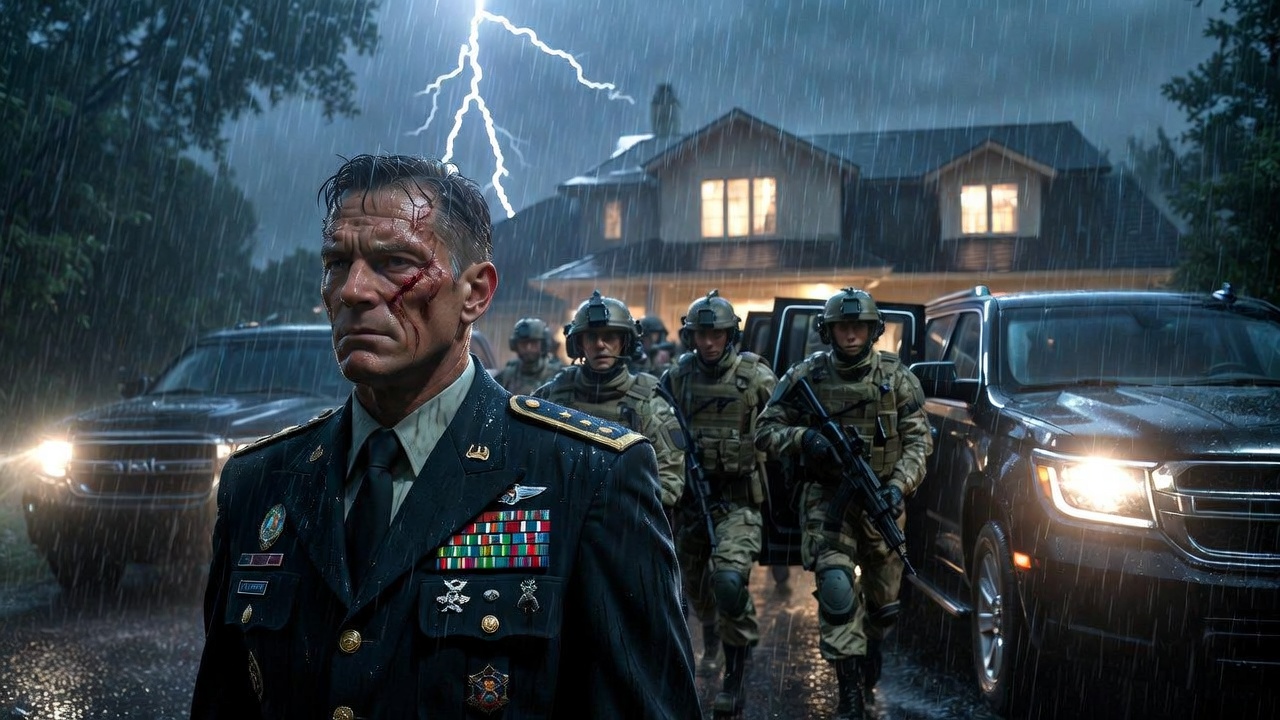
Tiffany was too busy laughing at my soaked medals to notice the three black SUVs swerving onto the sidewalk, blocking the exit. She didn’t see the doors fly open.
She didn’t see the brotherhood arriving.
Chapter 1: The Stain on the Soul
The red wine didn’t just ruin the wool of my uniform; it felt like it was dissolving the last ten years of my life. I sat motionless as the dark liquid dripped off the tip of my nose and onto the white tablecloth of the finest restaurant in Fairfield County.
Tiffany leaned in, her perfume—something expensive and floral—mixing with the acidic tang of the wine. “You look pathetic,” she whispered, loud enough for the neighboring tables to hear. “I spent my youth waiting for a ghost. I’m done waiting.”
Julian, her ‘consultant,’ stepped closer, the camera lens inches from my face. “Look at the camera, Sergeant. Give us a tear. The followers love a crying hero. It’s the ‘broken warrior’ aesthetic.”
I looked up, but not at the camera. I looked at the woman I had carried a photo of in my helmet for three tours in the Middle East. She was wearing the pearl necklace I’d sent her from an airport in Germany. She looked beautiful. She looked like a stranger who had stolen my wife’s face.
“Is this what you want?” I asked, my voice surprisingly steady. “To humiliate me in the town where we grew up? To destroy the only thing I have left from the service?”
“I want you to realize you don’t own me just because you wear that suit,” she snapped. She turned to the crowd of staring diners, spreading her arms wide. “He thinks he’s a king because he has a few ribbons! He’s a shell of a man who can’t even hold a conversation without looking at the door!”
She was right about the door. I was always looking for the exit. It was a habit I couldn’t break after seeing what I’d seen in the Kunar Province. But right now, I wasn’t looking for an exit for myself. I was looking at the men stepping out of the black SUVs that had just jumped the curb.
Marcus was the first one out. Six-foot-four, a former Ranger with a chest like a barrel. Behind him came Sarah, a combat medic who had stitched my leg in a sandstorm, and Miller, the quietest sniper I’d ever known.
They didn’t look like they were out for a Sunday brunch. They walked with a synchronized, heavy-booted stride that caused the crowd on the sidewalk to part like the Red Sea. They didn’t say a word. They just formed a semi-circle around our table, a wall of living muscle and shared history.
Tiffany’s laughter died in her throat. She stepped back, her designer heel catching on the uneven stone of the patio. Julian lowered his phone, his smirk replaced by a look of sheer, primal terror.
“Who… who are these people?” Tiffany stammered, her voice suddenly small.
Marcus stepped forward, his eyes locked on the wine dripping from my lapel. He reached out, his hand the size of a dinner plate, and gently touched the silver Star on my chest. Then he looked at Tiffany with a coldness that would have frozen the sun.
“This uniform belongs to the United States Army,” Marcus said, his voice a low, vibrating growl. “But the man inside it belongs to us. And you just made the biggest mistake of your very shallow life.”
I finally stood up. The wine-soaked fabric felt heavy and cold against my skin. I picked up the velvet box from the table—the diamond band I was going to surprise her with to celebrate my retirement. I didn’t look at my team. I looked at the woman who had just tried to kill my spirit for a few likes on Instagram.
“I was going to quit today, Tiff,” I said. “I was going to tell you I was finally staying home. But you were right. I am a relic. And relics belong with people who know their value.”
I dropped the ring into her glass of wine. It sank to the bottom with a soft, final clink.
Chapter 2: The Weight of the Brotherhood
The “consultant,” Julian, tried to tuck his phone into his pocket, his hands shaking so violently he nearly dropped it. He looked around the circle of veterans, his chest heaving with shallow breaths.
“We were just… it was a joke,” Julian squeaked, his bravado evaporating. “Social media content, man. It’s all about the engagement. We were going to post a ‘reconciliation’ video tomorrow. It’s a strategy!”
Miller, the quiet sniper, stepped into Julian’s personal space. He didn’t touch him. He didn’t have to. He just stood there, radiating the kind of stillness that only comes from people who have spent weeks waiting in the dark for a target.
“The phone,” Miller said softly. “Hand it over before I decide your ‘content’ constitutes a threat to a commissioned officer.”
“I have rights!” Julian yelled, though it sounded more like a sob.
“And David has a dry-cleaning bill for a suit that costs more than your car,” Sarah, the medic, snapped. She walked over to me, pulling a clean microfiber cloth from her pocket. She didn’t look at Tiffany. She just started dabbing the wine off my face with a tenderness that made my throat ache. “You okay, Cap?”
“I’m fine, Sarah,” I said, though my voice felt like it was being squeezed out of a narrow pipe.
Tiffany finally found her nerve, or maybe her ego just couldn’t handle being ignored. She stepped between me and Marcus, her face flushed with a mix of fury and embarrassment. “This is a private matter! This is my husband! You people can’t just show up here and intimidate us in public. I’ll call the police!”
“Please do,” Marcus said, crossing his arms. He didn’t budge an inch. “My brother is the Chief of Police in this district. I’d love for him to see the video your friend here just recorded. Humiliation, harassment, and destruction of government property—that uniform is technically federal issue, isn’t it, David?”
Tiffany turned to me, her eyes wide. “David! Tell them to leave! Tell them this is between us!”
I looked at her, really looked at her, for the first time in years. I saw the filler in her lips, the coldness in her eyes, the way she clutched her expensive handbag like a shield. I wondered when the girl I’d fallen in love with in high school had been replaced by this caricature of a person.
“It’s not between us anymore, Tiffany,” I said. “It hasn’t been for a long time. You’ve been living a double life on my dime while I was eating dust in a valley you can’t even find on a map. You wanted an audience? Well, you got one. These are the people who actually know me.”
“You’re choosing them?” she hissed. “A bunch of broken soldiers over your wife?”
“I’m choosing the truth,” I replied.
I turned to Marcus. “Let’s go. I’m done here.”
“Not quite,” Sarah said, looking at Julian. “The live feed is still running. Julian, why don’t you tell the three thousand people watching right now exactly whose credit card paid for that suit you’re wearing?”
Julian looked at the camera, then at the circle of angry veterans. He turned tail and ran, stumbling over a flower pot as he sprinted toward the parking lot, leaving Tiffany standing alone in the middle of the restaurant patio.
As we walked toward the SUVs, the entire restaurant—the diners who had been silent moments ago—began to clap. It wasn’t a loud, raucous cheer. It was a slow, respectful rhythmic beat. Tiffany stood in the center of the patio, wine-stained and solitary, as the world moved on without her.
Chapter 3: The Paper Trail of Betrayal
We didn’t go to a bar. We went to Marcus’s garage, a sanctuary filled with the smell of motor oil, sawdust, and old memories. It was the “Tactical Operations Center” of our civilian lives.
The adrenaline was wearing off, replaced by a hollow, echoing exhaustion. I’d stripped off the ruined tunic, sitting in my white undershirt as Sarah handed me a beer.
“She’s been busy, Dave,” Miller said, sitting on a workbench with a laptop open. He had “retrieved” Julian’s phone during the scramble at the restaurant. “I’m not a hacker, but Julian didn’t even have a passcode. This guy is as dumb as he is smug.”
I took a sip of the beer, the coldness hitting my stomach. “How bad is it?”
“It’s not just the cheating, David,” Sarah said, her voice unusually grave. She was looking over Miller’s shoulder. “We’ve been looking into the VFW legal archives. Tiffany didn’t just spend the mortgage. She’s been diverting your disability back-pay into a shell company registered in Julian’s name.”
I felt a coldness settle in my bones. “That was for my surgery. The one for the shrapnel in my hip.”
“She told the VA you were ‘mentally incapacitated’ and signed as your power of attorney while you were still in the recovery ward at Landstuhl,” Marcus said, his voice cracking with rage. “She forged your signature, Dave. She didn’t just pour wine on you today. She’s been bleeding you dry for three years.”
The room went silent. The betrayal was so deep, so calculated, that it felt like a physical weight on my chest. I thought about the long nights in the hospital, the way she’d bring me magazines and talk about our future house, all while she was signing away my health for a designer lifestyle.
“I want her out,” I said, my voice barely a whisper. “I want her out of my house, out of my life, and I want her to feel every bit of the dirt she tried to put on me.”
“That’s why I called the General,” Marcus said.
I looked up. “General Vance?”
“He’s retired now, but he runs the most aggressive veteran advocacy firm in the Tri-State area,” Marcus explained. “He’s already seen the video. It went viral, Dave. Not the way Tiffany wanted. The internet is calling her the ‘Wine Pouring Witch.’ And Vance? He’s a shark. He’s already filed for an emergency freeze on all your joint accounts.”
Just then, my phone buzzed. It was a text from Tiffany.
David, please. Julian left. He took the car. I have no way home. I’m sorry. I was just stressed. Please come get me. I love you.
I looked at the screen, then at the men and women in the room—the people who had actually bled with me.
“Miller,” I said, handing him my phone. “Block her. And Sarah? Call the General. Tell him we don’t want a settlement. We want everything.”
“What about the house?” Sarah asked.
“The house is a tomb,” I said. “Let her stay there for one more night. Tomorrow, the eviction notice arrives with a moving crew of twenty angry Rangers. I want to see her face when she realizes that a hero’s service might mean nothing to her, but it means everything to the law.”
Chapter 4: The Eviction of a Ghost
The next morning was gray and drizzly, the kind of weather that feels like a mourning period. I stood at the end of the driveway of the house I’d bought with my reenlistment bonus—a beautiful colonial with a wrap-around porch that Tiffany had turned into a temple of vanity.
At 0800 sharp, the “battalion” arrived. It wasn’t just Marcus and the team anymore. Word had spread through the local VFW and the American Legion. Twenty men and women, some in old fatigue jackets, some in suits, all with the same grim determination.
We walked up the driveway in silence. No shouting. No drama. Just the weight of numbers.
Tiffany opened the front door, wearing a silk robe, a coffee cup in her hand. She looked like she’d been crying, but the second she saw the crowd, her face hardened.
“What is this, David? A circus? You can’t just bring your ‘friends’ to my home!” she yelled.
“It hasn’t been your home since you forged my name on those VA documents, Tiffany,” I said, stepping forward. I handed her a thick packet of papers. “This is a court-ordered emergency eviction and a temporary restraining order. You have one hour to pack whatever you bought with your own money. Which, according to the General’s forensic accountants, is basically nothing.”
Tiffany turned pale. “You’re joking. You can’t throw me out! I have rights!”
“You had a husband,” Marcus stepped up, holding a stack of empty cardboard boxes. “Now you have a legal nightmare. Move. Or we move you.”
The next hour was a blur of frantic packing and cold efficiency. The veterans didn’t say a word to her. They simply moved through the house, labeling my belongings, ignoring her screams. I watched as Sarah went into the master bedroom and came out with my grandfather’s flag—the one Tiffany had been using as a backdrop for her “lifestyle” photos. Sarah folded it with military precision and handed it to me.
“Everything that matters is safe, Cap,” she whispered.
Tiffany stood on the lawn, clutching a single suitcase and her designer handbag. She looked small against the backdrop of the house. Julian was nowhere to be found; he’d been arrested at a motel three towns over for grand larceny and fraud.
“You’re going to regret this, David!” she screamed, her voice cracking. “Who’s going to take care of you? Who’s going to help you when you wake up screaming in the middle of the night? These guys? They have their own lives!”
I looked at Marcus, who was carrying out my old footlocker. I looked at Sarah, who was checking my meds. I looked at the line of cars down the street, neighbors who had come out to watch—not to mock me, but to stand guard.
“They already are taking care of me, Tiff,” I said. “And for the first time in ten years, I’m not waking up to a nightmare. I’m waking up to the truth.”
As she hailed an Uber, her designer heels sinking into the mud of the lawn she’d obsessed over, I felt a strange sense of peace. The wine stain on my soul was finally being washed away.
Chapter 5: The Cost of the Truth
The legal battle that followed was a grueling march through the mud. Tiffany tried everything. She claimed I was abusive; the restaurant video and twenty witnesses debunked it. She claimed I was mentally unstable; my commanding officer and three doctors provided testimony to my fitness.
But the real blow came when the forensic accountants finished their work.
I sat in General Vance’s office—a room that smelled of old leather and tobacco. The General, a man with white hair and eyes like flint, slid a file across the desk.
“She didn’t just steal from you, David,” Vance said. “She was selling your story. She’d been ghostwriting a ‘memoir’ about being a martyr wife to a ‘broken soldier.’ She had a six-figure book deal lined up. The hook? Your eventual ‘tragic spiral.’ She was literally betting on your failure to make herself a star.”
I felt a wave of nausea. “She wanted me to fail? She was waiting for me to… to end it?”
“The narrative sells,” Vance said grimly. “But here’s the good news. Since the book was based on forged documents and slander, the publisher has pulled the plug. They’re suing her for the return of the advance. Between that and the fraud charges for the VA money, she’s looking at significant jail time.”
I walked out of the office and into the crisp autumn air. I didn’t feel the triumph I thought I would. I just felt a profound sadness for the woman she could have been, and the man I’d almost let her destroy.
I went to the VFW that night. It wasn’t a party. It was just a Tuesday. But when I walked in, the room went quiet.
The Commander, an old vet from the Vietnam era named Pops, stood up from his stool. He didn’t say a word. He just walked over and handed me a new uniform tunic. It was crisp, the wool dark and perfect. All my medals had been transferred over, cleaned and polished until they shone like new.
“We heard the old one got a bit of a stain on it,” Pops said, his voice gruff. “Consider this a gift from the post. A man’s service isn’t defined by the people who don’t understand it. It’s defined by the people who do.”
I ran my hand over the silver star. I thought about the valley in Afghanistan. I thought about the hospital bed. And then I thought about the garage, the SUVs, and the twenty people who had stood on my lawn.
“Thank you, Pops,” I said, my voice thick.
“Don’t thank me, son,” he said, patting my shoulder. “Just wear it. And remember who you are.”
I realized then that the “relic” Tiffany mocked wasn’t something old and useless. It was a foundation. I was a part of something that wouldn’t break, no matter how much wine was poured or how many lies were told.
Chapter 6: The Final Salute
A year later, the world looked very different.
The divorce was final. Tiffany was serving three years in a minimum-security facility for fraud. Julian was gone, a footnote in a cautionary tale about the dangers of chasing clout.
I was standing on the porch of a new house—a smaller place, closer to the base where I now worked as a civilian consultant for transitioning veterans. It didn’t have a wrap-around porch or a designer kitchen. But it had a guest room that was always occupied by someone who needed a place to stay.
I was wearing my uniform again. It was a local Veterans Day parade, and for the first time, I didn’t feel like I was hiding.
As I stood in the staging area, a young woman approached me. She was holding the hand of a small boy.
“Excuse me,” she said, her voice trembling. “Are you… are you the man from the video? The one whose friends showed up?”
I nodded, bracing myself. “I am.”
“I just wanted to say thank you,” she said, her eyes filling with tears. “My husband is deployed right now. I’ve been so lonely, and sometimes I get angry at him for being away. But when I saw that video… when I saw how much you meant to those people… it reminded me why he does it. It reminded me that he belongs to a family that will never let him fall. Even if I’m not strong enough, they are.”
She reached out and shook my hand. The little boy saluted me, his hand wobbling but his eyes wide with awe.
I watched them walk away, and I felt a warmth in my chest that had nothing to do with the sun.
Marcus pulled up in his truck, Sarah and Miller in the back. “Hey, Cap! Parade starts in ten. You ready to show this town what a real battalion looks like?”
I climbed into the passenger seat. I looked at the medals on my chest—the ones Tiffany had tried to rip off, the ones the brotherhood had polished back to life.
“I’m ready,” I said.
As we drove down the main street, the crowds lined the sidewalks. They weren’t recording for likes. They weren’t looking for a “viral moment.” They were just standing, some with their hats over their hearts, some with tears in their eyes.
I realized then that the stain was gone. Not just from the fabric, but from my heart. I had been humiliated in front of the world, only to realize the world was much bigger and much kinder than the person I’d shared a bed with.
I was a soldier. I was a brother. And I was finally, truly home.
True honor isn’t found in how the world treats you, but in how you stand when the world is at its worst.