CHAPTER 1: THE WEIGHT OF A POLAROID
The humidity in Oakhaven, Ohio, always felt like a wet wool blanket, but inside Miller’s Diner, the air smelled of burnt coffee and missed opportunities. Jaxson Reed sat in the corner booth, the one where the spring poked through the vinyl, and stared at the photo.
It was a Polaroid, the edges yellowed and the image slightly overexposed. It showed two men in desert camouflage, arms slung around each other’s shoulders, grinning like they knew a secret the rest of the world didn’t. One of them was Jaxson—ten years younger, twenty pounds heavier, and with eyes that still knew how to see the light. The other was Sam.
Sam was the one who didn’t come back.
Jaxson’s thumb traced the corner of the photo where a faint smudge of Sam’s thumbprint still lingered from the day it was taken in the Kandahar heat. It was the only thing Jaxson had left that felt solid. His medals were in a shoebox under his bed. His uniform was in a mothballed bag. But the photo? The photo stayed in his pocket, a paper anchor keeping him from drifting away entirely.
“Look at him,” a voice boomed, cutting through the low hum of the ceiling fan. “The local hero, still dreaming about the glory days.”
Jaxson didn’t look up. He didn’t have to. Hunter Vance’s voice was like a jagged piece of glass—grating, loud, and full of the unearned confidence that came from being the son of the town’s wealthiest developer. Hunter was Oakhaven’s Golden Boy. He’d been the star quarterback, the homecoming king, and now, at twenty-four, he ran the town like it was his personal playground.
Hunter slid into the booth opposite Jaxson, uninvited. He smelled of expensive cologne and cheap beer. Behind him, his usual choir of “yes-men” stood grinning, phones already out, sensing a show.
“I’m eating, Hunter,” Jaxson said softly. His voice was a low rasp, the sound of a man who hadn’t used it much lately.
“You’re moping, Jax,” Hunter corrected, leaning forward. He reached out and tapped the photo with a manicured fingernail. “Is this him? The brother who went out in a blaze of… well, not glory, right? What’d the report say? An accident?”
The air in the diner seemed to exit the room. Mrs. Gable, at the register, stopped counting change. Deacon, the old bartender from across the street who was grabbing a late lunch, slowly set his fork down.
Jaxson’s hand tightened around his coffee mug, but his face remained a mask of stone. “Don’t talk about Sam.”
“Oh, I’ll talk about whoever I want,” Hunter laughed, looking back at his friends for approval. They chuckled dutifully. “See, that’s the problem with you vets. You think because you went over there and did whatever you did, we owe you something. But look at you. You’re a ghost, Jaxson. You’re a drain on this town’s vibe.”
Hunter’s hand shot out. It was a fast, practiced movement—the kind he’d used to snatch footballs out of the air. He grabbed the Polaroid before Jaxson could react.
“Give it back,” Jaxson said. The mask was cracking. A dark, tectonic energy began to shift behind his eyes.
“Make me,” Hunter sneered. He stood up, holding the photo high. “Let’s see what Sam would think of his big brother now. A broken-down janitor at the high school. Pathetic.”
Hunter turned to walk toward the door, his crew parting for him like the Red Sea. Jaxson rose from the booth. He didn’t run. He didn’t shout. He walked with a measured, rhythmic gait that felt like a countdown.
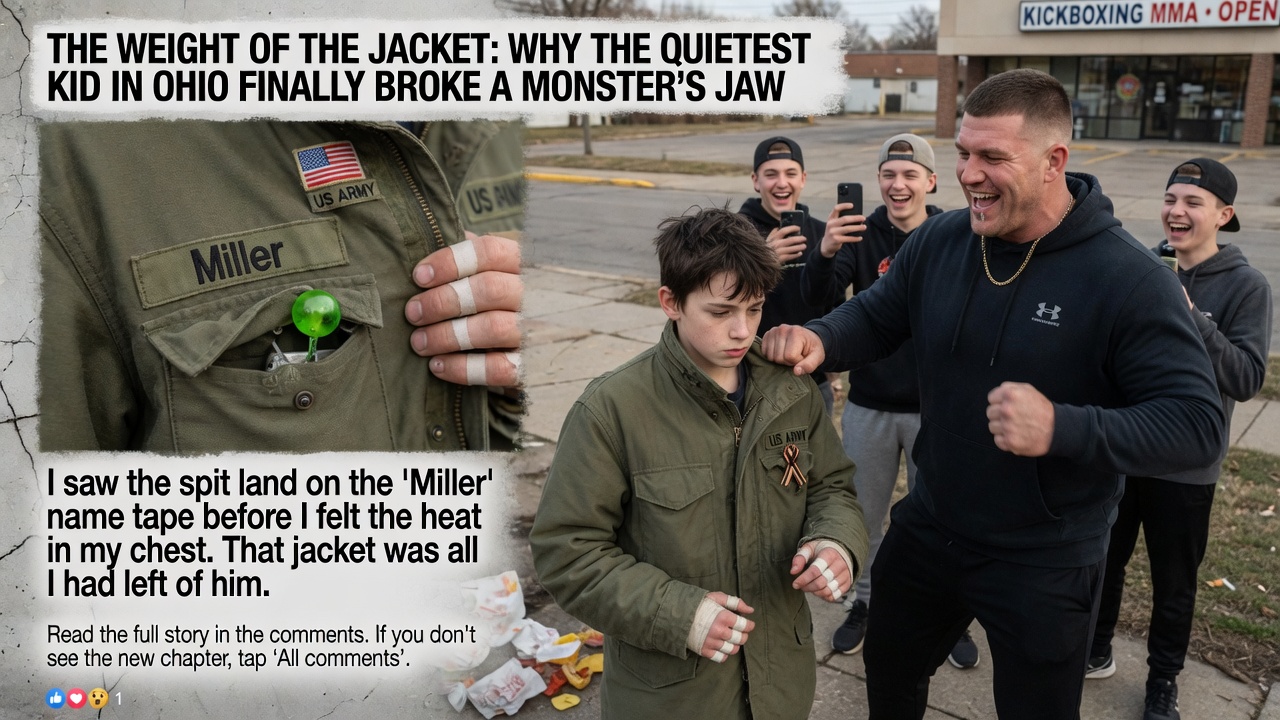
They reached the sidewalk just as the afternoon sun hit the pavement. The suburban street was busy—moms pushing strollers, cars idling at the red light, teenagers hanging out by the fountain.
“Hunter, give him the picture,” Maya, Hunter’s girlfriend, whispered from the sidewalk, her face pale. “This isn’t funny anymore.”
“It’s hilarious,” Hunter said, his eyes wild with the adrenaline of the crowd. He looked at Jaxson, who was now only five feet away. “You want it? Here. Go get it.”
With a flick of his wrist, Hunter slapped the photo. Not just a drop—he slapped it out of the air as if swatting a fly. The Polaroid tumbled through the humid air and landed face-up on the dirty concrete.
Jaxson froze. He looked at the photo of him and Sam. They were still smiling.
Then, Hunter lifted his boot.
It was a heavy, designer work boot—clean, expensive, and devastating. He brought it down right in the center of the image, twisting his heel. The sound of the photo tearing and the grit of the sidewalk grinding into the emulsion was the loudest thing Jaxson had ever heard.
“There,” Hunter grinned, his face inches from Jaxson’s. “Now he’s just like you. Trash.”
Jaxson Reed didn’t see the suburb anymore. He didn’t see the shocked faces of his neighbors. He saw the red dust of a road in Helmand. He felt the phantom weight of a rifle. He felt the soul of a warrior, long suppressed by the need to be “civil,” snap its chains.
“You shouldn’t have done that,” Jaxson whispered.
And then, the quiet man disappeared, and the weapon Sam had died beside took his place.
CHAPTER 2: THE ECHOES OF THE DEAD
To understand why Jaxson Reed stayed quiet for so long, you had to understand the house he grew up in. It was a small, two-bedroom ranch on the edge of Oakhaven, where the grass was always a little too long and the porch light always flickered. His father had been a man of few words and many scars, a factory worker who believed that silence was the ultimate form of strength.
“The loudest dog in the yard is the one that’s scared, Jax,” his father would say. “The quiet one? That’s the one that’s thinking.”
Jaxson and Sam were inseparable. Jaxson was the shield, Sam was the heart. When Sam got bullied for his glasses in middle school, Jaxson didn’t start a fight; he simply stood behind his brother at the bus stop, his presence a silent wall that no one dared to scale.
When they both enlisted after high school, the town threw a parade. They were the Reed boys—the pride of the county. But the Army doesn’t care about hometown pride. It cares about utility. Jaxson was a natural in the infantry, a man who could endure cold, hunger, and fear without a twitch of his lip. Sam was the medic, the one who tried to find the humanity in the middle of a war zone.
The photo Hunter had just destroyed was taken three days before the IED hit their Humvee. Sam had been complaining about the heat, laughing as he wiped sweat from his brow.
“When we get back, Jax,” Sam had said, “we’re going to open that gym. No more sand. No more screaming. Just us and the weights.”
The explosion hadn’t been a “blaze of glory.” It had been a sudden, violent erasure. One moment the world was beige and loud; the next, it was black and silent. Jaxson had crawled through the wreckage, his own legs shredded, screaming his brother’s name until his lungs burned. He found Sam, but there was nothing a medic could do for himself. Sam’s last act had been to reach out and touch Jaxson’s hand, leaving that smudge of blood and grease on the corner of the Polaroid Jaxson had been carrying in his vest.
When Jaxson returned to Oakhaven, he was a hollowed-out version of the boy who left. The town, once so eager to wave flags, quickly grew uncomfortable with his silence. They didn’t want the Jaxson who stared at walls or the Jaxson who worked the night shift cleaning floors so he didn’t have to talk to anyone. They wanted a story. They wanted a hero who smiled.
Hunter Vance, meanwhile, had spent the war years in a frat house, fueled by his father’s money and a growing sense of entitlement. He viewed Jaxson’s trauma as a weakness. To Hunter, life was a game of dominance. If you didn’t fight back, you were a victim. And Hunter loved nothing more than a victim who used to be a lion.
For months, Hunter had poked and prodded. He’d “accidentally” bumped into Jaxson at the grocery store. He’d made comments about “losers who can’t get a real job.” Jaxson had taken it all. He had a debt to Sam to stay peaceful. Sam wouldn’t want more violence.
But Sam was currently being ground into the dirt under a rich kid’s boot. And the peace was gone.
CHAPTER 3: THE SNAPPING POINT
The silence on the sidewalk was so heavy it felt physical. Hunter’s friends, sensing a shift in the atmosphere, stopped laughing. Their phone cameras were still recording, but the hands holding them were beginning to shake.
Jaxson’s eyes weren’t on Hunter anymore. They were on the boot.
“Hunter, move your foot,” Deacon barked from the diner doorway. The old man’s voice was like gravel. “Move it now, son. You don’t know what you’re doing.”
“I know exactly what I’m doing, old man,” Hunter spat, though a flicker of uncertainty crossed his face. He looked down at Jaxson. “What are you gonna do, Jax? Cry? Call the VA?”
Jaxson didn’t cry. He didn’t move fast, at first. He reached out and placed a hand on Hunter’s shoulder. It wasn’t a shove. It was a grip—a terrifying, vice-like pressure that sank through the expensive fabric of the varsity jacket and found the bone.
Hunter’s eyes widened. “Hey! Get your hands off—”
Jaxson’s other hand moved. It was a short, sharp palm strike to Hunter’s solar plexus. It wasn’t designed to kill, but it was designed to stop the world. Hunter’s breath left him in a sickening whoosh. He doubled over, gasping, his face turning a mottled purple.
“Sam lived for this country,” Jaxson said, his voice terrifyingly calm. “He died for people like you. People who have everything and respect nothing.”
One of Hunter’s friends, a kid named Caleb who had always been more of a follower, tried to step in. He swung a wild, telegraphed punch at Jaxson’s head. Jaxson didn’t even look at him. He slipped the punch with a slight tilt of his head, caught Caleb’s arm, and used the boy’s own momentum to send him crashing into a row of metal trash cans. The noise was like a car wreck.
The crowd scrambled back. This wasn’t a “local brawl.” This was a professional dismantling.
Hunter, finally catching a ragged breath, tried to swing. He was big, and he was strong, but he was fighting a man who had been trained to survive against enemies who didn’t care about rules. Jaxson blocked the swing with his forearm—a bone-on-bone clatter—and then he was inside Hunter’s guard.
A flurry of strikes followed. To the onlookers, it looked like a blur. To Jaxson, it was a sequence. Ribs. Thigh. Jaw. He was writing a lesson in pain on Hunter’s body.
Hunter hit the pavement hard. His nose was gushing, and his “Golden Boy” face was already starting to swell. He looked up, his eyes finally filling with the realization that he had stepped on the wrong man’s soul.
“Please,” Hunter wheezed, the bravado gone. “I’m sorry! It was just a joke!”
Jaxson stood over him, his chest rising and falling in a steady, lethal rhythm. He looked down at the ruined photo, then back at the boy who thought life was a game.
“My brother’s life wasn’t a joke,” Jaxson said. “And my memory of him isn’t your playground.”
CHAPTER 4: THE LESSON IN BLOOD
The sirens began to wail in the distance, but the world on that Ohio sidewalk was frozen. Officer Miller—Hunter’s father’s cousin—was likely the one responding, and everyone knew it.
Hunter lay on the ground, his designer clothes ruined, clutching his stomach. He looked small. For the first time in his life, the Vance name couldn’t protect him from the reality of his own actions.
Jaxson didn’t run. He didn’t try to hide. He slowly knelt down, ignored the blood on his knuckles, and reached for the Polaroid.
It was bad. The plastic layer was cracked, and Sam’s face was obscured by a deep, jagged scratch from the grit of Hunter’s boot. The smudge of Sam’s thumbprint was gone, replaced by a smear of Oakhaven mud.
Jaxson’s hands began to shake. Not with rage, but with the sudden, crushing weight of a second loss. It was as if Sam had died all over again, right here in front of a Five Below and a Starbucks.
“Jax,” Maya whispered, stepping toward him. She had tears in her eyes. She had been dating Hunter for two years, ignoring the red flags, the cruelty, the ego. Seeing the man she “loved” crumble so easily after being so monstrously cruel had broken something inside her. “Jax, I’m so sorry. I should have stopped him.”
Jaxson didn’t look at her. He pressed the photo against his chest, right over his heart.
Two police cruisers screeched to a halt. Officer Miller jumped out, his hand on his holster. He saw Hunter on the ground and his face turned a deep, angry red.
“Reed! Get on the ground! Hands behind your back!” Miller screamed, his voice cracking.
Jaxson stood up slowly. He didn’t resist. He didn’t fight the officers as they slammed him against the side of the car. He didn’t even flinch when Miller tightened the cuffs so hard they bit into his skin.
“You’re finished, Reed,” Miller hissed in his ear. “You think you can touch a Vance in this town? You’re going away for a long time.”
Jaxson turned his head, looking Miller directly in the eye. “The photo, Miller. Look at the photo.”
Miller looked down at the sidewalk. He saw the torn, muddy Polaroid. He knew who Sam was. Everyone did. For a split second, the officer’s bravado wavered. He saw the boot print. He saw the deliberate nature of the disrespect.
But then he looked at Hunter, who was being loaded into an ambulance, and the politics of Oakhaven took over.
“I don’t see anything but a criminal,” Miller said, shoving Jaxson into the back of the cruiser.
As the car pulled away, Jaxson looked out the window. He saw the townspeople watching. Some looked horrified. Some looked satisfied. But then he saw Deacon. The old man was standing in the middle of the sidewalk. He had walked over and picked up the photo Jaxson had been forced to drop.
Deacon didn’t look at the police. He looked at Jaxson. And he gave a slow, solemn nod—the salute of one soldier to another who had finally stood his ground.