CHAPTER 1: THE WEIGHT OF THE BLUEPRINT
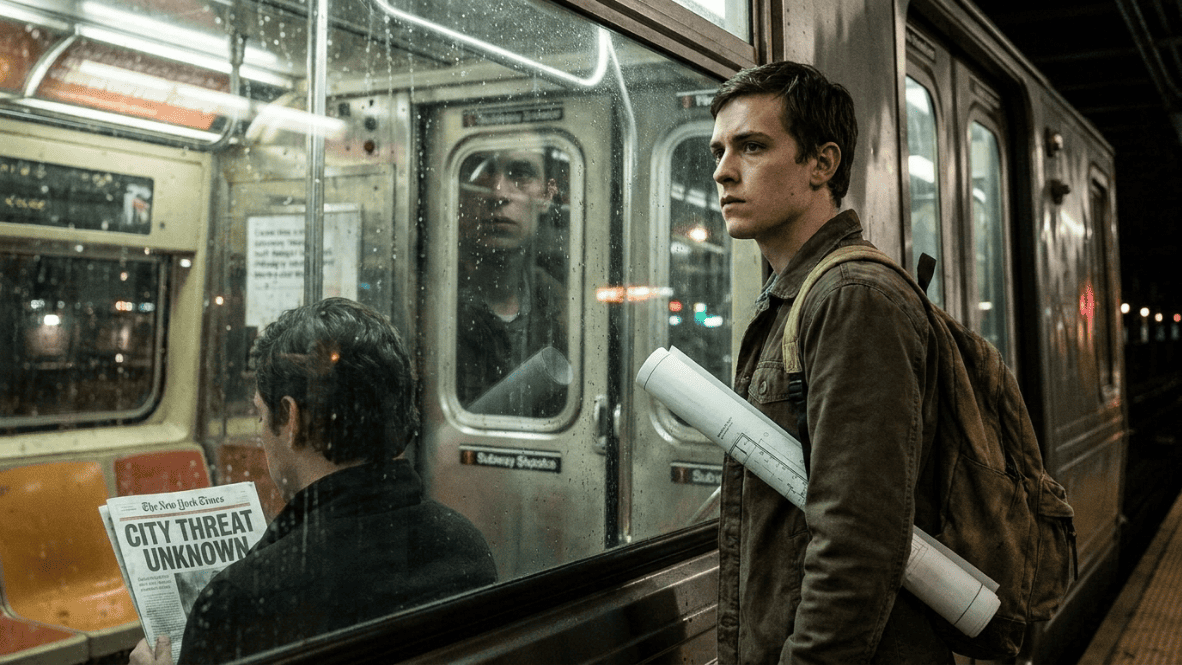
The Blue Line of the Chicago “L” train has a specific rhythm—a metallic, grinding heartbeat that matches the pulse of the city it dissects. For Elias Vance, it was the sound of a countdown.
It was 11:15 PM, and the air in the subway car was thick with the scent of wet wool, ozone, and the quiet, desperate exhaustion of a Wednesday night. Elias sat in the corner seat, his fingers white-knuckled as he gripped the straps of his North Face backpack. Inside wasn’t a laptop or a textbook. It was a 1:50 scale architectural model of a community center—a “Blueprints for Hope” project that represented his final ticket out of the South Side.
Elias was a shadow in a city of neon. At twenty-two, he was an engineering student at IIT, a man who moved through the world with the invisibility of a ghost. He wore a faded varsity jacket from a high school that had since been shut down, and he kept his eyes on the floor. He had learned early that in Chicago, eye contact was a currency he couldn’t afford to spend.
He was thinking about his sister, Maya. Maya was ten years younger and possessed a heart that was too big for her zip code. She was currently sleeping in their cramped apartment, waiting for him to bring home the “A” that would prove their struggle meant something. Elias sent her 80% of his work-study check every month. He lived on black coffee and the memory of their mother’s voice.
“Look at him,” a voice boomed, cutting through the low hum of the train’s motor. “The local hero, still dreaming about a future that doesn’t want him.”
Elias didn’t look up. He didn’t have to. Bryce Sterling’s voice was like a jagged piece of glass—grating, loud, and full of the unearned confidence that comes from being the son of the city’s third-wealthiest developer. Bryce was twenty, wore a hoodie that cost more than Elias’s tuition, and possessed a boredom that usually manifested as cruelty.
Bryce stepped into Elias’s personal space, flanked by two boys, Jace and Leo, who looked like they’d never seen a day of real work. They were “clout-chasers,” the kind of kids who treated the subway like their personal playground for social media.
“I’m talking to you, scholar,” Bryce said, leaning over Elias. He reached out and snatched the backpack from Elias’s shoulder. “What’s in the bag? Drugs? Or just more of that ‘bootstrap’ propaganda your kind loves so much?”
“Give it back, Bryce,” Elias said softly. His voice was a low rasp, the sound of a man who hadn’t used it much lately.
“Make me,” Bryce laughed, looking back at Jace, who was already holding up a phone, the red “Record” light blinking like a sinister eye. “I don’t like your look, Vance. You look like you think you’re better than us. You look like you think you’re going somewhere.”
The train began to slow as it approached the Clinton station. The doors were about to open.
Bryce reached into his pocket and pulled out a small, flick-blade knife. The steel glinted under the flickering fluorescent lights. “Let’s see what happens to the blueprint when the architect is gone.”
Elias Thorne felt the familiar prickle at the base of his neck—the “danger dial” he had kept locked behind a cage of discipline for a decade. He thought of Maya. He thought of the gym where a man named Pops had taught him how to move like water and hit like a stone.
“Last chance, Bryce,” Elias whispered.
CHAPTER 2: THE GHOST OF THE MIDWAY
To understand Elias Vance, you had to understand the “The Midway” gym. It was a windowless basement on 63rd Street where the air was 90% sweat and 10% desperation. It was the place where Elias had spent every afternoon from age twelve to eighteen, not because he wanted to fight, but because he had to survive.
His mentor was a man named “Pops” Henderson, a retired Buffalo Soldier who believed that a man’s hands were the last resort of a failed mind, but when they were used, they had to be final. Pops hadn’t taught Elias how to “box.” He had taught him how to dismantle.
“You’re a small kid, Elias,” Pops would say, his voice sounding like gravel in a blender. “But a small kid who knows where the hinges are can bring down a skyscraper. Don’t be the river that hits the rock. Be the river that goes around it, then crushes it from behind.”
Elias was a prodigy of the “unyielding river.” He had a nervous system that was rewired for tactical assessment. When he walked into a room, he didn’t see people; he saw pressure points, exits, and improvised weapons. He saw the world in high-definition blueprints of violence.
But he had promised Pops he would never be the aggressor. “A man who uses his hands to hurt is a man who’s lost his heart,” Pops had told him on the day he graduated high school.
So Elias buried the warrior. He took the engineering scholarship. He became the quiet guy who cleaned up the spills at the campus lab. He became the “NPC” in everyone else’s story.
His pain was a quiet, constant ache—the feeling of being a weapon that was rusting in a closet. He missed the clarity of the ring, but he feared the darkness it brought out in him. He had once broken a bully’s arm in tenth grade, and the look of pure, primal terror on that boy’s face had haunted Elias more than any punch he’d ever taken.
His weakness was Maya. She was his heart, but she was also his vulnerability. Every decision he made was a calculation to ensure she never had to see the “Shadow Elias.”
But as Bryce Sterling flicked that blade, the calculation changed. The risk of losing the architectural model—his ticket to a job that would pay for Maya’s heart surgery—outweighed the risk of breaking his promise.
The train hissed, the brakes screaming as it pulled into the station. The doors began to slide open.
“Say hi to the internet, Vance,” Bryce sneered, stepping forward to slash the straps of the bag.
Elias didn’t blink. He didn’t shout. He just breathed. In that breath, the “Student” vanished. The “Shadow” took the wheel.
FULL STORY
CHAPTER 3: THE WHIRLWIND AT CLINTON STATION
The transition was instantaneous.
One second, Elias was a slumped-over student; the next, he was a blur of lethal, calculated motion.
As Bryce’s hand came forward with the knife, Elias didn’t pull back. He stepped into the strike. It was a move called “Entering the Storm.” His left hand shot up, his palm striking Bryce’s wrist at a 45-degree angle, sending the knife flying toward the train’s ceiling.
Before Bryce could even register the pain, Elias’s right hand found the back of Bryce’s neck. With a surgical twist of his hips, Elias used Bryce’s own unearned momentum. He didn’t punch; he guided.
Jace and Leo, fueled by a cocktail of adrenaline and stupidity, lunged forward. Jace tried to tackle Elias, but Elias simply pivoted on his lead foot—the “Midway Shuffle.” Jace flew past him, his face connecting with the metal pole of the subway car.
Leo, the cameraman, dropped the phone. He swung a wild, telegraphed haymaker. Elias ducked, his shoulder driving into Leo’s solar plexus. The air left Leo’s lungs in a sickening whoosh.
The entire confrontation lasted four seconds.
The train doors were halfway open. Bryce, Jace, and Leo were stumbling, their “alpha” personas shattered into visible panic. They were no longer the kings of the Blue Line; they were three boys who had just realized they were trapped in a cage with a predator.
Elias didn’t stop. He moved with the “controlled violence” Pops had feared. He grabbed Bryce and Jace by their designer collars and, with a terrifying display of core strength, launched them toward the opening doors. Leo followed, shoved by the sheer force of Elias’s presence.
They crashed onto the platform, rolling over the dirty yellow tactile tiles.
The doors hissed shut.
The train began to move.
Elias stood in the center of the car, his chest barely heaving. He reached down and picked up his backpack. He checked the architectural model. A single corner of the balsa wood was chipped, but the “blueprint” was intact.
He looked at the commuters. A middle-aged woman in a nurse’s uniform was staring at him, her hand over her mouth. A businessman had his phone out, but he was frozen, too afraid to hit record.
“I just wanted to get home,” Elias said, his voice a low, hollow vibration.
He sat back down in his corner seat. He looked at his hands—the “Shadow” hands—and saw that they were perfectly steady. That was the scariest part. He wasn’t shaking. He wasn’t scared. He was perfectly, terrifyingly calm.
As the train descended back into the tunnel, the station lights vanished, leaving Elias in the dark. He realized then that the invisibility was gone. He had let the city see the ghost. And the city never forgot a ghost.
FULL STORY
CHAPTER 4: THE VIRAL GHOST
By 8:00 AM the next morning, Elias Vance was the most famous man in Chicago.
Jace’s phone had survived the fall. The video, titled “Subway Janitor Assaults Rich Kids,” had been uploaded by a “witness” and viewed four million times. The narrative was already being written by people who had never stepped foot on the South Side.
“This is a dangerous threat to our city’s youth,” Bryce’s father, Sterling Sr., told a news crew outside his Gold Coast mansion. “My son is in the hospital with a concussion. This ‘student’—if that’s even what he is—used professional combat techniques. We want him in a cell.”
Elias sat in the campus library, staring at the screen of a public computer. His heart felt like a stone. He had a notification from the IIT administration: Immediate Suspension Pending Investigation.
He walked out of the library, the weight of the backpack feeling like a lead suit. People were staring. He saw a group of students whispering, their eyes darting to his varsity jacket.
“Elias?”
It was Sarah. She was a third-year law student who worked in the campus legal aid clinic. She was thirty, with sharp eyes and a weary smile. She had seen the video, but she had also seen the way Elias helped the janitors stack chairs after hours.
“I saw it, Elias,” she said, catching up to him. “The whole video. Not the edited one Sterling is pushing. I saw the knife, Elias. I saw Bryce reach for your bag.”
“It doesn’t matter, Sarah,” Elias said, his voice sounding like it was coming from the bottom of a well. “Sterling owns the news. He owns the board of this school. I’m just a guy who sent his son through a train door.”
“You’re a guy who defended a blueprint for a community center,” Sarah snapped. “I’m a law student, Elias. And I’m a witness. I was on that train. I was the nurse’s sister sitting three seats away.”
Elias stopped. He looked at her. “Why help me? You saw what I did. You saw the ‘whirlwind.'”
“I saw a man who was pushed until he had no choice but to be a weapon,” Sarah said softly. “My pain is watching people like Sterling win because they have the loudest microphone. My motivation is making sure you get to finish that model.”
But the threat was deeper than a suspension. Bryce’s friends weren’t just “punks.” They were part of a legacy that didn’t take “no” for an answer.
When Elias returned to his apartment that afternoon, the door was ajar.
His heart stopped. “Maya?”
He rushed inside. The apartment was trashed. His textbooks were torn. But in the center of the room, on the small kitchen table, sat the architectural model. It was crushed into a thousand pieces of balsa wood and glue.
And Maya was gone.