The tie was too tight. It felt like a noose, but I pulled it straight anyway.
I hadn’t worn my dress blues in three years—not since the day the IED took my peripheral vision in my left eye and the strength in my right leg. Tonight was supposed to be different. It was the “Valor and Victory” Charity Gala, a night meant to raise funds for the boys coming home with holes in their souls.
“You look stiff, Silas,” Elena said, not looking at me as she adjusted her emerald earrings in the vanity mirror. “Try to smile. People want to see a hero, not a statue.”
Elena was the kind of woman who thrived in rooms like this. She moved through the high-society circles of our Virginia suburb like she’d been born to it. I was just the rugged accessory that gave her social standing—the “War Hero’s Wife.”
But when we arrived at the ballroom, the air felt thin.
I went to the bar to grab two waters. When I turned back, I didn’t see my wife talking to donors. I saw her in the shadows of the velvet curtains, her arms wrapped around Julian Vane.
Julian was the golden boy of the county. Rich, handsome, and famous for “finding a medical deferment” three weeks before our unit deployed ten years ago. While I was eating sand in a foxhole, he was building a real estate empire on his father’s dime.
I watched him lean in and kiss her. It wasn’t a quick peck. It was the kiss of two people who had been sharing a bed for a long time.
My heart didn’t race. It went cold. That’s the thing they don’t tell you about trauma—sometimes, when the worst thing happens, your body just thinks it’s back in the war. You stop feeling, and you start calculating.
I didn’t cause a scene. Not then. I waited until the “Hero’s Tribute” began.
Elena and Julian walked onto the stage together, looking like the king and queen of the ball. Then, Elena leaned into the microphone.
“Before we start the auction,” she said, her voice smooth as silk, “I’d like to invite my husband, Silas, to the stage. He’s been struggling lately… and I think it’s time we all acknowledge the reality of what happens when a soldier outlives his usefulness.”
The room went silent. I walked up the stairs, my limp more pronounced than usual under the harsh spotlights.
Julian stepped forward, a smirk playing on his lips. He leaned into the mic and looked me dead in the eye. “Tell them, Silas. Tell them how it feels to have your wife taken care of by a man who actually knows how to win.”
The spotlight was blinding. It felt like the heat of a desert sun, the kind that bakes the sanity out of you until you start seeing things that aren’t there. But this was real. The smell of expensive perfume and aged scotch was real. The sound of a hundred socialites holding their breath was real.
Julian Vane stood there, his hand casually tucked into the pocket of a tuxedo that cost more than my first year’s salary. He leaned into the microphone again, his voice amplified, booming through the ballroom speakers.
“You see, folks,” Julian said, his eyes scanning the crowd for a laugh, “Silas here is a symbol. A symbol of what happens when you prioritize grit over gold. He’s got the medals, sure. But I’ve got the woman, the house, and the future. Elena and I have been waiting for the right moment to tell him… but a gala for ‘Valor’ seemed like the perfect stage for a little honesty.”
Elena didn’t look away. She stood by his side, her chin tilted up. This wasn’t just an affair; it was an execution. She had spent months playing the grieving wife, the supportive pillar, all while siphoning our joint savings into Julian’s new development project. I knew that now. The realization hit me with the force of a kinetic blast.
“Silas,” she said, her voice amplified now as she took the mic from Julian. “You haven’t been a husband in years. You’ve been a project. A ghost haunting our home. I’m tired of waiting for the man I married to come back from the dead. Julian is alive. He’s here. And he’s the one who’s going to take care of me now.”
She reached out and flicked the Purple Heart pinned to my chest. “You can keep the scrap metal. We’ll take the life you can’t provide anymore.”
A few people in the back laughed. It was a sharp, ugly sound—the sound of people who felt safe enough to mock a man who had sacrificed his peace so they could have theirs.
I didn’t speak. I couldn’t. My throat felt like it was filled with dry sand. I looked down at my hands—calloused, scarred, and trembling. I looked like a broken man. That was the image they wanted. The “Pathetic Veteran.”
“Well?” Julian prodded, stepping closer until I could smell the expensive mint on his breath. “Nothing to say? No ‘Oorah’? No battle cry? Just a broken toy.”
He reached for the microphone, ready to deliver the final blow, when the heavy double doors at the rear of the hall didn’t just open—they were thrown back with such force they hit the marble walls like a mortar strike.
The silence that followed was absolute.
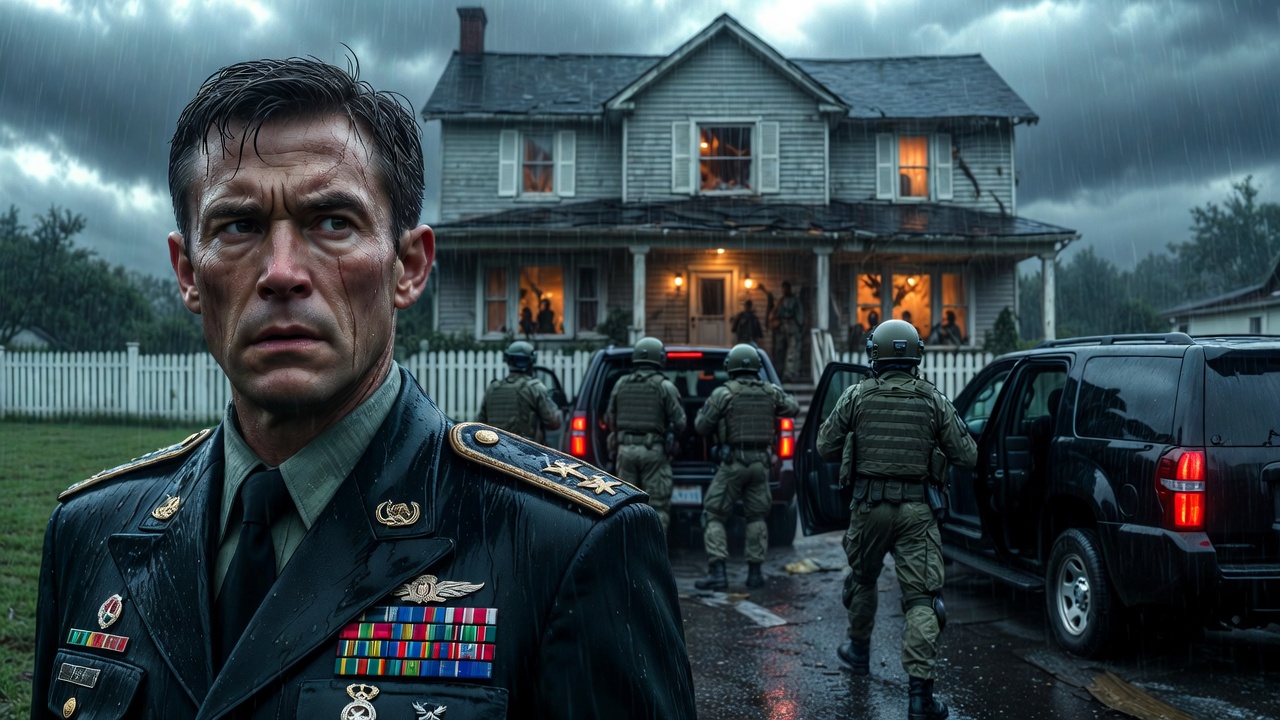
Walking down the center aisle was a man whose face was etched into the history books of this country. General Marcus Sterling. Four stars on his shoulders, a chest full of ribbons that spanned three decades of conflict, and a stare that could freeze boiling water.
He wasn’t alone.
Behind him marched six men in crisp, black tactical dress. The “Iron Brotherhood.” My old unit. The men I’d pulled out of the fire, and the men who had pulled me out. They moved with a synchronized, rhythmic thud of polished leather on marble.
Julian’s smirk didn’t just fade; it evaporated. He took a half-step back, his hand falling away from the microphone stand.
The General didn’t stop until he reached the edge of the stage. He didn’t look at the crowd. He didn’t look at the cameras. He looked at me.
“Colonel Thorne,” the General’s voice wasn’t amplified, yet it filled every corner of that room. “You are out of uniform.”
I stood a little straighter. “Sir?”
The General stepped onto the stage. He ignored Elena as if she were a piece of discarded furniture. He walked straight to Julian, who was now visibly shaking.
The General reached out and plucked the microphone from Julian’s hand. He didn’t use force, but the sheer weight of his presence made Julian let go as if the metal had turned white-hot.
“I’ve spent forty years leading men into the dark,” General Sterling said into the mic, his eyes fixed on Julian. “And in all that time, I’ve learned to spot two things instantly: a leader, and a scavenger.”
He turned to the audience.
“You all came here tonight to donate to ‘Valor,'” the General barked. “But you’ve spent the last ten minutes watching a draft-dodging coward insult the finest officer I’ve ever had the honor of commanding.”
He turned back to me. “Silas, your ‘Final Escort’ has arrived. And we aren’t here for a charity auction. We’re here to take home what belongs to the Brotherhood.”
FULL STORY
The ballroom had transformed. The glitz and glamour now felt like a cheap coat of paint peeling off a rotten wall. Under the General’s gaze, the “distinguished guests” looked like children caught misbehaving.
“General Sterling,” Elena stammered, her voice losing its polished edge. “You don’t understand the situation. Silas has been… unwell. We were just trying to—”
“Quiet, Ma’am,” Sterling said. He didn’t raise his voice, but the two words cut through her sentence like a bayonet. “I understand the situation perfectly. I understand that while this man was bleeding in a ditch in the Zhari district, you were looking for a way to upgrade your lifestyle. I understand that while he was learning to walk again, you were learning how to hide his money.”
The Iron Brotherhood moved. Two of them, Miller and Jax, stepped up onto the stage. They didn’t look like guests. They looked like the inevitability of justice.
Miller, a man with a beard like wire and eyes like flint, walked over to Julian. Julian tried to puff out his chest, but against Miller, he looked like a paper bag in a hurricane.
“I remember you, Vane,” Miller said, his voice low and dangerous. “I remember your name on the deferment list. ‘Asthma,’ wasn’t it? Funny how that asthma didn’t stop you from winning that amateur tennis circuit while we were breathing in burnt oil and cordite.”
Julian’s mouth opened and closed, but no sound came out.
“The General mentioned a ‘Final Escort,'” I said, finally finding my voice. It was raspy, but it was mine. I looked at Elena. “Is that what this is, Sir? Am I being retired?”
“Not retired, Silas,” Sterling said, turning to me. “Reinstated. Not to the field—your body has done enough. But the Pentagon needs a new Director for Veteran Reintegration. Someone who knows what the ‘reality’ looks like. Someone who can’t be bought by people like… these.”
He gestured vaguely at the room.
“But before we leave,” the General continued, “there’s the matter of the restitution.”
Jax, the unit’s tech specialist, stepped forward holding a ruggedized tablet. He tapped the screen and the massive projector behind the stage—which had been showing a slideshow of “Heroic Images”—suddenly flickered and changed.
It wasn’t a hero shot. It was a bank ledger.
“This is the Thorne Family Trust,” Jax announced to the room. “Or it was, until forty-eight hours ago. It shows forty-two separate transfers to ‘Vane Acquisitions.’ Totaling six hundred and forty thousand dollars.”
The crowd gasped. The scandal was no longer a juicy piece of gossip; it was a documented crime.
“That’s private information!” Julian yelled, his voice cracking. “You can’t show that! I’ll sue! I’ll have your commissions!”
“Sue away, son,” Sterling said with a grim smile. “But those transfers were flagged by the Treasury Department as part of a larger investigation into your father’s shell companies. We didn’t ‘hack’ you. We just intercepted the evidence before you could delete it.”
Elena looked at the screen, her face turning a sickly shade of grey. Her emerald dress suddenly looked like a costume from a play that had just been cancelled.
“Silas,” she whispered, stepping toward me, her hands outstretched. “I was doing it for us. I was investing it. I wanted us to have a real future when you finally got your head straight.”
“My head is perfectly straight, Elena,” I said. I reached up and unpinned the Purple Heart myself. I looked at the medal—the weight of it, the cost of it.
I turned to Julian. “You wanted this? You said it was ‘scrap metal’?”
I stepped forward. Julian flinched, expecting a blow. I didn’t hit him. I simply grabbed his hand and pressed the medal into his palm, closing his fingers over it with enough force to make him wince.
“Keep it,” I said. “It’s the only piece of honor you’ll ever have. But remember this: every time you look at it, you’ll remember the night you lost everything to a man you thought was broken.”
I turned to the General. “I’m ready, Sir.”
“Good,” Sterling said. He looked at the Iron Brotherhood. “Escort the Colonel to the transport. And someone call the MPs. I believe Mr. Vane has some questions to answer regarding federal wire fraud.”
As we walked off the stage, the crowd parted like the Red Sea. No one laughed. No one whispered. They stood in a silence so thick it was heavy.
Behind us, I heard Elena start to cry. It wasn’t the sound of a broken heart. It was the sound of a woman realizing the spotlight had finally gone dark.
FULL STORY
The night air outside the hotel was crisp, a sharp contrast to the suffocating heat of the ballroom. A line of black SUVs waited at the curb, their engines idling with a low, rhythmic thrum.
“You okay, Silas?” Miller asked, falling in step beside me. He didn’t use the ‘Colonel’ title now. Out here, we were just brothers.
“I feel lighter,” I said, and I meant it. “Like I just dropped a hundred-pound ruck I didn’t know I was carrying.”
General Sterling stopped by the lead vehicle. He looked at me, his expression softening for the first time all night. “You did well in there, Thorne. Most men would have broken that civilian in half. You showed him the difference between a soldier and a bully.”
“Thank you, Sir. For coming.”
“I didn’t come because I was asked, Silas. I came because the Brotherhood doesn’t leave its own to be torn apart by wolves in silk suits,” Sterling said. He checked his watch. “The MPs are inside now. The FBI will be at Vane’s office by morning. They’ve been building a case on his old man for years. Your wife… she picked the wrong horse to bet on.”
“She wasn’t always like that,” I said, looking at the stars.
“War changes the people who stay home, too,” Sterling replied. “Some grow stronger. Some grow greedy. We’ll get your accounts frozen and the money recovered. It’ll take time, but you won’t lose a cent of your retirement.”
He shook my hand—a firm, crushing grip—and climbed into the SUV. “I’ll see you in D.C. on Monday. Don’t be late. There’s a lot of work to do.”
As the General’s car pulled away, the rest of the unit gathered around me. Jax, Tank, Stitch, and Miller. The men who had seen me at my absolute worst—in the dirt, in the blood, and in the dark.
“So,” Tank said, a massive man with a grin that could light up a city block. “D.C. Director, huh? Does that mean we have to call you ‘Sir’ all the time now?”
“Only when I’m buying the drinks,” I joked.
“Well then, Sir,” Miller said, clapping me on the shoulder. “I believe there’s a quiet bar three blocks from here that doesn’t allow tuxedos or draft-dodgers. What do you say?”
We started walking. My limp was still there, a constant reminder of the price I’d paid, but for the first time, it didn’t feel like a weakness. It felt like a badge.
As we reached the corner, I heard the sound of camera flashes and shouting back at the hotel entrance. I didn’t look back. I didn’t need to see the handcuffs or the disgrace.
I had my brothers. I had my honor. And for the first time in ten years, I had a future that I had chosen for myself.
We walked into the night, five men who had been through hell and back, moving together as one. The “Final Escort” wasn’t taking me to a retirement home or a hospital. It was taking me back to the world.
And this time, I was ready for it.
FULL STORY
The “quiet bar” Miller had found was exactly what I needed. It was a place of dark wood, low ceilings, and the comforting smell of hops and sawdust. No crystal chandeliers. No emerald gowns. Just the honest noise of a Friday night.
We sat in a booth at the back. Five of us crammed into a space meant for four, shoulder to shoulder. It felt like the inside of an armored transport—cramped, hot, and safe.
“To Silas,” Miller said, raising a glass of dark ale. “The only man I know who can win a war and a divorce in the same fifteen minutes.”
“To Silas!” the others echoed, their glasses clinking with a satisfying thud.
The adrenaline was finally starting to fade, leaving a hollow ache in its place. I stared at the foam on my beer. “I keep thinking about the house. Everything in it. The photos. The furniture we picked out. It’s all tainted now, isn’t it?”
Stitch, the unit’s medic, leaned forward. He had a way of looking at people like he was diagnosing a wound. “Tainted? No. It’s just stuff, Silas. You think that house was your home, but your home is right here. And it’s in D.C. It’s anywhere the people who actually give a damn about you are standing.”
“He’s right,” Jax added. “Besides, we already talked about it. Next weekend, we’re taking the trucks over there. We’re packing up your gear, your books, and your dad’s old desk. Anything she bought with your money stays. Anything that’s you comes with us.”
“And if she tries to stop us?” I asked.
Tank laughed, a sound like gravel in a blender. “I’d like to see her try to stop four guys who used to breach compound walls for a living. We’ll be in and out before she can even find a lawyer’s phone number.”
The support was overwhelming. It was the kind of loyalty that most people never experience—a bond forged in the most extreme conditions imaginable. It made the betrayal of Elena and Julian feel small. Pathetic, even.
“I’m worried about the job,” I admitted. “Director of Reintegration? I’m a field officer. I don’t know how to navigate the Pentagon.”
“That’s exactly why Sterling wants you,” Miller said. “He’s tired of bureaucrats who think a ‘reintegration strategy’ is a three-page pamphlet and a handshake. He wants someone who knows that the hardest part of the war isn’t the fighting—it’s the silence when you get back.”
We spent the rest of the night talking, but not about the gala. We talked about the guys we’d lost. We talked about the jokes we used to tell in the back of the Stryker. We talked about the future.
For the first time since the blast, I wasn’t thinking about what I had lost. I was thinking about what I still had.
As we left the bar in the early hours of the morning, the city was quiet. The streetlights reflected off the damp pavement. I looked at my brothers—these men who had become my “Final Escort” out of the darkness.
“I’ll see you guys at the house next Saturday?” I asked.
“0800 hours,” Miller said, snapping a mock salute. “Don’t sleep in, Director.”
I watched them walk to their cars, their silhouettes strong and steady. I stood there for a moment, breathing in the cold air.
My phone buzzed. A text from an unknown number. I knew it was her.
Silas, they took Julian. The police are everywhere. Please, you have to help me. I have nowhere to go. I’m sorry. I’m so sorry.
I looked at the screen. I thought about the three Purple Hearts. I thought about the years of physical therapy. I thought about the man on the stage who had called me a “broken toy.”
I didn’t feel anger. I didn’t feel pity.
I hit ‘Delete.’ Then I blocked the number.
I looked up at the moon, clear and bright over the Virginia skyline. The war was over. The betrayal was settled.
I started my car and drove toward the sunrise, leaving the ghosts behind me where they belonged.
FULL STORY
Monday morning in Washington D.C. was a chaotic symphony of sirens and suits. The Pentagon loomed in the distance, a massive concrete fortress that held the weight of the world.
I stood in front of the mirrored glass of the entrance, checking my reflection. No dress blues today. Just a well-tailored charcoal suit and a clean white shirt. I looked like a civilian, but the way I carried myself—the straight spine, the watchful eyes—was all soldier.
“Director Thorne?” a young aide asked, approaching me with a tablet in hand. “General Sterling is expecting you in Briefing Room 4.”
“Lead the way,” I said.
The hallways were a maze of history and power. We passed generals, senators, and analysts. Some of them looked at my limp with curiosity; others looked with a flicker of recognition. The story of the gala had made the rounds in the military community. The “Hero Who Stood His Ground” was the new topic of conversation.
I entered the briefing room. General Sterling was there, along with a group of senior officials from the VA and the Department of Defense.
“Ah, Silas. Right on time,” Sterling said, gesturing to the empty chair at the head of the table. “Gentlemen, this is Director Silas Thorne. He’s here to tell us why our current programs are failing.”
I sat down. I looked at the faces around the table—men and women who made decisions that affected millions of lives.
“The programs are failing,” I began, my voice steady and resonant, “because they treat veterans like problems to be solved rather than assets to be utilized. We don’t need ‘handouts.’ We need a purpose. We need to know that when we come home, we aren’t being left behind in the dark.”
For the next two hours, I spoke. I didn’t use jargon or statistics. I told them about the men I knew. I told them about the night of the gala. I told them about the “Iron Brotherhood.”
When the meeting ended, the room was silent. One by one, the officials stood up and shook my hand. They weren’t just being polite; they were listening.
As the room cleared, Sterling stayed behind. “You’ve got a long road ahead of you, Silas. This building moves slow.”
“I’ve got time, Sir,” I said.
“I know you do. Oh, before I forget… I heard about the move this weekend.”
“The guys came through,” I said, a smile tugging at the corners of my mouth. “We cleared the house in four hours. Elena tried to call the police, but when they saw the paperwork and the size of Tank, they decided it was a civil matter and left.”
“And the woman herself?”
“She’s moving back to her parents’ place,” I said. “The house is on the market. The proceeds will go to the Veteran’s Reintegration Fund we discussed. It felt… right.”
Sterling nodded. “You’re a good man, Silas. A better man than most.”
I walked out of the Pentagon that afternoon and headed toward the National Mall. I found a bench overlooking the reflecting pool, with the Lincoln Memorial standing tall at the end.
I pulled a small object out of my pocket. It was the Silver Star the General had mentioned. My real one. The one I’d earned for pulling Miller and Jax out of a burning building under heavy fire.
I looked at the medal. It didn’t feel like “scrap metal” anymore. It felt like a promise.
A young man in a worn army jacket sat down on the bench next to me. He looked tired. His eyes had that distant, hollow stare that I knew all too well. He saw my suit, then his eyes drifted to the medal in my hand.
“That yours?” he asked, his voice barely a whisper.
“It is,” I said.
“I just got back,” the kid said, looking at the water. “Two weeks ago. Everything feels… loud. My wife… she’s trying, but she doesn’t get it. I feel like I’m drowning.”
I looked at him. I saw myself ten years ago. I saw the kid who thought he was alone.
I put the medal back in my pocket and turned toward him.
“I know how that feels,” I said, leaning in. “But listen to me. You aren’t drowning. You’re just learning how to swim in a different kind of water. And you aren’t doing it alone.”
I spent the next hour talking to him. I didn’t tell him it would be easy. I told him it would be worth it.
As I walked away, I felt a sense of peace that I hadn’t known since before the war. I wasn’t just a soldier anymore. I wasn’t just a victim of betrayal.
I was a bridge.
The “Final Escort” hadn’t just saved my honor; it had given me my life’s work.
I walked toward the sunset, my limp a steady rhythm on the pavement, knowing that as long as we look out for each other, no hero ever truly has to stand alone in the light.
True honor isn’t found in the medals on your chest, but in the hand you reach out to the brother still standing in the shadows.