The smell of the VA hospital stays in your skin. It’s a mix of industrial floor wax, stale coffee, and the metallic tang of medicine that never quite works. For six months, that was my world.
I’d traded my ability to walk for a piece of shrapnel in a valley near Kunar, and I thought I’d finally paid my dues. I thought coming home would be the victory lap.
I was wrong.
When the taxi pulled onto my street in Silver Oaks, I saw the moving van first. Then I saw Derek’s car—a shiny, silver German import parked in my spot. Derek was my wife’s “business consultant.” At least, that’s what she’d called him in the letters that stopped coming three months ago.
I watched from the backseat, my heart thudding against my ribs like a trapped bird.
Derek was laughing. He was holding my titanium-frame wheelchair—the one the unit had pooled their money to customize for me. He swung it like a piece of scrap metal and heaved it into the dumpster sitting at the edge of my lawn.
“Finally,” I heard Megan say, her voice carrying through the open taxi window. “I hated looking at that thing. It made the house feel like a hospital.”
I felt a coldness settle over me that no desert sun could ever burn off. I didn’t have my legs, but I still had my pride.
“Sir?” the taxi driver asked, his voice shaking. “Do you want me to call the police?”
“No,” I said, reaching into my pocket for the burner phone Miller had given me before the deployment. “Call the Vanguard. Tell them the perimeter is breached.”
The taxi driver didn’t wait for me to pay. He saw the look in my eyes—a look that belonged to a man who had seen the end of the world and was currently inviting it into his driveway—and he simply set my duffel bag on the curb and sped away.
I was sitting on the hot pavement, my useless legs tucked under me. The asphalt burned through my thin hospital sweats, but I didn’t care. I was staring at the dumpster. My chair—my only way to move through the world without crawling—was buried under a pile of old drywall and stained carpet from the remodel they were doing with my combat pay.
“Caleb?” Megan’s voice was high, shrill with a panic she tried to mask with indignation. She walked to the edge of the porch, clutching a glass of white wine. “What are you doing here? The doctors said you needed another eight weeks of rehab.”
“I missed my wife,” I said, my voice sounding like gravel. “But it looks like the house was already full.”
Derek stepped out from behind her. He was tall, tan, and wore a polo shirt that probably cost more than my first truck. He looked at me on the ground and didn’t even have the decency to look ashamed. Instead, he smirked.
“Look, pal,” Derek said, stepping off the porch. “Megan’s had a hard time. While you were playing hero, she was here alone, dealing with the bills and the house. We’re moving in a different direction now. You’re a liability. You can’t even stand up for yourself, literally.”
He laughed, and Megan joined in—a nervous, brittle sound.
“The chair, Derek,” I said, pointing to the dumpster. “Get it out.”
“Or what?” Derek asked, taking a step toward me. “You going to kick me?”
He looked back at Megan, expecting another laugh, but the laughter died in the air.
A low, rhythmic thrumming began to vibrate through the ground. It wasn’t the sound of suburban traffic. It was the synchronized roar of heavy-duty, turbocharged diesel engines.
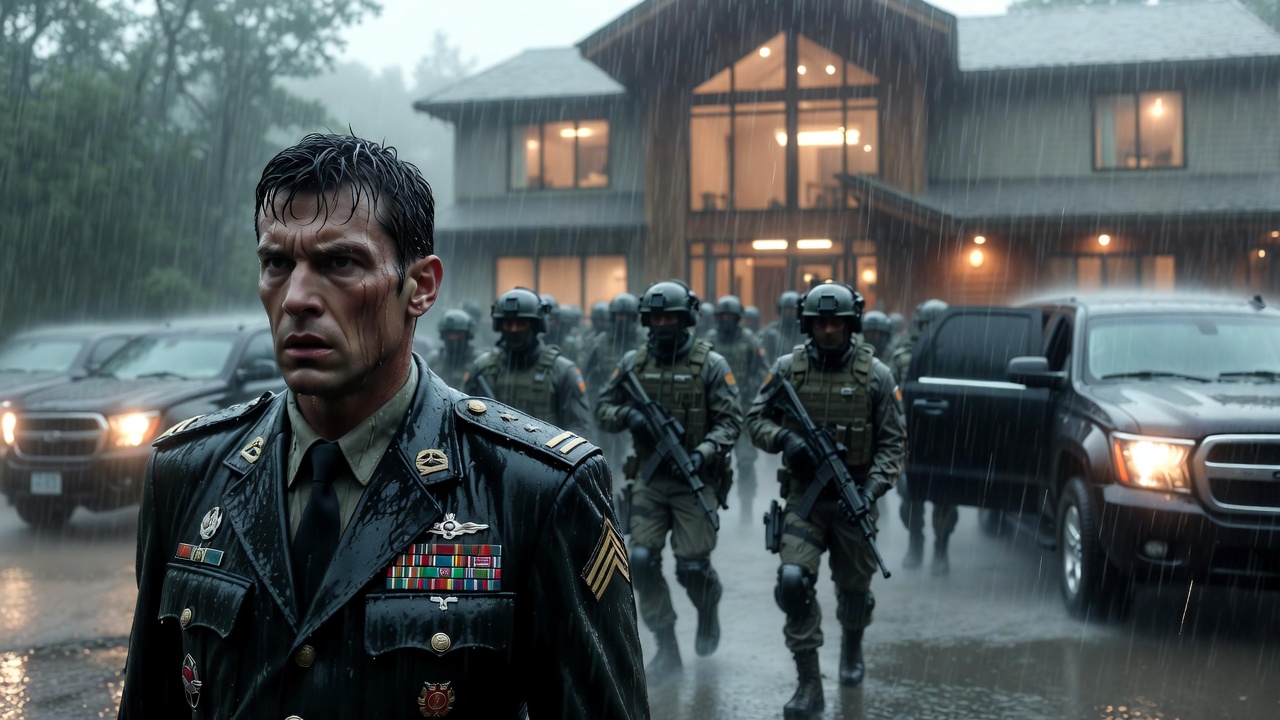
At the end of the cul-de-sac, four black armored SUVs swerved around the corner in a tight “V” formation. They didn’t slow down for the neighborhood speed bumps. They hit them with the weight of tanks, their suspension absorbing the shock as they tore toward my house.
The neighbors, who had been watching the “domestic drama” from their porches, scrambled back inside. They knew that sound. It was the sound of professional violence.
The lead truck, a modified Ram 3500 with a brush guard that could level a wall, swerved across my lawn, tearing deep ruts into the manicured grass Megan loved so much. It stopped inches from Derek’s silver sedan.
The doors flew open.
Six men in black tactical gear and baseball caps stepped out. They didn’t have their rifles, but they didn’t need them. Their hands were empty, their faces were stone, and their eyes were fixed on the man standing over me.
Miller, my old team sergeant, walked to the front. He was a man who had survived three IEDs and a gunshot to the neck, and he looked like he’d just stepped out of a nightmare.
He didn’t look at Megan. He didn’t look at Derek. He knelt in the mud next to me.
“Sorry we’re late, Boss,” Miller said, his voice a low rumble. “Traffic was light, but we had to pick up a few friends.”
He signaled to the other trucks. Another twelve men stepped out—the entire “Iron Vanguard” unit, plus a few from the 75th. Twenty elite operators stood in a semi-circle around my driveway, their presence turning my suburban street into an occupied zone.
“What is this?” Megan shrieked from the porch. “I’m calling the police! This is trespassing!”
Miller stood up slowly. He looked at the dumpster, then at Derek.
“Stitch,” Miller said, not looking back.
A wiry man with a medic’s bag stepped forward. “Yeah, Lead?”
“The Colonel’s chair is in the trash. Retrieve it. And if there’s a scratch on the frame, I want the name of the man who threw it.”
Derek’s face went from tan to a ghostly, translucent white. He tried to back up toward the porch, but Tank—a man who lived up to his name—was already standing behind him, blocking the stairs.
“I… I didn’t know,” Derek stammered. “I thought it was just… junk.”
“That ‘junk’ cost forty thousand dollars in specialized engineering,” Miller said, stepping into Derek’s personal space. “And it represents the legs my brother gave up so you could stay home and sell overpriced insurance. You’re going to get in that bin, Derek. And you’re going to hand that chair to me like it’s a religious relic.”
The neighborhood was silent, save for the heavy, idling breath of the diesel trucks. Derek was trembling so hard I could hear his teeth chattering from six feet away. He looked at Megan for help, but she had retreated into the house, peering through the sidelight of the front door like a cornered animal.
“I… I can’t get in there,” Derek whispered, looking at the towering metal dumpster. “It’s filthy.”
Tank didn’t say a word. He simply placed a massive hand on Derek’s shoulder and squeezed. The sound of Derek’s expensive polo shirt tearing was audible.
“The dumpster, Derek,” Tank rumbled. “Or I can put you in it the hard way.”
Derek scrambled over the side, his polished loafers slipping on the metal. He disappeared into the shadows of the bin. A moment later, the sound of shifting drywall and broken glass echoed out.
Stitch and Miller stood by the edge, waiting.
“Caleb, talk to me,” Stitch said, kneeling beside me again. He was checking my pulse, his eyes scanning for signs of autonomic dysreflexia or shock. “How’s the pain? You hit the ground pretty hard.”
“I’m fine, Stitch,” I said, though my hip felt like it was on fire. “Just get me in the chair.”
A moment later, Derek’s shaking hands appeared over the rim of the dumpster, holding the titanium frame of my wheelchair. He handed it off to Miller like he was passing a ticking bomb.
Miller inspected the chair with the precision of an armorer. He wiped a smudge of drywall dust off the armrest with his sleeve. “Frame’s straight. No structural damage.”
He and Stitch lifted me with a practiced, effortless strength and set me back in my seat. As soon as my hands hit the rims, I felt the world shift back onto its axis. I wasn’t a heap of meat on the asphalt anymore. I was a man.
“Now,” I said, looking at the front door of the house. “I want my keys.”
“Caleb, please!” Megan’s voice came through the screen door. She didn’t come out. “Just take the chair and go! You can’t stay here! The house is in my name!”
“Actually,” a voice called out from the back of the group.
A man in a sharp suit—Eli, our unit’s legal liaison and a former JAG officer—stepped forward, holding a leather briefcase. He opened it and pulled out a stack of notarized documents.
“Mrs. Vance,” Eli said, his voice clear and professional. “I’ve spent the last forty-eight hours reviewing the deed and the mortgage history. Seeing as the down payment was made using Mr. Vance’s combat-related injury settlement, and the mortgage has been paid exclusively through his VA disability and military pension—which you’ve been siphoning into a private account—the state of Virginia has some very specific thoughts on ‘separate property.'”
He tapped the papers. “I have an emergency injunction. This house is a primary residence for a disabled veteran. You have thirty minutes to pack a bag. And Mr…. Derek, is it? You’re not on the lease, the deed, or the guest list. You leave now. On foot.”
Derek climbed out of the dumpster, covered in white dust and smelling of old carpet. He looked at his silver sedan, which was currently boxed in by three armored trucks.
“My car…” Derek started.
Tank stepped forward and leaned his entire weight against the hood of the silver sedan. The metal groaned and buckled. “Your car is an obstruction of justice, Derek. Start walking.”
Derek didn’t argue. He turned and started jogging down the street, his expensive loafers slapping against the pavement.
Megan finally stepped out onto the porch. She wasn’t the polished, yoga-ready woman from twenty minutes ago. She looked haggard. Desperate.
“You’re doing this to me?” she sobbed, looking at the twenty men standing in her yard. “After everything I sacrificed? Waiting for you while you were halfway across the world?”
“You didn’t wait, Megan,” I said. “You were just waiting for the checks to clear.”
I signaled to Miller. “Let’s go inside. I want to see what they did to my office.”
The interior of the house felt like a stranger’s museum. The walls I had painted “Combat Sage” were now a sterile, trendy “Cloud White.” My mahogany desk was gone, replaced by a minimalist glass table that looked like it would shatter if you set a heavy book on it.
The Vanguard moved through the house with tactical efficiency. They weren’t looting; they were clearing. Within ten minutes, every piece of Derek’s clothing, his cologne, and his “business” files were piled neatly on the front sidewalk.
Megan sat on the stairs, clutching her head. She looked at me, her eyes red and puffy.
“What am I supposed to do, Caleb? I have nowhere to go.”
“You have the apartment in the city,” I said. “The one you bought with the ‘medical supplies’ money you told me I needed. I checked the bank statements, Megan. I’m paralyzed, not stupid.”
She froze. The sobbing stopped instantly. The mask was gone.
“You were always so busy being the hero,” she hissed, her voice low and venomous. “You never cared about what I wanted. I wanted a life that didn’t involve physical therapy and VA appointments. I wanted a man who could actually take me out to dance, not someone I had to wheel around like a piece of luggage.”
The room went cold. I saw Miller’s jaw tighten. I saw Tank step forward, his fists clenched, but I held up a hand.
“I gave you everything,” I said quietly. “My health. My future. Every cent I earned bleeding in the dirt. And you threw me in the trash the second the ride got bumpy.”
I looked at Stitch. “Is the guest room clear?”
“Clean as a whistle, Boss.”
“Good. Miller, you and the guys take the upstairs. We’re turning this place into a temporary housing unit for the Vanguard. We’ve got a lot of guys coming home from the 3rd Battalion who don’t have a place to land. This house is too big for one man anyway.”
Megan stood up, her face twisted in a sneer. “You’re turning my home into a barracks? The neighbors will sue you! The HOA will have you evicted in a week!”
Eli, the lawyer, stepped forward with a thin smile. “Actually, under the ‘Service Members Civil Relief Act’ and the new state-level ‘Veteran Housing Initiative,’ this property has been designated a non-profit transitional residence. The HOA has no jurisdiction over federal-backed veteran housing. But please, feel free to call them. I’d love to show them the fraud charges we’re preparing to file against you for siphoning military benefits.”
Megan looked at the documents, then at the twenty stone-cold men standing in her living room. She realized the battle was over before it had even begun.
She grabbed her designer purse and walked toward the door. She stopped in front of my chair, looking down at me one last time.
“You’ll always be broken, Caleb,” she whispered. “No matter how many ‘brothers’ you bring home.”
“Maybe,” I said. “But at least I’m not empty.”
She slammed the door behind her.
Miller walked over and handed me a cold bottle of water. He sat on the edge of the glass table, his weight making it creak ominously.
“So,” Miller said, looking around the white, sterile room. “First order of business?”
I looked at the glass table, then at the dumpster visible through the front window.
“First,” I said. “We get my mahogany desk back. And then, we paint these walls a color that doesn’t look like a hospital.”
Three months later, the house at 412 Maple Drive didn’t look like a “Cloud White” museum anymore. The walls were a deep, warm cedar. The glass table was in a thousand pieces at the local dump, replaced by the heavy, scarred mahogany desk the Vanguard had retrieved from a storage unit Megan had hidden it in.
But the biggest change wasn’t the furniture. It was the noise.
The house was alive.
There were four of us living there now—me, Miller, and two young guys from the 10th Mountain Division who were working through their own shadows. We called it “The Vanguard House.”
On Saturday mornings, the driveway wasn’t filled with silver imports. It was filled with trucks and motorcycles. The neighbors, who had once looked at me with pity, now came over to ask Tank for help with their landscaping or to ask Eli for legal advice.
I was sitting in my office—the real one—finishing a report for the VA on accessible housing. I heard a knock on the door.
It was Sarah. She was a physical therapist I’d met at the hospital, but she was also something more. She was the first person in three years who looked at me and didn’t see “luggage.”
“Working late again, Colonel?” she asked, leaning against the doorframe. She was holding two coffees.
“Just finishing up,” I said, wheeling myself around. I moved with a fluidity I hadn’t possessed six months ago. The Vanguard had spent their weekends building custom ramps and widening the hallways until the house was a tactical playground for a wheelchair.
“The guys are starting the grill,” she said, handing me a cup. “Tank bought a whole side of beef. I think he’s trying to feed the entire zip code.”
“That sounds about right.”
We sat in silence for a moment, the smell of woodsmoke and charcoal wafting in through the window. It was the smell of a life I hadn’t thought was possible when I was lying on that asphalt in my hospital sweats.
“I heard about Megan,” Sarah said softly.
“Oh?”
“Eli said the settlement went through. She had to sell the apartment to pay back the diverted funds. She’s working in retail in the city now. Derek… well, Derek’s firm fired him for ‘unethical conduct’ once the fraud investigation went public.”
I took a sip of the coffee. I thought about the rage I used to feel—the burning, suffocating desire for revenge.
It was gone.
“I hope they find what they’re looking for,” I said. “But I’m glad they aren’t looking for it here.”
I looked at the photo on my desk. It was a picture of the Iron Vanguard standing in my driveway the day I came home. Twenty men with clenched fists and stone-cold faces, standing guard over a brother who thought he was alone.
“Caleb?” Sarah asked. “What are you thinking about?”
“I’m thinking about the trash,” I said.
“The trash?”
“Yeah. Derek was right about one thing. He said ‘out with the old.’ I just don’t think he realized he was the one being thrown out.”
She laughed, and for the first time in a decade, the sound didn’t feel brittle. It felt like home.
“Come on,” she said. “The steak’s getting cold.”
The sun was beginning to set over Silver Oaks, painting the sky in bruises of purple and gold. I wheeled myself out onto the back deck, which the guys had extended into a massive wrap-around porch.
The Vanguard was all there. Miller was arguing with Tank over the proper way to sear a steak. Stitch was showing Caleb—the younger Caleb from the 10th Mountain—how to clean a service dog’s paws. Eli was on his phone, likely terrorizing another bank on behalf of a vet.
It was a beautiful, chaotic, messy family.
I looked down at my hands on the rims of my chair. These hands had held rifles, they had held the dirt of a dozen countries, and they had held the weight of my own broken body. But tonight, they were holding a glass of cold lemonade and the promise of a quiet night.
Miller walked over and leaned against the railing next to me. He looked out at the quiet suburb, his eyes never quite losing that tactical scan.
“You did good, Boss,” Miller said quietly. “This place… it’s saved more than just you.”
“We did it together, Miller. I just provided the roof.”
“Nah,” Miller shook his head. “You provided the reason. A lot of these guys were drifting. They didn’t have a mission. You gave them a perimeter to guard. That’s more important than a roof.”
He clinked his glass against mine. “To the Vanguard.”
“To the Vanguard,” I echoed.
As the night deepened, the neighbors started to drift over. The old man from two houses down brought over a bowl of potato salad. The young couple from across the street brought their toddler, who immediately decided that Tank was a giant climbing gym.
I watched it all from my chair.
I wasn’t the “paralyzed veteran” anymore. I wasn’t the “liability” Megan had seen. I was the center of a community. I was a man who had been thrown away, only to be caught by the strongest hands in the world.
Later that night, after the guests had gone and the house was quiet, I sat in the living room by the fireplace. The light flickered against the mahogany desk, highlighting the deep grains of the wood.
I realized then that Megan was right about one thing. I would always be broken. My legs would never feel the earth again. The shadows of Kunar would always linger in the corners of my mind.
But being broken doesn’t mean being useless. A shattered mirror still reflects the light. A cracked foundation can still support a home if you fill the gaps with the right people.
I reached down and locked the brakes on my chair. I didn’t feel like luggage. I didn’t feel like a ghost.
I looked at the front door—the same door Megan had slammed, the same door Derek had tried to lock me out of.
I wasn’t waiting for someone to come home anymore.
I was already there.
True strength isn’t about standing on your own two feet; it’s about having the brothers who will stand for you until you find your own way to lead.