The snow in Minnesota doesn’t just fall; it bites. It felt like thousands of tiny needles pressing into my skin as I stood on my own porch, peering through the frosted glass of the bay window. I had been gone for three years. Three years of sand, heat, and the constant humming of adrenaline. I just wanted to taste home.
But home was eating my dinner without me.
Through the glass, I saw Sarah. She looked radiant in the blue silk dress I’d sent her from overseas. But she wasn’t alone. A man I didn’t recognize—soft-handed, wearing a bathrobe that looked suspiciously like mine—was sitting in my chair. My homecoming steak, the one Sarah promised in every letter, was steaming on the table.
When I knocked, my hands were so numb I could barely feel the wood. Sarah didn’t run to the door with tears of joy. She walked slowly, her face twisting into a mask of cold annoyance. She opened the door just a crack, letting the heat escape.
“You’re early, Elias,” she said. No hug. No “I missed you.” Just ice.
The man in the bathrobe walked up behind her, holding a wine glass. He looked me up and down, then reached for the plate on the table. With a slow, deliberate motion, he tilted the plate. My homecoming meal hit the hardwood floor with a wet thud, splattering grease onto my combat boots.
“You’re the help, right?” the man sneered, his voice dripping with unearned ego. “Clean that up. Then maybe we’ll let you sleep in the garage.”
Sarah didn’t protest. She just smiled that cruel, sharp smile I realized I never truly knew. “Go on, Elias. You’re good at following orders, aren’t you?”
I looked at the mess on the floor, then at the woman I’d spent a thousand nights dreaming about. The cold inside my chest was suddenly much worse than the blizzard outside.
Chapter 1: The Ghost at the Window
The silence of a suburban winter is louder than a mortar blast when your heart is the thing exploding. I stood there, my duffel bag dropped in the slush, feeling like a stranger in my own life. This was the house I’d paid for with hazard pay and re-enlistment bonuses. These were the rosebushes I’d planted before my first tour, now buried under a foot of indifferent white powder.
“Elias, don’t make a scene,” Sarah whispered, her voice barely audible over the whistling wind. “Marcus and I were having a private evening. You should have called from the airport.”
“Called?” I rasped. My throat felt like it was lined with sandpaper. “I wanted to surprise you, Sarah. I’ve been traveling for forty-eight hours. I haven’t slept in three days.”
“Well, consider me surprised,” she said, leaning against the doorframe. She didn’t move to let me in. The warmth from the foyer hit my face, smelling of the expensive vanilla candles she loved—the ones I bought her.
Marcus, the man in my robe, stepped forward. He was younger than me, with styled hair and a gym-sculpted physique that had never carried a sixty-pound ruck. He looked at my worn uniform, my scuffed boots, and the dirt under my fingernails with visible disgust.
“The lady said it’s a private night, pal,” Marcus said, stepping closer to the mess of steak and potatoes he’d just dumped at my feet. “Now, be a good little soldier. Clean up the floor so my girl doesn’t slip, and then find a motel. I hear the Motel 6 has a veteran’s discount.”
He laughed—a high, nasal sound that made my blood run cold. Sarah joined in, a delicate chime of betrayal.
I looked down at the food. I thought about the MREs I’d eaten in the dirt. I thought about the nights I’d spent staring at Sarah’s picture by the red light of a headlamp, telling myself that every second of hell was worth it because she was waiting at the end of the tunnel.
The tunnel wasn’t empty. It was occupied.
I didn’t move. I couldn’t. I was hovering on the edge of a breakdown, my hands shaking not from the cold, but from the sheer, crushing weight of reality. I had fought for a country that didn’t know I existed, for a woman who wished I didn’t.
“I’m not cleaning that up,” I said, my voice finally finding its steel.
Marcus’s face darkened. He took a step onto the porch, pointing a finger at my chest. “Listen here, you pathetic—”
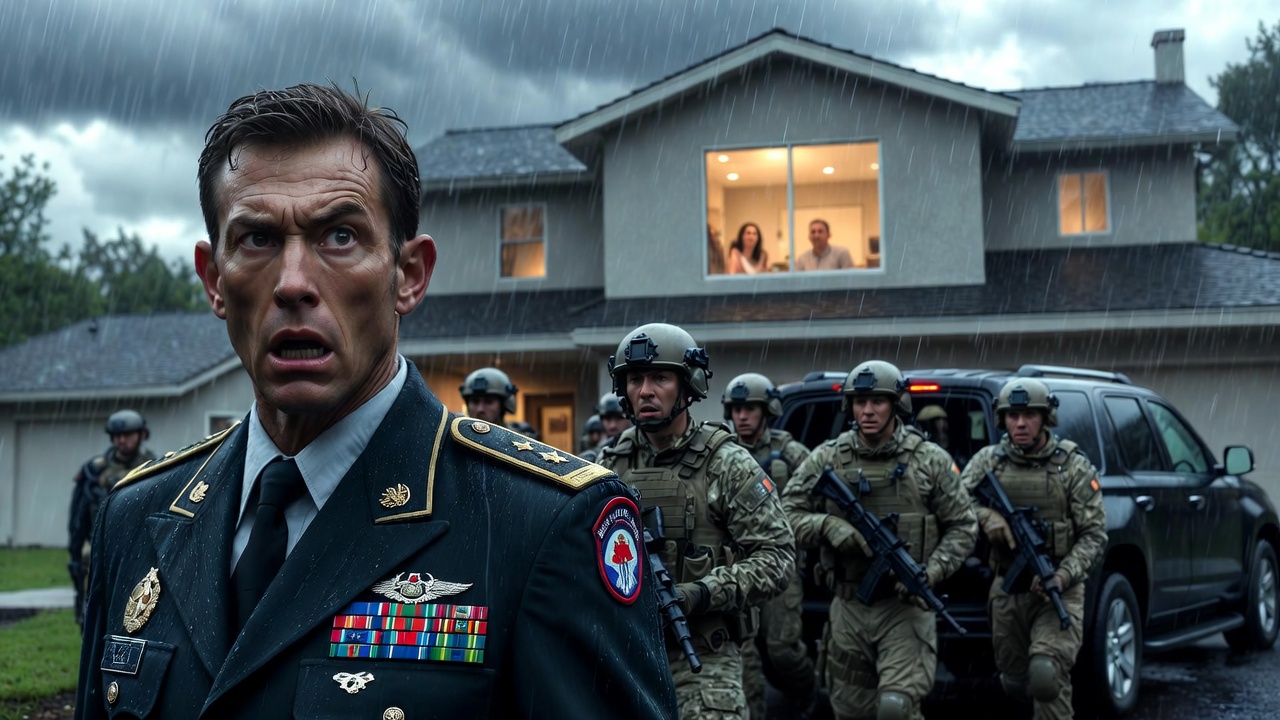
He never finished the sentence. A set of high beams, bright as a supernova, cut through the falling snow, illuminating the porch in a harsh, blinding white. The roar of a heavy diesel engine drowned out the wind. Then another. And another.
A black heavy-duty truck skidded to a halt at the curb, followed by two more. A man stepped out of the lead vehicle. He was built like a mountain, his face a map of old scars and new determination.
It was Sergeant Major Silas Miller. My CO. The man who had pulled me out of a burning Humvee in Fallujah.
“Thorne!” Miller’s voice boomed across the yard, vibrating in my very bones. “Why are you standing in the cold like a stray dog? I thought we were here for a celebration.”
Chapter 2: The Repossession
Miller didn’t wait for an answer. He marched up the walkway, his boots crunching the ice with the rhythmic finality of a firing squad. Behind him, three other men stepped out of the trucks. Jackson, our lead medic; Ox, a man who could lift a transmission by himself; and Cooper, the best marksman I’d ever known.
They weren’t in uniform, but they moved with the unmistakable synchronization of a unit. They saw me shivering, saw the food on the floor, and saw the man in the bathrobe.
“Who the hell are you people?” Marcus barked, trying to maintain his bravado. “This is private property! I’m calling the police!”
Miller stepped onto the porch, his presence so massive that Marcus actually recoiled. Miller didn’t look at Marcus. He looked at the steak on the floor, then at Sarah.
“Ma’am,” Miller said, his voice dropping to a low, dangerous rumble. “I believe you’re mistaken about whose property this is. My Sergeant here has been sending ninety percent of his pay home to a joint account for three years. An account you emptied last month to buy… what was it, Jackson?”
Jackson looked at a clipboard, his face a mask of professional coldness. “A 2026 BMW and a membership to a high-end country club, Sarge.”
Sarah’s face went from pale to ghostly. “That’s… that’s not your business.”
“Actually, it is,” Miller said. He reached into his parka and pulled out a manila envelope. “You see, Elias’s sister is a paralegal. While Elias was busy dodging snipers, she was busy tracking your ‘private evenings.’ We have the deed to this house, Sarah. It’s in Elias’s name. Only his name. And the power of attorney he gave you? Revoked as of 0800 hours this morning.”
Marcus tried to slam the door, but Ox’s hand shot out like a piston, catching the edge of the wood. The door didn’t just stop; it creaked under the pressure.
“We’re not here for a fight, son,” Ox said, smiling at Marcus with too many teeth. “We’re just here for a move. And since you’re so fond of having people clean up after you, I think it’s time you practiced what you preach.”
Miller drapes a heavy, fur-lined military parka over my shoulders. The warmth was instantaneous, but the feeling of being seen was what saved me.
“Thorne,” Miller said, his hand heavy on my shoulder. “Go sit in the truck. Jackson’s got a thermos of coffee with your name on it. We’ll handle the heavy lifting.”
“Miller, what are you doing?” I asked, dazed.
“We’re taking back what’s yours, Elias,” Miller said. “Every chair, every spoon, every memory that isn’t tainted by this woman. If you paid for it, it’s going in the trucks. And as for this ‘realtor’…”
Miller turned his gaze to Marcus, who was now trembling. “I think he’s got five minutes to get his things and get out. And Marcus? If I see you wearing that robe when you leave, I’m going to consider it a theft of government property. Do I make myself clear?”
Marcus didn’t say a word. He turned and ran into the bedroom. Sarah began to scream, a high, ugly sound that tore through the quiet neighborhood. But my brothers just started walking in, carrying empty crates and a sense of absolute purpose.
Chapter 3: The Empty Rooms
The next three hours were a masterclass in tactical relocation. While I sat in the cab of Miller’s truck, the heater blasting and Jackson forced-feeding me hot coffee and a protein bar, the house was gutted.
My squad didn’t just move furniture; they operated with a surgical coldness. They took the living room set I’d bought on my first leave. They took the TV, the dining table, and even the curtains. Every time one of them walked out with a box, they glanced at me with a nod of solidarity.
Sarah stood in the center of the living room, her silk robe fluttering as the cold wind whipped through the open front door. She was hysterical now, shouting about her rights, about the police, about how I was a monster for doing this to her in the middle of a storm.
“A monster?” Cooper said, carrying a stack of my old books past her. “The man survived three IED strikes to come home to you. You gave his dinner to a guy who sells condos. You’re lucky we’re only taking the furniture.”
Marcus emerged from the back, clutching a suitcase and wearing a cheap tracksuit. He didn’t look like a conqueror anymore. He looked like a cornered rat. He tried to scurry past Ox, but Ox stuck out a foot, tripping him. Marcus tumbled into the snow, his suitcase bursting open.
“Clean that up, pal,” Ox mimicked, his voice a perfect imitation of Marcus’s earlier sneer. “Then get off the property.”
Neighbors had begun to gather at the edge of their driveways, wrapped in heavy coats, watching the spectacle. In a normal world, this would have been a scandal. In this world, it was an execution.
Eventually, the trucks were full. The house, once a warm sanctuary of lies, was now an empty shell of drywall and echoing screams.
Miller walked out last, carrying a small, framed photo. He looked at it, then smashed the glass against the porch railing and handed me the picture inside. It was a photo of me and Sarah on our wedding day.
“You don’t need the glass, Elias,” Miller said. “Just the reminder of who you’re not allowed to be anymore.”
Sarah walked to the edge of the porch, her hair wild, her eyes red. “Where am I supposed to go, Elias? There’s nothing left! You took everything!”
I looked at her, and for the first time in years, I didn’t feel the pull of her gravity. I didn’t feel the need to protect her.
“You have Marcus,” I said, my voice sounding foreign to my own ears. “I’m sure he’s got a great apartment. Or maybe he can find you a nice motel. I hear they have a veteran’s discount… but you wouldn’t know anything about that.”
We pulled away, the tires of the heavy trucks churning the snow into a dark slush. In the rearview mirror, I saw the two of them standing in the doorway of a dark, empty house, two small figures dwarfed by the cold they had created.
Chapter 4: The Warehouse Sanctuary
We didn’t go to a hotel. We went to Miller’s “Project”—a massive, heated warehouse on the outskirts of the city where he kept his collection of vintage trucks and a woodshop.
The guys unloaded my life into a corner of the warehouse. My bed, my couch, my bookshelf. It looked pathetic and small in the vast industrial space, but it was mine.
“Tonight, you sleep here,” Miller said, tossing me a set of keys. “It’s got a bathroom, a kitchenette, and enough security cameras to see a squirrel a mile away. Jackson’s staying in the loft upstairs just in case you… well, in case you need anything.”
“I don’t know how to thank you guys,” I said, sitting on the edge of my mattress, staring at the concrete floor.
“You don’t,” Cooper said, leaning against a workbench. “You just get your head right. We lost three guys in the last rotation, Thorne. We’re not losing a fourth to a woman in a silk robe.”
But the silence that followed was the hardest part. When the trucks were gone and the guys had settled into their own corners of the world, the adrenaline crashed. I sat in the middle of that warehouse and felt the full weight of the betrayal.
I thought about the money. I had worked every overtime shift, volunteered for every dangerous patrol, just to make sure she was comfortable. I’d sent home local jewelry from markets in Kabul, silk from Dubai, and every cent of my hazard pay. She hadn’t just cheated on me; she had treated me like an ATM that bled.
A door creaked open. It was Sarah’s sister, Elena. She was the one who had tipped off Miller. She walked across the warehouse floor, her boots echoing, carrying a bag of groceries.
“I’m sorry, Elias,” she said, her voice soft. She was the opposite of Sarah—quiet, grounded, and fiercely loyal. “I tried to tell her. I told her she was going to lose everything. She didn’t care. She thought you were never coming back.”
“Why did you help me?” I asked.
Elena sat on a crate across from me. “Because I saw the letters you wrote her. She’d leave them on the counter like they were junk mail. I read them, Elias. I saw the man you were trying to be for her. A man like that shouldn’t have to freeze on his own porch.”
She stayed with me that night, not saying much, just helping me organize the wreckage. She told me about Marcus—how he’d been bragging about “his” new house and “his” new car.
“He’s a predator, Elias,” Elena said. “But Sarah was a willing victim. She wanted the life you provided, but she didn’t want the man who had to leave to provide it.”
As the sun began to peek through the high warehouse windows, I realized that the woman I loved hadn’t existed for a long time. Maybe she never did.
Chapter 5: The Reconstruction
Six months passed. The warehouse didn’t stay a storage unit for long. With Miller’s help and Elena’s business sense, we turned it into “The Vanguard Workshop.”
We started small—reclaiming old, weathered barn wood and turning it into high-end furniture. There’s something therapeutic about taking something that the world has discarded, something that has been beaten by the elements, and sanding it down until the beauty underneath shows through.
I worked until my hands bled and my back ached. It was the only way to keep the ghosts at bay. Miller, Ox, and Cooper were there every day. We became a hub for local vets—a place where you could work with your hands and talk about the things that didn’t have words.
The divorce was a bloodbath, but Elena’s documentation was airtight. Sarah tried to sue for “emotional distress,” but the judge, a retired Marine, laughed her out of the courtroom when he saw the photos of me locked out in the snow.
One afternoon, a familiar car pulled up to the warehouse. A battered, rusted sedan. Sarah stepped out. She didn’t look radiant anymore. Her hair was unkempt, and the blue silk dress had been replaced by a cheap, stained coat.
She walked into the workshop, her eyes wide as she saw the thriving business. “Elias?”
I didn’t stop sanding the table I was working on. The smell of sawdust and linseed oil was my new sanctuary. “What do you want, Sarah?”
“Marcus is gone,” she whispered, her voice trembling. “He took the car. He said he couldn’t handle the ‘drama.’ The bank took the house last week. I… I have nowhere else to go, Elias. I made a mistake. Can we just talk?”
I turned off the sander. The silence that followed was heavy. I looked at her, and I saw the woman who had watched me shiver in the snow. I saw the woman who had smiled while a stranger insulted my service.
“I’m busy, Sarah,” I said, my voice calm and flat.
“Please,” she sobbed, taking a step toward me. “I know you still love me. All those letters… you can’t just turn that off.”
“I didn’t turn it off,” I said. “You did. When you pulled those curtains shut, you didn’t just lock me out of the house. You locked yourself out of my life. I don’t love you, Sarah. I don’t even know you.”
I reached into my pocket and pulled out twenty dollars—the price of a cheap steak. I laid it on the workbench.
“Get something to eat,” I said. “And don’t come back. This is a place for people who build things. Not people who tear them down.”
She stared at the money, then at me. For the first time, she saw the man I had become—a man who didn’t need her to be whole. She turned and walked out, her footsteps disappearing into the gravel.
Chapter 6: Mile Marker Zero
A year to the day after my return, we held an open house at The Vanguard Workshop. The place was packed. Neighbors from the old suburb, local business owners, and dozens of veterans and their families were there.
The centerpiece of the showroom was a massive, eight-foot dining table made from reclaimed white oak. It was rugged, scarred, and absolutely unbreakable.
Miller stood next to me, a glass of cider in his hand. “Good work, Thorne. It looks like it could survive a mortar strike.”
“That’s the idea, Sarge,” I said.
Elena walked over, looking stunning in a simple green dress. She had become my partner in every sense of the word. She wasn’t a “North Star” I looked at from a distance; she was the person walking the path beside me.
“We just got an order for ten more tables from the new veterans’ center downtown,” she said, her eyes shining with pride.
As the sun began to set, casting long, golden shadows across the workshop, I walked to the large bay doors and looked out at the snow. It was falling again, just like that night. But this time, I wasn’t on the outside looking in.
I looked back at the room full of people—at Miller laughing with Ox, at Cooper showing a young kid how to use a lathe, and at Elena, who was watching me with a look of pure, uncomplicated care.
I realized then that the blizzard hadn’t been a tragedy. It had been a clearing. The snow had covered the lies so that the truth could finally grow.
I walked over to the new table, the one I’d built for this very moment. I picked up a carving tool and, in the corner underneath the heavy oak top, I carved three small words: Mile Marker Zero.
This wasn’t the end of the road. It was the beginning.
I looked at the men who had saved me and the woman who had helped me save myself. I wasn’t a soldier lost in the cold anymore. I was a man who had found his way home.
The greatest homecoming isn’t the one where they hang a banner; it’s the one where you realize you no longer need one.