Chapter 1: The Ghost in the M65
The city of Oakhaven had a way of swallowing people whole. For Elias Thorne, the descent hadn’t been a fall; it had been a slow, deliberate walk into the shadows. He sat on a discarded milk crate in the alley behind 4th and Main, the steam from the subway grate rising around him like the ghosts of men he’d left behind in the Hindu Kush.
He was fifty-two, but his hands looked eighty. They were mapped with scars—white lines from shrapnel, jagged ridges from knife blades, and the deep, invisible tremors of a man who had seen too much. He wore an old M65 field jacket, the olive drab faded to the color of swamp water, and a pair of boots held together by duct tape and sheer will.
His only prize was tucked into the inner breast pocket, right over his heart: a folded American flag. It wasn’t a souvenir. It was the flag that had covered his brother’s casket twenty years ago.
“Hey, pops. You’re in our seat.”
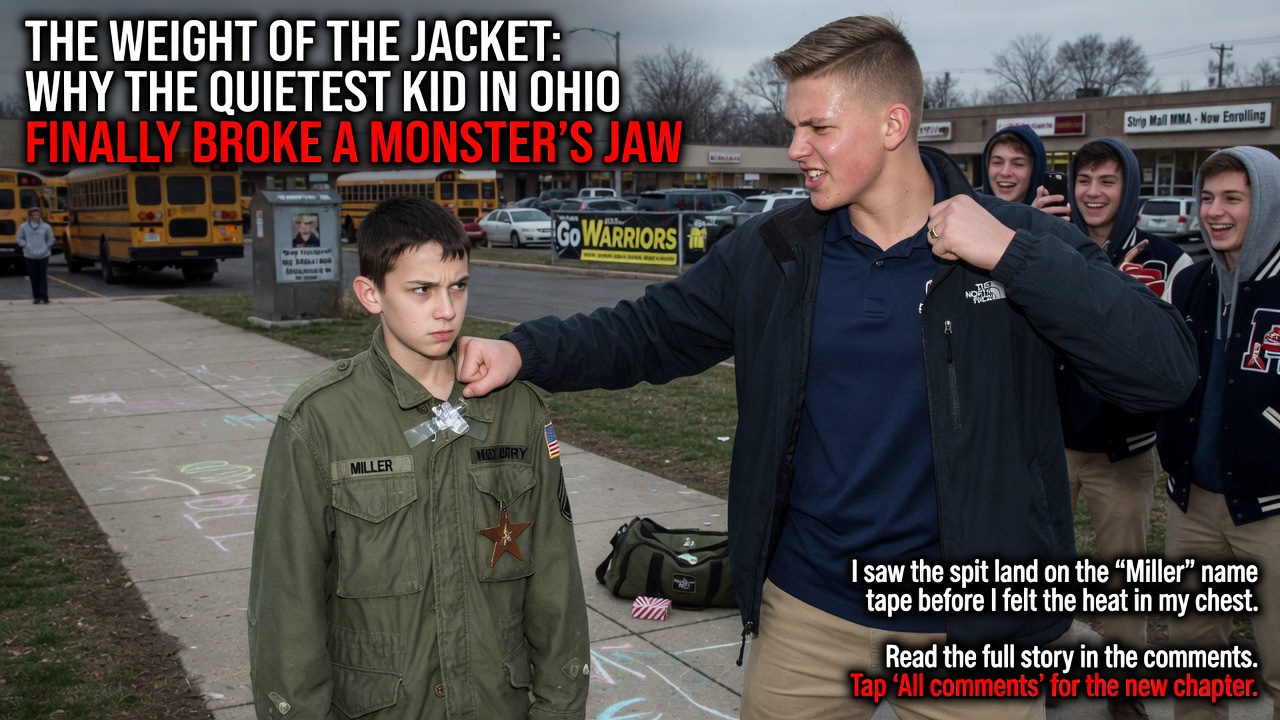
Elias didn’t look up. He knew the voice. Jax Miller. Jax was twenty-two, built like a linebacker, and possessed the kind of cruelty that only grows in the absence of a father and the presence of too much cheap whiskey. He was flanked by Brody and Leo, two boys who followed Jax because they were terrified of being his next target.
“I’m just staying warm, son,” Elias said, his voice a low rumble, like stones grinding together. “There’s plenty of alley for everyone.”
“I ain’t your son,” Jax spat, stepping into the flickering light of a red neon ‘Liquor’ sign. He kicked Elias’s milk crate, sending the older man sprawling onto the wet concrete.
The flag fell from Elias’s jacket. It landed in a puddle of oily water.
Brody laughed, snatching it up. “Look at this piece of junk. What, you think you’re a hero, old man?”
Brody wiped his muddy boot across the stars and stripes.
Elias felt a coldness spread from his chest to his fingertips. It was a familiar sensation—the “Zone.” It was the feeling he’d lived in for two decades as a Tier 1 operator. It was the feeling that turned off his humanity and turned on the machine.
“Please,” Elias said, and for the first time, his voice didn’t tremble. It was flat. “Pick up the flag. Apologize. And walk away.”
Jax roared with laughter, stepping forward and grabbing Elias by the throat, hoisting him up against the brick wall. “Or what? You’re gonna cry? You’re nothing. You’re trash we step on.”
Jax’s grip tightened, his knuckles turning white. He reached back with his free hand, balled into a massive, clumsy fist.
The air in the alley seemed to solidify.
In one fluid motion, Elias’s hand shot up. He didn’t grab Jax’s hand; he grabbed his thumb. With a sharp, surgical snap, he folded it back toward Jax’s wrist.
The sound of the bone breaking was like a dry branch snapping in a winter forest.
Jax’s scream was cut short as Elias’s other hand struck his throat—a precision laryngeal strike that turned the bully’s roar into a pathetic wheeze. Elias didn’t stop. He stepped into the space Jax vacated, his movements a terrifying display of muscle memory.
Brody lunged with a pocketknife. Elias didn’t even look at him. He caught the wrist, twisted, and drove his elbow into Brody’s forearm. The knife clattered to the ground along with the sound of a shattering radius bone.
Five seconds.
That was all it took.
Jax was on his knees, clutching his throat and his broken hand. Brody was curled in a fetal position, sobbing. Leo, the third boy, stood paralyzed, his bladder letting go as he stared into Elias’s eyes.
They weren’t the eyes of a homeless man. They were the eyes of a reaper.
Elias reached down and picked up the flag. He carefully shook the muddy water from it, his hands finally beginning to shake—not with fear, but with the weight of the monster he had just let out of its cage.
“I told you,” Elias whispered to the shivering boys. “I’m just trying to stay warm.”
He walked out of the alley, leaving the three ‘kings’ of 4th Street bleeding into the gutter. But as he reached the streetlights, he saw a police cruiser turn the corner. He knew the rules of the city. A veteran with a record of violence, even in self-defense, was just a problem to be solved.
The machine was back. And the machine knew how to disappear.
Chapter 2: The Weight of the Medal
The shelter on 8th Street was a symphony of coughs and whispers. Elias sat in the far corner, his back against the wall, the flag now drying on his lap. He had cleaned it as best he could with a damp rag, but the stain of Jax’s boot remained—a dark, jagged mark over the white stripes.
“You’re the one, aren’t you?”
A young man sat down two mats away. He looked barely twenty, with a prosthetic leg that looked like it had been salvaged from a scrap yard. His name was Sam, a former combat medic who had lost his limb—and his mind—in a roadside blast in Syria.
“The one who did what?” Elias asked, not looking up.
“The one who put Jax Miller in the ICU,” Sam whispered, his eyes wide. “Word travels fast. People are saying a ghost came out of the bricks and dismantled them. They’re calling you ‘The Reaper.'”
Elias winced. He hated that name. It was the callsign his unit had given him after a botched extraction in the Valley of Death. He had been the only one to walk out.
“I’m just a man who wanted to be left alone, Sam,” Elias said.
“Well, you picked the wrong guy to break,” Sam said, leaning in closer. “Jax’s uncle is Detective Miller. He’s the head of the gang task force. He doesn’t care that his nephew is a piece of work. He only cares that someone made a fool of his blood. They’re turning the city upside down looking for an ‘aggressive vagrant’ with military training.”
Elias closed his eyes. He had spent his life running from the noise of the world, seeking the silence of the streets. But the world had a way of finding him.
“Why are you telling me this?” Elias asked.
Sam reached into his pocket and pulled out a small, tarnished coin. It was a challenge coin from the 75th Ranger Regiment. “Because I know who you are, Sergeant Major Thorne. I saw your picture in the Hall of Heroes at Benning before I deployed. You’re a legend. And legends don’t die in a hole like this.”
“Legends are just stories told by people who weren’t there,” Elias spat.
Suddenly, the front doors of the shelter kicked open. The bright glare of tactical flashlights sliced through the dim room.
“Nobody move! Hands where we can see them!”
The voice was authoritative, sharp, and laced with personal vendetta. Detective Miller stepped into the room. He was a broad-shouldered man in a leather jacket, his service weapon drawn and held at the low ready.
He didn’t look at the other homeless men. He walked straight toward the back corner. Straight toward the man in the M65 jacket.
“Stand up, ‘hero,'” Miller sneered, the light from his torch blinding Elias. “My nephew is getting his jaw wired shut right now. You’re going to wish you’d died in whatever hole you crawled out of.”
Elias didn’t move. He felt the coldness coming back. He felt the phantom weight of a rifle in his hands.
“Detective,” Elias said calmly. “Your nephew attacked me. I have witnesses.”
“I don’t see any witnesses,” Miller said, glancing at the room full of terrified men who immediately looked at the floor. “I see an armed and dangerous transient who resisted arrest.”
Miller reached for his handcuffs, but his eyes were full of a darker intent. He wasn’t planning on taking Elias to the station. He was planning on taking him to the “Short Walk”—a quiet spot under the bridge where the cameras didn’t reach.
Sam stood up, his prosthetic leg clicking. “He didn’t do anything! I saw the whole thing!”
Miller didn’t even turn. He backhanded Sam with his free hand, sending the young man sprawling. “Shut up, gimp. You’re next.”
Elias’s vision tunneled. The shelter faded. The flashlights became the muzzle flashes of a midnight raid. He saw Sam hit the ground, and something snapped.
As Miller reached for Elias’s collar, Elias moved. He didn’t strike. He grabbed the barrel of Miller’s gun, his thumb sliding behind the hammer so it couldn’t fire. With a sharp twist of his hips, he disarmed the detective in a move so fast the eye could barely track it.
He held the gun by the slide, disassembled it in three seconds, and let the pieces clatter to the floor.
“I’ve spent my life protecting people from men like you,” Elias said, his voice a low, terrifying growl. “Don’t make me remember how to hunt.”
The other officers in the room froze, their weapons trained on Elias.
“Shoot him!” Miller screamed, scrambling back. “Shoot the son of a—”
“Lower your weapons!”
A new voice cut through the tension. A woman in a black trench coat walked through the door. She held up an ID. “Agent Sarah Vance, FBI. This man is under federal protection.”
Elias looked at the woman. He didn’t know her, but he knew the look in her eyes. She was a hunter, too.
“Detective Miller,” she said, her voice like ice. “You’re about to be arrested for civil rights violations and witness tampering. And Mr. Thorne? We need to talk about why you disappeared three years ago with a hard drive full of government secrets.”
Elias looked at the flag in his lap. The “quiet life” was officially over. The machine was going to have to do one more job.
Chapter 3: The Cold Room
The FBI safe house was a stark contrast to the grime of the 8th Street shelter. It was clean, smelled of ozone and expensive coffee, and sat in a high-rise overlooking the city. Elias sat at a glass table, still wearing his tattered M65 jacket. He refused to take it off. It was his armor.
Agent Sarah Vance sat across from him. She wasn’t much older than thirty, but she had the tired eyes of someone who had spent too many nights staring at a computer screen.
“We thought you were dead, Elias,” she said, sliding a tablet across the table. It showed a map of the mountains in Northern Iraq. “The Army declared you KIA after the convoy hit. But we knew. You don’t kill a man like you with a simple IED.”
“I didn’t want to be found, Sarah,” Elias said, his voice flat. “I was done. I’ve given forty percent of my skin and a hundred percent of my soul to this country. I just wanted a piece of sidewalk and some silence.”
“You can’t have silence when you’re carrying the ‘Black List,'” Vance replied. “The hard drive you took from the CIA station in Erbil. It contains the names of every double agent working in the Middle East. And more importantly, the names of the American politicians who are funding the very people you were sent to kill.”
Elias looked out the window. “I didn’t take it for power. I took it because my brother died for those names. He was burned by one of those politicians. He died in a cage because someone in D.C. wanted a higher stock price.”
“I know,” Vance said softly. “That’s why I’m here. I’m not here to arrest you, Elias. I’m here because the people on that list found out you’re alive. Detective Miller’s nephew wasn’t a coincidence. They’ve been using local thugs to flush you out for months.”
Elias felt a chill. Jax. The “punks” in the alley. They hadn’t just been bullies; they were hounds, sent by a master they didn’t even know.
“They’re coming for you,” Vance continued. “And they won’t send street punks this time. They’ll send the cleaners.”
Suddenly, the lights in the high-rise flickered. A soft thwip-thwip-thwip sounded from the roof.
“Get down!” Elias barked.
He didn’t wait for her to react. He tackled her off her chair just as a high-caliber round shattered the glass table where her head had been a second ago.
The “cleaners” had arrived.
The apartment exploded into chaos. Smoke grenades crashed through the windows, filling the room with thick, acrid gray fog. Elias was on his feet instantly. He didn’t have a gun, but he had the room. He knew the geometry of violence.
He grabbed a heavy kitchen knife from the counter.
A shadow emerged from the smoke—a man in full tactical gear, wearing a night-vision shroud. He moved with professional grace. Elias was faster. He stepped inside the man’s guard, driven by the instinct of a thousand close-quarters battles. He didn’t use the knife to kill; he used the butt of the handle to strike the temple, then swept the man’s legs, sending him crashing into the wall.
“Vance! The back door!” Elias shouted.
“I have my sidearm!” she yelled, firing two rounds into the smoke.
“Keep it! We need to move!”
They scrambled into the hallway, but the elevators were already pinned. Two more operators emerged from the stairwell. These weren’t punks. These were former teammates. Elias recognized the movement patterns.
“Elias! Give it up!” one of them shouted. “It’s over! Just give us the drive!”
“Come and get it, Miller!” Elias roared.
He didn’t mean the detective. He meant the shadow behind the shadow.
Elias grabbed a fire extinguisher from the wall and hurled it at the attackers. As they dodged, he charged. He was a whirlwind of controlled fury. He used the narrowness of the hallway to his advantage, turning it into a meat grinder. He broke a collarbone with a palm strike, redirected a rifle barrel with a flick of his wrist, and delivered a devastating knee to a solar plexus.
He was fifty-two, but in the heat of the fight, he was the Reaper again.
They made it to the service stairs, but Elias stopped. He felt a sharp pain in his side. He looked down. A shard of glass or a stray graze had opened a deep gash in his ribs.
“You’re hit,” Vance gasped.
“Keep moving,” Elias hissed, clutching the folded flag inside his jacket. “I’m not dying in a suit-and-tie building. If I go, I go on the street.”
They burst out into the rainy night, the neon lights of the city reflecting in the puddles. But as they reached the alleyway, Elias saw the black SUVs closing in.
They were surrounded. And this time, there were no FBI agents to save them. Only the ghost of a soldier and the flag he clutched like a prayer.
Chapter 4: The Truth in the Rain
The rain was a deluge now, washing the blood from Elias’s hands as he leaned against a dumpster in the alley behind the high-rise. He was pale, his breath coming in shallow hitches. Sarah Vance stood over him, her gun trained on the entrance to the alley.
“Elias, stay with me,” she whispered. “The backup is five minutes away.”
“They won’t make it,” Elias said, a grim smile touching his lips. “The people who want me dead… they own the clocks in this city.”
A figure stepped into the light at the mouth of the alley. He wasn’t wearing tactical gear. He was wearing a tailored charcoal suit and carrying an umbrella. It was Senator Harrison Vance—Sarah’s father.
Sarah froze. “Dad? What are you doing here?”
The Senator looked at his daughter with a mixture of pity and annoyance. “I told you to stay out of the archives, Sarah. I told you that some things are better left in the dark.”
“You?” Sarah’s voice trembled. “You’re on the list? You’re the one who sold out Elias’s unit?”
“It was a different time, Sarah,” the Senator said, his voice smooth and persuasive. “The world was changing. We needed to secure our interests. Elias and his brother… they were just casualties of a larger peace.”
“A larger peace?” Elias rasped, pulling himself upright. He held the flag in one hand and the hard drive in the other. “You sold my brother to a warlord for a seat on the Intelligence Committee. You watched the feed while they tortured him.”
“I did what was necessary for the country!” the Senator shouted, his composure finally breaking. “And now, I’ll do what’s necessary to protect it. Give me the drive, Elias. I’ll make sure you get a proper burial. Full honors. At Arlington. Right next to your brother.”
“I don’t want your honors,” Elias said. He looked at Sarah. “Your father is a ghost, Sarah. A monster wearing a human skin. You have a choice.”
Sarah looked at the drive in Elias’s hand, then at the man who had raised her. Her hand was shaking. The black SUVs were behind the Senator, men with rifles stepped out, waiting for the word.
“Put the gun down, Sarah,” the Senator said softly. “Come home. We can fix this.”
“No,” Sarah said.
She turned and fired—not at her father, but at the fuel tank of the lead SUV.
The explosion was deafening. A wall of fire erupted, separating the Senator’s men from the alley.
“Go!” Sarah screamed, grabbing Elias by the arm.
They ran through the maze of the city’s underbelly—through the subway tunnels, across the rail yards, and into the forgotten industrial district. Elias was losing blood fast. He could feel the world fading, the neon lights turning into the stars of the desert sky.
They reached an old, abandoned warehouse—the place where Elias had spent his first nights after returning to the states.
“Elias, I need to call for help,” Sarah said, tearing her sleeve to make a bandage for his side.
“No help,” Elias said. He handed her the drive. “Take it. Get to the press. Not the FBI. Not the CIA. Go to the people. It’s the only way it ends.”
“What about you?”
Elias looked at the flag. It was wet, stained with mud and blood, but it was still his.
“I’m going to wait for them,” Elias said. “I’m going to show them what a ‘casualty’ looks like when he stops being polite.”
“Elias, you can’t—”
“Go!” he roared.
Sarah looked at him, tears blurring her vision. She leaned down and kissed his forehead. “Thank you, Sergeant Major.”
She disappeared into the shadows just as the first flashlight beams cut through the warehouse windows.
Elias sat on the floor, his back against a crate. He pulled a heavy iron bar from the debris. He didn’t have a gun. He didn’t have armor. But he had twenty years of rage and a flag that needed to be honored.
The door creaked open.
“He’s in here!” a voice shouted.
Elias stood up. The pain in his side vanished, replaced by a cold, white heat. He wasn’t a homeless man anymore. He wasn’t a victim.
He was the Reaper. And he had one more harvest to gather.