The key didn’t stick. That was the first sign.
Ten years. Three tours. Two purple hearts. And the lock to my own front door had been changed.
I stood on the porch of the house I’d sent every paycheck back to cover, smelling the expensive hickory smoke of a professional caterer. My tactical bag felt like a ton of lead on my shoulder. Through the frosted glass of the sidelight, I saw shadows dancing. Too many shadows.
I didn’t knock. I walked around to the sliding glass doors in the back, the ones that looked out over the pool I’d paid for but never swam in.
There she was. Sarah.
She looked beautiful—richer than when I left. She was laughing, a glass of vintage wine in her hand, leaning into a man who looked like he’d never seen a day of dirt in his life. He wore a tailored navy suit and a watch that cost more than my first truck.
The house was packed. Our neighbors, the people I thought were friends, were clinking glasses. Nobody noticed the man in the mud-stained boots standing in the dark.
Then I saw it. On the mahogany sideboard I’d built with my father.
My shadow box. The one containing my Silver Star and the tattered flag from the Humvee fire. It wasn’t on the wall. It was being used as a coaster for a tray of appetizers.
My blood didn’t boil. It went ice cold. That’s what they teach you in the unit—anger is a luxury; precision is a necessity.
I slid the door open. The music—some upbeat pop track that felt like a needle in my ear—was the only sound for a split second. Then, a tray of shrimp cocktail hit the floor.
“Elias?” Sarah’s voice didn’t have a drop of love in it. Just sharp, jagged panic.
The man in the suit stepped forward, trying to play the hero. He didn’t know he was standing in the kill zone of a man who had nothing left to lose.
The silence in the room was heavy, the kind of silence that precedes a lightning strike. Sarah’s face went through a dozen emotions in three seconds—shock, guilt, and finally, a cold, hard defiance that hurt worse than the shrapnel I’d pulled out of my leg in Kandahar.
“You weren’t supposed to be back until Thursday,” she said, her voice steadying. She didn’t move toward me. She stayed anchored to the man in the suit.
“The transport arrived early,” I said. My voice sounded like gravel under a boot. I looked at the man. “Who are you?”
He straightened his silk tie, regaining his composure. “I’m Julian. And frankly, Elias, you’re trespassing. Sarah and I are hosting a private event.”
A ripple of nervous laughter went through the crowd. I recognized Miller from across the street. He’d promised to look after the lawn while I was gone. He looked away, staring intensely at his drink.
“Trespassing in the house I pay the mortgage on?” I asked. I walked toward the sideboard. Every step felt like I was moving through waist-deep water. I reached for the shadow box.
Julian’s hand shot out, grabbing my wrist. He was fast, probably spent his mornings at a high-end boxing gym with a personal trainer. But he had no idea what “fast” really meant.
“Don’t touch that,” Julian sneered. “It’s being used. Besides, Sarah said you wouldn’t mind. You’re a ‘man of the people,’ right? Sharing is caring.”
He looked around for approval, and he got it. A few of the younger guys, probably his associates from some firm downtown, started chuckling.
“Get your hand off me,” I said quietly.
“Or what? You’ll call the MPs? You’re a civilian now, Elias. A broken, tired civilian in a dirty jacket.” He sneered, his grip tightening. With his other hand, he picked up a glass of red wine and poured it—slowly, deliberately—right onto the glass of my medal case. “Oops. Looks like your little trinkets need a wash.”
Sarah didn’t stop him. She watched with a strange, hungry look in her eyes, as if seeing me humiliated was the final step in her liberation.
I didn’t hit him. Not yet. I simply looked at the Silver Star, now obscured by a veil of cheap Merlot. I reached into my pocket and pulled out an old, encrypted satellite phone—the one the unit used when we were off the grid.
I hit a single speed-dial button.
“Ghost Lead,” I said into the receiver. “Signal is Red. My coordinates. Bring the cleanup crew.”
Julian laughed, a loud, barking sound. “What is that? Some kind of LARPing? You calling your little soldier buddies?”
“I’m calling the only family I have left,” I replied.
“Get him out of here,” Sarah snapped, her face twisting into something ugly. “Julian, call security. I want him gone.”
Two large men, hired muscle for the party, started moving toward me. They looked like they played college football—big, corn-fed, and overconfident. They reached for my shoulders.
I didn’t resist. I let them lead me out the sliding doors and onto the lawn. The party followed, a trail of silk and cologne spilling out onto the grass to watch the “homeless vet” get tossed from his own property.
Julian stood at the top of the porch steps like a king. He held my shadow box in his hands.
“You want this back?” he yelled, loud enough for the whole cul-de-sac to hear. “Come and get it!”
He raised the box high and slammed it down onto the stone steps. The mahogany cracked. The glass shattered with a sound like a gunshot. My Silver Star skittered across the concrete, landing in the dirt.
A collective gasp went through the crowd. Even some of Julian’s friends looked uncomfortable now. But Julian wasn’t done. He stepped down and ground his heel into the velvet lining of the case.
“There,” Julian said. “Now it matches your life. Broken.”
At that exact moment, the air changed. The crickets stopped chirping. A low, rhythmic thrumming began to vibrate through the pavement.
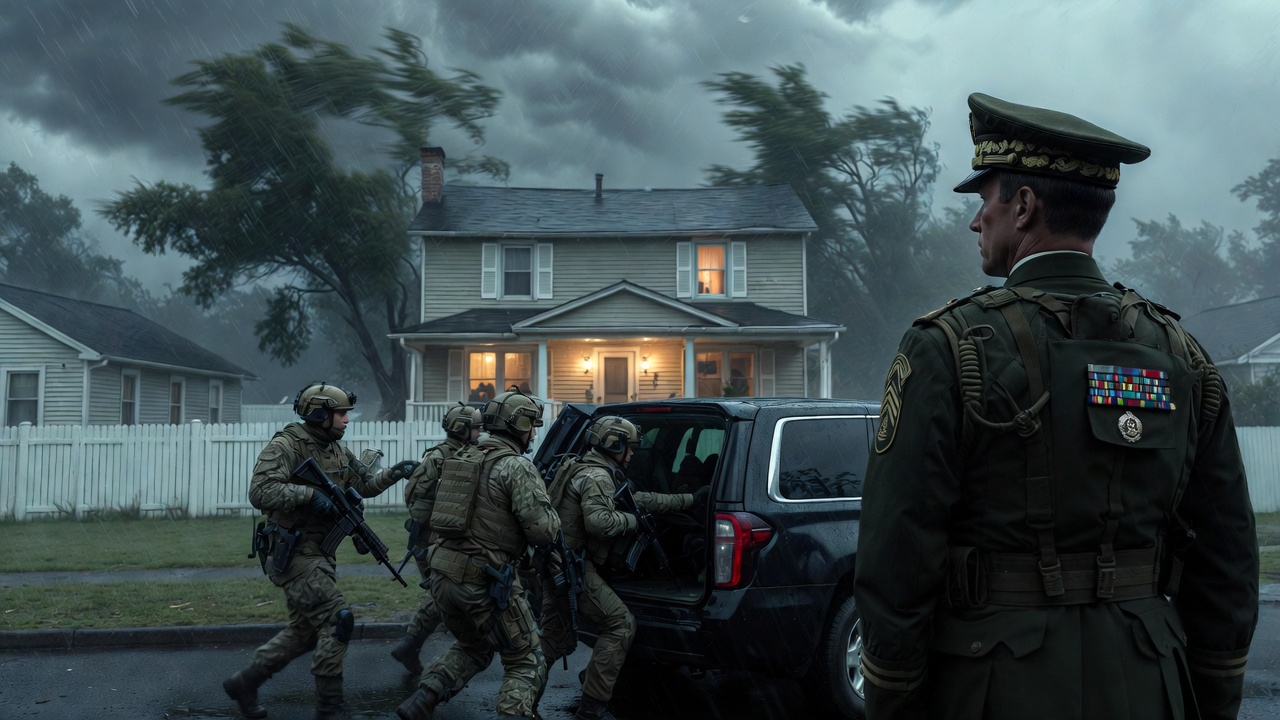
Down the street, three sets of high-intensity LED light bars cut through the darkness. Three matte-black SUVs rounded the corner, moving in a tight, aggressive formation. They didn’t slow down for the speed bumps.
They braked hard in front of my driveway, the tires screaming.
The partygoers scrambled back. Sarah gripped Julian’s arm, her eyes wide.
“What is this?” she whispered.
The doors of the SUVs opened simultaneously. Five men stepped out. They weren’t in uniform, but they wore the aura of professional violence like a second skin. Dark tactical pants, fitted black hoodies, and the cold, unblinking stares of men who had seen the end of the world and come back.
Leading them was Jax, a man I’d pulled out of a burning wreckage in the Helmand Province. He looked at the shattered glass on the steps, then at the man in the suit.
“Elias,” Jax said, his voice a low rumble. “Tell me this isn’t the guy.”
I looked at Julian, who was suddenly finding it very hard to breathe.
“That’s the guy,” I said.
Jax nodded. He didn’t look at the partygoers. He didn’t look at Sarah. He looked at the operators behind him.
“Secure the perimeter,” Jax ordered. “Nobody leaves this party until we’ve collected what belongs to the Colonel.”
The shift in the atmosphere was instantaneous. The “Ghost Platoon”—the nickname my unit had earned for our ability to disappear into the noise of war—moved with a fluid, terrifying grace. Within seconds, they had positioned themselves at every exit point of the property. They didn’t say a word. They didn’t have to.
Julian tried to maintain his “alpha” persona, but his voice went up an octave. “Who do you think you are? This is private property! I’m calling the police!”
Jax walked up the steps, stopping inches from Julian’s face. Jax was a head taller and built like a mountain of granite. “The police are busy, Julian. And technically, this property is currently under federal inquiry regarding the theft of government property. Namely, those medals you just desecrated.”
It was a lie, but a beautiful one.
“I… I didn’t steal anything!” Julian stammered, backing up until he hit the front door. “Sarah gave me that stuff! She said it was junk!”
Jax turned his head slightly toward Sarah. She looked like she wanted to melt into the siding. “Is that right, ma’am? You told this civilian that a Silver Star for Valor was ‘junk’?”
Sarah opened her mouth, but no sound came out. The neighbors, the same ones who had been sipping wine and laughing minutes ago, were now trying to hide behind their bushes.
“Pick it up,” I said.
The crowd went quiet. I walked toward the steps, my eyes fixed on the shattered remains of my father’s handiwork.
“What?” Julian asked, trembling.
“Pick up the medal. Pick up every piece of glass. Use your hands,” I said. My voice was calm, which made it ten times more frightening.
“Elias, stop this!” Sarah screamed, finding her voice. “You’re scaring everyone! You can’t just bring these… these thugs here!”
“Thugs?” Jax laughed, a dry, humorless sound. “That’s funny, lady. Six months ago, we were the only thing standing between your comfortable life and a pile of rubble. We’re not thugs. We’re the people you forgot existed while you were picking out new curtains with your boyfriend.”
Another operator, a lean guy we called ‘Stitch’ because of the sheer number of times he’d been patched up, stepped forward. He was holding a heavy, waterproof Pelican case. He set it down on the lawn and flipped the latches.
Inside was a laptop and several thick folders.
“Colonel,” Stitch said, looking at me. “We did the deep dive on the drive over. The house isn’t just yours. The mortgage was paid ahead five years using your combat pay bonuses. But look at this.”
He turned the screen toward me. My heart sank. Sarah hadn’t just been having an affair. She’d been siphoning my savings into a shell company registered in Julian’s name. They weren’t just breaking my heart; they were stripping my bones.
“They’ve moved three hundred thousand out of the joint account in the last eighteen months,” Stitch said loudly. The neighbors gasped. “Looks like Julian’s ‘investment firm’ is just a laundry mat for a soldier’s blood money.”
Julian’s face went from pale to ghostly white. “That’s… that’s private financial information. You can’t have that!”
“We’re the Ghosts, buddy,” Jax said, stepping into Julian’s personal space again. “We have everything. We have your browsing history. We have the texts you sent Sarah about how you were going to ‘drain the grunt dry.’ We even have the receipt for that watch you’re wearing. Bought it on July 14th. The same day Elias was taking fire in a valley you couldn’t find on a map.”
The crowd’s murmur turned into a hiss of disapproval. The “friends” were starting to turn.
“Is this true?” Miller, the neighbor, asked, stepping forward. “Sarah, you told us Elias had abandoned the family. You said he was sending the money to some girl overseas.”
“He lied!” Sarah shrieked, pointing at me. “He was never here! I was alone! I deserved a life!”
“You had a life,” I said, finally walking up the steps to stand in front of her. I looked at the woman I’d written a letter to every single night for three thousand nights. “You had a man who would have died for you. Instead, you chose a man who hides behind your skirt when the real world shows up.”
I looked at Julian. “Pick up the medal. Now.”
Julian scrambled to his knees. He began picking up the jagged shards of glass, his expensive suit trousers tearing on the stone. His fingers bled as he fumbled for the Silver Star.
“I’m sorry,” he sobbed. “I’m sorry, okay? Just take your stuff and go!”
“We’re not going anywhere,” Jax said, looking at the house. “Actually, Stitch, did you find that other thing?”
“Yeah,” Stitch said, a grim smile on his face. “The deed was never transferred. It’s 100% in Elias’s name. And under the Service Members Civil Relief Act, this ‘private event’ is an unauthorized occupation.”
Jax looked at the partygoers. “Everyone who doesn’t live here has sixty seconds to clear the premises. If you’re still on the grass in sixty-one seconds, you’ll be treated as a hostile intruder on a federal site. Go.”
It was like a starter pistol had been fired. People dropped their glasses and ran. Cars started engines, tires chirped, and within forty-five seconds, the “party of the year” was a ghost town.
Only Sarah and Julian remained on the porch, surrounded by the Ghosts.
“What about us?” Sarah whispered, her bravado completely gone.
I looked at the house, then at the medal in Julian’s shaking, bloody hand.
“You have ten minutes to pack a bag,” I said. “And Julian? Leave the watch. It was paid for with my blood. I think I’ll give it to a veteran’s charity.”
The next ten minutes were the quietest I’d ever experienced in that suburb. Inside the house, I could hear the frantic sounds of Sarah throwing clothes into suitcases. She was crying—not the quiet, mourning cry of someone who lost love, but the sharp, angry sob of someone who lost their safety net.
Julian sat on the bottom step, guarded by Jax. He looked small. Without the expensive wine, the loud music, and the borrowed status, he was just a middle-aged man with a bad haircut and a terrified expression.
“You know,” Jax said, leaning against one of the SUVs, “I’ve seen a lot of cowards. But you’re a special breed. You didn’t just take his wife; you tried to take his dignity. That’s a debt that usually gets paid in teeth.”
Julian flinched. “I’ll pay him back. Every cent. I promise.”
“Oh, we know you will,” Stitch said from the laptop. “I’ve already initiated a freeze on the shell company accounts. By morning, the forensic accountants will have a clear map. You’re not just going broke, Julian. You’re going to a very small room with very gray walls.”
I walked through the house one last time. It was strange. It looked like the home I’d imagined, but it felt like a museum. Every piece of furniture, every painting, felt tainted by the secret life that had been lived here.
I stopped at the master bedroom. Sarah was stuffing a designer bag. She looked up, her eyes red and puffy.
“You ruined everything,” she spat. “You come back here with your soldiers and your threats… you think you’re a hero? You’re a monster, Elias. You’re a cold, dead machine.”
I looked at the framed photo on her nightstand. It was a picture of us on our wedding day. I looked happy. I looked like I believed in the world.
“I stayed alive for you,” I said softly. “In the dark, when the humvees were burning and the air was full of lead, I closed my eyes and saw this room. I saw you. That’s what kept the ‘machine’ running, Sarah.”
I reached out and took the photo, but I didn’t take the frame. I pulled the picture out, folded it once, and put it in my pocket.
“You didn’t just break a promise,” I continued. “You broke the only thing I had left to come home to.”
“I was lonely!” she screamed. “You were gone for years! What was I supposed to do?”
“You could have left,” I said. “You could have been honest. But you wanted the money and the hero’s wife status while you had the lover on the side. You wanted the house and the lie.”
I turned and walked out.
On the lawn, Julian was standing up. Sarah came out a moment later, lugging two heavy bags. None of the Ghosts offered to help her.
“Where are we supposed to go?” she asked, looking at the dark street.
“Not my problem,” I said.
They walked down the driveway, their shadows stretching long under the streetlights. They looked like two refugees from a war they had started themselves. Julian was limping, his fancy shoes ruined.
As they reached the edge of the property, Miller, the neighbor from across the street, stepped out of his shadows. He was holding a small box.
“Elias?” he called out.
I walked toward him. “Yeah, Miller?”
“I… I’m sorry,” he said, his voice thick with shame. “We knew something was wrong. We saw the cars. We heard the stories she told. But it was easier to just go to the parties and stay quiet. I’m a coward.”
He handed me the box. Inside was a collection of mail—letters I’d sent that Sarah had thrown in the trash. Miller had been pulling them out of the bin for months, saving them.
“I didn’t know what to do with them,” Miller whispered. “But I couldn’t let them be destroyed.”
I took the box. “Thanks, Miller. For at least that much.”
The Ghosts gathered around me. Jax put a heavy hand on my shoulder.
“What now, Colonel? We could stay the night. Set up a watch.”
I looked at the house. It was a beautiful structure. High ceilings, granite counters, a three-car garage.
“No,” I said. “I don’t want to sleep in a graveyard.”
“Then where?”
I looked at my brothers—the men who had bled with me, the only people who truly knew who I was.
“There’s a veteran’s lodge about fifty miles north,” I said. “They need help with the renovations. And I hear the coffee is terrible.”
Jax grinned. “Terrible coffee and hard work? Sounds like home to me.”
As we loaded into the SUVs, I looked back one last time. I saw the shattered glass on the steps. I saw the empty house.
I reached into my pocket and felt the Silver Star. It was scratched, the ribbon a bit frayed, but the metal was still strong.
“Let’s go,” I said.
The SUVs pulled away in a silent, synchronized line. The “Ghost Platoon” disappeared into the night, leaving the suburb back to its quiet, hollow secrets.
I was starting over with nothing but my name and my brothers. And for the first time in ten years, I felt like I was finally, truly home.
The drive north was a symphony of engine hum and low-frequency radio chatter. My brothers didn’t push me to talk. They knew the weight of the silence. In the military, you learn that some wounds don’t bleed—they just hollow you out until there’s nothing left but the mission.
We pulled into the “Pathfinder Lodge” at 3:00 AM. It was a sprawling, weather-beaten timber structure nestled at the edge of a pine forest. It had seen better days. The porch sagged, and the paint was peeling like sunburnt skin, but it had a soul.
“Who owns this place?” Jax asked, stretching his massive frame as he climbed out of the SUV.
“A guy named Sergeant Major Harrison,” I said. “He was my instructor at Benning. He spent thirty years in the service and his retirement fund on this place. He wanted a spot where guys coming back could just… be.”
A light flickered on inside. A moment later, the front door creaked open. An older man with white hair cut into a sharp flattop stepped out. He was wearing a flannel shirt and holding a mug of coffee like it was a weapon.
“Thorne?” the Sergeant Major barked. “You’re late. I expected you three tours ago.”
I walked up the steps and shook his hand. It felt like shaking a piece of seasoned oak. “Had a few detours, sir.”
He looked past me at the four men standing by the blacked-out SUVs. He recognized the stance, the way their eyes scanned the treeline even in a safe zone.
“Ghosts,” Harrison grunted. “I’ve heard of you. Mostly in reports that ended with ‘classified’ and ‘unaccounted for.’ Come inside. The coffee is burnt and the heaters are temperamental.”
Inside, the lodge smelled of cedar, old books, and woodsmoke. It was the polar opposite of the sterile, expensive house I’d left behind. There were no granite countertops here, just long communal tables and a fireplace big enough to roast a boar.
We sat down, and for the next hour, we didn’t talk about Sarah. we didn’t talk about Julian. We talked about the lodge. Harrison told us the bank was leaning on him. The roof needed fifty thousand dollars in repairs, and the local zoning board was trying to squeeze him out to make room for a luxury “glamping” resort.
“They think we’re an eyesore,” Harrison said, staring into his mug. “A bunch of broken old soldiers scaring the tourists. They want us gone by the end of the month.”
Jax looked at me. I looked at Stitch, who was already opening his laptop.
“How much is the total debt, Sergeant Major?” I asked.
“Including the back taxes? About four hundred thousand,” Harrison sighed. “Might as well be four million.”
Stitch tapped a few keys. “Colonel, I’ve been looking at the recovery from Julian’s shell company. Because the money was stolen from a service member during active deployment, federal law allows for immediate seizure and restitution. I’ve already flagged the transfer back to your primary account.”
He turned the screen around. The balance was sitting there. Three hundred and eighty-two thousand dollars of my blood money, reclaimed from the man who tried to bury me.
I looked at the Sergeant Major. I thought about the house in the suburbs—the house Sarah wanted, the house that represented a lie.
“I have a house for sale,” I said. “In a very prime neighborhood. High-end finishes, great schools, and a very interesting history. If we list it tomorrow, it’ll go for seven hundred thousand, easy.”
“What are you saying, Thorne?” Harrison asked.
“I’m saying the Ghost Platoon needs a base of operations,” I said. “And the Pathfinder Lodge needs a new roof. And a gym. And maybe a state-of-the-art security system.”
The men around the table grinned. For the first time in years, the “Ghost Lead” had a mission that wasn’t about destruction.
“We’re staying,” I said.
The next two weeks were a whirlwind of activity. The Ghosts didn’t know how to relax, so they treated the renovation like a combat operation. Jax handled the structural repairs, swinging a sledgehammer with the same precision he used with a breaching charge. Stitch rewired the entire lodge, installing high-speed internet and a security grid that would make the Pentagon jealous.
I handled the paperwork. With the help of a JAG lawyer I’d known from my second tour, we filed a massive civil suit against Julian and Sarah. We didn’t just want the money back; we wanted a public record of what they’d done.
The story started to leak. A local journalist heard about the “Special Ops team” fixing up the old veteran’s lodge. Then, the story of the party—the shattered medal, the “Silent Signal,” and the betrayal—went viral.
The American public has a very specific reaction to a veteran being mistreated. It’s a quiet, simmering rage that turns into a tidal wave of support.
By the end of the second week, the “Pathfinder Project” had raised another two hundred thousand dollars in donations. People sent tools, lumber, and crates of coffee. Veterans from three states away drove over just to help paint for a weekend.
One afternoon, a familiar car pulled up the gravel drive. It was Miller, my old neighbor. He looked out of place in his clean loafers and ironed shirt.
“Elias,” he said, stepping out. “I thought you’d want to know. The house sold. A young couple—he’s a nurse, she’s a teacher. They seemed like good people.”
“And Sarah?” I asked.
Miller looked down. “The lawsuit wiped them out. Julian’s firm collapsed under the fraud investigation. Last I heard, Sarah’s living in a studio apartment above a dry cleaner’s. Julian’s waiting on his court date. Nobody in the neighborhood talks to them. They’re… they’re pariahs, Elias.”
I didn’t feel the rush of victory I expected. I just felt a sense of closure. The “Ghost” was finally leaving the cemetery.
“Thanks for coming all this way, Miller,” I said.
“I had to,” Miller said. He reached into his pocket and pulled out a small, velvet-lined box. “I went to a specialist. Had the glass replaced and the mahogany refinished. It’s not the original box your dad built, but… I tried to match the wood.”
He handed me my shadow box. The Silver Star was inside, cleaned of the wine stains, resting on a bed of deep navy blue velvet. The glass was crystal clear.
I looked at my reflection in the glass. I didn’t see a broken man. I saw a builder.
“It’s perfect,” I said.
The grand reopening of the Pathfinder Lodge was held on a crisp Saturday in October. The air smelled of pine and woodsmoke, and the American flag flying from the new pole snapped sharply in the wind.
Hundreds of people showed up. There were veterans in faded caps, families with young kids, and local officials who had suddenly decided they loved the lodge now that it was popular.
Jax and the rest of the Ghosts stood on the porch, looking uncomfortable in clean shirts, but their eyes were bright. They had found something they hadn’t realized they were missing: a community.
I stood at the podium, looking out at the crowd. I didn’t have a prepared speech. I just had the truth.
“A few months ago,” I began, my voice carrying across the quiet woods, “I thought I had lost everything. I thought the country I fought for had forgotten me, and the home I built had turned into a stranger’s house.”
I saw Miller in the crowd, nodding. I saw Sergeant Major Harrison standing tall in his dress blues.
“But I was wrong,” I continued. “Home isn’t a mortgage or a zip code. It isn’t a granite countertop or a fancy car. Home is the person who stands beside you when the glass shatters. Home is the brother who answers the phone at 2:00 AM when you send the signal.”
I held up the shadow box. The Silver Star caught the afternoon sun, gleaming like a beacon.
“This medal is called a Silver Star for Valor,” I said. “But true valor isn’t what happens on a battlefield. True valor is the courage to keep going when the person you love betrays you. It’s the courage to build something new out of the ruins of the old.”
The crowd was silent.
“The Pathfinder Lodge is open,” I announced. “And as long as I’m breathing, no veteran will ever have to send a silent signal and find nobody listening. We are the Ghosts, but we are finally visible.”
The applause wasn’t a roar; it was a deep, sustained thrum of respect.
Later that evening, after the crowds had left and the fire was roaring in the great hall, I sat on the porch with Jax. We were drinking coffee that wasn’t burnt—Harrison had finally let us buy a new machine.
“You okay, Boss?” Jax asked.
“I am,” I said. And for the first time, I meant it.
My phone buzzed in my pocket. It was a message from an unknown number. I opened it.
Elias. I’m sorry. For everything. I didn’t realize what I was throwing away until the house was empty. Please. Can we talk? – S.
I looked at the message for a long time. I thought about the woman in the silk dress laughing as wine was poured over my medals. I thought about the man who ground his heel into my life.
I didn’t feel anger. I didn’t feel the need for revenge.
I hit the ‘Delete’ button. Then, I blocked the number.
I looked out at the dark treeline, the stars hanging low and bright over the mountains. Inside the lodge, I could hear the sounds of laughter and the clinking of mugs—the sounds of a family that didn’t need a bloodline to stay together.
I reached into my pocket and pulled out the folded wedding photo I’d taken months ago. I looked at it one last time, then I walked over to the fire pit in the center of the yard.
I tossed the photo into the embers. I watched as the edges curled, turned black, and finally disappeared into the heat.
The past was ash. The future was timber and stone.
I walked back into the lodge and shut the door behind me, locking it with a key that turned perfectly.
True strength isn’t about what you can destroy, but what you have the heart to protect when everyone else has walked away.