“You’re half a man now,” she hissed.
The words didn’t just cut; they cauterized. Sarah didn’t say them quietly. She wanted the neighbors in our quiet Ohio suburb to hear. She wanted the kids on their bikes and the retirees watering their lawns to see me at my absolute lowest.
With a violent shove, she sent my olive-drab duffel bag tumbling down the porch steps. It hit the concrete with a heavy, metallic thud—the sound of my prosthetic leg shifting inside and my service medals hitting the pavement.
Behind her, through the polished glass of the front door I’d paid for with three tours of duty, I saw him. Mark. He was wearing one of my old college hoodies, smirking as he held a glass of the expensive scotch I’d been saving for our tenth anniversary.
“Sarah, please,” I rasped. My voice was thin, a ghost of the command voice I used to have. “I have nowhere to go. My physical therapy starts at 0800 tomorrow.”
“Then crawl there,” she snapped, her face a mask of cold resentment. “I didn’t sign up to be a nurse for a broken toy. I want a life, Elias. A real one. With a man who can actually take me dancing without clicking every three steps.”
She stepped back and slammed the door. The deadbolt clicked—a final, metallic sentence.
I stood there in the middle of the driveway, the late afternoon sun casting a long, jagged shadow of a man with only one good leg and a heart that felt like it had been shredded by shrapnel all over again.
I looked at the house. My house. The flower beds I’d planted to help with the PTSD. The swing set I’d built for the kids we never had because I was too busy “defending freedom.”
A few doors down, Mr. Henderson stopped pruning his roses. Mrs. Gable clutched her dog’s leash tighter. They were watching. The silence of the neighborhood was deafening.
I felt the familiar heat of shame rising in my neck. I knelt, my carbon-fiber limb groaning, to pick up the Silver Star that had rolled near the gutter.
“Need a hand, Brother?”
The voice didn’t come from the house. It came from the street.
I looked up. A battered Jeep Rubicon had pulled up to the curb. Then a Harley. Then a Ford F-150. They were all flying small, crisp American flags.
Chapter 2
The man stepping out of the Jeep was Miller. We’d served together in the 10th Mountain. He looked older, grayer, but his eyes still had that “thousand-yard” clarity. He wasn’t alone. Behind him, four other guys—men I’d bled with, men I hadn’t seen in three years—were dismounting their vehicles like they were staging for a breach.
“Miller?” I breathed, my hand trembling as I gripped my Silver Star. “What are you doing here?”
“Word travels fast in the net, Elias,” Miller said, his voice a low rumble that commanded the entire block. He didn’t look at me with pity. He looked at me with the tactical assessment of a Sergeant Major. He looked past me, straight at the front window where Sarah and Mark were now standing, their smirks beginning to fade into confusion.
“We heard there was a veteran in need of a tactical extraction,” Miller continued.
Two more trucks pulled up. Then a van from the local VFW. Within three minutes, the entire street in front of my house was lined with vehicles. Men and women in various stages of age and physical wear, all wearing gear that marked them as part of the tribe, stepped onto the asphalt.
They didn’t shout. They didn’t cause a scene. They just stood there. A silent, grim wall of camouflage jackets and leather vests.
“Hey!” Mark shouted, finally opening the door, trying to reclaim his bravado. “This is private property! Get these junk heaps off the street or I’m calling the cops!”
Miller took one step forward, onto the edge of my lawn. “Call them. I’d love for the local PD to see how you treat a Purple Heart recipient. My cousin is the Captain of the Third Precinct. He’s about two minutes away.”
Sarah came out then, her face flushed with anger. “This is my house! Elias is off the deed! He signed the papers last month!”
I looked at the ground. I had signed them. I’d been so depressed, so lost in the fog of my recovery, that I’d signed whatever she put in front of me just to make the arguing stop.
“Maybe he signed the deed,” a new voice spoke up. It was Sarah’s own father, Jim. He walked out from behind Miller’s Jeep, his face pale and eyes red.
“Dad?” Sarah gasped. “What are you doing with these people?”
“I’m standing with a man of honor,” Jim said, his voice shaking with disappointment. “Something I clearly failed to raise in my own daughter.”
Chapter 3
The air in the suburb shifted. It wasn’t just my old squad anymore; the neighbors were moving now. Mr. Henderson dropped his shears and walked across the street, standing next to Miller. Mrs. Gable followed.
“I saw what you did, Sarah,” Mr. Henderson said loudly. “I saw you throw his medication into the dirt. We all saw it.”
Sarah retreated a step, her hand flying to her throat. Mark tried to pull her back inside, but the wall of people was moving closer to the porch. They weren’t being violent—they were being a witness.
“Elias,” Miller said, turning to me. “Go get your things. All of them.”
“She locked the door,” I said quietly.
Miller smiled, a cold, sharp expression. “The door is an obstacle. We’re specialists in overcoming obstacles. Jim, you still have your key?”
Jim stepped forward, pulling a brass key from his pocket. He looked at his daughter with a sadness that seemed to age him a decade. “I bought this house for you two as a wedding gift, Sarah. The deed might be in your name, but the soul of this home was built on Elias’s sacrifice. If he goes, everything I put into this place goes with him.”
We walked up the steps. Mark tried to block the doorway, but when he looked into the eyes of six combat veterans who had seen things he couldn’t imagine in his worst nightmares, his knees visibly buckled. He stepped aside, his “alpha” persona evaporating like mist.
I walked into the foyer. It smelled like her perfume and the expensive candles I’d bought her for Christmas.
“Start with the safe,” Jim whispered to me. “And the cabinets.”
For the next hour, the neighborhood watched a silent, disciplined operation. My brothers-in-arms didn’t just grab my clothes. They took every piece of furniture I’d paid for, every appliance, every light fixture I’d installed. We weren’t just moving; we were stripping the house of the life I’d breathed into it.
Sarah screamed. She threatened. She cried. But every time she tried to interfere, Miller or one of the others would simply stand in her path, a silent reminder that her power ended the moment she chose cruelty over loyalty.
Chapter 4
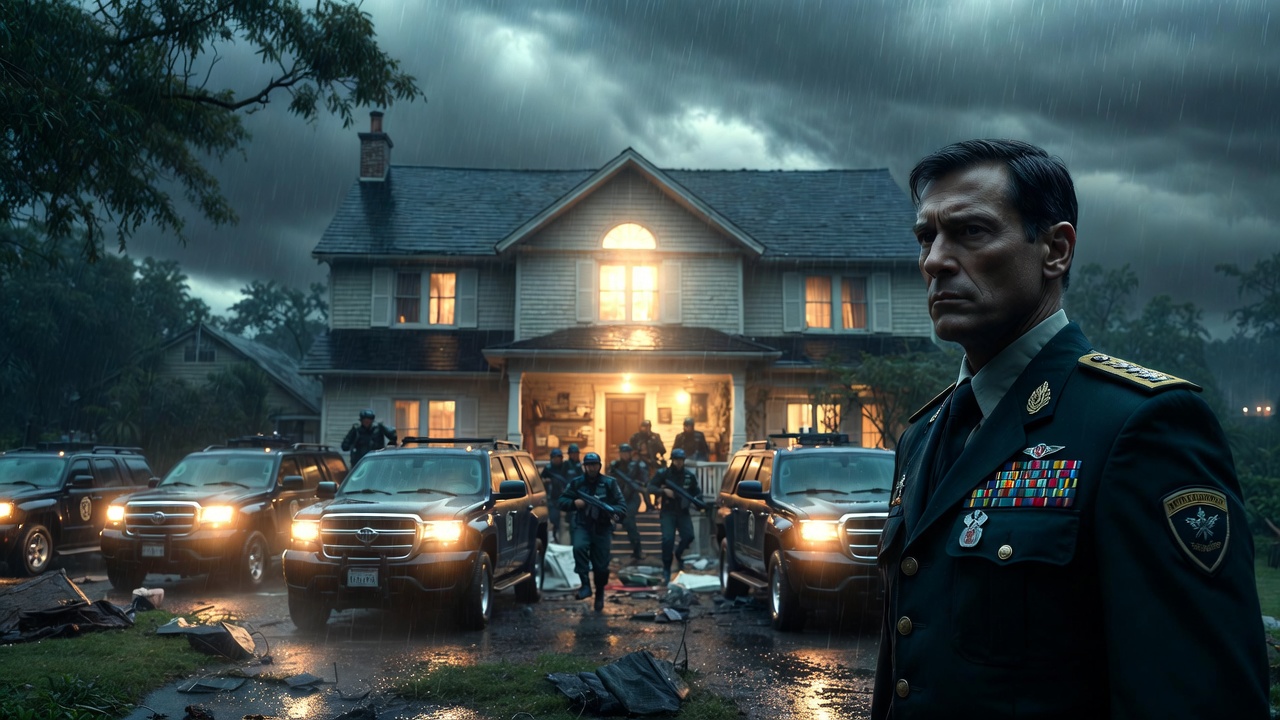
As the last of my tactical gear was loaded into Miller’s truck, a black-and-white cruiser pulled up. The officer got out, looking at the crowd of nearly fifty people standing on the lawn.
He saw the veterans. He saw the medals pinned to vests. He saw me, leaning on my cane, holding the flag that had flown over our outpost in Kandahar.
The officer walked up to Sarah, who ran to him, sobbing about “trespassers” and “theft.”
The officer looked at the open duffel bag on the driveway, the one she’d thrown. He saw the prosthetic limb sticking out. He looked at Sarah, then at Mark, who was trying to hide in the kitchen.
“Ma’am,” the officer said, his voice echoing in the evening air. “This man is a hero. You threw his life into the street. According to the law, he has a right to his belongings. And according to my conscience, you’re lucky these men are more disciplined than I am.”
He turned to me and snapped a sharp, crisp salute. “Where to, Sergeant?”
“To a new start,” I said, my voice finally finding its strength.
But as I turned to leave, I saw something in the corner of the garage. It was an old wooden chest. My father’s chest. Sarah had told me it was lost in the move two years ago.
“Wait,” I said.
I walked toward it. Sarah tried to block me. “That’s mine now! It was left in the house!”
“Move, Sarah,” I said. It wasn’t a plea. It was a command.
She saw something in my eyes she’d never seen before—the ghost of the man who survived an IED. She stepped back.
I opened the chest. Inside weren’t just old photos. There were documents. Legal folders. Sarah’s eyes went wide. She lunged for them, but Miller caught her arm gently but firmly.
“Let’s see what’s so important,” Miller said.
I pulled out a folder. It was a life insurance policy and a power of attorney—but the dates were wrong. She had forged my signature while I was in a medically induced coma, redirecting my disability backpay into a private offshore account in her name.
The silence that followed was like a bomb going off.
Chapter 5
The police officer stepped forward, his face hardening. “Let me see those, son.”
He scanned the papers. The smirking man in the house, Mark, suddenly bolted for the back door. Two veterans who had been “scouting” the perimeter caught him before he reached the fence.
“Fraud, embezzlement, and identity theft,” the officer muttered, looking at Sarah. “You didn’t just throw him out. You robbed a wounded soldier while he was fighting for his life.”
Sarah collapsed onto the porch steps, the same steps she’d used to humiliate me an hour ago. The “half a man” comment felt like a lifetime ago. She looked small. Shriveled.
“I was lonely!” she wailed. “You were gone for months! Then you came back… broken! I deserved a normal life!”
“You deserved a man like Elias,” her father, Jim, said, his voice thick with tears. “But he never deserved a woman like you.”
The officer pulled out his handcuffs. “Sarah Jenkins, you’re under arrest.”
As they led her to the car, the neighborhood stood in total silence. The irony was suffocating. She had tried to shame me in front of the world, and instead, the world had watched her soul get stripped bare.
I looked at the house. It was just a shell now. Wood and brick.
“Elias,” Miller said, clapping a hand on my shoulder. “We’ve got a room set up for you at the ranch. Plenty of space, plenty of brothers. And we start your real recovery tomorrow. No more hiding.”
I looked at the crowd. These people—some I knew, some I didn’t—had formed a circle around me. They weren’t looking at my missing leg. They weren’t looking at my scars. They were looking at me like I was the most important person on earth.
Chapter 6
Six months later.
I sat on the porch of the Veterans’ Ranch in the foothills of the Appalachians. The air was clean, smelling of pine and woodsmoke. My new prosthetic felt like a part of me now, thanks to the specialized trainers Miller had found.
I looked at my phone. A news clip was going viral. It wasn’t about my divorce or the fraud case, though Sarah was currently serving a three-year sentence.
The video was of that day on the driveway. A neighbor had filmed the moment the veterans arrived. The caption read: The Shield That Never Breaks.
I realized then that Sarah was right about one thing: I wasn’t the same man I was before the war. I was different. I was forged.
I stood up, walking without the cane, feeling the solid earth beneath me. A group of young vets, fresh from their own battles, were arriving at the gate. They looked lost. They looked like I did six months ago—shattered and discarded.
I straightened my shirt and walked down the steps to meet them.
I wasn’t “half a man.” I was a man who had been broken down and rebuilt with a foundation made of brothers, neighbors, and a community that refused to let a flame go out.
I reached out my hand to the first young soldier stepping off the bus.
“Welcome home, brother,” I said, and for the first time in years, I meant it.
The greatest rescue mission isn’t the one that pulls you out of a trench; it’s the one that pulls you back into the light.