The Dead Billionaire Left Everything to His Perfect Son, Until a Scarred Boy Walked in with One Photo That Proved the Entire Empire Was Built on a Lie
The air inside St. Jude’s Cathedral tasted like expensive incense, old money, and collective hypocrisy. It was the kind of silence that only hundreds of millions of dollars could buy—heavy, performative, and perfectly curated. Arthur Vance, the titan of Vanguard Shipping, was dead.
In the front row sat Marcus Vance, the golden heir, looking every bit the part of the grieving successor in his bespoke charcoal suit. Next to him was Eleanor, Arthur’s longtime executive assistant, her eyes darting nervously toward the back doors as if she expected the ghosts of Vanguard’s past to walk through them.
Then, the heavy oak doors groaned open.
The rhythmic clicking of cameras sputtered and died. The priest stopped mid-sentence, his Latin liturgy hanging frozen in the chilly air.
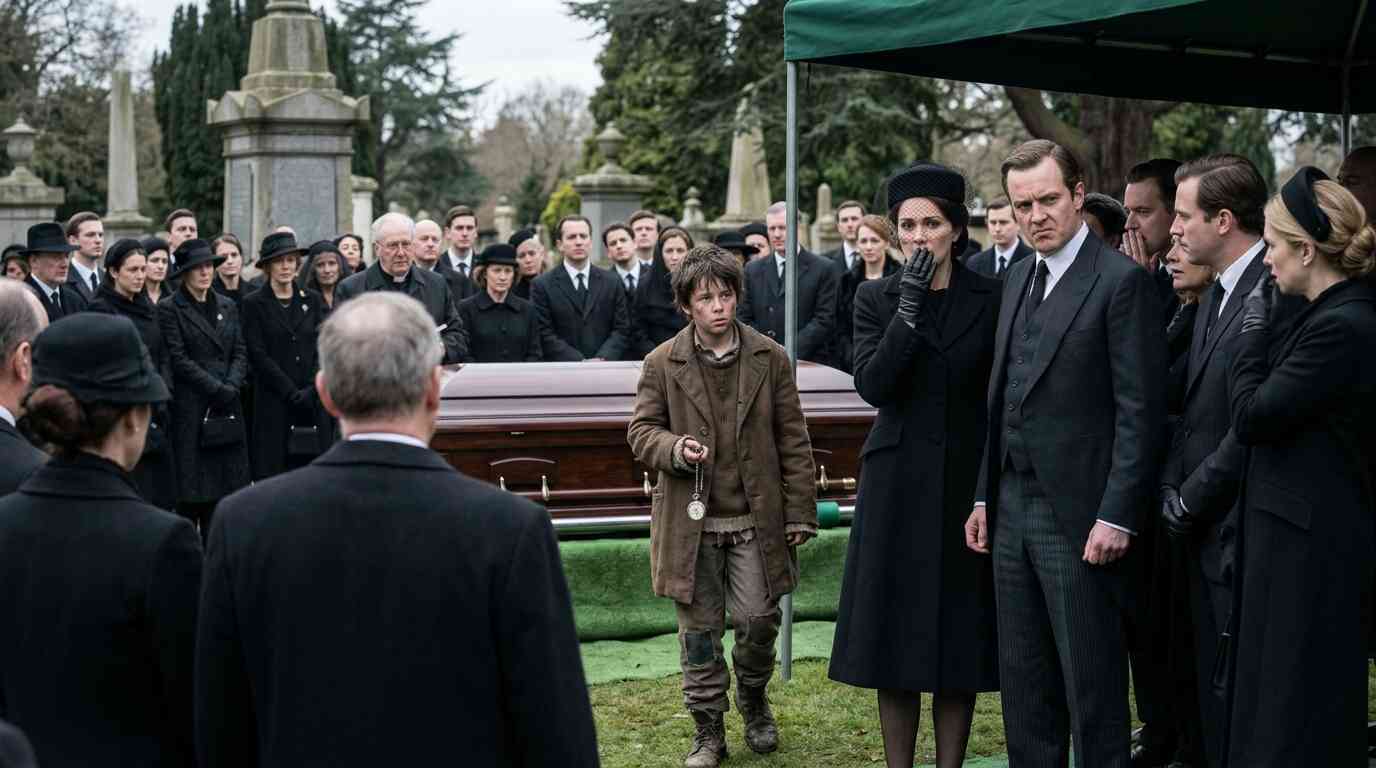
He didn’t belong in a place like this. He wore an oversized, frayed canvas jacket that smelled faintly of damp asphalt and woodsmoke. His shoes were splitting at the soles, held together by grime and sheer willpower. But it was his face that made the socialites gasp and draw back into their velvet pews. A jagged, silver-white burn scar tore across his left cheek, pulling the corner of his mouth into a permanent, tragic tilt.
He was nineteen, maybe twenty, but his eyes carried the ancient, freezing exhaustion of a man who had died a thousand times over on the concrete streets of Chicago.
Julian stepped past the velvet ropes. The red carpet beneath his boots felt absurdly soft, like walking on moss after a lifetime of gravel. Two towering bodyguards in earpieces immediately stepped into the aisle, their hands moving instinctively toward their jackets.
“Hold on,” Marcus’s voice cut through the cavernous room, smooth and sharp as a scalpel. He didn’t stand up. He just looked back, his expression a calculated mix of pity and disgust meant for the reporters in the gallery. “If you’re looking for the soup kitchen, kid, it’s three blocks down. Don’t disrespect my father’s memory.”
Julian didn’t blink. He kept walking, his steps slow and deliberate, until he was standing just ten feet from the polished mahogany casket. The silver handles glinted under the stained-glass windows, mocking the darkness he had lived in for a decade.
“I’m not here for a handout, Marcus,” Julian said. His voice was a raspy whisper, damaged by old smoke, but it carried to the highest vaulted ceilings of the church.
He raised his right hand. It was trembling, rough and calloused from winters spent sleeping under highway overpasses. Pinched between his dirty fingers was a faded, water-damaged photograph. The edges were peeling, but the image was unmistakable: a younger, laughing Arthur Vance standing in a modest backyard, holding a little boy with a flawless, unscarred face on his shoulders.
Julian held the picture high, forcing the flashing cameras to catch the contrast between the boy in the frame and the broken young man standing in the aisle.
“If this man died a saint,” Julian whispered, his eyes locking onto Marcus’s suddenly pale face, “then why was I erased?”
Full story in the first comment…
👇If you don’t see the new chapter, tap “All comments”.
FULL STORY
Chapter 1
The air inside St. Jude’s Cathedral tasted like expensive incense, old money, and collective hypocrisy. It was the kind of silence that only hundreds of millions of dollars could buy—heavy, performative, and perfectly curated. Arthur Vance, the titan of Vanguard Shipping, was dead.
In the front row sat Marcus Vance, the golden heir, looking every bit the part of the grieving successor in his bespoke charcoal suit. Next to him was Eleanor, Arthur’s longtime executive assistant, her eyes darting nervously toward the back doors as if she expected the ghosts of Vanguard’s past to walk through them.
Then, the heavy oak doors groaned open.
The rhythmic clicking of cameras sputtered and died. The priest stopped mid-sentence, his Latin liturgy hanging frozen in the chilly air.
He didn’t belong in a place like this. He wore an oversized, frayed canvas jacket that smelled faintly of damp asphalt and woodsmoke. His shoes were splitting at the soles, held together by grime and sheer willpower. But it was his face that made the socialites gasp and draw back into their velvet pews. A jagged, silver-white burn scar tore across his left cheek, pulling the corner of his mouth into a permanent, tragic tilt.
He was nineteen, maybe twenty, but his eyes carried the ancient, freezing exhaustion of a man who had died a thousand times over on the concrete streets of Chicago.
Julian stepped past the velvet ropes. The red carpet beneath his boots felt absurdly soft, like walking on moss after a lifetime of gravel. Two towering bodyguards in earpieces immediately stepped into the aisle, their hands moving instinctively toward their jackets.
“Hold on,” Marcus’s voice cut through the cavernous room, smooth and sharp as a scalpel. He didn’t stand up. He just looked back, his expression a calculated mix of pity and disgust meant for the reporters in the gallery. “If you’re looking for the soup kitchen, kid, it’s three blocks down. Don’t disrespect my father’s memory.”
Julian didn’t blink. He kept walking, his steps slow and deliberate, until he was standing just ten feet from the polished mahogany casket. The silver handles glinted under the stained-glass windows, mocking the darkness he had lived in for a decade.
“I’m not here for a handout, Marcus,” Julian said. His voice was a raspy whisper, damaged by old smoke, but it carried to the highest vaulted ceilings of the church.
He raised his right hand. It was trembling, rough and calloused from winters spent sleeping under highway overpasses. Pinched between his dirty fingers was a faded, water-damaged photograph. The edges were peeling, but the image was unmistakable: a younger, laughing Arthur Vance standing in a modest backyard, holding a little boy with a flawless, unscarred face on his shoulders.
Julian held the picture high, forcing the flashing cameras to catch the contrast between the boy in the frame and the broken young man standing in the aisle.
“If this man died a saint,” Julian whispered, his eyes locking onto Marcus’s suddenly pale face, “then why was I erased?”
The silence that followed was suffocating. Marcus stood up slowly, the fabric of his trousers falling perfectly into place. He was a man built on control, trained from birth to manage crises, but a tiny, frantic muscle twitched beneath his left eye. He looked at the photograph, then at Julian’s scarred face, and for a fraction of a second, a shadow of ancient terror crossed his features.
“Security,” Marcus said, his tone dropping an octave, losing its public warmth. “Remove this vagrant. He’s clearly delusional.”
Before the guards could grab Julian’s shoulders, Eleanor gasped, her hand flying to her mouth. She stared at the faded photograph, her eyes wide with a recognition she had spent ten years trying to bury. “Marcus… wait,” she breathed, her voice carrying just enough weight to make the guards hesitate.
Julian didn’t run. He stood his ground, the cold draft from the open doors whipping through his thin jacket, a living specter at a feast of thieves.
To understand the fire that ruined Julian’s face, one had to understand the coldness of the man lying in the mahogany box. Arthur Vance hadn’t always been a billionaire. Twenty years ago, he was a ruthless, mid-level logistics manager with an insatiable hunger and two families. There was the official family—his high-society wife and their brilliant, polished son, Marcus. And then there was the shadow family, hidden away in a crumbling triplex on the industrial fringes of Gary, Indiana.
Julian remembered that triplex. He remembered the smell of cheap pine cleaner, the sound of the freight trains rattling the windowpanes at 3:00 AM, and the soft, tired laugh of his mother, Sarah. Most of all, he remembered the rare weekends when Arthur would visit. To five-year-old Julian, Arthur wasn’t a titan of industry; he was a larger-than-life figure who brought expensive toys, smelled of rich tobacco, and promised that one day, they wouldn’t have to hide anymore.
“We’re going to have a big house, Jules,” Arthur would whisper, tucking him into a bed that smelled of damp walls. “With a yard so big you can run until your legs ache. Just give Daddy a little more time to fix things.”
But Arthur didn’t fix things. He optimized them.
When Julian was nine, the shipping empire took off. Arthur’s legitimate father-in-law passed away, leaving him sole control of the board. The shadow family was no longer just an indiscretion; they were a massive liability, a multi-million-dollar scandal waiting to detonate in the press. Arthur’s solution was swift, silent, and brutal. The monthly checks stopped. The phone lines were disconnected.
Sarah, desperate and broke, tried to confront Arthur at his corporate headquarters. She was humiliated by security, thrown out into the rain, and told that if she ever came back, the state would take her child away. She retreated to the Gary triplex, her spirit broken, turning to cheap gin to dull the ache of abandonment.
Then came the night of October 14th.
Julian remembered the heat first. It didn’t start like a normal fire; it exploded from the basement, a roaring wall of chemical-fueled orange that swallowed the stairs in seconds. He remembered his mother’s screams, thick with panic and alcohol, as she tried to drag him toward the window. The ceiling collapsed, a heavy, burning beam pinning her to the floorboards.
“Run, Julian! Don’t look back! Run!”
Those were her last words. When Julian tried to pull her free, a shower of sparks and melting insulation rained down onto his face. The pain was an agonizing, white-hot scream that consumed his entire reality. He remembered tumbling through a broken second-story window, landing hard on the frozen mud below, watching the only home he had ever known turn into a funeral pyre.
The police report called it an accidental electrical fire caused by faulty wiring in a neglected rental unit. The case was closed in forty-eight hours. No one asked why the landlord vanished the next day, or why a Vanguard Shipping corporate vehicle had been spotted idling down the street just an hour before the first spark.
Julian woke up in a county hospital three weeks later, half his face wrapped in thick, sterile gauze. There were no flowers. No visitors. Only a cold, gray social worker who told him his mother was gone, and that he was being entered into the state foster system.
When he finally looked in a mirror, he didn’t see a child anymore. He saw a monster. A scarred, discarded remnant of a life someone had paid very good money to incinerate.
Now, ten years later, standing in the center of St. Jude’s, Julian looked at Marcus. The golden boy. The brother who had slept in silk sheets while Julian slept on concrete loading docks, wrapping his face in dirty scarves to hide his scars from the predators of the night.
“You know exactly who I am, Marcus,” Julian said, his voice hardening, losing its trembling edge. “And so does Eleanor. Look at her. She remembers typing the non-disclosure agreements. She remembers the hush money.”
The reporters in the balcony were in a frenzy now, the shutters of their cameras sounding like a flock of metallic birds. Marcus’s face turned a dangerous, mottled red. He took three long strides down the altar steps, stopping just inches from Julian. The scent of Marcus’s cologne—expensive sandalwood—hit Julian, triggering a sudden, violent flashback to his father’s coat.
“I don’t know what kind of scam you’re running, but you’re going to prison for this,” Marcus hissed, his voice low enough to escape the microphones but loud enough for Julian to hear the malice dripping from every syllable. “My father was a great man. You’re a piece of street trash trying to extort a grieving family. Get him out of here!”
The guards grabbed Julian’s arms, twisting them behind his back with brutal efficiency. The faded photograph slipped from his fingers, fluttering face-down onto the red carpet.
Julian didn’t fight them. He let them drag him backward down the aisle, his boots scuffing the pristine fabric. But as he reached the massive oak doors, he lifted his head, his scarred face illuminated by the gloomy Chicago sky outside.
“The fire didn’t finish the job, Marcus!” Julian shouted, a raw, unyielding declaration that echoed through the holy space. “And neither will you!”
Chapter 2
The holding cell at the 1st Precinct smelled of old sweat, industrial bleach, and despair. Julian sat on the cold steel bench, his knees pulled tight against his chest, staring at the floor. The guards had taken his shoelaces and his belt, but they couldn’t take the memory of Marcus’s terrified eyes. For ten years, Julian had been a ghost, a shadow slipping through the alleyways of the city, noticed only when people wanted to avoid him. But today, he had been seen.
The heavy iron door of the cell block buzzed open, the sound scraping against Julian’s frayed nerves. A guard stepped to the bars, his expression indifferent. “Vance, get up. Your lawyer posted bail.”
Julian frowned, slowly lowering his legs. “I don’t have a lawyer. I don’t have a dime.”
“Tell it to the lady waiting out front,” the guard grunted, unlocking the cell door with a loud clank.
When Julian walked into the sterile, fluorescent-lit waiting room of the precinct, he expected to see a public defender with a cheap briefcase and an oversized suit. Instead, sitting on the plastic chairs was Eleanor. She looked smaller outside the grandeur of the cathedral, her expensive wool coat wrapped tightly around her as if she were freezing in the climate-controlled room.
She stood up immediately when she saw him, her eyes tracking the silver scar on his cheek. A profound, heavy sorrow settled into the lines of her face. “Hello, Julian,” she said softly.
Julian stopped five feet away from her, his posture defensive, his muscles tense. “What are you doing here? Did Marcus send you to buy me off? Tell him the price just went up.”
“Marcus doesn’t know I’m here,” Eleanor said, her voice trembling slightly. She looked around the precinct, leaning closer. “If he finds out, I lose my pension, my apartment… everything. But I couldn’t sit by and watch them do it to you again. Not after what happened in Gary.”
Julian’s eyes narrowed into slits. “You knew about the fire.”
“I knew your father was desperate,” Eleanor whispered, tears welling in her eyes. “I didn’t know how far he would go until it was too late. Come with me. Please. Before Marcus’s people realize I used a private account to get you out.”
They walked out into the biting Chicago wind, the sky a bruised purple as evening settled over the city. Eleanor led him to a modest sedan parked down the block. Julian sat in the passenger seat, feeling entirely out of place against the clean fabric and the smell of vanilla air freshener.
Eleanor drove without speaking for ten minutes, navigating away from the downtown core toward a quiet, working-class neighborhood. Finally, she pulled into the driveway of a small bungalow and turned off the engine. She gripped the steering wheel, her knuckles white.
“Your father loved your mother, Julian. In his own twisted, selfish way, he did,” Eleanor began, her voice cracking. “But he loved power more. When Marcus’s mother threatened to take half the company and ruin the Vanguard name in a public divorce, Arthur panicked. He told me he was going to ‘relocate’ you and Sarah. He said he had bought a house for you in Arizona under a different name.”
Julian let out a harsh, bitter laugh. “The house in Arizona was made of gasoline and matches, Eleanor.”
“I didn’t know!” she cried, turning to face him, the tears finally spilling over. “I swear to God, Julian, I didn’t know about the fire until I saw the news report the next morning. When I confronted Arthur, he looked me dead in the eye and told me that if I ever breathed a word to the police, I’d end up just like Sarah. He was a monster when he was cornered.”
“And Marcus?” Julian asked, his voice cold as ice. “Where was the golden boy when his father was burning a nine-year-old kid alive?”
Eleanor swallowed hard, her gaze dropping to her lap. “Marcus wasn’t an innocent bystander, Julian. He was nineteen at the time, already working in the logistics division. He was the one who signed the work order for the Vanguard corporate vehicle that was seen in Gary that night. He didn’t just know about it. He helped clear the paper trail.”
The revelation hit Julian like a physical blow. He had always assumed Arthur was the sole architect of his misery, but Marcus had his hands on the shovel too. The anger that had sustained Julian for a decade, the slow-burning ember in his chest, suddenly erupted into a raging inferno.
“Where is the paperwork now, Eleanor?” Julian demanded, his hand gripping the dashboard so hard the plastic groaned. “The original files. The work orders. There has to be a record.”
“Arthur kept everything,” Eleanor whispered. “He didn’t trust anyone, not even Marcus. He kept a shadow ledger—a black binder containing every off-the-books transaction, every payoff, and the true ownership documents of the Gary triplex. It’s locked in the private safe at the Vance estate in Lake Forest.”
“Then that’s where I’m going,” Julian said, reaching for the door handle.
“Julian, wait!” Eleanor grabbed his jacket sleeve. “You can’t just walk in there. The funeral reception is happening there right now. The house is crawling with security, politicians, and police. Marcus is preparing to announce his official takeover of the company tonight. If you show up, he’ll have his men kill you and call it self-defense. He’s already looking for you.”
Julian looked at his reflection in the dark passenger window. The silver scar stared back at him, a permanent reminder of what he had lost.
“He already killed me once, Eleanor,” Julian said softly, pulling away from her grip. “The only difference is, this time, I’m bringing the fire to him.”
Chapter 3
The Vance estate in Lake Forest was a sprawling, stone fortress hidden behind wrought-iron gates and ancient oak trees. Tonight, the mansion was ablaze with light, its long driveway choked with black town cars and luxury SUVs. Inside, the elite of Chicago’s business world sipped vintage champagne, offering hollow condolences to Marcus Vance while securing their own financial futures.
Julian stood in the tree line at the edge of the property, the cold mud soaking through his worn boots. He had spent the last two hours observing the security patrols. They were professional, but they were focused on the front entrance and the main driveway. No one expected an intruder to scale the steep, rocky ravine at the back of the estate—the side that faced the freezing waters of Lake Michigan.
Julian’s hands were raw and bleeding by the time he reached the top of the ravine. He slipped through a side gate, blending into the shadows of the extensive manicured gardens. He knew the layout of the house; Eleanor had described it in vivid detail during their drive. Arthur’s private study was on the second floor, accessible via a service staircase near the kitchen.
As he approached the glass French doors of the sunroom, Julian paused. Through the glass, he could see Marcus standing in a circle of men in tailored suits. Marcus was laughing—a genuine, unburdened laugh—while holding a crystal tumbler of scotch. The sight made Julian’s stomach turn. His mother was in an unmarked grave in a state cemetery, and this man was celebrating his ascension to a throne built on her ashes.
Julian waited until a catering staff member opened the side door to carry out a tray of empty glasses. Slipping inside with the practiced stealth of a street survivor, Julian moved past the chaotic, high-stress environment of the kitchen. The staff were too busy managing a hundred wealthy guests to notice a young man in a dark hoodie slipping up the back stairs.
The second floor was entirely different—quiet, dimly lit, and carpeted in thick wool that muffled his footsteps. Julian found the heavy mahogany door to Arthur’s study at the end of the hall. He turned the brass handle; it was locked.
Julian reached into his pocket and pulled out a rusted, heavy screwdriver he had stolen from a construction site on his way here. He jammed the flat head into the door frame, using his body weight to lever the lock. With a sharp, wooden crack that sounded like a gunshot to his racing pulse, the latch gave way.
He slipped into the room and shut the door behind him. The study was massive, lined with leather-bound books and oil paintings of Vanguard ships. In the corner sat a heavy, antique desk, and behind a painting of a storm at sea was the wall safe Eleanor had described.
Julian moved the painting aside, his fingers tracing the cold steel of the electronic keypad. Eleanor had given him the code—a sequence of numbers Arthur had used for everything, a sequence that made Julian’s blood run cold when he realized what it was: the date of the fire in Gary. 101406.
Julian punched in the numbers. The safe gave a low, mechanical click, and the heavy door swung open.
Inside were stacks of bonds, cash, and velvet boxes of jewelry. But Julian didn’t care about the wealth. At the very bottom of the safe lay a thick, black leather binder with no markings. He pulled it out, flipping through the pages under the dim light of his phone screen.
There it was.
The title deed to the Gary property, listed under a shell corporation owned entirely by Arthur Vance. A series of internal memos detailing the “disposal of liabilities” signed by Arthur. And finally, a scanned copy of a maintenance request from October 14th, authorizing a Vanguard technician to “override safety breakers” at the Gary address. At the bottom of that page, written in bold, confident ink, was the signature of approval: Marcus Vance.
“It’s beautiful, isn’t it?”
The voice came from the dark corner of the room, smooth, confident, and completely devoid of warmth.
Julian spun around, his heart slamming against his ribs. Marcus stepped out from the shadows, a sleek, silver-plated handgun held loosely in his right hand. He wasn’t smiling anymore. His face was a mask of cold, aristocratic fury.
“I knew Eleanor would break,” Marcus said, taking a slow step forward. “She always had a soft spot for my father’s mistakes. I had her followed the moment she left the precinct. I knew she’d send you right to me.”
Julian gripped the black binder against his chest, his eyes locking onto the barrel of the gun. “You signed the order, Marcus. You burned a nine-year-old kid’s house down. You killed my mother.”
Marcus shrugged, an casual, indifferent movement of his shoulders. “It was business, Julian. My mother built Vanguard with her family’s capital. Your mother was a cocktail waitress who thought she’d struck gold. If my father’s little secret had come out during the merger, the company would have collapsed. Thousands of people would have lost their jobs. It was a simple calculation: one insignificant life to save an empire.”
“An insignificant life?” Julian’s voice cracked, the raw pain of a decade of loneliness exploding into the room. “She loved him! I was his son!”
“You were a mistake,” Marcus hissed, his eyes narrowing. “A genetic error that should have been erased ten years ago. And tonight, I’m going to correct my father’s failure to finish the job.”
Marcus raised the gun, aligning the sights with Julian’s chest. The ambient noise of the party downstairs—the clinking of glasses, the muffled laughter—seemed to fade away, leaving only the sound of Julian’s heavy, ragged breathing.
Chapter 4
Julian didn’t look at the gun. He looked into Marcus’s eyes, searching for a single shred of humanity, a flicker of remorse. He found nothing but the cold, calculating vacancy of a shark.
“You think you can just shoot me and walk back down to your party?” Julian asked, his voice dropping to a terrifyingly calm register. “There are a hundred reporters outside, Marcus. The whole city saw me at the funeral.”
“They saw a crazy, scarred homeless kid trying to extort a grieving family,” Marcus countered, a cruel smirk playing on his lips. “When the police find you up here, dead with a stolen screwdriver and a safe full of cash in your backpack, it won’t be a murder investigation. It’ll be a tragic case of a desperate junkie breaking into the wrong house. The Vance name stays clean. It always does.”
Marcus tightened his finger on the trigger.
In that fraction of a second, Julian didn’t see his own death. He saw the roaring flames of the Gary triplex. He smelled the melting plastic. He heard his mother’s final scream telling him to run. He hadn’t survived that inferno just to die in a carpeted room in Lake Forest.
With a primal yell, Julian launched himself forward, throwing the heavy black binder straight at Marcus’s face.
The gun roared, a deafening blast in the enclosed room. The bullet grazed Julian’s shoulder, tearing through his hoodie and drawing a line of hot pain across his skin, but the impact of the heavy binder caught Marcus square in the nose. Marcus stumbled backward, his vision blurring, his weapon wavering.
Julian didn’t hesitate. He tackled Marcus around the waist, slamming the older brother into the heavy mahogany desk. Crystal inkwells shattered, spilling dark blue ink across the expensive wood. Marcus snorted in pain, blood pouring from his broken nose, but his grip on the gun remained tight. He swung the butt of the pistol into the side of Julian’s head, striking the silver scar.
Julian fell to the floor, his vision spinning, the taste of copper flooding his mouth. Through the ringing in his ears, he could hear footsteps sprinting up the stairs downstairs. The gunshot had alerted the security team.
“Get up,” Marcus growled, wiping the blood from his mouth with the back of his sleeve, his face distorted with rage. He stood over Julian, raising the gun once more. “Get up so I can watch you die.”
The door to the study burst open.
It wasn’t the security guards. It was Eleanor, her hair disheveled, her coat gone. Behind her stood Detective Miller, a gruff, veteran Chicago homicide investigator whom Eleanor had spent the last two hours convincing to follow her. Behind them were three uniformed officers, their weapons drawn.
“Drop the weapon, Mr. Vance!” Miller bellowed, his voice cutting through the chaos. “Drop it now!”
Marcus froze, his arm extended, the gun pointed directly at Julian’s head. For three agonizing seconds, the room hung in a terrifying stasis. Marcus looked at the police, then at Eleanor, and finally down at Julian, who lay bleeding on the floor, his fingers still clutching a stray page from the binder that had fallen during the struggle.
The calculated, perfect facade of Marcus Vance crumbled in real-time. His eyes darted around the room, realization sinking in: there were too many witnesses now. The narrative was out of his control.
Slowly, deliberately, Marcus lowered the gun and set it on the desk. He raised his hands, his voice returning to its smooth, detached cadence. “Detective, thank god you’re here. This man broke into my father’s safe. He attacked me. I was defending myself.”
Detective Miller didn’t look at Marcus. He walked past him, kneeling down beside Julian. He looked at the jagged scar on the young man’s face, then down at the page Julian was holding—the maintenance order with Marcus’s signature authorizing the override of the safety breakers.
Miller picked up the page, reading it carefully. He looked up at Marcus, his expression grim. “Mr. Vance, you have the right to remain silent. Officers, cuff him.”
“What?” Marcus barked, his voice cracking into a high-pitched panic as the uniformed officers stepped forward with zip-ties. “Are you insane? Do you know who I am? I am the CEO of Vanguard Shipping!”
“I don’t care if you’re the King of England,” Miller said, standing up and pulling Julian to his feet. “This paperwork says you’re a suspect in a double arson and first-degree murder investigation from 2016. Move.”
As the officers dragged Marcus out of the room, his frantic protests echoing down the long, elegant hallway, Julian leaned against the desk, his body shaking with exhaustion and pain. Eleanor stepped forward, wrapping a warm, trembling arm around his shoulders.
“It’s over, Julian,” she whispered, her tears soaking into his jacket. “It’s finally over.”
Julian looked down at the black binder lying open on the floor. The pages were smeared with Marcus’s blood and Arthur’s ink. The empire hadn’t collapsed from an external force; it had rotted from the inside out, and the truth had finally broken through the concrete.
Chapter 5
The weeks following the raid on the Vance estate were a media circus. The headline “The Billionaire’s Burned Secret” dominated every news outlet from coast to coast. The image of Julian—scarred, unyielding, and standing on the steps of the Cook County Courthouse—became an overnight symbol of the forgotten victims of corporate greed.
Vanguard Shipping’s stock plummeted sixty percent in forty-eight hours. The board of directors scrambled to distance themselves from the Vance family, launching internal audits that revealed a decade of illegal payoffs, hush money, and environmental violations. The empire was dismantling itself, one corrupted brick at a time.
Marcus Vance sat in a maximum-security cell at Cook County Jail, denied bail due to his immense wealth and flight risk. The state prosecutor was building a airtight case of conspiracy to commit arson, murder, and corporate fraud. The golden boy who had never known a day of discomfort was now facing life without the possibility of parole.
For Julian, the victory didn’t feel like a celebration. It felt like a long-overdue exhale after holding his breath for ten years.
He spent those weeks in a quiet apartment rented for him by Eleanor, who had turned state’s witness in exchange for immunity. For the first time in his adult life, Julian had a bed with clean sheets, a refrigerator full of food, and a door that locked from the inside. Yet, every night, he woke up at 3:00 AM, his heart pounding, expecting to hear the rattle of the Gary freight trains or the roar of approaching flames.
One crisp November morning, Detective Miller visited the apartment. He looked tired, his trench coat smelling of stale coffee and cigarettes, but his eyes were kind. He placed a small, manila envelope on the kitchen table.
“We finished processing the evidence from Arthur’s safe,” Miller said, taking a seat across from Julian. “The state is keeping the ledger for the trial, but I found this tucked into the back cover. It wasn’t listed on the official evidence manifest. I thought you should have it.”
Julian reached out, his scarred hand hovering over the envelope before opening it. He slid the contents out onto the table.
It was a bankbook, issued by a small savings and loan association in Indiana, dated two weeks before the fire. The account was in Julian’s name, with Sarah listed as the custodian. The initial deposit was substantial—half a million dollars—but what caught Julian’s eye was the small, handwritten note tucked between the pages.
The handwriting was Arthur’s—hurried, erratic, and pressured.
Sarah, I can’t stop Marcus. He’s taken the files to the board. They’re coming for the property to force my hand. Take Julian and go to the place in Michigan we talked about. Don’t look back. I’m sorry. I’m so sorry.
Julian stared at the note, the ink blurring as tears finally filled his eyes. For ten years, he had believed his father was a calculated executioner who had actively chosen to burn him out of existence. But the truth was more pathetic, more human, and deeply tragic. Arthur wasn’t a mastermind; he was a coward. He had built a monster in Marcus—a colder, more ruthless version of himself—and when that monster took control, Arthur had been too weak to stop him.
“He tried to warn her,” Julian whispered, his voice cracking.
“He didn’t try hard enough,” Miller said gently, standing up and placing a hand on Julian’s uninjured shoulder. “A real father doesn’t hide behind a bankbook, kid. But at least you know. He didn’t want you dead. He was just too small a man to keep you alive.”
After Miller left, Julian sat alone in the quiet apartment for hours, holding the note. The anger that had defined his entire identity—the shield he had used to protect himself from the pity of the world—was gone, replaced by a profound, hollow grief. He wasn’t a shadow family’s secret anymore. He was just a boy who missed his mother.
Chapter 6
The trial of Marcus Vance never happened. Faced with a mountain of forensic evidence, Eleanor’s testimony, and the shadow ledger, Marcus’s legal team negotiated a plea deal to avoid the death penalty. He pled guilty to first-degree murder and corporate conspiracy, accepting a sentence of life imprisonment without the possibility of parole at Stateville Correctional Center.
The Vanguard empire was liquidated, its assets sold off to satisfy creditors and pay restitution to the hundreds of families Arthur and Marcus had exploited over the decades. A substantial portion of the remaining estate was legally designated for Julian—the sole surviving heir to the Vance lineage.
Julian didn’t buy a mansion in Lake Forest. He didn’t buy sports cars or expensive suits. He used the money to purchase the abandoned plot of land in Gary, Indiana, where the triplex had once stood.
On a warm spring morning, Julian stood on the property. The charred timber and twisted metal had long been cleared away, replaced by a beautifully designed, modern community center. The building was constructed of brick and glass, filled with light, music rooms, and a massive library. Above the main entrance, carved into deep, enduring stone, were the words: The Sarah Vance Memorial Shelter for Women and Children.
A small crowd had gathered for the opening ceremony—local residents, the children who would use the facility, Eleanor, and a few reporters who had followed the story from the beginning.
Julian stepped up to the modest wooden podium. He wore a simple, clean button-down shirt, his silver scar exposed to the bright morning sun. He didn’t look like a victim anymore. He looked like a man who had walked through the fire and come out the other side as iron.
He didn’t use a written speech. He looked out at the faces of the community, seeing the same exhaustion he had carried for a decade in the eyes of some of the young mothers in the front row.
“Ten years ago, a fire took everything I had,” Julian began, his voice steady, carrying clearly over the quiet neighborhood. “It took my mother, it took my home, and it took my face. For a long time, I thought the people who did it had won. I thought that if you were poor, if you were hidden, your life didn’t leave a mark on the world.”
He paused, looking down at his hands, then back up at the crowd.
“But the truth has a funny way of surviving,” he continued, a small, genuine smile touching the unscarred side of his mouth. “It can survive under concrete, it can survive in the dark, and it can survive the hottest flames. This place isn’t a monument to a billionaire’s guilt. It’s a home for the people who refuse to be erased.”
The crowd erupted into applause, a warm, resonant sound that seemed to chase away the last lingering ghosts of the old triplex.
Later that afternoon, after the guests had moved inside for the reception, Julian walked to the back of the property. He stood near a young oak tree he had planted exactly where his mother’s bedroom used to be. He reached into his pocket and pulled out the old, water-damaged photograph—the one he had held up at St. Jude’s Cathedral.
The edges were still frayed, but the image of the little, unscarred boy sitting on his father’s shoulders felt like it belonged to a different lifetime. He didn’t need the photo anymore to remind him of who he was.
Julian knelt down, digging a small hole in the rich, dark soil at the base of the oak tree. He placed the photograph inside, covering it gently with earth, smoothing it down with his palm.
He stood up, looking out at the children playing on the new green lawn of the center, their laughter filling the afternoon air. He took a deep, clean breath of the spring wind, feeling the warmth of the sun on his face, healing the old wounds from the inside out.
We are all born into stories we didn’t write, but we are the ones who choose how they end.