Instead, it became the night the past walked through the front door, wearing rags.
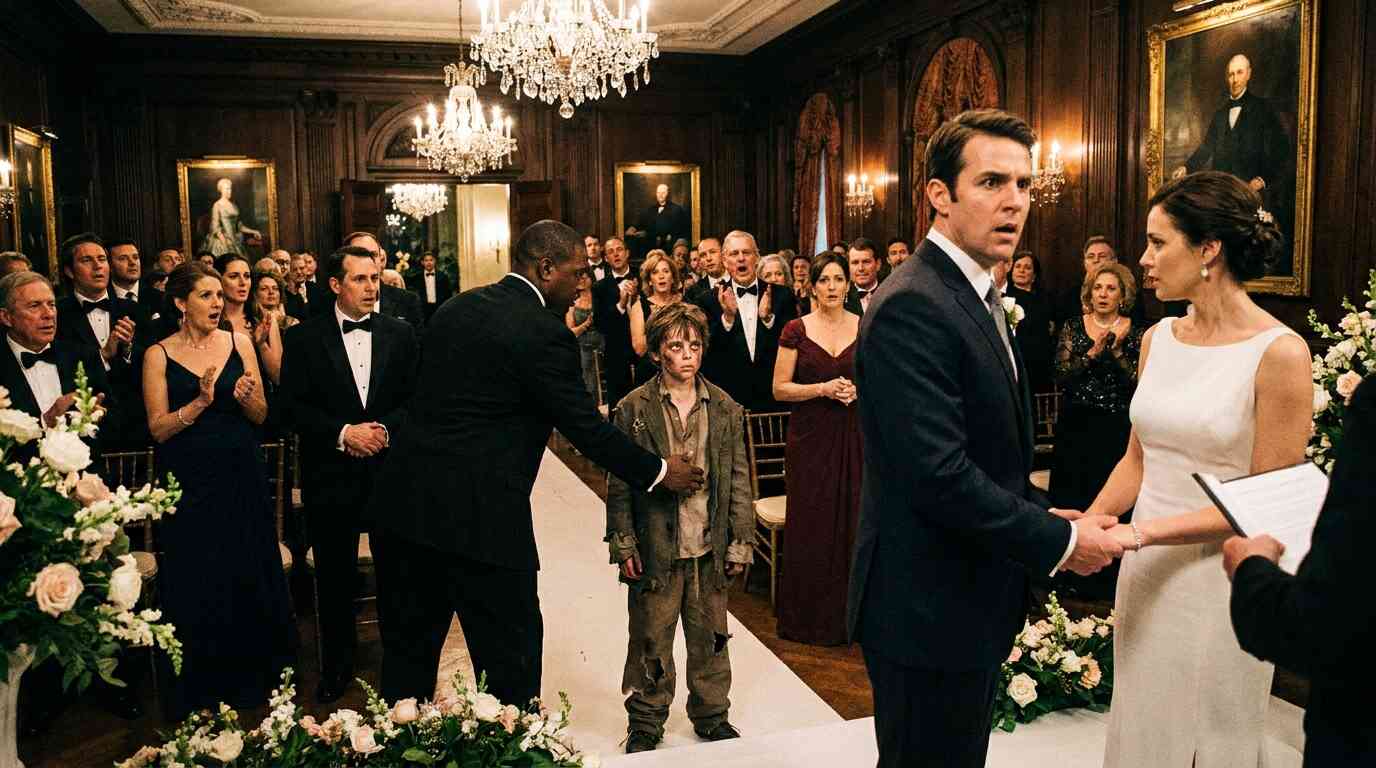
The double doors of the ballroom didn’t just open; they were slammed back against the marble walls with a heavy, echoing thud that cut straight through the classical string quartet. The music died in a ragged scrape of bows. Hundreds of heads, adorned with diamonds and custom tailored tuxedos, turned in unison toward the entrance.
Standing on the threshold of the pristine, white-marble floor was a boy. He couldn’t have been older than eight. He was breathing heavily, his chest heaving under a threadbare denim jacket that was missing a sleeve. His knees peered through jagged tears in his jeans, coated in a layer of dark, wet city grime. A stark trail of dried mud cut across his pale, sunken cheeks.
But it was his eyes that froze the room. They weren’t the eyes of a frightened child. They were burning, carrying a fierce, ancient rage that belonged to someone three times his age.
Arthur Vance stood at the apex of the room, a crystal glass of scotch held loosely in his manicured hand. The warmth of the alcohol instantly drained from his veins, leaving him cold. His heart hammered against his ribs like a trapped bird. He knew that face. He had spent five years and millions of dollars trying to pretend that face didn’t exist.
“Get him out of here,” Arthur whispered, his voice trembling so slightly that only Julian, his towering head of security standing inches away, could hear it. “Now, Julian. Don’t let him speak.”
Julian moved with terrifying, silent efficiency, his massive frame cutting through the sea of socialites like a wolf through sheep. But the boy didn’t run. He didn’t even flinch. He walked straight down the center aisle, leaving dark, muddy footprints on the imported Belgian rugs.
“Arthur!” the boy’s voice cracked through the silence, raw and desperate. “You promised!”
The crowd gasped. Whispers erupted like a swarm of hornets. The name wasn’t Mr. Vance. It was Arthur. A personal, intimate accusation thrown from the lips of a beggar.
Julian reached the boy just as he stopped three feet from the grand banquet table. The guard’s massive hand clamped down on the child’s small shoulder, squeezing hard enough to bruise, attempting to drag him backward toward the service exit.
The boy twisted violently, fighting against the crushing weight of the adult. He pointed a trembling, dirt-caked finger directly at Arthur’s chest.
“You promised you’d come back to the valley!” Leo screamed, his voice breaking as tears finally cut through the dirt on his face. “You said if we kept quiet, you’d save him! You let my daddy die in that dirt!”
Arthur felt the room spin. The edges of his vision blurred. Five years ago, in the coal-dusted valleys of Pennsylvania, a mining collapse had buried three men. Arthur had bought the silence of the families to protect his company’s stock. He had stood in a cramped, freezing kitchen and looked this exact boy in the eyes, promising him that his father would receive the best medical care, that the Vance foundation would never abandon them. Then, Arthur had signed the nondisclosure agreements, sealed the vault, and never looked back.
Until now.
Eleanor Vance, Arthur’s elegant, silver-haired mother and the true backbone of the family legacy, stepped forward. Her sharp eyes darted from the hysterical child to her son’s ghostly white face. She saw the guilt written in the lines of Arthur’s mouth.
“Julian, wait,” Eleanor commanded, her voice cutting through the panic. She turned her piercing gaze directly onto Arthur. “Arthur, look at his eyes. Who is this child? What did you do in the valley?”
“Mother, he’s a trespasser, a lunatic,” Arthur stammered, his polished public relations persona crumbling into dust. “He’s trying to extort us. Julian, remove him immediately!”
With a desperate surge of strength, the boy ripped himself away from Julian’s grip, stepping closer to the ice sculpture that threw cold, fractured light across the room. He didn’t look at the security guard. He looked only at the man who had traded his family’s lives for a corporate empire.
“You stole my father’s blood!” Leo shrieked, the words echoing off the vaulted ceilings. “You left him in the dark so you could build this house!”
The silence that followed was absolute. Nobody breathed. The guests stared at Arthur, waiting for a denial, waiting for the smooth, charismatic lie that always saved him. But Arthur couldn’t speak. His throat was tight, his mind flooded with the memory of a dark mining shaft and a dying man’s final, wheezing breath.
The boy stood his ground, his small fists clenched, his chest heaving, waiting for the truth to finally be told in the light of day.
Full story in the first comment…
👇If you don’t see the new chapter, tap “All comments”.
FULL STORY
Chapter 2
The echoes of the boy’s accusation lingered in the air, thick and suffocating. The grand ballroom, which had minutes ago been a sanctuary of wealth and celebration, now felt like a courtroom. The silence was so fragile that the sound of a single melting droplet of water falling from the ice sculpture onto the silver tray below sounded like a gunshot.
Arthur Vance felt the eyes of three hundred of Philadelphia’s most influential citizens burning into his skin. He could see his reflection in the glass walls of the mansion—his perfectly tailored tuxedo, his crisp white shirt, his immaculate hair—and for the first time in his life, he looked like a fraud to himself. His hands were shaking so violently that he had to set his crystal glass down on a passing waiter’s tray to keep it from shattering.
“Arthur,” Eleanor’s voice was lower now, a dangerous, quiet rumble that carried the weight of three generations of Vance authority. She stepped into the clearing between her son and the ragged child, her silk gown rustling softly against the marble. “I asked you a question. Who is this boy, and why is he accusing you of murder?”
“It’s not murder, Mother,” Arthur hissed, his voice cracking as he tried to regain his composure. He took a step forward, trying to use his height to intimidate the boy, but Leo didn’t move an inch. The boy stood rooted to the spot, his bare ankles red from the winter cold, his jaw set in a hard, stubborn line that Arthur recognized all too well. It was the same jawline as Thomas Miller.
“Then what do you call it?” Leo shouted, his voice ringing out, refusing to let Arthur minimize the pain. “You told my mom that if we signed the papers, the doctors would fix him. You said you had a special hospital in the city. But the moment the news trucks left our town, the checks stopped coming. The doctors stopped calling. My dad coughed blood for two years in that trailer until his heart just gave up last week!”
The crowd murmured, a rising tide of shock and judgment. Julian, the security chief, looked at Arthur, waiting for the signal to use real force, to drag the boy out by his hair if necessary. Julian was a man paid to make problems disappear, and his massive hands were clutched into fists at his sides. He had a wife and three kids in the suburbs; he didn’t care about the morality of the Vance family, only the size of his paycheck. But even Julian hesitated under the raw power of the boy’s grief.
“This is a fabrication,” Arthur said loudly, turning to face the crowd, trying to project the smooth, authoritative tone he used during quarterly earnings calls. “The Vance Energy Group has always maintained the highest safety standards. This child is clearly being manipulated by a rival firm or a disgruntled union rep to sabotage our public offering tonight. It’s a classic shake-up.”
“You’re lying!” Leo’s scream was a physical strike. He reached into the pocket of his oversized denim jacket and pulled out a crumpled, stained piece of paper. He didn’t throw it; he held it up high, his small hand shaking. “I have the letter! The one with your name on it! The one you sent after the funeral telling my mom that if she talked to the lawyers, you’d take our house too!”
Eleanor’s eyes locked onto the paper. She didn’t wait for Arthur’s permission. She walked directly to the boy, her diamond necklace catching the light, and gently took the paper from his dirt-stained fingers.
“Mother, don’t,” Arthur pleaded, reaching out to stop her, but she threw her hand up, silencing him with a single glance.
Eleanor unfolded the paper. It was printed on the heavy, embossed letterhead of the Vance Legal Group, dated four years prior. As her eyes scanned the cold, clinical language—the threats of litigation, the termination of medical stipends, the explicit orders to remain silent about the structural failures of Shaft 7—her face hardened into stone. She turned slowly to face her son, the paper trembling in her hand.
“You told me the accident at Shaft 7 was entirely due to operator error,” Eleanor said, her voice dropping to a terrifying whisper. “You told the board that the families were fully compensated. You told me you took care of them, Arthur.”
“I did what I had to do to save the company, Mother!” Arthur snapped, his frustration finally boiling over, his polished facade cracking completely. “Do you have any idea what would have happened to our stock if the federal investigators found out we skipped the structural reinforcements to hit our Q3 targets? The company would have gone under! We would have lost everything! This house, the foundation, your lifestyle—all of it would have been gone!”
The admission hung in the air, naked and ugly. The guests stared in absolute horror. The press photographers, who had been hired to cover the gala for the society pages, began lifting their cameras, the flashes exploding like miniature lightning bolts across the ballroom.
“Stop them!” Arthur roared at Julian, pointing at the photographers. “Smash those cameras! Get everyone out of here! The gala is over!”
But it was too late. The truth had broken through the gold leaf, and the empire was already beginning to bleed.
Chapter 3
The grand ballroom emptied within twenty minutes, leaving behind an eerie, cavernous silence. The half-eaten catering platters, the melting ice sculpture, and the scattered diamond jewelry left behind by fleeing socialites made the space look like the ruins of a collapsed civilization.
Only four people remained in the center of the room: Arthur, Eleanor, Leo, and Julian, who stood by the exit like a silent gargoyle.
Arthur was pacing back and forth across the marble, his hands buried deep in his pockets. His collar was undone, his bow tie hanging limply around his neck like a noose. The financial news channels on the massive wall-mounted screens were already running breaking news banners: Vance Energy IPO Halted Amid Corruption Accusations.
“We can fix this,” Arthur muttered, his voice manic as he stared at the floor. “We buy them off. We find the mother. What’s her name? Sarah. Sarah Miller. We offer her five million, ten million. Whatever it takes for her to release a statement saying the boy is confused, that the letter was a forgery. We can spin this. We just need to control the narrative.”
“The narrative is dead, Arthur,” Eleanor said. She was sitting on a velvet sofa, her posture still perfectly straight, but she looked older now, the lines around her eyes deeper than they had been an hour ago. “You didn’t just lie to the public. You lied to me. You used your father’s legacy to bury a family in the dirt.”
“Don’t give me a lecture on morality now, Mother!” Arthur shouted, spinning around to face her, his face flushed with anger. “Where do you think the money for your art gallery came from? Where do you think the funding for your charity galas came from? It came from Shaft 7! It came from the choices I made to keep this family at the top of the food chain! You didn’t complain about the methods when the dividends hit your account every month!”
Eleanor winced, the blow hitting its mark. She looked down at her hands, the heavy diamond rings suddenly feeling like lead weights. She had spent her entire life cultivating an image of grace and philanthropy, but she had never questioned where the wealth came from. She had allowed herself to be blind because the blindness was comfortable.
Meanwhile, Leo was sitting on the edge of a gold-trimmed chair, his small legs dangling, looking completely out of place against the luxury fabric. He was shivering now that the adrenaline of his entrance had faded. Julian, moved by a rare impulse of human decency, walked over and placed a clean, warm linen napkin around the boy’s shoulders, offering him a glass of water. Leo took the water with trembling hands but kept his eyes locked on Arthur.
“My dad didn’t want your money,” Leo said, his voice small but clear in the quiet room. “He just wanted to see the sun again. He spent three days trapped in that hole before they dug him out. He told me that every night he was down there, he prayed to God that the boss man would keep his word and take care of us if he didn’t make it. He died believing you were a good man.”
Arthur stopped pacing. The boy’s words didn’t just pierce his armor; they shattered it. He looked at Leo, really looked at him, and for a fleeting second, he didn’t see a threat to his stock price. He saw himself twenty years ago, looking up at his own father with absolute trust.
Arthur remembered the night of the collapse. He had stood at the edge of the smoking pit in the valley, listening to the screams of the families. He had felt a genuine surge of horror and empathy then. He had gone to the Miller home with every intention of helping them. But then the lawyers had arrived. Then the financial advisors had shown him the projections. They had told him that empathy would cost him three hundred million dollars and his freedom. And so, pixel by pixel, he had erased his own humanity until he became the monster standing before them tonight.
“I have to call the board,” Arthur said, his voice suddenly sounding hollow and exhausted. He reached for his phone, but before he could dial, the heavy front doors of the mansion creaked open once more.
A woman stood in the doorway. She was wearing a faded winter coat that was patched at the elbows, her hair damp from the snow beginning to fall outside. Her face was pale, lined with the unmistakable exhaustion of grief and poverty. It was Sarah Miller.
She had followed her son all the way from the valley, driving a dying car through the storm, knowing exactly what he had come to do. She walked into the ballroom, her boots clicking against the marble, her eyes fixed solely on her child.
“Leo,” she whispered, her voice cracking.
Leo slid off the chair, the linen napkin falling away, and ran into his mother’s arms. She caught him, holding him tightly against her chest, her tears soaking into his hair. She looked up from the floor, her eyes meeting Arthur’s. There was no anger in her face—only a profound, crushing sadness that made Arthur feel smaller than he ever had in his entire life.
“You didn’t have to hide from us, Arthur,” Sarah said softly. “We wouldn’t have ruined you. We just needed help.”
Chapter 4
The night dragged on, turning the luxury mansion into a staging ground for a legal and familial reckoning. Sarah Miller sat with Leo in the morning room, a small parlor off the main hall that was usually reserved for intimate family breakfasts. Eleanor had ordered the kitchen staff to bring them warm food and tea, a small gesture of hospitality that felt entirely inadequate given the circumstances.
In the adjacent study, the door firmly shut, Arthur was on the phone with his chief legal counsel, Marcus Vance, who also happened to be his cousin. The conversation was not going well.
“What do you mean, criminal negligence?” Arthur yelled into the receiver, his knuckles white as he gripped the edge of his mahogany desk. “The statute of limitations on the regulatory filings passed last year! We checked this, Marcus! We cleared every hurdle!”
“The statute on the filings passed, Arthur, but the destruction of evidence hasn’t,” Marcus’s voice crackled through the speaker, dry and clinical. “The letter the boy has—the one sent from our firm’s satellite office—explicitly references internal safety reports that were never turned over to the federal grand jury. If those reports still exist, and if the Department of Justice subpoenas them now, you’re looking at obstruction of justice and corporate manslaughter. The IPO is dead. The board is already drafting your termination papers.”
Arthur dropped the phone onto the desk. It rattled against the polished wood before falling silent. Termination. The company bore his family name. He had sacrificed his marriage, his morals, and his peace of mind to build it into a global powerhouse, and now he was being discarded like a piece of faulty machinery.
He stood up and walked to the window, looking out over the manicured lawns of his estate. The snow was falling thicker now, covering the statues and the fountains in a heavy blanket of white, erasing the boundaries of his wealth. He felt completely isolated, a king trapped in a castle made of ice that was rapidly melting around him.
The door to the study opened, and Eleanor walked in. She had changed out of her evening gown into a simple black wool dress. She looked tired, the illusion of eternal youth completely gone, but there was a new, hard determination in her eyes.
“The lawyers are advising you to fight this, aren’t they?” she asked, standing by the fireplace.
“They’re advising me to protect myself,” Arthur said without turning around. “They say if I step down and hand over the internal documents, I might avoid prison time. But the family name will be dragged through the mud for a decade. The Vance foundation will have to close. Everything you built, Mother, will be gone.”
Eleanor let out a short, bitter laugh. “What did I build, Arthur? A monument to our own vanity? I sat in that ballroom tonight surrounded by people who didn’t care about us, only our money. And I realized that the only person in that room who spoke the absolute truth was an eight-year-old boy in rags.”
She walked over to the desk and placed a small, leather-bound journal in front of him. Arthur recognized it immediately. It was his father’s personal diary from the early days of the company, when Vance Energy was just a single coal mine in western Pennsylvania.
“Your father always told me that the moment a mine owner forgets the names of the men working the coal face, the mine owns him,” Eleanor said softly, her hand resting on the leather cover. “You forgot their names, Arthur. You forgot Thomas Miller’s name.”
Arthur closed his eyes. The memory of Thomas Miller hit him with the force of a physical blow. Thomas had been a foreman, a man who had worked for the Vance family for fifteen years. He had been the one who warned Arthur about the shifting shale in Shaft 7 three weeks before the collapse. Arthur had told him to keep digging, promising that the reinforcements would be installed during the winter shutdown. He had gambled with Thomas’s life to meet a production quota, and he had lost.
“I didn’t mean for him to die,” Arthur whispered, a tear finally escaping his eye and tracing a path down his pale cheek. “I thought we had more time.”
“Then go tell his wife that,” Eleanor said, pointing toward the door. “Not your lawyers. Not the press. Go look her in the eye and tell her the truth.”
Chapter 5
The morning sun broke through the storm clouds, casting a cold, bright light over the estate. The snow was pristine, untouched except for a single set of small footprints leading from the main driveway to the morning room doors.
Arthur stood outside the morning room for a long time, his hand hovering over the brass doorknob. He had faced hostile boardrooms, aggressive federal prosecutors, and cutthroat competitors, but he had never felt as terrified as he did at this moment. He took a deep breath, turning the handle, and stepped inside.
Sarah was sitting by the window, watching the sunrise, while Leo lay asleep on the sofa, wrapped in a thick cashmere blanket. The boy’s face looked peaceful in sleep, the anger gone, leaving behind only the vulnerability of a child who had carried a mountain on his shoulders for far too long.
Sarah didn’t look up when Arthur entered. She kept her gaze fixed on the snow outside. “He didn’t want to come here at first,” she said, her voice a quiet melody of exhaustion. “He saw you on the television commercial last week. You were talking about ‘powering the future with clean hands.’ He looked at his father’s old boots in the hallway, and he just started crying. He told me he was going to make you remember.”
Arthur walked over and sat in the chair opposite her. The distance between them felt like a vast, unbridgeable chasm. “I do remember,” he said, his voice raw. “I remember everything, Sarah.”
“Then why did you stop the help?” she asked, finally turning her head to look him dead in the eye. “The first six months, the checks arrived every week. The medication was delivered to the door. We thought we were going to make it. Then, nothing. I called the office fifty times. The receptionist told me the account was closed. Why?”
Arthur looked down at his hands, the guilt weighing heavily on his chest. “Because the board found out,” he confessed, the truth pouring out of him like blood from a wound. “They told me that if we continued the payments, it would create a paper trail that proved we acknowledged liability for the collapse. They said it would invalidate our insurance policies and trigger a federal investigation. They gave me a choice: protect the company, or protect you. And I chose the company.”
Sarah closed her eyes, a single tear slipping down her nose. “You traded my husband’s life for a balance sheet.”
“Yes,” Arthur said, the word choking him. “And it’s the greatest regret of my life. There isn’t enough money in the world to fix what I broke, Sarah. I know that now.”
He reached into his pocket and pulled out a signed, notarized document—not a legal defense, but a full confession. He had spent the remaining hours of the night writing it out by hand, detailing every safety violation, every corporate cover-up, and every threat made against the Miller family.
“I’ve sent this to the District Attorney and the Securities and Exchange Commission,” Arthur said, placing the document on the table between them. “The IPO is officially canceled. By noon today, I will be removed as CEO, and by the end of the week, I will likely be arrested. The company assets will be frozen, but I have set up a blind trust from my personal holdings that cannot be touched by the liquidation. It will ensure that you and Leo are taken care of for the rest of your lives.”
Sarah looked at the document, then back at Arthur. For the first time, she saw a man, not a corporate logo. She saw the brokenness in his posture, the genuine horror in his eyes, and the willingness to finally pay the price for his sins.
“It won’t bring Thomas back,” she said softly.
“I know,” Arthur replied, his voice breaking. “But it’s the only truth I have left to give.”
Chapter 6
Two weeks later, the gates of the Vance estate were surrounded by news vans and police vehicles. The scandal had gripped the nation, a textbook cautionary tale of corporate hubris and the power of a single voice. The grand ballroom was dark now, the furniture covered in white sheets, looking like a collection of ghosts waiting for a resurrection that would never come.
Arthur stood in the grand entrance hall, wearing a simple gray suit. His wrists were bare, waiting for the handcuffs that he knew were coming within the hour. Julian stood beside him, holding a small duffel bag containing Arthur’s basic personal belongings. The security chief had resigned from the company the day after the gala, but he had volunteered to stay with Arthur until the end, a final act of personal loyalty to a man who was finally trying to do the right thing.
“The transport is outside, Mr. Vance,” Julian said, his voice respectful but somber.
“Thank you, Julian,” Arthur said, shaking the big man’s hand. “For everything. Make sure the staff are paid their severance out of the primary account before the federal agents lock the doors.”
“Already taken care of, sir,” Julian replied.
Eleanor walked down the grand staircase, her movements slow but dignified. She didn’t offer any words of comfort or false hope. She knew her son was going to prison, and she knew he deserved to go. But she also knew that by choosing to surrender, he had saved whatever soul the Vance family had left.
She stepped forward and wrapped her arms around his neck, holding him tightly for a long moment. “I’ll be here when you get out, Arthur,” she whispered into his ear. “We’ll start over. Without the gold leaf.”
Arthur smiled through his tears, kissing her cheek, and walked down the steps toward the front doors.
As he stepped out into the crisp, cold morning air, the flashbulbs exploded in a blinding wall of light. Reporters shouted questions over the roar of the engines, thrusting microphones toward his face. Are you guilty, Mr. Vance? Did you kill those men? What do you have to say to the families?
Arthur stopped at the top of the stone steps, looking out past the media circus, past the iron gates of his estate. In the distance, standing across the street under the shade of a bare maple tree, were Sarah and Leo. They weren’t shouting. They weren’t holding signs. They were just watching.
Leo was wearing a new, warm winter coat, his face clean, his hand clutched tightly in his mother’s. He looked across the crowd of reporters and caught Arthur’s eye. The boy didn’t nod, and he didn’t smile, but the burning rage that had defined his eyes two weeks ago was gone. In its place was a quiet, profound peace—the peace of a child who had finally been heard.
Arthur looked back at the boy one last time before stepping into the rear seat of the police cruiser. He didn’t look down. He didn’t hide his face from the cameras. He sat up straight, watching the boy disappear into the distance as the car pulled away from the curb.
The world would remember the Vance family for the empire that crumbled in a single night, but Arthur knew that true wealth wasn’t measured by the height of a tower or the price of a stock, but by the courage to look a child in the eyes and finally tell the truth.