The rain wasn’t just falling; it was punishing the earth.
I’ve been a foreman for fifteen years, and I’ve seen the ground swallow a lot of things—tools, machines, even hope. But I never expected it to give something back.
It was 4:45 PM. The crew had already packed up, fleeing the deluge that had turned Sector 4 into a soup of gray sludge and twisted rebar. I was doing one last sweep when I heard it.
It wasn’t a mechanical groan or the wind. It was a sob. A high, thin, terrified sound that set my teeth on edge.
I found her huddled near the base of the primary pylon, the one we’d just reinforced. A little girl, maybe seven years old, wearing a yellow sundress that looked like it belonged in a vintage Sears catalog. She was covered in that thick, suffocating foundation mud.
“Hey, sweetheart,” I breathed, my heart hammering against my ribs. “How did you get down here?”
She didn’t answer. She just looked at me with eyes that seemed to hold a lifetime of secrets, then collapsed into my arms. Her skin was like ice.
I didn’t think. I just ran. I carried her through the mud, her small weight feeling impossibly heavy, like I was carrying the earth itself. I burst into the site’s main office, dripping, desperate, and screaming for a blanket.
Marge, our secretary, was at her desk. She’s been with this firm since it was just a trailer and a dream. She looked up, a smile starting to form as she went to offer me a late-afternoon coffee.
Then she saw the girl’s face.
The ceramic mug hit the floor, shattering into a thousand white shards. Dark roast splattered her sensible shoes, but she didn’t blink. She looked like she’d seen a ghost—because, as it turned out, she had.
“Elias,” Marge whispered, her voice cracking like dry wood. “Where did you find her?”
“Sector 4. In the mud. Marge, call an ambulance, she’s freezing!”
Marge didn’t move toward the phone. She moved toward the back office, her hands shaking so hard she had to lean on the wall. She came back holding a framed, sepia-toned photograph from 1976.
It was a picture of the groundbreaking ceremony for the original factory that stood here fifty years ago. In the corner of the photo, standing next to the old foreman, was a little girl in a yellow sundress.
The same eyes. The same ribbon in her hair. The same girl I was currently holding in my arms.
“That’s Sarah Thorne,” Marge gasped, the color draining from her face until she was as gray as the concrete outside. “She disappeared the day they poured the foundation for Sector 4. They never found her. My father… he was the one who signed off on the pour.”
I looked down at the girl. She wasn’t shivering anymore. She was just staring at Marge, a slow, knowing smile creeping across her mud-streaked face.
And then she whispered five words that changed everything:
“Is the concrete dry yet?”
PART 2
CHAPTER 1: The Weight of the Rain
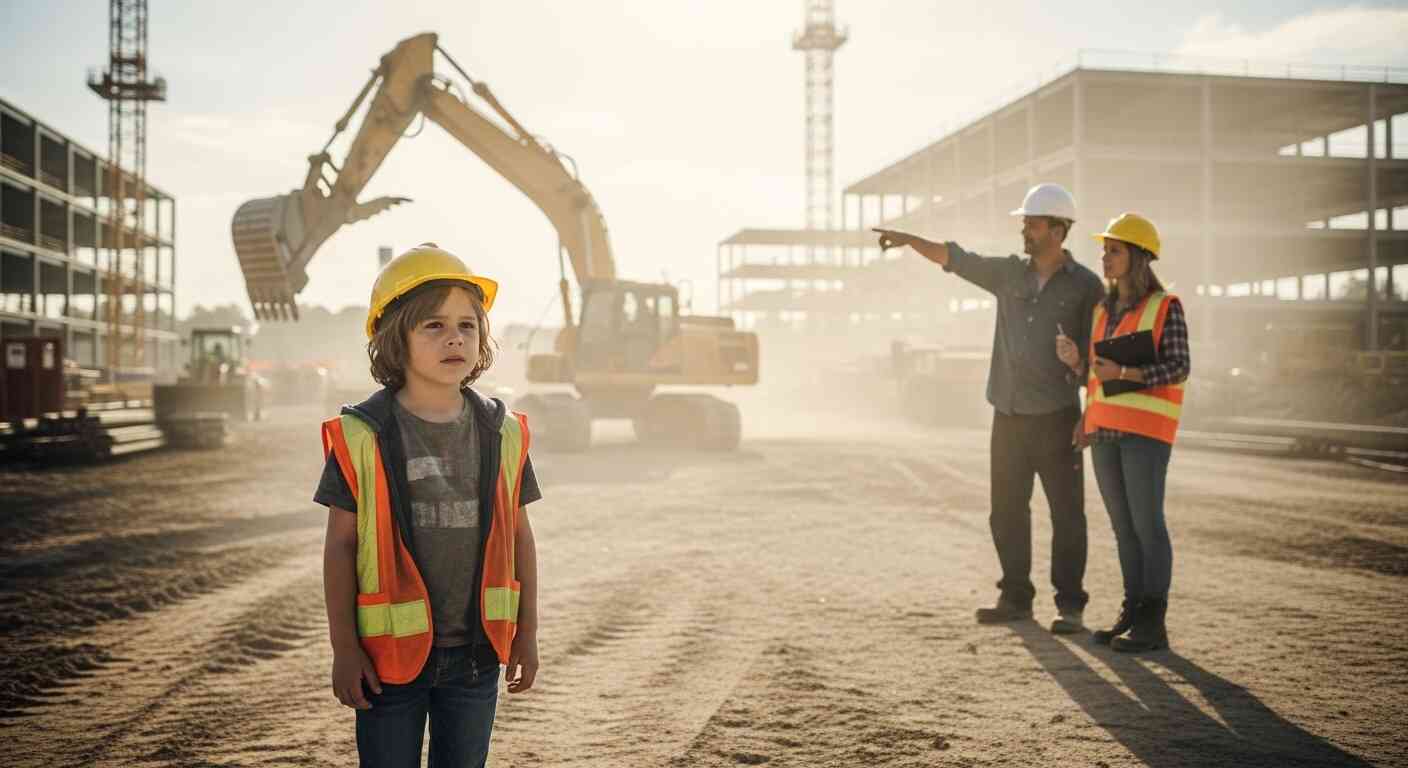
The sky over Blackwood, Pennsylvania, was the color of a fresh bruise. It was the kind of rain that didn’t just get you wet; it soaked into your bones and stayed there, reminding you of every mistake you’d ever made. I stood at the edge of the pit in Sector 4, watching the water pool around the massive concrete pylons.
Being a foreman isn’t just about blueprints and budgets. It’s about listening to the ground. And today, the ground was screaming.
I’m Elias Vance. Forty-two years old, divorced, and currently living in a studio apartment that smells like sawdust and regret. My life has been one long series of pouring foundations for other people’s dreams while mine crumbled in the rearview mirror. My daughter, Lucy, would have been seven this year. Maybe that’s why I was so attuned to the sound.
“Help… please…”
The voice was small, dampened by the rhythmic thrum of the rain. I froze. The site was supposed to be empty. We’d cleared out an hour ago when the mud became a safety hazard.
I climbed down the ladder into the pit, the orange glow of the site’s work lights casting long, distorted shadows against the gray walls. The mud was up to my shins, thick and sucking at my boots.
“Is someone there?” I shouted.
I saw a flash of color. Yellow. A stark, impossible contrast to the monochrome world of the construction site.
She was tucked into a crevice between the pylon and the raw earth wall. A little girl, shivering so violently I could hear her teeth chattering over the downpour. She wore a dress that looked like it had been pulled from a 1970s time capsule—daisy patterns, lace collar, and a matching ribbon that was now matted with filth.
“Oh, God. Hey, kiddo. It’s okay. I’ve got you,” I said, my voice cracking with a sudden, sharp professional panic. If a kid had fallen into the pit on my watch, my career was over. But as I reached for her, that thought vanished. All I saw was a child who looked exactly like the photos of Lucy I kept in my wallet.
When I lifted her, she didn’t feel like a normal child. She was dense. Not heavy in the way of muscle and bone, but heavy like a stone that had been sitting in a river for decades. Her skin wasn’t just cold; it felt like it had never known heat.
“Stay with me, honey,” I muttered, scrambling back up the ladder with one arm hooked around her. I ignored the ache in my shoulder and the way the wind tried to tear us off the rungs.
I kicked open the door to the site trailer, the heat from the space heater hitting me like a physical wall.
“Marge! Grab a blanket! Now!”
Marge Miller was the backbone of Miller & Sons Construction. She was sixty-eight, had hair the color of steel wool, and had seen three generations of Millers run this company into the ground or into the chips. She was halfway through her fourth cup of coffee when I burst in.
The crash of her mug was the loudest thing I’d ever heard.
She didn’t grab a blanket. She didn’t move toward the first aid kit. She just stared at the girl in my arms with a look of profound, existential horror.
“Elias,” she whispered. “Put her down. Put her down right now.”
“She’s hypothermic, Marge! What’s wrong with you?”
Marge walked toward me, her legs stiff. She didn’t look at the girl’s face; she looked at her left hand. The girl was wearing a small, tarnished silver bracelet with a charm shaped like a bell.
“My father gave her that,” Marge said, her voice barely audible. “He bought it for her eighth birthday. She never got to wear it to the party.”
Marge turned and went to the filing cabinets in the back—the old ones that hadn’t been digitized, the ones that smelled of damp paper and secrets. She pulled out a folder labeled 1976: Project Alpha.
She slapped a newspaper clipping onto the desk. The headline read: LOCAL GIRL MISSING AS FACTORY PROJECT BEGINS.
The photo was of the girl in my arms. Same dress. Same ribbon. Same hauntingly vacant stare.
“Sarah Thorne disappeared the night of the big pour,” Marge said. “The police searched everywhere. They even stopped the trucks for four hours. But my father… he was under pressure from the board. He told them the pit was clear. He told them to pour the concrete.”
The girl in my arms suddenly gripped my neck. Her fingers were like iron. She leaned in, her breath smelling of wet earth and old copper.
“He lied,” she whispered into my ear.
I looked at Marge, then at the girl, then at the storm raging outside. I realized then that I hadn’t saved a life. I had unearthed an old sin.
CHAPTER 2: The Echo in the Walls
The silence in the trailer was thick enough to choke on. The girl—Sarah—was now sitting on a bench, wrapped in my spare flannel shirt. She didn’t drink the water I gave her. She just sat perfectly still, her eyes tracking Marge like a predator.
“This is impossible,” I said, pacing the narrow floor of the trailer. “Marge, look at her. She’s breathing. She’s real. People don’t just… come back after fifty years looking exactly the same.”
“In Blackwood, they do,” Marge replied, her voice trembling. She was clutching a rosary she usually kept hidden in her desk drawer. “There are stories about this land, Elias. Stories my father tried to bury under twelve feet of reinforced concrete. They say the earth here has a memory. It doesn’t like being covered up.”
Suddenly, the door to the trailer swung open, letting in a gust of freezing rain and a man who looked like he owned the world, even if it was currently underwater.
Silas Miller. The owner of the site and Marge’s nephew. He was forty, wore a three-thousand-dollar suit under a designer raincoat, and had the soul of a spreadsheet.
“Vance! Why are the lights still on? I told you we needed to—” He stopped mid-sentence, his eyes landing on the girl.
I expected him to be shocked. I expected him to ask who she was. Instead, his face went perfectly neutral. Too neutral.
“Who is the kid?” he asked, his voice cold.
“I found her in the pit, Silas,” I said. “Marge thinks she’s… well, she thinks she’s someone who went missing in ’76.”
Silas didn’t look at the newspaper clipping. He didn’t look at Marge. He walked straight up to the girl. “Listen to me, kid. I don’t know what game you’re playing or who sent you here to shake us down, but the Thorne family moved away decades ago. There’s no one left to collect a settlement.”
The girl looked up at him. “You have his eyes,” she said. “The man who watched.”
Silas flinched. It was subtle, a momentary twitch of his jaw, but I saw it. “Elias, take her to the hospital. Now. I’ll handle the paperwork. And Marge—get rid of that old folder. It’s a fire hazard.”
“Silas, look at her!” Marge cried. “She hasn’t aged a day! This is a miracle… or a curse.”
“It’s a trespasser,” Silas snapped. “Elias, I’m paying you to build a high-rise, not run an orphanage for ghosts. Get her out of here before the press catches wind of this. We’re already behind schedule on the Sector 4 foundation.”
I felt a surge of anger. “She’s a child, Silas. And she was in the foundation. If there’s a body down there, or if this girl has been living in some… I don’t even know, some pocket of the old structure, we have to stop.”
“We stop for nothing,” Silas said, stepping into my personal space. “Do you know what happens if we delay? The bank pulls the funding. This town dies. You lose your job. Marge loses her pension. Do you want that on your conscience?”
I looked at Sarah. She was staring at a map of the construction site on the wall. She pointed a small, muddy finger at a specific spot in Sector 4.
“That’s where the air stopped,” she said softly.
A chill that had nothing to do with the rain ran down my spine. I realized then that Silas wasn’t afraid of a ghost. He was afraid of the truth. He knew something about what his grandfather had done, and he was willing to bury this girl all over again to keep it hidden.
“I’m taking her to the hospital,” I said, grabbing my keys. “But I’m not leaving her alone. And Silas? If I see a single concrete truck near Sector 4 tonight, I’m calling the state police.”
As I led Sarah to my truck, I saw Marge watching us from the window. She was crying. And in the shadows of the trailer, Silas Miller was on his cell phone, his face twisted into a mask of pure, desperate malice.
I climbed into the driver’s seat, the girl sitting silently beside me. As I pulled out of the muddy lot, I looked in the rearview mirror.
The site lights flickered once, twice, and then went pitch black. But in the darkness, I could have sworn I saw dozens of small, pale figures standing at the edge of the pit, watching us drive away.
FULL STORY
PART 3
CHAPTER 3: The Sins of the Father
The hospital was a blur of fluorescent lights and the smell of antiseptic. I sat in the waiting room of the St. Jude Medical Center, my hands stained with the gray mud of Sector 4. They had taken Sarah into an exam room twenty minutes ago.
The nurse, a woman named Elena who looked like she’d seen everything twice, had pulled me aside before entering. “Mr. Vance, where did you say you found her?”
“The construction site on Miller Road,” I said, my voice hoarse. “Is she okay?”
Elena had hesitated, her hand on the door handle. “Her core temperature is 82 degrees. Physically, that should be impossible for someone who is conscious and speaking. And her clothes… they aren’t just dirty. They’re degraded in a way I’ve only seen in archaeological finds.”
Now, I waited. My phone buzzed in my pocket. It was a text from a blocked number: Leave it alone, Elias. For your own sake.
I ignored it. I was thinking about Marge’s father. He had been the foreman back then. He had been the one to give the order. I thought about the pressure of a small town, the need for jobs, the way men justify small evils for the “greater good.”
Suddenly, the doors to the ER swung open. It wasn’t a doctor. It was Detective Sarah Miller—Silas’s cousin, but a woman built of entirely different moral fiber. We’d dated briefly three years ago, before my life fell apart.
“Elias,” she said, her eyes scanning my disheveled state. “What the hell is going on? Marge called me. She sounded hysterical.”
“I found a girl, Sarah. Or a ghost. I don’t know anymore.”
I told her everything. The pit, the yellow dress, the photo from 1976. As I spoke, the skepticism in her eyes shifted to something sharper—professional curiosity mixed with personal dread.
“My grandfather was a complicated man,” Sarah said, sitting next to me. “He was obsessed with the Miller legacy. But there were always rumors. My dad used to say the foundation of the old factory was built on a ‘blood sacrifice,’ but I always thought he was just being dramatic. A drunk’s campfire story.”
“The girl knew about Silas,” I said. “She knew he ‘watched.'”
Before Sarah could respond, the ER went into a frenzy. Codes were called over the intercom. Nurses ran toward the room where they’d taken the girl.
“Wait!” I shouted, jumping up.
I pushed through the doors just as Elena was backing out of the room, her face white.
“She’s gone,” Elena whispered.
“What do you mean gone? Did she run away?”
“No,” Elena said, pointing into the room.
The hospital bed was empty. The monitors were flat-lining, but not because a heart had stopped. They were flat-lining because the sensors were lying on the sheets. In the center of the bed was a pile of gray, wet mud and a single, tarnished silver bracelet with a bell.
The girl was gone, but the room smelled like the earth after a heavy rain.
“She didn’t run,” Sarah Miller said, picking up the bracelet with a gloved hand. “She went back. She’s not finished.”
“We have to get back to the site,” I said, a sense of urgency clawing at my throat. “Silas is going to pour the secondary foundation tonight. He’s going to seal Sector 4 forever.”
CHAPTER 4: The Moral Choice
The drive back to the site was a race against the elements. The storm had escalated into a full-blown gale. Trees whipped violently in the wind, and the road was a river of runoff.
“If we find remains,” Sarah said, clutching the grab handle as I took a corner too fast, “this becomes a crime scene. The site gets shuttered. Silas loses everything.”
“And if we don’t?” I asked. “Then I’m just a guy who went crazy and brought a pile of mud to the ER.”
“I saw the bracelet, Elias. I saw the look on Elena’s face. Something is happening.”
When we reached the gates, the padlocks had been cut. I saw the silhouettes of heavy machinery moving in the dark. The roar of diesel engines competed with the thunder.
“He’s doing it,” I growled. “He’s pouring the slurry.”
We jumped out of the truck and ran toward the lights of Sector 4. Two massive concrete mixers were positioned at the edge of the pit, their chutes extended like the proboscises of giant insects.
Silas stood on the edge, a radio in his hand, screaming at the drivers.
“Stop!” I yelled, my voice lost in the wind.
Sarah pulled her service weapon and held it at her side. “Silas Miller! Police! Cease operations immediately!”
Silas turned, his face illuminated by the harsh work lights. He looked deranged. “It’s for the town, Sarah! We can’t let a fifty-year-old ghost story ruin the future! There’s nothing down there but dirt and old mistakes!”
“Then let us dig!” I shouted. “If there’s nothing there, you’re cleared!”
“I can’t risk it!” Silas screamed. He signaled the driver. The first mixer began to groan, the thick, gray concrete starting to slide down the chute.
Suddenly, the ground groaned. Not a mechanical sound, but a deep, tectonic shift. The mud in the pit began to churn.
Out of the slurry, hundreds of small hands began to emerge. Not just Sarah Thorne’s.
“Oh, God,” Sarah Miller whispered, her gun hand dropping. “It wasn’t just one girl.”
Marge appeared from behind a stack of rebar, clutching an old ledger. “The ‘missing’ orphans from the 1950s,” she cried, her voice carrying over the storm. “My father didn’t just bury one girl. He used the foundation as a graveyard for the ‘unwanted’ children the county didn’t want to track. He got paid for every one he ‘disappeared’ for the state.”
The realization hit me like a physical blow. The “blood sacrifice” wasn’t a legend. It was a business model.
The concrete hit the mud, but instead of filling the hole, it seemed to be swallowed by it. The small hands gripped the edge of the chute, pulling. The massive truck began to tilt, its wheels slipping on the saturated earth.
“Get back!” I yelled, grabbing Sarah and Marge and pulling them toward the safety of the trailer.
Silas didn’t move. He was mesmerized by the pit. He watched as the mud rose up, taking the shape of a dozen children, their faces featureless except for wide, dark eyes.
The girl in the yellow dress stood at the center. She wasn’t sobbing anymore. She was pointing at Silas.
“You knew,” she said, her voice echoing in the skulls of everyone present. “You found the ledger when you were twenty. You kept the secret to keep the money.”
The ground beneath Silas’s feet gave way.
FULL STORY
PART 4
CHAPTER 5: The Climax
Silas screamed as he tumbled into the pit. The gray concrete slurry followed him, a slow-moving tidal wave of liquid stone.
“Help me! Elias! Sarah!”
I ran to the edge. Every instinct told me to let him go. This was justice, wasn’t it? The earth reclaiming the man who had profited from its silence. I looked at Sarah Miller; she was frozen, the weight of her family’s legacy crushing her.
But then I saw the girl. Sarah Thorne was standing just inches from Silas as he struggled in the quicksand-like mud. She wasn’t attacking him. She was just… watching. Her eyes were full of a sadness so profound it made my own grief for Lucy feel like a shallow scratch.
I can’t be like them, I thought. I can’t be the man who watches.
“Sarah! Give me your belt!” I shouted.
I stripped off my heavy work jacket and tied it to a length of tow chain sitting near the edge. I threw it down into the pit.
“Grab it, Silas!”
He was chest-deep now. The concrete was hardening in the cold rain, turning into a tomb. He reached out, his manicured fingers clawing at the muddy air.
Just as his hand closed around the jacket, the earth shifted again. The heavy mixer truck, which had been teetering on the edge, finally lost its footing. It began to slide, thousands of pounds of steel heading straight for Silas.
“Elias, get back!” Sarah Miller screamed, lunging for my waist to pull me away from the crumbling edge.
I didn’t let go of the chain. I pulled with everything I had. My muscles screamed, my vision went white with the effort. Silas was a dead weight, the suction of the mud fighting me for every inch.
The truck roared as it slid, the sound of grinding metal like a dying beast.
At the last second, a dozen small, pale hands reached out from the mud—not to pull Silas down, but to push the truck. They strained against the massive tires, their translucent forms flickering in the work lights.
With a final, gargantuan heave, I pulled Silas onto the ledge just as the mixer plummeted into the pit, landing with a bone-shaking thud right where he had been standing seconds before.
The impact sent a plume of mud and concrete into the air. When the dust settled, the pit was silent.
The small hands were gone. The figures had vanished. Only Sarah Thorne remained, standing on the hood of the sunken truck. She looked at me, then at Marge, and finally at the sky.
The rain began to taper off. The oppressive weight that had hung over the site for days suddenly lifted.
She didn’t say a word. She just touched the silver bell on her wrist, and with a soft chime that seemed to vibrate in the very air, she dissolved into a mist that the wind carried away over the Pennsylvania hills.
CHAPTER 6: The Foundation of Truth
The aftermath was a whirlwind of state investigators, forensic teams, and national news crews. The “Blackwood Foundation Horrors” became a headline that stayed on the front pages for months.
They found them. All of them.
Deep beneath the secondary pylons, preserved by the very concrete meant to hide them, were the remains of fourteen children. Sarah Thorne was the last one they recovered. She was still wearing the yellow dress, the fabric miraculously intact after fifty years in the dark.
Silas Miller didn’t go to jail—not at first. He vanished the night he was released from the hospital, leaving behind a confession that implicated his grandfather, his father, and himself. He left the company to Marge, who immediately dissolved it and turned the site over to the state.
I sat on the porch of my new apartment, a small place in the valley. The air was clear, and the smell of wet earth no longer felt like a threat.
Sarah Miller walked up the steps, carrying two cups of coffee. She wasn’t wearing a uniform. She’d resigned from the force a week ago.
“How are you holding up?” she asked, handing me a cup.
“Better,” I said. “I went to the memorial service yesterday. They buried them all in the town cemetery. Proper headstones. Names. Flowers.”
“Marge paid for the whole thing,” Sarah said, sitting next to me. “She says it’s the only way she can sleep.”
I reached into my pocket and pulled out a small object. It was the silver bell charm. I’d found it in the mud after the trucks were hauled away. It shouldn’t have been there—it should have vanished with the girl—but it was solid, cold, and real.
“Do you think they’re at peace?” I asked.
Sarah looked out at the horizon, where the sun was finally breaking through the stubborn clouds. “I think they were waiting for someone to care enough to look. You didn’t just build a skyscraper, Elias. You unburied a town’s soul.”
I thought about my daughter, Lucy. For the first time in seven years, when I thought of her, I didn’t feel the crushing weight of the “what ifs.” I felt a strange, quiet warmth.
I realized that we all spend our lives building over the top of our pain, pouring layer after layer of concrete over the things we’re too afraid to face. But the foundation only holds if it’s built on the truth.
I stood up and walked to the edge of the porch, shaking the little bell. The sound was clear and bright, a tiny defiance against the silence of the past.
Somewhere in the distance, I could have sworn I heard the laughter of a child.
Healing begins not when we forget the past, but when we finally give it a voice.