FULL STORY
Chapter 1: The Bottom of the Chain
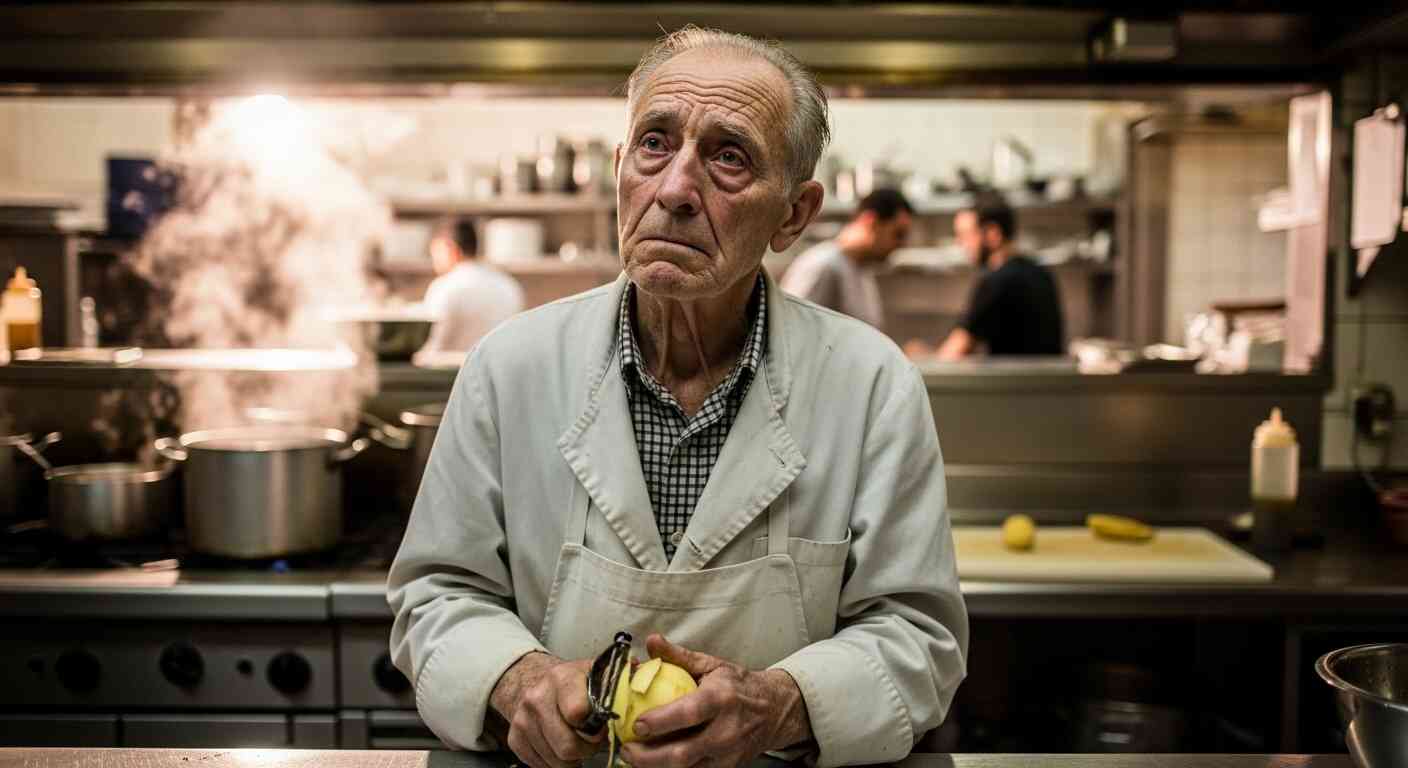
The air in the kitchen of ‘Big Al’s Greasy Spoon’ didn’t just hang; it adhered. It was a suffocating mix of aerosolized canola oil, stale cigarette smoke drifting from the back door, and the sour, pervasive scent of industrial-grade dish soap. At 6:00 PM on a Friday, the dinner rush was a physical assault. Plates clattered like gunfire, tickets printed with the insistent zzzt-zzzt of a modern torture device, and the heat off the grill line was enough to melt the paint off a Buick.
Silas Thorne was the eye of this hurricane.
At sixty-four, Silas was wiry, his skin mapped by decades of sun and scars that told stories he never shared. He was the dishwasher. It was the lowest job in the hierarchy, and that suited him just fine. The rhythm was hypnotic: scrape, spray, load, run. It required no small talk, no emotional investment, only endurance. He wore a faded, rubberized apron over a work shirt that still bore the faint outline of a patch ripped off twenty years ago. He was a shadow in a room full of noise.
His only distraction was the management.
Brock Miller, the owner’s twenty-six-year-old nephew, didn’t manage; he occupied space. Brock was thick-necked, aggressive, and wore a permanent expression of aggressive boredom. He had inherited his position, and he exercised his authority like a child with a magnifying glass over an anthill. Brock hated Silas. He hated the old man’s silence, his lack of deference, and the fact that even while scrubbing scorched lasagna pans, Silas held himself with an erect, disciplined posture that made Brock feel small.
Tonight, Brock was in a rare mood. His NFL team had lost their afternoon game, and his latest girlfriend had broken up with him via text. He needed a win. He needed a victim.
“Hey, Pops!” Brock’s voice cutting through the din was like a razor blade through linen. He was standing by the passthrough, holding a heavy ceramic plate that was dripping with melted cheese and grease. “What part of ‘scrape’ don’t you understand? These are coming back dirty. Do your damn job.”
Silas didn’t break rhythm. He caught the plate in one fluid motion, bringing it down to the sink. “Yes, sir.” His voice was low, graveled, and entirely devoid of inflection.
“Don’t ‘sir’ me with that attitude,” Brock snapped, stepping into the dish pit, invading Silas’s space. He smelled of expensive cologne and cheap desperation. “You think you’re better than this place, don’t you? With your quiet acts and your old-man routine. You’re just a relic, Silas. A drain on my uncle’s payroll.”
Silas continued to spray the plate. He knew the game. Resistance was the fuel that fed bullies like Brock. Silence was starvation.
“I’m speaking to you!” Brock yelled, the veins in his neck bulging. The rest of the kitchen, including Sarah, a waitress who always looked at Silas with a mixture of pity and respect, went still.
Silas turned the faucet off. He looked Brock directly in the eyes. “I am doing my job, Brock. The plate is clean.”
The use of his first name, without the requested ‘sir’ or even a title, was the trigger. It was a subtle act of mutiny in Brock’s eyes.
“Sarah,” Brock barked, not breaking eye contact with Silas. “The health inspector left that bucket of kitchen waste by the back exit, right? The one with the grease and the old slaw?”
Sarah blanched. “Yes, Brock, but…”
“Go get it. Bring it here. Right now.”
“Brock, that’s disgusting, we’re in the middle of service—”
“Now, or you’re fired!”
Sarah shot Silas a panicked look, but the desperation of a minimum-wage single mother won out. She disappeared toward the back alley door.
Silas waited. He could feel the anticipation rolling off Brock. This was the moment Brock had been building to for months. He wanted to break Silas, to make him beg, or better yet, make him fight back so he could call the cops. Silas felt a coldness settle in his chest, an old, familiar sensation. It wasn’t fear. It was the calm before a specific type of storm.
Sarah returned, carrying a five-gallon plastic bucket that emitted a stench so vile it immediately overwhelmed the smell of cooking food. It was filled with a slurry of gray dishwater, coffee grounds, soggy napkins, half-eaten burgers, and the slimy remnants of coleslaw that had sat in the heat all day.
“Put it down,” Brock commanded. Sarah placed it on the floor, her eyes watering. “Get back to your station.”
Brock picked up the bucket. The weight of it made his muscles tense. He smiled, a slow, ugly thing.
“You know, Silas,” Brock said, leaning in. “You spend all day cleaning, but I think you forgot to clean yourself. You’re just a collection of garbage, aren’t you? An old man with nothing left.”
“I have my dignity,” Silas said softly.
“Dignity?” Brock laughed, a harsh, cracking sound. “Let me show you where your dignity gets you at Big Al’s.”
With a sudden, violent motion, Brock swung the bucket.
Silas saw it coming, but his body, compromised by years of injuries and the slow corrosion of age, was too slow. The initial impact wasn’t from the bucket’s contents, but from Brock’s own fist. As he swung the bucket, he simultaneously delivered a brutal, aimed punch to Silas’s solar plexus.
The air left Silas’s lungs in a single gasp. His vision blurred around the edges. His knees, already weak from hours of standing, betrayed him. He crumpled, doubling over, his hands clutching his stomach as he fought for breath.
And as he was down, bent at the waist, Brock completed the motion.
The five gallons of rancid, gelatinous kitchen waste descended. It was a viscous waterfall of humiliation. The cold, wet slurry hit Silas’s back, his neck, and the back of his head. It soaked through his shirt, plastering the wet apron to his skin. The smell was overpowering, filling his nose and mouth with the taste of decay.
Silas didn’t make a sound. He just bent further under the weight of the assault, the filth dripping from his hair onto the oily kitchen floor.
The kitchen was silent. Not even the grill sizzled. The only sound was the drip, drip, drip of the slop falling from Silas onto the pavement.
Brock stood over him, holding the empty bucket, a triumphant, manic look on his face.
“There,” Brock said, his breath coming in shallow bursts of excitement. “That’s better. This is where you belong, old man. At the bottom of the food chain, covered in trash.”
Silas stayed down for a full ten seconds. He used the time not to recover from the pain, but to let the coldness in his chest expand, until it was an absolute zero that froze out any trace of anger or impulse. He didn’t want revenge. Revenge was an emotional act. This required precision.
He placed one hand on the slick, greasy floor. He could feel the eyes of the entire kitchen on him—Sarah, tears streaming down her face; the line cooks, looking away in shame; and Brock, gloating.
Silas pushed. His muscles, dormant under the weight of age, remembered their training. He rose slowly, a machine reawakening. The movement was disciplined, unhurried, and entirely contrary to what Brock expected. Brock expected a broken man, a weeping man, or a man who would throw a pathetic, flailing punch.
Silas stood up straight. He ignored the slop dripping down his face. He ignored the smell. He ignored the dull ache in his gut.
He looked at Brock. He didn’t see a manager. He didn’t see a bully. He saw a target that had just identified itself.
“The bottom is where you see everything clearly,” Silas said. His voice was changed. It wasn’t the graveled murmur of the dishwasher anymore. It was resonant, commanding, a sound from a different world, a world of life-and-death stakes and split-second decisions. “Especially the moment the predator becomes the prey.”
“Wh-what did you say?” Brock stammered. The shift in Silas’s tone had disoriented him. The triumphant smile flickered.
Silas didn’t answer with words. He reached up, unhooking the strap of the wet, rubberized apron. It fell to the floor with a heavy, wet splash.
He wore a dark blue tactical work shirt beneath it, now also soiled. But it wasn’t the shirt that held Brock’s gaze.
It was what the removal of the apron revealed.
On his right shoulder, secured by a professional-grade kydex holster, was a weapon. But it wasn’t the service weapon of a police officer or the standard sidearm of a security guard.
It was a custom-built 9mm, the entire slide and frame meticulously plated in 24-karat gold. The grip panels were dark, rich ebony, inlaid with an intricate, unrecognizable seal. It was a weapon of unparalleled craftsmanship, dazzling even in the fluorescent light of the kitchen.
It was not a hidden weapon. It was a badge.
Brock, whose knowledge of the military came entirely from video games, nevertheless froze. The sight of the firearm itself was terrifying, but it was the type of firearm that paralyzed him. A gold-plated weapon wasn’t standard issue; it was a reward. A massive, historical reward.
Brock had seen a picture of a gun like that before. In his history textbooks. He remembered the section on the ‘Great Northern Conflict,’ the shadowy war that ended with the mysterious ‘Savior of the Nation’ single-handedly negotiating peace while standing over the body of a tyrant. The rumor was that the ‘Savior’ was an unnamed operative, a man who refused all honors except one: a ceremonial, gold-plated pistol, of which only three were ever made.
Brock’s eyes darted from the gun to Silas’s face. He saw the same eyes that were in that textbook, the eyes of a man who had stared down legions.
His legs, thick and muscular, suddenly felt like water. The smell of the garbage on Silas seemed to vanish, replaced by the scent of ozone and ancient authority.
“Oh,” Brock whispered, the sound a ragged exhale of total, unadulterated terror. He tried to step back, but his muscles wouldn’t obey. He simply crumpled, his knees buckling not from a punch, but from the weight of the realization. Brock Miller, the king of the kitchen, collapsed backward into the very bucket of slop he had just emptied, his eyes locked onto the golden weapon, trembling like a child in a storm.
Silas didn’t even draw the weapon. He simply looked down at the shivering manager, and in the silence of that broken kitchen, the natural order of the world was restored.
PART 2: Chapters 1 & 2
Chapter 1: The Weight of Silence
The air in the kitchen of ‘Big Al’s Greasy Spoon’ didn’t just hang; it adhered. It was a suffocating mix of aerosolized canola oil, stale cigarette smoke drifting from the back door, and the sour, pervasive scent of industrial-grade dish soap. At 6:00 PM on a Friday, the dinner rush was a physical assault. Plates clattered like gunfire, tickets printed with the insistent zzzt-zzzt of a modern torture device, and the heat off the grill line was enough to melt the paint off a Buick.
Silas Thorne was the eye of this hurricane.
At sixty-four, Silas was wiry, his skin mapped by decades of sun and scars that told stories he never shared. He was the dishwasher. It was the lowest job in the hierarchy, and that suited him just fine. The rhythm was hypnotic: scrape, spray, load, run. It required no small talk, no emotional investment, only endurance. He wore a faded, rubberized apron over a work shirt that still bore the faint outline of a patch ripped off twenty years ago. He was a shadow in a room full of noise.
His only distraction was the management.
Brock Miller, the owner’s twenty-six-year-old nephew, didn’t manage; he occupied space. Brock was thick-necked, aggressive, and wore a permanent expression of aggressive boredom. He had inherited his position, and he exercised his authority like a child with a magnifying glass over an anthill. Brock hated Silas. He hated the old man’s silence, his lack of deference, and the fact that even while scrubbing scorched lasagna pans, Silas held himself with an erect, disciplined posture that made Brock feel small.
Tonight, Brock was in a rare mood. His NFL team had lost their afternoon game, and his latest girlfriend had broken up with him via text. He needed a win. He needed a victim.
“Hey, Pops!” Brock’s voice cutting through the din was like a razor blade through linen. He was standing by the passthrough, holding a heavy ceramic plate that was dripping with melted cheese and grease. “What part of ‘scrape’ don’t you understand? These are coming back dirty. Do your damn job.”
Silas didn’t break rhythm. He caught the plate in one fluid motion, bringing it down to the sink. “Yes, sir.” His voice was low, graveled, and entirely devoid of inflection.
“Don’t ‘sir’ me with that attitude,” Brock snapped, stepping into the dish pit, invading Silas’s space. He smelled of expensive cologne and cheap desperation. “You think you’re better than this place, don’t you? With your quiet acts and your old-man routine. You’re just a relic, Silas. A drain on my uncle’s payroll.”
Silas continued to spray the plate. He knew the game. Resistance was the fuel that fed bullies like Brock. Silence was starvation.
“I’m speaking to you!” Brock yelled, the veins in his neck bulging. The rest of the kitchen, including Sarah, a waitress who always looked at Silas with a mixture of pity and respect, went still.
Silas turned the faucet off. He looked Brock directly in the eyes. “I am doing my job, Brock. The plate is clean.”
The use of his first name, without the requested ‘sir’ or even a title, was the trigger. It was a subtle act of mutiny in Brock’s eyes.
“Sarah,” Brock barked, not breaking eye contact with Silas. “The health inspector left that bucket of kitchen waste by the back exit, right? The one with the grease and the old slaw?”
Sarah blanched. “Yes, Brock, but…”
“Go get it. Bring it here. Right now.”
“Brock, that’s disgusting, we’re in the middle of service—”
“Now, or you’re fired!”
Sarah shot Silas a panicked look, but the desperation of a minimum-wage single mother won out. She disappeared toward the back alley door.
Silas waited. He could feel the anticipation rolling off Brock. This was the moment Brock had been building to for months. He wanted to break Silas, to make him beg, or better yet, make him fight back so he could call the cops. Silas felt a coldness settle in his chest, an old, familiar sensation. It wasn’t fear. It was the calm before a specific type of storm.
Sarah returned, carrying a five-gallon plastic bucket that emitted a stench so vile it immediately overwhelmed the smell of cooking food. It was filled with a slurry of gray dishwater, coffee grounds, soggy napkins, half-eaten burgers, and the slimy remnants of coleslaw that had sat in the heat all day.
“Put it down,” Brock commanded. Sarah placed it on the floor, her eyes watering. “Get back to your station.”
Brock picked up the bucket. The weight of it made his muscles tense. He smiled, a slow, ugly thing.
“You know, Silas,” Brock said, leaning in. “You spend all day cleaning, but I think you forgot to clean yourself. You’re just a collection of garbage, aren’t you? An old man with nothing left.”
“I have my dignity,” Silas said softly.
“Dignity?” Brock laughed, a harsh, cracking sound. “Let me show you where your dignity gets you at Big Al’s.”
With a sudden, violent motion, Brock swung the bucket.
Silas saw it coming, but his body, compromised by years of injuries and the slow corrosion of age, was too slow. The initial impact wasn’t from the bucket’s contents, but from Brock’s own fist. As he swung the bucket, he simultaneously delivered a brutal, aimed punch to Silas’s solar plexus.
The air left Silas’s lungs in a single gasp. His vision blurred around the edges. His knees, already weak from hours of standing, betrayed him. He crumpled, doubling over, his hands clutching his stomach as he fought for breath.
And as he was down, bent at the waist, Brock completed the motion.
The five gallons of rancid, gelatinous kitchen waste descended. It was a viscous waterfall of humiliation. The cold, wet slurry hit Silas’s back, his neck, and the back of his head. It soaked through his shirt, plastering the wet apron to his skin. The smell was overpowering, filling his nose and mouth with the taste of decay.
Silas didn’t make a sound. He just bent further under the weight of the assault, the filth dripping from his hair onto the oily kitchen floor.
The kitchen was silent. Not even the grill sizzled. The only sound was the drip, drip, drip of the slop falling from Silas onto the pavement.
Brock stood over him, holding the empty bucket, a triumphant, manic look on his face.
“There,” Brock said, his breath coming in shallow bursts of excitement. “That’s better. This is where you belong, old man. At the bottom of the food chain, covered in trash.”
Silas stayed down for a full ten seconds. He used the time not to recover from the pain, but to let the coldness in his chest expand, until it was an absolute zero that froze out any trace of anger or impulse. He didn’t want revenge. Revenge was an emotional act. This required precision.
He placed one hand on the slick, greasy floor. He could feel the eyes of the entire kitchen on him—Sarah, tears streaming down her face; the line cooks, looking away in shame; and Brock, gloating.
Silas pushed. His muscles, dormant under the weight of age, remembered their training. He rose slowly, a machine reawakening. The movement was disciplined, unhurried, and entirely contrary to what Brock expected. Brock expected a broken man, a weeping man, or a man who would throw a pathetic, flailing punch.
Silas stood up straight. He ignored the slop dripping down his face. He ignored the smell. He ignored the dull ache in his gut.
He looked at Brock. He didn’t see a manager. He didn’t see a bully. He saw a target that had just identified itself.
“The bottom is where you see everything clearly,” Silas said. His voice was changed. It wasn’t the graveled murmur of the dishwasher anymore. It was resonant, commanding, a sound from a different world, a world of life-and-death stakes and split-second decisions. “Especially the moment the predator becomes the prey.”
“Wh-what did you say?” Brock stammered. The shift in Silas’s tone had disoriented him. The triumphant smile flickered.
Silas didn’t answer with words. He reached up, unhooking the strap of the wet, rubberized apron. It fell to the floor with a heavy, wet splash.
He wore a dark blue tactical work shirt beneath it, now also soiled. But it wasn’t the shirt that held Brock’s gaze.
It was what the removal of the apron revealed.
On his right shoulder, secured by a professional-grade kydex holster, was a weapon. But it wasn’t the service weapon of a police officer or the standard sidearm of a security guard.
It was a custom-built 9mm, the entire slide and frame meticulously plated in 24-karat gold. The grip panels were dark, rich ebony, inlaid with an intricate, unrecognizable seal. It was a weapon of unparalleled craftsmanship, dazzling even in the fluorescent light of the kitchen.
It was not a hidden weapon. It was a badge.
Brock, whose knowledge of the military came entirely from video games, nevertheless froze. The sight of the firearm itself was terrifying, but it was the type of firearm that paralyzed him. A gold-plated weapon wasn’t standard issue; it was a reward. A massive, historical reward.
Brock had seen a picture of a gun like that before. In his history textbooks. He remembered the section on the ‘Great Northern Conflict,’ the shadowy war that ended with the mysterious ‘Savior of the Nation’ single-handedly negotiating peace while standing over the body of a tyrant. The rumor was that the ‘Savior’ was an unnamed operative, a man who refused all honors except one: a ceremonial, gold-plated pistol, of which only three were ever made.
Brock’s eyes darted from the gun to Silas’s face. He saw the same eyes that were in that textbook, the eyes of a man who had stared down legions.
His legs, thick and muscular, suddenly felt like water. The smell of the garbage on Silas seemed to vanish, replaced by the scent of ozone and ancient authority.
“Oh,” Brock whispered, the sound a ragged exhale of total, unadulterated terror. He tried to step back, but his muscles wouldn’t obey. He simply crumpled, his knees buckling not from a punch, but from the weight of the realization. Brock Miller, the king of the kitchen, collapsed backward into the very bucket of slop he had just emptied, his eyes locked onto the golden weapon, trembling like a child in a storm.
Silas didn’t even draw the weapon. He simply looked down at the shivering manager, and in the silence of that broken kitchen, the natural order of the world was restored.
Chapter 2: The Echo of the Gold
The kitchen remained in a state of suspended animation for what felt like hours, though only seconds had passed since Brock’s collapse. The hum of the industrial refrigerator seemed deafeningly loud.
Silas didn’t look at the other staff. He didn’t look at the mess on the floor. He simply walked to the locker room in the back, his footsteps heavy and wet.
“Silas!” Sarah’s voice was a frantic whisper. She had followed him, stopping just outside the locker room door. “Silas, you have to go. Brock… he’s going to call the police. He’s already reaching for his phone. He’s going to say you threatened him with a gun.”
Inside the locker room, Silas stripped off the soiled tactical shirt. Underneath, his skin was a map of puckered scar tissue—shrapnel wounds on his ribs, a long, jagged line across his shoulder that spoke of a blade, and the smaller, circular marks of entry wounds. He reached into his locker and pulled out a clean, gray sweatshirt. He didn’t move with haste; he moved with the economy of a man who had survived a thousand ambushes.
He checked the gold-plated 9mm. He didn’t holster it back on his shoulder; instead, he tucked it into a concealed waistband holster at the small of his back.
“Let him call them,” Silas said, stepping out of the locker room. He looked at Sarah. For the first time in three years, she saw the man behind the dishwasher’s mask. His eyes weren’t tired anymore. They were sharp, calculating, and strangely kind. “Sarah, get your things. Go home. Don’t be here when they arrive.”
“But what about you?” she asked, her voice trembling. “That gun… Silas, who are you?”
“Nobody you need to know,” he replied. He reached into his pocket and pulled out a wad of cash—his entire week’s earnings—and pressed it into her hand. “Buy your daughter those shoes she wanted. The blue ones.”
Before she could protest, Silas was out the back door, disappearing into the charcoal shadows of the alleyway.
Back in the kitchen, Brock Miller had finally found his voice, though it was several octaves higher than usual. He was sitting on the floor, covered in the same filth he’d meant for Silas, clutching his iPhone with shaking hands.
“Yes! Police! I need the police at Big Al’s Greasy Spoon!” he screamed. “I have an employee… he’s crazy! He’s got a gun! A gold gun! He punched me! He… he’s a terrorist! Get someone here now!”
Within ten minutes, the parking lot was a sea of strobing red and blue. Four squad cars screeched to a halt, followed shortly by a black, unmarked SUV.
Officer Miller—no relation to Brock—and his partner, a young rookie named Henderson, burst through the front doors, weapons drawn. They found Brock sitting in a booth, wrapped in a blanket Sarah had grudgingly provided, smelling like a landfill.
“Where is he?” Officer Miller barked.
“He went out the back!” Brock pointed a shaky finger. “He’s an old man, Silas Thorne. He’s got a gold-plated handgun, 9mm. He’s dangerous! He threatened to kill me!”
Officer Miller froze. He lowered his Glock slightly. “A gold-plated 9mm? You’re sure?”
“Yes! I saw it! It had some weird seal on the grip. Like an eagle and a sword or something.”
The two officers exchanged a look that Brock couldn’t interpret. It wasn’t the look of hunters closing in on a prey. It was the look of men who had just stepped onto a landmine.
The door to the diner opened again, and a man in a sharp charcoal suit walked in. He had the build of a linebacker and eyes that looked like they were made of flint. This was Detective Marcus Vance, a man who had spent twenty years on the force and seen everything.
“Report,” Vance said, his voice a low rumble.
“Suspect is Silas Thorne, sixty-four,” Miller said, his voice noticeably tighter. “Complainant says Thorne brandished a ceremonial gold-plated firearm before fleeing the scene.”
Vance walked over to Brock. He didn’t look sympathetic. He looked disgusted. He sniffed the air around Brock and recoiled. “You dumped trash on him, didn’t you, Miller?”
“He was being insubordinate!” Brock yelled. “It doesn’t matter! He had a gun! That’s illegal!”
Vance leaned down, his face inches from Brock’s. “Listen to me very carefully, you little stain. If that man is who I think he is, the only thing illegal in this room is the fact that you’re still breathing. Do you have any idea what that weapon represents?”
“It’s just a gun!”
“No,” Vance said, standing up and looking toward the back door. “That weapon is a ‘Grand Cross of Valor’ sidearm. Only three were ever commissioned by the Department of Defense. One is in the Smithsonian. One was buried with General Halloway. And the third…” Vance trailed off, a shadow of genuine awe crossing his face. “The third belonged to the man who ended the Siege of New York. A man the government officially listed as ‘retired into legend’ fifteen years ago.”
Vance turned to his officers. “Cancel the APB. Change the call status from ‘Armed and Dangerous’ to ‘High-Value Asset Protection.’ And Miller? If you or anyone else touches a hair on that man’s head, you won’t just lose your badge. You’ll lose your existence. Am I clear?”
“But he’s just a dishwasher!” Brock wailed.
Vance looked at the empty dish pit, then back at Brock. “He was a lion sleeping in a sheepfold. And you just poked him with a stick.”
PART 3: Chapters 3 & 4
Chapter 3: The Sanctuary of Shadows
Silas Thorne’s apartment was a study in minimalism. It was a single room in a crumbling brick walk-up on the edge of the industrial district. There was a bed, a small table, a single chair, and a hot plate. No television. No radio. The only decoration was a small, framed photograph on the bedside table—a group of five men in desert fatigues, their faces blurred by time and the harsh sun of a country half a world away. Silas was in the center, younger, his eyes already carrying the weight of the future.
He sat on the edge of the bed, the gold-plated 9mm resting on the threadbare quilt. He didn’t look at it with pride. He looked at it with a profound, weary sadness.
For fifteen years, he had tried to disappear. He had been a janitor in Seattle, a longshoreman in Maine, and finally, a dishwasher in this forgotten corner of the Midwest. He had sought the mundane, the repetitive, the invisible. He wanted the noise in his head—the screams of the dying, the roar of the thermobaric charges, the silence of the aftermath—to be drowned out by the clatter of porcelain and the rush of water.
And Brock Miller had ruined it.
There was a soft knock at the door. Not the heavy, rhythmic thud of the police, but a hesitant, light tapping.
Silas didn’t reach for the gun. He knew the gait of every person in his life. He recognized the uneven step of someone carrying a heavy burden.
“Come in, Sarah,” he said.
The door creaked open. Sarah stood there, still in her waitress uniform, her face pale. She stepped inside, looking around the Spartan room with wide eyes.
“The police are everywhere at the diner,” she whispered. “But they aren’t looking for you the way they look for criminals. I saw a man in a suit. He looked… scared of you. Even though you weren’t there.”
Silas sighed, a sound that seemed to come from the very marrow of his bones. “They aren’t scared of me, Sarah. They’re scared of what I represent. They’re scared of the paperwork that comes with a ghost coming back to life.”
“Who are you, Silas?” She sat in the single chair, her hands trembling in her lap. “I’ve known you for three years. You helped me fix my car. You walked me to my bus stop when the creeps were out. You’re the kindest man I know. But that gun… it looked like it belonged to a king.”
“It belonged to a soldier who did things no king should ever ask of a man,” Silas said. He picked up the weapon, the gold catching the dim light of the streetlamp outside. “This was given to me by a President who is now dead, for a war the public isn’t allowed to remember. It was supposed to be a symbol of peace. But all it’s ever been is a magnet for trouble.”
“Why did you let him do it?” Sarah asked, her voice cracking. “Why did you let him punch you? You could have stopped him in a second. I saw the way you moved when you stood up. You’re fast. You’re… you’re a predator, aren’t you?”
Silas looked at the photograph of his dead friends. “Because if I fought back the way I was trained, Brock Miller wouldn’t be sitting in a booth right now. He’d be in a morgue. And I promised myself a long time ago that I was done adding to that particular tally.”
He stood up and walked to the window, looking down at the street. A black SUV was idling at the corner. They had found him. Of course they had.
“Sarah, you need to go out the fire escape,” Silas said, his voice turning hard again. “The people who are coming now aren’t local cops. They’re the ones who managed my ‘retirement.’ And they don’t like witnesses.”
“I’m not leaving you,” she said, her maternal instincts overriding her fear.
“You have a daughter,” Silas reminded her, turning to look at her. “Go. Now.”
The authority in his voice was absolute. Sarah stood, nodded once, and disappeared through the window onto the metal grate of the fire escape.
Silas turned back to the room. He picked up the gold gun and tucked it into his waistband. He straightened his sweatshirt. He didn’t have much, but he had his dignity, and he had his memories.
He waited.
Chapter 4: The Escalation of a Coward
Brock Miller wasn’t a man who learned lessons; he was a man who nursed grievances.
Three hours after the incident at the diner, Brock was sitting in the back of his uncle’s Cadillac, his face purple with rage. His uncle, Alistair “Big Al” Miller, was driving in silence. Al was a man who had built his business on hard work and grease, and he looked at his nephew with a mixture of pity and revulsion.
“You’re a damn fool, Brock,” Al said, his voice gravelly. “I told you to leave the old man alone. He was the best worker I had. Never complained, never late.”
“He had a gun, Uncle Al! A gold gun! He’s a freak! He’s probably a sleeper agent or something!” Brock pounded his fist against the leather upholstery. “The cops aren’t doing anything. That Detective Vance… he threatened me! Can you believe that? I’m the victim!”
“Vance is a smart man,” Al muttered. “If he’s backing off, it’s because Silas Thorne is someone you don’t want to mess with.”
“I don’t care who he is,” Brock hissed. “I have friends too.”
Brock pulled out his phone and dialed a number he’d used before to make “problems” go away. The man on the other end was Leo “The Hammer” Vance—no relation to the detective, but a low-level enforcer for a local debt-collection ring.
“Leo? It’s Brock. I need a favor. A big one. I need a guy dealt with. An old man. Lives in the district. Yeah, he’s got a toy he thinks is special. A gold-plated pistol. I want the gun, and I want him broken. Ten grand if you do it tonight.”
On the other end, Leo chuckled. “An old man? Ten grand for a geriatric? You’re on, kid. Send me the address.”
Brock hung up, a predatory smirk returning to his face. If the law wouldn’t protect his “honor,” he’d use the underworld. He didn’t care about the “Savior of the Nation” or the “Grand Cross of Valor.” To Brock, Silas was just the man who had made him look like a coward in front of his staff. And in Brock’s world, that was a death sentence.
“Where are you going, Brock?” Al asked as Brock hopped out of the car at a red light.
“To finish what I started,” Brock shouted back over his shoulder.
He didn’t see the black SUV following him. He didn’t see the two men in tactical gear watching his every move through thermal optics.
Brock Miller thought he was playing a game of checkers. He had no idea he was standing on a chessboard where the King had just decided to move.
Leo “The Hammer” arrived at Silas’s apartment complex twenty minutes later with two of his associates—thick-necked men with scarred knuckles and zero imagination. They moved up the stairs like a pack of wolves, sensing an easy kill.
They kicked in the door to room 402 with a synchronized thud.
“Alright, Grandpa! Time to pay the—” Leo started, but the words died in his throat.
The room was empty. The window was open, the curtain fluttering in the cold night breeze.
On the small table in the center of the room sat a single item.
It was a small, black coin. On one side was an embossed eagle. On the other, a single word: RECKONING.
Leo felt a cold chill wash over him. He’d heard stories about this coin in the darker corners of the state’s prisons. It wasn’t a coin used by criminals. It was a marker left by a specific unit of the Special Activities Division. It meant you were no longer being hunted by the police. You were being hunted by the shadows.
“Boss?” one of the associates asked, looking at the coin. “What is it?”
“We’re leaving,” Leo said, his voice cracking. “Now. Forget the ten grand. Forget Brock. We’re going to the coast. Tonight.”
But as they turned to the door, a shadow blocked the hallway.
It wasn’t Silas.
It was Detective Marcus Vance, and behind him stood six men in black tactical gear, their suppressed rifles leveled at the hearts of the three thugs.
“Going somewhere, Leo?” Vance asked, his voice devoid of humor. “I’m afraid you’ve stumbled into a federal matter. And by ‘stumbled,’ I mean you’ve walked into the middle of a national security event.”
“We were just—”
“Silence,” Vance commanded. “Where is Brock Miller?”
“He’s… he’s at the docks. Warehouse 14. He wanted us to bring the old man there.”
Vance turned to the lead tactical officer. “Secure these three. Notify the Director. The asset is on the move, and the secondary target has initiated a terminal conflict.”
Vance looked at the black coin on the table. He whispered under his breath, “God help you, Brock. You didn’t just poke the lion. You tried to steal its cub.”
PART 4: Chapters 5 & 6
Chapter 5: The Final Stand at Warehouse 14
The docks were a graveyard of rusted shipping containers and the smell of dead fish and diesel. Warehouse 14 was a cavernous, derelict space that had once been used for grain storage. Now, it was just a hollow shell.
Brock Miller stood in the center of the warehouse, illuminated by the headlights of his BMW. He was pacing, his shadow stretching long and distorted against the corrugated metal walls. He held a baseball bat in one hand, slapping it rhythmically against his palm.
“Where are they?” he muttered. “How hard is it to grab one old man?”
“It’s not hard at all, Brock. If the old man wants to be caught.”
The voice didn’t come from the entrance. It came from the rafters.
Brock spun around, swinging his bat at the air. “Who’s there? Leo? Is that you?”
A figure dropped from the shadows, landing silently twenty feet away. Silas Thorne stood up, his posture relaxed, his hands at his sides. He wasn’t wearing the gray sweatshirt anymore. He was back in the tactical shirt, though it was now clean and pressed. The gold-plated 9mm was visible on his shoulder, a beacon of lethal elegance.
“You came,” Brock said, his voice a mixture of triumph and terror. “You actually came.”
“I don’t like people visiting my home uninvited,” Silas said. “And I don’t like people threatening my friends.”
“Friends? You mean that waitress? Sarah?” Brock laughed, though it sounded hysterical. “I’ll deal with her next. After I take that gun and show everyone what a fraud you are.”
“You won’t be dealing with anyone, Brock,” Silas said, stepping forward. “Look around you.”
Brock squinted into the darkness. Suddenly, the warehouse erupted in light. High-intensity floodlights mounted on the ceiling roared to life, blinding him. From every entrance, black-clad figures swarmed in, their movements synchronized and silent.
But they didn’t point their weapons at Silas. They formed a perimeter around him, facing outward.
An older man, silver-haired and wearing a heavy overcoat that cost more than Brock’s car, walked through the main doors. He was flanked by Detective Vance and a woman carrying a diplomatic briefcase.
“Silas,” the man in the overcoat said, his voice echoing in the vast space. “It’s been a long time.”
“Director Halloway,” Silas replied, not looking away from Brock. “I told you I was done.”
“The country is never done with you, Silas,” Halloway said. He turned his gaze to Brock, who was now trembling so violently the bat fell from his hands with a hollow clack. “And who is this… individual?”
“A manager,” Silas said. “He thinks the world belongs to the loudest person in the room.”
Halloway walked up to Brock. He looked at him as if he were a particularly uninteresting insect. “Mr. Miller, do you know what a ‘Non-Person’ is? It is a legal designation for someone whose actions have become so detrimental to national security interests that their presence in society must be… corrected.”
“I… I just wanted the gun!” Brock sobbed, dropping to his knees. “I didn’t know! I swear!”
“You punched a recipient of the Grand Cross of Valor,” Halloway said coldly. “You dumped refuse on a man who prevented a nuclear exchange in the winter of ’09. You then attempted to hire criminal elements to assassinate him.”
Halloway leaned in. “You aren’t going to jail, Mr. Miller. Jail is for citizens. You are no longer a citizen. You are a liability.”
“Silas! Help me!” Brock screamed, looking at the dishwasher. “Please! You’re a good man! You’re the kindest man I know!”
Silas looked down at the man who had humiliated him. He remembered the feel of the punch, the smell of the slop, and the look of pure malice in Brock’s eyes.
“I am a good man,” Silas said softly. “But I am not a forgiving one. You took my peace, Brock. That was the only thing I had left.”
Silas turned to Halloway. “What happens to him?”
“He’ll be relocated,” Halloway said. “A remote facility in the Aleutians. He’ll spend the rest of his life scrubbing floors. Real floors. Not diner floors. It seems poetic, don’t you think?”
Two of the tactical officers grabbed Brock by the arms and dragged him toward a waiting van. His screams faded as the heavy doors slammed shut.
Chapter 6: The Ghost Departs
The warehouse cleared out as quickly as it had filled. Within minutes, only Silas, Halloway, and Detective Vance remained.
“You can’t go back to the diner, Silas,” Vance said, his voice sympathetic. “The story is already breaking. ‘Dishwasher Revealed as Hero.’ It’ll be viral by morning.”
“I know,” Silas said. He looked at the gold-plated weapon on his shoulder. He unclipped the holster and handed the entire rig to Halloway.
“What are you doing?” Halloway asked.
“I don’t need the badge anymore,” Silas said. “Brock was right about one thing. I was a relic. Carrying this around… it was just a way to hold onto a ghost. I’m ready to be just Silas Thorne now.”
“We can give you a new identity,” Halloway offered. “A villa in France. A ranch in Montana.”
Silas shook his head. “I like the Midwest. I think I’ll head south. Find a place where the air doesn’t smell like grease.”
“And Sarah?” Vance asked.
Silas paused. He thought of the waitress, her kindness, and the way she had stood by him even when the world turned upside down.
“She deserves a better life,” Silas said. He reached into his pocket and pulled out a small, encrypted key fob. “This is the access code to my offshore pension. I haven’t touched it in fifteen years. There’s enough in there to buy her that restaurant. Tell her Big Al is retired, and she’s the new owner. Tell her it’s a gift from a friend who moved away.”
“You’re a hell of a man, Silas,” Vance said, extending a hand.
Silas shook it—a firm, soldier’s grip. “I’m just a man who knows the value of a clean plate.”
Silas walked out of the warehouse and into the cool night air. He didn’t take a car. He didn’t take a plane. He just started walking, his shadow merging with the darkness of the docks.
The next morning, the diner was crowded with reporters. Sarah stood behind the counter, dazed, as Detective Vance handed her a manila envelope. Inside were the deeds to the property and a letter in Silas’s precise, disciplined handwriting.
Sarah,
The bottom is where you see everything clearly. I saw your heart, and it was the only thing in that kitchen that didn’t need scrubbing. Run this place well. And if a man ever comes in looking for a job as a dishwasher, give him a chance. You never know who might be hiding behind the suds.
—S.
Sarah looked out the window at the morning sun. Somewhere out there, the Savior of the Nation was walking down a dusty road, finally free of the gold and the grime.
The world finally knew his name, but Silas Thorne was finally happy being a nobody.