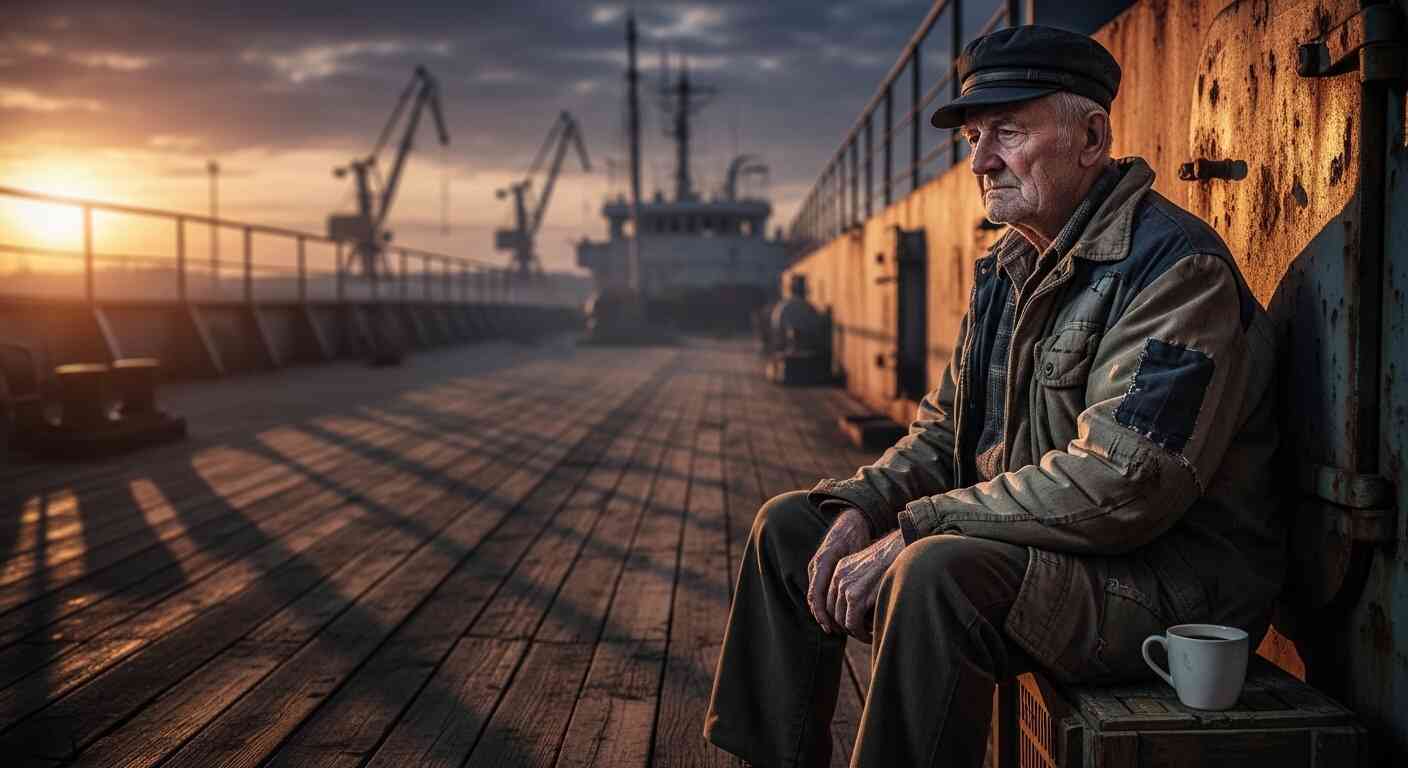
The blood was warm, stark against the gray composite decking, but the wind cutting across the North Atlantic felt like broken glass. I was sixty-eight years old, my joints ached with every swell of the shipping vessel, and my t-shirt was currently soaking up another man’s arrogance.
His name was Kyle. Thirty years younger than me, fifty pounds heavier, and the owner’s nephew. He’d dropped a heavy shackle, slicing his own thumb open. The cut was shallow, a minor inconvenience that should have been solved by a Band-Aid and a trip to the galley. But Kyle needed a target.
“Vance!” he’d bellowed, the same way a spoiled child summons a servant. “Look what your faulty rigging did to me! Clean this mess up. Now.”
I knew the rigging wasn’t faulty. I’d inspected it an hour ago. I didn’t say that, though. Words cost too much energy these days. I just picked up the sponge from the wash bucket and bent my stiff knees.
But apparently, a sponge wasn’t degrading enough for Kyle. Before I could touch the red puddle, his steel-toed boot shot out, connecting with the plastic bucket. Water and gray suds exploded across the deck, drenching my jeans.
“Not like that, old man,” Kyle sneered, the cold salt spray already misting his cruel smile. He grabbed the hem of my worn Navy-issue t-shirt, tugging it with enough violence that the old cotton fabric screamed before ripping. With one sharp motion, he ripped it clean off my back.
I was left bare-chested to the November wind. My skin was a roadmap of fading scars—old shrapnel kisses, ancient surgeries, a lifetime of surviving things that should have killed me.
“Use that,” he ordered, dropping the ruined shirt into the blood. “On your hands and knees. Get it spotless.”
I looked at the bloody shirt. I looked up at Kyle, who was grinning as two younger deckhands watched, their faces pale and conflicted. They were scared of Kyle; I was just tired.
I looked down again. Slowly, agonizingly, I lowered myself, first one knee, then the other. The composite deck was unforgiving on my cartilage. I grasped my own bloody shirt and began to scrub the blood with a simple, circular motion.
Kyle was laughing. A high, grating sound that whipped in the wind. “Scrub harder! Maybe the blood will remind you of all the battles you lost.”
He thought I was broken. He thought he was exerting dominance. He was wrong.
My name is Silas Vance. I live a quiet, solitary life on this coast, working these grueling industrial shipping shifts not because I have to, but because I can’t stand the silence of my own apartment. I am an invisible old man to the world, just one more weathered face.
But Kyle’s words didn’t just insult me. They insulted my ghosts.
I stopped scrubbing. The blood was gone, the decking pristine, my shirt saturated and ruined. I gripped the wet cotton, using it as a brace as I forced myself to stand. My breath hitched in my chest, fogging in the air. I looked directly at Kyle.
“I never lost a battle; I only lost brothers who were ten times the man you’ll ever be.”
My voice was quiet, raspy, but it carried across the waves, louder than the wind. Kyle’s laugh died, his jaw dropping in surprise that the dog he was kicking had suddenly barked.
“What did you say?” He stepped closer, attempting to tower over me.
I didn’t answer him. I just slowly turned around. I needed to let the cold dry the sweat and blood off my skin.
What Kyle saw next made him freeze, his body becoming rigid, his smug expression replaced by a sudden, choking silence.
He saw my back.
Covered. Completely.
It was an intricate, devastatingly massive tattoo that listed the precise latitude and longitude coordinates, the specific dates, and the code names for every major, clandestine, and critical naval victory in modern American history.
It was a classified history book inked in black. And at the very bottom, beneath the coordinate that marked the final, decisive action that had averted a global catastrophe fifteen years ago, was my name. Not Silas Vance, the deckhand.
My signature. Silas Vance, The Strategist.
My back was a testament to the fact that while men like Kyle boasted and blustered, men like me had won.
Kyle didn’t speak. He stared at the list of battles, recognizing the famous dates from his history books, seeing the horrifying detail of the coordinates, his eyes tracking down to that signature. He stumbled back, colliding with the railing.
The deckhand who had always been a joke, an object to be bullied, was the man who had architected his nation’s entire modern naval dominance.
PART 2: Chapters 1 and 2
Chapter 1
The blood was warm, stark against the gray composite decking, but the wind cutting across the North Atlantic felt like broken glass. I was sixty-eight years old, my joints ached with every swell of the shipping vessel, and my t-shirt was currently soaking up another man’s arrogance.
His name was Kyle. Thirty years younger than me, fifty pounds heavier, and the owner’s nephew. Kyle was the kind of man who viewed compliance as weakness and silence as an invitation for abuse. He had dropped a heavy shackle, slicing his own thumb open—a minor inconvenience that, for anyone else, would have been solved by a Band-Aid. But Kyle needed a target, and I was the easiest one.
“Vance!” he’d bellowed. “Look what your faulty rigging did to me! Clean this mess up. Now.”
I knew the rigging wasn’t faulty. I’d inspected it an hour ago. I knew that, but words cost too much energy these days. I didn’t defend myself. Silence had been my sanctuary for nearly twenty years. I just picked up the sponge from the wash bucket and bent my stiff knees to the unforgiving deck, ready to wipe away the crimson sign of his carelessness.
But a sponge was too dignified for Kyle. Before the porous yellow block could touch the deck, his steel-toed boot shot out, connecting with the plastic bucket. Water and gray suds exploded across the deck, drenching my jeans.
“Not like that, old man,” Kyle sneered, his cold eyes gleaming. “You’re not just a low-life hand; you’re an old, incompetent low-life hand. A sponge isn’t personal enough. Since you love being on the bottom of the ladder so much, use your hands.”
I looked at the water soaking into the composite. I didn’t react, which only infuriated him.
He reached down, grabbing the hem of my worn Navy-issue t-shirt. With one vicious jerk, the fabric screamed as it ripped, leaving me bare-chested to the blistering wind. The chill hit me immediately, stinging the scars that networked across my skin—ancient kisses from shrapnel, old surgeries, a lifetime of surviving things that should have killed me.
He threw the torn fabric into the blood. “Use that. On your hands and knees. Get it spotless, or I’ll throw the bucket water directly in your face next.”
The other deckhands watched. There were five of us on this run. Two of them were new kids, faces pale and eyes darting away. The other two were lifers, men like me who just wanted to punch their timecard. Nobody intervened. To interfere with Kyle Remington was to interfere with his uncle, the owner, and this job paid too well to jeopardize over dignity.
My name is Silas Vance. To the modern world, I am ghost. I live a solitary life in a run-down apartment that always smells slightly of boiled coffee. I work these grueling industrial shipping shifts on these massive commercial vessels because the manual labor distracts me. It stops the ghosts from talking.
I was invisible, just another weathered face in a plaid jacket.
Slowly, agonizingly, I lowered myself to my knees. It took a long time. Every pop of cartilage, every protest from a spinal column worn thin by decades of pressure, screamed. I grasped my own bloody shirt and began to scrub the red puddle in a simple, precise circle.
Kyle was laughing now. A high, grating sound that whipped in the wind, a sharp contrast to the deep drone of the ship’s engines. He paced around me, enjoying the spectacle of an old man broken by authority.
“Scrub harder! Maybe the blood will remind you of all the battles you lost.”
He thought he was being witty. He thought I was just a washed-up service member who’d never amount to anything.
He was wrong. He was so, devastatingly wrong.
But I continued to scrub. I scrubbed until my hands were numb and the composite decking looked as gray as the ocean. I finished, gripping the red-stained cotton in one hand, forcing myself to stand, a process that required a physical and emotional toll Kyle would never understand. I stood, shivering but upright, my eyes locked on his.
“I never lost a battle,” I said, my voice quiet, but carrying clearly on the wind, surprising everyone.
“Excuse me?” Kyle stepped closer, his smile dropping.
“I never lost a battle,” I repeated, maintaining eye contact. “I only lost brothers who were ten times the man you’ll ever be.”
Before he could react—before he could raise his fist to strike me for my audacity—I slowly turned around.
The North Atlantic wind hit my bare back, drying the cold sweat and salt spray instantly.
Kyle’s reaction was immediate and absolute. He froze. His smug, aggressive posture shattered, replaced by a rigid, horrified stillness. He didn’t just stop talking; he looked as though someone had pulled the plug on his entire reality.
He saw my back. He saw the coordinate listing. He saw the dates. He saw the classified code names of every major clandestine victory, battle, and naval operation of the last thirty years—an intricate, massive tattoo that covered my entire spine and ribcage. He saw the signatures that confirmed the source.
He saw the name.
His eyes tracked down past the dates to the signature beneath the largest coordinate—the operation fifteen years ago that had ended a war before it started. It wasn’t signed Silas Vance, the deckhand. It was signed with a large, unmistakable floral flourish:
Silas Vance, The Strategist.
Kyle’s breath caught. He knew the name. He might be an incompetent buffoon, but he was a Remington, and the Remingtons knew history. They knew The Strategist was the architectural genius behind the modern nation’s total global naval dominance. A ghost. A man of legend.
A man who was now standing on his deck, shivering and shirtless, looking at him with eyes that had seen entire fleets vanish at his command.
Chapter 2
The silence on the deck of the Titan’s Harvest was more heavy than any ocean swell. It wasn’t just quiet; it was vacuum quiet. The only sounds were the distant rumble of the engine and the relentless slap of the grey Atlantic against the hull.
Kyle Remington was still staring. His face had gone from aggressive red to a sickly, pale grey. His hand, the one that had just slapped the shoulder of an old man, was trembling. He looked smaller, somehow, beneath the shadow of my signature.
I didn’t say anything. I just maintained the silence. The greatest weapon in any strategist’s arsenal is a well-placed silence. It forces the other side to reveal their hand, their fear, or their ignorance. Kyle revealed all three.
“You’re… you’re Vance?” his voice cracked, a squeak that betrayed his terror. “Not the… not the Silas Vance? The… The Strategist? That’s not real.”
I slowly turned back around, facing him. The cold wind bit at my bare skin, but I didn’t let myself shudder. I looked him dead in the eyes, my expression a stone wall.
“It’s very real, Kyle.”
I didn’t need to shout. I didn’t need to make threats. The simple statement, backed by the history written on my skin, was a bullet train of context hitting his entire worldview.
Kyle’s two friends, the newer deckhands, exchanged looks of pure, wide-eyed shock. They were young. They knew the name too. The Strategist was a figure of semi-mythological status in the military history they’d all watched online. The man who commanded fleets from a dark room, whose single coordinate could change the fate of empires. The idea that he was the old guy who got the bad shifts and always took the fall for their mistakes was too big a jump for them to process instantly.
Kyle, however, understood instantly. He understood that he had just humiliated, in front of witnesses, a national hero of legendary proportions. He understood that his family’s wealth and connection couldn’t protect him from the sheer weight of what I represented.
“I… I didn’t… you should have told us,” Kyle blurted, his arrogance attempting a feeble re-assembly. “You just came on as a… a no-name. You should have stated your rank.”
I shook my head slightly. A small, sad smile touched my lips. “The world changes, Kyle. Positions end. People disappear. Some of us don’t need titles to know who we are.”
I looked down at the ruined, bloody shirt in my hand. Then I looked at the bucket that Kyle had kicked over. The sudsy, cold water was still seeping across the composite, mingling with the last hints of blood Kyle’s cut had produced.
“But some of us still have a job to do,” I said.
I bent down again. It was just as painful as before. Every joint popped, every muscle protested the strain of my aging body. I picked up the fallen sponge, dipped it in the remains of the dirty water Kyle had spilled, and began to wash the deck properly.
Kyle didn’t move. He stood, paralyzed, watching the legendary Architect of Naval Dominance finish cleaning up a puddle of spilt suds and blood from a deckhand’s sloppy accident.
The deckhands stared. They saw the legend. But as I worked, I felt something else too. I felt their respect shift. It wasn’t just fear of my past; it was a realization that my past was irrelevant. I was doing the work. I was maintaining the ship. I was finishing my job.
After a few minutes, when the last suds were gone, I stood again, wiping the worst of the grime from my hands with a different corner of my ruined shirt. The wind was getting colder. I needed a shirt.
I looked at Kyle one last time. I didn’t glare. I didn’t smirk. I just looked. A long, level gaze that stripped away his bluster, his family name, and his entire artificial construct of power. I looked until his eyes dropped, unable to meet mine.
“The deck is clean, Mr. Remington,” I said. The use of his full title was more of an insult than anything I could have shouted. It placed him on a rung far below me, defined by his bloodline and not his capability.
I didn’t wait for a response. I turned and walked toward the crew hatch, the North Atlantic wind stinging my bare back, carrying with me the silence I had just shattered, a silence that Kyle Remington would now have to live with every single day of his remaining life on this ocean.
PART 3: Chapters 3 and 4
Chapter 3
The hatch to the lower decks closed with a solid, echoing metallic clang. The instant I was out of the direct line of Kyle’s vision, the adrenaline that had fueled my composure evaporated. My whole body began to tremble. It wasn’t just the cold, though my bare chest was covered in goosebumps and numb from the exposure. It was the violation.
I had spent twenty years in shadows. Twenty years cultivating an existence so bland it wouldn’t draw a second glance. And in fifteen minutes, a thirty-year-old child had torn it open with a handful of blood and a bruised ego.
I made my way down the steep, narrow crew ladder. Every step down hurt my knees. I couldn’t just be angry at Kyle; I had to be angry at my own vanity. Why didn’t I just take the sponge and say nothing? Why did I need to fight back? Why did I need to stand?
Because they were insulting the ghosts. That thought stopped me on the fifth step down. Kyle hadn’t just been insulting an old deckhand; he had been mocking the memory of every man whose coordinate was inked onto my spine. He was mocking the dead. And I couldn’t let that stand.
I reached the crew quarters, a cramped, stale-smelling hallway. I needed to get to the medical locker and get a shirt, then to my cabin to process the new silence that now ruled the Titan’s Harvest.
I found the medical locker. The ship didn’t have a dedicated doctor for runs this small, but the First Mate, Miller, was a pragmatist with a basic EMT certification.
Miller was in his tiny cabin, adjacent to the medical supply room. He looked up, his weathered face hard and unsurprised by my presence. He’d seen plenty of men injured or humiliated in his thirty years. He probably assumed Kyle had physically assaulted me.
“Vance,” he said, his voice a low gravel rumble. “Remington get you?”
“No. It was… an issue of protocol,” I said.
Miller stood, walking to the locker. He unlocked it and pulled out a packet of fresh cotton undershirts. He tossed me one. I caught it, my numb hands barely managing the task.
I was shirtless, my back to the wall, trying to hide the evidence I had just displayed on the deck. I pulled the fresh shirt over my head quickly.
“Heard about it?” I asked, keeping my voice neutral.
“The whole ship probably heard about it,” Miller said, leaning back against the wall. “The cook is already spreading it. Said Remington made you scrub blood with your shirt.” Miller paused, looking at me closely. He wasn’t like Kyle. He was a good seaman, a hard worker who respected competence.
“That kid’s a liability,” Miller said. “He knows navigation like a cat knows thermodynamics. He’s going to get someone killed one day. But his uncle…”
“I know,” I said, the collar of the fresh shirt settling against my neck. “The uncle.”
Miller didn’t ask about my back. He didn’t ask about the tattoo. That made me respect him. He respected boundaries.
“You okay?”
“I’m fine, Miller.”
“Good. Remington wants us to run some specific heading tests on the way back through the Channel. Some new buoy system. He specifically listed you on the detail.” Miller gave me a warning look. “Be ready, Vance. He’s the type to push.”
I nodded and left the medical bay. He wasn’t pushing me; he was retaliating. This was his move to re-assert control, by making me do his homework on a technical test.
I walked back to my cabin. Six-foot by four-foot, bunks for two. I was alone this run, which was a blessing. I locked the door and sat on the edge of the lower bunk.
My secrets were out.
I couldn’t run from it. The coordinates were etched in my memory before they were etched in my skin. I could close my eyes and see the satellite map for 17N, 134E, June 3rd, 1999. The operation name, “Iron Spear.” The tactical challenge of coordinating twelve separate fleets across three distinct oceanic fronts without breaching communication silence. The precise decision I’d made, a gamble so massive my own command staff had called me insane, that had trapped the enemy in the shallow channels of the Spratly Islands and forced a surrender.
I had been The Strategist. The ghost of the War Room. The man whose mind could visualize global military strategy the way a conductor visualizes a symphony.
And I had left. The guilt of the men who didn’t make it, the specific faces of the brothers I’d mentioned, the ghosts who haunted my apartment—it was too much. The applause, the medals, the hush that fell when I entered a room—they felt fake. They felt bought with blood.
I didn’t want respect. I wanted silence.
But Kyle Remington had broken the contract. He had made me matter. He had forced me to stand and reclaim the title I had buried.
And now, he wanted me to do his heading tests.
Chapter 4
Three days after the incident on the deck, we were moving toward the English Channel. The weather had held, but the tension on the Titan’s Harvest was a thick, unspoken pressure.
Nobody talked to me, but everyone was talking about me. I could feel the stares. The way the other deckhands shifted uncomfortably when I walked by. The way even First Mate Miller seemed to afford me an extra foot of personal space. I was no longer Vance the Invisible. I was Vance, The Strategist.
I walked into the navigation bridge. Kyle Remington was at the chart table. He was wearing his captain’s jacket over a polo shirt. He looked polished, but I could see the sweat on his temples. Beside him was the ship’s actual captain, a man named Sterling, a pragmatist who I had always assumed Kyle bullied as much as anyone else.
Sterling gave me a nervous nod. Kyle didn’t even look at me. He kept his eyes on the chart, his posture rigid.
“Heading test, Vance,” Sterling said, his voice tense. “We’re testing the new deep-channel navigation system. Remington has designed the parameters. He’s requested your assistance with the coordinate logging and system response.”
“Yes, sir.” I stepped closer to the chart table, taking the logging clipboard from the desk.
The test required running a precise zigzag pattern across a specific section of the shipping lanes where a new set of submerged, highly sensitive acoustic buoys had been anchored. The goal was to prove that Kyle’s automated software could calculate and hold these course changes under dynamic current and wind conditions, effectively allowing for safe automated navigation through congested, volatile waters.
It was a complex maneuver. And it was exactly the kind of test a skilled navigating officer should perform. But I knew Kyle. I had watched him on the last six runs. The kid had the technical mind of a toaster. This entire test was designed to impress his uncle, and he was counting on the automation to do the heavy lifting.
And now, he was terrified of failure, but his arrogance wouldn’t allow him to ask for my help directly. So he’d ordered it.
“Initial heading is 215, Vance,” Kyle barked, his voice forced. He still didn’t make eye contact. “Record the timestamp and the GPS variance at every 10-degree increment.”
“Understood,” I said.
The first turn began. The Titan’s Harvest groaned as her massive engines adjusted, the hull tilting slightly. It was a simple maneuver. I logged the numbers. Kyle watched the automated systems monitor, Sterling checked the manual charts.
The second turn, a sharper shift to 235, went smoothly.
The third turn was the real challenge. It wasn’t just a turn; it was a shift in power. We had to decrease speed to twelve knots, hold a stable heading for precisely ninety seconds, then apply maximum power and turn hard to 180 degrees, simulating an emergency course correction to avoid traffic while maintaining stability in a strong current.
The automation took over. Kyle sat back, crossed his arms, and a look of smug relief finally touched his face.
I wasn’t an engineer, but I had spent forty years on ships, either in the war room or on the deck. I knew the specific groan a vessel makes when her structure is being taxed. And as the automated program executed the speed reduction, the drone from the engine room began to climb in pitch. It was an unhappy sound. The automation was attempting to slow the propeller RPM faster than the hull was de-accelerating. It was straining the main drive shaft.
I looked at the power gauge. It was spiking.
“Engine loading seems high, Mr. Remington,” I said. I used his full name again. It made him grit his teeth.
“It’s a stress test, Vance,” Kyle snapped, not taking his eyes off the screen. “The automation handles it. The engineering specs say the shaft is rated for this loading.”
“Engineering specs are built in a simulation room, not a heavy current,” I said.
“Record the timestamp, old man, and shut up.”
I did as ordered. The 90-second holding period began. The current hit us hard, pushing against the port side. The automation fought back, applying tiny thruster corrections every two seconds, each correction a microscopic shudder through the entire 60,000-ton hull.
The engines began to scream. Not just groan, but scream. The vibration coming through the deck plates of the bridge was increasing.
“He’s losing stability,” Sterling whispered, checking his instruments. He looked terrified to speak up. “Kyle, we might want to manually override.”
“Manual is inefficient, Sterling! The system knows the water. This proves the program works!” Kyle’s voice was too high. He was panicking, but his vanity wouldn’t let him retreat.
The automation executed the final stage of the test. The 180-degree hard turn under maximum power.
It was a maneuver that should have been an orchestra of coordinated engineering. Instead, it was a car crash in slow motion. The main engines roared, applying maximum torque while the bow thrusters engaged simultaneously to spin the ship.
But the current was too strong. The automation over-calculated. The ship began to list heavily.
The sound that echoed from beneath our feet was sickening—a sharp, deafening CRACK that made the entire bridge shudder. It was the sound of metal failing. The main drive shaft had sheered under the stress of the opposing loads.
Alarms erupted across the console. The engines went silent instantly, their roar replaced by a high-pitched, desperate whine. The Titan’s Harvest had no propulsion. We were adrift in the North Atlantic, listing to port, and in less than five minutes, we would drift into the primary path of the deep-channel shipping lanes—directly into the path of an oncoming 200,000-ton container ship that was barreling down on us at twenty knots, unable to alter course in time to avoid a broadside collision.
Kyle stood paralyzed, his eyes wide with a different kind of terror than what he had felt when I revealed my back. This wasn’t a risk to his reputation; this was a risk to his life.
He looked at the control panels, the alarms blinking in red. He looked at Sterling, who was fumbling with the radio.
And then, Kyle slowly, slowly turned, his eyes finding mine. The man who had humiliated me, who had mocked my ‘lost battles,’ who had ordered me around, was now drowning in the consequences of his own incompetence.
He knew who I was. He had called me a legend. He had seen the proof.
His mouth worked, but no sound came out. Finally, he whispered, a question that was also a prayer.
“Vance… The Strategist… what do we do?”
I looked at him. I could have walked away. I could have gone to the lifeboats. I could have let him drown in his own failure.
But my ghosts were watching. And I never lost a battle.
PART 4: Chapters 5 and 6
Chapter 5
Alarms pulsed across the bridge, a chaotic rhythm of red light and shrieking klaxons. The Titan’s Harvest was a 60,000-ton steel corpse, adrift and listed fifteen degrees to port, and the primary shipping lane was a funnel we were sliding directly into.
Kyle Remington stood completely frozen, his eyes wide and vacant. He was looking at me, but he wasn’t really seeing me. He was seeing the crushing weight of his reality: his uncle would hate him, the insurance companies would destroy him, and he might very well die. He had commanded this test with an arrogance born of ignorance, and now he was drowning in the consequences.
Sterling, the actual captain, was hyperventilating into a deactivated radio, completely useless. The only other people on the bridge were me and First Mate Miller, who had rushed in when the alarm started.
“Main drive shaft sheered. We have no propulsion. Alarms across all engine systems. Manual controls are locked,” Miller read off the console, his voice a professional calm that I appreciated. He looked at me, not Kyle.
I looked from Kyle to Sterling. Sterling was a broken man. Kyle was a lost child. A ship with no chain of command is just a massive tomb.
I dropped the logging clipboard I was holding. The simple clap of wood hitting metal made Miller snap his head around. Kyle flinched, but Sterling didn’t even hear it.
“Mr. Miller,” I said, my voice cutting through the alarms. It was quiet, authoritative, a tone that hadn’t crossed my lips in two decades. “You are currently the senior ranking competent officer on this vessel. Sterling is incapacitated. Kyle Remington is an observer.”
Miller didn’t waste time arguing rank. He nodded. “Give me orders.”
I didn’t smile. I didn’t gloat. Gloating is for amateurs. A real strategist values efficient resource deployment above all else.
I stepped to the main chart table, ignoring Kyle completely. I looked at the map of the channel, the flow and depth data, and the tracking markers for oncoming traffic.
I had architected fleets in the Spratlys and the Mediterranean. I had calculated missile trajectories through supersonic winds. I knew the physical laws of this ocean the way I knew the sound of my own breath. I didn’t need a computer. I didn’t need fancy automated software. I just needed geometry, current, and will.
The current was moving us northeast at four knots. The listed angle increased the drag on the port side. The oncoming container ship, the Emerald Star, was eight miles out, traveling at twenty knots on a course that would have us collide precisely over a section of shallow underwater ridges that marked the edge of the shipping lane.
“Miller, the listing isn’t critical to stability yet, but it’s critical to drag,” I said. “It’s pulling us into the collision path. We can’t get propulsion, but we can manage gravity.”
“How?” Miller asked.
“Kyle Remington’s automated test was monitoring acoustic buoys,” I stated, recalling the technical parameters of the test. “This ship has automated ballast-transfer pumps designed for heavy industrial cargo loading. Since Kyle bypassed the bridge manual controls to load his testing software, that whole automated ballast system is probably currently slaved to the main automated server in the server room, not the engine room.”
Kyle, hearing his name, seemed to come back to reality slightly. He looked at me, a flicker of intelligence returning to his eyes. He realized I was using the very systems he had installed against him, for our survival.
“Go on,” Miller said.
“If we can access that server, we can write a simple command to execute an emergency anti-listing ballast transfer. We can force the ship to list fifteen degrees to starboard within ninety seconds.”
“Ninety seconds? The pumps won’t handle that,” Miller objected.
“They will if you purge the safety-limits protocols,” I stated matter-of-factly. “The engines are broken; we don’t care about safety limits for non-propulsion systems. We are essentially converting 60,000 tons of vessel into a giant, controllable rudder.”
“But how do we navigate?” Kyle whispered. He seemed to be understanding the tactical impossibility of the plan. “We have no propulsion! We’re just a massive, drifting metal box!”
I looked at him, directly this time. My expression was a stone mask. The gaze of The Strategist.
“We use the enemy’s momentum against them, Mr. Remington,” I stated. “By listing hard to starboard, we increase the surface area exposed to the northeast current while simultaneously altering the hull’s hydrodynamic flow. The ship wants to drift with the current. If we list hard enough, the list acts as a sail under the water.”
I grabbed the protractor from the chart table, my fingers automatically placing the center over our current position. I drew a line. It was an impossible course, a calculated gamble that required anticipating the precise second the ocean would interact with a massive steel body.
“By initiating a 15-degree starboard list sixty seconds from now, we will execute a rapid, non-powered turn through a 60-degree arc. We will decelerate our collision velocity relative to the Emerald Star by 40% while simultaneously moving our broadside profile out of its primary path.” I drew the final coordinate point. A point on the chart that looked like open ocean to Sterling, but to me, looked like safety.
“We won’t just avoid the collision,” I stated, looking up at Miller. “We will drift precisely over the shallow underwater ridges, and the initial starboard list will make the entire vessel pivot on the reef. The ship won’t broadside collision; it will execute a controlled, non-powered grounding. We will stop drifting. We will be safe from being run down, and we will wait for a tow.”
The bridge was dead silent. Even the klaxons seemed to have lowered their pitch.
Miller stared at the chart, at the coordinate I had drawn. Then he looked at me. He saw the coordinates tattooed on my back, the historical victories, the decisions made under pressure that should have been impossible.
He looked at Kyle, whose life was in my hands. He looked at Sterling, who was still fumbling.
“You’re insane, Vance,” Miller whispered.
“Maybe,” I said. “But I never lost a battle.”
Miller nodded once. A decisive, military action. He grabbed his radio.
“Engineering! This is First Mate Miller. We have a command override on all automatic ballast systems. Do not, repeat, do not interfere. Vance is going down to the server room.”
I didn’t wait. I ran for the hatch, leaving the chaos behind. I knew the code to the server room. I’d installed some of these systems twenty years ago, before I disappeared.
I was no longer an old man. I was The Strategist. My joints didn’t hurt. My breath was steady. I was on a mission. The battlefield had changed, but the objective was the same: victory.
Chapter 6
The Titan’s Harvest sat perfectly still. It was a bizarre, unnatural stillness on the ocean. The gray-green water of the North Atlantic clapped gently against the hull, but the massive 60,000-ton vessel didn’t move. She was listing forty degrees to starboard.
I stood on the bridge, leaning against the chart table. The engine noises were gone, the alarms were silent, replaced by the crackle of the radio.
Sterling was still on the floor, in shock. He was going to have a very long talk with the Coast Guard in a few hours.
Kyle Remington was not on the bridge. When I’d initiated the final automated list command and the ship began to tilt violently, Kyle had run for the lifeboats, a primal reaction to a calculated survival strategy he didn’t understand. Miller, with a cold efficiency, had caught him before he could launch a boat into a four-knot current and dragged him down to the galley, ordering him to sit and shut up.
The only people left on the bridge were me and Miller. The true chain of command.
The radio crackled again. “Titan’s Harvest, this is HMS Protector. We are currently holding position 1.2 miles off your starboard beam. We are launching a tow line. Are all personnel accounted for?”
Miller nodded at me, then depressed the radio button. “HMS Protector, this is First Mate Miller. All personnel are accounted for. We are ready to receive the line. Our main propulsion is lost; we are grounded on the southeast edge of the ridge.”
“Understood, Titan’s Harvest. We will begin the extraction process shortly. Be advised, we will need to coordinate closely on the ballast transfer to stabilize you for tow. Our command staff will need detailed logs of the automated procedure you executed.”
Miller looked at me, a small, weary smile touching his face. He knew my code to execute that ballast transfer would puzzle military tech specialists for years.
“Vance, you magnificent son-of-a-bitch,” Miller said, leaning back against the helm. He wasn’t insulting me. It was an expression of pure, relieved respect.
I didn’t say anything. I just maintained the silence. The battle was over. The objective was achieved. Victory didn’t require fanfare. It didn’t require recognition. In fact, victory was best savored in the quiet, alone.
I turned from the helm and began to walk toward the exit of the bridge.
“Where are you going, Vance?” Miller asked, a new warmth in his voice.
“The battle is over, First Mate,” I said. I was Silas Vance, The Strategist again. And The Strategist always leaves after the victory is secure. “I’m going to my cabin to pack. I think my service on this run is complete.”
I didn’t wait for an objection. I walked through the hatch, the narrow metallic hallways now familiar and unthreatening. I went down to the cramped crew quarters. My solitary life was waiting.
But as I packed my one duffel bag, placing my few items into the worn green canvas, I knew something had changed. I had spent twenty years in shadows, hiding from my ghosts, terrified of the responsibility of my own brilliance.
And in fifteen minutes, a thirty-year-old child had torn it open with a handful of blood and a bruised ego. But I had chosen to stand. I had chosen to fight. And I had won.
Kyle Remington didn’t win. He lost his reputation, his job, and maybe his pride. He’d spend the rest of his life as the man who almost killed a crew and who didn’t know he was bullying a national hero.
But I had won. I hadn’t just won the battle against the current; I had won the battle against the silence. I had remembered who I was. I had remembered that while men like Kyle boasted and blustered, men like me architected the very reality they enjoyed.
I picked up my duffel bag and walked out of the cabin, the stillness of the ship a testament to my past. The North Atlantic was waiting, and I knew that whatever silence lay ahead, it was no longer a sanctuary to hide in, but a victory I had rightfully earned.
My name is Silas Vance. I have architected global strategies and decided the fate of fleets.
And I have never lost a battle.