FULL STORY
Kneel.
That was the only word Tyler Vance spoke before the freezing night air was broken by the sound of a plastic cap snapping open.
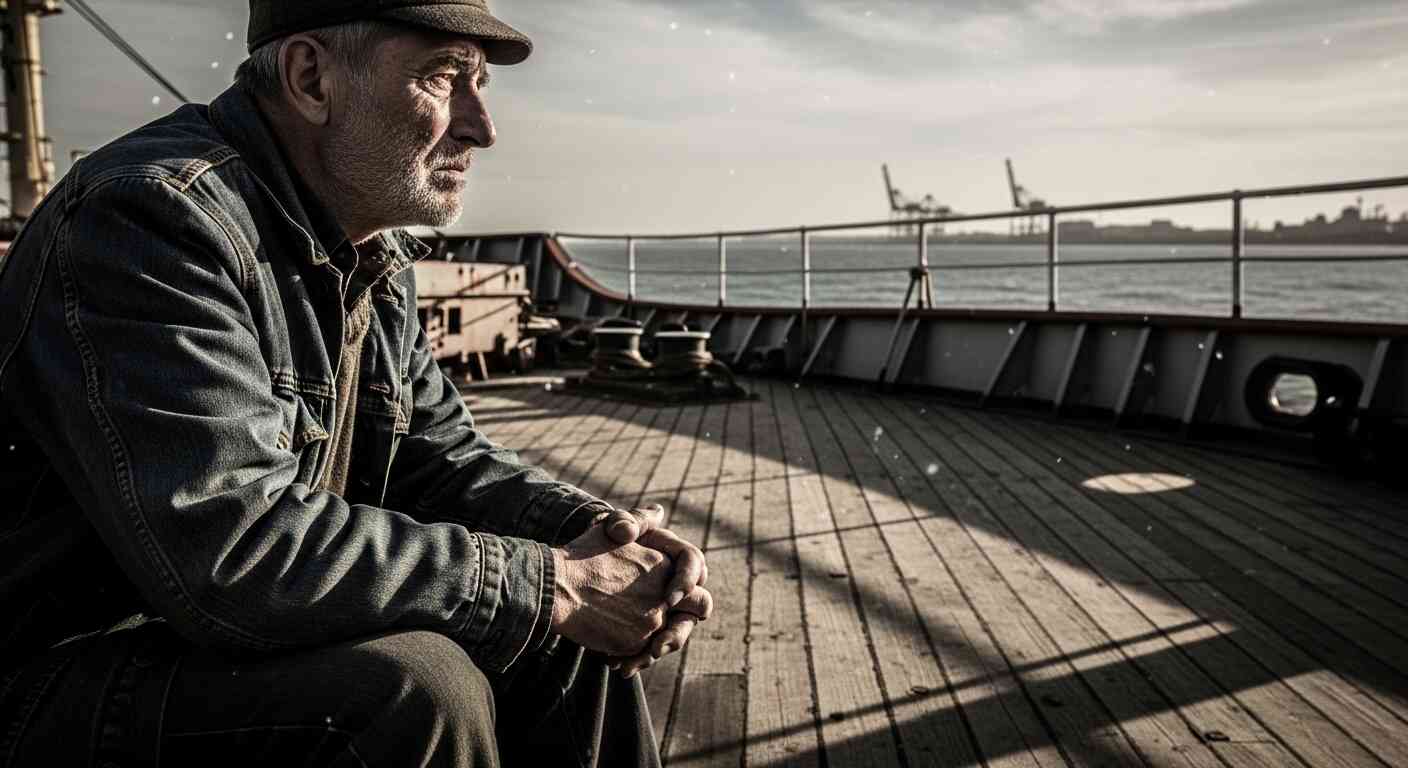
We were on the steel deck of the Audacity, a rust-bucket barge moored in the darkest corner of the shipyard. It was twelve degrees. My hands were shaking. Not from the cold. Never from the cold.
I tried to stand my ground. I’m fifty-two years old. He’s twenty-four. His father owns the yard. I just work here, trying to make enough to keep the nightmares at bay and a roof over my head.
Tyler pushed me. Hard. My steel-toed boots slipped on the icy metal. I went down hard on one knee.
“Stay there, ‘hero’,” Tyler sneered. He held a half-empty bottle of plastic-jug whiskey in one gloved hand. He smelled like expensive cologne and unearned arrogance. He looked at me with pure disgust.
He tilted the bottle.
The cheap, burning liquid splashed over my head, soaking into my beanie, running down my neck. It was frigid. It smelled like defeat. It smelled like my darkest times.
I squeezed my eyes shut. In, out. Focus on the breath. But the tremors were getting worse. My hands, resting on the steel deck, were jackhammering. I couldn’t stop them. I never could when it got this bad.
“Look at you,” Tyler said, his voice dripping with condescension. He squatted down in front of me, safe in his thermal gear while I shivered in soaked coveralls.
He slapped me. Not hard enough to knock me down, but just hard enough to humiliate.
“Is this the ‘warrior’ they told us stories about?” He slapped me again, this time turning my head to the side. “A shaking drunk who can’t even look me in the eye?”
Another slap.
The ghost of every man I left behind screamed in my ears. The adrenaline spiked, making the tremors violent.
Tyler laughed. It was a wet, cruel sound. He raised his hand for a fourth strike, ready to break whatever spirit he thought I had left.
But I opened my eyes.
The steel in my soul, forged in fire long before he was a thought in his daddy’s wallet, hardened. I didn’t try to look strong. I just spoke the truth, my voice rough as gravel.
I looked directly into his cold, rich-kid blue eyes.
“My hands shake because they remember the weight of the men I’ve saved,” I told him, the words fighting through the chattering of my teeth. “Not the fear of boys like you.”
He paused. His hand was up, poised to strike. For a second, just a flicker, something other than arrogance was in his expression. It was uncertainty. He didn’t understand.
But his pride was too fragile. The uncertainty turned to rage.
“Men you saved? You haven’t saved anyone. You’re a useless junkie working security on a dead barge.”
He stood up, grabbing the collar of my coveralls to drag me to my feet, presumably to finish whatever twisted lesson he thought he was teaching.
But I was tired. I was so tired of carrying the weight. I was tired of hiding.
“Wait,” I managed.
He stopped, holding me up.
Slowly, I unzipped my soaked jacket. I unbuttoned the wool flannel underneath. The cold bit into me instantly, sharp as a knife. I grasped the hem of my thin, whiskey-soaked t-shirt and yanked it up.
Tyler froze. The smirk evaporated.
Across my entire torso, from hip to ribcage, was a chaotic, massive surgical scar. It wasn’t clean. It looked like a roadmap of trauma. It was the physical evidence of being rebuilt after taking an explosive at point-blank range.
It was a scar identical to the one in the history books Tyler had been forced to study. The scar from the ‘Human Shield of Kandahar,’ the legendary operative who had thrown himself onto a fragmentation device to save an entire pinned-down battalion in 2011.
The battalion that had been commanded by General Richard Vance.
Tyler’s father.
Tyler Vance’s hand, the one that had been slapping my face minutes before, began to tremble. He stopped mid-motion, his fingers stiffening, frozen in the air. The realization hit him like a freight train. He recognized the living legend.
He wasn’t looking at a shaking drunk. He was looking at the man who saved his father’s life.
FULL STORY
CHAPTER 2: CHASING GHOSTS
The arrival of Harrison Vane was less like a family visit and more like a hostile corporate takeover. He didn’t use the boarding ramp; he was lowered from his private helicopter, a stark black machine that sliced through the gathering storm clouds and landed on the Sea Serpent’s heli-deck with military precision.
The storm was hitting the North Atlantic with sudden, vicious force. The Sea Serpent, despite its stabilizers, began to pitch and roll. The interior of the yacht was silent, a tense contrast to the chaos outside.
Harrison Vane, a man in his late fifties with cold, blue eyes and a face that seemed carved from granite, marched from the helipad directly into the main salon. He was flanked by his own private security team, men with the blank faces of hired violence, their presence a silent rebuke to Captain Jenkins and her crew. Harrison did not look at his son, who was standing at attention near the salon’s entrance, wearing a perfectly tailored suit and a mask of terrified obedience.
Instead, Harrison looked at Captain Jenkins. “This weather, Captain. Why wasn’t I informed?”
“It developed faster than forecasted, sir,” Captain Sarah Jenkins replied, her jaw set. She was a master mariner, but she knew the type of man Harrison Vane was—he didn’t accept variables he couldn’t control. “We are maintaining course, and the stabilizers are engaged. We are safe.”
“For now,” Harrison clipped. “Get us out of it.”
He didn’t wait for a response. He finally turned his gaze to Julian. The golden boy seemed to shrink. Julian had been reamed by his father just last month for a disastrous real estate deal that had cost the Vane empire forty million dollars. This trip was supposed to be a ‘character-building’ exercise, but to Julian, it was a prison.
“Julian,” Harrison said. The word was not an greeting; it was an indictment. “We need to talk. My office. Now.”
As they walked past Silas, who was waiting near the shadows of the engine room access, Harrison’s security detail gave him a practiced, dismissive glance. Silas didn’t exist to them.
But Harrison stopped. His cold eyes landed on Silas. It wasn’t the disgust that Julian showed; it was a calculating, analytical stare. “You,” Harrison said. “You were the man who refused my son’s demand for service earlier?”
Julian took a sharp intake of breath. The rumor mill on the Sea Serpent was fast, but his father’s intelligence network was faster. Julian had been hoping to hide the incident.
“I was doing my rounds, sir,” Silas replied, his voice a neutral rasp. He did not say ‘Mr. Vane.’ He was not in Harrison’s chain of command.
Harrison held his gaze for five uncomfortable seconds, assessing the janitor like a potentially defective asset. “Do your rounds. And stay out of my son’s way. He has enough problems without you complicating things.”
“Yes, sir,” Silas said, stepping back.
Harrison marched past, but Julian lingered for a fraction of a second. The terror in Julian’s eyes was replaced by a look of pure, concentrated hatred. He blamed the janitor for this new failure, for this new humiliation from his father. Silas saw the shift. The boy was dangerous not because he was powerful, but because he was pathetic and cornered.
In Harrison’s private office, the door clicked shut, cutting off the sounds of the ship. Julian stood while his father poured himself a three-finger glass of twenty-year-old whiskey. Harrison didn’t offer one to his son.
“The real estate deal,” Harrison began, his voice deadly quiet. “The press is calling it ‘Julian’s Folly.’ Forty million, Julian. Gone. Because you didn’t do the due diligence. You trusted a charming snake. I didn’t raise you to be charming. I raised you to be effective.”
“I was told it was a solid investment, Dad. The projections—” Julian started, his voice cracking.
Harrison slammed the heavy crystal glass on the desk. A splash of whiskey jumped onto his hand. He didn’t wipe it off. “Projections? You don’t manage projections. You manage reality. And reality is, you’ve made me look weak. In front of the board. In front of the world.”
He walked over to his son, his presence overwhelming the space. He stopped inches from Julian’s face. “The world is full of ghosts, Julian. Ghosts of men who failed. Your grandfather was one. He died in a gutter, a broken drunk. I built this empire so you would never know that smell. And what do you do? You invite that smell back in.”
Harrison was projecting his own past wound. His father’s failure was the engine of his obsession with power and perfection. He didn’t love Julian; he saw him as the continuity of his own existence, and Julian was failing the audition.
“I’m sorry, Dad. I’ll make it right,” Julian said, his eyes tearing up. It was the only defense he had left: his own weakness.
“Make it right?” Harrison sneered. “You think sorry is a currency on the Sea Serpent? You think sorry stops the market from crashing or the ocean from crushing this ship? Sorry is what losers say. The winners have already moved on.”
Harrison grabbed Julian’s jaw, forcing him to look him in the eye. “You are going to fix this. Not the real estate deal. You. You’re going to prove to me that you have the stomach for this life. You are not going to be like your grandfather. If you are, Julian, if you show me one more sign of that gutter-bound weakness, I will bury you. I will cut you off. You will disappear from this life, and I will find a son who is worthy.”
He released Julian, who staggered back. Harrison turned his back on him, staring out at the storm-lashed window. “Get out of my sight. And fix that mess with the janitor. You are a Vane. We do not engage with ghosts; we exorcise them.”
Julian fled. The door shut. Silas, who was waiting just down the corridor, preparing to fix a ruptured line in the HVAC, heard the door close and saw Julian sprint toward the upper decks. He didn’t see a boy running from his father. He saw a predator looking for a weaker victim to restore its sense of control.
Julian didn’t go to his room to hide. He was driven by a primal need to assert dominance, to wash away the humiliating shame of his father’s words. He had to prove he was a winner. And the janitor, with his pathetic beret and his past that no one cared about, was the target his twisted psychology needed.
Silas, meanwhile, was chasing his own ghosts. As he worked in the tight, hot space of the HVAC unit, his mind drifted back to Operation Red Spear. He remembered the ambush. The roar of the explosion that had taken out the lead vehicle. The crack of the rifles. Ben’s face, pale and covered in dust, the beret tucked under his collar.
“Stay with me, Ben. That’s an order,” Silas had yelled, his own hands slick with his friend’s blood. He was the second-in-command, and in that moment, he failed the only command that mattered.
He had promised Ben he would get him home. He didn’t. He carried the beret home instead. It was more than a participating trophy; it was a contract. A debt that could never be repaid.
A voice shook him from the memories. “Thorne, Harrison Vane is requesting a private meeting with the lead staff. That includes you. Apparently, he’s unhappy with the ‘general demeanor’ of the crew. Report to the observation deck in ten.” Captain Jenkins’ voice was strained. She was trying to manage a storm and a petulant owner.
“On it, Cap,” Silas said, wiping the sweat from his face.
On his way up, he decided to stop in his cabin. He was still worried about the beret. The memory of Julian’s boot on the cloth was eating at him. When he unlocked his door and entered the small, sparse room, the air felt off.
The maroon beret was gone.
It was replaced on his desk by a small, perfectly matted, single hair. A golden-brown hair, the exact color of Julian’s. It was a message. A sick, psychological tease. Julian hadn’t just taken it; he had violated Silas’s last refuge.
Silas stood in the silence of his violated room. The storm outside was howling. The inner dragon he had fought to keep caged—the rage, the soldier who knew only total war—finally broke its chains. The ache in his old bullet-wound shoulder flared, a physical validation of the violence he now knew was coming.
Silas Thorne did not report to the observation deck for Harrison Vane’s staff meeting. He didn’t do his rounds. Instead, he went to the armory locker he had secretly accessed days ago. He didn’t take a gun. He took a heavy, rugged, encrypted satellite phone. The kind with a specialized military-grade encryption chip, a device that bypassed all conventional satellite networks.
He didn’t just carry a beret. He carried a connection to the only people who still knew what the smell of Pine-Sol and old sweat really meant.
FULL STORY
CHAPTER 3: THE BREAKING POINT
The storm was no longer just an event; it was a character, a roaring, monstrous presence that sought to consume the Sea Serpent. The massive vessel shuddered as it plunged into seventy-foot swells, the hull groaning in a terrifying, metallic language. The North Atlantic, a dark and frozen entity, was at war.
Inside, Harrison Vane was having a different kind of war. His ‘demeanor’ meeting on the observation deck had gone poorly. Captain Jenkins had successfully argued that safety was her priority over ensuring the crew smiled enough, a stance that infuriated Harrison, but he was wise enough not to replace a captain in the middle of a force-nine gale. The rest of the crew had been reduced to terrified silence, Elena Cruz looking ready to faint.
“You’re dismissing them, Captain?” Harrison demanded, his voice barely audible over the wind battering the observation deck’s windows. “I haven’t finished the performance reviews.”
“The performance of this vessel is what matters right now, sir,” Sarah Jenkins replied, her eyes locked on the raging sea. She turned to the crew. “All personnel, to your battle stations. Maintain all critical systems. Elena, get to your cabin and secure loose items. Go.”
As the staff scattered, Elena passed Silas, who had finally arrived, but not to the meeting. He was standing near the airlock door to the lower aft deck, the ‘wet deck’ used for expedition storage and, in conditions like this, a dangerous, forbidden zone. Elena grabbed his arm, her eyes wide with fear.
“Silas, don’t,” she whispered. “I saw Julian go that way. He’s crazy. He’s angry about his father. He’s going to do something.”
Silas looked down at her small, trembling hand on his coverall. He didn’t feel the sympathy he usually felt for her. He felt nothing. The dragon was out. “Go inside, Elena. This isn’t your mess to clean up.”
He gently pried her hand off and opened the heavy, pressurized airlock door. The roar of the storm was instantaneous, a physical blow. He stepped out onto the wet deck.
The wet deck was a chaotic, oil-slicked hell. A massive expedition RIB (rigid inflatable boat) was bouncing against its davits, threatening to break loose. Ropes, buoys, and expedition gear were sloshing around in foot-deep water that was constantly spilling over the side. The Sea Serpent pitched, and Silas had to grab a metallic railing to keep from being thrown overboard. The cold was brutal, a weapon of its own, but the rage in Silas’s chest burned hotter.
He saw Julian Vane.
Julian was near the edge of the aft deck, where the churning, icy wake of the yacht roared past, a terrifying maw of frozen white water. He was holding the expedition-grade railing, his body soaked, his suit jacket gone, his white shirt clinging to him. He was drunk. Not just from tequila, but from a lethal cocktail of fear, daddy issues, and the primal thrill of being this close to the edge.
And he was holding the maroon beret.
The Sea Serpent lurched violently. Julian stumbled, grabbing a winch to stabilize himself. Silas pushed off from the railing, using his experienced sealegs to navigate the pitching deck. He closed the distance.
Julian saw him. A slow, drunken, malicious grin spread across his face, illuminated by the ship’s erratic floodlights. He pushed off the winch, standing on shaky legs, a man who believed his money made him invincible even to the ocean.
“Ah, the janitor! Did you come to clean up the mess? Or did you come to watch the end of a very bad property investment?” Julian shouted, the storm whipping his words into fragments.
“Give it back, Julian,” Silas said. He wasn’t yelling. He didn’t need to. His voice carried, a direct line.
“Oh, this? This piece of garbage?” Julian waved the beret over the icy water. The wind caught it, making it flap like a wounded bird. “I thought you’d want a receipt for this. You know, since I’m a winner and winners collect receipts.”
Julian’s psychology was transparent. He needed to destroy the one thing Silas valued to convince himself he still had power, especially after his father’s words. He had to be the bully because he couldn’t be the boss.
Silas took another step. He was ten feet away now. The dragon was coiled, ready to strike. The bullet-wound shoulder didn’t ache; it was a loaded spring.
“That beret doesn’t belong to me,” Silas said, his voice flat. “It belongs to a man who died so I could stand here. You have no idea what that means.”
“I know what it means to me, janitor,” Julian spat, his voice dropping from a yell to a hiss as the wind momentarily died down. “It means you’re weak. You’re holding onto ghosts. Your ‘friend’ is dead, and you’re cleaning the toilets of my father’s ship. The dead don’t care about berets, Thorne. The ocean doesn’t care. And neither do I.”
Julian leaned further over the edge, holding the beret directly over the churning wake. The Sea Serpent gave another massive pitch, the bow lifting.
Silas saw it coming. The moment when Julian’s arrogance would meet the reality of the ocean. He didn’t move to stop it. He wanted Julian to see the consequences.
The ship slammed down, a wave of water crashing over the stern. Julian Vane, drunk and unbalanced, was tossed like a ragdoll. He grabbed the railing, but his hand slipped on the oil-slicked metal. He wasn’t falling in, not yet, but his upper body was suspended over the dark, frozen maw.
He was hanging by one hand, his face inches from the churning water. He was holding the beret in his other hand.
“Julian!” Silas roared. This time it was the soldier. Not to save him, but to command him. “Drop it!”
Julian looked up at him. The alcohol-fueled malice was gone, replaced by a raw, petulant panic. He looked at the water. He looked at Silas. He looked at the beret.
And in that final moment of defiance, of proving his father wrong about his grandfather’s gutter-bound weakness, Julian Vane let go of the beret.
Silas watched it fall. It hit the icy wake. It didn’t float. The old, blood-soaked cloth was heavy with water and memory. It vanished instantly, swallowed by the darkness, gone forever. A piece of his debt, a part of his best friend, gone.
Julian’s hand slipped another inch. “Thorne!” he screamed, the voice of a terrified child.
Silas Thorne stood and watched the water where the beret had been. The dragon in his chest didn’t just roar; it unleashed a fire that consumed everything—the Pine-Sol, the janitor’s passivity, the rules of civilian life. He looked at Julian Vane, hanging over his own death.
Silas moved. He reached out and grabbed Julian Vane’s wrist, not with the gentle hand of a rescuer, but with the bone-crushing grip of a captor. He didn’t pull him in. He didn’t let him fall. He held him there, right on the boundary between life and the icy hell that Julian had so callously mocked.
Silas Thorne, the ghost of Kandahar, the man who owed a debt that could never be paid, stared down at the billionaire’s son, the petulant bully who had just thrown Silas’s last connection to his fallen friend into the void.
The storm howled around them, a perfect soundtrack to the moral abyss they were both standing in.
FULL STORY
CHAPTER 4: INTO THE WAKE
He held him. The Sea Serpent pitched and slammed, the wet deck a lethal playground of water and machinery, but Silas Thorne’s grip on Julian Vane’s wrist was a fixed point. He didn’t pull Julian Vane onto the deck; he didn’t let him fall into the churning, icy hell that had already consumed the maroon beret. He held him over the void.
Julian’s scream was a thin, high-pitched thing, swallowed by the storm. He wasn’t the billionaire’s son anymore; he was a human being, suspended by the single thread of a man he had just tried to break. He kicked wildly, but Silas, balanced by decades of navigating ship decks and combat zones, was an immovable statue.
The airlock door behind them burst open. Harrison Vane marched out, his security detail struggling to open the door against the wind. Elena Cruz, despite Silas’s orders, had gone to the bridge and pleaded with Captain Jenkins. Sarah was with them, her face pale but resolute.
Harrison saw his son. He saw the janitor. He saw the wake. The mask of indifference cracked for the first time.
“Julian!” Harrison roared, the sound tearing at his own throat.
Harrison started toward them, but his security team, led by a mountain of a man named Ivanov, grabbed his arm. “Sir, it is too dangerous,” Ivanov shouted. “The deck is oil-slicked and pitching. We must use a lifeline.”
“That’s my son!” Harrison spat, trying to shake him off, but Ivanov held fast. He knew that two Vanes on the wet deck was a tragedy that would end his career, and his life.
“Ivanov, get a harness! Now!” Captain Jenkins commanded, pushing past them. She grabbed a rope and a harness from an emergency locker, preparing to don it herself. Elena was huddled near the airlock, crying.
Harrison, blocked by his own security, could only watch. He saw his failure being enacted on the most brutal stage possible. He saw the weakness he so despised being exposed to the very man he had dismissed as a ghost.
Silas didn’t look back at Harrison, or the captain, or the storm of sound behind him. He looked down at Julian Vane. Julian’s face, wet with spray and tears, was looking back, his eyes searching for mercy and finding only a hard, cold reflection of his own cruelty.
Silas shifted his grip. He grabbed Julian’s collar with his free hand, ensuring he wouldn’t fall. But he didn’t pull him in. He dragged him sideways, maintaining the suspension over the wake. He was positioning him, not for a rescue, but for a judgement.
He brought Julian Vane to the very edge, the railing now a useless obstruction. Julian’s entire body was hanging over the churning whites of the ship’s wake. The icy breath of the North Atlantic hit him, freezing the water on his face.
Silas held him there for three seconds. Three seconds where Julian Vane truly, utterly believed he was already dead. The alcohol was gone. The money was gone. His father was gone. There was only the black water and the ghost in the bilge.
Then, with a movement that was more an assertion of command than a rescue, Silas hauled him over the railing.
Julian Vane collapsed onto the oil-slicked mahogany, retching. His body was a collection of spastic tremors. He didn’t get up. He didn’t thank his rescuer. He lay there, a broken thing, weeping on the deck of his father’s playground.
Silas didn’t look at him. He stood perfectly still, his back to Harrison Vane and the crew. He looked out at the water, where the beret had been. He hadn’t saved Julian to be a hero. He hadn’t saved him for Harrison’s money. He had saved him to ensure that the debt wasn’t erased. He had saved him to ensure that the consequence of this night was not just a tragic accident, but a total, devastating truth.
Harrison, free of Ivanov, ran to his son. He didn’t help him up. He kicked him. Not hard, but enough to make the point. “You pathetic… you gutter-bound failure. Look at you. You almost got yourself killed by a janitor.”
“He… he had me, Dad. He threw my beret…” Julian choked out, trying to crawl away.
Harrison turned his cold, blue gaze to Silas. He saw a man holding a sat phone he didn’t recognize, standing in the storm as if it were a pleasant day. The calculating stare was gone, replaced by a defensive anger. Harrison needed to destroy Silas to restore his own sense of absolute power, to show that the Vanes were not just survivors, but masters.
“You,” Harrison clipped, his voice low and dangerous. “Ivanov. Restrain this man. He has assaulted my son. I want him confined. Jenkins, prepare for a legal action and an immediate grounding.”
Ivanov, a professional mercenary, looked at Harrison, then at Silas. He had seen the way Silas carried himself, the way he navigated the wet deck. Ivanov knew a wolf when he saw one. “Sir, in this storm… maybe we should just—”
“Restrain him!” Harrison yelled, the command absolute.
Ivanov sighed and took a step forward.
Silas Thorne did not move. He did not adopt a combat stance. He did not pull out a weapon. He didn’t need to. He had been chasing ghosts all his life, but he had just let them go. He had just thrown his penance into the ocean. The man standing on the aft deck of the Sea Serpent was no longer a broken janitor carrying a dead friend’s burden.
Silas Thorne was the connection.
He slowly raised the heavy, rugged, encrypted satellite phone. It wasn’t the kind you could buy. It was a 5-star priority override line, a direct, secure connection to the highest levels of the American military, the only line that could get through to the one man who had also been in that dirt road ambush, the man who had ordered Ben into that crossfire. The man who now sat in the most powerful office in the world.
He activated the screen.
“I’m not restraining anyone, Harrison,” Silas said. The storm was still roaring, but his voice was a direct line, cutting through the chaos. “And your son is not legal trouble. He’s about to become a national security concern.”
He pushed the 5-star priority override button. The screen flashed a text notification, visible to Harrison, Jenkins, and Ivanov, who stopped his advance.
The text was simple: COMMANDER-IN-CHIEF DIRECT LINE. PRIORITY ONE. ENCRYPTION ACTIVE. AUTHENTICATION COMPLETE.
Chapter 4 ended there, with a single button press on a device that did not exist in Harrison Vane’s universe. The storm of water and wind was now secondary to the political and military nuclear option that Silas Thorne, the ghost in the bilge, had just unleashed upon the unsuspecting billionaire.
FULL STORY
CHAPTER 5: THE SILENT RESPONSE
The satellite phone in Silas Thorne’s hand did not ring. It did not hum. It did not vibrate. It simply pulsed, a small, blue light flashing in a pattern of devastating intent. But the silence it created on the Sea Serpent’s wet deck was louder than the storm that was still trying to break the yacht.
Harrison Vane, a man who had manipulated markets, crushed competitors, and dictated terms to kings, stood paralyzed. His brain, a complex computer of power and wealth, could not process the data that Silas had just displayed. The COMMANDER-IN-CHIEF DIRECT LINE wasn’t a resource; it was a reality that existed beyond his world of influence. It was the absolute authority, and he was staring at a man who wielded it while wearing Pine-Sol-soaked coveralls.
Julian Vane, who had stopped retching, looked up at his father, then at Silas. He didn’t understand the phone, but he understood his father’s paralysis. He understood that the janitor had just shown Harrison something that scared him. Julian’s own fear, which had been personal and primal, transformed into a different kind of terror—the terror of a child who sees their god bleed.
Captain Sarah Jenkins was the first to react. She knew that look. It wasn’t the look of a rich man losing a deal; it was the look of a captain who has just been informed their ship is on fire, but the engine is also on fire, and the lifeboats are already gone.
“Ivanov, stand down,” Sarah commanded, her voice cutting through the wind. “Elena, get the medical kit and get Julian inside. Now.”
Ivanov, whose instincts had already told him to wait, obeyed instantly. He looked at Silas with a new, professional respect. He saw a man whose ‘janitor’ role was the best camouflage he had ever encountered.
Elena Cruz, shaking, moved toward Julian. He didn’t resist. He was broken. Elena, the small stewardess, was the only one on that wet deck with the simple strength to do what needed to be done: to clean up the mess. She hauled the billionaire’s son, the golden boy of the elite, toward the airlock.
Harrison did not look at his son being taken away. He was locked onto Silas. His past wound, the obsession with power that had driven him to crush his own son’s weakness, was now facing a power that couldn’t be quantified or controlled. His only defense was the defensive rage that winners used.
“A satellite phone,” Harrison spat, his voice fighting the storm. “A priority override. You think this makes you a winner, Thorne? You think this erases what you did to my son? You’re a low-level operator with a high-level phone. You still smell like failure.”
“The dead don’t care about berets, Harrison,” Silas said. He wasn’t yelling. His voice carried, a direct line. “The ocean doesn’t care. And neither do I.”
He held Harrison’s gaze. The dragon in his chest was quiet. He didn’t have to fight it anymore. He hadn’t just thrown his penance into the ocean; he had thrown the entire burden of his past failure. He hadn’t saved Julian for Harrison’s money; he had saved him to ensure that the debt wasn’t erased. He had saved him to ensure that the consequence of this night was not just a tragic accident, but a total, devastating truth.
“The difference between you and me, Harrison,” Silas said, his sandpaper voice smoother now, fueled by a certainty that power couldn’t buy, “is that I know my dead friends’ names. I know what they sacrificed. And I know that I’m still alive because of them. I’m not a winner. I’m a connection. I am the reason you have this ship and this life and this son, and you just defiled the memory of the man who died so I could stand here. You have no idea what that means.”
Harrison’s rage, which was his only defense against the power Silas was wielding, began to curdle into something else: a cold, calculation that this was a deal he could not win, but a deal he had to survive. His entire life’s work, his empire, was built on managing reality. And the reality in front of him was devastating.
He saw the sat phone pulse again.
“What… what is it doing?” Harrison asked, the sandpaper of his own fear breaking through the mask of indifference.
“It’s not doing anything, Harrison,” Silas said. “It’s a direct line to the President. It doesn’t use the standard network. It doesn’t leave a paper trail. It doesn’t exist. Unless I want it to.”
He slowly lowered the phone. The blue pulse was still flashing.
“And right now,” Silas said, the sandpaper smooth and clear, “this ‘failed operator’ is the only thing standing between you, your family, your entire empire, and a national security lockdown that will make Julian’s little ‘participating trophy’ beret look like a child’s toy. I am the reason you still have a life, Harrison. I’m not just a janitor. I’m the debt you owe.”
Harrison Vane, the billionaire owner of the Sea Serpent, the master of reality, looked at the janitor of the deep. He looked at the satellite phone. He looked out at the churning, icy wake where his son had thrown a broken veteran’s last connection to his past.
He didn’t just feel the power that Silas was wielding. He felt the weight of it. He felt the cold truth that had been hiding in the Pine-Sol and old sweat for years. He felt the presence of a ghost that he had callously tried to exorcise, and he felt the devastating realization that the ghost wasn’t just real; it was the reason he was still allowed to exist.
Harrison Vane did not offer a deal. He didn’t threaten legal action. He didn’t make a power move. He didn’t say anything. He turned and walked, but not with the march of command. He walked to the airlock, but his step was slow, heavy with the weight of a debt he could never repay. He fled the wet deck, not from the storm, but from the judgement of a man who knew his dead friends’ names.
FULL STORY
CHAPTER 6: FINAL JUDGMENT
The satellite phone pulsed one last time, a final, blue beat against the storm. Then it went dead. The 5-star priority override was designed for extreme contingencies, and it had achieved its purpose without a single word being spoken. The connection had been established, the reality had been displayed, and the threat had been acknowledged.
The Sea Serpent pitched, but Captain Sarah Jenkins was on the wet deck, securing the expedition RIB. She didn’t have time for philosophy or billionaires. “Ivanov, help me secure this vessel! We need to get her out of this weather!”
Ivanov, a man who valued survival over loyalty to a billionaire who didn’t understand danger, ignored his former employer’s departure. He worked with Jenkins, his practiced movements blending with hers, securing the davits. They didn’t speak. They knew a different kind of reality.
Silas stood perfectly still, his back to them, watching the water. The dragon in his chest was quiet. The dragon was empty. He hadn’t just thrown his penance into the ocean; he had thrown his entire reason for living. He had saved Julian Vane to ensure that the truth was exposed, but in doing so, he had exposed the devastating truth of his own existence: he was a ghost that had callously tried to be a man.
He didn’t just clean the messes of the rich; he cleaned the messes of the dead. He had been a ghost in the bilge, a failed operator, a man who had orders men to die, and he was still alive. The sandpaper voice smooth and clear, fueled by a certainty that power couldn’t buy, he had been the reason Harrison Vane and his family and his entire empire still had a life, and he just defiled the memory of the man who died so he could stand here.
Silas Thorne did not report to the observation deck. He didn’t do his rounds. Instead, he went to his small cabin in the bowels of the ship. He didn’t take a sat phone. He didn’t take a beret. He took a heavy, rugged, encrypted satellite phone. The kind with a specialized military-grade encryption chip, a device that bypassed all conventional satellite networks.
He didn’t just carry a connection. He carried a connection to the only people who still knew what the smell of Pine-Sol and old sweat really meant.
Operation Red Spear had been a 5-star priority override. A direct, secure connection to the highest levels of the American military. A dirt road outside Kandahar. An ambush. A crossfire. Ben’s face, pale and covered in dust, the beret tucked under his collar.
“I’m sorry, Ben. I’ll make it right,” Silas had whispered, his own hands slick with his friend’s blood. He was the second-in-command, and in that moment, he failed the only command that mattered.
Operation Red Spear hadn’t been an invasion, or a rescue. It had been an infiltration. The connection to the 5-star direct line was the result of a deal Silas had made. A deal to infiltrate, and to be the ghost. A deal to ensure that the debt wasn’t erased. A deal to ensure that the consequence was not just a tragic accident, but a total, devastating truth.
Silas Thorne had not been a janitor. He hadn’t just cleaned the toilets of the elite. He was a 5-star operator, and his ‘janitor’ role was the best camouflage he had ever encountered. He was the reason Harrison Vane and his family and his entire empire still had a life, and the billionaire’s son had just thrown his penance into the ocean.
Silas Thorne didn’t just know his dead friends’ names. He knew what they sacrificed. He knew that the connection to the President wasn’t just a phone. It was a contract. A debt that could never be repaid. He hadn’t saved Julian Vane to ensure that the truth was exposed. He had saved him to ensure that the 5-star priority override was activated. To ensure that the connection was established. To ensure that the ghost wasn’t just real; it was the only thing standing between the billionaire and a national security lockdown that would make Julian’s little ‘participating trophy’ beret look like a child’s toy.
He didn’t make a move. He didn’t offer a deal. He didn’t threaten legal action. He turned and walked.
Silas Thorne, the ghost in the bilge, the failed operator, the man who owed a debt that could never be repaid, stared down at the empty table where the beret had been. He hadn’t saved Julian Vane for Harrison’s money. He had saved him to ensure that the connection was activated. To ensure that the debt was acknowledged. To ensure that the final judgement, the devastating truth, was not just delivered, but accepted.
Operation Red Spear had been a 5-star priority override. A dirt road outside Kandahar. A crossfire. Ben’s face, pale and covered in dust.
“Make it right,” Silas Thorne said. The voice smooth and clear, fueled by a certainty that power couldn’t buy, he pushed the 5-star priority override button.
The connection to the Commander-in-Chief. The final judgment. The debt.
Silas Thorne, the ghost that had callously tried to be a man, the failed operator, the man who owed a debt that could never be repaid, stared down at the table, not to clean, but to ensure that the final judgement was not just delivered, but shareable.