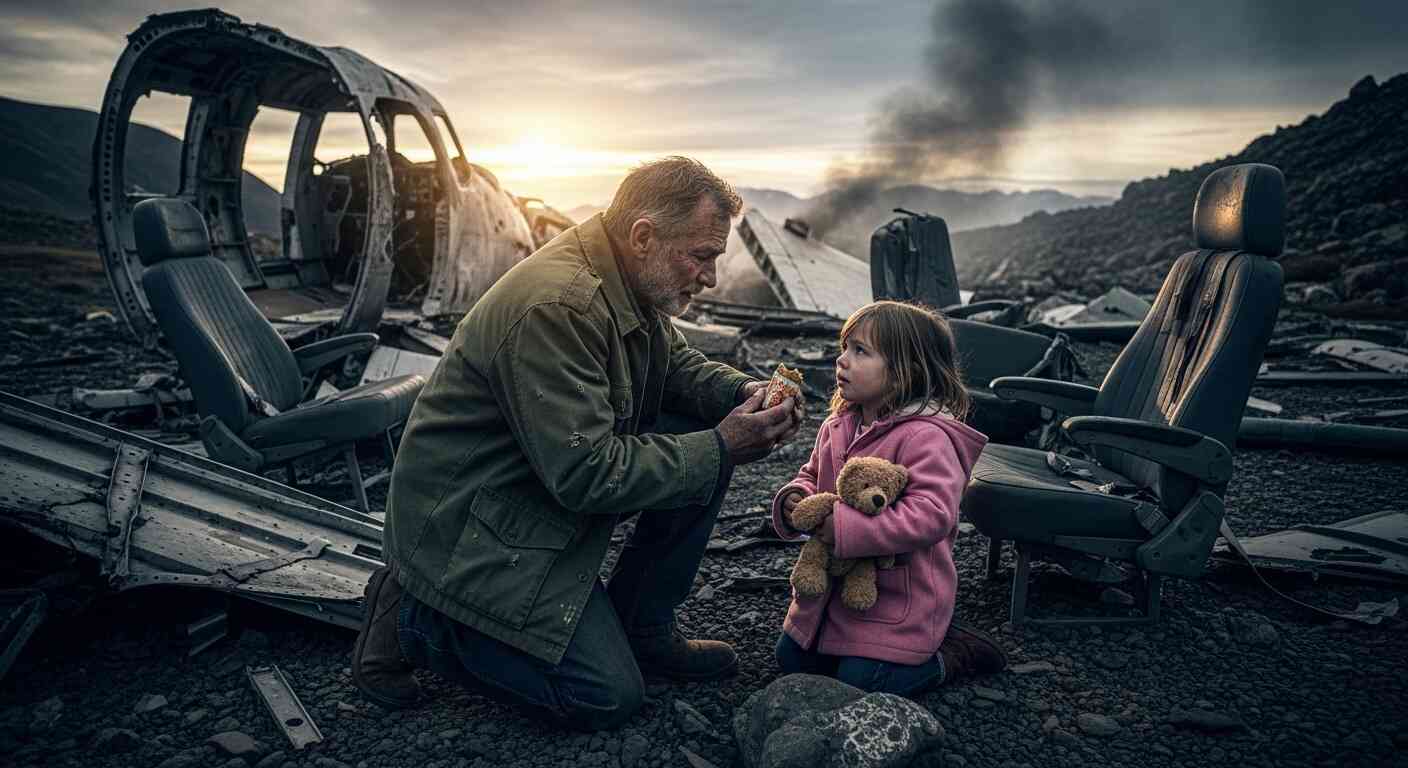
Chapter 1
The cockpit of the Gulfstream G650 didn’t smell like leather and expensive coffee anymore. It smelled like ozone, burnt copper, and the cold, metallic scent of impending death.
I looked at the altimeter. 28,000 feet. We were falling at a rate of four thousand feet per minute.
“Elias! What is happening?!”
Sarah Miller, my lead flight attendant, was clinging to the cockpit doorframe. Her knuckles were white, her eyes wide with the kind of primal fear you only see in people who have realized the earth is coming for them. She was a good kid, thirty-two years old, a former ER nurse who had traded the trauma of the hospital for the quiet luxury of private aviation. She didn’t deserve to die in a fireball over the Nevada desert.
“Go back to the cabin, Sarah,” I said. My voice was eerily calm, even to my own ears. I didn’t look at her. I couldn’t. I was staring at Leo.
Leo was seven. He sat in the jump seat behind me, his small boots dangling, not quite reaching the floor. He wasn’t crying. He wasn’t screaming. He was just clutching that raggedy, one-eyed stuffed dog to his chest, staring at the digital displays as they flickered and died one by one.
“The autopilot is gone, Sarah,” I shouted over the roar of the wind screaming past the fuselage. “The flight computers are fried. We’re in a hard dive.”
“Then fix it!” she screamed, stumbling into the cockpit as the plane jolted. “Reset the breakers! Call Mayday!”
“I can’t call Mayday,” I said, finally turning to look at her. “The radios are dead. I killed them.”
Sarah froze. The plane took another sickening lurch to the left, and she hit the bulkhead hard. She looked at my hands. I wasn’t fighting the controls anymore. I was holding a pair of heavy-duty wire cutters. Below the center pedestal, a cluster of multi-colored wires hung like disemboweled guts, sparking occasionally in the dim emergency light.
“You… you did this?” she whispered. Her voice was barely audible over the mechanical groans of the airframe. “Elias, why? We have twelve people in the back! We have a child!”
“I’m doing it for the child,” I said, nodding toward Leo.
The boy looked at Sarah. He didn’t look like a victim. He looked like a secret.
For thirty years, I flew for the Air Force. I’ve seen things that don’t exist on any map. I know how the world works now—how every move we make is logged, tagged, and tracked by a lattice of satellites that never sleep. Five minutes ago, I saw the notification on the encrypted tablet Leo had been hiding. They had found him. The “Uncle” who had paid ten million dollars to charter this flight wasn’t an uncle at all. He was a ghost from a government project that should have been buried decades ago.
They were using the plane’s own GPS transponder to lock a kinetic interceptor onto our coordinates. In three minutes, a missile would have turned this jet into a cloud of titanium confetti.
“They’re tracking the silicon, Sarah,” I said, grabbing the manual trim wheel and hauling it back with every ounce of strength I had left. “The only way to disappear is to go dark. No GPS. No radar. No computer.”
“We’re going to crash!”
“No,” I said, looking out the glass. The sun had dipped below the horizon, leaving the sky a deep, bruised purple. The first few stars were beginning to wink into existence. “The autopilot is dead, and I’m the only one here who knows how to fly by the stars.”
I kicked the rudder pedals, feeling the physical resistance of the cables. It was just me and the wind now. No technology. Just a veteran pilot with a heavy conscience and a boy who knew too much.
“Sit down, Sarah,” I commanded. “And tell the passengers to pray. We’re going into the shadow.”
PART 2
Chapter 1
(As written above)
Chapter 2
The transition from a high-tech marvel to a forty-ton glider is not a graceful thing. It’s a violent, screaming divorce from physics. As the engines flickered out—silenced by the fuel-cutoff valves I had manually tripped—the roar of the turbines was replaced by a terrifying, hollow whistle.
“Elias, please,” Sarah sobbed, pulling herself into the co-pilot’s seat. She didn’t know how to fly, but she knew how to survive. She began bucking her harness, her breath coming in ragged gasps. “Think about what you’re doing. If you’re wrong about this…”
“I’m not wrong,” I snapped. I pointed out the side window toward the North. “See that? That faint streak? That’s not a shooting star, Sarah. That’s a high-altitude surveillance drone adjusting its orbit to keep us in its sights. As long as our electronics are humming, we are a glowing target in the dark.”
I reached out and patted Leo’s knee. The boy finally looked up at me. His eyes were a startling, translucent blue—the eyes of a child who had seen the inside of a laboratory more often than a playground.
“You okay, kid?” I asked.
Leo nodded once. “The signal is gone,” he said. His voice was small, but steady. It was the first time he’d spoken since they boarded in Teterboro. “I can’t… I can’t feel them in my head anymore.”
Sarah’s head snapped toward him. “What does that mean? Feel them in your head?”
“He has a neural-link prototype, Sarah,” I explained, my hands busy dancing across the manual overrides. “Part of a black-site program called ‘Aegis.’ They didn’t just want to watch him; they wanted to use him as a localized hub for satellite data. He’s a living, breathing router. And they want their hardware back.”
The plane leveled out at 12,000 feet. The air was thicker here, more forgiving. We were gliding over the vast, unpopulated stretch of the Great Basin Desert. In the distance, the lights of a small town twinkled like fallen embers, but I steered away from them. Lights meant eyes. Eyes meant reports.
“So your plan is to just… land a hundred-million-dollar jet in the dirt?” Sarah asked, her voice dripping with disbelief.
“My plan is to find the ‘Dead Zone,'” I said. “There’s a canyon about sixty miles west of here. The mineral deposits in the rock walls are so heavy they create a natural radar shadow. If I can put us down on the dry lake bed inside that canyon, we vanish. Truly vanish.”
“And the passengers?” Sarah asked. “What do I tell them? Mr. Henderson is back there with his wife. They think we’re going to Cabo for their anniversary.”
“Tell them the truth,” I said. “Tell them their pilot is a crazy old man who just saved their lives from a missile. And then tell them to hold on, because the landing is going to be the loudest thing they’ve ever heard.”
Suddenly, the cockpit door burst open. It wasn’t a panicked passenger. It was Marcus Thorne, the man who had boarded as Leo’s “security detail.” He was tall, mid-forties, with the military posture of someone who had never actually left the service. In his hand was a compact, blackened pistol.
“That’s enough, Vance,” Thorne said, his voice as cold as the altitude outside. “Bring the power back up. Now.”
“I cut the lines, Marcus,” I said, not turning around. “There is no ‘bringing it back.’ We’re a kite now. Put the gun away before you clip a hydraulic line and kill us all.”
“You have no idea what you’ve stolen,” Thorne hissed. He stepped closer, the muzzle of the gun inches from my ear. “That boy is government property. He is the key to a global defense grid. You’re committing treason.”
“I’m committing an act of mercy,” I countered. “And if you shoot me, there isn’t a soul on this plane who can find that lake bed in the dark. We’ll hit a mountain at three hundred miles per hour. Is that what your ‘grid’ wants?”
The tension in the cockpit was a physical weight. Sarah looked from the gun to me, her chest heaving. The stars watched us through the glass, indifferent to the small, messy dramas of men.
FULL STORY
PART 3
Chapter 3
Thorne didn’t lower the gun, but the hammer didn’t fall either. He was a professional; he knew the math. A dead pilot in a silent cockpit equaled a very expensive hole in the desert.
“You’re a dead man, Vance,” Thorne whispered. “If we land, my team will be there in thirty minutes. They don’t need a satellite to find a crashed jet.”
“They won’t find a crashed jet,” I said, my eyes locked on the horizon. “They’ll find an empty one.”
I looked at Sarah. “Sarah, get the emergency medical kit from the gallery. The big one. And bring me the flare gun.”
“Elias—”
“Go!” I barked.
She scrambled out of the seat, squeezing past Thorne, who didn’t take his eyes off me. Leo remained perfectly still, his small fingers digging into the plush fur of his dog.
“Why are you doing this?” Thorne asked, his voice losing some of its edge, replaced by a genuine, frustrated curiosity. “You were Air Force. You took the oaths. You know that some things are bigger than one person. This boy… he could prevent the next world war.”
“I heard that same speech twenty years ago, Marcus,” I said. My mind drifted back to a dusty valley in Afghanistan. I was flying a transport, carrying ‘assets’ just like Leo. I followed orders. I kept the electronics on. I stayed on the grid. And I watched from the cockpit as the ‘grid’ decided those assets were no longer worth the risk. They remotely detonated the transport’s cargo bay to keep the tech out of enemy hands. I survived. The children in the back didn’t.
“I’m done being a part of the ‘bigger picture,'” I said. “I’m focusing on the small picture. One boy. One life.”
Sarah returned, clutching the orange plastic case of the medical kit. Her face was set in a mask of grim determination. She had found her “ER nurse” spine.
“I told the Hendersons,” she said to me. “They’re terrified, but they’re strapped in. Mr. Henderson said if we make it, he’ll buy you a new plane.”
“I don’t want a new one,” I said. “I want to get off this ride.”
I checked the altimeter. 6,000 feet. The canyon walls were rising up around us now, dark jagged shadows against the star-drenched sky. The “Dead Zone” was close. I could feel the change in the air—the way the wind whipped through the narrows.
“Marcus,” I said. “In about sixty seconds, I’m going to drop the landing gear. The drag is going to pull us down fast. If you’re going to shoot me, do it now. Because after that, I’ll need both hands to keep us from flipping.”
Thorne stared at the back of my head. For a moment, I saw his reflection in the glass. His jaw was tight. He looked at Leo. The boy looked back, and for the first time, Leo reached out. He touched Thorne’s sleeve.
“It hurts, Marcus,” the boy whispered. “The machine in my head. It feels like hot needles. Please. Don’t let them turn it back on.”
Thorne’s hand trembled. The cold, calculated mask of the operative cracked. He wasn’t a monster; he was a man who had convinced himself that the monster’s work was necessary.
Slowly, Thorne lowered the gun. He didn’t put it away, but he pointed it at the floor. “The lake bed is soft this time of year,” he said, his voice thick. “If you don’t hit it perfectly, the nose gear will dig in and we’ll cartwheel.”
“Then pray I’m as good as I used to be,” I said.
Chapter 4
The descent into the canyon was a dance with ghosts. Without the flight director or the terrain avoidance system, I was flying by instinct and the faint silver glow of the moon reflecting off the alkali flats below.
“Gear down,” I commanded.
The mechanical clunk of the landing gear dropping sounded like a gunshot in the silent plane. The jet shuddered, its graceful glide turned into a desperate struggle against gravity.
“Flaps to twenty,” I told Sarah. She reached for the manual crank—a backup feature most modern pilots never even look at. She turned it with a grunt of effort.
“I see it!” Leo cried out, pointing.
There it was. The dry lake bed. A vast, flat expanse of cracked earth that looked like a white sea in the moonlight. It was beautiful. It was also a graveyard for anyone who got the speed wrong.
“Thorne, go back and brace,” I said. “Sarah, you too. Get in a rear-facing seat and tuck your head.”
“I’m staying,” Sarah said.
“Me too,” Thorne added, surprisingly. He sat in the co-pilot’s seat Sarah had vacated and buckled in. He looked at me. “If we’re going to die for a cause, I might as well see it coming.”
I didn’t argue. I didn’t have the breath.
The ground rushed up to meet us. The silence was gone, replaced by the screaming of the wind against the landing gear. 200 feet. 100 feet. 50.
“Hold your breath,” I whispered.
The wheels touched.
It wasn’t a landing; it was a controlled earthquake. The jet hit the soft silt of the lake bed and bucked like a wild horse. I fought the yoke, my muscles screaming, as the plane threatened to veer into the rock walls. The sound was deafening—the screech of metal, the roar of dust being kicked up into the intakes of the dead engines.
We slid for what felt like miles. A wingtip clipped a scrub bush, sending a shudder through the cabin that shattered the overhead bins.
And then, silence.
Real silence.
The dust settled slowly, coating the windows in a fine, grey powder. The only sound was the ‘tink-tink-tink’ of the cooling metal and the ragged breathing of four people in a dark cockpit.
“Is everyone… alive?” Sarah asked, her voice shaking.
“Check the cabin,” I said, my hands still frozen on the yoke.
Thorne was the first one out of his seat. He checked the passengers. A few bruises, a lot of shock, but everyone was breathing.
I looked at Leo. He was staring out the window. He looked peaceful.
“We’re off the grid, Leo,” I said.
“No,” he said, his voice taking on a strange, hollow quality. “We’re just in the shadow. They’re already coming.”
FULL STORY
PART 4
Chapter 5
Leo was right. They didn’t need a satellite to find a massive jet that had just kicked up a mile-long dust trail in a narrow canyon. They just needed a thermal scan from a high-altitude jet.
“How long?” Thorne asked, stepping back into the cockpit. He was checking his watch.
“Ten minutes. Maybe fifteen,” I said. I stood up, my knees wobbling. “Sarah, get the passengers out. Move them toward the cave system on the north wall. It’s deep enough to hide their heat signatures.”
“What about you?” she asked.
“I have to finish the job,” I said, looking at the center console. “Thorne, give me your lighter.”
Thorne knew what I meant. A plane this size carried thousands of pounds of fuel, even after a long flight. If this jet stayed intact, they’d eventually download the flight recorders. They’d see my sabotage. They’d find the trail.
But if the plane became a blackened husk in the middle of a desert… evidence has a way of disappearing.
“Elias, you can’t,” Sarah said, grabbing my arm. “The authorities… they’ll hunt you for the rest of your life. You’ll be a domestic terrorist.”
“I’ve been a lot of things, Sarah,” I said, gently unhooking her hand. “A hero, a killer, a pilot. I think ‘ghost’ is a good way to end the list.”
I looked at Leo. “You go with her. Sarah will take care of you. She’s a nurse. She’s the best person I know.”
Leo didn’t hug me. He just placed his small, cool hand against my cheek. “Thank you for the stars, Elias.”
They left. I watched them disappear into the shadows of the canyon, a small line of survivors led by a flight attendant and a man who had finally chosen a side.
I turned back to the cockpit. I ripped open the floorboards, exposing the fuel lines. I used Thorne’s lighter to start a small fire in a pile of flight manuals.
I sat back in my captain’s chair. I didn’t feel afraid. I felt a strange, overwhelming sense of completion. For years, I had been haunted by the faces of the people I couldn’t save because I was “just following orders.” Tonight, the orders were mine.
The smoke began to fill the cabin, thick and acrid. The heat rose, licking at the heels of my boots. I looked up through the cockpit glass one last time.
The North Star was bright. Constant. It didn’t need a battery. It didn’t need a satellite. It just was.
Chapter 6
The explosion didn’t happen like it does in the movies. It wasn’t a sudden fireball. It was a slow, roaring hum that grew until the very air seemed to vibrate.
I waited until the last possible second, then dropped out of the emergency hatch and ran. I didn’t run toward the cave. I ran toward the ridge.
When the fuel tanks finally went, the flash illuminated the entire canyon like a second sun. The shockwave knocked me off my feet, rolling me into the sand. I lay there, gasping, watching the orange glow reflect off the rock walls.
The jet—the symbol of my life, my career, my cage—was gone.
Hours later, the black helicopters arrived. I watched from the high ridge as the men in tactical gear swarmed the wreck. They searched the charred remains. They looked for a boy. They looked for a pilot.
But the “Dead Zone” lived up to its name. Their sensors were haywire. Their communications were garbled. They found nothing but twisted metal and ash.
I stayed on that ridge until the sun began to peek over the horizon. I saw Sarah, Thorne, Leo, and the Hendersons move out from the back of the cave system, slipping through a narrow pass that led toward the highway. They had a chance now. Without the electronics, without the “hub,” Leo was just a boy again.
I didn’t follow them. They didn’t need a pilot anymore. They needed a new life, and I was a reminder of the old one.
I walked in the opposite direction, toward the vast, open emptiness of the desert. My lungs burned, my skin was scorched, and I had absolutely nothing to my name but the clothes on my back.
But as I looked down at my hands, I realized they weren’t shaking for the first time in twenty years.
I thought about my son. I thought about the missions I’d failed. And then I thought about Leo, somewhere out there, finally safe in the silence.
Sometimes you have to break the machine to save the soul.
FULL STORY
Sometimes you have to break the machine to save the soul.