FULL STORY
Chapter 1
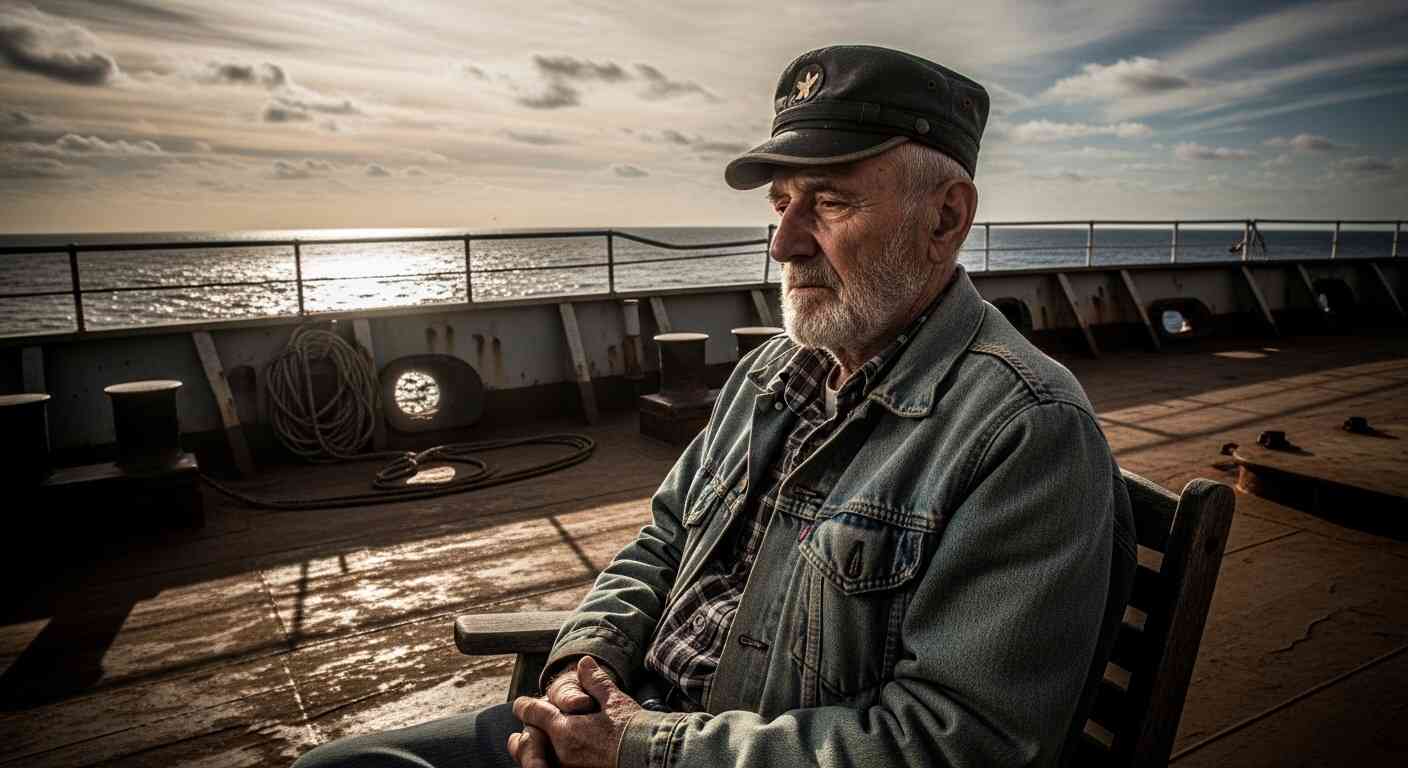
The jagged metal deck of the Arctic Sentinel always hummed, a low-frequency vibration that Elias Thorne used to feel in his bones. Today, he felt it in his teeth.
Sixty-two years old, and here he was, scrubbing fish guts off a trawler deck in the Gulf of Alaska, because a promised pension had evaporated like morning mist, and his granddaughter’s college tuition wasn’t going to pay itself. The cold seeped into his joints, a persistent ache that was a reminder of too many years, too many miles, and too many things best forgotten.
Elias adjusted the small beige device nestled in his left ear. It was his last thread connecting him to the waking world. It wasn’t just about hearing instructions; it was about safety. In this gray, churning wilderness, silence wasn’t peace—it was danger. A rogue wave, a snapping cable, a panicked shout—they all made sounds. Without his hearing aid, Elias was walking through a minefield with his eyes closed.
He was focused on the stain near the starboard winch when a shadow eclipsed the weak afternoon sun.
Brock Sterling. Twenty-five, built like a brick shithouse, and carrying an attitude that suggested the world owed him a living. Brock was the son of one of the boat’s silent partners, a “work experience” placement meant to build character. Instead, it had only built his arrogance. Brock hated the work, he hated the smell, and he especially hated Elias, whose quiet competence was a constant, silent reprimand.
Elias saw Brock’s mouth open before he heard the sound. He adjusted the volume dial.
“—slacking off again, Old Man?” Brock’s voice was too loud, intentionally sharp. “Dad pays for work, not meditation.”
Elias didn’t look up. He kept scrubbing. Experience had taught him that responding to Brock was like throwing gas on a fire.
This silence, this refusal to acknowledge his authority, infuriated Brock. It stripped away his perceived power. Elias could feel the younger man’s frustration radiating off him.
Suddenly, a heavy rubber boot slammed into Elias’s shoulder, throwing him off balance. He grabbed the winch frame to steady himself, gasping.
“I’m talking to you!” Brock snarled.
Elias slowly rose to his full height. He was shorter than Brock, thinner, but his frame possessed the hard-packed density of a life spent in physical labor. He met Brock’s eyes, a steady, calm gaze that had stared down far more terrifying things than a trust fund bully.
That look broke Brock’s control. It wasn’t fear he saw; it was pity.
Brock lurched forward, intending to shove Elias back down. Elias, anticipating the move, stepped slightly aside and checked the charge with his shoulder. It was a minimal force move, designed to deflect, not injure. But the wet deck was unforgiving. Brock, expecting no resistance, lost his footing. He didn’t fall, but he stumbled wildly, grabbing at a net pile to save his dignity.
His face turned a deep, ugly red.
“You senile piece of garbage,” Brock spat. The locker-room intimidation was gone, replaced by raw, narcissistic rage. He looked around, making sure the crew—busy with the nets—weren’t watching.
Elias saw the intent in Brock’s eyes a fraction of a second too late. Brock didn’t swing. He kicked. It wasn’t a standard kick; it was a sweep, aimed at Elias’s weak, arthritic left knee.
Elias’s leg buckled. He slammed down hard onto the jagged, abrasive metal deck, his breath leaving him in a sharp whoosh. The pain was immediate and excruciating, a hot poker driving into his joint. He dropped his scrubbing brush.
Brock laughed. It was a high, unpleasant sound that cut through the engine hum. He stepped over the fallen man.
“What’s the matter, Grandpa? Legs too old for a man’s job?” Brock reached down, not to help, but to humiliate. His fingers snagged Elias’s left ear.
Elias felt the sharp tear of plastic being ripped away. The beige device—his last lifeline—was yanked free. Brock held it up like a trophy, then intentionally dropped it onto the wet metal, centimeters from Elias’s wincing face.
Before Elias could reach for it, Brock raised his heavy boot and brought it down. Crunch.
Total silence slammed into Elias’s world.
The roar of the engines, the scream of the gulls, the slosh of the water—it was all gone. It wasn’t an empty silence; it was a heavy, suffocating pressure, like being underwater, deep underwater.
Brock was laughing again. Elias could see his mouth moving, his chest shaking, but no sound came. The lack of auditory feedback made the pain in Elias’s knee feel twice as sharp. He looked at the shattered plastic remnants of his connection to the world, and a cold, familiar calm settled over him.
It was the calm of the abyss. The calm he hadn’t felt in thirty years.
Brock leaned down, putting his face inches from Elias’s. Elias watched his lips move, reading the insult with an ease that would have shocked Brock.
“You can’t even hear the world laughing at you anymore, you deaf, broken relic,” Brock taunted, his lips spitting out the words.
Elias Thorne didn’t flinch. He didn’t show pain. He simply stared back, reading the fear behind the aggression, the deep, screaming insecurity that Brock was trying so desperately to crush in someone else.
In that perfect, silent clarity, Elias understood everything. He understood Brock’s pain, his weakness, and his overwhelming cowardice. And he knew exactly what he had to do.
FULL STORY
<Title: The Silent Assassin’s Mark: When the World is Quiet, the Real War Begins>
PART 2
Chapter 1 (Included above)
Chapter 2
The silence was the abyss, but Elias Thorne knew how to swim in it.
Brock Sterling was still sneering, his face a grotesque mask of arrogance, unaware that he was now standing on ground that Elias had mastered long ago. Elias didn’t need to hear. He could see the fear, plain as day, behind Brock’s eyes—the frantic need for validation, the desperation to be the hammer so he wouldn’t have to be the anvil.
Elias slowly pushed himself upright. The movement was agonizing; a sickening grind in his left knee told him he’d done real damage. But he forced his face to remain placid, a mask of aged stone. He met Brock’s gaze.
Brock’s sneer faltered, just for a microsecond. The old man wasn’t broken. He was… waiting.
Elias opened his mouth, his voice steady, carrying a resonance that didn’t need amplification. He knew he was speaking too loudly in the silent world, but it didn’t matter. His words were precise.
“I don’t need to hear your insults,” Elias said, locking eyes with the bully, “to know that your heart is screaming in cowardice.”
He saw the shock on Brock’s face. He saw Brock’s lips move, likely stammering an indignant retort, but Elias wasn’t finished.
He raised a scarred, calloused hand, not to strike, but to reveal. He shifted the collar of his heavy wool shirt, exposing the skin of his neck.
There, embedded in the tough, weathered flesh, was a faint but unmistakably distinct mark. It wasn’t a tattoo. It was a pattern of deep, surgical punctures, four marks forming a precise square, with a jagged line running diagonally through it. It looked like a map to a hidden pain.
The “Silent Killer” mark.
It was the signature signature of the Elite Underwater Demolition (EUD) ‘Phantoms’, a unit so classified they didn’t officially exist. This mark wasn’t awarded; it was given, usually during a final, excruciating graduation ritual that involved surviving pressure tests no human was meant to survive. Only twelve men in history had earned it. Elias was the only one still alive.
Elias watched Brock’s eyes track to the scar. He saw the recognition—not instant, but creeping, as if the images from a documentary, or a book he might have read to impress his dad, were clicking into place. Brock had studied naval history to find angles to exploit; he knew what the Phantoms were. They were the men who swam into enemy harbors, planted mines on the hulls of battleships while the crew slept, and vanished before the explosions.
The color drained from Brock’s face. His sneer collapsed into a pale, trembling slackness. He staggered back a step, the arrogance replaced by a primal, overwhelming terror. He looked at Elias not as an old relic, but as a predator that had suddenly shed its sheep’s clothing. The broken hearing aid, the arthritic knee—they didn’t matter. Elias Thorne was a weapon.
For five long seconds, they stood in that perfect, silent tension. Elias, stoic and waiting; Brock, a shaking mess, unable to speak, unable to look away from the mark of the man who had single-handedly ended the last war Brock had only read about.
Then, Elias simply lowered his collar, turned his back on the bully, and started hobbling toward the stern. He had work to do. He didn’t need to hear the sound of Brock’s worldview shattering to know the battle was won.
PART 3
Chapter 3
The rest of the shift was a blur of gritted-teeth endurance. Elias’s knee was swollen to the size of a grapefruit, a throbbing pulse of pain that kept time with the engines he could no longer hear. But he didn’t stop. He worked with a meticulous, mechanical efficiency, focused solely on the task, allowing the new, profound silence to envelop him.
Silence wasn’t an enemy anymore; it was an environment. It stripped away distraction. He could see the stress in the faces of the other crew members as the seas grew rougher. He could read the waves better now, anticipating the ship’s roll by the shift in the deck’s vibration. He was a Phantom again, operating in a world of pure observation and action.
But the silence also brought back the ghosts.
In the quiet, he could see them: Jackson, Miller, and ‘Docs’—the Phantoms who hadn’t come home. He saw Jackson’s final grin as he’d set the timer on the ammunition depot; he saw Miller sinking into the dark water, the victim of a faulty rebreather. Their faces were clear, their silent expressions conveying a mix of duty, fear, and comradeship. He realized he’d been hiding from them with the noise of his hearing aid, with the busywork of his old age. Now, they were back, not to haunt him, but to remind him of who he was.
He was a protector. He was the one who went into the dark so others could live in the light. This boat, this crew, even Brock—they were his responsibility now.
When the Sentinel finally pulled into the docks at Valdez, Elias was the last one to leave. He was hobbling badly, his knee locking with every third step.
As he walked down the gangplank, a figure stepped out from behind a stack of crates. It was Brock.
He looked different. The expensive oilskins were gone, replaced by a cheap hoodie. He wasn’t sneering. His face was pale, his eyes wide, and he was holding something in a trembling hand.
It was a small, cardboard box. He didn’t look Elias in the eye. He held the box out like an offering to a wrathful god.
Elias stopped. He read Brock’s lips.
“I… I bought you new ones. The best I could find.”
Elias took the box. He didn’t open it. He simply looked at Brock, a long, searching gaze that seemed to peel away the layers of pretense. Brock flinched under the scrutiny. He opened his mouth, perhaps to apologize, but Elias held up a hand.
He knew what the words would be. They would be hollow, born of fear, not regret. An apology didn’t fix a shattered connection; it didn’t erase the impulse that led to the cruelty.
Elias simply nodded once, a gesture that was both acceptance and dismissal. He tucked the box under his arm and continued on his painful walk toward the truck. Brock stood there, watching him go, a small, insignificant figure shrinking against the backdrop of Elias’s silence.
Chapter 4
The new hearing aids were top-of-the-line. When Elias inserted them, the world didn’t just rush back; it roared. He had to turn the volume down to the minimum setting, and even then, the sounds felt too bright, too sharp.
The engine hum was a guttural growl. The gulls were a screeching chorus. The voices of the crew were a cacophony of worry, laughter, and complaint. Elias hated it.
He missed the silence. He missed the clarity.
The Sentinel’s captain, a man named Henderson who looked like he’d been forged from the same metal as the ship, called Elias into his office the next morning. It was a cramped space smelling of diesel and old coffee.
“Thorne,” Henderson said, his voice a low rattle. “Brock Sterling isn’t on the manifest for this leg. Says he’s ‘pursuing other opportunities’.”
Elias nodded. He already knew.
“The crew’s talking,” Henderson continued. “They saw him kick you. They say you showed him something. Something that scared him shitless.” He leaned forward, his eyes narrowed. “You were EUD, weren’t you? I saw the mark.”
Elias didn’t confirm or deny. He simply waited.
Henderson sighed. “Look, Sterling’s dad is pissed. He’s threatening to pull funding. Says his kid was assaulted. I know the kid’s a shithead, and I know what I saw on that deck, but funding is funding.”
This was the core conflict Elias had feared. The past wound—the pension he lost—had forced him into this vulnerable position. The secret he’d tried to keep was out, and now he had to make a difficult moral choice: let the boat suffer because of one arrogant kid, or sacrifice his dignity for the sake of the job.
“I didn’t assault him,” Elias said, his voice calm. He spoke at a normal volume, the sound odd to his own ears.
“I believe you,” Henderson said. “But belief doesn’t pay for fuel. He wants you gone, Thorne. A ‘gesture of goodwill’ to cool his dad down.”
Elias felt the blow, not in his knee, but in his chest. This was about his granddaughter. Her future.
“I have a contract,” Elias stated.
“I can pay you out,” Henderson said, looking down. “But I can’t guarantee another one. Sterling’s influence is… long.”
This was the moral choice. Elias looked out the small port window. The bay was gray and turbulent. A past memory bubbled up: Jackson, Miller, and Docs. They had never worried about funding. They had never worried about politics. They had only worried about the mission.
He looked back at the Captain. The captain was a victim too, in a way, bound by the money that fueled his life’s work.
“What about the others?” Elias asked. “The crew? Will they lose their jobs if Sterling pulls out?”
Henderson hesitated. “It… it wouldn’t be good. We’d have to scrimp, maybe cut two hands.”
Two families, gone because Elias couldn’t hide a scar. The past wound had truly reopened, bleeding into the lives of people who had done nothing wrong. The moral choice was clear, even if it was devastating. He couldn’t be the cause of another man’s loss.
“Pay me out,” Elias said. He felt a profound weakness in that moment, a sense that he was being defeated by a ghost of his own past. “And Captain, tell the crew… tell them the Phantom says good hunting.”
PART 4
Chapter 5
Leaving the Arctic Sentinel felt like dying, just a little.
He wasn’t the only victim, though. In the days that followed, the consequences ripples outward. Two young deckhands, barely twenty, with new wives and babies at home, were laid off. Captain Henderson, a man who had dedicated his life to the sea, was forced to accept Brock’s father as a “managing partner,” meaning the Sterling family now owned the very soul of the vessel. The crew, once a cohesive unit, became suspicious and fragmented, the specter of “another cut” hanging over every shift.
Elias watched from the sidelines. He had his payout, enough to secure his granddaughter’s college fund, but it felt like blood money. He’d traded the livelihoods of honest men for his own financial peace. The guilt was a shadow that followed him, darkening his every moment. He realized that his weakness wasn’t his old age, or his deafness, or even his pride. It was his willingness to accept defeat when the battle wasn’t purely physical. He was a protector who had failed to protect the very people he had sacrificed his own place for.
He found himself sitting by the water one evening, the new hearing aids cranked to maximum volume. He was punishing himself with the noise, the cacophony mirroring the turmoil in his mind. The waves, the traffic, the voices—they were an assault.
Then, a sudden, bright realization hit him.
He was a Phantom. The core philosophy of the EUD was that the mission was paramount, and the mission didn’t end just because the terrain changed. He was focusing on the wrong battlefield. He’d lost the physical confrontation (the job), but the war—the moral battle for the soul of the crew and the safety of his friends—was still being fought. He hadn’t just revealed his scar to terrify Brock; he’d revealed it to remind himself of who he was.
He turned off the hearing aids.
Perfect, absolute silence. And with the silence, the clarity.
He needed to act. Not as a deckhand, but as an operative. The target wasn’t Brock; the target was the fear that Brock’s money represented. The victim was the boat’s integrity. The perpetrator was greed.
Elias had one last contact from his old life. A man named Silas, a fixer who owed Elias more than a few favors. Elias pulled out his phone. He couldn’t call, but he could text.
Message: I need a detailed financial audit on Sterling Maritime. Off the books. Full visibility.
Silas’s reply came minutes later. Done. Give me 48 hours.
The war was on. Elias wasn’t retreating; he was just re-deploying to a deeper dive.
Chapter 6
Forty-eight hours later, the report was in Elias’s inbox. It was more than he could have hoped for.
Silas hadn’t just found financial discrepancies; he’d found systemic fraud. The Sterlings had been laundering money through their “investments” in commercial fishing vessels, inflating costs and skimming profits. The Arctic Sentinel wasn’t just a passion project; it was a cleaning facility for dirty money. And Brock’s “work experience” had been a way to familiarize him with the operations he was set to inherit.
This was the moral choice. He could go to the authorities, and the Sterlings would be destroyed. But so would the Arctic Sentinel. It would be impounded, the crew out of work, Captain Henderson’s legacy erased.
All characters had their logical motivations. The Sterlings wanted wealth and power. Captain Henderson wanted his boat. The crew wanted to feed their families. And Elias? Elias wanted to protect.
He knew what he had to do. The mission had changed, but the end goal remained.
He made three copies of the report. He sent the first copy, via certified mail, to Mr. Sterling’s personal home address.
The second copy he hand-delivered to Captain Henderson. He didn’t speak. He just placed the envelope on the Captain’s desk, the new hearing aids carefully tuned to ambient noise. He saw the look of utter despair on Henderson’s face as he read the first few pages. Henderson saw the death of his legacy.
Then, Elias placed a third document on the desk.
It was a contract, drafted by Silas, detailing the terms of a new, completely transparent investment partnership. A group of silent, ethical investors—led by an anonymous former Phantom—was willing to buy out the Sterling’s share of the Sentinel at a generous, but fair, market price. This would dissolve the laundering operation, remove the Sterling family, and leave Captain Henderson in sole command.
The logical motivation of the Sterling family was self-preservation. When they received their copy of the report, they would realize they had two choices: go to prison, or sell their share and vanish. Greed, in the face of absolute exposure, becomes a frantic scramble for safety.
Henderson looked from the report to Elias, his eyes wide, disbelieving. The old man wasn’t just a relic. He was a savior. He had just bought the boat’s freedom with information, the ultimate Phantom maneuver.
“You… you did this?” Henderson’s voice trembled through Elias’s hearing aids.
“Good hunting, Captain,” Elias said, a faint smile touching his lips. He didn’t need to see the Sterling family pack their bags. He didn’t need to see the crew celebrate. He didn’t need to be there when the two laid-off deckhands were rehired, their faces bright with relief.
He had completed the mission.
The moral choice was resolved. The past wound had healed, not by erasing the pain, but by using the strength born from it to protect others. He had been weak when he accepted defeat; he was strong when he realized the battle was his to win.
The ending was quiet. Elias Thorne stood on the pier, the noise of the harbor a manageable, even pleasant, background hum. He watched the Arctic Sentinel pull out, its engines a steady, reassuring vibration in the distance. His granddaughter’s college fund was safe. The boat was free. And for the first time in thirty years, Elias Thorne didn’t need to turn off his hearing to find peace.
He adjusted the small beige device in his ear. The silence was his weapon, but the sound of freedom… that was his reward.