Chapter 1
The gravel was hot, sharp, and unforgiving against my palms. It was the kind of heat that soaked through your jeans and reminded you exactly where you stood in the world. And right now, I was at the bottom of the pile.
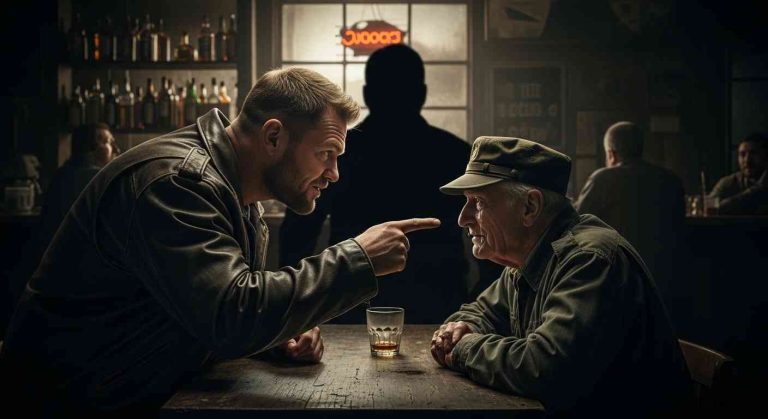
“Get out of here before I break your other leg,” Rick hissed.
He was the kind of man who smelled like cheap cigars and unearned authority. He stood over me, his shadow blocking out the harsh Pennsylvania sun, looking down at my twisted left knee like it was a personal insult to his job site. I didn’t say anything. I just stared at the dirt, feeling the familiar, rhythmic throb in my joint—the souvenir I’d brought home from a valley in the Hindu Kush that didn’t exist on any civilian map.
To Rick, I was just Elias, the “gimp” who hauled rebar too slowly. I was the quiet guy who lived in a trailer behind the Sunoco and never pushed back. He didn’t know that fifteen years ago, men with stars on their shoulders waited in silence just to hear me whisper a single coordinate.
“You hear me, old man?” Rick kicked a spray of dirt into my face. “I don’t pay for charity. You’re a liability. Pack your trash and vanish. If I see you on this site again, you’re leaving in an ambulance.”
The crew—young guys with clean boots and no scars—watched in a circle. Some looked away, guilty. Others just grinned. It’s a primal thing, watching a predator take down the weak. It makes the others feel safe.
I started to push myself up, my fingers digging into the stones. My “other” leg—the good one—shook with the effort. I didn’t want trouble. I had spent a decade trying to be invisible, trying to drown the screams of the past in the mundane hum of a circular saw.
But then, the air changed.
It started as a low vibration in the soles of my feet. It wasn’t the heavy machinery of the site. It was a synchronized, high-output hum that I recognized in my very marrow. Then came the screech of high-performance tires on asphalt.
Four black Suburban SUVs, armored and tinted to a mirror finish, tore around the corner of the suburban street, ignoring the “Road Closed” signs. They moved with a predatory grace, flanking the construction site in a perfect diamond formation.
Rick stepped back, his bravado flickering like a dying bulb. “What the hell is this? Local PD?”
The doors flew open before the vehicles even fully stopped. It wasn’t the police.
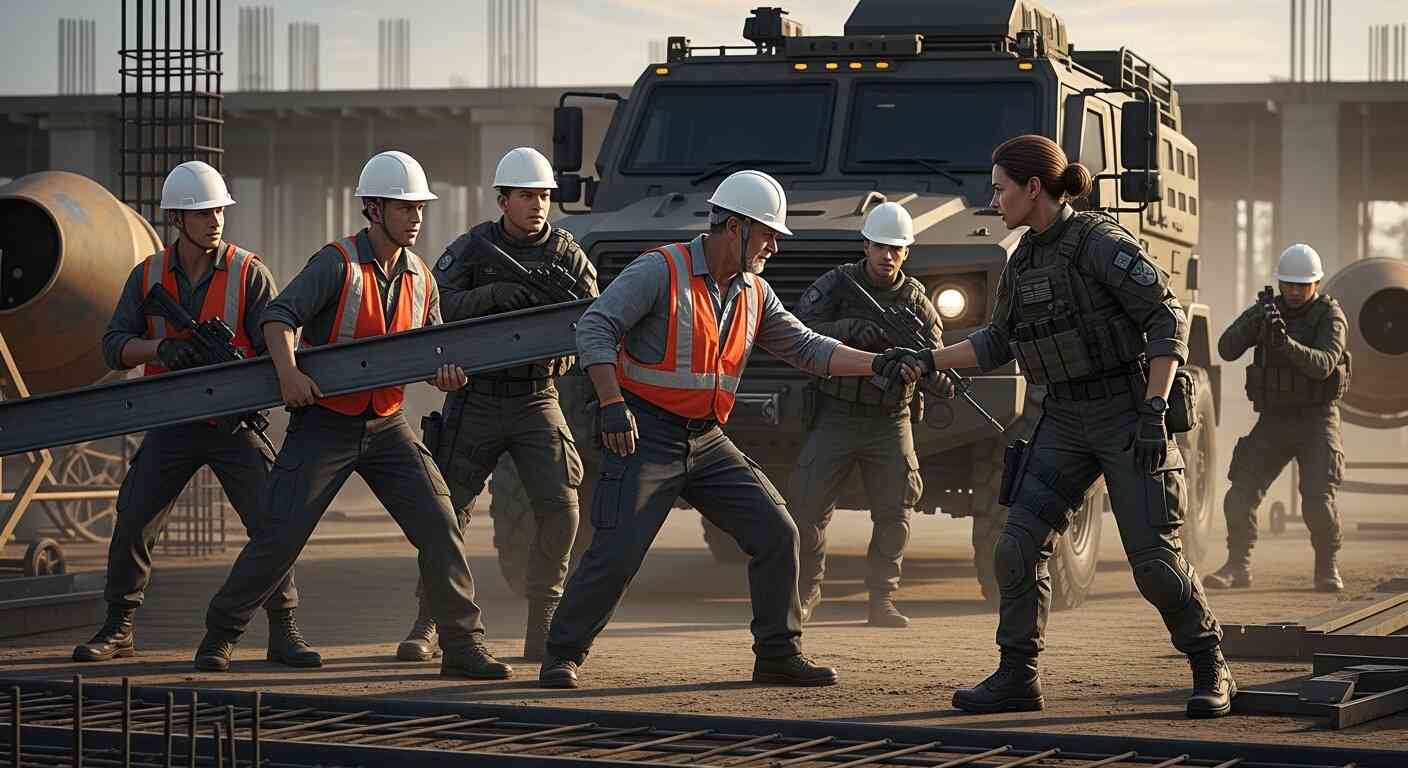
Men in charcoal-grey tactical gear, devoid of patches but radiating a terrifying level of competence, spilled out. They didn’t point their rifles at me. They formed a perimeter, their backs to me, facing the stunned construction crew.
The lead vehicle’s rear door opened. A man stepped out. General Marcus Miller. He looked exactly the same—stone-faced, eyes like flint, and a chest full of medals he could never wear in public. He stepped onto the construction site, his polished boots clicking against the very gravel where I sat.
Rick, trying to regain his footing, stepped forward. “Hey! You can’t be here! This is a private…”
Miller didn’t even look at him. He didn’t have to. Two of the commandos moved like shadows, placing themselves between Rick and me. One of them put a hand on Rick’s chest—a gentle touch that carried the weight of a death warrant. Rick froze, his mouth hanging open, the color draining from his face until he looked like a ghost.
The General walked straight to me. He didn’t care about the dust on his uniform or the cameras the neighbors were surely pulling out of their pockets.
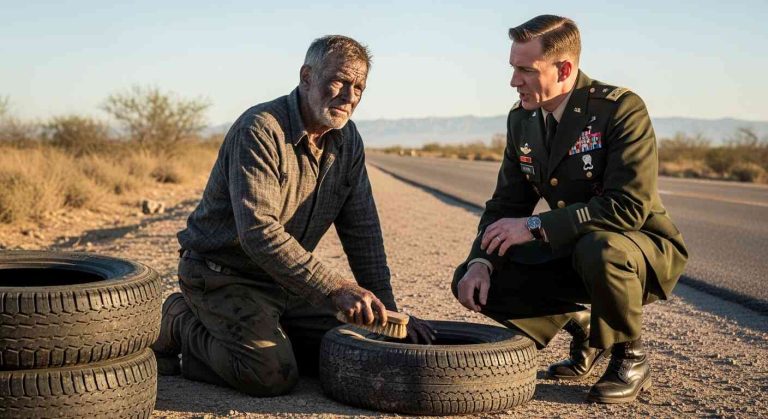
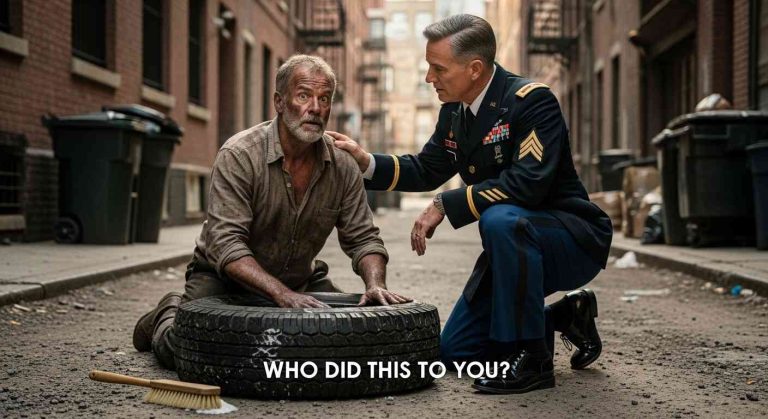
He stopped two feet away, snapped his heels together, and brought his hand to his brow in a crisp, sharp salute. Then, slowly, he dropped to one knee in the dirt right in front of me.
“Architect,” Miller said, his voice cracking with a rare flicker of emotion. “The world is on fire, sir. And we’ve realized we can’t put it out without the man who built the engine.”
I looked at his outstretched hand, then back at Rick, who looked like he was about to vomit from pure terror. I looked at my own scarred, calloused hands.
The ghost was dead. The Architect was back.
“FULL STORY
Chapter 2: The Weight of the Crown
The silence on the construction site was heavy, thick with the smell of diesel and the sudden, suffocating realization of a massive mistake. Rick Vance, a man who had spent the last six months making my life a living hell, was now trembling so violently his hard hat rattled against his head.
“”Sir?”” Miller asked, his hand still extended.
I didn’t take it. Not yet. I looked at the gravel embedded in my palms, then at the black SUVs that looked like alien monoliths in this quiet American suburb. This was exactly what I had run from. I had spent years in the dark, choosing the pain of a physical labor job over the psychological weight of deciding who lived and who died.
“”I’m retired, Marcus,”” I said, my voice raspy from lack of use. “”I’m just a guy with a bad leg and a shovel.””
“”With all due respect, sir,”” Miller said, still on one knee, “”we both know that’s a lie. You’re the man who won the Battle of Seven Peaks without firing a single shot. You’re the one who predicted the 2019 collapse three years before it happened. We didn’t come here because we wanted to. We came here because the simulation ran ten thousand scenarios, and you were the only variable that didn’t end in total collapse.””
I finally gripped his hand. His gloved fingers were rock solid. He pulled me up, and for a second, my bad leg buckled. Miller caught me, his eyes softening for a fraction of a second—a silent acknowledgment of the price I’d paid.
“”Who… who are you people?”” Rick stammered, his voice three octaves higher than it had been a minute ago. He tried to take a step back, but a commando named Sarah—I recognized her stance, Delta-trained—shifted her weight, and Rick nearly fell over his own feet.
Miller finally turned his head. It was a slow, predatory movement. He looked at Rick like he was a bug on a windshield.
“”This man,”” Miller said, pointing a finger at me, “”is a National Treasure. He has a security clearance that would make your governor look like a tourist. And you just pushed him into the dirt.””
“”I-I didn’t know!”” Rick cried out, his hands up. “”He was just… he was slow! He wouldn’t listen! I was just doing my job!””
“”Your job,”” I said, stepping forward, the limp still there but my posture changing, the old steel returning to my spine, “”was to build a house, Rick. My job was to ensure you had a country to build it in.””
The neighbors were all on their porches now. Mrs. Gable, who usually complained about the noise, was staring with her mouth wide open. My neighbor from the trailer park, a kid named Leo who I sometimes shared my sandwiches with, looked at me like I was a superhero from a movie.
“”We have a bird waiting at the local airfield,”” Miller said, ignoring the crowd. “”We have twenty minutes before the window closes. The situation in the North Atlantic has gone kinetic. The Board is waiting.””
I looked around at the unfinished skeleton of the house. I looked at the mud, the mundane struggle of my life here. It was a simple life. It was a life where the only thing at stake was whether or not a wall was level.
“”I have a dog,”” I said quietly. “”Barnaby. He’s at the trailer.””
Miller nodded to one of his men. “”Secure the dog. Transport him to Site R with full honors. High-protein diet, medical checkup.””
I looked at Rick one last time. He was kneeling now, too, but not out of respect. He was kneeling because his legs wouldn’t hold him. He looked small. Pitiful.
“”Rick,”” I said.
He looked up, tears blurring his eyes. “”Yes, sir? Anything, sir.””
“”Finish the house,”” I said. “”And do it right. If I come back and find one crooked nail, I’ll have the General here audit your taxes for the last twenty years.””
I didn’t wait for his answer. I turned and walked toward the lead SUV. My leg screamed in protest, but I didn’t let it show. The commandos snapped to attention as I passed, a wave of discipline and power that felt like a cold shower.
As the door hissed shut, sealing out the sounds of the suburbs, the world I had tried to build for myself vanished. The screens inside the SUV flickered to life, showing maps, red zones, and satellite feeds.
The Architect was back in the room. And the room was terrifying.
Chapter 3: The Ghost’s Burden
The Gulfstream G650 cut through the clouds at forty thousand feet, the interior a stark contrast to the dust-choked construction site I’d left an hour ago. Miller sat across from me, a tablet in his hand, his eyes tracking the frantic movement of global assets.
“”Why now, Marcus?”” I asked, sipping a coffee that cost more than my weekly grocery budget at the Sunoco. “”You’ve had crises before. The Taiwan buildup, the Moscow hack… you handled those without digging up a dead man.””
Miller sighed, a sound of profound exhaustion. He slid the tablet across the mahogany table. “”Because this isn’t a crisis, Elias. It’s a funeral. Someone found the ‘Aegis’ protocol.””
I felt the blood drain from my face. My heart, usually a steady, slow thud, hammered once against my ribs. “”That’s impossible. I buried that code in a hard-gap server in the Cheyenne Mountain sub-levels. It requires a physical biokey and a three-man authentication.””
“”They didn’t break the code, Elias,”” Miller whispered. “”They found the man who helped you write it. Dr. Aris Thorne.””
My breath hitched. “”My brother is dead. He died in the Belgrade bombing.””
“”That’s what the CIA told you,”” Miller said, his voice dropping an octave. “”But we found evidence. He’s been in a black site in the Urals for twelve years. And three days ago, that black site was wiped off the map by a private military corporation. They didn’t kill him. They took him.””
I leaned back, the leather of the seat feeling like a cage. Aris. My younger brother. The genius who saw the world in strings of light while I saw it in geography and steel. We had built Aegis together—a defensive AI so powerful it could neutralize a nation’s entire power grid and communication network without dropping a single bomb. It was meant to be the ultimate deterrent. A way to win a war by making it impossible to fight.
But in the wrong hands, it wasn’t a shield. It was a guillotine.
“”He won’t help them,”” I said, my voice shaking. “”Aris is a man of principle.””
“”They don’t need him to help,”” Miller countered. “”They just need his biometric signature to unlock the final phase. And they have his daughter, Elias. They have your niece, Clara.””
I closed my eyes. The image of a five-year-old girl with blonde curls and a gap-toothed smile flashed behind my eyelids. The last time I’d seen her was at a “”funeral”” that was a lie. I had spent a decade mourning a family that was being used as leverage in a game I thought I’d quit.
The pain in my leg flared—a white-hot reminder of the day I tried to walk away. I realized then that my “”retirement”” hadn’t been a choice. It had been a tactical relocation by people who wanted me out of the way so they could play with my toys.
“”Who has them?”” I asked, my voice turning into the cold, clinical tone that used to terrify my subordinates.
“”A group calling themselves ‘The Vanguard,'”” Miller said. “”They’re not a country. They’re a collection of billionaires and rogue generals who think the current world order is ‘inefficient.’ They want to use Aegis to reset the global economy. They start with the US East Coast. Tonight.””
I looked out the window. The sun was setting, casting long, bloody streaks across the horizon.
“”I need a map of the Urals, the blueprints for the Cheyenne server, and a direct line to the President,”” I said.
“”The President is in a bunker, sir,”” Miller said. “”He’s already given you ‘Delta-Omega’ authority. You are the acting commander of all domestic and foreign tactical responses until this threat is neutralized.””
I looked at my reflection in the dark glass. I didn’t see the broken laborer anymore. I saw the man who had played God with the map of the world.
“”Get me a suit,”” I said. “”And tell the kitchen I want a steak. Rare. If I’m going to save the world, I’m not doing it on an empty stomach.””
Chapter 4: The Betrayal at Home
While I was soaring toward the Pentagon, back in my small town of Oakhaven, the ripples of my departure were turning into a tidal wave.
Rick Vance sat in his pickup truck, parked outside the trailer park. He was nursing a flask of bourbon, his hands still shaking. He had spent the afternoon being interrogated by two men in black suits who didn’t exist on any government payroll. They had taken his phone, his laptop, and his dignity.
But Rick wasn’t just a bully; he was a man with debts. And those debts were owned by people who had been looking for Elias Thorne for a long time.
His phone buzzed—a burner he kept in the glove box.
“”He’s gone,”” Rick whispered into the receiver. “”The military took him. Big shots. Generals.””
“”Where?”” a cold, mechanical voice asked on the other end.
“”I don’t know! They mentioned a bird at the airfield. Listen, I did what you asked. I kept him suppressed, I kept him broken. But this… this is over my head.””
“”You did well, Rick,”” the voice said. “”But there’s one more thing. Thorne left something behind. A small wooden box under the floorboards of his trailer. Get it. Now. Or the money you owe won’t be your biggest problem.””
Rick looked at the trailer. It was a pathetic thing, rusted and lonesome. He climbed out of his truck, glancing around. The military guards Miller had promised were there, but they were focused on the perimeter, not a local foreman they’d already dismissed as a coward.
Rick knew the layout. He’d “”inspected”” the trailer months ago when Elias was at work, looking for something to steal. He crawled under the chassis, the smell of damp earth and oil filling his lungs. He felt around the rusted beams until his fingers hit something smooth. Wood.
He pulled it out—a small, cigar-sized box bound in iron.
As he retreated, a shadow fell over him. It was Leo, the kid from the trailer next door.
“”What are you doing, Mr. Vance?”” Leo asked, his eyes narrow. “”Elias said nobody touches his stuff.””
Rick scrambled to his feet, tucking the box into his jacket. “”Mind your business, kid. I’m just… checking the pipes. Construction stuff.””
“”You’re stealing,”” Leo said, stepping forward. He was only sixteen, but he had the protective streak of someone who had been treated with kindness by a man the rest of the world ignored. “”Give it back.””
Rick, fueled by bourbon and desperation, pushed the boy. “”Get lost, brat!””
But as Leo fell, he grabbed Rick’s jacket, tearing it. The wooden box hit the gravel—the same gravel where I had been pushed earlier that day. The lid popped open.
Inside wasn’t gold or jewels. It was a single, silver coin and a thumb drive.
Suddenly, a red dot appeared on Leo’s chest. Then another on Rick’s.
“”Don’t move,”” a voice barked from the darkness.
It wasn’t the commandos. It was a third party—The Vanguard’s recovery team. They had been waiting for Rick to do their dirty work.
Rick looked at the red dot on his heart and finally realized the truth: in the world of giants, the ants are always the first to be crushed. He looked at Leo, the kid he’d just endangered, and for the first time in his miserable life, Rick Vance felt a spark of something like shame.
“”Run, kid,”” Rick whispered, his voice cracking. “”Run!””
He threw the flask at the nearest shadow and lunged for the box, not to steal it, but to keep it away from them. A muffled thwip echoed through the trailer park. Rick gasped, stumbling, but he grabbed the thumb drive and shoved it into Leo’s hand.
“”Go to the Sunoco,”” Rick wheezed, blood beginning to stain his yellow vest. “”Find the woman in the blue van. Tell her… tell her the Architect’s shadow is compromised.””
Leo didn’t look back. He ran into the woods as the shadows descended on the fallen foreman. Rick Vance, the bully of Oakhaven, died in the dirt, finally understanding what it meant to serve something greater than himself.
Chapter 5: The Choice
I stood in the “”Pit””—the ultra-secure command center beneath the Pentagon. Wall-to-wall screens displayed the terrifying reality: the Aegis protocol was live. Across the East Coast, the lights were flickering. Not a blackout, but a “”pulse.”” A warning.
“”They’re testing the frequency,”” I said, my voice echoing in the sterile room. “”They’re trying to find the resonance of the power grid. Once they lock it, they can shatter it like a glass.””
“”We have a problem, sir,”” Miller said, stepping into the light. He looked pale. “”We lost contact with the Oakhaven security detail. A third-party strike team moved in. They were looking for your off-site backup.””
My heart went cold. “”My trailer.””
“”Yes. We found Vance. He’s dead. But the kid, Leo… he’s missing. We think he has the backup.””
I leaned over the terminal, my hands trembling. The weight of the world was on my shoulders, but my mind was in a trailer park in Pennsylvania. I had spent my life thinking in “”acceptable losses.”” Ten thousand lives to save a million. It was the math of a monster.
“”Sir,”” an analyst shouted. “”The pulse is intensifying! Manhattan is at 40% capacity. We have reports of hospitals losing backup generators. We need to initiate the ‘Burn’ protocol.””
The Burn protocol would destroy the entire Aegis server, but it would also fry every piece of connected hardware from Maine to Florida. It would send the US back to the 1800s for a decade. Millions would die in the chaos.
“”There’s another way,”” I said. “”If I can get the biometric key from my backup, I can override the Vanguard’s signal and shut Aegis down from the inside. No burn. No dark age.””
“”But the backup is with a sixteen-year-old boy in the woods of Pennsylvania,”” Miller said. “”And the Vanguard is hunting him.””
I looked at the map. I looked at the ticking clock.
“”I’m going back,”” I said.
“”Sir, you are the only one who can coordinate the global defense!”” Miller protested. “”You can’t go into a hot zone!””
“”I’m not a commander right now, Marcus,”” I said, grabbing a sidearm from a nearby rack. “”I’m a neighbor. And I’m done letting people I care about pay for my mistakes.””
I turned to the screens. “”Keep the grid alive for two hours. Redirect all satellite coverage to Oakhaven. If you see a kid in a red hoodie, you tell the Air Force to give him the same protection they’d give the President.””
I walked out of the Pit, my limp barely noticeable. The adrenaline had replaced the pain. I wasn’t the Architect of war anymore. I was the Architect of a rescue.