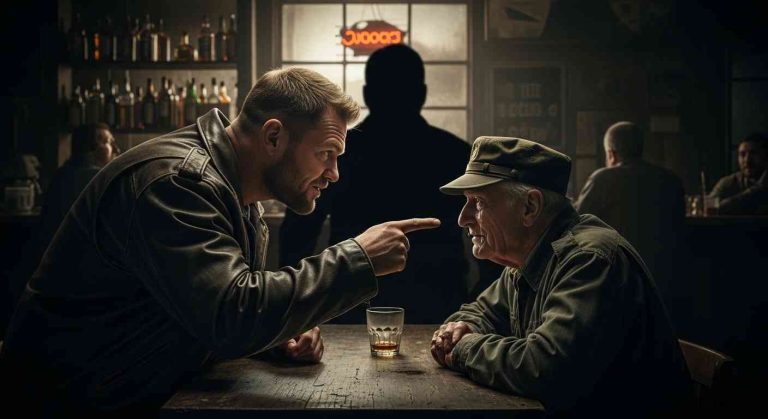
At sixty-eight, Elias Thorne didn’t ask for much. He asked for a steady hand, a sharp needle for the velvet upholstery, and enough peace to drown out the echoes of a war the world had forgotten. He was the “Ghost of the Grand Lyric,” the man who fixed the chairs while the world watched the stars.
But to the young stagehands who ran the theater like a private kingdom, he was just an obstacle. A piece of human furniture that breathed too much of their air.
“Hey, Grandpa! I told you to clear this row an hour ago!” Jax’s voice boomed, echoing off the gold-leafed ceiling.
Elias didn’t look up. He was focused on a stubborn spring in Row F, Seat 12. His hands, scarred by shrapnel and decades of hard labor, moved with a precision that was almost poetic.
“I’ll be done in ten minutes, son,” Elias said softly. “The tension in this frame is off. If someone sits here during the Gala, the wood will snap.”
Jax laughed, a harsh, jagged sound. He stepped over a row of seats, his heavy work boots marking the pristine carpet. “The only thing snapping today is my patience.”
What happened next wasn’t just a confrontation; it was a collision of two worlds. One world built on service and sacrifice, and another built on the cheap thrill of power over the weak. They didn’t know who Elias was. They didn’t know that the man they were about to break was the only man who knew how to stop the ticking clock under their feet.
“Chapter 1: The Weight of Velvet
The Grand Lyric Theater was a cathedral of echoes. It smelled of floor wax, stale perfume, and the heavy, metallic scent of history. Elias Thorne loved the theater most when it was empty. In the silence, he could pretend the world hadn’t changed—that men still respected the craft, and that silence was a sign of reverence rather than neglect.
Elias sat on a small wooden stool, his back arched like a bow. He was stitching a tear in a 1920s mohair seat. It was delicate work, the kind that required a man to be still. And Elias was very good at being still. He had learned that skill in the jungles of the Mekong and the deserts of the Middle East, where being still was the difference between a heartbeat and a funeral.
“”Look at him,”” a voice sneered from the stage. “”Stitching a chair like a grandmother. Hey, Thorne! You missed a spot!””
Elias didn’t flinch. That was Jax. Jax was twenty-four, fueled by energy drinks and a profound sense of unearned importance. He was the head of the “”load-in”” crew, a group of young men who saw the theater as a playground rather than a landmark.
“”The work takes the time it takes, Jax,”” Elias said, his voice a low, gravelly hum.
“”The Gala is in four hours,”” Jax barked, jumping down from the stage with a thud that vibrated through Elias’s knees. “”The Governor is coming. The Joint Chiefs are coming. And here you are, clogging up the aisle with your little sewing kit.””
Jax’s shadow fell over Elias. He was accompanied by Miller, a kid who looked like he’d never seen a day of hard labor in his life, and Sarah, a young violinist who was practicing in the orchestra pit. Sarah looked up, her brow furrowed with worry.
“”Leave him alone, Jax,”” Sarah called out, her voice thin but brave. “”He’s the only one who actually cares about this place.””
“”Mind your fiddle, Sarah,”” Jax snapped. He turned back to Elias and, with a sudden, cruel movement, kicked Elias’s toolbox.
The box skidded across the floor, spilling brass tacks, curved needles, and a weathered leather pouch across the carpet. Elias stared at the pouch. It was the only thing he had left from his time in the 10th Mountain Division. It held his tools—and his memories.
“”Pick it up,”” Jax ordered.
Elias looked at the mess, then up at Jax. His eyes weren’t angry. They were tired. “”You’re a young man, Jax. You think strength is about how much noise you can make. But real strength is knowing when to be quiet.””
“”Is that right?”” Jax stepped closer, his chest puffed out. “”Well, I’m making a lot of noise now. Pick. It. Up.””
When Elias didn’t move, Jax reached down and grabbed the front of Elias’s gray work shirt. He hauled the older man to his feet. Elias was surprisingly light, his body wiry and lean under the jumpsuit.
“”You think because you’ve been here thirty years you’re special?”” Jax hissed. “”You’re a janitor who knows how to sew. You’re replaceable. In fact, I think I’ll replace you right now.””
Jax swung his arm, a wide, clumsy arc. His open palm connected with Elias’s cheek with a sickening crack. The force of the blow sent Elias staggering backward. His heel caught on the edge of the open technical pit—a six-foot drop used for moving heavy stage equipment.
For a second, Elias balanced on the precipice, his arms windmilling. Then, with a grunt of shock, he vanished into the darkness.
The sound of his body hitting the concrete floor of the pit was dull and final.
“”Oh my God!”” Sarah screamed, dropping her violin bow. She ran to the edge of the pit. “”Elias! Are you okay?””
Jax stood there, his hand still stinging, a smirk playing on his lips. “”He’s fine. Old bones bounce. Maybe it’ll teach him to move faster next time.””
Miller chuckled nervously, looking at the manager, Mr. Henderson, who had just walked into the auditorium. Henderson was a man who wore suits that cost more than Elias made in a year. He looked at the scene, looked at the empty seat Elias had been fixing, and then at the pit.
“”Is the chair finished?”” Henderson asked, his voice cold.
“”Almost,”” Jax said.
“”Then finish it,”” Henderson said, turning on his heel. “”And get that man out of the pit before the VIPs arrive. I don’t want the Governor seeing the help sleeping on the job.””
Inside the dark pit, Elias lay on his side. His shoulder screamed in pain, and a thin trickle of blood ran down his temple. But he didn’t cry out. He just closed his eyes and breathed. He thought about the men he’d lost. He thought about the secret tucked away in the theater’s sub-basement—a secret he had guarded for twenty years.
And then, he heard the sirens.
FULL STORY
Chapter 2: The Ghost in the Machine
Elias Thorne didn’t belong in a theater. Not really. His hands were meant for demolition, for structural engineering, for the kind of “”problem solving”” that the government didn’t put in textbooks. In 1998, he had been the lead engineer for a project so sensitive it didn’t have a name. They had built a bunker—a “”continuity of government”” site—directly beneath the foundation of the Grand Lyric Theater.
The theater was the perfect cover. Thousands of people coming and going, the noise of orchestras masking the hum of servers, the grandeur of the arts hiding the cold steel of national security. When Elias retired, he refused a pension. He refused a medal. He only asked for one thing: to be the caretaker of the theater.
He wasn’t just fixing chairs. He was listening to the building. He knew every groan of the steel beams, every vibration of the ventilation shafts. He was the silent sentry, the only man alive who knew that if the theater’s structural integrity failed, the most secure communication hub on the East Coast would be crushed under five hundred tons of marble and velvet.
“”Elias? Can you hear me?””
Sarah’s voice drifted down into the pit like a soft light. She was kneeling at the edge, her face pale.
Elias groaned, pushing himself up. His left arm was numb—dislocated, most likely. He’d popped it back in before, in worse places than this. He gripped his wrist, braced his shoulder against the concrete wall, and with a sharp, guttural hiss, slammed his weight forward. The joint clicked back into place.
“”I’m here, Sarah,”” he called out, his voice steady despite the sweat on his brow.
“”I’m calling 911,”” she said, her fingers fumbling with her phone.
“”No,”” Elias said firmly. “”Don’t. The Gala. If there’s an ambulance, Henderson will lose his mind. Just… give me a hand.””
Jax leaned over the edge, looking down with a cruel grin. “”Look at him. The old lion is a stray cat now. You want a hand, Thorne? Here.””
Jax picked up a heavy rubber mallet from the stage floor and dropped it. It whistled through the air, narrowly missing Elias’s head and thudding into the dirt beside him.
“”Oops,”” Jax laughed. “”Dropped my tool. Why don’t you bring it up when you’re done crying?””
Elias looked at the mallet. He looked at the darkness of the pit. He felt the old fire—the one he’d tried so hard to douse—flicker in his chest. He wasn’t a violent man, not anymore. But he knew that the world was built on a delicate balance. And Jax had just tipped the scales.
“”You shouldn’t have done that, son,”” Elias whispered to the shadows.
Above him, the theater’s heavy brass doors swung open. The sound was different this time—not the light tap of a visitor, but the synchronized stomp of heavy boots.
Mr. Henderson came scurrying out of his office, adjusting his silk tie. “”Is that the caterers? They’re late! Tell them to go to the service entrance!””
But it wasn’t the caterers.
Six men in dark navy suits, wearing earpieces and tactical holsters under their jackets, fanned out across the lobby. They didn’t ask for permission. They didn’t look at the art. They scanned the rafters, the exits, and the stage.
Behind them walked a man who looked like he was carved out of granite. General Marcus Vance, Chief of Naval Operations. He wasn’t in his dress blues; he was in a flight suit, looking like he’d just stepped off a jet.
“”Clear the room,”” Vance barked.
Henderson ran forward, his face a mask of oily smiles. “”General Vance! What an honor! We weren’t expecting you for another three hours. The reception isn’t quite—””
Vance didn’t even look at him. He walked straight to the center of the aisle, his eyes scanning the rows of seats. He stopped at Row F. He saw the spilled toolbox. He saw the half-stitched chair.
“”Where is he?”” Vance asked.
“”Where is who, sir?”” Henderson stammered. “”The Governor? He’s in transit—””
“”I’m not looking for the Governor,”” Vance snapped. “”I’m looking for the Master of the House. I’m looking for Elias Thorne.””
Jax, sensing the shift in the room, stepped forward, trying to look helpful. “”The janitor? He… uh… he had an accident, sir. Fell into the pit. Totally clumsy. We were just about to help him.””
Vance turned his gaze toward Jax. It was the look of a man who had stared down nuclear silos. Jax’s smirk evaporated. He felt a cold sweat break out on the back of his neck.
Vance walked to the edge of the pit and looked down.
“”Elias?”” the General called out. His voice wasn’t a command; it was a plea. “”Elias, are you down there?””
From the darkness of the pit, a calm, tired voice rose up. “”I’m here, Marcus. But I’m going to need a minute. My left side is a bit stiff.””
Vance’s face contorted with a mix of relief and simmering rage. He looked at the rubber mallet lying next to Elias. He looked at the red mark on Elias’s face. Then he looked at Jax.
“”You,”” Vance said, his voice a low, terrifying growl. “”Did you put him down there?””
Jax stuttered, his knees beginning to shake. “”I… it was a joke, sir! He was in the way! He’s just a repairman!””
Vance stepped so close to Jax that the young man could smell the jet fuel on his flight suit. “”That ‘repairman’ is the reason you have a country to be a coward in. And if he’s hurt, there isn’t a hole in this world deep enough to hide you from me.””
Vance turned to his men. “”Get him out. Now. And call the White House. Tell them the architect is compromised.””
FULL STORY
Chapter 3: The Broken Foundation
The rescue was surgical. Two of Vance’s men descended into the pit with a collapsible ladder. They didn’t treat Elias like a janitor; they treated him like a king. One of them, a medic, began checking Elias’s vitals while the other apologized profusely for the “”unacceptable conditions.””
“”I’m fine, Sergeant,”” Elias said, wincing as he climbed the ladder. “”Just a bit of dignity lost in the dust.””
When Elias reached the top, the theater was silent. The stagehands were huddled in a corner, guarded by a man with a sidearm. Mr. Henderson was white as a sheet, clutching a velvet rope for support. Sarah stood off to the side, tears streaming down her face, clutching her violin.
General Vance stepped forward. To the shock of everyone in the room—especially Jax—the four-star General snapped to attention and delivered a crisp, formal salute.
Elias stood there, his jumpsuit covered in gray dust, his face bruised, and he slowly returned the salute.
“”Status, Elias?”” Vance asked.
“”The building is talking, Marcus,”” Elias said, his voice dropping all pretense of being a simple worker. He pointed toward the stage. “”The vibrations from the new sound system they installed last week… they’re hitting the resonance frequency of the primary support pylons for the Level 4 hub. There’s a hairline fracture in the foundation directly beneath the orchestra pit. If the theater fills up tonight—if the bass from the orchestra hits—the whole thing collapses into the bunker.””
Henderson gasped. “”That’s impossible! We had inspections!””
Elias looked at him with pity. “”You had inspectors look at the aesthetics. I built the bones. The bones are screaming.””
Vance turned to his lead agent. “”Cancel the Gala. Evacuate the block. Tell the FAA to clear the airspace.””
“”Wait!”” Jax shouted, his voice cracking with desperation. “”You’re listening to him? He’s a crazy old man who stitches chairs! You can’t cancel a Presidential Gala because a janitor heard a noise!””
Vance didn’t even yell this time. He just looked at Jax. “”This ‘janitor’ designed the security protocols for the Pentagon’s deep-site storage. He has a Congressional Medal of Honor that he keeps in a shoebox because he doesn’t like the attention. And right now, he is the only person standing between you and a very long prison sentence for assaulting a federal asset.””
Jax collapsed onto a theater seat—the very one Elias had been trying to fix. The wood groaned. A sharp snap echoed through the hall. The seat gave way, and Jax fell through the frame, landing hard on the floor.
“”I told you the tension was off,”” Elias said softly.
The room began to move. Vance’s team was on their radios, their voices urgent. The reality of the situation was setting in. This wasn’t just a theater anymore; it was a ticking bomb.
Elias walked over to Sarah. He took her trembling hand in his. “”Go home, Sarah. Take your violin. Don’t come back tonight.””
“”What about you, Elias?”” she whispered.
Elias looked at Vance, then back at the dark pit he had just been thrown into. “”The General needs a problem solver. It seems I’m not retired after all.””
FULL STORY
Chapter 4: The Descent
The evacuation of the surrounding area was conducted with the quiet efficiency of a military operation. To the outside world, it was a “”gas leak”” or a “”structural precaution.”” But inside the Grand Lyric, the air was thick with the scent of a brewing storm.
Elias, now wearing a tactical vest over his dusty jumpsuit, led General Vance and a team of four combat engineers toward the hidden access panel behind the pipe organ.
“”Elias, how bad is it?”” Vance asked as they descended a narrow spiral staircase that went deep into the earth, far below the theater’s sub-basement.
“”The bunker was designed to withstand a direct hit from a bunker-buster,”” Elias explained, his voice echoing off the damp concrete. “”But it wasn’t designed for the foundation above it to liquefy. If the theater’s main support gives way, it creates a piston effect. The pressure will blow the seals on the cooling system for the server farms. We’ll lose the entire Eastern Seaboard’s backup comms. And the fire… it’ll be a chemical burn that won’t go out for a month.””
They reached a heavy steel door. Elias placed his hand on a biometric scanner that looked twenty years old. It glowed green.
“”You kept your clearance active?”” Vance asked, surprised.
“”I never left the post, Marcus,”” Elias said. “”I just changed the uniform.””
The door hissed open, revealing a world of humming machines and glowing blue lights. This was the “”Level 4 Hub.”” It was a cathedral of data, the silent brain of a nation. But the ceiling was dripping. Not water—dust. Fine, white powder from the shifting marble of the theater above.
“”There,”” Elias pointed to a massive steel pylon that was vibrating with a low, rhythmic thrum. A crack, jagged and angry, was snaking up the side of the metal.
“”We need to shore it up,”” the lead engineer said, looking at his tools. “”But we need high-pressure hydraulic jacks. We don’t have time to bring them in.””
Elias looked at the pylon, his mind racing through thousands of blueprints. He remembered a failsafe he’d built into the theater’s stage lift—a secondary hydraulic system that had been decommissioned ten years ago but never removed.
“”The stage lift,”” Elias said. “”If we can reroute the fluid from the main theater’s lift through the emergency fire lines, we can create enough pressure to stabilize the pylon for twenty-four hours.””
“”How?”” Vance asked.
“”I have to go back up,”” Elias said. “”Into the pit. The manual override is in the technical shaft where they threw me.””
“”It’s too dangerous,”” Vance said. “”The building is shifting. If that pylon snaps while you’re in the shaft, you’ll be crushed.””
Elias looked at his scarred hands. He thought about the theater. He thought about the chairs he’d stitched with so much care. He thought about the people who walked those halls, never knowing how much was held up by so little.
“”I’ve spent my whole life fixing things people didn’t know were broken,”” Elias said. “”I’m not stopping now.””
He turned and headed back toward the stairs. He didn’t look like a 68-year-old man anymore. He looked like a soldier going back to the front.