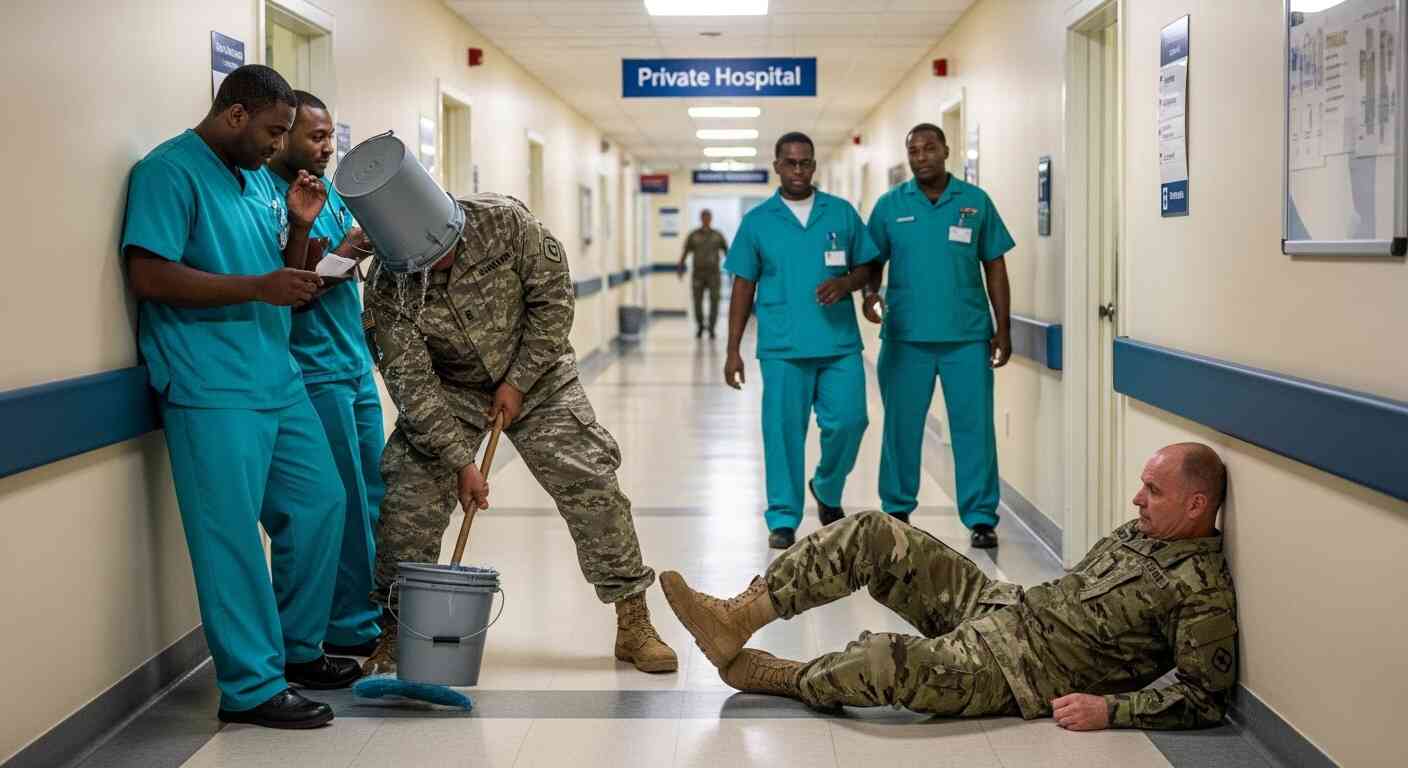
Chapter 1: The Ghost in the Blue Jumpsuit
Silas Vance didn’t mind the smell of bleach. To most, it was the clinical scent of sickness and hospitals, but to him, it was a shield. It covered the smell of things he’d rather not remember—the metallic tang of desert dust, the acrid bite of cordite, and the heavy, sweet scent of things lost in the sand.
He was sixty-two years old, though his knees felt like they were eighty. Every morning at 5:00 AM, he pulled on his faded navy-blue coveralls, pinned his “S. VANCE” name tag to his chest, and grabbed the heavy industrial mop that had become his only companion in his “retirement.”
The St. Jude’s Private Pavilion was a place for the wealthy to get better in silence. It was all marble floors and soft piano music in the lobby. Silas liked it because no one looked at him. To the surgeons, he was a piece of the architecture. To the patients, he was just the “cleaning guy” to be avoided.
“Hey! Gramps! You missed a spot.”
Silas didn’t look up. He knew that voice. Tyler, the head of night-shift security, was twenty-four, had a gym membership he bragged about constantly, and wore a tactical vest that was three sizes too small for his ego.
Tyler stepped onto the freshly mopped tile, his heavy black boots leaving muddy streaks across the gleaming surface. Silas paused, his hands tightening on the wooden handle of the mop.
“I’ll get it, Tyler,” Silas said, his voice a low, gravelly rasp.
“You’re damn right you will,” Tyler smirked, leaning against the reception desk where Brenda, a nurse who found joy in other people’s discomfort, was watching. “You know, Silas, I’ve been thinking. A guy like you… what’d you do? Fail out of high school? Spend your life under a bridge? You’ve got that ‘homeless’ vibe down to a science.”
Brenda giggled, tapping her polished nails on the counter. “Maybe he’s just slow, Ty. Look at his hands. They’re shaking. Probably the booze finally catching up to him.”
Silas’s hands weren’t shaking from drink. They were shaking because of a shrapnel wound from 2004 that hit him during a night extraction in Fallujah—a night where he’d carried three men out of a burning Humvee. But Silas didn’t say that. He never said anything. He just dipped the mop back into the bucket.
“I’m just doing my job, ma’am,” Silas said quietly.
“Your job is to stay out of our way,” Tyler snapped. He looked around to make sure the lobby was empty of high-paying patients. It was 6:15 AM. The shift change was starting. He felt bold.
With a sudden, violent motion, Tyler kicked the side of Silas’s yellow plastic bucket.
The gray, chemical-heavy water surged over the rim, soaking Silas’s boots and the bottom of his trousers. The old man stumbled, the wet floor slick beneath him. His feet went out, and he hit the marble with a dull, heavy thud that echoed through the high-ceilinged lobby.
Tyler didn’t help him up. He stood over him, laughing. “Oops. Looks like there’s a spill in aisle one. Better get to work, ‘Sarge.'”
He used the nickname like a slur, unaware of how close to the truth he was.
Silas sat there on the cold, wet floor. Pain flared in his lower back—the old injury from a helicopter crash-landing. He looked up at Tyler, then at Brenda, who was now filming the “funny” incident on her phone. He saw the contempt in their eyes. He saw that they didn’t see a human being. They saw a leftover. A piece of trash.
Silas took a breath, closing his eyes for a second. Control the breathing. 4-4-8. Don’t engage. The war is over.
But outside, the sound of low-frequency engines began to hum, vibrating the massive glass windows of the Pavilion. A fleet of black SUVs was pulling into the VIP circle, and for the first time in twenty years, Silas Vance’s past was about to catch up with his present.
“FULL STORY
Chapter 1: The Ghost in the Blue Jumpsuit
The pain in Silas’s hip was a dull roar, a constant reminder of a world he had tried to leave behind. As he sat on the wet floor of the St. Jude’s lobby, the cold water seeping into his clothes, he didn’t feel anger. He felt a profound, weary sadness. He looked at Tyler, whose face was twisted in a smirk of unearned superiority.
“”What’s the matter, Silas?”” Tyler asked, stepping closer until his boot was inches from Silas’s hand. “”Did we break the old man? Maybe we should call a real doctor, though I doubt they’d waste the supplies on a janitor.””
Brenda let out a sharp, bird-like laugh. “”Oh, hush, Ty. He’s fine. He’s probably just wondering if he can sue us for a new pair of thrift-store shoes.””
Silas slowly pushed himself up. His movements were methodical, ingrained by years of “”brace and climb.”” He didn’t use the mop handle for leverage; he used his core. Even at sixty-two, there was a hidden architecture of muscle beneath the baggy coveralls. He stood a full head taller than Tyler, a fact the guard ignored because Silas always kept his shoulders hunched.
“”I’ll clean it up,”” Silas said, his voice devoid of emotion.
“”You’re damn right you will,”” Tyler said. He reached out and shoved Silas’s shoulder—not hard enough to knock him down again, but enough to make him stumble. It was a gesture of pure dominance. “”And do it fast. The big shots are coming in for the board meeting today. I don’t want them seeing a swamp in my lobby.””
Silas didn’t reply. He walked to the supply closet, his wet boots squeaking on the tile. Every squeak felt like a countdown.
In the closet, surrounded by the scent of pine-sol and ammonia, Silas leaned his head against the cool metal shelving. He remembered a different kind of “”big shot.”” He remembered General Miller—back then just a jittery Captain—clinging to Silas’s vest as they ran through a hail of gunfire toward the last bird out of the Green Zone.
Why am I here? Silas asked himself.
He was here because he couldn’t handle the silence of a normal apartment. He was here because working as a janitor meant he could be invisible. He didn’t want a pension; he didn’t want medals. He wanted to be the man who cleaned the floors so well that no one noticed he was there.
But the world has a way of finding the people who try the hardest to hide.
He emerged from the closet with a fresh bucket, but as he stepped back into the lobby, he saw that Tyler hadn’t moved. The guard was standing with Brenda, and they had a new target. A young orderly, a kid named Leo who was working his way through nursing school, was being cornered.
“”I saw you talking to the janitor yesterday, Leo,”” Tyler was saying, his voice loud. “”You two planning a revolution? Or were you just asking him for tips on how to be a failure?””
Leo, a slim kid with thick glasses, looked terrified. “”We were just talking about… about his shoes, sir.””
“”His shoes?”” Tyler laughed, looking at Brenda. “”He’s giving fashion advice now?””
Tyler grabbed Leo’s clipboard and tossed it across the floor. “”Pick it up. And while you’re down there, tell Silas he missed a spot under the rug.””
Silas watched. He could handle the water. He could handle the shove. But he had spent thirty years of his life protecting the “”Leos”” of the world from the “”Tylers.””
The low hum outside grew louder. The glass doors vibrated.
“”Tyler,”” Silas said.
The guard turned, his eyes widening in surprise that the old man had spoken his name without being prompted. “”What did you say to me?””
“”Leave the kid alone,”” Silas said. He wasn’t hunched anymore. He was standing straight. His chest was out. His chin was tucked.
“”Or what?”” Tyler stepped toward him, his hand moving to the baton on his belt. “”You gonna mop me to death?””
At that exact moment, the air in the lobby changed. The automatic doors didn’t just slide open; they seemed to fly back with a sense of urgency. The morning sun was eclipsed by the silhouettes of four massive, armored Suburbans pulling onto the sidewalk, ignoring the “”No Parking”” signs.
Men in dark suits with earpieces jumped out first, securing the perimeter with practiced, lethal efficiency. Then, a man in a crisp Army Combat Uniform with three silver stars on his shoulders stepped out, followed by a woman in a Navy uniform with two stars.
Tyler froze. Brenda dropped her phone. The hospital’s Chief of Staff, Dr. Aris, came running from the elevators, adjusting his tie frantically.
“”General Miller! We weren’t expecting—”” Aris began, his voice cracking.
General Raymond Miller didn’t even look at the doctor. His eyes were scanning the room like a predator. He ignored the marble. He ignored the art. He looked at the shadows.
He looked at the man in the wet blue coveralls holding a mop.
“”There he is,”” the General whispered.
Chapter 2: The Fall of the Small-Town King
The silence that descended upon the St. Jude’s lobby was heavy, the kind of silence that usually precedes a lightning strike.
Tyler, the security guard, stood paralyzed. His hand was still resting on his baton, a gesture that now looked pathetic and amateurish in the presence of the three-star General and the elite security detail. He tried to pull himself together, stepping forward with a shaky, sycophantic smile.
“”General, sir! I’m Tyler Vance—no relation—Head of Security for the morning shift. I’ve already secured the lobby for your arrival. This… this janitor was just causing a bit of a disturbance. I’ll have him removed immediately.””
Tyler reached out to grab Silas’s arm, intending to drag him toward the service exit.
“”Don’t touch him.””
The General’s voice wasn’t loud, but it carried the weight of a mountain. It stopped Tyler’s hand an inch from Silas’s sleeve.
General Miller walked across the lobby. His boots clicked with a rhythmic, terrifying precision on the marble. He stopped two feet in front of Silas. The General, a man who commanded tens of thousands of lives, looked at the wet trousers, the gray water stains, and the bruise beginning to form on Silas’s cheek where he’d hit the wall earlier.
The General’s face went a dangerous shade of red. He turned his gaze to Tyler.
“”What is your name again?”” Miller asked.
“”T-Tyler, sir. Tyler Higgins.””
“”Mr. Higgins,”” Miller said, his voice dropping to a low, lethal vibrato. “”Do you have any idea who this man is?””
Tyler looked at Silas, then back at the General. He gave a nervous, high-pitched laugh. “”He’s… he’s the janitor, sir. He cleans the toilets. He’s a bit slow, honestly. Probably a vagrant we hired out of—””
SMACK.
The sound of the General’s open palm hitting the marble reception desk was like a gunshot. Brenda shrieked and jumped back.
“”This man,”” Miller said, pointing at Silas, “”is Master Sergeant Silas Vance. He is a recipient of the Distinguished Service Cross, three Silver Stars, and more Purple Hearts than you have brain cells. He has saved more American lives than this entire hospital has patients.””
The General turned back to Silas. His expression softened into something resembling reverence. He did something that made every person in that lobby gasp: he took off his cover cap, tucked it under his arm, and snapped a rigid, formal salute to a man holding a mop.
“”Master Sergeant,”” Miller said. “”It took us a year to find you. You’re a hard man to track down when you don’t want to be found.””
Silas sighed. The “”janitor”” mask was gone. His eyes, once dull and tired, were now sharp enough to cut glass. He didn’t salute back—he was a civilian now—but he stood with a posture that made Tyler look like a toddler.
“”I wasn’t hiding, Ray,”” Silas said quietly. “”I was just finished. Or I thought I was.””
“”The world isn’t finished with you,”” Miller replied. He looked down at Silas’s wet clothes. “”Why are you wet, Silas?””
Silas glanced at Tyler. The guard looked like he was about to faint. His knees were literally knocking together. He looked at Brenda, who was trying to hide her phone behind her back, her face pale and tearful.
“”The bucket tipped,”” Silas said.
“”Did it?”” the General asked. He turned to the security detail behind him. “”Major, retrieve the security footage from the last ten minutes. I want to see exactly how this bucket ‘tipped.'””
“”Sir, please!”” Tyler stammered, his voice breaking. “”It was a joke! We were just… we didn’t know! He never said anything!””
“”That’s the point of a hero, son,”” the General said, stepping into Tyler’s personal space. “”They don’t have to say anything. Their life speaks for them. You, on the other hand… your life seems to consist of bullying old men who could kill you with a thumb and a prayer.””
Dr. Aris, the Chief of Staff, finally pushed through the crowd. “”General, I am so sorry. This is a massive misunderstanding. We value all our staff—””
“”Save it, Doctor,”” the General snapped. “”The Pentagon is currently reviewing your hospital’s federal grants. I suggest you decide very quickly if you want to be associated with employees who assault war heroes.””
Aris turned to Tyler and Brenda with a look of pure loathing. “”You’re fired. Both of you. Get your things and get out before I have the real police escort you out in handcuffs.””
Tyler looked like he wanted to cry. Brenda was already sobbing. They slunk away, two small people who had tried to feel big by making someone else feel small.
Silas watched them go. He didn’t feel vindicated. He just felt tired.
“”Why are you here, Ray?”” Silas asked. “”You didn’t bring a motorcade just to get a janitor a promotion.””
General Miller’s face turned grim. “”We have a situation, Silas. A rescue mission in a high-threat environment. Our tactical medicine protocols are failing. We need the man who wrote the book on battlefield triage under fire. We need the ‘Ghost of Fallujah.'””
Silas looked at his mop. Then he looked at his hands. “”I’m an old man, Ray.””
“”No,”” the General said. “”You’re a legend. And legends don’t retire. They just wait for the right call.””
Chapter 3: The Weight of the Medals
The hospital’s VIP lounge had been cleared. Silas sat on a plush velvet chair that cost more than six months of his janitorial salary. He still smelled like bleach and dirty floor water, a stark contrast to the polished brass and expensive cologne of the officers surrounding him.
General Miller handed him a tablet. On the screen was a map of a mountainous region Silas recognized instantly: the border of Afghanistan and Tajikistan.
“”Three days ago, a medical evacuation bird went down,”” Miller explained. “”It wasn’t a combat unit. It was a humanitarian team. Six doctors, four nurses. They were providing vaccines to the mountain villages. They’re being held by a splinter cell. The terrain is a nightmare. Our standard SEAL teams are the best in the world at kicking doors, Silas, but they aren’t medics. And our medics aren’t used to this kind of terrain.””
Silas stared at the map. He could almost feel the thin, freezing air of the Hindu Kush. “”You want me to go back in?””
“”I want you to lead the training and oversee the extraction from the TOC,”” Miller said. “”But let’s be honest—if anyone gets stuck, you’re the only one I trust to go down that rope.””
Silas went silent. The ghosts started to stir in the back of his mind. He thought about his wife, Martha. She’d died five years ago. Cancer. He’d spent every cent of his military pension and his savings to keep her comfortable. That was why he was working as a janitor. He didn’t want the government’s help; he wanted to earn his way, just like he always had.
“”I have a job here, Ray,”” Silas said, though he knew it was a weak argument.
“”You had a job here,”” Miller corrected. “”Now you have a mission. And Silas… we know about the medical bills. The Army has retroactively cleared all of Martha’s outstanding debt. It’s the least we could do for a man we let slip through the cracks.””
Silas felt a lump form in his throat. He’d been drowning in debt for years, a weight he carried as silently as his memories.
“”Why me?”” Silas asked. “”There are younger men. Faster men.””
“”Because you don’t just save bodies, Silas. You save souls,”” a new voice said.
Colonel Sarah Jenkins, the woman who had arrived with the General, stepped forward. She looked at Silas with a gaze that was both clinical and deeply empathetic. “”I was a second lieutenant at Landstuhl when they brought in the men you rescued from the Humvee in ’04. They didn’t talk about the fire. They didn’t talk about the pain. They talked about the man who held their hands and told them they were going home. We need that spirit right now. The military has become too much about tech and not enough about heart.””
Silas looked down at his calloused, scarred hands. He remembered the feeling of a pulse under his thumb in the middle of a sandstorm.
“”I need to change,”” Silas said.
“”The Suburbans are waiting,”” Miller said. “”We have a flight to D.C. in an hour.””
As Silas walked out of the VIP lounge, the lobby was packed. Word had spread through the hospital like wildfire. Nurses, doctors, and even patients had lined the hallway.
When Silas appeared, no longer hunched, but walking with the steady, purposeful stride of a commander, the room went quiet. Then, someone started to clap. It started with Leo, the young orderly. Then Dr. Aris joined in. Within seconds, the entire lobby was echoing with applause.
Silas didn’t wave. He didn’t smile. He just nodded—a soldier’s acknowledgment.
As he reached the glass doors, he saw Tyler and Brenda standing by the curb, clutching cardboard boxes of their belongings. They were watching the spectacle, their faces a mask of shame and disbelief.
Silas stopped in front of Tyler. The guard flinched, expecting a blow.
Instead, Silas reached into his pocket and pulled out a small, crumpled five-dollar bill—the tip a patient had given him the day before. He handed it to Tyler.
“”Get yourself a coffee, son,”” Silas said, his voice calm. “”You look like you’re going to have a long day of looking for a new job.””
He stepped into the lead SUV. The door closed with a heavy, armored thud. The motorcade pulled away, leaving the hospital—and the life of a janitor—in the rearview mirror.
Chapter 4: The Training Ground
The air at Fort Bragg was thick with humidity and the sound of distant mortar fire. For Silas, it was the sound of home.
He was no longer in blue coveralls. He wore a crisp set of OCPs (Operational Camouflage Pattern). The “”VANCE”” tape was back above his right pocket. On his collar were the diamonds of a Master Sergeant.
He stood on a wooden platform overlooking a group of twenty young men and women. They were the best Pararescuemen (PJs) and Combat Medics the military had to offer. They were young, fit, and cocky.
“”Listen up!”” the General shouted. “”This is Master Sergeant Silas Vance. He is your Primary Instructor for Operation Mountain Ghost. If he tells you to breathe, you ask what color air he wants. If he tells you you’re dead, you lie down and stop moving. Do I make myself clear?””
“”YES, SIR!”” the group roared.
But as the General walked away, Silas saw the looks. The eye rolls. The “”who is this old guy?”” whispers.
A young Captain named Miller (no relation to the General), a man with a chest full of tabs and a jawline like a chisel, stepped forward. “”With all due respect, Master Sergeant, we’ve been training for this for six months. We know the protocols. We’ve got the latest tech. What can a… veteran of your era… teach us about modern extraction?””
Silas hopped down from the platform. His knees groaned, but he didn’t show it. He walked up to the Captain, stopping so close their chests almost touched.
“”Technology is great, Captain,”” Silas said softly. “”Until the batteries die in the cold. Until the GPS signal is jammed by the mountains. Until you’re elbow-deep in a man’s chest cavity and the only light you have is the moon.””
Silas looked at the gear they were carrying. “”You’re heavy. You’re carrying 80 pounds of ‘just in case.’ In the mountains, ‘just in case’ will kill you. Speed is your only medicine.””
“”We’re plenty fast,”” the Captain smirked.
“”Prove it,”” Silas said. “”Full kit. Three-mile uphill run. Now. I’ll lead.””
The soldiers laughed. This old man was going to lead a three-mile uphill run against elite twenty-somethings?
Ten minutes into the run, the laughing stopped.
Silas didn’t run like an athlete; he ran like a machine. He didn’t breathe through his mouth; he kept a steady, rhythmic intake through his nose. He didn’t look at the ground; he looked at the horizon.
By mile two, the Captain was gasping for air, his face purple. Two of the PJs had dropped back. Silas hadn’t even broken a sweat. He turned around, running backward for a moment to look at them.
“”Is this the ‘latest tech’?”” Silas called out. “”Because your lungs look like they’re running on Windows 95!””
When they reached the summit, Silas was waiting for them. He wasn’t even winded. He stood there, silhouetted against the sun, looking like a statue of Ares himself.
The Captain collapsed at Silas’s feet, clutching his knees.
“”You… how?”” the Captain wheezed.
“”Because I don’t run with my legs, Captain,”” Silas said, reaching down to pull the man up. “”I run with my ‘why.’ I run because if I don’t get there, a mother loses a son. A wife loses a husband. When your ‘why’ is big enough, your body doesn’t get a vote.””
The mockery was gone. In its place was a burgeoning, desperate respect.
“”Now,”” Silas said, his voice turning hard. “”Let’s talk about how to sew an artery shut in a dark cave with a fishing line and a prayer.””
For the next week, Silas pushed them to their breaking point. He simulated failures they hadn’t even thought of. He broke their gear. He jammed their radios. He made them work in the mud, in the dark, and under the pressure of his own constant, biting criticism.
“”You’re not medics yet!”” he’d scream as they struggled to find a vein on a training mannequin in the rain. “”You’re just butchers with fancy bags! Find the pulse! Feel the life! If you don’t care about the man, you can’t save the body!””
But on the final night before deployment, Silas sat with them by a small fire. He told them about the janitor job. He told them about Tyler and the water bucket.
“”Why didn’t you hit him?”” the Captain asked. “”I saw your file, Sarge. You could have put him in the ICU in three seconds.””
Silas looked into the flames. “”Because, Captain, the hardest battle isn’t the one you fight against an enemy. It’s the one you fight against yourself. Restraint is the ultimate form of power. Anyone can be a bully. It takes a warrior to be humble.””
The Captain nodded, finally understanding.
“”We leave at 0400,”” Silas said. “”Get some sleep. Tomorrow, we go bring our people home.””