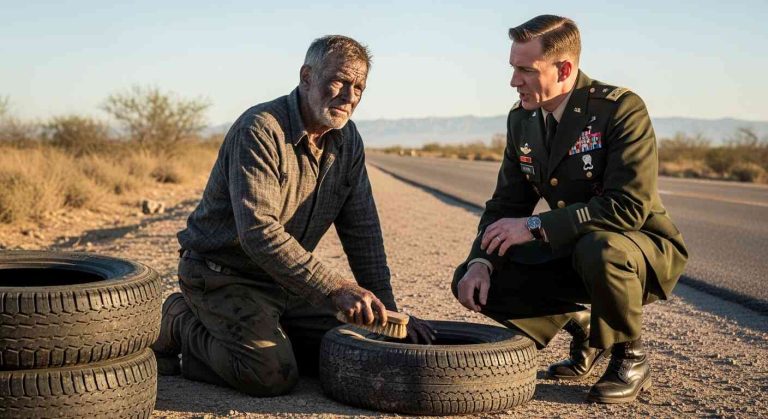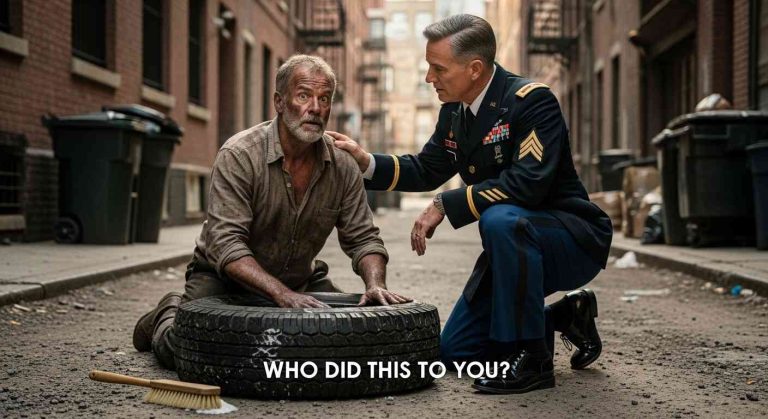
The dust in Oak Creek didn’t usually settle on anything more exciting than a Tuesday lawn-mowing or a dispute over a fence line. But today, the dirt was in Arthur Vance’s mouth.
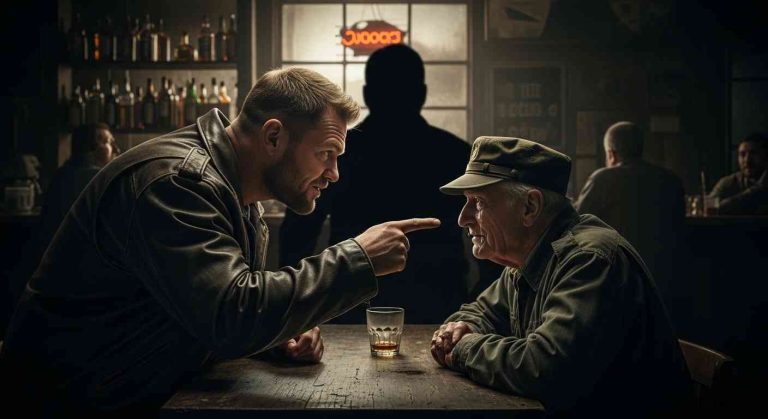
“I told you, old man. This curb is for people who actually pay their HOA dues. Not for your rusted-out garbage,” Tyler Rake spat. He was twenty-four, fueled by protein shakes and his father’s hedge fund, and he was currently standing over a seventy-year-old man who had done nothing but try to fix a vintage sewing machine on his own porch.
Arthur didn’t move. He felt the sting in his palm where the gravel had bitten deep. He felt the humid Missouri air clinging to his skin. But mostly, he felt the absence of the weight on his nose. His glasses—the ones Martha had bought him for their fiftieth anniversary, just three months before the cancer took her—lay three feet away.
Tyler’s expensive sneaker came down. Crunch.
The sound was small, but in the sudden silence of the neighborhood, it sounded like a gunshot.
“Oops,” Tyler laughed, looking at his two friends who were capturing the whole thing for a “Pranking the Homeless” video they’d likely edit later to make themselves look like heroes. “Looks like you’re even more blind now. Maybe it’ll help you find the way to the dump.”
Arthur looked up. He didn’t look like a victim. He didn’t have the watery, pleading eyes of the elderly man Tyler thought he was. Arthur’s eyes were a cold, glacial blue—the kind of blue that usually belonged to the deep ocean or the business end of a scalpel.
“Those were a gift,” Arthur said. His voice wasn’t shaking. It was a low, resonant rumble that seemed to come from the earth itself.
“Cry about it,” Tyler snapped, shoving Arthur’s shoulder again. “Move this scrap metal off the street by five o’clock, or I’m calling the city to haul it—and you—to the landfill.”
Tyler and his crew sauntered off, hooting and high-fiving. They didn’t see Arthur reach into his pocket. They didn’t see him pull out a phone that didn’t look like a smartphone, but a rugged, encrypted device that hadn’t been turned on in five years.
Arthur didn’t call the police. He didn’t call a lawyer. He pressed a single speed-dial button.
“It’s Vance,” Arthur said when the line picked up on the first half-ring. “I’m at the house in Oak Creek. Someone broke Martha’s glasses.”
There was a sharp intake of breath on the other end. A voice, trembling with a mix of terror and absolute devotion, replied: “We are already moving, Sir.”
Arthur sat on his porch, the broken frames of his glasses in his hand. He waited. He didn’t have to wait long.
“FULL STORY
Chapter 1: The Weight of Silence
The afternoon sun in the suburbs has a way of making everything look innocent. The golden light hits the white picket fences, the sprinklers create miniature rainbows over the Kentucky bluegrass, and the sound of distant lawnmowers provides a rhythmic heartbeat to the American Dream. But for Arthur Vance, the beauty was a thin veil. He knew what lived beneath the surface of things. He had spent forty years dealing with the rot in the foundations of much more powerful places than Oak Creek.
Arthur lived in the smallest house on the block, a tidy but dated bungalow that the local Homeowners Association (HOA) viewed as a “”visual liability.”” To them, he was a recluse. A man who spent his days in his garage, surrounded by what they termed “”junk””—old clocks, typewriter parts, vintage engines, and discarded electronics.
To Arthur, it wasn’t junk. It was a puzzle. Since Martha died, the silence in the house had become a physical weight, a pressure in his ears that only the rhythmic clicking of gears and the smell of WD-40 could alleviate. He fixed things for the people who couldn’t afford to buy new. He fixed the single mother’s toaster two blocks over; he repaired the neighborhood kids’ bicycles for the price of a thank-you.
But Tyler Rake didn’t see a craftsman. Tyler saw a target.
Tyler lived three doors down in a house that looked like a glass-and-steel fortress. He was the kind of young man who believed the world was an app designed specifically for his convenience. He was the vice president of the HOA, a title he used like a cudgel.
“”Mr. Vance,”” Tyler had said a week ago, leaning against Arthur’s picket fence with a sneer. “”We’ve had complaints. The ‘hobby’ in your driveway? It’s bringing down property values. We’re aiming for a certain… aesthetic here.””
“”I’m repairing a 1940s Singer sewing machine for Mrs. Gable, Tyler,”” Arthur had replied mildly, his hands stained with oil. “”She’s eighty-five and wants to make a quilt for her grandson. I don’t think a sewing machine on a workbench is a threat to your portfolio.””
“”It’s an eyesore. Clean it up, or we’ll clean it for you.””
Arthur had ignored him. He had faced men who controlled national power grids and private armies; a boy with a gym membership and a leased BMW didn’t register on his Richter scale of threats.
Until today.
The confrontation had escalated quickly. Tyler and his “”content crew””—two other boys with cameras and expensive haircuts—had caught Arthur as he was moving a heavy crate of parts from his truck. They had blocked his path, mocking his age, mocking his clothes. When Arthur tried to step around them, Tyler had delivered the shove.
Now, sitting on his porch, Arthur felt a strange sensation. It wasn’t anger—not exactly. Anger was hot and messy. What Arthur felt was a cold, familiar clarity. It was the feeling he used to get before a “”negotiation”” in a high-rise in Hong Kong or a back alley in Prague.
He looked at his hands. They were steady. At seventy-two, the Lion of the Levant—as he had once been known in circles that didn’t exist on any official map—was still there. He had tried to bury that man under layers of suburban boredom and grief. He had promised Martha he was done with the shadows.
But they had broken her glasses.
The wire frames were snapped at the bridge. One lens was spider-webbed with cracks. These were the glasses she had picked out because they made him look “”distinguished”” rather than “”dangerous.””
Arthur closed his eyes. He remembered the day she bought them. They had been in a small boutique in Chicago. She had laughed, tucking a lock of silver hair behind her ear, and told him, “Now you look like a grandfather, Artie. Maybe people will stop being so afraid of you.”
He had worn them every day since. They were his tether to the man she wanted him to be.
Across the street, he saw Sarah, his neighbor from two doors down. She was a nurse, a woman who worked twelve-hour shifts and still found time to bring Arthur a plate of cookies every Sunday. She was standing on her lawn, her face pale, holding her phone.
“”Arthur? Are you okay? I saw what they did,”” she called out, her voice trembling with indignation. “”I called the police, but they said it’s a ‘neighborhood dispute’ unless there’s a serious injury. Do you want me to come over?””
Arthur looked at her and forced a small, practiced smile. “”I’m fine, Sarah. Just a bit of a tumble. Go back inside. It’s going to get a bit crowded on the street shortly, and I wouldn’t want you to get caught in the middle of it.””
Sarah frowned, confused. “”Crowded? What do you mean? Is the HOA coming back?””
“”Something like that,”” Arthur said.
He stood up, his joints popping. He walked to his garage and pulled a heavy, mothballed tarp over his workbench. He didn’t want any oil splatters on what was coming. Then, he went into his house, washed the dirt from his face, and changed his flannel shirt for a charcoal-colored turtleneck. It was a simple garment, but it changed his silhouette. He looked less like a tinkerer and more like a shadow.
He walked back out to his porch and sat in his rocking chair. He didn’t rock. He just watched the entrance of the subdivision.
Ten minutes passed. The neighborhood was quiet, save for the sound of Tyler’s stereo thumping from down the street. Tyler was probably celebrating his “”victory,”” uploading the footage of the “”junkman”” hitting the dirt.
Then, the sound started.
It wasn’t a roar. It was a hum. A deep, synchronized vibration that began to rattle the windows of the multi-million dollar homes. Sarah came back out onto her porch, looking toward the main road.
From the entrance of Oak Creek, a black SUV appeared. Then another. Then five more. They weren’t the luxury SUVs the neighbors drove; these were matte-black, armored, with tinted windows that looked like obsidian. They moved in perfect formation, three abreast, filling the wide suburban street from curb to curb.
The line of vehicles seemed endless. They didn’t honk. They didn’t speed. They moved with the terrifying, inevitable momentum of a glacier.
Tyler Rake came out of his house, his phone in his hand, his brow furrowed. “”What the hell is this? A funeral?”” he yelled toward his friends.
The SUVs reached Arthur’s house and stopped. In unison—a sound like a single, massive heartbeat—five hundred doors opened.
Five hundred men stepped out.
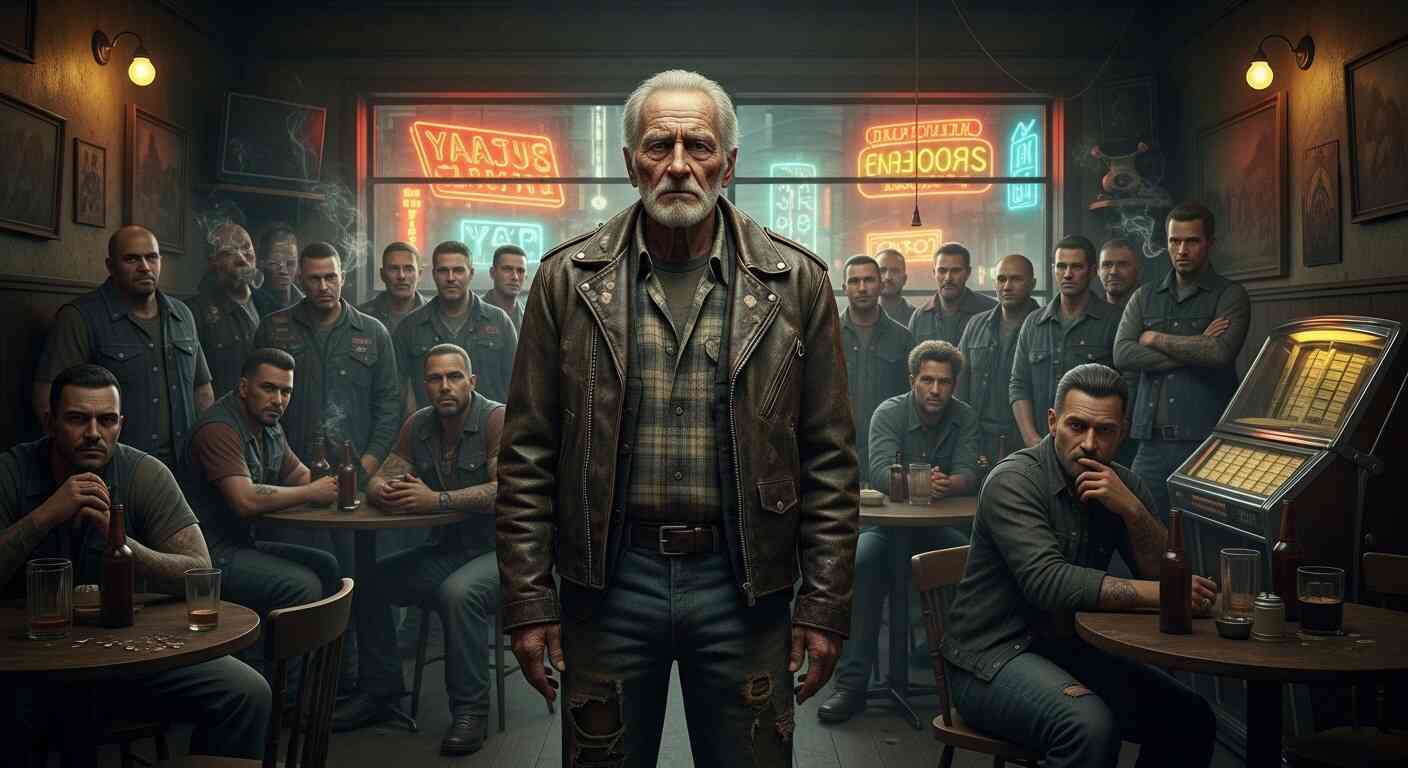
They weren’t thugs. They weren’t street brawlers. They were men in impeccably tailored black suits, their hair cropped short, their expressions devoid of emotion. They were the elite “”Fixers”” of the Vance Syndicate—the ghost army that Arthur had built over four decades to keep the peace in a world of chaos.
They stood in the street, five hundred shadows under the Missouri sun. The neighbors had all come out now, standing on their lawns in stunned silence. The birds seemed to have stopped singing.
One man stepped forward from the lead vehicle. He was younger than Arthur, in his fifties, with a jagged scar running along his jawline. This was Leo, the man who had taken over the day-to-day operations when Arthur retired. Leo, who had once taken a bullet meant for Arthur in Istanbul.
Leo walked up the driveway, his polished shoes crunching on the same gravel that had cut Arthur’s hand. He stopped at the base of the porch steps.
Behind him, the five hundred men moved. As if pulled by a single string, they turned toward the small, unassuming bungalow. They snapped their heels together and bowed. A deep, silent, terrifying display of absolute fealty.
Leo looked at Arthur’s face. He saw the cut on his cheek. He saw the broken glasses sitting on the side table.
Leo’s eyes turned into flint.
“”Sir,”” Leo said, his voice a low rasp. “”The family is gathered. Who do we need to delete?””
Arthur stood up slowly. He looked down the street at Tyler Rake, who was currently clutching his phone so hard his knuckles were white, his knees visibly knocking together.
“”No one is being deleted today, Leo,”” Arthur said, his voice carrying clearly through the silent street. “”But I think the neighborhood needs a lesson in property values.””
Chapter 2: The Shadow in the Suburbs
The silence in Oak Creek was no longer the peaceful quiet of a Saturday afternoon; it was the heavy, suffocating silence of a courtroom before a death sentence is read.
Tyler Rake’s phone slipped from his hand, hitting the grass with a soft thud. He tried to speak, but his throat felt like it was filled with dry sand. He looked at the sea of men in black. He looked at the armored SUVs that blocked every exit to his world. These weren’t the “”poor people”” he was used to bullying. These men radiated a type of quiet, expensive power that made his father’s wealth look like pocket change.
Leo didn’t look back at the crowd. His eyes remained fixed on Arthur. “”Sir, with all due respect, they touched you. The protocol is clear.””
“”The protocol has been in a drawer for five years, Leo,”” Arthur said, stepping down from the porch. His gait had changed. Gone was the slight stoop of the elderly tinkerer. He moved with a predatory grace that made Sarah, watching from her lawn, feel a chill she couldn’t explain. She had lived next to this man for three years, and she realized she didn’t know him at all.
Arthur walked toward the edge of his property. The five hundred men parted for him like the Red Sea, creating a corridor of black fabric and steel-eyed stares. Arthur stopped ten feet away from Tyler.
Tyler’s friends had already retreated, hovering near Tyler’s front door, looking for a way to vanish inside. But two of Leo’s men were already standing on Tyler’s porch, their arms crossed, looking like statues of dark marble.
“”Tyler,”” Arthur said softly.
Tyler flinched at the sound of his name. “”I… I didn’t… I thought you were just…””
“”A junkman?”” Arthur finished for him. He reached into his pocket and pulled out the broken glasses. He held them up. The sunlight caught the cracks in the lens, casting jagged shadows on the pavement. “”You see these, Tyler? My wife Martha bought these for me. She was the kindest person I ever knew. She spent her whole life trying to convince me that the world was full of good people. People who would look out for one another. People who didn’t need to be feared.””
Arthur took a step closer. Tyler scrambled backward, tripping over his own feet and falling onto his backside in his perfectly manicured lawn.
“”I spent five years trying to prove her right,”” Arthur continued, his voice dropping to a whisper that only Tyler could hear. “”I fixed clocks. I planted roses. I let you talk to me like I was dirt beneath your feet. Because I wanted to believe she was right. I wanted to believe that a man like me could find peace in a place like this.””
Arthur leaned down, his face inches from Tyler’s. “”But then you broke her glasses. And you reminded me of something I tried very hard to forget.””
“”What?”” Tyler whimpered, tears beginning to track through the expensive bronzer on his face.
“”That some people only understand the language of the shadow,”” Arthur said. He stood up and turned to Leo. “”Leo, who owns the mortgage on this subdivision?””
Leo didn’t even look at a phone. “”The holding company is a subsidiary of the Crown-Vance Trust, Sir. You own it. Technically, you are the HOA’s primary creditor.””
A collective gasp went up from the neighbors who were close enough to hear. The “”junkman”” didn’t just live in the neighborhood; he owned the land it was built on.
Arthur nodded. “”And Tyler’s father? What does he do?””
“”Robert Rake. Senior Partner at Rake & Associates. They handle the offshore accounts for several of our… less reputable competitors. We have the leverage to bankrupt the firm by Monday morning, 9:00 AM.””
Tyler’s jaw hung open. His entire life—the cars, the house, the “”status””—was built on a foundation of cards that this old man held the match to.
“”No, please,”” Tyler begged, finally finding his voice. “”My dad… he has nothing to do with this. It was just a joke! We were just making a video!””
“”A joke,”” Arthur repeated. He looked at the five hundred men standing in the sun. “”Does anyone look like they’re laughing, Tyler?””
Arthur turned back to Leo. “”I don’t want his money. And I don’t want his father’s firm. Not yet. But I want this street cleared. I want the ‘junk’ moved.””
Leo blinked. “”Sir?””
Arthur pointed to the end of the cul-de-sac. “”Tyler said my work was an eyesore. He said it was bringing down property values. So, let’s help him. I want every single vehicle in this street—except for ours and Sarah’s—towed. Now. I want the ‘aesthetic’ Tyler loves so much to be replaced with something a bit more… functional.””
“”And the boy?”” Leo asked, his hand drifting toward the inside of his jacket.
“”The boy is going to help me,”” Arthur said, a grim smile touching his lips. “”He’s so concerned about my ‘junk.’ He’s going to help me fix every single piece of it. By hand. Without his phone.””
Arthur looked at Tyler. “”Pick up your phone, Tyler. Call your father. Tell him he needs to come home. Tell him he’s going to meet his new landlord. And then, get over to my garage. You have a sewing machine to reassemble.””
As Tyler scrambled to comply, the neighborhood watched in awe. The SUVs began to move, their engines a low growl. But the five hundred men didn’t leave. They took up positions. One on every corner. One in front of every house. They stood like silent sentinels, turning the pastel-colored suburb into a fortress.
Arthur walked back toward Sarah’s house. She was still standing on her porch, her hand over her heart.
“”Arthur?”” she whispered as he approached. “”Who… who are you?””
Arthur stopped at the edge of her lawn. He looked at the broken glasses in his hand, then back at the woman who had brought him cookies when he was mourning.
“”I’m just a man who’s very tired of being pushed, Sarah,”” he said gently. “”Go back inside. It’s going to be a long night, and I suspect the HOA is about to have a very urgent meeting.””
He walked back to his porch, the weight of the silence replaced by the humming energy of an empire reclaimed. He had started a war he hadn’t wanted, but as he sat back down in his rocking chair, he knew one thing for certain:
The junkman was retired. The Lion was back.
Chapter 3: The Gathering Storm
By nightfall, Oak Creek looked like a military compound. The streetlights flickered on, casting long, dramatic shadows of the men in black suits who stood every fifty feet with the stillness of statues. The typical suburban sounds—the barking of dogs, the muffled audio of televisions—had been replaced by a heavy, expectant thrum.
In Arthur’s garage, the air was thick with the scent of old iron and sweat. Tyler Rake sat on a wooden stool, his designer hoodie discarded, his hands covered in grease. He was staring at the internal gears of a 1940s Singer sewing machine.
“”I… I don’t know where this spring goes,”” Tyler muttered, his voice cracking. He looked exhausted. He had been working for four hours under Arthur’s silent, watchful eye.
Arthur sat in the corner, cleaning a different set of lenses—a spare pair he had found in a drawer. They weren’t Martha’s, and they didn’t fit quite right, but they allowed him to see the fear in Tyler’s eyes with perfect clarity.
“”It goes behind the tensioning disc, Tyler,”” Arthur said. “”It’s about balance. If the tension is too high, the thread snaps. If it’s too low, the stitch is useless. Much like life.””
“”Why are you doing this?”” Tyler asked, dropping a small screw that skittered across the concrete floor. “”You have all these guys. You have all this money. Why do you care about a stupid sewing machine?””
Arthur stood up and walked over. He picked up the screw with a steady hand and placed it back on the bench. “”Because this ‘stupid machine’ is the only thing keeping an eighty-five-year-old woman connected to her past. Because things that are broken deserve to be fixed, Tyler. Not thrown away because they’re ‘eyesores.'””
Before Tyler could respond, the sound of a high-end engine screeched to a halt outside. A silver Mercedes-Benz had managed to bypass the first checkpoint—likely because the driver was screaming about his rights.
Robert Rake, Tyler’s father, burst into the garage. He was a man who looked like a polished version of his son—expensive suit, aggressive posture, and an aura of someone who had never been told “”no.””
“”Tyler! What the hell is going on? There are men in my driveway! They wouldn’t let me into my own house!”” Robert roared. He turned his glare toward Arthur. “”Vance? Is this your doing? I’ll have you in jail by midnight! I don’t care what kind of security firm you hired; you can’t occupy a private street!””
Arthur didn’t look up from the sewing machine. “”Hello, Robert. It’s been a long time. Not since the Zurich merger in ’08, I believe.””
Robert froze. The color drained from his face as he actually looked at the man in the charcoal turtleneck. He squinted, the memories of a high-stakes board room in Switzerland flooding back—a room where a man named Vance had dismantled a billion-dollar conglomerate with three sentences and a cup of tea.
“”Vance?”” Robert whispered, his voice losing all its bravado. “”Arthur Vance? I thought… the rumors said you were dead. Or in hiding in South America.””
“”I was in the garden, Robert,”” Arthur said, finally looking up. “”I was trying to be a peaceful man. But your son here has a very expensive habit of breaking things that don’t belong to him.””
Robert looked at Tyler, then at the grease on his son’s hands, then back at Arthur. He knew exactly who was standing before him. He knew that the 500 men outside weren’t “”security.”” They were the ghosts of the Vance legacy.
“”Arthur, listen,”” Robert said, his voice now a frantic, placating whine. “”He’s young. He’s stupid. He didn’t know. I’ll pay for whatever he broke. Tenfold. A hundredfold. Just… call off your people. This is a quiet neighborhood. We don’t want any trouble.””
“”The trouble is already here, Robert,”” Arthur said. He walked toward the garage door and looked out at the street. “”The trouble arrived when this neighborhood decided that some people were ‘junk’ and others were ‘owners.’ I’ve decided to reorganize the management.””
“”What do you want?”” Robert asked, sweating through his silk shirt.
“”I want a public apology,”” Arthur said. “”To the whole neighborhood. For every time you used the HOA to bully a senior. For every time your son filmed someone’s misfortune for ‘clout.’ And I want a donation. Five million dollars to the St. Jude’s Children’s Hospital, made in the name of Martha Vance.””
Robert swallowed hard. Five million was a staggering hit to his liquidity. “”And if I say no?””
Arthur stepped out into the driveway. He raised a hand.
Immediately, every SUV in the street turned on its high beams. The neighborhood was flooded with a blinding, artificial noon. The 500 men turned in unison, facing Robert’s house.
“”If you say no,”” Arthur said quietly, “”Leo will begin the audit. And by Monday, you won’t own the house, the car, or the shoes you’re standing in. You’ll be the ‘junk,’ Robert. And I won’t be there to fix you.””
Robert looked at his son, then at the army in his street. He lowered his head. “”I’ll make the call.””
“”Good,”” Arthur said. “”But Tyler isn’t finished. He still has the sewing machine. And after that, he’s going to fix the fence he broke three months ago at the park. And he’s going to do it while the ‘junkman’ watches.””
As Robert retreated to make the transfer, Arthur felt a hand on his arm. It was Sarah. She had come back out, her eyes wide with a mix of fear and curiosity.
“”Arthur,”” she whispered. “”I saw the news. They’re saying there’s a ‘security event’ in Oak Creek. The police are staying back. They’re saying someone very important is here.””
Arthur looked at her, his expression softening for the first time. “”No one important, Sarah. Just a man who’s finally standing up.””
“”Is it over?”” she asked.
Arthur looked at the 500 men, his silent brothers in the shadows. “”Not yet. Truth is like a gear, Sarah. Once it starts turning, you have to let it finish the cycle.””
Chapter 4: The Truth in the Gears
The following morning, the sun rose over a different Oak Creek.
The black SUVs were still there, but they had moved to the perimeter. The 500 men were no longer standing in the street; they were seated on the curbs, sharing coffee and talking in low tones. To the neighbors peering through their blinds, it looked less like an invasion and more like a strange, incredibly disciplined convention.
But the real change was on Arthur’s front lawn.
Tyler Rake was there, his hands blistered, his expensive clothes ruined. He was kneeling in the dirt, carefully replacing the slats of Arthur’s picket fence. He wasn’t filming. He wasn’t joking. Every time he looked up and saw a man in a black suit watching him, he worked a little harder.
Arthur sat on his porch, holding the sewing machine. It was hummed perfectly now. The timing was precise, the stitches even. Tyler had actually done it—with three hours of swearing and four hours of Arthur’s patient correction.
A black sedan pulled up—not one of the armored SUVs, but a sleek, understated town car. A woman stepped out. She was in her late forties, dressed in a sharp power suit, her eyes hidden behind dark glasses. She walked toward Arthur’s porch with the confidence of someone who owned the air she breathed.
The men in suits didn’t stop her. They bowed.
“”Isabelle,”” Arthur said, not rising.
“”Father,”” the woman replied.
The neighborhood, which had been eavesdropping from every porch, collectively held its breath. The “”junkman”” wasn’t just a boss; he was the patriarch of a dynasty. Isabelle Vance was the CEO of one of the largest logistics firms in the world—a woman whose face had been on the cover of Forbes and Time.
“”You broke cover,”” Isabelle said, leaning against the porch railing. She looked at Tyler, then at the army filling the street. “”For a pair of glasses, Father? Really? You know the State Department is frantic. They think you’re planning a coup.””
“”I was planning a quilt, Isabelle,”” Arthur said, gesturing to the sewing machine. “”The glasses were just the catalyst. I spent five years being the man your mother wanted me to be. I was quiet. I was invisible. I let these people treat me like a ghost.””
Isabelle sighed, removing her sunglasses. Her eyes were exactly like Arthur’s—cold, calculating, but currently filled with a reluctant warmth. “”And now?””
“”Now they know the ghost has a name,”” Arthur said. “”And they know that this ‘junkman’ is the reason their houses stand and their bank accounts are full. I’m tired of the pretense, Isabelle. I’m not going back to the shadows. But I’m not going back to the throne, either.””
“”Then what are you going to do?””
Arthur looked at Tyler, who was currently being shown how to properly hammer a nail by one of the 500 “”Fixers.””
“”I’m going to stay right here,”” Arthur said. “”I’m going to fix what’s broken. Starting with this neighborhood.””
Isabelle looked around at the pristine, artificial suburb. “”They’re terrified of you, Father. They’ll never look at you the same way.””
“”Good,”” Arthur said. “”Fear is a temporary measure. But respect? Respect is earned in the gears. They’ll learn.””
Isabelle nodded slowly. She signaled to one of the men. A briefcase was brought forward. “”Robert Rake’s donation has cleared. The hospital is naming a wing after Mom. And Robert? He’s resigned from the HOA. He’s moving his family to a ‘smaller’ property by the end of the month.””
“”Make sure he leaves the BMW,”” Arthur said. “”Sarah needs a new car. Her old Honda is a death trap.””
Isabelle chuckled. “”I’ll handle it.”” She turned to leave, then paused. “”The 500? Do you want them to stay?””
Arthur looked at his men. They were his family, his legacy, his burden. “”Leave ten. For ‘neighborhood watch.’ Tell the rest to go home. But tell them… thank you. For Martha.””
As the fleet of SUVs began to pull away, a strange thing happened. Sarah walked across her lawn. She wasn’t carrying cookies this time. She was carrying a toolbox.
“”I heard you were teaching the Rake boy how to fix things,”” she said, looking at Arthur. “”My sink has been leaking for a month. I don’t care who you were in Zurich, Arthur. Can you help me?””
Arthur smiled. It wasn’t the smile of a legend. It was the smile of a neighbor.
“”Get the boy, Sarah,”” Arthur said. “”He needs the practice.””
Chapter 5: The Cost of the Crown
The weeks following the “”Occurrence””—as the Oak Creek HOA newsletters would later refer to it in hushed, terrified tones—were a study in social transformation.
The black SUVs were gone, replaced by a single, modest black sedan that sat in Arthur’s driveway. The men in suits had vanished, though everyone knew they were never truly far away. The neighborhood had become the safest three square miles in the United States. Crime didn’t just drop; it ceased to exist. You could leave your front door wide open and a diamond ring on the porch, and it would be there in the morning, possibly polished.
But the real change was internal.
Tyler Rake didn’t move away with his father. In a move that shocked everyone, Arthur had purchased a small, run-down apartment building on the edge of town and made Tyler the “”Maintenance Trainee.””
“”You wanted to be an influencer, Tyler,”” Arthur had told him. “”Influence the plumbing. Influence the electrical. Real things for real people.””
Every Saturday, Tyler would show up at Arthur’s garage. He was thinner, his designer clothes replaced by durable denim. He was learning.
One afternoon, as they were working on a vintage clock from the 1800s, Tyler looked up. “”Do you miss it?””
Arthur didn’t need to ask what “”it”” was. “”The power? The feeling that the world was a chessboard and I was the only one who could see the moves?””
Tyler nodded.
“”Every day,”” Arthur admitted, his voice quiet. He picked up a tiny brass gear with a pair of tweezers. “”Power is an addiction, Tyler. It makes you feel like a god. But gods are lonely. They have to live on mountains. I’d rather live here, in the dirt, where the gears actually turn.””
The garage door opened, and Detective Miller walked in. Miller was a local cop who had spent twenty years patrolling these streets. He looked at Arthur with a complicated expression—a mix of professional wariness and deep, grudging respect.
“”Vance,”” Miller said.
“”Detective. Is there a problem?””
“”Found a group of guys over in the east district,”” Miller said, leaning against the doorframe. “”They were trying to set up a protection racket for the local shops. When I went to arrest them, they told me I couldn’t touch them because they worked for ‘The Lion.'””
Arthur’s hand froze. The silence in the garage became cold.
“”And do they?”” Arthur asked.
“”They had the tattoos,”” Miller said. “”Old guard. They think now that you’re ‘back,’ the old rules apply. They think the city is open for business again.””
Arthur stood up. He looked at his hands—the hands of a man who had spent months fixing sewing machines and fences. He looked at the broken glasses that he had finally repaired, the bridge held together by a tiny, elegant gold solder.
“”Tyler, go inside,”” Arthur said.
“”But—””
“”Now.””
When Tyler was gone, Arthur turned to Miller. “”Where are they?””
“”A warehouse on 5th. They’re waiting for ‘instructions’ from the top.””
Arthur walked to a locked cabinet in the back of his garage. He pulled out a heavy, leather-bound case. He didn’t open it. He just rested his hand on the lid.
“”I tried to be done, Miller,”” Arthur said.
“”I know you did, Arthur. But a man like you? You don’t just retire. You’re a landmark. People use you to find their way—even the bad ones.””
Arthur looked at the detective. “”I’ll handle it. But you need to look the other way for two hours.””
Miller sighed. “”I’ve been looking the other way since those SUVs showed up, Arthur. Just… don’t make me regret it.””
Arthur didn’t call the 500. He didn’t call Leo. He called a different number—a number for a man who didn’t exist.
“”This is Vance,”” he said into the phone. “”I have a few weeds in my garden. Send a disposal team. No noise. No mess. Just… removal.””
He hung up and looked at the clock he had been fixing. It was ticking perfectly. Tick. Tock. Tick. Tock.
The cost of peace, he realized, was a constant war against his own nature. He had shown the neighborhood his shadow to protect his light, but the shadow was a hungry thing. It didn’t want to go back into the box.
That night, Arthur didn’t sleep. He sat on his porch, watching the shadows of the trees dance on the pavement. He thought about Martha. He thought about the man she wanted him to be.
He realized that he could never truly be that man. Not entirely. But he could be the man who kept the monsters away from people like Sarah and Tyler. He could be the junkman who fixed the world, one broken soul at a time.
Even if it meant getting his hands dirty again.
Chapter 6: The Final Stitch
The warehouse on 5th Street didn’t burn down. There were no sirens, no headlines, and no bodies found in the river. There was simply a group of men who boarded a bus at 3:00 AM and were never seen in the state of Missouri again.
When the sun rose on Sunday morning, Arthur Vance was back on his porch.
The neighborhood was waking up. Sarah was out walking her dog—the new BMW Arthur had “”arranged”” for her sat shining in her driveway. She waved at him, a genuine, warm smile on her face. She no longer looked at him with fear. She looked at him as a protector.
Tyler Rake arrived at 9:00 AM sharp. He was carrying a box of donuts and a stack of mail.
“”Hey, Arthur,”” Tyler said, setting the box down on the porch table. “”The HOA had a meeting last night. They wanted to know if you’d accept the position of President.””
Arthur laughed—a rare, genuine sound that crinkled the skin around his eyes. “”President of the HOA? I’ve run international syndicates, Tyler. I don’t think I have the stomach for a debate over mulch colors.””
“”I told them that,”” Tyler said, grinning. “”I told them you were busy. We have that old tractor to look at, remember?””
Arthur nodded. “”The tractor. Yes.””
They spent the morning in the garage. It was a slow, quiet work. The air was warm, and the sound of the neighborhood felt… right. It felt like home.
Around noon, a small girl from down the block—little Emma, whose bike Arthur had fixed weeks ago—ran up the driveway. She was holding something in her hands, her face streaked with tears.
“”Mr. Arthur?”” she sobbed. “”My doll… her arm came off. My mommy said you can fix anything.””
Arthur knelt down, his old joints complaining, but his heart light. He took the doll—a simple, plastic thing with a torn sleeve. He looked at the break. It was a clean snap.
“”Don’t you worry, Emma,”” Arthur said, his voice soft and steady. “”This is a very easy fix. It just needs a little bit of support and a new stitch.””
He took the doll to his workbench. Tyler watched, fascinated, as the man who could command 500 soldiers used a tiny needle and thread with the delicacy of a surgeon.
“”There,”” Arthur said ten minutes later, handing the doll back. “”She’s stronger now than she was before. Sometimes, the places where we break are the places where we become the toughest.””
Emma hugged the doll, thanked him with a bright smile, and ran back to her mother.
Arthur stood in the doorway of his garage, looking out at the street. He saw the world for what it was—a collection of broken things, all trying to hold together. He saw the shadows at the edge of the woods, the men he had stationed there to ensure this peace remained. He saw the boy he was turning into a man.
He reached up and adjusted his glasses—the ones with the gold-soldered bridge. They weren’t perfect. The crack in the lens was still visible if you looked closely. But they worked. They allowed him to see the beauty in the rust and the hope in the dirt.
He thought of Martha. He hoped she was watching. He hoped she saw that he was still trying.
“”Tyler,”” Arthur said.
“”Yeah, Arthur?””
“”The tractor is going to take more than a day. We’re going to need more grease.””
“”I’ll go get some,”” Tyler said, already heading for his car.
Arthur sat back down in his rocking chair. He wasn’t a legend today. He wasn’t a boss. He wasn’t a shadow. He was just a man on a porch in a quiet American suburb.
He picked up a small, rusted gear from the table and began to polish it. He didn’t mind the dirt. He didn’t mind the silence. Because he knew that as long as he was here, the world might still have a chance to be fixed.
The junkman was home, and for the first time in a very long time, the silence was enough.
The world thought he was an old man lost in his junk, but he was actually the only thing holding their world together.”