CHAPTER 5: THE CONFRONTATION
The twenty-first day was the breaking point.
The blue was starting to mottle, turning a sickly, bruised shade of indigo, but it was still there. Jax cornered me in the chemistry lab after hours. I was cleaning up. I knew he was coming.
He didn’t look like a king anymore. He’d lost weight. His eyes were bloodshot. The blue on his face made him look like a corpse that had been pulled from the river.
“Give me the neutralizer,” he rasped. He held a heavy wrench in his blue hand.
“There isn’t one, Jax. I told you. It’s a cycle. You just have to wait.”
“I can’t wait!” he screamed, slamming the wrench into a lab table. “My scouts are gone! My dad won’t even look at me! I’m a joke, Leo! Everyone is laughing!”
“Now you know,” I said softly, stepping closer. “Now you know what it’s like when the world decides you don’t matter. When you’re just a ‘toy’ for someone else to break.”
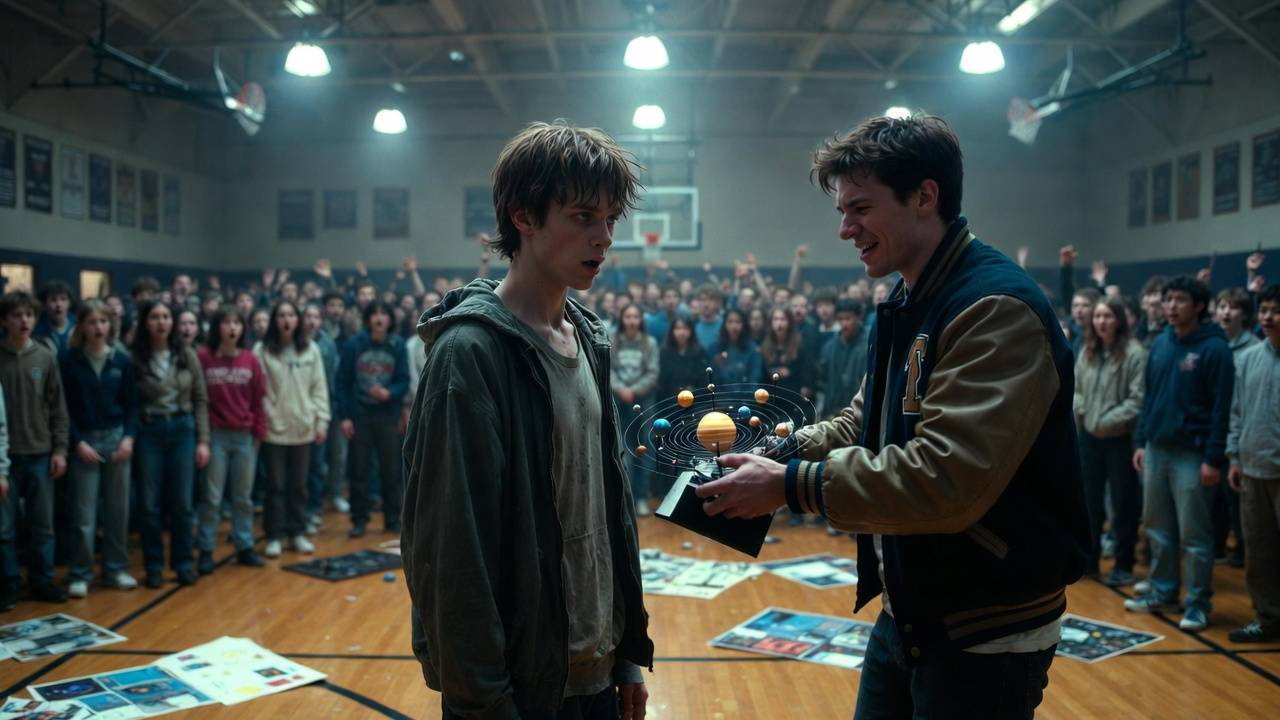
He raised the wrench. For a second, I thought he’d do it. I thought he’d finish what he started at the science fair.
“Go ahead,” I said. “Hit me. But remember, the police won’t be able to ignore a blue-handed suspect. You’re literally caught blue-handed, Jax. For the next nine days, you are the evidence.”
He shook. His hand trembled, and the wrench clattered to the floor.
He slumped against the lockers and started to cry. It wasn’t a cinematic cry. It was pathetic—the sound of a boy who had realized that his father’s money couldn’t buy back his reputation.
“Why me?” he sobbed.
“Because you were the one who broke the glass,” I said. “I just provided the color.”
CHAPTER 6: THE FINAL RECKONING
By the thirtieth day, the blue was gone.
Jax Miller returned to “normal,” but the school had moved on. The backup quarterback was the new star. The scouts had shifted their focus to players who weren’t “unstable.”
Jax transferred to a private academy three towns over a week later. His father’s shadow couldn’t cover the stain that lived in the digital archives of every student’s phone.
I stood in the gymnasium, now empty, looking at the spot where my project had been destroyed.
Mr. Henderson walked up behind me. He looked at my new acceptance letter from MIT—the one that had arrived yesterday.
“You’re a brilliant chemist, Leo,” he said, his voice low. “But you’re a terrifying strategist.”
“I just followed the data, Mr. Henderson.”
“Data doesn’t choose a victim. People do.”
I looked at my hands. They were steady. I thought about my father, about the way he’d been erased. I hadn’t cleared his name, not yet. But I’d learned how the world worked. It wasn’t about who was right; it was about who was marked.
I walked out of the gym and into the Seattle sunshine—a rare, bright day that felt earned.
Vengeance is a slow-acting reagent. It doesn’t need to be loud to be permanent. Sometimes, the most powerful thing you can do is let a person show the world exactly who they are, one shade at a time.
I realized then that I wasn’t the Ghost anymore.
I was the one holding the brush.
The world is a blank canvas, but it’s the stains we leave behind that truly tell the story.